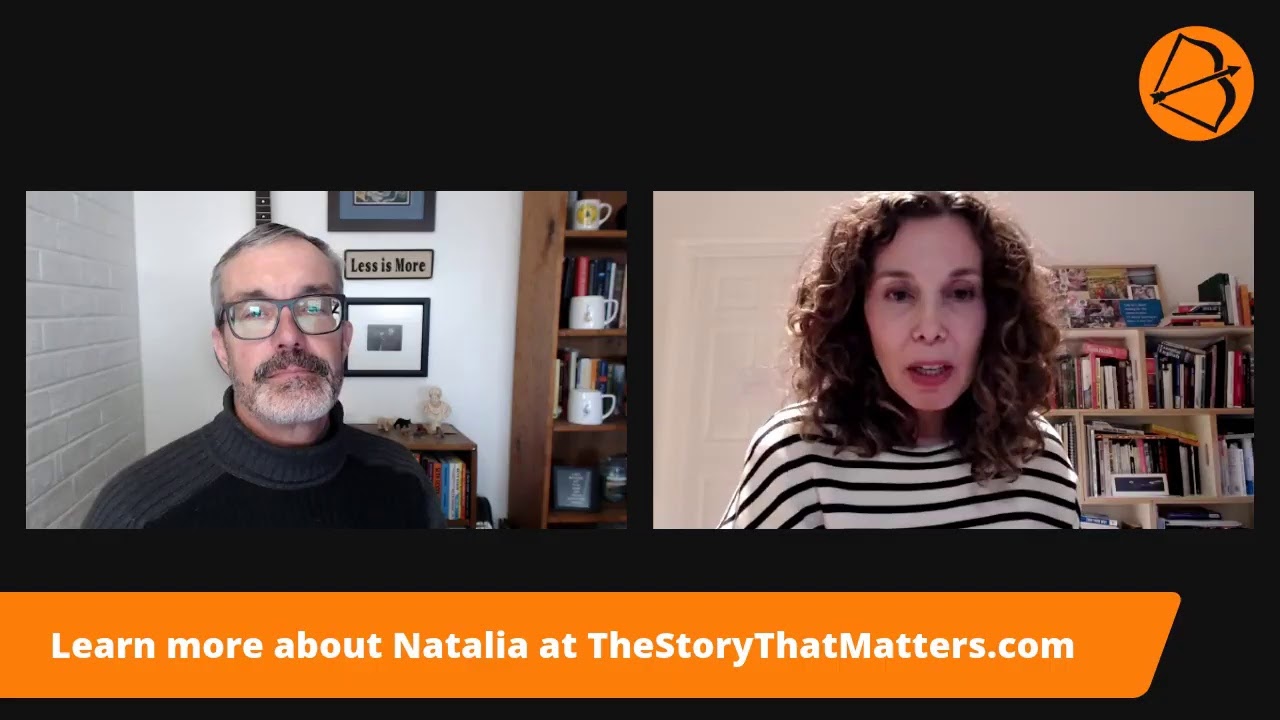
Storytelling coach Natalia Alvarez breaks down story into three levels: emotional language, cultural shaping, and shared narrative for collective action. She argues that uncovering your "why" through life patterns enables authentic connection, and warns against fixed identity labels like Enneagram types. A failed workshop taught her to let emotions emerge rather than control them.
Chapters
Zipping across the ether. Having trouble with LinkedIn again. We're going to let that— let it slide. We'll repost there since evidently StreamYard and LinkedIn don't want to play nicely today. Anyways, viewers, welcome to Creative on Purpose Live. To learn more about Creative on Purpose, visit creativeonpurpose.com and get going with the difference only you can make. Are you ready to start living your legacy? Visit creativeonpurpose.com back or slash challenge and join us in the Creative Difference Maker Challenge. Remember that this broadcast is also an iTunes podcast. Check it out and leave a 5-star review. 30 seconds of your generosity helps spread the goodness delivered by my guests. Let's get to today's show. Welcome to Creative on Purpose Live. These conversations are about flying higher and the difference only you can make and ever better. It's time to be creative on purpose. Are you ready? Let's go. I'm your host, Scott Perry, author of Onward and Difference Maker Coach at Akimba Workshops and Creative on Purpose. Don't die with the difference only you can make still inside. Visit creativeonpurpose.com to learn more about how to start living your legacy today. This season, we're drawing insight and inspiration from guests who are successfully embracing uncertainty, navigating adversity, and making things better by doing work that matters. Let's meet today's guest, Natalia Alvarez, Welcome to the broadcast. Tell our viewers who you are, what you're up to these days, and where can they connect with you to learn more about you and the difference you're making?
Well, first of all, thank you for bringing me here. I'm a longtime admirer of your work. So delighted to be here, Scott Perry. So about me. Well, I'm a coach and consultant, and I work with people who want to capitalize the power of stories in their organizations to make a change. And lately I've been, I've been working on a small guide to help people to get started with the stories and creating a space, an open space for practicing. That's what I've been doing lately, and working on my website that is nearly finished.
I think we're all working on a website that's almost finished, always. Uh, I've been working on— I've been— mine, mine's almost been ready for 15 years now.
Oh, wow.
So I would love to start by just defining what do you mean when you talk about story? Because I think it's a really fascinating approach and a really vital approach to connecting with other people to make the difference that you want to make. What is story and how does that play in?
Let me explain first maybe what I mean by capitalizing or capitalize the power of stories, because the way I understand stories is in 3 levels. And the first one is how we teach people and help people to tell stories when they communicate, when they talk to others, which it means language of emotional— emotion, sorry. So how we use the language of emotions in our communication and we tell more stories. And that's one level, and you can teach people, that's a skill. And there is a second level, which is how we notice stories and how we collect them and how we use them in marketing. Well, we do that, and also when we want to create a culture in which everybody can contribute. And then there is a third level, which is how we use the stories to create a common narrative that people feel that they belong to, and they— so we can invite them with us to do something. It's about act, it's about acting, it's about moving people forward. And that's for me a third level. So the way I think about the story is not just at the communication level, which is experience that you share with people that create a change, but also how we create common narratives in which people can bring their best work and how we invite people to move forward with the stories that we tell.
Really love that. So what I heard was there's the emotional level, there's the creation of culture, and then within, it sounds like almost attached to that, is this idea of creating a sense of belonging. And this is all done through story. I really love that framing. One of the things that I wrote about in Onward was the fact that we are narrative creatures. It's how we've always made sense of ourselves in the world. And at any given moment, we can choose the story that we're telling. If it's not serving us, we can change the story. Now, I make that sound very simple because it is simple. It just happens that it's not very easy because we are very attached to our narratives, to the stories we tell ourselves. So how do you help people frame their stories in a way that creates a sense of belonging and helps teach and helps teach people about what the change that they can make?
Well, I always start with purpose and values. And I think that that's the place where it normally is ignored because no much action. It seems like it's inwards and we all want to connect, but that's the place for me to start. So when you start in that place and you dig into and understand what you really stand for, Things start to emerge, and then you start seeing patterns that connects you with others. And what are the narratives? What are the things that are important to you and others? What language is used? How they communicate? What they hear? What is the feedback? So it's an organic process in which is from me, from what it's that the difference that I want to make, what I want to bring, and how you connect with the people that you want to bring forward.
I love that. Well, that's one of the many places where your work and my work intersects because we at Creative On Purpose, we start with who. And the first who we start with is yourself and dialing in values because we— your guiding principles, your values are the things that will enable you to connect with more of the right people. Because if we connect on values and then use our talents to enhance the lives of others, we have a chance to be associating with and working with and for the right people. You mentioned purpose too, and this is, you know, the name of my brand is Creative On Purpose. This is—
I know, I know.
What is purpose for you?
Oh, what a question. What is purpose? I'm terrible at finding definitions. I never satisfy. I mean, every time I look at definitions, I say there is something missing, and I'm not very keen on, but it's finding your why. It's finding the driving force is finding the theme. If you look at back in your life, there is always something that is emerging. It's a pattern of why you were doing that, why you study law, why you did— in my case, human rights— why you start working with indigenous people. There is something there holding, and if you look at it carefully, you find your why, your reason. Where you find meaning and work relationships and everything that matters to you is who you are.
I've just finished reading a book called Work by James Sussman, which is about work. And one of the things that was really fascinating, and I've been blogging about this ever since, is how human— so work is the thing that that distinguishes living things from non-living things, the transfer of energy for some purpose. But humans are the only beings on the planet, the only living things that use work to help define who they are and to forge meaning from their lives. And I love what you said about looking back, because I think our purpose only makes sense when we look back through time to see the through lines, to see the theme, to see the connect the dots. Because I'm not sure, for me, purpose isn't a destination. It's something that you can cultivate by actually bringing purpose to your work before you actually fully embody and understand the purpose. You do the work with intention and integrity. And somehow purpose comes, even if it's just in the way you do the dishes or the way you have a conversation with your spouse or the way that you're parenting your kids. If you do it purposefully, then more purpose will, will naturally come. Um, and I, you also use the word emerging, which I love because I've been thinking a lot about I'm a— just have a few years on you, Natalia. And as I'm looking back on my life, I see these— I, I saw this series of reinventions of myself, but when I thought about it more deeply, I decided it was actually just a long journey into becoming who I am. But I, I actually like your word better, emerging, um, because it, it's full of possibility.
And what is beautiful about purpose, the way I see it, is that it prevents you from falling in love into a category. I am this, I am that, and then you start to be so attached to that identity that if it disappears because you don't have that job anymore, or you become a mother and you stop working, you have such a crisis because you don't know who you are. But when you are connected to your purpose, it's bigger and you are constantly reinventing yourself. In a way that you adjust to what needs to be done. So you can be more in the present and less in other people's expectations about what is the job that needs to be done, because it's motivated towards something else that is beyond categories, which is a killer for when you do creative work. Never fit, it's impossible. I mean, I try so hard and, and you can't, you know, you just break every single definition of what what it is to be a lawyer or what it is to be an academic, and you're just finding connections in places that never exist. So for creative work, it's so important to connect to purpose.
Yeah, well, I'm totally with you. One of the things that I work with a lot of people who love the Enneagram, and they say, I am And I don't know the terminology and I don't know what all the letters and numbers mean, but they say, I am this, as if it were a fixed state and that they actually finally found themselves. And now that they found themselves, they're going to stay just like this. Or when people talk, you know, we hear a lot about introverts lately and people identify as I'm an introvert or I'm an extrovert, as if it's not a spectrum that we can be moving around in. And again, this speaks to what you said earlier about emerging. Like, we are always full of potential. Like, we can be this now, and we can be becoming something even better or more or different. Um, and so clinging too, too tightly to our current identity can be a really dangerous enterprise because, as you say, you know, the mother that's a lawyer, or the, the lawyer that becomes a mother and then stops lawyering, has— can, can feel very broken and lost because they've lost touch with something that gave them purpose and passion. Um, and it's difficult to switch gears and put it into this other thing, whereas if you're just a, a human being on a journey of becoming whoever it is that you're you're becoming, you get to move around. Purpose can be something that's fluid and changing. What's really interesting about that is how different it is from, you know, I love Simon Sinek's work and I love Start With Why, but he really, he talks about how purpose, your purpose is defined by the time you're 21 years old. And I never, that never resonated with me. It's like, if I were defined by who I was at 21 years old, I, I don't think I would have lasted this long.
Well, yeah, there are theories and ideas, and it's good if it helps certain people. It's good.
So what are the— you know, the work that you do is so important, and you are— I know that in a lot of ways you're dealing in this creative space, which sometimes in academic or institutional or corporate circles feels a little woo-woo, but it's actually the way we actually make sense of the world. So it actually is very pertinent to corporate, academic, institutional work. But I think, you know, for folks like you and I that are doing this kind of meaningful work that is non-traditional, it requires routines and relationships that are different than people that are just do have a day gig, you know, where they, they sit in a cubicle or they, they're doing, uh, the same thing kind of over and over and over again. My sense is your day-to-day does not look the same every day.
Uh, I like routine a lot. Um, and, uh, it roots me. So I start with meditation every day, which is very important for me to anchor. And, but yes, I mean, I, I got lost with the question.
Sorry. Routines and relationships that sustain you because the work that you're doing is challenging. And so when you're doing challenging work, you need habits and other people that will help lift you up.
Yeah, well, relationships. I mean, people having the ability to talk to people that nurture you, go to places where there is life and stop going to places where life is not there. You know, some people lift you up, others put you down. And so that, that's an important distinction. And it's not whoever— I mean, there are a lot of masterminds and stuff like this, like get your, um, I don't know, 6, 7-figure business, whatever it is. If that's your goal, go ahead, you know. But when I'm talking about places that nurture you, I'm talking about places that nurture who you are. And that comes with all sizes. I, I don't think that we all need to be bestsellers and number ones. And I think that there is place for each of us to be who we are and who want to be. And it's collective. Everybody has a part to play. And when you're proud of your part, it's easier.
Yeah, I love that.
The part that you want to, not the part that other people decide for you. But it might be that you want to be, I don't know, I mean, just somebody who is looking after your community and you don't want to do a tech talk or Well, maybe one day you want to challenge, but that's okay too. We don't need to be on a line, on a race, always just— some people have that type of drive, but others, they are perfectly happy nurturing their small community, and that's so valuable.
Well, it's where all the meaningful change always begins, is person to person, human to human, within individual circles of spheres of influence and connection. And I really appreciate What else you were saying about, you know, we have SMART goals, metric-based goals that we can measure, like making 6 figures, 7 figures, whatever. There's no guarantee that reaching a SMART goal is going to bring you joy and happiness in a sense of flourishing and fulfillment in what you do. In fact, very frequently we hear about people that achieve fame and fortune, and that is exactly what they set out for and are still deeply unhappy. And oftentimes the joy and fulfillment and the sense of flourishing comes from establishing these routines and relationships, the process goals, the effort. You know, if we apply ourselves with intention and integrity to doing meaningful work every day, it doesn't matter how many people it impacts or how much attention and applause we get. The work itself is its own reward.
And in the ambition, I mean, I think that Sometimes we don't realize how important it is to have an ambition to help others and make it big. You can be serving a community, but say, how can I help other people who are serving communities too? And how can I get that? And how can I— and, and that's another type of ambition. I'm very firm believer on that, helping others and making a big ambition about your calling and your service. Is the way forward.
Yeah, well, if you're speaking my language, one of our catchphrases at Creative On Purpose is you enhance your life most through work that serves others. And I know if there were such a thing as a help others category, all my books would be there. Instead, they have to go into self-help because that's the category available. As we're approaching the end of our time together, there's a couple questions I want to sneak in. The first is When you are doing meaningful work, which you are most definitely doing, when you are making a difference, which you are definitely doing, you are doing work that is fraught.
It—
there will be misfortune, there will be challenges, there will be failures. There's a lot of uncertainty, there's a lot of adversity, and mistakes will be made. If you're willing, I would love for you to share as big or little a mistake as you're willing to share that you've made It could be recently or from deep in the past, but what's a mistake that you've made or a false step, a misfortune that you've experienced, and what did you learn from that? Or if it was something that has a silver lining or that you turned into an opportunity, I'd love to hear that too. But just speak to learning from the challenges, learning from the difficulties and the failures.
I think that very much in this topic, a long time ago, I was hired by an organization to facilitate a workshop on purpose. And I was warned that emotions were high, that people were feeling quite volatile and emotional about a lot of things, and that it was going to be challenging. And I thought, well, I'm going to bring a process, you know, a methodology, and everything was measured, blah, blah, blah, 2 days, you know, cutting here and then a group here and then these questions. And so I arrived with all my perfect methodology and it worked. I mean, the first, I mean, bit of the workshop worked pretty well, but when I started working in groups, I saw somebody crying and another group, there was somebody who was very mad. And in the third group, someone just left the room. So I decided to call for a break. And so I tried to just retreat to one corner with my cup of tea, try to think what was next, because obviously my methodology was not working. So the person who hired me came to me with my schedule and said, well, Natalia, can you just remind me what comes next? And obviously, I mean, that day and at that moment, I made myself a promise that I will never ever facilitate a process to control people's emotions or a room, and I will do the brave work of letting things emerge. And that's, that's a challenge for me. I trained as a lawyer, I work in academia, so that was a big failure that I have to face in order to be able to embrace other opportunities. I mean, it ended up well, it was one of the most rewarding experiences that I have, but it was very intense.
Yeah, well, I love— I really appreciate that example. And what comes up for me, because emotions— we're emotional beings. I mean, emotions come up, but they're, they're often reactions, you know. It's not like we can turn them off or we can stop them from bubbling to the surface. They just, they appear. And I sometimes try to distinguish between an emotional response, which, you know, let's face it, you know, we can also experience positive emotions and we want to enjoy and embrace those and cultivate those. And we want to not let negative emotions drag us down a rabbit hole or cause us, you know, to extend our suffering or harm. But I think I, I try to distinguish between emotions and feelings. So emotions are just the human things that come up and we can't really control, but we do get to control how we feel. So once the emotion comes up, we have to decide, are we attaching and sticking with this, or are we holding it loosely? And I loved what you were saying because it sounds like you kind of held some space and some grace for yourself and the group. To say, okay, this is happening. Let's name this. And instead of letting the problem work us, let's work the problem. Like, how do we get through this moment so that we can get through to a better place? So I don't know if there's anything there that you want to speak to, but it was just a reflection that jumped to mind.
No, that's what it is. I mean, it's dropping the illusion of control. That we all have. And well, some of us more than others.
Well, this is the great lesson, I think, for all humans to learn is we are, we tend to be, at least here in the States, I know that people are very goal-oriented, outcome-oriented, result-oriented. And when things go our way, we love to celebrate ourselves and our genius and our great skill and achievement because of course we made it happen. And then when things don't go our way, we like to say, oh, well, it was forces beyond my control. Events conspired against me. Other people were not, you know, on my side. Um, but the fact of the matter is the outcome is always beyond your control. And I believe that the only thing that you do control— well, so bad news, everything's beyond your control, except for good news, the two things that you need to find fulfillment and joy, which is you get to control how you see things, how you frame them, and you get to decide what to do next. So you always have, um, an ability to reframe things and to choose, uh, your next step to, you know, to what we spoke to earlier. You get to choose your story. Um, you don't have to always be in reactive mode.
No. Yeah, that's, that's a very important lesson.
Yes, absolutely. Well, as we're coming to the end of our 30 minutes together here, I wanted to just ask you a question that I ask every guest at the end of the broadcast, which is, we are— this broadcast is all about helping difference makers like you fly higher and the difference that only they can make. And as someone who is achieving great things and doing great work and finding success and feeling of flourishing and fulfillment in their work. I'm wondering if there's any last tip or piece of advice or any insight that you'd want to lend to someone who, like you, would like to be flying a little higher and ascending in the difference that only they can make.
There is a quote that has been inspiring my work for many, many years. It comes from an Aboriginal leader and activist and artist from Australia, Lila Watson. I mean, this quote has been credited to her, but later on she clarified that it came up of a collective process of an Indigenous, I mean, Aboriginal rights group in Queensland. And the quote says that if you come here to help me, you're wasting your time. You know that one, do you? But if you're coming because your liberation is bond with, uh, bond up with mine, then let us work together. And, and I think I found that extremely inspiring for the kind of work that people like you and I, we do, and many others, that— and which is that you don't work people— I mean, you don't look down on people, you don't help them By working with others, you are helping yourself and you're helping all of us. And there is something bigger than us when we start working together, and we are serving this.
Love that. The sum is greater than the individual parts. What you were saying reminds me a little bit of the Christian story of give a man a fish or teach a man to fish. That's a beautiful, a beautiful message to end with. Really appreciate that and appreciate the great work that you're doing. And of course, everyone that's tuning in, Natalia and I really appreciate you lending us some of your valuable time and attention. We hope that today's broadcast motivates you to lean into an endeavor that matters with a greater sense of curiosity and courage, and that you, um, invite you to learn more about Natalia Alvarez and her work at The Story That Matters at thestorythatmatters.com. Of course, it's always great to hear from you at Creative on Purpose. If you're watching this live or in the next couple of days, please go to creativeonpurpose.com/challenge to consider joining us in the Creative Difference Maker Challenge. And until next time, take the insight and the inspiration from this conversation and keep flying higher in the difference only you can make. Natalia Alvarez, thank you so much for your time today.
Thank you, Scott Perry. Thank you.
More from Scott



Stoics Don't Suppress Emotions, They Do This Instead #stoicism #emotionalintelligence #mindset







