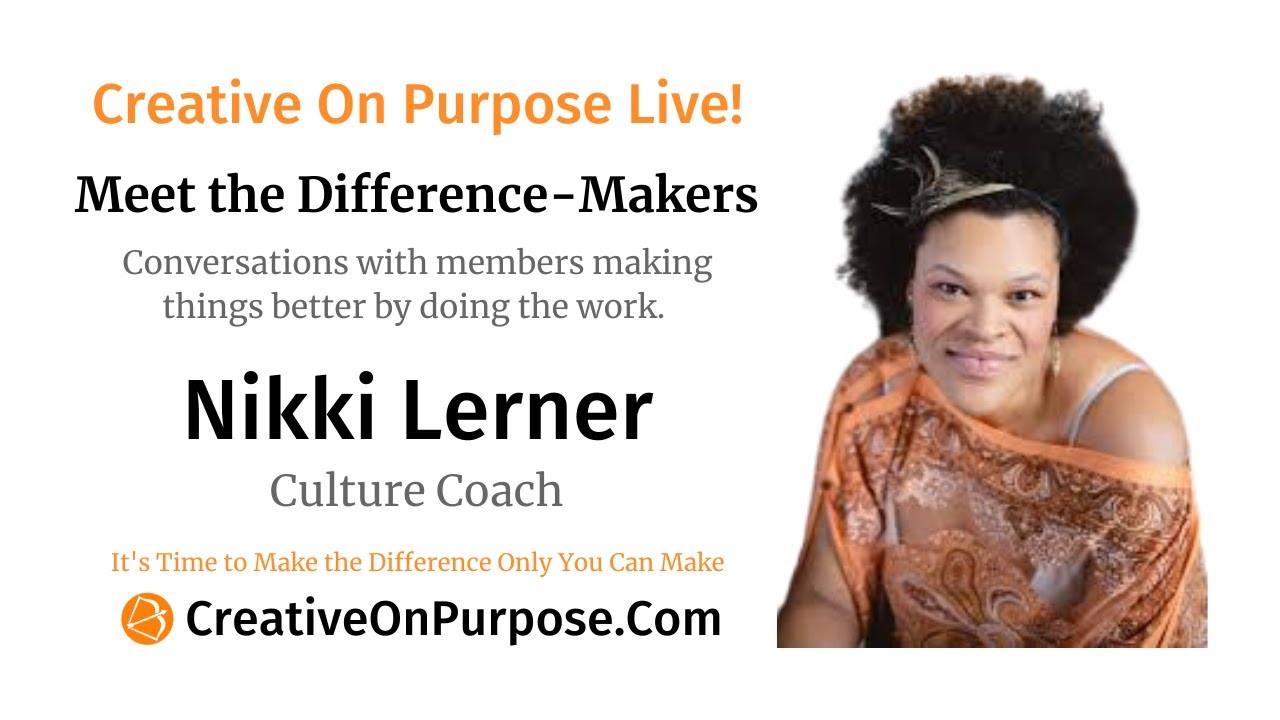
Nikki Lerner, a culture coach and author, explains her model for cross-cultural conversations in organizations. She emphasizes small, incremental actions to build courage, warns that senior-level bottlenecks often stall progress despite executive enthusiasm, and stresses the importance of checking your own motives and balancing support with accountability.
Chapters
And, well, it says we're live. So welcome everyone to Creative on Purpose Live. To learn more about Creative on Purpose, you can visit creativeonpurpose.com and get going with the difference only you can make. Remember that this broadcast is also an iTunes podcast. Check it out and leave a 5-star review. 30 seconds of your generosity helps spread the goodness delivered by my guests. Let's get to today's show. Welcome to Creative on Purpose Live. These conversations are about flying higher and endeavors that make a difference. Do the work you're meant to do now. It's time to be creative on purpose. Are you ready? Let's go! I'm your host, Scott Perry, author of Onward! and Chief Difference Maker at Creative on Purpose. Visit creativeonpurpose.com to start stepping into possibility with the difference only you can make. This month, we're profiling members of the Difference Makers community at Creative on Purpose. Let's meet today's guest, Nicki Lerner. Welcome to the broadcast! Please tell our viewers who you are, what you're up to these days, and where we can connect with you to learn more.
Yeah. Hey, everybody. So glad to sort of meet you. I'm Nikki Lerner. I'm based in Columbia, Maryland, and I am a culture coach. I'm an artist. I'm an author. I'm a speaker. Makes me sound really busy. And what I do is help organizations and individuals move from monocultural to healthy multicultural in their life, in their work, in their business, whatever endeavor that they are working on. So that's what I do in these days, working hard to help people stay together, to stay more unified and just trying to make it like everybody else. Scott Perry. Yeah.
Well, so unpack a little bit more about the difference that you make and this movement from monocultural to multicultural. What specifically does that look like and what's the transformation that's really on offer through the promise make in culture coaching?
Absolutely. So the difference that I'm making is I am creating a new model and a new way to first have conversations cross-culturally, because the way that we have done it so far in the country is extremely binary. And there's a lot more nuance and beauty and diversity in these conversations that we're missing when we stay binary. So I help people navigate how to have those conversations in a more nuanced way. The second thing is, is that the difference that I make is to show people how to actually have change. Usually when we're talking about cultural conversations, cultural information, again, we're either talking about, you know, something with regards to racism or not. That's kind of pretty much where we go. But again, there's more to it than that. So I help people, remind them that they don't have to stay in the clouds or hope or wish or there's some kind of pipe dream that things could get better, but actually to move forward with real steps, real proven ways that every person, no matter where you are on the spectrum, can take steps and see some change cross-culturally. Yeah.
Well, one of the— so you and I are old friends and we have had cultural conversations, uh, especially a series of broadcasts that we did where we were just trying to really help open up and getting people comfortable with the idea, like, we can talk about this and it doesn't matter if you look like me or if you look like Nikki or if you look like somebody else. Like, we can give ourselves permission to have these conversations with But the thing that seemed to really be holding people up and hanging people up is, especially for people that look like me, like, how do I have these conversations without saying something stupid or wrong or being misunderstood or having my motivations misunderstood? How do you solve that difficult problem that I think a lot of us have is to We just don't even know where to start with having these kind of conversations.
Yeah, this is why I'm trying to be a gap filler and difference maker, Scott, is because there is a way. But in order to have a conversation, first of all, we just need to make agreements with one another when we step into conversations cross-culturally. It's like, it's like what you do with Difference Maker coaching, right, is there's an agreement for people to step into possibility. Like, you have to decide to step in in a certain way. And that's usually what's missing from these conversations is the agreement with people who have decided to enter a conversation that for that hour or 2 hours or 4 weeks, whatever it is, that it will be a conversation for learning. And you can't learn something new or develop a new practice or skill without being willing to fail. And oftentimes we can feel that cultural conversations are riskier than other things, but we need to channel and practice that same idea of being willing and taking the risk to fail, to say something that's not perfect, to put your foot in your mouth and know that the people within the context of that conversation, because of the agreements have said it's OK to do so. In fact, we expect you to do so and we're going to give you space for it and dust you off after you do it and put you right back in the game.
Yeah, well, that's a big part of the work that you and I both do is creating these containers. And I'm getting tired of safe containers. I prefer to think of them as brave containers or catalytic containers. Like, how can we create a space and a relationship where open dialogue without fear of failure is possible. So the agreement piece that you mentioned is really, I think, an important piece. It's that idea like we're enrolling in this journey together, knowing that the destination is not absolutely set in stone or absolutely clear, that we're going to have to cottywample our way forward, meaning act confidently going in a direction of really unknown, with an unknown endpoint. And then, and then find our way together. And so what do you find challenge? So I know that you'd work a lot with organizations, and, you know, the conversations are hard enough with individuals, with human beings one-on-one. But I imagine that when you are working with an organization where there are people that are wondering what their boss thinks, or what the people below them think, or what their peers think, you know, in management, or what have you? What's— how do you address those situations where the conversations are happening in a bigger group?
Yeah, it's tricky, Scott Perry. I mean, I'm just keeping it real with you. It's tricky, and it takes longer than you think. Because organizations in particular have operated one way for so long that it's not easy to change overnight. Even with a new insight, there is a practice that is necessary afterwards. What I have found is that in almost every organization that I've worked with, usually if there's a bottleneck, it is at the top. Mm-hmm. Always the highest level, senior level executives that have at first, the most willingness to lean in. But then when the information starts to come in about what things need to change, that's usually where there's a pause, because it's a new practice. And sometimes, you know, for me, I have to remember as a coach that for me, I'm like, what are you talking about? This is a really easy thing. Like, just do this, you know. But oftentimes I have to remind myself, Okay, even something for me that I would say, this is pretty simple, like I haven't even asked you to do anything hard yet, right? Like, this is really simple. It's still a jarring of worldview, of operational life, all of that. And so that doesn't change overnight. So the tricky side, sometimes the dark side, if you will, of my work is everything's great when it stays informational and insightful. It's when the change and the practice needs to start is where most of us individually, as well as in our organizations, where we get stuck because we're afraid and we haven't seen it yet. And so it's a lot harder to lean into, to a new practice if you don't know what it's going to look like on the other end.
Yeah. Well, and And how can you possibly know what it's going to look like on the other end? And so it sounds to me like a lot of your work has to be about trust building, like getting people to trust the process and to trust that something good will come out of this, even if it's not the exact expectation that people entered with. And the other part is just, uh, the idea of doing the work. Because what I have found in some of the situations where I've been involved in this kind of work is people like to talk about the, the concepts and the ideas and make it— and because it— talking about it sounds like you're doing something about it, but actually talking about it and learning about it doesn't impact or change a thing. We can only make change happen when we are actually involved in doing the work like doing our thinking on the ground, connecting human to human in real life, in real time, and pushing through the resistance of what you were speaking to earlier, which is companies have done things a certain way for so long. The status quo is not perfect. The status quo could actually be toxic and harmful, but at least we know what's expected and where we stand. And that part seems to be the part that humans like to cling to no matter what, even when there's the promise that there's a better way, and that if we work together, we can kind of get there. Um, go ahead.
I was just gonna say that, that, that, that's it, is that, you know, to keep having the conversation round and round and round and round and round, you feel like you, you have done something. Um, but it— the rubber meets the road when you actually have to put it into practice. I, I liken it to— I don't know if you've ever seen that show American Pickers. Um, it's, it's really cool. These guys run around and they find these old farmhouses that people own, and people who stock up on stuff, old cars and old antiques. And the guys say that they go because they want to buy stuff and resell it, right? So when they go to somebody that owns something, uh, they try to get them to start spending little bits of money, right? So, hey, I'll take that figurine How about I give you $10 for it? And the person's like, sure, you can have that. Okay, how about that, you know, that cup over there? That's antique. How about I give you $20 for it? Oh yeah, that's great. In preparation for, hey, I see that you've got a 1962 Mustang. Are you willing to sell that? Right? Because that's the harder thing for people to let go of. Right. So the point is, little by little by little, you start to gain your courage, right, by doing little things, little acts of engagement. But if you can't get a person or even an organization to do the $10, $20 little bit, there's no way you're going to get them to do the Mustang. But here's the thing, Scott Perry, what I'm finding is most organizations though they want you to start with the Mustang. Because then if they say no or choose not to do it, then they can say, well, she wanted to buy our Mustang. We can't do that. Right? You know, she wanted us to, you know, add more people to our executive team, you know, that are more diverse. Well, we can't do that. So it's, it's complicated.
Yeah, for sure. Well, I so thoroughly appreciate that you're doing this work and doing it with impact and doing it, you know, so generously and openly. And it's hard. I'm imagining that along the way, a time or two, a mistake has happened that, you know, there's something that you in retrospect might have felt like, oh, I could have done that differently. And I wonder, you know, I think like, you know, we talked about encouraging other people to have the willingness to do things that are hard and to do things where they may not turn out the way they want, or to do things and recognize that they might fail. What's an example from your work and your life doing this work where a mistake, maybe even a big mistake, was made? And what did you learn from that experience? And if you did find a way to flip the, that misfortune into an opportunity or to make the situation right? How did that happen?
Hmm. Gosh, there's so much. I literally have a running list here in my office on a flip chart that says mistakes to learn from. And I write them down every time I do it or a client of mine does it. I write it down so that I don't repeat it. I would say most recently, The most challenging misstep is when you work with an organization and you know that a leader of an organization is trying. It's hard sometimes to figure out when they are self-sabotaging and scared. And I have before probably coddled a leader too long without leaning in at the right point to say, you got to step up now and you have to make a decision. Either we're going to do this or you're not. But we can't— you have enough information now to not stay in that, I don't know what's going to happen. You have enough information now to take a step. I'm not asking you to take all the steps, but a step. And I will say that In the past, I have made a mistake of not wanting to scare off a leader in process, right? But also not calling them to something higher soon enough.
Yeah, no, that's— I mean, in both the work that you do and the work that I do, we're in this situation all the time. How do we get people to see what they, you know, to see what they don't see and see it in a way that creates the tension and the urgency, um, to take the action to step through and into, into possibility. And it seems like a big part of the dance that, that you or I might do is around, um, making that, making that realization happen. Without being over and just like pointing to it and saying, hey, look, do you see that?
Right?
So it's, it's like inviting them, and, and through that, you know, through the, the, the hard work of asking question after question and sitting in the tension of they're not knowing and it's right there. So any, any tips or any, um, you know, tactics that you use to to help, help your clients do the heavy lifting of seeing what they don't see and recognizing what they haven't, you know, heretofore recognized and inviting them to take a small step forward?
Yeah, 2 or 3 things come to mind, and they're short. One is I always start with myself because particularly in that context, if, if I am spending too much time doing the dance with a leader, I always have to ask myself the question, am I up in my ego as a coach? Because am I afraid now to challenge? Because usually that's kind of what happens. I get weird and up in my ego about it. So that's a question I think for all of us to do any kind of work like this, to ask, am I up in my ego? The second thing is trying to put the things that you're recommending for your clients into even smaller steps. And as a coach, you know, you may think, but this is the smallest step it could be, right? But really trying to say, okay, put myself in their mind, and I'm— let's just assume I'm freaked out, scared to death. Of taking a step. Okay, then what is even a smaller step that you could take towards that? So that, that's that. And then the third thing is, you know, this idea of, uh, some grace, which is challenging sometimes when you're working with organizations who are all based on outcomes. Because if you get too outcome-focused or data-driven or quota-based in culture work, That doesn't serve people well. Then it becomes things like, well, how did we know that this coaching worked? Well, now we've got 6 Chinese people, 3 white people, and 2 African American people. Like, that's dangerous when those are your outcomes, right? You need broader and, quite frankly, bigger outcomes than that. The diversity is a reflection of a healthier culture. Right, in a culture that is starting to see things a bit more broadly. That is now the reflection. So, yeah, so those are just some things that come to mind of trying to help, apart from— sometimes you just come to a point where you're like, we either have to do this or we don't. But I'm not sure what else I can give you. Usually what happens with organizations is if they don't want to do some of the steps I recommend, they'll start making up their own steps, um, which sometimes I, I give into maybe once or twice because I'm like, they have to do something, like, we have to get moving somewhere. And while it's not my process, um, just to get them moving at all can sometimes open up to say, let's go back to what I said and let's do those things, because they want to start adding things, and it's usually more information not information.
Yeah, well, which is always seems to me to just be a glorified way of, in a seductive and clever way, to try to hide from actually doing what you, you said that you, you came to do. And I love what you said about organizations, but people in general, especially here in the United States, we tend to be outcome results kind of oriented, and we don't honor and appreciate and respect enough, oftentimes, the importance of the process, like trusting the process. And in your work, where we're talking about healing racial divide, racial injustice, where we're trying to increase diversity, equity, and inclusion in the workplace, we are— you are undoing and trying to create healing and progress. In a domain where there's been a lot of, there's been inertia. Well, there's been serious problems, right? For hundreds of years. And it's hiring a culture coach and having her come down for a few days, um, is probably not going to solve the problem. It's the, the idea that, you know, we can come in and we can introduce a new way of thinking, uh, an understanding of that what got us where we are is not going to get us where we want to go. And that what we're really doing at this moment is starting another— we're starting a new journey, not coming in like a plumber, uh, with their tools kit to fix a leaky faucet. Like, this is, this is a systemic situation problem that needs to be solved by developing a new way of thinking, new routines, new relationships, and all that. It's fraught and important work.
And the thing is, Scott, let me just say, with culture work is— let me say it this way. People can debate, based on their experience in the world, whether or not systematic racism exists. Okay. You could debate that forever. What I do think we can all agree on, hopefully, particularly in organizational life, is that what does exist and that what I would say most of us exist in is systematic cultural blind spot. So it's, it's harder and it actually takes more time in the work that I do, when you have organizations that have historically been run by majority culture folks here in America, to help them to see that the way that they have been existing in organizational life, that there are some things that we would term normal. Mm-hmm. But they're only normal because they're part of majority culture. Right. People who are in the non-majority see that as cultural. And so helping a, uh, a group of people that have existed in what's normal to them see that there are processes or policies or providers that they use that are all from one type of person, and that this now has systemic issues in their business takes time, and it's very, it's very tricky. Because if you're part of any majority culture, no matter what it is, it's hard for you to see sometimes that you need to learn. And so therefore, you don't ask as many questions as you need to ask, because you don't know what you don't know. And when someone else comes in and starts to give you some new insight, you still filter it through what's normative for you, rather than this is a new way of seeing things. Yeah.
Well, and just what a, what a gift to be able to try to go into relationships and go into organizations and, and help people start to get, just wrap their heads around the idea that we could embrace this. Like we could embrace a new way of being, a new way of thinking about things, and we can make mistakes along the way. Even as we are making progress towards making things better and making, making things better, not just for the organization or for the, you know, but making things better, like for everyone, everywhere, culturally across, um, you know, the culture, whether it's, it's in the United States or across the globe that you and I have had this conversation before. There is way more abundance than we are able to see when we look through the prism and the filter of the way that we've been doing business, you know, for, for hundreds of years now. And if we can just get past the scarcity mindset and the survival of the fittest, you know, I'm gonna get mine, good luck getting yours, you know, there's actually, um, all of us have potential that we can develop And there's plenty of opportunity for us to be doing more and better.
Yes.
In whatever work that we're doing. Well, as we're wrapping up our time here together, I would love for you to just share, you know, this Difference Maker— being a Difference Maker is all about identifying the difference that only you can make and developing and delivering that work. What's a tip or a piece of advice that you would share to anybody that seeks to explore their potential through the difference that they, only they can make, and in an endeavor that elevates and improves themselves by serving others?
Hmm, that's a great question. I would encourage anyone that is ready to step into possibility and to step in the, into the difference they can make, to work hard at recognizing the value of what you have been given for this life, because you will not share anything that you do not see as valuable. You can't be generous with something that you feel like is lacking or not there or empty or not good enough or those kinds of things. That— those are the things that are keeping us stuck. I actually think we find our freedom to move forward and to move onward when we start, even in the smallest of ways, start to see the value of the gifts and the skills, the insights, the worldview, whatever, that we have been given to make things better. And so make a practice out of highly valuing what you have been given on this earth to do, what is inside of you, because then you will know how to be generous with it.
I love that. Well, this is called Meet the Difference Maker. You are a difference maker because you and I have been, well, in digital years, we're really old friends.
We really are.
What's, for those that might be tuning in and interested in some of the difference maker talk that happens here on LinkedIn and on Facebook. What, what are some of the things that you would say have been beneficial to you by either working with Difference Maker coaching or by work being a part of the Difference Maker community?
Hmm. The coaching has, has been amazing. Just having someone look at what you're doing from an outside view is huge. You spend, you know, I spend all of my days doing that for other people, but we're human, so we can't see it ourselves. And I'm pretty self-aware. But there's also, there's that 10 to 20% I can't see. And that's just a human thing. So being able to have you and having another coach look at what I'm not only what I'm doing, but what I'm saying to challenge beliefs that I hold that I don't even know are tripping me up is just so valuable. And I'm grateful for it. I can't imagine now going forward, I can't imagine not having the Difference Maker coaching in my life because it spurs me on every single time. Every time we have a conversation or every single time, it spurs me on to the next thing. And so It's, it's life-giving. I think it is so important for anybody that's trying to do anything of purpose or value or importance. Have somebody else look at what you're doing and help you move forward.
Yeah, really appreciate that. And Nicky, you know that I so appreciate the work that we get to do together. You inspire me every time we get together for a conversation, whether it's in a coaching call or out in the world, which we are we are wont to do from time to time. And so just what a privilege and what an honor to not just bear witness to the difference that you're making in the world, but also to be a small part in helping you get to where you want to go with the change that you seek to make in the world. So thank you for being here. Thank you for the work that you do. Thank you for just being you.
Thanks, Scott Perry. Back at you.
All right. Thanks, gang.
More from Scott



Stoics Don't Suppress Emotions, They Do This Instead #stoicism #emotionalintelligence #mindset







