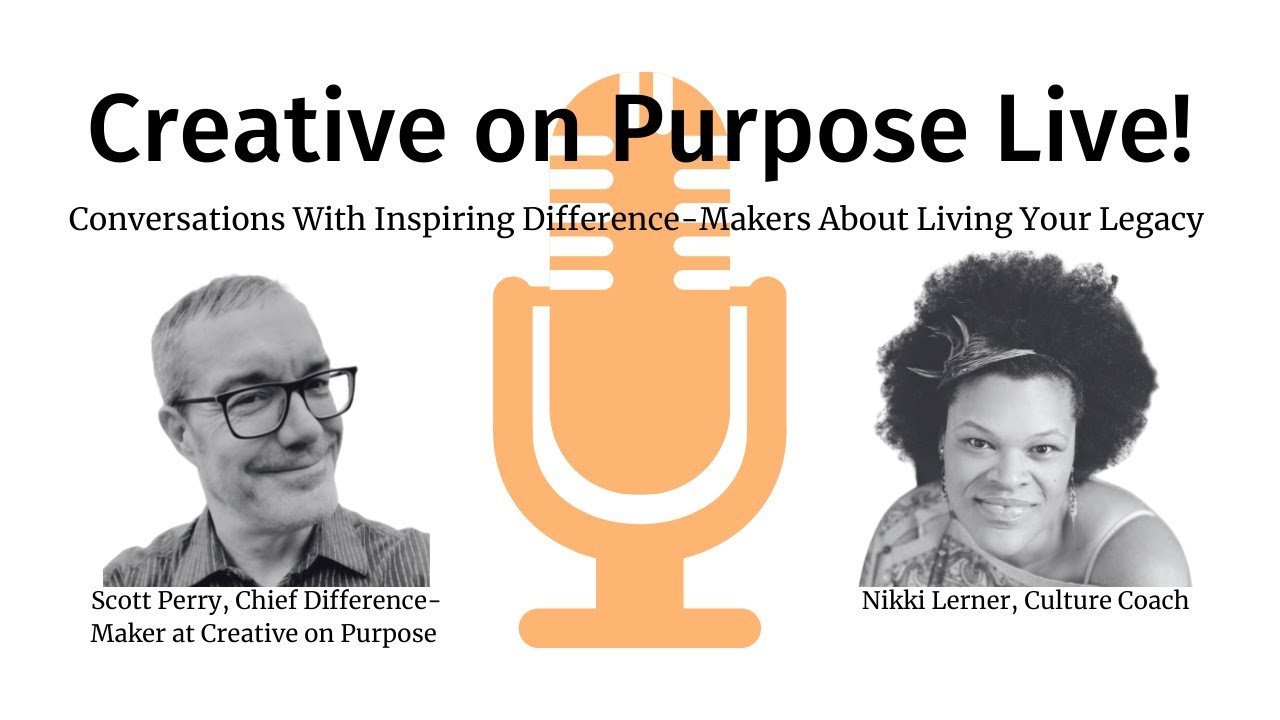
Scott Perry interviews culture coach Nikki Lerner about moving DEI work beyond compliance and metrics. She explains how identity work starts from the inside out, and shares practical habits for leaders to become more culturally curious and effective in cross-cultural work.
Chapters
We are zipping across the ether at the speed of bytes. I bet, I bet we're live. Holy cow! We did it again! We made it! Welcome to Creative on Purpose Live, conversations with inspiring difference makers about living your legacy. I'm your host, Scott Perry, Chief Difference Maker at Creative on Purpose. If you're ready to fly higher in the difference only you can make, visit creativeonpurpose.com and sign up for the newsletter. Get insight and inspiration delivered to your inbox 3 times a week and a free copy of Trust Yourself: A Simple 3-Step Decision-Making Process to Power Past Imposter Syndrome and Your Inner Perfectionist. You should never have a subtitle that requires a breath in between. Oh well, that's the way it goes. Hey, let's meet today's guest. I'm so excited. One of my favorite people on the planet, Nicki Lerner, is here with us today. Nicki, welcome to the broadcast. Please tell our viewers who you are, what you're up to these days, and where can people go to connect with you, and learn more.
Hey! Hi, Scott Perry! Glad to be with you. Glad to be with everybody else. I help people navigate cross-culturally— individuals, organizations, whomever. And you can check me out at nickilearner.com. I like to keep it simple.
Awesome. This season, this entire year, the theme of my work is going to be about living your legacy. This idea that legacy is not the money and the monuments that you leave behind, but it's the difference that you're making right now. And when I was I was thinking about people that I wanted to bring onto the show, um, for the beginning of the new season, you were the first person I thought of. Um, in part because we're, we're friends and colleagues and we've been working together for some time. Um, your work, the legacy that you are living right now is part of the most important work that is going on in the world right now. And this is— and you have a great way of articulating the work that you do, which involves the word "culture" and "come from." So tell us, just go ahead and give us a little bit of a frame. So what is— what does Nikki Lerner, Culture Coach, what does she do?
Yeah, well, thanks for that. That's lovely things to say. I love the work that I get to do. You know, for a long time, I share this with my clients all the time, you know, our, our only model up until this point, really, for talking about issues, cultural issues that matter to us with regards to culture as it relates to ethnicity, or culture as it relates to heritage, culture as it relates to come from, right, that, and that's a, that's a broad term, is, you know, we just kind of wait for negative things to happen, or we wait for something, you know, that everybody's talking about on the news we wait for somebody to get canceled, or we wait, you know, and that's when we start to talk about these cultural issues that matter the most to us. And so my work really is about trying to create space proactively to say, how do we better understand each other as people? I often share with my clients that, you know, my work is to help them get back to human to human. In their conversations instead of only issue to issue. Because if we stay on issue to issue, it's, it's never ending, uh, and it's easier for us to dehumanize each other in conversation when we have differences if we stay on issue only, uh. And so I'm trying to help, uh, bring back the humanity, uh, in culture work and cross-cultural work. And also knowing that there's so much to learn if we would just stay curious about one another in our workplaces and in our offices, that we could step outside of just traditional, quote, DEI work, which is starting to mean nothing now. But if we can really see each other again, that is actually where all of the changes lie that we long to make.
Love that. Quick shout out to Florian, who is tuned in and is especially excited to see Nikki Me too, Florian. One of the things that— so culture and come from, I, you know, that I'm a big fan of that tagline, that headline, that, that kind of subheading of, of the work that you do. And I love what you were saying about, you know, can you're leveraging these basic human instincts of curiosity and creativity Um, and our social nature, our capacity to be, you know, for consciousness and, um, being rational and reasonable and all this. But I also know, and you've really helped me understand this, you know, we also, while that might be a wonderful place to, to land ultimately in the here and now, a lot of the, the challenge is around identity. Um, and so while we are all human beings, we often are forging meaning and building identity in our lives around, um, well, for marginalized pop— historically marginalized populations is around where they come from and what they look like. Uh, and if you look more like me, you probably don't really think about it too much because you've lived in the land of privilege for so long, you don't see it. So how do you begin with, you know, because that's— you're going right to the, to the thing that actually is, is in part feeding the problem, this idea of I am this way and you are that way. And people like me don't necessarily do things like that or hang out with people like you. So I just help us understand, like, where can we start this, you know, to acknowledge our identities and to then broaden the circle, circles of concern so that we become more inclusive and more embracing of diversity and more equitable in the way that we treat other people.
We always need to start with ourselves. And I, I believe that, that one of the trickiest things right now, particularly for non-majority cultures, um, particularly in the U.S., is if we start trying to find our identity out there somewhere, wherever out there is, or wait for somebody else to tell us who we are, um, or lump us into just kind of one monolithic group, right? We will always go astray because we are waiting for somebody to give us our own come from. So it's very important for all of us, no matter where we are in our lives right now, to just take a pause and figure out our own come from, our own origin story. What are the things that have happened in our lives to get us to the point where we are now? What are the things that have even happened culturally that have given— got us to the point where we are now. All of us, no matter what people group we come from, we all have a culture story. And if we really would allow ourselves, we all have a race story. And when I mean race, I don't mean just Black people. I mean a, a, a story of some sort that made us think about our racial come from, right? And so that's where we need to start, is trying to identify What are those things? What are those things that make us who we are? Because then what that does is it actually allows us to step into these conversations around culture and come from much more powerfully and much more abundant. Sometimes we step into these conversations and we hear the lived experience of other people, and if it's not our lived experience, we somehow now feel lack. Right? Or maybe, well, my experience isn't quite as, um, important or is as impactful, right, as someone else because it's different. And, and what we need to do is step back into, no, just because it's different doesn't mean it's any less valuable, or just because it's different doesn't mean it's any less, uh, good or, uh, viable or whatever it is. And that's why it's so important that we start with our first, our own culture, for people that look like you, Scott Perry, a lot of times, uh, the downside is majority culture folks don't always have a connection to their own cultural come from either, right? Because if we lean into an idea of sameness in the United States, right, um, then, you know, if you have an Irish heritage or a Dutch heritage or a German heritage or something like that, you don't even get to explore that, right? Um, and so when people that look like you, people from other people groups, can even connect to those things, now we can have a much broader conversation about culture and how we see the world and how we got into some of our systems, how we got into some of our patterns. But we always have to start with us. Love that.
Quick shout out from Leila, my, one of my new LinkedIn friends who is tuning in from Prague. And she loves the way that you express yourself. Me too, Leila. So what I was just hearing and what you were just saying at the beginning is you mentioned starting with yourself. And I think that that is, you know, Kudos to the great success Simon Sinek has had with Start With Why. I think that's a dangerous place to start because most of us can't identify our why, and it's probably more of a journey than it is a destination. The easier place to start is with who, and the who to start with is you. And I love that you said, you know, starting with yourself, identity from the inside out. Who am I? The other thing that you were saying that I think is really— so you were talking earlier about, you know, defining, you know, or engaging human to human instead of issue to issue. And so often we do our identity, our belonging is determined by external forces.
Yes.
Not the inter— like, again, from the inside out. So I love that you were weaving that in and that, um, I also was hearing some idea around it's, you know, this and like, I can be, I can be a cisgender white male, aged man, vintage male, and, you know, I can be these other things. A husband, a father, a friend. Um, and so, yeah, and see, Scott Perry, you had to choose that.
You had to have an awareness of that. Uh, this is kind of, I think, where we are right now in the culture, is that if you don't have an awareness of that, then all, all you can do is receive what those external forces are telling you. So for instance, you know, from my people group, I'm a Black American person. Right, grew up here in, in the United States. Well, there's a lot of diversity within my people group, right? And so if I, I or anybody else in my people group are waiting for media or commercials or messaging to tell us who we are, well then, first of all, somebody is deciding who we all are as one particular culture group. And that's ridiculous for any culture group, right? That we all think the same, vote the same, have the same values, and have the same lived experience. So, you know, I used to joke with people when I would be traveling for work, you know, I stopped telling people I was from Baltimore. I don't live in Baltimore City, right? I live about 20, 25 minutes from Baltimore City. I grew up in Baltimore County, okay? Now there is a very big difference between people who grew up in Baltimore County and people who grew up in Baltimore City. Now if I say I'm from Baltimore, people who live in the city are like, you don't— you are not from Baltimore, right? You are not from there. But you could have another person standing next to me that looks exact— that looks very much like me from my people group and that person and me, just the fact that geographically we have grown up very differently, you can't put us in the, in the same lived experience. And so that's why I love these, these terms of culture and come from, because everybody's got a culture and it's broad and it's vast, and everybody's gotta come from and usually those two things, they're not mutually exclusive. Those two things are together. You know, I'm thinking about someone like Leila who's listening, right? So if Leila's in Prague, but let's say she lived 10 years in Los Angeles, right? But now she lives in Prague. Well, that's a come from. So she has a culture, an ethnic culture, and they come from And all— both of those things form together to the beautiful person that she gets to be now. Uh, and that's why those two things are so important, uh, to broaden the conversation around race and culture. There's so much more for us to talk about with regards to those things other than the binary ways that media or external forces may force us to do. Right, there's a lot more, a lot more richness to our lives than those two things that are used to basically sell, uh, and get viewers.
Well, and it's, it's speaking to what you're saying earlier, but that's too often we're seeking, um, to have our identity validated by external forces. And, you know, culture, um, feels like it's, uh, kind of about what's going on right now. This is, this is the culture that I am a part of. My come from is my my, my background, my backstory, my origin story. You know, the piece that's interesting to me that we weave in the work we do at Creative Our Purposes and who are we becoming, because then it's also like, you know, and I have seen this in just working with you for all these years is watching. I've seen where you have, where you were and where you had been and where you wanted to be. And to, you know, we've worked a lot together to have you step into your becoming. And that, to me, that's the journey that's much more interesting and so much more rich and where there is so, you know, there's so much more possibility and opportunity. And of course, there's also a lot of, um, challenge and uncertainty, which is not something that we're really programmed to embrace most of the time. So I would be curious, just as you're helping people in your work, you know, I know you're working in institutions and organizations that are, that get it, that they, they need to improve their posture, their, their approach to diversity, equity, inclusion. You're trying to help them navigate that without just using the jargon and doing it kind of superficially. And, you know, how, how do you get them to embrace the fullness of the journey, which means challenge, because it's, that's anything that's worth it is going to have uncertainty and challenge. And to, you referenced earlier cancel culture is, you know, this is just a real thing that's happening and it, it, It's insidious because it plays to our— one of the fundamental conversations going on in every single one of our heads around imposter syndrome, perfectionism, you know, don't, don't stand out, keep your head down, go with the herd. At the same time, if we're going to, if we're going to step into this becoming, we're going to have to trust that we're not going to be articulate all the time, that we're not going to always say or do things just the the way that we wish we would have to. And even if when we do, we might be misinterpreted, or just be seen as doing it wrong. How do you help people navigate all that uncertainty and challenge and step in with confidence and seek greater clarity?
I really work to model it for them in our conversations. And to help them work through it in real time with me. And that's even how the, this term culture coach came into being. You know, I don't know, 8, 10 years ago, some colleagues of mine and myself were sitting around, we're like, wouldn't it be great if everybody had somebody they could call from a different culture when they had questions? And they could call them, you know, without this fear of judgment or getting it wrong, or, you know, they could put their foot in their mouth, and that person knows that they're trying to get better. And that's really the whole basis around my work, is helping people see that, first of all, perfectionism cannot exist if you're trying to get better culturally, cross-culturally. I mean, it just can't. Perfectionism and this work do not go together. There's no such thing, uh, because nobody knows everything about cross-cultural interactions or what the right thing is. If somebody comes to you, even as a consultant, and says, I know the perfect blueprint for your company or your organization to go from, you know, I don't know, 100 white people to 50 white people and 50 non-white people— if somebody comes up to you, don't believe— they're selling you something. Because there's no such thing. There's no such thing as a blueprint. Now, now, I'm a practitioner and have been a practitioner for 20 years, and so a lot of it's trial and error, uh, even when you're successful in building a multicultural team or a multicultural company, right? So, so helping people step into this sense of You have to show up as a person. You know, this is not like we're trying to, you know, your company or you as a business person, you're trying to, you know, start, start a new data entry system, right? This is not a new data entry system. But sometimes that's how leaders can approach it is just give me the steps, give me the blueprint so that, you know, 2 years from now, I can tell all of my business friends that we improved our diversity in our company by 20%. But what happened now, that in itself is very majority culture thinking, by the way. That's a blind spot because it's about the doing, not the being. Right. What I'm trying to help leaders, business leaders step back into is this sense of being, this sense of humanity in approaching issues of diversity. Because that is actually what needs to transform. Because once that transforms, once the person transforms, Scott Perry, all the tasks and the strategy and the doing falls into place. Because now it's congruent with who that leader is, or that CEO is, or that whoever that executive team is. It's coming out of a place of humanity, not out of a place of quotas and percentages and numbers and compliance, which is not the work that I do.
Well, that's, that's really, really interesting. Because I was just listening to an interview that you did with our mutual friend, Rich Litfin.
Yes.
Where you were talking about metrics and the measurement. So here's, here's, here's what was coming up for me from that conversation. Because I, I actually had this very same conversation with my own coach and then with one of my clients. It's like, how do I know that I'm making progress? How do I know that I'm getting there? How will I know when I'm there? And it's, you know, I think those measurables and, you know, feed off of our desire for certainty and, you know, I gotta make sure I'm following the steps, checking the boxes, and then I'm bulletproof. I've done what I've done, all I can do. I checked all the boxes.
Don't blame me.
So there's, you know, there's, there's that kind of, um, I mean, that to me is a very non-resilient posture, right? That's a very fragile way of being.
Yes. And it's defensive.
Right. But then there's, you know, but the other thing is that You know, what about the things that we, that we strive for that defy measurement? Like, how do I, you know, feeling safe, feeling belonging, feeling seen, heard, and understood, having joy, having equanimity, having a sense of fulfillment, significance, meaning, purpose. I mean, Yeah, I don't know. We can, we can make measuring sticks for that, right?
Well, here's, here's, here's a perfect example. One of my clients I work with, you know, I always ask people, I said, hey, so tell me, tell me what practices you started to put in place. You know, this new information, these new insights you have. And so one of my clients said, here's what I've noticed. They said, they said, my wife and I were, you know, vacationing somewhere. It ended up where— he's a white American man— it ended up where we were, you know, at a table with people where we were the minority. Now, they weren't used to this, okay, because of where they live in, in the country. And they started talking about, you know, some things about, you know, the government and stuff like that, and it didn't align with our values or what we think about the world. He said, and then I heard your voice in my head, and I thought about the questions, the tools that you gave to me. And he said, the old, the old me, even like 6 months ago, would have gotten really frustrated and upset and just felt like I had to tell my opinion. But instead of that, I took a breath and I asked a question. And he said, and I used a question that, that you gave me, which was— this is what I tell my clients oftentimes— when you feel offended by a lived experience or a worldview that is not yours from someone else, and you really want to engage with that person, ask them, can you tell me more? Particularly when it doesn't align with who you are, right? Lean in. Ask them, can you tell me more? He says, and I did that, and they kept talking, and I kept doing it. I kept asking them that, he said, and it opened the door for us to share some things, he said. And we actually ended up spending the next 2 days with this group of, of, of people, non-white people, because we were all connecting and having such great conversation. Now, this person, this leader my client, who is a leader in an organization, he's not going to be able to mark that in the compliance checklist of, you know, how did working with Nikki, you know, benefit your whatever. But here's the thing, just the fact that he paused and thought and tried to do something else, right, and tried it and it worked That is success, right? But that came out of being, right? That, that new practice of his came out of being, not, you know, how do I— let's go on vacation, let me have a great story for the office. You know, these are the things that start to change us, which again then overflow into tasks and things like that. I, I've decided, Scott, I can't remember if I told you this or not, but I don't, I don't do unconscious bias training. I just don't. Um, people ask, ask for it. Um, there's a lot— there's some of that in everything I do, right? I don't call it that. All I know is that we all have cultural bias because we're human beings. We all have it. So that's just a given. Um, but I said I don't do that anymore. I don't do a, a, uh a siloed training on bias, they usually ask, what's it for? Right? So what are you gonna do with it after you, after you know it? Is it gonna make your company better? Is it gonna— I mean, if so, then cool, but I'm not going to call it that. But I will not come in and just do that, because that means nothing. That is part of compliance. And there's some of that that definitely needs to happen. But for me, and the work that I'm trying to do, I'm not about helping people comply more. And that just sounds awful when you hear it too. No, no, no, I help you comply.
Well, yeah, I mean, it's, it's fascinating, because it's, it's just another way of saying, we want to, you know, we've heard we got to do this thing, give it to us so that we can check the box and say we did the compliance or the bias, unconscious bias training, we're good. And, but what I do know is that you do help people bring consciousness into everything that they do, not just their diversity, equity, inclusion work. So that's right. You know, that's, and again, it's, I, I haven't figured out, you know, I just listened to that conversation that you had with Rich. So I'm still processing, like, how do I, and I had these other two conversations about it today. It's like, how do I navigate this? And I, what leapt to mind is that idea. And it's, it's, I can't remember his name, the person, he's an alumni of my alma mater, um, the 1% better, you know, the, you know, it's like, to me, that's a good enough metric. If I, if I was 1% more, um, tranquil, joyful, calm, cool, collected today than I was yesterday, then, then that's a victory. And of course, there's days when I like go in the other direction and I'm 1% less better. And that's just part of it. But I mean, if you look at the, the, you know, I for myself find myself to be satisfied with, okay, I am trending in the right direction. Can I give you the dollar figure, the number of inches, um, the number of grams, the number of— no, I can't give you that. I can just tell you that overall I notice that I feel better and other people notice that I am better. We're coming up to, um, the end of our time. You know the drill because you've been on the show before. I always, um, like to hold space at the very end for my guests to just, you know, I think again, I was so interested in having this conversation with you because I think whatever you want to call, um, the moment we're in around social justice, racial justice, equity, diversity, inclusion, what, whatever terminology works for you. We have a lot of work to do in this area, and it's not going to be— it's not going to— the legislative and legal system is not going to help us because it never has. Otherwise, we wouldn't be having this conversation because we've done all that. If there was just one final piece of a practice, a quote, a maxim, an idea that would help someone be just half a shade braver in stepping into the uncertainty of improving themselves around culture and come from? What would you, what would you say to them?
I'll say two things. One, I may have said this on the show before. One of my favorite quotes comes from Marie Forleo. And she says, clarity comes from engagement, not thought. And it's the same in cultural work. You have to go out and practice every day. And there's only so much reading you can do. There's only so many, you know, how to be an anti-racist books you can read before you go out there and go to a new neighborhood to get some coffee and meet somebody that's not like you. Uh, if you, you know, you have to go engage, uh, in order to get better. So I'd say that the second thing is, is that, you know, most people believe that there are some people that are just born in the world and they can navigate cross-culturally perfectly, you know, and they just have the gift, they're the genius. That's what most people believe. But what the truth is is that it's a practice, just like anything else. And it's a skill that you can learn, just like anything else. The only reason I know, or am more practiced or involved in this more even, you know, maybe than you, Scott Perry, is just because I've lived it. Right? It's just more practice. I just got more practice. That's it. And so if that's the case, That should encourage all of your listeners. Because what that does mean is that you can keep getting better cross-culturally, the more you engage, because it's practice. I get excited about that.
I love that. Learn by doing and adopt a practice so that you can build the skill.
Yes.
I love it. Thanks everyone for tuning in. Nikki and I really appreciate you lending us some of your valuable time and attention. We hope today's broadcast motivates You to Lean into an Endeavor That Matters with Greater Curiosity and Courage. You can learn more about Nikki and the fantastic work she is doing right there at NikkiLerner.com. And of course, it is always delightful and thrilling to see you at CreativeOnPurpose.com as well. Now take a little bit of the learning that, and, and that we just discussed here, and go out and do something with it and fly a little bit higher in the difference Only You Can Make. Nikki Lerner, thank you so much for your time today.
Thanks, Scott Perry.
More from Scott



Stoics Don't Suppress Emotions, They Do This Instead #stoicism #emotionalintelligence #mindset







