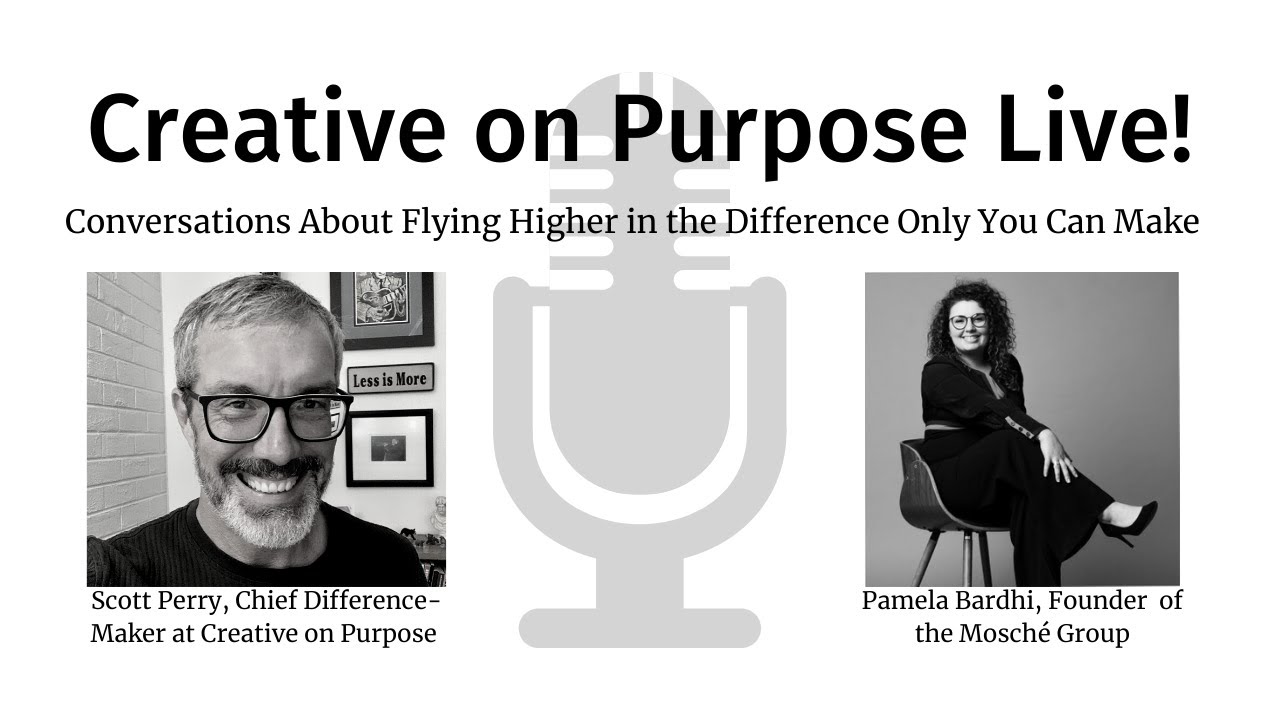
In this episode of Creative on Purpose Live, host Scott Perry interviews Pamela Bardhi, a Boston‑based real‑estate entrepreneur, developer, broker, and host of the Underdog podcast. Pamela shares her immigrant background, early experience running family restaurants, and the decision to diversify into real estate after recognizing the need for multiple revenue streams. She recounts building a $100 million real‑estate portfolio, being featured in Forbes and Time, and launching a podcast that emphasizes vulnerability and authentic storytelling to connect with listeners. The conversation delves into her mission to empower women and millennials, identifying fear of uncertainty as the primary obstacle entrepreneurs face, and outlines a practical method of breaking down fears into manageable steps. Pamela highlights the pivotal role of coaching—investing in a coach helped her navigate early cash‑flow challenges and accelerate growth. She discusses how listening to audience questions shapes her upcoming coaching programs and digital courses. The interview also covers lessons learned from cash‑flow mismanagement and overextension, emphasizing focus, budgeting, and the "less is more" principle. Finally, Pamela offers actionable advice: be fearless, write down fears, take small calculated actions, and invest in mentorship to unlock potential.
Chapters
The upright position. We are zipping across the ether at the speed of bytes, and we are indeed live. Welcome everyone to another episode of Creative on Purpose Live. Start living your legacy. Visit creativeonpurpose.com and let's get going with the difference only you can make by joining the Better Decisions mini-course. 3 simple questions to help you bust through indecisiveness, overwhelm, and confusion. Remember that this broadcast is also an iTunes podcast. Check it out and leave a 5-star review. 30 seconds of your generosity helps spread the goodness delivered by my guests. Let's get to today's show. Welcome to Creative on Purpose Live. These conversations are about flying higher and the difference only you can make. Ready to live your legacy? Endeavor better. It's time to be creative on purpose. Are you ready? Let's go. I'm your host, Scott Perry, author of Onward and Difference Maker Coach at Akimbo Workshops and Creative on Purpose. Don't die with the difference only you can make still inside. Visit creativeonpurpose.com to learn how to start living your legacy Today, this season, we're drawing insight and inspiration from guests who are successfully embracing uncertainty, navigating adversity, and making things better by doing work that matters. Let's meet today's guest, Pamela Libardi. Welcome to the broadcast. Tell our viewers who you are, what you're up to these days, and where can they go to learn more about you and the fantastic work you're doing?
Thank you for the fabulous introduction, Scott Perry. You are amazing. I'm so honored to be here today. So as Scott was mentioning, my name is Pamela Bardi. I am a real estate entrepreneur based here in Boston, Massachusetts. So basically I'm a developer. I also have a construction company as well as a brokerage company. So that's kind of my career side. And then I also have a podcast called Underdog, um, and I'm launching, um, some coaching programs, different things in the real estate realm pretty soon. So I'm all about real estate and empowerment. So that is me. I'm all over LinkedIn, Pamela Barty, on Instagram as well. And then of course, the podcast website as well, underdogshow.com.
And having had direct personal and relevant experience with your podcast, I can highly recommend tuning in. I understand there's an episode upcoming with somebody that sounds a lot like me. So you can find that really soon. So Pamela, I— one of the things that I loved in just getting to know you a little bit is you have what I think is a pretty interesting origin story in terms of how you got into not just podcasting, but how you got into real estate. Um, can you give us just a, a, a quick thumbnail sketch of what got you to where you are right now?
Absolutely. So I'll give you a little bit of a timeline, which is my life story in a nutshell. So I came to the US when I was 5. Um, my parents bought a restaurant when I was about 10, and I started working there when I was about 10. So by the time I was 18 years old, I was actually running my family business. And by the time I was 21, I had 2 restaurants of my own, plus my family's business that I was operating on the back end. And then, I don't know, somehow I got bored and I just felt unfulfilled. And a voice inside my head was like, you know, Pam, you've got to diversify revenue streams. And then I started thinking and I was like, I put all my eggs in one basket my whole life, my short life of, you know, like 10 years of working in the restaurant world. But that's all I knew. And I had a college degree and everything. And what I read was the average millionaire has 7 different streams of revenue. And I was like, well, I only have 2, so I got to step up. And then, of course, I'm looking at different industries that I can get involved in. And real estate was very dynamic, like it can be as passive or as active as you want it to be. And it is the industry that creates the most amount of millionaires, period. So I was like, you know what, this seems like an interesting, interesting realm that I could get into and that I could enjoy because It's all about people, it's about creating, it's fast-paced, it's dynamic. So I was like, okay, cool, I'll jump into that. And then I hired a coach and basically bought my first flip, absolutely fell in real— fell in love with real estate, and here we are today. That's, uh, that's my synopsis of how I got into real estate in a nutshell.
What I love about that story is, and this is a theme that's come up with several guests recently, beginning with Jacqueline Novogratz, who wrote the Manifesto for a Moral Revolution and is the founder of Acumen. And she was talking about all of the reinventing of herself that she had done over time, started off in banking and now runs a very, very dynamic and difference-making nonprofit that's changing lives all over the world. And I was thinking about, as she was telling me her story of reinvention, I was thinking about that in the context of my own life because I've been, uh, I've been in the restaurant business, I have been a teacher, I have been a musician, and now I'm doing this entirely, you know, other thing called coaching. And then I thought, well, actually, I don't know that I've reinvented myself. I just, I'm I'm in this act of becoming because there was a common thread through all of those things that I was doing, and it revolved around helping people get from where they are to where they want to be. So it's just teaching and coaching. It just had diff— I had different job, uh, descriptions. So just interested in the context of the way you think about how, you know, where you were, where you are now, where you want to go. Is it, uh, reinventing, or do you see a common thread, and do you see that thread pointing you in a particular direction as you move forward into the, the coaching and the community that you're building?
Absolutely. So yeah, I mean, you know, I— it happened when I— so I was about 27 when I had this revelation. So it was about a year and a half, 2 years ago now. Um, so what happened was, you know, I've been super successful in my real estate career. I've sold, developed, or acquired over $100 million in real estate assets in the last 8 years alone. Right? And so with that being said, you know, I, I mean, I've been featured in Forbes, Time magazine, like all these, all this crazy amazing stuff at such a young age. I'm 29 now, but you know, it got to a point like about a year and a half ago, I was like, Pam, you know, you're doing great in your career, but like, what are you doing for the world? And that hit me like a brick. I was like, my gosh, like, what am I doing? I mean, don't get me wrong, people were inspired by what I was doing in real estate, and of course creating places is a big deal, But like, I felt like— I felt a calling to do something deeper, to do something more. And that's when I sort of formulated the concept. It took me a while to think about how I wanted to add value and contribute authentically to the world. Um, that's when the whole, you know, ideology of the podcast came along. And then I was like, well, let me see how this goes, and then kind of transition from there. So when we launched on October 8th, 2020, by Halloween, we were on Apple's New and Noteworthy charts, which was crazy. And then just like seeing the responses from so many people and just like so many people reaching out, being like, Pam, you know, you're meant to inspire, like, you, you know, you're an inspiration to me and all these things. And I'm just like, because I started sharing my story. So the thing is, with my podcast, I kind of, you know, before I never really showed weakness, right? Like I never really talked about it. I only showed like the good stuff. Right? I mean, as most people do, we don't normalize struggle in this society. It's just not what we do. But that— what I found was like an issue, because then I, I met and felt a lot of people who were disconnected. And that's the whole reason why I created the podcast, so that, that way people could feel connected, hear authentic stories, to know like, yes, struggle is a very normal thing. We all go through it, just nobody talks about it. So I had to challenge myself when I went on to the podcast my own podcast. I have my own story that, that I talk about everything. Like, I like— and I've never done that, you know. I've, I've come to learn that vulnerability is actually a strength, which is crazy. I never would have. So it's been like a personal journey for me, but hearing the responses of people hearing me be vulnerable and how it affected them and how it inspired them, I was like, okay, well, in that respect, if my story is actually helping inspire people, then I guess I'm meant to tell it. And I'm meant to empower. And the thing is, you know, real estate has been, you know, it's been an underdog experience for me because I'm a young female immigrant who's doing these massive construction projects and, you know, being in deals that you typically wouldn't see, you know, a girl like me being, being part of, right? Like, or even just females in general, let alone like immigrant or whatever. But, you know, it's, it's something that because it's inspired other people, I have been called to my life purpose, which is to empower others through the work that I do. So now I'm building out a lot more, like with the programs and, you know, digital courses and all that kind of stuff, so I can help elevate people's lives, you know, best I can, especially with my specialized knowledge in real estate. Yeah, really.
I just finished reading Adam Grant's book about rethinking, which is called Think Again, and he talks about the importance— I think it's in the last chapter or in the conclusion— he talks about the importance of kind of confident vulnerability, like being really comfortable with what you know and what you don't know, um, what you're good at and what you're not good at, and being transparent in all of your engagements, um, but also being curious and not To your point, in the United States in particular, I think we reward overconfidence and certainty in judgments where there is absolutely no room for certainty because there's no empirical proof that your position is rock solid, absolutely correct, and that the outcomes are guaranteed. So I, I love that part of it. And what I was hearing at the beginning of your response there was you were wanting to think beyond just being a successful businesswoman and making the, the, your first million and all that, but you wanted to be making a difference as well. At Creative On Purpose, we call that living your legacy. In other words, it's not about the money and the monuments that you're going to leave behind after you've passed. It's about the difference that you're making right now. And I'm hearing this theme of empowerment. Uh, I'd love for you to unpack that a little bit more. Is there a particular audience that you seek to empower? Is it women entrepreneurs like yourself, or is, is there another avatar? And what's the biggest challenge that that group faces?
Yes, absolutely. So I mean, I found that I primarily empower mostly women just because they just understand each other better. I've owned, you know, several businesses, been a small business owner, been a big business owner, been in the real estate game, the restaurant game, and a bunch. And I've also advised a bunch of other businesses, you know, startups and all that kind of thing, which are like flourishing now. But female entrepreneurs are the ones that I sort of tend to inspire the most. But I think in as a whole, mostly millennials, because I've also, you know, trained with men too and helped advise them and all of that. And it's funny, like, you know, everyone, everyone has a very similar situation where it's, it's an issue of fear and self-confidence. And that's between men, women, but women second-guess a lot more than men do. But men do face it too, surprisingly, um, which I didn't, you know, I didn't realize. And I think it's just the one thing that binds us all together as humans, you know. It's like this, this fear of uncertainty, right? And so when you become a business owner, you are stepping into the uncertain realms, right? And so my hope is through my work to show people like, hey, I had no experience in real estate, I had no experience in construction, I had no experience in anything, but I invested in a coach and then I also hustled my tail off and I was able to do it. So I wanted to be like a walking symbol of like, hey, if she can do it, you can do it. And just throughout my process and my journey, like, I've noticed that there's the fear of the uncertainty is the number one problem. And if I could just get people to understand, like, it's okay, you take— there's ways to take calculated risk and to mitigate that risk and just to empower them to just take that first step. Like, if I can do that, if I can help them get over that first hump, it's golden. It's golden. If I can just empower them, just the first step doesn't have to be the whole process. If I can just get them to the point and be that cheerleader for them to say, yes, you can do it, get over that first hump, then they hit the ground running, right? It's like, it's like babies, right? They crawl, then they walk, then they run. If I can just get them to crawl, it's all that, that makes a huge difference. Because after that, then they get a taste like, oh, this isn't, this isn't so bad, this isn't so scary, and they move forward. So, you know, I'm trying to break it down a little bit to make it seem not so scary.
Yeah, I love that. I think you're absolutely right that almost all of us, um, you can call it whatever you want— fear, anxiety, resistance, imposter syndrome. I mean, we have tons and tons of names for it, but it is about stepping into possibility, which is stepping into the unknown and the uncertain. And what it was just struck me as you were speaking, that, you know, Fear of uncertainty is fear about something that can never be known. So it's a real, you know, that piece is a real paradox. And so we at Creative on Purpose, we tend to try to reframe things that appear to be negative and see if we can't find a silver lining or a way to flip. And so uncertainty also means possibility. And I'm just wondering if, if there's a particular way that you reflect back to people the things that they are fearful of or uncertain about in a way that helps them see the possibility. And I love what you were saying about just taking the, the smallest possible step into, into that and just leaning into that just in the smallest way possible.
Right, absolutely. And I think the thing is, you know, when you, when you're afraid of something, right, it becomes this thing in your mind. And like, you just, you don't even realize what you're afraid of. It's just like, oh, it's scary. And then, you know, like, I ask people, I'm like, so what scares you about it? Like, let's break it down piece by piece. What elements scare you about this situation? And so with that, once we start breaking it down, they're like, oh, That's not that scary. And I'm like, see, so it's okay to take that first step. So it's a matter of like breaking it down, figuring out, okay, what is it exactly that's, that's bothering you? What, what are you fearing? And let's try to mitigate that fear as much as we can by writing it down and seeing how we can tackle it. And that has been huge. Like, I've had to do that for my own self. Like, when I first started, I was like, well, Pam, like, what are you afraid of? Okay, well, if you're afraid of messing up on a project, you have your coach, so invest in your coach and your coach Scott has got your back. Why are you, you know, why are you stressing out? Okay, cool, you know. And then it's like, you know, you gotta like— it sounds so funny, but it's really like these, these kindergarten steps that you've got to take in your mind. You really gotta like slow it down, break it down, and then realize like it's not so scary. There's ways to really mitigate this, and so you— so that you're not fearful.
Yeah, well, as human beings, we are creatures that make sense of the world by narrative, and we have narratives about our situation, ourselves, other people, the stories other people might be telling themselves about us. And we always go like from, oh, this is, this is something I don't understand, to I'm going to die. Like I'm going to do something. I'm going to be called out. I'm going to fail. Uh, my partner's going to leave me. I'm going to end up being an alcoholic living under an underpass, and then I'm going to die. And you do that in a second when what you're saying is, if you actually zoom out for a minute and hold it at arm's length. And let go of the strong emotional attachments and the negative storytelling that's probably not true, then it's actually, it's just a thing and you can work the problem instead of letting the problem work you. We have a person on LinkedIn that's tuned in. She's asking the question, or they are asking the question, that it's not enough to meet someone halfway. You have to meet them 90% of the way. It takes a lot of work to go from 50 to 90%. How do you go from 50? To 90%. Any perspective on that?
Yeah, so let me think here for a second. So, wise copywriter meets audience halfway. Is this in the realm of speaking?
It sounds like this person is a copywriter, but I think it's this idea that we think sometimes, I find we think that, oh, all I have to do is come up with a brilliant idea, announce it to the world, and they will beat a path to my door. And that's actually not true. And then we think, well, I'll meet them halfway. But most of the time we really have to, you know, how do we build? Well, another way to framing this question I think is people are not going to come to you for assistance or enroll in your offer just because you showed up and just because you seem to be a nice person. You have to earn their awareness, their attention, their permission, their trust. Their enrollment. And you have to do all that before they're actually going to invest, you know, whether it's money or just time and attention in the journey that you can help them on. What's your strategy for closing the gap from where people are to, you know, from not knowing who you are at all to being interested in learning more about you and, and potentially becoming a client?
Absolutely. I think the, the questions. So like, in, in my experience, right, um, a lot of people are asking me questions in the real estate realm and like the business realm and all of these things. And I mean, I didn't realize, you know, when I was advising people that this is something that they needed and wanted, right? So your audience is listening to you because they, they want some value from you. They want to know how you can add value to their lives, right? What's in it for them, right? Why are they listening? Why would they invest in you? And the most important thing is to listen to their questions and to listen to what they want. That is absolutely critical because for me, you know, it was almost the reverse, right? Like when I— now that I'm building my coaching programs, it's because of the questions that people asked me and the questions I was getting so frequently, um, and the topics and all of that. Now I know how to craft my courses and my coaching programs because of all the questions that I've been asked before. So I think that the key would be to ask the questions, right? Tell your story and where you're the expert and where you're the master at, right? And then see where your audience needs the most help. Ask them the questions. Make it interactive, make it engaging, and see where it is that you can add value and help align. And then through that, people will absolutely invest in you because then you're providing that value for them. But I think it's very important to ask and to see what that is, because you can come out with something that you think is like the greatest thing in the world, and then nobody buys it, and you're like, yeah, you know.
Yeah, that's coaching 101, is when you've— when you're about to tell someone what to do or give that piece of advice, you know, take up— hit the pause button and ask another question. Um, I always think of the job of a coach and Being a coach and working, you know, with coaches that I've hired for my own personal development, the best coaches to me are not the ones that open doors and turn on lights. So they're the ones that help me see the doorways and the light switches so that I can turn them on, turn on the light and go through the door myself, as opposed to being, you know, held by the hand to walk through it. I really love, I really love that approach. So As we're getting toward the end of our half hour together, just a couple, couple last questions. One is, I find that the people that, that who's, who resonate with my message and, and my programs are people, uh, that are scratching an itch that I've been scratching just a little bit longer. They're trying to solve a problem that I've figured out some solutions to, and most of that has come through, you know, recovering from and learning from mistakes that I've made. I'm wondering if there is a failure in your, in your business life or in your life in general, or a mistake that you've made that you're willing to share, that where you either learned a really important lesson that you could apply going down the road, or a situation that appeared to be a failure or mistake that there was a silver lining in, or that you were able to flip into an opportunity, right?
Absolutely. I mean, so stepping into— so mind you, when I was transitioning from restaurants to real estate, I still had my restaurants for a few years as I was building the restaurant world. So for me, I didn't particularly budget accordingly. So, you know, when I first started in both having the restaurants, because my— one of my first restaurants was being built out while I had the other one, and then I also had heavy investments on the real estate front. So my cash flow situation was not the greatest in the beginning. And then like I was running around like maxing out credit cards. It was like— it was a cash flow like nightmare. And also with that being said, it's like you can't like when you're a new entrepreneur, you can't just go to a bank and be like, hey, I want a loan, you know. They're not going to give it to you. So like, I literally exhausted every option because here I was trying to pay my employees and then also, you know, trying to take on new projects and do different things. But all of that required a lot of capital, you know, upfront. So, you know, I messed up with my credit a little bit. I had to miss some credit card payments. So like, it was just like financial forecasting was one of my biggest struggles, and it was my first like 3 years of entrepreneurship. And it was really tough because it's like, here I am just trying to do a million things at once. And then what I learned is you can't stretch yourself too thin. You can't be the jack of all trades and master of none, right? So I learned the cash flow situation as well as, you know, making sure I'm laser focused where I want to be. Because if you just try to do too many things at once, it's just— you're just gonna— it's gonna backfire right on you. So I— so that— those were the 2 major lessons that I learned in my first years. And, and I mean, it's just— and that just came out of the ambition. I was just trying to do it all. I was like, yeah, I can do this, but not properly analyzing. Pam, you're going to need X amount of cash for this, X amount of cash for this. And then you also make sure you need your cash to pay your employees on both restaurants here and here. And then it just— I mean, I figured it out, but it was something that I wish I did ahead of time, properly budgeting. Yeah, yeah, that's definitely some major lessons for sure.
Well, you can see the sign behind me says less is more. It's a lesson I'm learning for myself. But I love what you said about, you know, I can tell from our discussions now and in the past that you are a very productive person. And sometimes we conflate our ability to produce a lot of work with making progress in a meaningful endeavor. And it's important to what you said, laser focus. Like, what's the one thing that if I get it done will actually move me and my endeavor the furthest and the fastest forward so I can continue to do better work going forward, as opposed to just keeping all the, the balls in the air and the plates spinning? If, um, this is a show that's, that's intended to, uh, provide insight and inspiration to people that are aspiring to or advancing in a difference that they are trying to make. What's one tip or piece of advice that we haven't covered yet that you would like to leave listeners with who aspire to fly higher in an endeavor that makes the difference only they can make?
Absolutely. I would honestly say just be fearless. Be fearless. What you think you're afraid of is really— it's, it's like your own mental block that you're creating for yourself, and you are keeping yourself from living your best life by doing that. And as we mentioned earlier, just break it down. What is it that you're, you're afraid of? Yes, you want to try something new. Okay, so what's stopping you? Write down that fear and see how you can conquer that, because I promise you, once you start to break it down, you're like, oh, this isn't so bad. Like, I could do this. You know, if you're out there, if you want to start a business or start a new movement or start anything new or make a change in your life, a career change, whatever it may be, write it down. Write down the pros and the cons. Like, okay, so if I do— if I stick to where I am, here's the pros and cons. And if I want to be here, here are the pros and cons. And once you write that down, it's not going to seem so scary, I promise. And just be fearless. Because had I thought about, you know, oh, what if I fail in real estate, I would have never done it. And I would never be here right now talking to you guys because I would have never done the podcast. I would have never been where I got to in real estate. None of I just shut out the noise. And I was like, you know what, I'm going to invest in a coach. I'm going to have him handhold me the first couple times. And then from there, I'll be able to handle it myself. You can mitigate any fear. It's just get those mental blocks out, be fearless.
I just— you've mentioned it a couple times, the importance of working with a coach. And it is one of, you know, there are very few people I find that wake up in the morning and go, you know what, I need, I want to invest in myself and get myself a coach to help me get out of my own way and, and, um, remove all the obstacles that I put in front of my, my own progress. And so it's what I love about what you've done is it began when you started to trust yourself that I can do this. This is possible. But then you went the further step and it sounds like the first thing you did was you invested in getting someone to help you find, you know, clarify your ideas, put together a strategy, get yourself on a path and going. I just think that that's a rare, um, a rare thing and something I wanted to amplify and applaud because I think that is probably the number one thing. If you look at routines and relationships, It's— you're not going to take yourself or your endeavor seriously until you put down money, make a bet on yourself by investing in something like coaching or a mastermind or what have you.
Thank you, Scott Perry. It's so important though, right? Because it's like, why do you go to college? Why do you invest in education? Why do you do any of that? You're— and people, you know, get themselves into six-figure debt because of it? Well, it's because you want to learn from experts. Coaching is the same principle. I just don't think people see that in that light as often. I did. I'm like, well, I've invested in college and look at what it taught me. That's— I got a great, you know, ROI on that, return on investment. You know, if I invest in a coach who has an established track record and is where I want to be then that's gold. Why would you not do it? It's almost like a no-brainer, right?
Yeah, absolutely. Love it. Well, thanks everyone for tuning in. Pamela, Pamela and I appreciate you lending us some of your valuable time and attention. We hope today's broadcast motivates you to lean into an endeavor that matters with greater curiosity and courage. You can learn more about Pamela Barty at theunderdogshow.com. And of course, it's always great you at creativeonpurpose.com as well. Now, take the insights and inspiration from this conversation and keep flying higher in the difference only you can make. Pamela Ubardi, thank you so much for your time today.
Thank you so much, Scott. It's been such an honor. Thank you.
More from Scott



Stoics Don't Suppress Emotions, They Do This Instead #stoicism #emotionalintelligence #mindset







