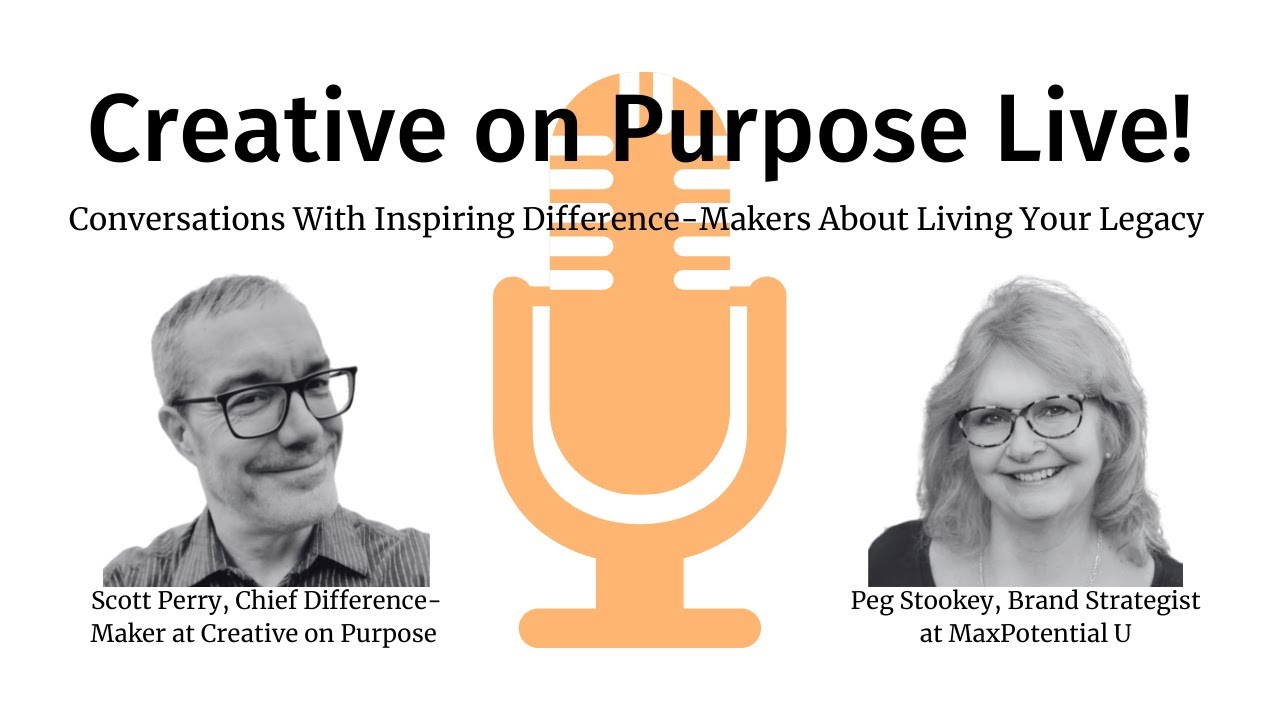
Peg Stookey, a career coach and personal brand strategist, shares how she pivoted from biology to raising four kids to coaching professionals through transitions. Her CliftonStrengths profile shows Futuristic and Activator, and she's writing The Gifts of Change to explore how setbacks become opportunities. She practices daily gratitude as a tool for sharpening focus.
Chapters
Born ready!
That's what we want to hear. And guess what, ladies and gentlemen, defying all expectations and overcoming severe, severe actual technical difficulties, we are indeed live. I wish that my computer would cooperate a little bit more, but we're going to get going for real right now. Welcome to Creative on Purpose Live, insightful conversations with inspiring difference makers to help you live your legacy and endeavors that matter. I'm your host, Scott Perry, Chief Difference Maker at Creative on Purpose. If you're ready to fly higher in the difference only you can make, visit Creative on Purpose and sign up for the newsletter. Get insight and inspiration for better living and making a bigger difference delivered to your inbox 3 times a week and a free copy of the Live Your Legacy Quick Start Guide. Let's meet today's guest, Peg Stuckey. Welcome to the broadcast. Please tell our viewers who you are, what you're up to these days, and where can people go to learn more about you and the difference you're making?
Thanks, Scott. First of all, thank you so much for having me. I have loved getting to know you both by our conversations and what I've been snooping around online about you.
Don't believe everything you read on the internet.
Well, I read Onward, so I think that was very telling.
Oh, thank you.
So anyway, that, that like leads me to what I've been doing. I'm a personal brand strategist and career coach. My first company is Legacy Connections. I run the LegacyCenter.com, DBA, the Legacy Center. So you and I have a lot of legacy stuff in common. I really saw that coming out when I read Onward. I was like highlighting and noting like, oh, this is something that I could say or would say, or it's another way that I could say it. And it was so great to be able to read that and see like, one, there's this camaraderie of thought and mindfulness. But also, you know, another resource that I can send people to that is very in alignment with what I believe and how I act. So anyway, kudos for that, and thanks for us connecting. I'm also a personal brand strategist, and I do that work at maxpotentialyou.com, and that's kind of a landing page that just shows 3 of my programs. Very simple. I told the web designer, I don't want any complicated 10-page website anymore. I just want a super simple, here's what I do, how you can get in touch with me. So that's what maxpotentialu.com is.
Fantastic. Well, you and I, I appreciate all the kind words, by the way. And I am very, very grateful, profoundly grateful for you and the dozen or so other people that have read my book. Thanks, Mom. And You know, in addition to the Legacy theme, we share the Potential theme, I think, as well. And I would love to just start by getting a little bit more of your origin story. So, you know, I arrived at the work that I'm doing now just reasonably recently. 6 years or so has been how long I've been building this brand. And I imagine that there were things that you did before you started Max Potential You and some of the other things that you're doing. So give us a sense of the arc of your journey and what brought you to this point.
You know, it's such an interesting question, but, but now doing career coaching, it's also sort of an example of how people go on these journeys, but they have no idea when they start out where they're going to be ending up. And I think you resonate with that, too. And I started out as a pre-med student. I was going to be a surgeon forever. I was going to be a surgeon and met the love of my life in college. And we ended up getting married between my, uh, between my sophomore and junior year and right after he graduated. He's a couple of years older than me. And, you know, we just really fell into this wonderful life together. I completed school. I started applying for med schools and just kind of decided that wasn't going to be the right thing for our family. Um, so I, I worked in a, biology lab, worked for one of my professors for a number of years. And then once we started having kids, I did, you know, kind of a traditional pivot and really focused on my family. So we raised 4 kids. Uh, during that time I started several businesses because self-employment seemed to be something that I could really work into my family schedule as opposed to having to try to work a job around my family schedule. And family's hugely important to me. So that led just one step at a time here. And you know where it started? I got a note in the mail, a solicitation of somebody who is selling franchises. So this is something I had never thought about. My husband and I had never talked about it. But as I read what it would take to become that type of entrepreneur, it kind of made sense because I felt like I didn't have the billion-dollar idea to go out or even the background to go out and do that successfully, start a business. So I started investigating franchises and long story short, I became a franchise consultant because what my consultant did for me— what my— so valuable. And I felt like if I could turn that around and do that for somebody else, that would be the most meaningful thing that I could do. So for 5 years, that was my career. Uh, again, you know, still raising kids, doing it kind of part-time, having success here and not so success there. And what I realized that I was really passionate about was the fact that my clients were professionals who were leaving the corporate world, asking the question, what do I want to be when I grow up? Is self-employment right for me? And could franchising be right for me? But what I realized too is that most of my clients ended up getting jobs or doing something other than buying a franchise. From me. So in 2005, I put out a little message to those clients and I said, did anything that I did with you have, you know, any, any part of your success in what you're doing today? I got huge feedback. One, a lot of people responded, and of those who responded, all of them said absolutely. And one woman sent me $1,000. And she said, Peg, you helped me so much and you put so much time into my franchise search and helped me pivot to what I'm doing today. And I didn't even think about the fact that you didn't get paid. And, and that was the reality in that world. You don't get paid unless you sell something, right? So that was really telling. So in 2005, I left that world, I pivoted and started doing more coaching, and that kind of started my path to where I am today.
That is really a fascinating story. One of the things that I'm hearing is kind of this theme of emergence. It's not so much that you reinvented yourself or did a hard pivot from one thing to another, but you just— there's a theme of service and of helping other people. You know, see what they don't see and step into possibility for themselves and into their power over their journey.
Absolutely.
So I love all that. I was struck by the question your initial clients were asking around, what am I going to be when I grow up? Because I always share with my clients that growing older is required, but growing up is actually optional.
I love that. I'm going to steal that.
Oh, you steal away. I'm sure I stole it from somebody. And, you know, the other thing that I would love to get your take on, your perspective on, is, you know, you use potential in your branding. And you and I have already highlighted that we share a deep interest in legacy. What are those? How do you define those terms as it applies to the work that you're doing and the difference you're making?
So first of all, legacy for me has become a core value, which, you know, that's to me, that in and of itself says something, right? Like, I'm just a legacy thinker. I'm also a huge believer in the whole CliftonStrengths, StrengthsFinder kind of thing. And my top strength is Futuristic. So, you know, thinking into the future is just something very natural to me. And for people who don't have that trait in their top 10 or so, I totally don't get how you think. But that's the way it all works, right? Good thing we're not all the same. But thinking forward, but using that forward insight and information to make decisions about today and take actions today that are meaningful. And the way that that has become so important for my work is that when people are in a state of transition, whether they're actually, you know, looking for new jobs or they're considering it or they're considering a change in some other point of their life, that's the wonderful time to do this work. Because when everything's okay and you're, you know, just getting up and going to work, it all becomes very routine. You're not willing actually to have these conversations. So one, that change mindset is kind of required, I think, to do this work. And when we're doing it, maybe the ultimate is you want to figure out what you want to do next, or how to do it, or, you know, how to brand yourself so that you go in the right direction. But I always tell people that the residual effects of this are really a secondary gift, and that is that you've got the tools now to keep thinking like this. Keep thinking about legacy. Keep thinking about, you know, is what I'm doing today reflective of where I want to go? And so for me, it's, it's a little bit of a long answer, but I'm very action-oriented. Another of my strengths traits is Activator. So, you know, to me, it's not enough to just think and strategize. You got to do. And so the whole legacy thing to me is a mindset, but it's also a skill set and actions that you can take.
Yeah, I love that. In that core talent of yours around future thinking, I've just recently received the— I purchased the CliftonStrengthsFinder book and plan on taking that assessment. But it sounds like your, your type is, you know, there must be some Um, you know, people that, that are that way have hope and are usually, you know, have positive thoughts about, you know, the possibility that lies ahead. And I think that's so important because for people that you are serving and, and the people that I'm serving too, they're in a liminal state, whether they, they acknowledge that or not. They're in between, they're in transition. And maybe that transition is being forced upon them through change in job or career circumstances or nearing retirement, or maybe your role as a, as a, you know, in child rearing is, is coming to a close. And we don't get any training in our schools or jobs about how to handle transition. And for many people, I think I'm like you in that, you know, we actually embrace, we, we love to seek the edges of our understanding and ability. We love to explore those edges. In my experience, many people do not.
Right.
So the, the value of what you're doing is you can be a guide and accompany people into this, you know, into the uncertainty, um, with a sense of hope and possibility. And, um, helping them see that they actually possess everything they already need to achieve whatever it is that they want to achieve. I just, I think that's so, so, so profound. I'm imagining that, um, there's also, um, as in any worthwhile endeavor, that there are moments, uh, of, of challenge and adversity. And, um, I'm guessing if you're at all like me that you've made a mistake or two along the way. Or what maybe felt like a mistake or a failure that maybe got flipped into an opportunity or a possibility. And I'm just wondering if there's a moment like that that you'd be willing to share, some, some time when things didn't work out exactly the way that you expected or wanted. And, you know, what, what were the lessons or takeaways that you were able to derive from that experience?
That's a great question. The thing that comes to mind did lead to another pivot point. And that was that I had a physical office for 7 years and it was a kind of a small business complex. I had a partner, she had her dedicated office. I had mine. It was a great place to meet clients. And the primary reason we were there is that it had a great training room and we did a lot of trainings, um, per first starting out with, uh, professionals who were looking at self-employment. And so we did a lot of entrepreneurial type training. And then during the years of the economic downturn, we pivoted a little bit and started volunteering with an organization here in Cincinnati called Return to Work. And Return to Work focused on helping people during that time get back to work. But, you know, if we all remember, this was a time where for any one job that was available, they had potentially thousands of applications. So it was, it was a very, very difficult time. And so, so that office really served us well for a period of 7 years. And after 7 years, the day that I had to either say yes or no, I'm going to continue my lease, The owners did something that was so unethical, and I only found out about it by accident. And so it caused us to pivot and say, we don't know what we're going to do next, but we're not going to do it here. It was, it was that bad. And the mistake I made honestly was in trusting people. They had actually changed the lease from the last time I'd signed it, and I didn't notice it. They'd taken out one line and they'd put in one line that completely changed things. And we operated under that actually successfully for a while. And then they went to this other level. And, you know, in general, I am very trusting, but it taught me a good lesson. You know, you always have to kind of be aware of what's in it for other people. And if what's in it for them and what's in it for you, you know, you don't share that value, it doesn't align, then you need to start questioning things. But like I said, whether it's because I'm a kind of person who will always make things okay, or because it really was where we were supposed to go in the first place, getting rid of that office was the best thing that happened. So, you know, was it a mistake? I don't know if it was a mistake. It was certainly a decision that ran its course and we recovered extremely well from that.
Well, what I'm hearing is it was an opportunity for, you know, maybe your trust in other people was shaken to a degree, but it was an opportunity for you to reengage with your trust in yourself and your ability to figure, figure out a way forward. And again, something that, um, you know, institutionalized education and occupation doesn't, um, instill in us, you know, trust in ourselves and, um, integrity and intention in, in our dealings with each other. Um, but I, I love that, uh, I love that story and, and just again, the idea that you're able to look at a situation and not just, uh, put on the, the, the victor or the victim cape, but to become the victor of your, of your own story.
So, for sure. And you know what I mean, like you said, I am very comfortable in change. Um, I learned that in the world of like quantum physics, there's this whole real reason that people go through a 7-year itch. I hadn't been having a 7-year itch, but it was a major change after 7 years. And I've really watched that kind of carefully. And maybe that's another learning that I had out of there. It's like, okay, we're in year 6, what's happening next year? And I embrace those changes. I really do. And again, whether it's that I'm that kind of person or things fall in place or whatever, I don't know. But I, but I do know that change leads to possibility.
Yeah.
I think I had mentioned that I was just part of writing a book. I probably should have included that in what I've been doing, or my publishers. I'm going to hear from them, but we can maybe talk about that before we're done. But I have another book coming that I'm really in love with this title, and I'm going to call it The Gifts of Change. And the reason I'm going to call it that is because that's a phrase I use with my clients, whether they're just starting or we're just ending, because one, I want them to kind of be open to the gifts of change, not closed to the situation that's at hand, right? And I've just found that every, every single person I've worked with, and myself and my family, every time there's a challenge put in front of us, We overcome and we come out better. And that's the gift. Okay. That's, you know, just in general, that's the gift. And then you can find so many minute gifts underway, like shutting down that office opened up really more of an attention on personal coaching and less on group training. You know, the depth of benefit that I've given to people really shifted. After we shut down that office. And I'm really proud of that. Yeah.
Well, since you brought up the book, I'd be curious to get your take as someone that has written a few and appreciate readers like you. What, what are you— what compels you or drive, you know, what motivates you to write a book? And What does that, you know, what, what, what do you, what's the benefit that, that you derive other than, you know, the possibility of some remuneration from book sales? What's, what's, what's the motivation? What's the benefit that you see in putting your work out there in, in that format?
Well, you know, the first thing that comes to mind, Scott, is the word legacy. You know, I said, this is, this is a core value of mine. Like, I don't want to waste my life. And the knowledge that I've gained, the experience that I've gained. So a book, just like a blog or this podcast or whatever, it's another way of passing on what I know and what might help somebody else. So that's, that's number one for me. Number two, as a business owner and a professional, somebody who's putting myself out there as an expert, credibility is also really important. And I think writing a book, being an author, is one of the most important and impactful things that you can do to establish your credibility. That's another reason why one of the areas of specialty I have is LinkedIn, because I think a well-written LinkedIn profile also helps build credibility, right? So they, they tie together, the whole personal brand kind of thing. And so personal branding and legacy, um, are really intimately tied for me, if that makes sense.
No, it's completely— the, the only other piece that, that kind of bubbles up for me is, for me, writing is a way of getting, uh, of organizing my ideas and developing the processes that I end up, uh, well, oftentimes for me, a book emerges through the blogging, which, you know, as I look back, I can see a theme developing and, and then it just is like telling me, I think this wants to be a book. And then I usually workshop it by actually holding workshops and, and pre— working through the process. And then the book becomes kind of the, the organization of that process. And I love what you were saying about credibility, because I, I totally agree that even, you know, even in a world where anybody can publish a book, and therefore anybody does publish a book, it's still, you know, to have a book, um, that's succeeding and visible, and, uh, you know, if you play your cards right, you can, you can get some, you know, top seller status on Amazon and whatnot. It really does raise your credibility. It's also what I was hearing and what you're saying about also being a part of your legacy. It's, it's an asset. It's something that you've built, um, and can leverage as, you know, as promotion, marketing, something that you, you know, you can gift. It sounds like your book is going to talk a lot about gifting. Um, really, really fabulous. So I'm grateful to hear that another work of yours is going to enter the world soon. And as we're kind of coming to the end of our time together in this conversation, I would love to, um, you know, this is a show where I'm interviewing inspiring difference makers like yourself in the hopes of informing and encouraging the journey of people who, like you, would like to advance in making a bigger difference, um, by leveraging the difference only they can make. So if there was just one final tip, quote, maxim, exercise routine that you would share for someone who would like to fly a little bit higher and the difference only they can make, what would you tell them?
Super simple answer for me, and that is develop a gratitude mindset and practice. I think the skill of gratitude is one of the most important success skills that any of us can develop. I was thinking about when you were talking about getting the book formulated. When I journal from a place of gratitude intention, which means I'm journaling about how grateful I am for the things that are coming, right? Not just for what I have, but for the things that are coming. That really clears my head about what is coming and how to get there and what do I really want and whatever. So, so for me, that kind of writing is super important. And it's something that I've passed on to hundreds of people And the feedback is 100% positive.
I love that. Yes, gratitude is one of the fastest ways to boost your attitude for sure. Love that.
Scott, I gotta show my book.
Oh, sure.
I can't—
it's hard. I'm not able to see it.
It's called Marketing Fusion.
Perfect.
Marketing Fusion. And it's a multi-author book. So my chapter is on personal branding and LinkedIn. Really designed for small business owners and professionals to help them with their marketing.
Well, feel free to drop a link to the book in the comments on this podcast. And we want to thank everyone for tuning in. Peg and I really appreciate you lending us some of your valuable time and attention. We hope today's broadcast motivates you to take a bolder step into possibility, living your legacy. You can learn more about Peg and the difference she's making at maxpotentialyou.com. And of course, Always great to see you at creativeonpurpose.com. If you're listening to this as a podcast, please consider leaving us a 5-star review. It helps get the word out to more of the right people. Now, take the insight and inspiration from this conversation and fly a little bit higher in the difference only you can make today. Peg, thanks so much for sharing your insight and wisdom with us today.
Scott Perry, thank you so much for having me.
More from Scott



Stoics Don't Suppress Emotions, They Do This Instead #stoicism #emotionalintelligence #mindset







