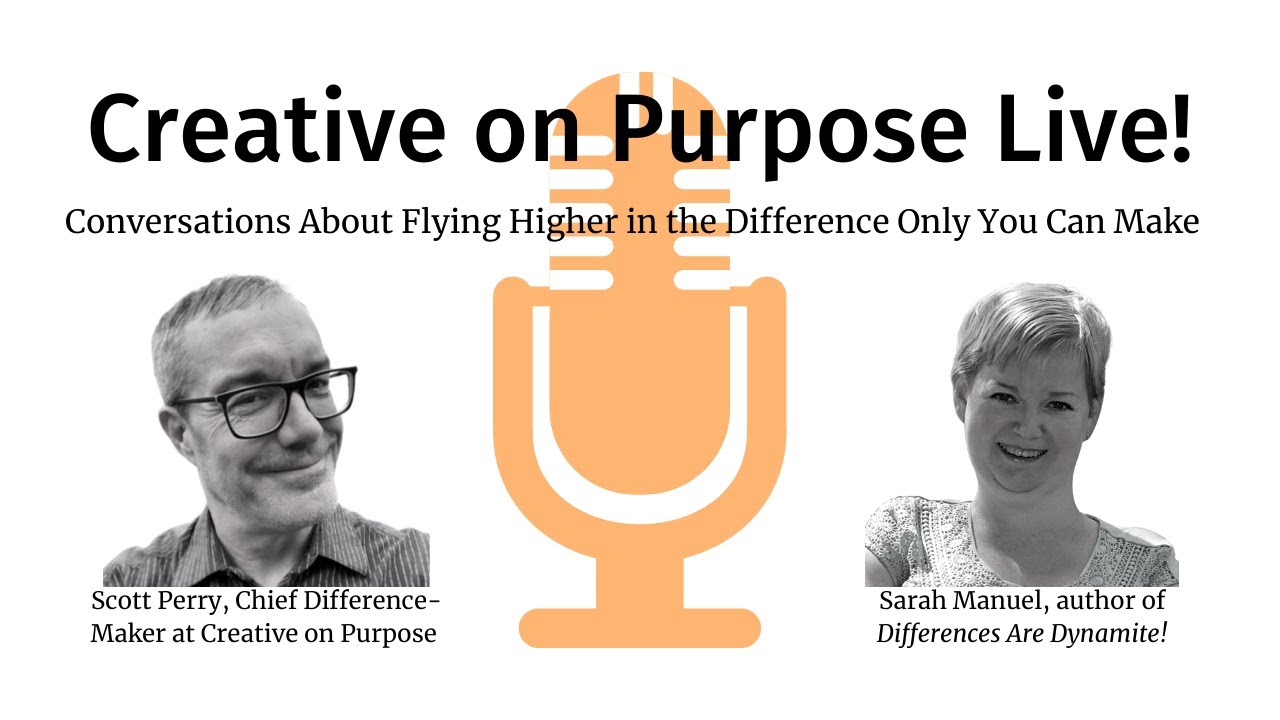
Sarah Manuel, who has lived with spinal muscular atrophy since childhood despite doctors predicting she wouldn't survive past five, defines purpose as living in alignment with God's intention. She wrote Differences Are Dynamite, a children's book celebrating diversity, and coaches clients to reframe obstacles as opportunities for growth.
Chapters
We are— bingo! Just like that, through the magic of digital tools, live. Welcome to Creative on Purpose Live. These conversations are about cultivating greater fulfillment and equanimity in endeavors that make a difference. I'm your host, Scott Perry, author of Onward and head coach at Akimba Workshops. You also find me as Chief Difference Maker at Creative on Purpose. You can visit creativeonpurpose.com to learn how to how different— I'm sorry, to learn how difference makers like you can solve burnout and overwhelm by making better decisions. And since Scott can't talk today, let's go ahead and introduce our guest, Sara Manuel. Please introduce yourself to our viewers. Tell them who you are, what you're up to these days, and where can they go to learn more about you and the difference that you're making.
Thanks so much for having me. I'm so excited to be here. So, uh, I am up to quite a bit these days, um, but who I am first I guess would be helpful, right? So, um, my name is Sarah Manuel and I have lived my life in a wheelchair. I was diagnosed with, um, a genetic disease that was supposed to, um, end my life by age 4 or 5, and here I am at age 45. So clearly the doctors didn't know everything that they were talking about. And I have just always been the type of person that has figured out a way to get done the things that I want to have done in my life. So for me, that has included a full-time profession. I'm a school psychologist, um, by day. I'm a life purpose coach and a children's book author, um, in my spare time. I've been married 20 years to a fantastic guy I met in a chat room online back in 1999 when it was not the cool or the safe thing to do. Scared my parents to death. And I have a 10-year-old son, which again, I defied the wisdom, quote unquote wisdom, of doctors, got pregnant, carried him full term, and he is a thriving, healthy child. So, and you can find more about me at sarahmanuel.com, and I also on Instagram and Facebook.
Fantastic, Sarah. I was really struck when your assistant reached out to me and shared a little bit of your story. My story about brevity of life is not nearly as dramatic or true is yours, but I remember Sister Mary Agnes said I would never live to be older than 30, and here I am, 57, or 27 years past that date. And one of the things that I often will joke about is that I've actually made it this long just to spite Sister Mary Agnes. You, on the other hand, you defied some really serious and scientific odds. I'm just curious about what, what do the doctors or what do you attribute your longevity in the face of a really, really dire prognosis early in your life?
Well, I think first of all, they just had the, the severity of my disease wrong. They thought I was more of a type 1, more severe. I have spinal muscular atrophy, which is one of the muscular dystrophy diseases. And they categorize the severity by the type. So Type 1 would be the most severe, and I have Type 2 because I've never walked. If I walked, I would be a Type 3, so I'm right in the middle. Um, but I'm what you would call a strong Type 2. I, um, I don't— I'm not hooked up to like feeding tubes or breathing machines all day. I am very, very fortunate, and I attribute a lot of that to God and to having a higher purpose, a bigger purpose than what anybody could imagine when I was 4 or 5 with that expiration date on my head. Um, but here I am, so there must be a reason.
Yeah, absolutely. And I, I love, love that. I also have a sense, um, and I want to talk a little bit about what— how purpose plays into your life, your work, and how you define that. But I sense a strong sense of volition or will and appreciation in your story as well. I'm just curious, before we dive into purpose, what is it, you know, what is it that fuels that desire to achieve so much that, you know, that you've achieved even as you were negotiating the difficulties of life in a wheelchair?
Well, I don't like it when people tell me no. So you call it will, my parents and my husband call it stubbornness, and I would tend to agree. But if you're gonna tell me I can't do something, I'm gonna go out of my way to find a way and to prove prove to you that I can. And it may not look the same way that it looks for other typical people, but it will have met the same, the same purpose in my life, or met the same goal, or check that same box. Um, so yeah, don't tell me no because you're just setting me up to, to prove you wrong.
I get it, I get it. Uh, on a good day when people are being kind, they will call me persistent. But I know that most of the time behind my back, they're calling me stubborn as well. So I totally get that. You mentioned purpose, and as a brand that's called Creative on Purpose, obviously purpose is a subject near and dear to our hearts here. And I'm just curious, when you use that word, how do you define that term? And where have, where for you have you found or cultivated purpose in the work that you're doing?
For me, purpose is living my life the way that God intended. It is, you know, I'm not like the type of YOLO type, short-term type of thinking type of person. I see a goal and I will do what I have to do to to take those baby steps to, to make sure that I can achieve that goal. Or if I can't, I kind of— maybe I realize on the way that maybe it's not quite right. Maybe I wanted it for reasons that were other than what's true to my purpose, and maybe I'll alter it or, or what have you. But I think there's a lot of self-awareness and purpose also, and it's just, to me it has always been such this big, huge thing, like you need to live with purpose, like you need to do what makes you happy, you need to do— and to me, like when the experts say, you know, find— do what makes you happy to find your purpose, it, it feels so, so false, so, so fake almost. Like, like, okay, if it was that easy, everybody would live their purpose by eating ice cream all day because who doesn't love ice cream? Who doesn't, you know, get happy by eating ice cream, especially if you're bummed out, right? But, um, so for me, it's more of finding joy and living life with joy and realizing why you're here. Because I, what I, I was— I tried the whole happiness path, and that, that led me down lots of roads that weren't fruitful. But when I stopped looking for happiness and started looking for fulfillment and joy, that's when I hit paydirt.
I love that. Thank you so much for sharing that. I wanted to just give a quick shout out to my friend Phil, who is tuning in and giving you a quick amen. I think he was both speaking to your, your spiritual practice, but also what your comments on living your purpose And you brought up two words that are also words that we've been discussing here at Creative on Purpose, uh, quite a bit, which is joy and how it is different from happiness. And I got a sense that you do have— you do distinguish that there's a little bit of a difference between those two.
Absolutely. To me, happiness is more like a reaction to your circumstances. If my husband brings me flowers, it makes me happy. But then if, you know, something happens in, you know, the house, something goes wrong, the happiness is gone because it's so fleeting. It's a reaction to your circumstance. Whereas joy, you feel it in every moment, the good moments, the rough moments, the moments that you wish were different. You still have that underlying feeling of joy. And I used to think it was just this myth. It's like, well, I, I just, I don't, I didn't get it. And then when I got it, I got it. And so now I find myself on that same quest for the sense of peace, um, because I've always been that achiever, been trying to meet those goals, been trying to prove people wrong, and I feel like maybe I'm getting ahead of myself or getting ahead of God. And I, I'm feeling the need to kind of press the brakes a little bit and let God do his thing. And, um, I think that's where I'm hoping I will find that sense of peace that I am looking for right now.
I love that, uh, and I couldn't agree more about the, the differentiation I mean, happiness is a natural emotion that we experience when things go our way or when we have a surprising and delightful experience, and we should allow ourselves to experience happiness. The problem, as I see it, is if we cling to the desire to have happiness all the time— I mean, happiness is usually very short-lived and it can't be sustained for a long time. Joy, on the other hand, which I heard you alluding to, is something that we can nurture and cultivate and sustain even as we face the inevitable challenges and adversities of life and, and, and weave our way through all the uncertainties. We can experience this joy. And you mentioned gratitude, and I think gratitude is a really important element of living joyfully, choosing to live joyfully. And I love what you said. I, you know, I think that we talk at Creative On Purpose and a lot of our work, we talk about equanimity. Like, you can experience a sense of calm and a sense of, you know, kind of an even hum, even as you're negotiating all the challenges, you know, both the victories and the vicissitudes of your day. So really, really appreciate those distinctions. I wanted to weave in also, Sarah, a little bit of your creative work. Because when I was looking at your site, I saw what looked like a really delightful children's book. But I also know that you express your creativity in your relationships through your coaching practice. I wonder if you would just unpack a little bit more about what creative endeavors that you're engaged in right now.
Yeah, well, my children's book is called Differences Are Dynamite. And so the way I found my purpose is when I stopped denying who I was. So let me delve into that a little bit further. I grew up in a really small town and I was like, there were 35 people in my high school class, small, like really, like less than 1,000 people. So I was, of course, the only one my age in a wheelchair. So I grew up not seeing other people in wheelchairs or any sort of disability. So when we would go to the city, because that's what country folk call the big cities, when we would go to the city, I would see other people with disabilities and it would make me feel really uncomfortable because it was like holding up a mirror to myself and I couldn't deny my reality, whereas at home, because I was the only one, I could, you know, I could do, you know, probably, probably make myself believe more than anyone else that I was just like everyone else, that there was no difference. And that's a healthy attitude to some degree, but when it gets to the point where it got for me to be a state of denial um, that part isn't healthy. Like, I would call and make restaurant reservations, and my parents would ask, well, is it wheelchair accessible? Like, I don't know, why would I ask that? So I'd have to call back. And it— so I was denying that part of myself that was so purposely created for me. And when I stopped denying it, like, that's when my whole world of purpose opened up. And I think everybody, and not just people with disabilities, I think everybody has parts of themselves that they deny because they don't fit in with society or with their family or with their friend groups. So they downplay that part of themselves or they completely pretend it's not there. But I really think that when we can acknowledge and celebrate that part of ourselves rather than you know, pretending that it doesn't exist. That's where our purpose comes in, because we were given that difference for a reason. So that's what the book is about. It's about animal friends who celebrate each other's differences rather than being embarrassed or ashamed about them, and how to celebrate them.
So yeah, yeah, no, it's really, really profound. What I'm hearing is that there was a moment where you were able to cultivate some acceptance for your situation. And, you know, that, you know, acceptance is different than settling for, or it, you know, that acknowledgement is what allowed you to then start to leverage the difference and to celebrate it and to use it apply it purposefully towards the writing of your book and, and to just your, your daily pursuits. Is that, is that a fair read?
Absolutely. And I remember a conversation with one of my friends, because when I was growing up, like, I remember, like, when I was really, really little, um, I remember that my parents took me to some healing services, and for them it didn't work because I didn't start walking. But looking back now, it's like, who's to say it didn't work? Look at how strong and healthy I am despite my disease at this point. And my friend told me, you know, the healings didn't work because you weren't a mistake. And I'm sure I'd heard that message before over the years, but when she said it in that moment, it resonated with me. And it's like, okay, being in a wheelchair and having this disease, yeah, it may not It may not be the greatest thing, but it wasn't a mistake. There is a reason for me to be in the situation I am in, and I'm going to find out what it is and, and, and use that as my purpose.
I love that. Thank you very much for leaning into that a little bit more and sharing that, Sarah. I'm curious too, a little bit, if you don't mind, you know, as a coach myself, and as someone that advocates coaching and celebrates the diversity of coaching out there. Would you mind sharing a little bit about your coaching practice and how it looks in practice?
Yeah. So I help people go through that process themselves of what are they denying about themselves? What do they wish wasn't that way about them? And helping them to take that and kind of flip it on its head and say, okay, instead of being ashamed of this, how can I celebrate it? How can I embrace it and make it part of my life story rather than like a footnote? Because if you're given that difference, it should be part of your life story. It should be something that you embrace, that you, that you really use to cultivate your life and kind of design your life around it rather than designing your life around avoiding it.
I love that. What I'm hearing is that you help people frame obstacles and challenges as opportunities and find the possibility. And I think that's really, really powerful. One of the things that we have discussed quite a bit in our community is, although we are deeply saddened by the amount of suffering that has happened as a result of COVID and sad even more so because much of it probably could have been avoided had we approached it differently, the pandemic has provided us a reminder, a powerful reminder, I think, that number one, we had been taking far too much for granted. And we had had a great deal of abundance that we weren't as grateful for as we, we probably should have been. And it was a powerful reminder for how important, um, human-to-human contact and connection is. And, you know, the, the age of social distancing and not being able to go to school, not being able to go to the workplace, um, you know, thank goodness we had these powerful digital tools where we could still maintain some semblance of that. Um, but again, you know, there's always an opportunity, even, uh, even in the very darkest moments. And I love that you're holding space and, and, and helping people, um, with, with that kind of work. Is there anything else going on in your, in your creative life right now that you'd like to, that, that you'd like to share? Are you working on any other books or, um, also?
I have some, um, more children's books in the works that I'm thinking about. Um, I'm also thinking about writing a book for adults that kind of explains or kind of talks about my life story and how to use the process I went through, um, to help other people find their purpose more creatively. Because I mean, that's what the purpose of a coach is, right? They help you find the shortcuts you don't have to go through all those years of torture and misery trying to find it. Because it's not— when you don't have purpose in your life, like, what am I going to be when I grow up? You just feel so lost and so out of touch with who you are and what the point of everything is. So I think the sooner someone can find their purpose and begin to live their life with purpose, and the quality of their life will increase infinitely.
Yeah, yeah. It's— it reminds me of a discussion I had, um, earlier this week with, uh, Beth Fitzgerald, who was on the broadcast, where, uh, the way that purpose is often discussed— and did I hear correctly, Sarah, that you are a school psychologist?
Yes.
And is that at the high school level or college level, elementary?
That is kindergarten through age 22.
Oh wow, fantastic. Well, so I'm curious about your take on this because I've been thinking about like where— so oftentimes with young people in particular, I remember, you know, adults telling me as a college student, high school student, and even younger, um, you got to find your purpose, you got to find your passion. And sometimes they said you got to find it like it's, it's out there, go find it. And sometimes they said it's inside you, you got to excavate it. And I just really, really struggled with that. And I, you know, I, I chose a purpose because I felt like I had to, and that purpose was actually teaching. Um, and I was a school teacher for the first several years out of college and then found but my true purpose was in music making and performing. And then later in life, uh, in the last 5 years, found it in coaching. And so I've been thinking more and more recently about purpose not really being this destination the way some people describe it, or purpose being this thing inside you that you have to somehow excavate, but it's something that is nurtured and cultivated by doing the work right in front of you, engaging in the relationships right around you with purpose and passion. If you can bring purpose and passion to your everyday activities, your everyday conversations, more purpose will reveal itself, and purpose and passion become clear. Just like talking and walking and riding a bike and learning to read and write, become clear. You learn it by doing it. Curious about your take on that. And I'm guessing that in your work as a, as a school psychologist, that purpose, you know, helping young people wrestle with purpose-driven, like purpose-driven living, but also finding their purpose and living their purpose through, through work and in their relationships. Any, any thoughts on how we can do a better job helping young people live, work, and engage with purpose, on purpose, for a purpose, with and for others.
Yeah, well, I think you had a similar experience as I did because in looking back now and looking, it's almost like the school set kids up for failure because first of all, they tell you your path in life needs to be your purpose, like your career and your purpose need to be intertwined. So you're telling an 18-year-old whose brain is not done developing even, go figure out what you're going to do for the rest of your life. And in the meantime, we're going to just, you know, charge you tons and tons and tons of money while you figure it out, while you go to college. And it's just, it's crazy. And I went through that, like I went to college and I was studying interior design because I had, I always shared a room with my brother. So like going and getting an apartment was the first time I got to decorate a house. So it's like, oh, this is fun, I'm gonna do this for my job. And then I got into it and it was fun, but it's like, okay, that's not— that's not what I'm supposed to do. So then I decided to double major in journalism because I was always good at writing. But then again, it's like, okay, what am I gonna do? I don't want to be a journalist. Like, I don't want to work for a newspaper. That's not what I want to do. So then I went to law school and I was there for a semester and a half and I met my husband just before I started. And there was a point one day where a professor basically talked about the amount of hours that you had to work to make partner. And like we've already talked about, if I'm going to do something, I do it like full force. And so I was going to be a partner. I was going to be the youngest partner they ever had. So it's like, okay, I could have a life or I could be a lawyer. So then I decided, okay, this isn't for me. And it took me so many years to figure it out. And in the meantime, I felt like such a loser. Like, who doesn't know what they want to do for their life? Look at all my friends. They got their degrees, they're working, they're doing their thing. Why can't I do the same thing? So I really feel like those expectations set us up for failure. And if instead we can just embrace the life journey, and like you said, set up purposeful experiences that will help us to, to kind of figure it out maybe earlier, just take the pressure off. Because I don't necessarily think that your job has to be your purpose. Like, I feel there are other outlets in life where you can live your purpose without, like, You don't have to like quit your job today and go, you know, become an NFT. You know, it's just, it's not, it's not all or nothing. And I think sometimes our society says it is, and I disagree with that.
That is brilliant. I couldn't agree more. We're coming to the end of our time here, Sarah, and the last question I always ask, and I want to first articulate that you have already shared a bunch of insight and inspiration for people like us that tune into shows like this that want to either, either aspire to develop and deliver the difference only they can make or want to advance in the difference that they're already making. And if there was just one final tip or piece of information or inspiration that you would have for for someone who, like you, wants to define, develop, and deliver the difference only they could make? What would that be?
It would be that your circumstances don't have to dictate your reality. For me, my circumstances could have very well dictated that I was going to live with my parents forever. There wasn't anybody out there who would love me because who would love someone that they would have to help take care of? That, you know, I could have listened to what the doctors and the professionals are saying about not taking a risk in getting pregnant. I could, you know, my life could look very different if I let my circumstances dictate my reality. And I think we need to step outside of it and maybe look from an outsider's perspective and always ask, okay, what can I do? Where can I start? What's my entry point? And go from there. And because it's going to be different for everyone, and if it looks different than what is typical or what society expects, that's okay if you're finding fulfillment and joy and purpose.
Fantastic. Thank you so much for that, Sarah. And thank you everyone for tuning in. Sarah and I really appreciate the gift of your time and attention, and we hope that today's broadcast motivates you to lean into an endeavor that matters with greater curiosity and courage. You can learn more about Sarah and the difference that she's making over here at sarahmanuel.com, and of course, it's always fantastic to see you at creativeonpurpose.com. Now please take the insight and inspiration from this conversation and fly higher in the difference only you can make. Sarah Manuel, thank you so much for the gift of your time and attention and all the insight and inspiration you provided with us today.
Thanks, Ron, so much for having me. I had a great time. I love talking about purpose.
Thanks.
More from Scott



Stoics Don't Suppress Emotions, They Do This Instead #stoicism #emotionalintelligence #mindset







