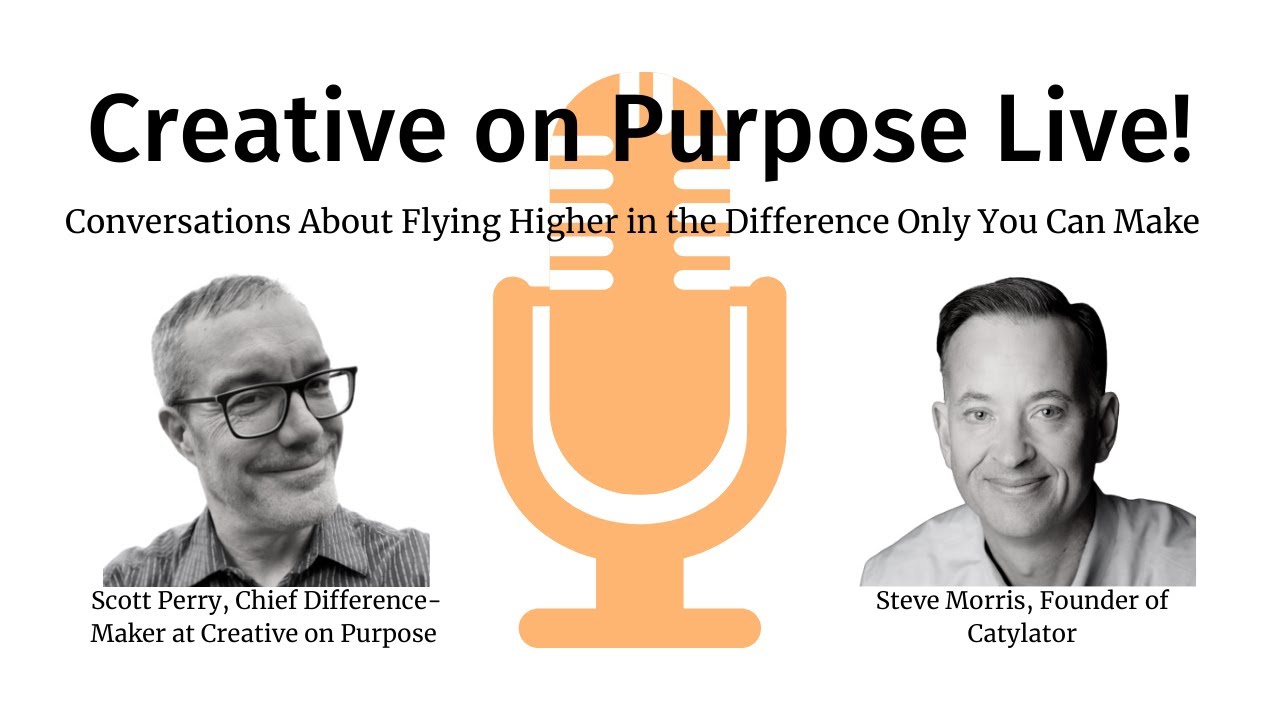
Scott Perry talks with business coach Steve Morris about building high-performing teams through core values and the Entrepreneurial Operating System. Morris draws lessons from professional yacht racing and Stoic philosophy to handle conflict and obstacles, plus practical breathwork techniques for managing stress.
Chapters
upright position. Okay, buckle your seatbelt. It looks like we are indeed live. Welcome to Creative on Purpose Live. These conversations are about flying higher and the difference only you can make. I'm your host, Scott Perry, author of Onward! and A Compass Helping Difference Makers Live Their Legacy at Akimbo Workshops and Creative on Purpose. Visit creativeonpurpose.com to learn more. This season we're learning— excuse me— this season we're drawing insights and inspiration from guests successfully embracing uncertainty, navigating adversity, and making things better, doing work that matters. Let's meet today's guest. Steve Morris, welcome to the broadcast. Please tell our viewers who you are, what you're up to these days, and where can they go to learn more about you and the difference that you're making?
Thanks, Scott. Thanks for having me on the broadcast. I really appreciate it. So, um, as you mentioned, my name's Steve Morris. I'm a business coach. I help come into businesses and help leadership teams really get aligned with where they're taking a business, figure out where their obstacles and their issues are, and get everybody on the same page about where they're going. You can find out about me at catalyta.com. It's my website. And I'm also on LinkedIn, Stephen A. Morris. Always happy to connect with people and have a conversation.
Fantastic. I'm always really interested in, especially with with guests that are fellow coaches. It's such a weird, weird job. I'm always interested in origin story. How did you, how did you come to this work? Is there other work that you did before you began Catalator.com?
Yeah, well, that's a good question, Scott. So I had a really cool and interesting start to my career designing multimillion-dollar racing yachts. And building and coaching teams to help our clients win the world's most demanding yacht races. So I've been coaching and leading teams, you know, my whole career, and I learned a tremendous amount in those early years about really what it took to be a great leader and about the incredible importance of processes and systems, because we had boats like— I've got these models behind me on the wall here out in the middle of the Southern Ocean, thousands of miles away from land, right? No one's going to come to help you if something breaks. But I really developed this deep passion and curiosity around what it really takes to build an awesome high-performing team. I worked with some incredible teams, Olympic-class sailors, like really inspirational top-shelf people. I also worked on some teams where we had a lot of resources, but we just didn't quite get there. And that really sort of formed a puzzle in my head at that time about, you know, how can we, how can this be better?
So I'm curious about the, so it's always interesting how, well, I'm, I won't put words in your mouth. When you look back at even going further back than that experience working with high performance yachting teams, What's the through line? What's the theme that you see? Is it around performance? Is it around leadership? Is it around teamwork?
I really love helping people get unstuck. And I think that that's sort of, you know, where you sort of come, and if I sort of go back, back, back further and further, I mean, I love helping people and particularly, you know, people who are confronted by obstacles. And Scott, you know, I've noticed you post a lot on LinkedIn about Stoicism, right? And this sort of philosophy, taking these frameworks that have been around for thousands of years now, right? And people use these frameworks to help them move forward. And to me, you know, out of all of the many, many parts of Stoicism, it's sort of like this idea of The obstacle is the way, right? And you sort of think about all of the times in my life when I've sort of been stuck or at some point when I'm just, I don't know how to move forward here. And the resistance in that, right? The shying away from that, but then of that obstacle, but then sort of having this philosophy, this framework, this thing inside you that says, you know, The obstacle is the way. This is difficult. This is really sucky. I'm having a hard time here, but going forward and going into that is something that that's the only way through. And my first job out of college, I was actually working on a professional sailing team, actually on this white boat here. It was a boat that was getting ready to sail around the world. So, I'd gone to engineering school. My job on the boat was doing the computer performance analysis. But I still had to get up at 6 o'clock in the morning and go train with the crew in the gym because, you know, we all would go out sailing together during the day to get the boat ready. And I still remember, like, we had this Commonwealth Games gold medal weightlifter. He was our trainer. Incredible guy, but he would put us through, you know, these exercises to basically toughen us up, right? And we'd be there with these, you know, we had a bar on our backs doing squats endlessly, and he's always saying, 'Another 30 seconds.' Now it just seems to go on forever and ever, but that sort of feeling of like, that's how we're going to get better, right, is to go through that the pain of that training. And when we get out on sailing and things happen out on the boat, well, it's okay because we've done the training. So, you know, really leaning into obstacles and figuring out that that's the path forward has been a huge thing for me throughout my whole career. Yeah.
So, the Obstacles Ways, quote from Marcus Aurelius that, um, obviously, uh, Ryan Holiday's turned into a very successful book. Um, and there's— you, you mentioned, you referenced resistance earlier, and this is, you know, one of the things that is really interesting to me is how frequently we are looking to eliminate resistance when in fact it's resistance that actually develops us and makes us stronger. We don't grow without there being some resistance, some friction, and having to push through resistance. The other thing that I really just want to reflect back from what you said that I think is really important is this. You've referenced two things. One, I would frame them as guiding principles and processes. So guiding principles like, this is who I am and this is what I believe and this is what I'm here to do. And then the This is how I do it. And so I'm wondering what, in your work with high-performance teams, what do you find to be the common guiding principles and the common process? Or if there is a common process, great. But if not, what's, what's the process that you're able to help them put together so that they can level up? To where they want to be?
Yeah, so, you know, that's a good way of sort of trying to look at, you know, this work that we do as coaches. And so, you know, the guiding principles I see is, you know, these frameworks that really do provide us with a path forward. And in terms of, so you know, in building a leadership team and building a business, it's like getting everybody on that same page about having, you know, the vision for the organization and where you're going. And to me, like, these guiding principles come down to like talking about really important things like what are the core values in the business. Because oftentimes I sort of see, you know, when I'm having discussions with teams, you know, they're having difficulty perhaps like hiring the right people into the organization, or they're having some doubt about like, you know, should we be going down this path? Should we be taking that choice? You know, the decision-making. And so to me, like those guiding principles are, well, you know, what are your core values? Like, what's your purpose as an organization? Like, why do you guys get up out of bed every morning and come to work and do the things that you do? And when we can talk about those things and we can get them, you know, fleshed out and written down on paper, now we've got something, you know, that provides a North Star for where we're going. And then, as you're talking about, you know, these processes, so I'm a professional EOS implementer and, you EOS is the Entrepreneurial Operating System. And it is a complete proven set of processes that have been used in 10,000 businesses here in the US and around the world to help business owners and their leadership teams get 3 things we call vision, traction, and healthy. You know, it's vision for the organization, getting everybody on the same page with that. And then traction from the standpoint of getting the discipline, the accountability, becoming masters of execution. And then healthy from the standpoint of making sure the leadership team's a healthy, functional, cohesive leadership team, which takes me all the way back to the beginning of my career, like, you know, that deep passion and curiosity about getting a group of people together to go on an amazing mission and achieve incredible things.
Yeah, what comes up for me is how important in all of that. So defining your values, defining your vision, and, and creating the mission and the goals and strategy that will help you, you know, that are on mission, that serve your vision, all really, really important. One of the things that I find also really important, so you can have the best vision in the world, you can have the best mission in the world, you can have the best goals, best strategy. And to the point of your work, if you don't have the best people, or maybe even better, the right people, it's very difficult to have everything else right, but have the people wrong and get to where you want to go. I'm just curious about in your work, where do you find, or, or how do you find whether or not the right people are on board as they're trying to execute all these other parts.
Yeah, well, so the saying is, you know, culture eats strategy for breakfast, right? That's the thing. And I experienced this, you know, very, you know, viscerally with some of the teams that I worked with. Like, you know, you'd go on board the— on the boat, you'd be training with them and helping them, you with the performance of the boat. Things are working like clockwork. Everybody is like working together, coordinated. And in those teams, I really saw that the— because they weren't sort of like arguing about, you know, you're going to pull this rope, you know, what's my job, that sort of thing. It freed up their energy to look up and out of the boat and to be much more strategic. And then so the whole crew, the whole team's bringing information in. They're that helps everybody move forward. And then, in contrast to that, what I've also experienced is being on some teams where we've had these great resources and you see it in a lot of professional sports. You go buy the best people you can, get them on a team, put them in a room. That doesn't mean they all work together. Right? And so why is that? And it comes down to really getting on the same page about things like core values. And that's exactly what I work with my clients is we establish that. And these are not— the work that we do here is about discovering the core values of the team. It's not about being aspirational and saying, oh yes, we want to be respectful and we want to have integrity and all that stuff. It's like, no, if you can't tell me a story about how you've demonstrated how, you know, this core value, how it's showing up in the last week or the last month, then it's probably not something that you're actually doing now. So, you know, what are you as a team doing now? And we discover that, and we get that written down and come back to it. Does it still look good? And then we use that as a filter. To look at everybody on the team and as a filter for hiring new people in the interview process, you know, lay those core values down on the table and say, this is who we are as an organization. And to tell stories about, you know, how these things show up in the workplace and then to say to the prospective interviewee, you know, it's like, is this something you see yourself being a part of? Can you share these core values?, right? And then that filter also provides a way of effectively sort of repelling people who don't want to be a part of a company that has those core values. So, I think it's, I mean, I've seen this in the past too, it's sort of like if you don't sort of really say, this is who we are, this is how we practice working together, this is the things we believe in, then you can end up with you know, how do you hire people? Like, who do you end up with on the team? They're not the right people ultimately, you know, if you, if you haven't had that sort of in-depth, um, examination of it. So I think it's really important, and, and that's a way of making sure we get the right people on the team.
Yeah, we had Jacqueline Novogratz on the broadcast some months ago, and one of the things— we were having a very similar conversation around. One of the lessons that she shared is she has learned the lesson about, you know, it's— you can, when you're, when you're hiring just for skills and not paying attention to the person and their values, you can get into some very dicey situations. And when you are hiring just based on character, you might not get the correct collaboration, complementary skills together that are going to move you forward. So there's definitely a little bit of both that need to come into the equation. But one of the things I know from my time, especially as a musician and a band leader, is I fell into the trap of I always wanted to have the best players that I could get and afford. Um, turned out that in the music world, being the best at your instrument in a geographical area does not make you the best person necessarily. Um, and so through the process of experience, just discovered like, oh, I can actually hire really good people and I can train them to become the best in their instrument, as opposed to hire the best— because it's very difficult to hire someone that's the best on their instrument that's not a good person and then teach them how to become a good person. So really appreciate That reflection. I'm— couple, couple questions around just the challenges. So as Difference Makers, as coaches, you know, we, we are involved in doing work that's very, very fulfilling. Of course, it's also work that's very, very fraught. It's human work, and we are, you know, doing the difficult thing of making change happen. What's, what's the biggest challenge that you experience And I know that it varies from organization to organization, I'm sure. But is there a common theme or a common challenge that you find in this helping teams become high-performance teams?
Yeah, so of course, we're all human. And as people coming into businesses and making up leadership teams, people issues become the most sort of prevalent issues I think that I see and work with clients. And they're difficult, right? People, it's difficult, but also dealing with people issues is difficult. And people are reticent to sort of really have the conversations that they want to have. So oftentimes there's sort of like a lot of kind of dancing around the elephant in the room, right, which is that maybe we don't have the right person in the right seat on our leadership team. And I think that that's the hardest thing because we all sort of tend to grow into leadership roles in businesses, perhaps oftentimes because of, you know, maybe more of our technical skills and things like that. There's very little training on sort of how to become that leader that has the good people skills. I mean, some of it sort of tends to come to some people innately. But there's not a lot of sort of objective training around that that I see. So, you end up with people in leadership positions who don't know how to have a difficult conversation with a direct report or even one of their colleagues. And Patrick Lencioni wrote The Five Dysfunctions of a Team. He talks a lot about needing to get into having healthy conflict. But people shy away from conflict. He talks about this sort of this continuum of conflict that at one end, you kind of have artificial harmony. So, like, no one's engaging in conflict. Everybody's walking around with a smile sort of pasted on their face and not getting into it. And on the other end of this, the spectrum, you've got, you know, better personal, you know, wars and things like that going on where you don't want that either. But as he wrote about in Five Dysfunctions, it's like somewhere in the middle there is a sweet spot for healthy, passionate conflict in the team. You really want to have people bring themselves into the workplace, you know, into their teams and to be able to argue with passion for their good ideas. But that sweet spot can have a cliff on the edge of it. And if the team goes over that edge and it goes from sort of constructive debate into unhealthy debate, then people don't like that, right? They shy away from that. But the really great teams that have exercised that muscle and do that training know that sometimes they may find that edge, they may go over that edge. But if they can recover from that and come back and say, oh, look, you know, that did get out of hand. I'm sorry. You know, I apologize. I shouldn't have said those things. But if people can make the repair and come back and now they're a stronger team because they've now realized, like, we can go this far. With our— bring our passion. And there's the edge, and we know where the edge is. The trouble is most teams have no idea where their limit is. And so, therefore, they stay at the shallow end of the pool, you know, artificial harmony. And people just button that stuff up. You know, they don't bring their passion. They don't bring their ideas. And the company loses, in my opinion. So, that's one of the real challenges. And I'm not perfect. I see it myself in my life. I mean, you sort of choose sometimes in different contexts with different people, like, am I going to get onto it or am I not? You know, how do I feel today about like, you know, going into having a difficult conversation? I mean, it's never easy and straightforward, but I think that's one of the biggest challenges.
Yeah, I love that. Sheila Heen, who wrote the book Difficult Conversations has also been on the broadcast. And that's another great resource for cultivating that kind of posture where you can, or holding space where those can happen. At Creative on Purpose, we call it, we have two ways of framing it. One is we can disagree without being disagreeable. And the other is naming without name-calling. And I love you were referencing this, like sometimes there's an elephant in the room and if we don't name it, We've got a real problem because the elephant is still mucking up the works, uh, and everybody sees that nobody's doing anything about it. But at the same time, you know, naming without shaming and blaming can be really, really important. So I appreciate all those, those different ways of looking at it. It's, uh, super helpful and probably seems to be one of the biggest challenges we're having here in the United States these days anyways, is how can we, how can we agree to disagree and do it without being disagreeable. One last, well, two last questions as we're coming towards the end of our time together. You can reframe this in any way that, that, that is useful or helpful to you. But I love to hear from guests about how they experienced, you know, whatever it felt like in the moment, a mistake, a failure, a missed opportunity, a misstep, whatever it was. Was there, is there a moment that that you would have called that at the moment, that you were able to either, to your opening about obstacles and being able to flip obstacles and turn them into the way. So, or where you drew a lesson or a takeaway that even though, you know, the failure is still a failure, you were able to leverage the learning to be stronger, better, faster. In moving forward?
Yes, that's a, that's a good question. What comes to mind is an experience I actually had fairly early on in my career where we were working with a client who needed a lot of help and a lot of resources around them. And I'd gone and found some resources to help the client.. And then the person that I knew, you know, called me up one day and said, hey, you know, I haven't been paid for my work. Of course, I was deeply embarrassed by this. So, you know, I dashed off a fax. It was back in those days when we used to have faxes to the client saying, you know, what's going on here? How come this person hasn't been paid? You know, all of this sort of stuff. But I was young. And impetuous and maybe, you know, not as thoughtful as I am today. And I obviously said some things in that fax which didn't land well with the client. And I actually got a handwritten letter back saying, I never want to receive a fax like that written in that tone ever again. You know, we'll fix this problem. And, you know, it's rectified and things, but I never want to, you know, get something like that from you again. And I was kind of like, you know, that was really embarrassing too. But it really is one of those sort of moments, you know, that makes you, you know, stayed with me my whole life is now to sort of like think and pause, you know, before you react, right? And we sort of talk about this, you know, with my clients now and things like that. There's this gap between a stimulus and response. And that day when I wrote that fax, I had no gap. But the more that we can sort of work by doing all of these things that we talk about with our clients, journaling and meditation and breathwork, and just take a moment, count to 10, whatever it is, but create that gap between a stimulus and a response and just think about What might be going on here? Having that mindset of curiosity before judgment and those things. But it's, it was a, I'm glad I learned that lesson early on.
Yeah, no, I love that. In the Akimbo workshops, we call it intent impact moments. And, you know, we, I tend to believe that or assume good intent. From, from everyone. The problem is that between your intention and mine and the impact it has on me, there's interpretation. And there's your interpretation and my interpretation, and they don't always fully align. And I agree, that's a really powerful, that's a really powerful lesson to learn. And I think probably everyone that's tuning in can appreciate that they've experienced something similar. Well, The last question that I ask each guest is just around— you've already shared a lot of really helpful insight and tips for people like us who seek to fly higher in The Difference Only They Can Make. I'm just wondering if there is, if there's one last tip, piece of advice, if you have a maxim that you follow, just something that will help the viewers here that either are aspiring to or wanting to advance in The Difference Only They Can Make. What would that be, Steve?
So, from the last year, you know, that we've been through this pandemic, which has really stressed a lot of us out, and I'm hearing, you know, people talk about burnout and exhaustion, you know, as we're coming out and wanting to move forward. One of the huge things that really struck me is this concept that our physiology and our psychology are not separate. And what that means is, you know, when we're getting triggered, when we're getting stressed, go into your body and in particular that your breath is the remote control for your nervous system. And that's something, you know, it came up on my radar about a year ago, you know, in a very sort of stressful time, but it's been something that I've been working with all of my clients on is just sort of like these times when you get triggered. You can always breathe, you can feel the breath coming in and out of your nostrils. And you can just take a moment there to clutch in to, you know, your body and then to have your body get your brain back online and working and thinking, you know, how you can get out of the stressful situation. Or a problem. And I think it's just, once again, all of these systems and tools and other things that we talk about in helping people, teams, and businesses move forward, like there's little things in there. If you can stop yourself getting triggered and reacting and you can keep your cognitive powers online and problem-solving, you're going to be so much better off moving forward into the future.
Really, really love that. Great insight. Well, we want to thank everyone for tuning in. Steve and I really appreciate you lending us some of your valuable time and attention. And we hope that today's broadcast motivates you to lean into an endeavor with greater curiosity and courage. You can learn more about Steve and the difference that he's making at catalator.com. And of course, it's always great to see you at creativeonpurpose.com as well. Now, take the insights and the inspiration from this conversation and put it into the difference that only you can make and keep flying higher. Steve Morris, thank you so much. For sharing your time and your wisdom with us today.
Yeah, thanks, Scott. It's been great. Thank you very much for having me.
More from Scott



Stoics Don't Suppress Emotions, They Do This Instead #stoicism #emotionalintelligence #mindset







