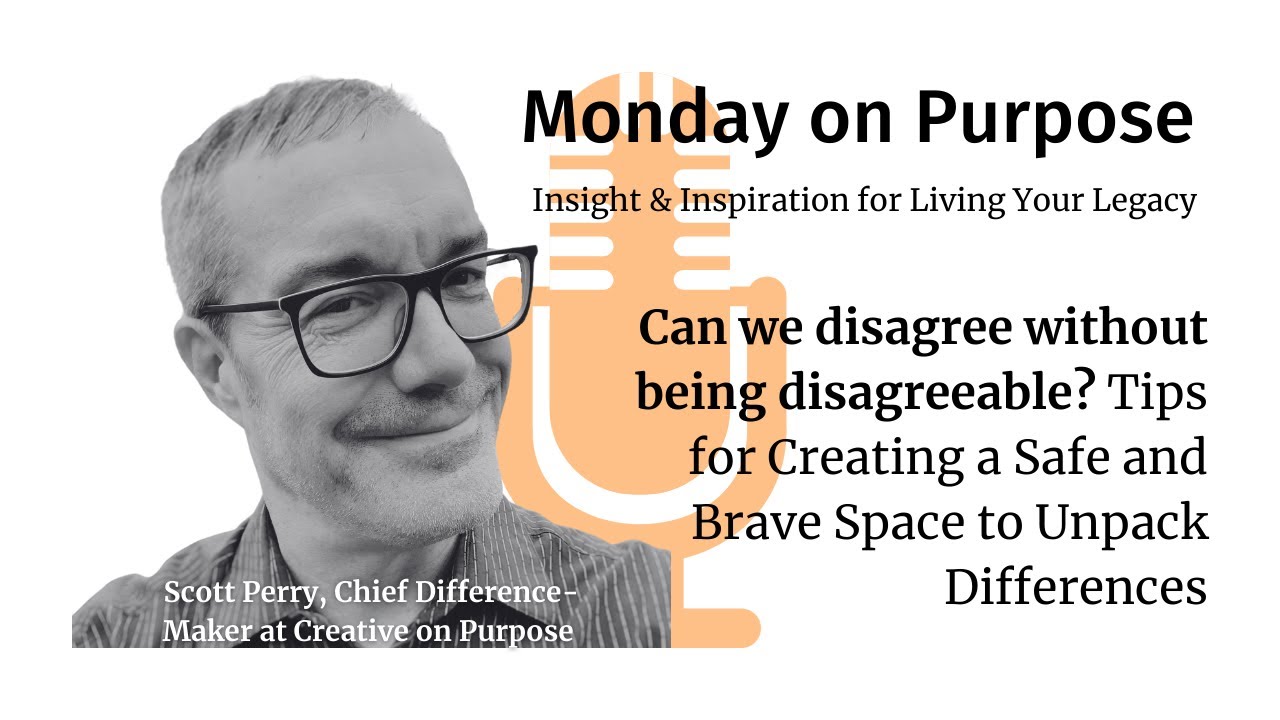
Scott Perry shares five principles for disagreeing without becoming disagreeable: listen and reflect back, pause before reacting, define disagreement in objective terms, keep it impersonal, and speak from personal experience. Modern media turns disagreement into outrage by exploiting tribal instincts, but common ground matters more than identity narratives.
Chapters
Welcome to Monday on Purpose presented by Creative on Purpose Live. I'm your host, Scott Perry, Chief Difference Maker at Creative on Purpose. Every Monday I share a bit of insight and inspiration to help you heed the call of vocation, to find the difference only you can make and live your legacy. Let's get to today's episode. Can we disagree without being disagreeable? Tips for creating a safe and brave space to unpack differences. Turn on the news or scroll through your feed, and you'll soon see that disagreement abounds. Maybe that's because media is in the business of making money, and disagreement sells. But I wonder if there's more to it. We are creatures quite caught up with our identities. We put a lot of stock in appearances, beliefs, and values. Finding disagreement with others' appearance, beliefs, and values is a seductive identity shortcut. Identity is a story we tell ourselves about ourselves and tell ourselves about others. Our political and social institutions leverage differences and disagreements in these identity stories. More often, this is for their gain, not our benefit. Media can be a disagreement catalyst. The stories crafted and shared by the news and social platforms can be very effective at moving us from disagreement to outrage before realizing it. We are tribal by nature, but the media's amplifier ratchets us into the dark corners of tribalism. We don't have to abdicate our authority over the stories we tell ourselves and others to those who benefit from manipulating our identity stories. Whatever distinguishes us from others pales when compared to what we hold in common. Here are a few principles I use to unpack disagreement without being disagreeable. Number 1: Listen. Witness and reflect what you hear. Quote, "Here's what I heard. Did I get that right?" And then ask for more information. Quote, "Is there anything else?" Number 2: Breathe. Don't speak from your emotional gut reactions or your justifying rationalizations. Be kind and speak from the heart. 3. Define the disagreement objectively. Take out the adjectives and adverbs. Don't make it personal. 4. Don't make it personal. Try to name without name-calling. Avoid put-downs and dismissiveness. 5. Speak from your own experience. Use "I" statements. Don't conflate the anecdotal with the universal. Of course, it's harder to practice disagreeing without being disagreeable with hot-button political or social issues than it is to argue over favorite cars or condiments. And of course, disagreement is an invitation you don't have to accept. Practice the art of disagreement judiciously and wisely. How do you disagree without being disagreeable? Are you developing that skill today? Thanks for tuning in to Monday on Purpose. If you like what you heard, check out the blog and other broadcast episodes at creativeonpurpose.com. If you're listening on iTunes, consider leaving a 5-star review, subscribing, and sharing this episode with a friend. Thanks for the difference you make. Let's keep making things better together.