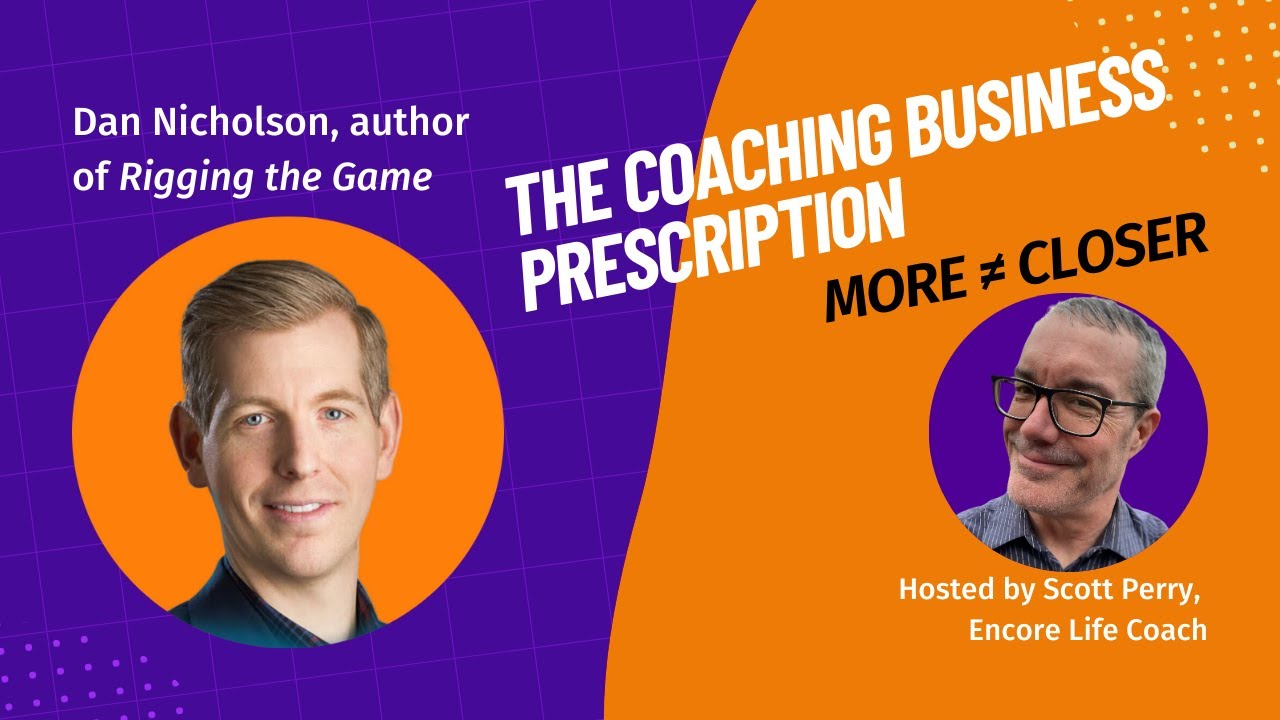
Dan Nicholson explains why chasing more clients and tasks doesn't get you closer to what you actually want. He introduces the Solvable Problem framework, which turns vague goals into concrete targets with dates and dollar values, and argues that investor-style thinking about loss-aversion and quitting strategically matters more than system redesign.
Chapters
Light. And once again, we have landed exactly where we belong. Welcome everyone to a bonus episode of Creative on Purpose Live. This is a series of special discussions I'm having with some of the friends and mentors whose thinking, ideas, principles, and practices informed my new book, The Coaching Business Prescription. I could not be more thrilled to have Dan Nicholson here, who I witnessed launch a book into the world and did my best to steal like an artist from some of the things that he was doing. And just couldn't be more happy to have him here. Dan, please tell our viewers a little bit about who you are, what you're up to these days, and then we'll let people know where they can go to learn more about you and the difference you make.
Yeah, I would say I am, uh, still the cliché kid that I was, uh, many years ago now, uh, scheming on business ideas. So yeah, I was very much a— albeit a very shy kid, uh, always running the numbers in my head and just thinking about the different business opportunities. And, and, uh, I think I was 9 when— this dates me quite a bit— but I was 9 when I was trying to talk my parents into letting me have a paper route. And because I ran the numbers, of course, the numbers when you're like 9, that seem a lot different than when you're in your sophisticated 40s like I am now. I like to just add sophisticated to whatever the age range it is because it makes it, I don't feel, uh, more palatable to me. Uh, so yeah, I was in my sophisticated 30s and now I'm in my sophisticated 40s.
That's awesome. And, and, uh, we've got a link to Dan's book Rigging the Game. I don't know if your ears were ringing earlier today, Dan, but I was on a call with the Creative on Purpose community, uh, earlier this morning, and, uh, there were 6 people on the call, and all 6 of them were in the midst of reading Rigging the Game. So the call was an impromptu book discussion. That's— it's, along with Bumpers, the, the most, uh, recommended book that I'm sharing these days. So highly recommend that, uh, folks check out Rigging the Game. I put a link in the comments wherever you're watching this, and you can, uh, click directly to that website. Then there were several principles, ideas, concepts that I learned from Rigging the Game and from following you and Nick and others online that I wove into my book. Because even though some of them were things I had thought about before or heard about before, the way that you articulate them really turned on some additional lights and opened some additional doors for me. The one that I listed in the unofficial Guardian Academy Facebook group when the question was asked, what principle has influenced you the most? I referenced closer over more. I repurposed closer doesn't equal more because as you can see, well, you can't see it right now, but my less is more sign is in the background. So it was just another frame for looking at that. So I'd love for you to just kick us off by articulating when you say to leverage more over close— I'm sorry, closer over more, what does that mean?
Yeah, I think there's a little bit of context first, if it's okay with you, that I'll share. So I started my career in the capital markets space, uh, derivatives hedging. I'm not going to bore everyone or scare everyone away by getting into the details of that. But what I learned in really playing in the space where there were billions of dollars at stake— one of my clients had over $100 billion in investable assets, they issued a $30 billion special dividend, just to like sort of provide some scale and perspective— and what I realized was that the best traders in that group understood their biases, and they, they spent a lot of time working through just the— what now people generally refer to as mindset, but I would refer to as mental agility. Um, and just a lot of time kind of in particular recognizing that we need to get out of trades faster So there's biases around loss aversion, for example, that really trips a lot of us up, where we, we might buy an investment and it goes down in value, and then we hold on to that because we got to make it back up, not recognizing that we'd be better served to sell that asset and reallocate the resources to something that will get us back to break-even faster. It's also why, uh, if you are someone who gambles, which I consider all business owners to be gamblers of sorts, uh, it's really dangerous when you're at the table because if you start losing money, you want to stay there longer to try to win it back. So there are all these biases, this sort of the moralist story at play, that control us really. We don't want to think about it that way, but we're kind of operating, based off heuristics. And it's called System 1 and System 2 if you wanna kind of do a deep dive into that. And so I mentioned that as kind of framing because we're biologically wired to chase more. And it sort of makes sense when you think about the old wiring that we have. You know, it's, it's not too long ago that we were struggling for basic needs. And some of us might still feel like we're struggling for basic needs, but I mean in the sense of like hunter-gatherer, of we're out foraging, hunting for food, and if we don't capture everything, if we're not incredibly opportunistic, we may not eat. And so we're constantly having to just grab whatever we could. And the way that that kind of plays out now is that We're constantly chasing more, more clients, uh, more businesses. And the danger with that is if we're not clear on what we really want, it might get us further away from the life that we want to live. And I say the biggest risk in life is not living the life that you want. And so, uh, closer versus more is a concept, what I call a commandment, to try to get us to to stop and go, is this action really going to get us closer to the life that we want? And whenever we're operating from a position of I have to do something different, our brain is probably hijacked, our emotions and such have been hijacked, and we should stop, maybe take a nap, maybe go for a walk and come back and go, okay, now that I have some mental clarity, or sobriety, is this really the action I should take to, to get me closer to the life that I want to live? Yeah, I—
it's really interesting because, you know, Nick was on the show, uh, last week and we were talking about function over form. And it, you know, there's so many other ideas that you and me both share in each of your books and each of your work that, that weave into like, you know, just one simple thing. And for the coaching business prescription Um, that's, uh, the reason why that concept was so hap— uh, powerful for me is if you have a business of any kind, uh, you know, there are just a few fundamental things that you have to get right enough to have a business get some traction. And then if you optimize, you know, raise the floor on the efficiency of the least effective part, then you, you will create a a more robust system. But that's not the way that most business owners are wired, and it's definitely not the way most coaching business owners are required. So coaches are notorious, and I am— have been one of them. It's like, my business isn't going as well as I want, so, um, oh, here's Alex Hormozi with another book, I'm gonna buy the book. Here's, um, Russell Brunson telling me I'm just one funnel away, I need to learn how to hack funnels. And so we just keep adding things to our, basically to our to-do list. And we spend most of our time working on all these tactical things, none of which work very well. Um, and, and it pulls us much further away from what we want, because what we want is we want to do more of the work we love, making a difference as a coach, and less of the work we hate, which is marketing, sales, and especially done in the way, that, that it's normally taught. And so when you talk about that context, I'm hearing other things from your book, like the investor's frame, um, and this idea of letting go of sunk costs. So, uh, I'd love to hear your insight as to like, how do we get better at quitting strategically sooner so that we can reallocate those resources and recoup our losses and, and get back into the black much faster.
Yeah, it's a, it's a practice like anything. So I, I reference a lot this quote from W. Edward Deming that says, every system is perfectly designed for the results it gets. And so if you don't like the results, then you have 3 choices. You can be a victim. That's where a lot of us live. I don't recommend it because it just guarantees that you'll maintain the certainty of misery. You can try to change the system— it's difficult and takes time— or you can change your behavior. So if you want to start practicing Closer Over More, then what we're talking about is a behavior change, and that's a, that's a practice that takes, takes time. And first off, I just try to kind of reassure folks that you're not going to get it right all the time. I don't get it right all the time. I have moments where I get spun out. I'm frustrated, angry, whatever the emotions might be— shame, guilt. And so even though I have all these, these principles and stuff, I still experience that pain. So you try to inoculate yourself as much as possible, but the reality is It's gonna happen. So the point of mentioning that is to acknowledge that as a truth, but go, okay, let me measure my performance. So when something bad happened before, I made a decision that I regret— let's just say that, uh, and it didn't get me closer— how long did that spin me out before? Or how long did I stay on that path that wasn't serving me before I caught caught it and reoriented. Let's say that was 6 months. And now if you're down to 3 months, that's a considerable— that's a 50% improvement. And then if a year from now you're down to a week, that's almost a— now that's a like 90% improvement. And eventually you get to maybe catching yourself and a couple hours, right? And so it's a process that we have to continually practice, knowing that we're not going to get 100% score on it. But it's, it's that continually practicing, and eventually you move from it being something that requires a lot of conscious thought to something that feels intuitive. So a lot of entrepreneurs, when they read my book, they go, well, Dan's an accountant, of course he's very linear. But I'm just an accountant by trade. I'm an entrepreneur at heart. I started as a marketing major. I got recruited by the accounting department, and ultimately I got a degree in accounting because what they showed me was there was a disproportionate amount of Fortune 500 CEOs who had accounting degrees. And so, yes, I know a lot about accounting, um, but I'm an entrepreneur at heart. And so I have the very same emotions, irrational moments that anyone else that doesn't have the same sort of like traditional linear degree, same, same, uh, sort of lived experience. So, you know, Dan's, Dan's really linear, so these things will work for him, but it won't work for me. And I only have these tools because I screwed up a bunch and I kept going, why do I feel like I keep getting punched in the face? What am I missing? And so I built this stuff out to counterbalance those biases, irrational moments, playing somebody else's game. Et cetera, et cetera. And now it's intuitive. But that took 15 years. For me, students who go through my CCA program, like a year later, they're like, no, I'm just now really getting it. Okay, well, you're 14 years ahead of me. So you're just now getting in a year, like, amazing. Yeah.
Well, what I, I love that, you know, like so many things, the things that you're teaching in your book and, and this idea of, um, of, of placing closer over more is it's just a skill. It's, it's a, it's a, it's a behavior, a habit. And like any skill, you get better at it through practice, but it also begins with, um, and you, you shared this too, You know, first you have to be aware that something is happening. 95% of our lives are unconscious, subconscious, just repeating thoughts and actions that we did yesterday today. But with practice, we can bring our awareness and our consciousness into the conversation and notice that we're getting caught up in another more over closer moment. And then we can name what we're doing so that we can then treat it as— and now I'm going to weave in one of your other principles— a solvable problem, something that we can, something that we can resolve for ourselves. So, and that's, you know, Laurel Portier introduced me to the solvable problem in, in the way that she has repurposed it for her business. And that probably is the thing that actually helped me turn my business— or not turn it around, but it helped me optimize my business from going from 10 hours, working 10 hours a day, 80% of the time on marketing and sales stuff to working 2 hours a day and spending 80% of my time actually on calls, clients, making a difference. So I'd love, you know, I know that there's the that there's a Dan Nicholson, uh, trademarked intellectual property of the solvable problem, um, and that has to do around financial certainty. But I'd love for you to share that, but also how can, how can that be repurposed for people that are here that want to get closer to the things that they want in life?
Yeah, great, great question. Uh, solvable problem is something I'm very, very passionate about, and I will tell you that myself and 8 other students from our Certified Certainty Advisor program are in the process of writing a solvable problem book where we will read— Laurel's one of them, so there'll be her application to marketing, and there will be applications to real estate, fitness, etc., just taking the concept and showing how it can work in many different domains. So with that as sort of the foreshadowing, uh, years ago I did a, uh, I spoke at a conference with about 300 outsourced CFO providers. And, uh, after I gave my kind of 90-minute presentation, I got, I know, 15, 20 questions that were all the same question. Now, I think you had my mentor Randy Massingale on recently. And he shares that the first principle is always to make sure you properly characterize the problem. Yeah. And I reference that because oftentimes we have, like I said, 20, 20 questions that were phrased differently, but they were all the same question. And how many times are we working on the same thing in 20 different areas of our business? We just haven't recognized that it's the same problem. So I reckon I left and went, wow, everyone is struggling with this same issue where they don't know how to retain their clients. This room of 300 of the best CFOs in the, in the world offering the service to small to medium-sized companies, they don't know how to demonstrate value. And so what's going on there? And what I recognized was that the offers had become commoditized. That the client, the small business owner, isn't an expert in accounting, finance, nor do they have an interest in it. And so they were just told it was something they needed. And that's a dangerous place to be in if you're providing some service, or really, or a product to someone, uh, and they bought it because they were told that they need it, but they don't know how to value it. Incredibly difficult proposition because there's a good chance, a high probability, that because they don't know how to value it, they won't value it at all. They'll come back later and say, 'Why? What did I pay you for again?' And then you feel underappreciated. So many people in that room are like, 'I don't know why they don't value me.' Because they didn't know how to value you from the beginning. And so from that, uh, became through a series of iterations It was originally called the Prophet Priority, and through a series of iterations, it became the Solvable Problem. And I mentioned the series of iterations because I try to reinforce to folks that what you see today was 5, 7, 15 years worth of work. I joke that I'm an overnight success, it just took me 10 to 15 years to get there. So it's been a lot of iteration to get it to, um, to get my concepts to where they are today. And so the Solvable Problem is taking someone's vision board, what they want out of their life, uh, which— and giving it dates and dollar values so that we can actually measure how far we are away from achieving that outcome. And the importance of knowing how far we are away from achieving that outcome is that it becomes a matter of resource allocation. So if I'm on a drive and I, I'm 50 miles away, I can measure, and I need to be there in an hour, then I know, well, I gotta drive at least 50 miles per hour to get there in an hour, right? So, uh, we wanna do the same thing with our goals, with the life that we want to be able to measure. How much effort do we really need to put in? How much risk do we really need to put in to fund the life that we want? And I found that many were going through this exercise of creating vision boards and having more anxiety afterwards because they didn't actually know the resources necessary. So that's sort of the context behind Solvable Problem, is taking what you want out of life, which is not a solvable problem because it's just a bunch of pictures, and it's very abstract, and making it something concrete so we can measure our progress. In my case, as someone who's a tax accounting finance expert, I can now show folks, hey, when I recover $100,000 in resources, here's how much time we collapsed. And now that's much more meaningful to someone when they go, wow, you just took 5 years off of me hitting my goals. I can now— I can conceptualize the value of that. And so Laurel's done the same thing in the marketing side, and you can really do it in any domain, uh, is take something abstract that someone doesn't know how to value, create a structure to help them create value around it so that you can measure the impact of what you're doing towards the ultimate goals. So you've taken the abstract thing that they have— fitness goals, health goals, relationship goals, marketing, advertising, real estate, whatever— make it solvable. So dates, dollar values, and then show them the impact that you're making.
Yeah, well, you touched on something that I, I just want to amplify a little bit, and, and that, uh, most of the time. I, I had this post that did very well on social media where, um, I started off by saying, are, you know, are you one of those coaches that doesn't— that's always saying, why don't my clients listen to me? Why don't they do what I tell them? Um, and basically said maybe it's time to, to look in the mirror because, you know, maybe it's just— it's not that you have shitty clients, you're a shitty coach because that's your job is to help them see what they don't see and get out of their own way and get going. So there's that, that I, you know, I think you were speaking to our kind of default hardwiring and reinforced by biology and evolution to always be looking out the window at the external reason why we're not succeeding, when we would save a lot of time and anguish if we just looked in the mirror and fixed ourselves first. So Really appreciate that. I want to be respectful of your time, and I know that we scheduled a half hour. I have one final question, but if you have an extra minute for a question before the final question—
I do.
Yeah, I would love to— something that you and I had a little back and forth about in an email exchange is something that you learned from Randy. And had— and it really— because I'm a fan of Stoic philosophy, have been since I was very young. You talked a little bit, and this is not in my book and it's not really in your book, but it's something that I know this audience is interested in. How can we be a little bit more Stoic, capital S, about the way that we approach things and a little less Epicurean with a capital E? Meaning in the ancient philosophical sense? And do you have any specific strategy for how you address that?
Yeah, I allude to it, I think, in Rigging the Game with some of my— well, the essence of having an operating system that you follow can lead to being more stoic in the sense that the intention behind the operating system is being very clear about what we're trying to achieve. So we're trying to achieve, uh, funding our solvable problem on our terms without compromise, with the least amount of risk, least amount of effort, most amount of options. I don't say no effort. It's just given all the options, I'm going to choose the one with the least amount of effort. I don't say no risk. Just given all the options, I'm going to choose the one with the least amount of risk. Actually, what I'm personally going to do is try to eliminate all risk. Because then I only have upside. And so having this operating system is intended to create the parameters, and the principles are intended to create the tools or the tactics to help me stay on the path and not get blinded by distract— what, what otherwise I would label as distractions. You mentioned Alex Hormozi's new book, and I signed up on the email list. $100 Million Leads, for those of you that aren't familiar, although most probably have heard about it. And I got the text messages and emails and whatnot and looked on his Amazon page. I definitely had moments of FOMO, and I need to go check that out. Uh, but do I need to be an expert on leads? No. I don't. In fact, there's so many people reading it, consuming it, that now there's a higher probability that I could find somebody else who's more of an expert on leads. So I had to apply the principles of going, hold on, I have this ping, uh, of like, I need to do something. And then I'm thinking to myself, is this going to get me closer No, uh, to what I want. Um, it's a preference. So I'm choosing to, based off my unique skills, to not necessarily be an expert in lead generation. Somebody else could choose to do that, but that's not my preference. So I'm just sort of going down my commandments in the book. And so this is a conversation that I have with myself when I feel this tinge or this ping of like, I gotta do something. Like, let me go through and reason through if this is going to be the best thing for me to choose now, because the next principle is trade-offs. So if I choose to spend time consuming his book and trying to implement it, there's an infinite number of other things that I could have been doing. It's hard to think in terms of infinite because It's the ultimate extreme, right? Um, and so we could think in a smaller quantity. There's 5 other things on my task list. And so if I go down this rabbit hole, I'm not gonna do the other 5 things. And so I'm— so again, it would get me further away. So having a, a toolkit is necessary to maintain, in my opinion, more of a Stoic life. Otherwise, you end up constantly playing somebody else's game, which is the worst position to be in, in my estimation, because you're destined to feel unsatisfied or blow yourself up at some point, or just chase more of that Epicurean lifestyle, which is about the appearances and the, um, more tangible things that you can sort of show off to others. Now, a Stoic can still have those things, right? Absolutely. So people miss that nuance. You still can have those things. The difference is that it does not control you. It does not— it is not the thing necessarily. It's a thing as part of the broader life that you want. So Stoic can still have the, the house and the multiple houses or whatever it may be as part of their, what I would call, solvable problem. But again, it doesn't control them.
Yeah, well, and just, you know, for the kids at home, the Epicureans decided that the reason for being, the purpose of life, is, um, to maximize pleasure, and to— and that the way to do that was to separate yourself from society. And the Stoics' point of The reason for being was virtue, the content of your character, and that it, um, that had to be done out loud and in public with, in full contact with reality. And so what I'm hearing and what you're saying is that, um, you know, one of the, the primary Stoic principles, uh, or one of the core virtues is self-control. You have to have the ability to control your passions, your needs, wants, dreams, and desires, um, and maintain, um, the course towards what it is that you want. That could be political office, or it could be property, or anything else.
That's my daughter speaking of closer versus more. My daughter said that to me today.
So, um, well, I appreciate that. As you know, my grandson is right there in the other room, and so there's many a time when, um, someone's very happy about the green beans that they're eating, and there will be, uh, screams of joy, sometimes screams of refusal, but, uh, we get it. So just in wrapping up, Dan, you've— I mean, your book is a phenomenal read just as a piece of, uh, written work. It teaches some, um, incredible— it's like a little handbook for just how to live a better life by being more clear about who You Are and What You Really Want and gives a strategy for getting there. If there was just, you know, one final takeaway for people that are, you know, on this call that are looking to get a little bit clearer about what their game is and how they can, you know, play that on their own terms without compromise, all in and full out, what final tip or piece of advice would you give them?
I would tell everyone that playing your game is an infinite game, so it will evolve, and so you reserve the right to change your mind. And, and in Western culture in particular, we have so much of our identity tied up in 'I do what I say I'm going to do.' And the problem with extreme statements like that is you end up violating them constantly, and Uh, it eats away at your subconscious. And I give lots of anecdotes about how often we violate the 'I do what I say I'm going to do' concept. And so give yourself permission to change your mind, knowing it's an infinite game. And again, it's a, it's a practice that eventually becomes more intuitive. So you won't reach mastery at this overnight. It takes time and it takes having other resources. I've been working with Randy now for a decade, right? And most of our conversations now are just— we're friends. Uh, but I still try to have that call with him every week because every once in a while there's— there is something that's acute or a little nugget that he mentions. And so it's that practice, constant practice, the sort of sharpening of the saw. So just ultimately, um, get on the path, give yourself permission to change your mind, forgive yourself when you get off the path because it will happen. And nobody benefits from you, uh, punishing yourself. You don't benefit, and the people who care about you or the people who count on you don't benefit either. And unfortunately, we've been conditioned to think that we have to punish ourselves, especially when we're self-employed. There's, there's no one to punish us necessarily. And so Like, well, no one's putting me in timeout, so I'm going to put myself in timeout. And it's completely unnecessary. It's completely unproductive. And, and just forgive yourself, move on, because the game is to constantly recover resources, reallocate it towards getting you closer to what you really want. Yeah, save all that time punishing yourself, recover those resources. And get back on track.
Yeah, I love that. The ultimate goal of an infinite game is to keep playing the game. That's all great advice. Really appreciate that, Dan. We appreciate all of you tuning in for the gift of your time and attention. I hope that some of the insights that Dan shared help you fly a little bit higher and the difference only you can make and help you play your game. You can access a link to Dan's book down below in the comments. There's also a link to the Coaching Business Prescription.. And if you are, happen to be a member of the Guardian Academy or the CCA or the Wolf Den, leave a 6-word update. What's your biggest lesson, aha takeaway from this conversation? And feel free to help spread the word. It really will help more of the right people connect with Dan and the difference he's making. Dan, thank you so much for the gift of your time and sharing your experience and wisdom with us today.
Appreciate you. Thank you.
More from Scott



Stoics Don't Suppress Emotions, They Do This Instead #stoicism #emotionalintelligence #mindset







