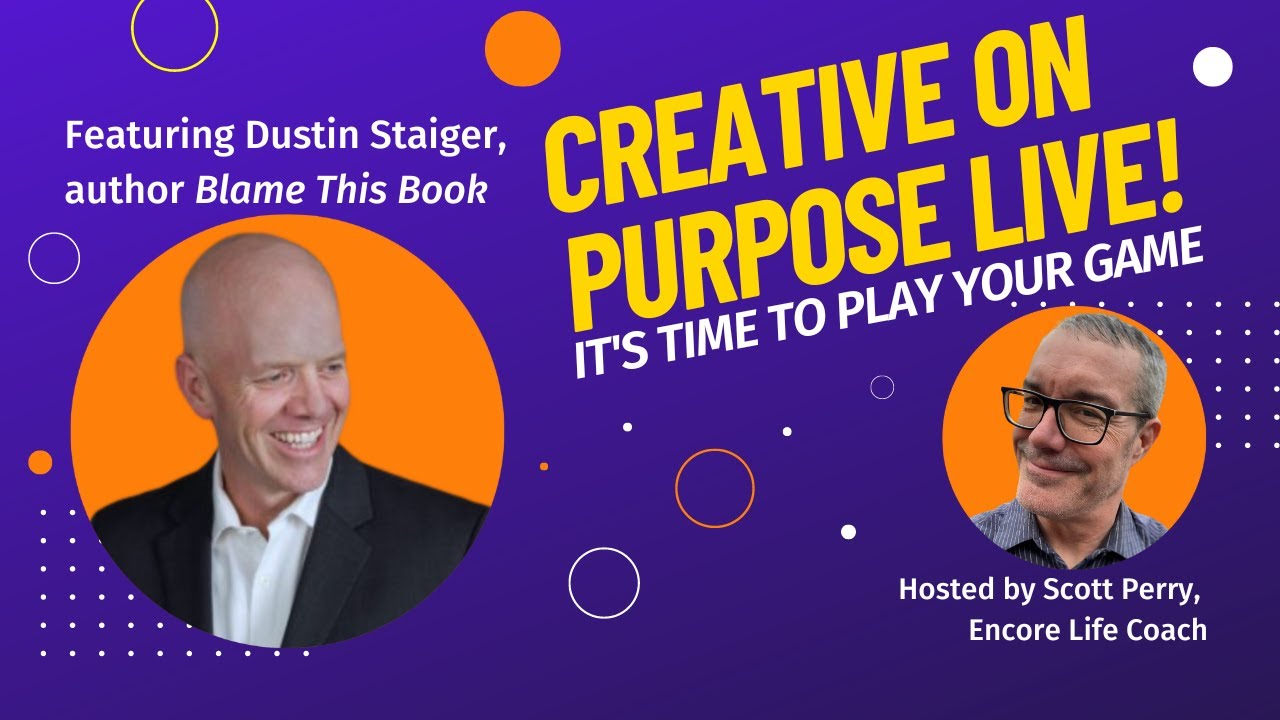
Dustin Staiger, author of Blame This Book, talks about how blame kills creativity and engagement at work. He breaks down the difference between responsibility and accountability, explains blameless post-mortems, and shows how reframing failure as falling instead of failing changes how teams respond to mistakes.
Chapters
Seatbelts, we are zipping across the ether at the speed of bytes. And just like that, here we are. Welcome to Creative on Purpose, conversations about making a better living and a bigger difference by defining, developing, and delivering the difference only you can make. I'm your host, Scott Perry, Encore Life Coach and author of The Art of Encore Living. If you're ready to play your game without compromise, visit creativeonpurpose.com to get started right now. Let's meet today's guest. Dustin, welcome to the broadcast. Please tell our viewers who you are, what you're up to these days, and where can people go to learn more about you and the difference you're making.
Okay, great. Thanks, Scott. Um, yeah, so I'm Dustin Steger, and, uh, I am, um, the owner of The People Brand, which is a branding and marketing agency here in the Dallas, Texas area. And I also am the offer— author of a book called Blame This Book. So yeah, you got your copy as well. And, uh, and so anyway, it's a, uh, it's a book about workplace culture and, um, and specifically about blame, of course, and why we're addicted to blame, uh, why, you know, how it makes our workplaces toxic, and then how we move beyond blame, basically.
So fantastic. Well, it's great to reconnect and have you back on the broadcast. Before we dive into the book, which I'm really interested in unpacking, especially since just last week we had another guest talking about toxicity in the workplace, I'm guessing that little 9-year-old Dustin didn't wake up one day and say, you know what I want to do when I grow up? I want to write a book about toxic work culture. So I'm just curious about your origin story and go back as far as you like.
Sure.
But without taking too much time, just how did you end up doing the work that you're doing right now?
Sure, sure. No, uh, yeah, so I grew up in rural Oklahoma just outside of Tulsa and was always that kid, you know, sitting over in the corner drawing on paper, got the crayons out, you know, just kind of always had that kind of creative bent. Um, you know, everyone always— I had a pencil in my ear all the time, and I had relatives that would keep drawer full of paper that they would let me just go to town on whenever I'd come visit. So always drawing, always just kind of daydreaming, and kind of had that, that creative bent to me. And, uh, and then ended up, you know, pursuing that and went on to, uh, college and studied art. And I was actually a graphic design major with an emphasis in illustration and began my career as an illustrator. And so I did some illustrations for books and magazines and other publications and, you know, kind of started doing that. And then it was a tough road to hoe and after— and kind of a little bit lonely. So after a time I was going around to some different agencies and showing my illustration portfolio and had somebody offer me, say, hey, we can use some of that, but I see also you do some graphic design and So kind of started working in that realm and worked in advertising, worked for a few different agencies, share some of that story in my book as well, 'cause there's like a whole episode of blame that happens right off the bat that is pretty common within the advertising industry. So had my experience with that. And then I ended up working internally on some marketing departments and technology firms.. And then actually got a call. I actually ended up moving into doing some work within a consulting group, and we're kind of the creative arm of that consulting group. And they also did a lot of consulting with oil and gas companies. And this was back in, um, it was— I want to be 2010. And so the, the BP oil spill occurred and they needed someone to come down and help BP on the internal communication side. And, uh, they wanted to tap somebody from that, the creative arm that we had in our department. So they asked me to come down and work on that, and they're like, yeah, this will be like a 4 to 6 week project. And so, um, ended up actually working with BP on that project for, uh, 4 months instead of 4 weeks. And, uh, which was a fascinating experience working with them and with their lead engineering team at the time that you know, they're trying to figure out how to, you know, cap this oil spill that's occurring in the Gulf. And, um, and then actually that, uh, introduced me into, uh, business management consulting. And then when that project was over, they're like, hey, we got another project, but it's not specifically on communications. Can you do this kind of more business management consulting work? I did that for 5 or 6 years and learned a lot from a, like, a project management and consulting aspect, but decided doing this within oil and gas companies just isn't my cup of tea. And ended up going back into marketing. And that's pretty much what led me to where I am today. And in that work with marketing, I ended up doing some partnership with Steelcase, which is the global leader in office furniture. And they had a lot of research that was around creativity in the workplace. In fact, I've got one, if I can point to the right place right here, which is about the physical workplace and how it impacts creativity., and that's some of their research. And I was studying that and helping them kind of put that out there. They're research-led with their marketing, and so that's what we were putting out there. And, uh, realize, hey, this is a message that I am really passionate about. And going back to my roots of, uh, being that, you know, that creative child, and then working with, uh, kind of creative— a creative career as well. It's like, how, you know, what can we do, not just physically in the workplace, but what are some of the other things that we can do to help support and foster an environment where creativity can thrive in organizations. And so that was a catalyst for those thoughts. And then I actually ended up going through Seth Godin's altMBA, which I know you and some of your listeners are probably really familiar with. And then also the Creatives Workshop where you were helping facilitate and you were a coach in that. And so doing the Creatives Workshop, we were working on, hey, there's something that you can, you can create something and ship it every day, right? And so I started writing these little pithy thoughts each day and, and shipping those and then creating an illustration that would go with it each week. And that became— I saw a common thread in that after going through that workshop and looking back on, hey, there's this common thread And there's something around this idea of, you know, creativity in the workplace and how do we support that. And how does— there also, there was also a thread of like blame in there as well. They're starting to look at, okay, what is keeping people from, from being their most creative selves, bringing all of themselves to the work that they're doing and engaging in that? And then what's frustrating leadership as well, that they're looking at how do we get people to become more engaged. 'Cause all these surveys, you know, that research that I go back to with Steelcase was saying, 1/3 of your workforce is engaged, then you're doing pretty well. And it's like, well, that's a pretty sad bar for us to set that, that twice as many people would not be engaged in their work. And you could still say you're doing well. You know, you're at least meeting the standard globally for workplace engagement. And so why aren't they getting that kind of engagement? Why are the employees not feeling like they're fulfilled in their work? And when I was looking at it, it's like, okay, so there is of course this fear, right? And people say fear is keeping you from leading your most creative self, right? And it's like, well, that's not necessarily helpful. How can we dive a little deeper in that? Well, fear of failure, right? When a lot of people say that, and that's also kind of cliché, you're like, well, is that really helpful? Because there's a lot of places where failure happens. And yet they're still highly creative, right? Because of the way they handle that failure. So what's different about some organizations and how they handle failure versus the ones that are suppressing their creativity and how they handle failure as well? And so I looked at, well, it's an issue of blame, right? That people are really afraid of is not necessarily the failure. It's about being blamed for that failure and being saddled with it. And so what does that look like? And that kind of led me down that road of pursuing what became kind of the, the great assertion that I make in my book, which is that blame is, is a big part of why workplaces have become toxic today. It's a big reason why people are frustrated with not being able to find more fulfilling work. And it's a big issue why leaders are having a hard time getting their employees to engage in the work and bringing, you know, creative ideas and innovation to the table. So that leads us to where we are today.
Fantastic. Well, I do recall colliding with you in the Creatives Workshop while I was a head coach there. And that was, we just had Seth on last week. And it was a profound experience for a lot of us on both ends of that. And so what I'm curious about is this idea, and this is something that, that Seth was talking about last week about this idea of, you know, how do we create workplace cultures where creativity is, is actually welcome, where people can step into their power as leaders to make a meaningful change for the better happen. And your assertion is that blame is at the, is kind of the roadblock or the obstacle that's preventing people from, or I guess, preventing 2/3 of the people from showing up fully and being engaged with the work they're doing. So What, where, where does, where does the, where does the healing or, you know, where does the removal of this obstacle begin? Because if, and I don't have a lot of experience working in workplaces other than Kimbo, but you know, what, what's the, what's, you know, where, where do you begin to help organizations start to dismantle this blame culture?
Thanks for that question. I think that one thing to clarify also is that even though this book is really about the workplace, it's beyond that as well. It's like anywhere that you have relationships, and that's pretty much everywhere. There's very few places that we're really fully on an island. Anytime you have a relationship, there's going to be an opportunity for blame to crop up and to create issues. And so I think the place to start, like, if whether you're a leader or you're somebody that is, you know, more of a frontline worker on the org chart, or even if you're somebody that basically is a freelancer or a solopreneur, but you've got these relationships that you're dealing with clients in one way, one capacity or the other, I think the first place to start is to start with some clarity around What is blame? You know, and so I think that's where, when I'm talking to leaders, and I, and I bring up this issue, you can kind of see the wheels turning. And they've got this question that they ask eventually around, OK, well, if I'm not blaming anyone for, for a mistake or a failure, then how am I holding people accountable? And how am I making sure that people are acting responsibly? It's like, okay, well, that's a great question because those are three completely different things. And so when that allows us to bring clarity around that, that basically that blame, as I define it, is resentment that we have toward someone or something that we hold at fault for a misfortune. And so when you view it that way and you want to just shorten that definition, you can say blame is resentment. And so then when you are able to clarify that and see what blame actually is and have that definition, then you realize, then what is the point? What is the point of resentment? And how does that help us accomplish anything, right? How does that help us be more successful in what we're doing? How does it help our organization be more successful? How does it help the people around us do that? And the answer is that it doesn't. And it really doesn't have any place in, in our lives or in our workplace. And so then you look at, okay, responsibility, and it's really about ownership of your own actions. Right? And so I'm going to own what I do. And then accountability is allowing others to hold me accountable for what I do, right? And so there might be some sort of consequences if I don't reach certain goals or something. And that's different than blame. And so when you can look at that, you can see, okay, so then the resentment that's there, that gets in the way. And so when there's a mistake or a failure that occurs and then we focus on the resentment by enacting blame and scapegoating, then that actually becomes a distraction from us actually finding a solution to the problem that occurred. And so that clarity is, is one big thing. And then recognizing, okay, then how do you move beyond that blame? What are some things that you can do? And so I— there's some tools that you can utilize. There's things like using a blameless autopsy or pre-mortem and post-mortem, you know, things that can help you to look at, okay, after a failure has occurred, here are some tools, the post-mortem or blameless autopsy, to look at, you know, what actually occurred, what we were trying to accomplish, and then, you know, why didn't we accomplish that? Why is there a delta between what we, what we were wanting to accomplish and what we actually were able to do. And then, you know, being able to do that and looking at objective facts instead of, you know, having, um, you know, the emotion of resentment getting in the way. And then also, um, being able to use even the premortem that I mentioned earlier, which is looking at, okay, when you start a project, even a creative project that you're starting, to gather the people that are going to be involved, talk about what you're hoping to succeed with the project, what the objective is, And then talking about, okay, bad news, this project failed. You know, all right, and this is before you've even started the project. It was an utter failure, we didn't accomplish anything that we wanted to accomplish. Now I want everyone in the room to talk about why did it fail. And when you're able to discuss that, then you're, you're once again, you're looking at objectively what could occur, and it helps you avoid that failure as well. And so even though that's not necessarily blame-focused, the premortem portion isn't, it helps us avoid you know, a catastrophic failure that could lead to blame as well.
Yeah, I love that. Well, and one of the things that I'm hearing that I think just really resonates is, you know, blame, which you tied to fear, fear of failure. You know, these are all, you know, very emotional type of reactions. And involve a lot of value judgments. And so what I'm hearing is that in order to defuse the human impulse to allow the amygdala to reign and for us to be in reactive mode, emotional mode, value judgment mode, to zoom out, take a step back and look at things a little bit more objectively so that organizations and people in organizations can work the problem instead of allowing the problem to work on them. I'm just curious about the thing that leaps up for me is, you know, I think, for me, blame and shame are kind of kindred spirits in all of, in all relationships and all of life's endeavors. One of the things that I think about is, you know, these are invitations you don't have to accept. And one of the things that that I find is that in working with people that are working in organizations is that the, one of the first blame narratives that has to be addressed is the blame narrative that we have with ourselves. I'm just curious about, you know, are the tools and principles in your book something that can help just, you mentioned solopreneurs, freelancers, can can they work to help us diffuse these narratives that are impeding our progress and preventing us from doing our best work and showing up fully?
Yeah, yeah, absolutely. And there's a lot of application in the book. There's portions of it that's the whole portion that we talk about what blame is when I was talking about defining blame, why we're addicted to it, how if you go back to you know, the origin stories in, um, you know, in, in Genesis and the Judeo-Christian Bible. And then it's also included in the, um, the Jewish Torah, and it's also included in the Muslim Quran, right? That there's this story of, you know, sin entering in, you know, man making a mistake— Adam and Eve make a mistake, right? And then being confronted about it, and then Adam blames Eve Eve blames a snake, right? And so it's not just this whole story of, you know, original sin necessarily in the act that they took of eating forbidden fruit, right? Everyone focuses on that, but what was their response to it? That's what I find really interesting is this failure occurred, right? What was their response? Well, the response was try to blame somebody else in that instance. And so you see that, you see how that's in all of us, right? Whether you're in a corporate environment or if you're a freelancer or solopreneur, you're still dealing with that on an individual basis as well because it's in, it's in all of us, right? That's over, over half of the global population is a follower of one of those three faiths, and that's a core story for each one of those faiths. And so, uh, so there's, there's that aspect and understanding, uh, why we're addicted to blame and what it is. And then, uh, I do talk about, you know, blaming others, which if you're a freelancer or solopreneur, you're going to be working with other people You're kind of creating your own work culture yourself. And so then you have to be very cognizant about that and, and self-aware of it. And then blaming ourselves is another part of what I delve into. And I think especially, I think creatives are people that are going to be extremely susceptible to that because your work becomes very much a part of who you are as a creative endeavor. And so then it becomes very easy to cloud that judgment between, you know, what is the work that I'm producing and what is essential to who I am as a person, right? And so being able to kind of hold that work out a little bit from yourself and understand, you know, what your part is in creating that and the gift that that is, but not necessarily making it a core part of your identity, right? And understanding the separation between, you know, a work failure and you as an individual. And so then there's tools that we're using as well. And so like one example is, uh, I talk about, uh, Dr. Henry Cloud and, uh, who wrote a book called Boundaries that a lot of people know about. When he also wrote a book called Boundaries for Leaders as a follow-up to that. And one of the things that he talks about is, uh, the 3 Ps of failure and how that creates a death spiral for us where when we encounter failure, we start to see it as personal, that, you know, it's something about me, my character that we're talking about, you know, getting that confused. And in like a business failure or a creative project failure, and it labeling me as being a failure. And then it becomes pervasive, and it's like everything I do is a failure all of a sudden. And it becomes permanent, right? So those are the 3 Ps. Permanent is like I'm always going to fail, right? And so then he says, you know, to take that and to start logging those thoughts that come up that reinforce those 3 Ps, and then go through and one by one being able to refute those and realize, hey, you know, this failure really isn't about me personally. There's other things that I've done that, you know, I'm capable of doing. My character, you know, there's areas in my family or whatever that are not failing. And then that also lights up that, oh, I can refute then that it's pervasive because I see these other areas that I'm able to succeed in. And then recognizing, hey, I haven't always been a failure and I haven't— everything that I do doesn't— hasn't failed in the past. And so probably, you know, in reality, when you look at it there, I'm going to, I'm going to encounter success again in the future. So it's not permanent. And being able to look at that and separate yourself from that concept of failure. And also the story of, you know, Simon Sinek, uh, share some of the thoughts that he had around failure as well. And the idea that, um, you know, when somebody fails a— in a big way or a small way, we still call it a failure, even if it's something huge and catastrophic or if it's something very minor. He says it's just like how we talk about cancers, if it's a basic skin cell cancer, basal cell carcinoma that can be easily remedied versus if it's stage 4 pancreatic cancer, we still call all of it cancer, right? And it has that weight to it. And failure has a similar weight. And so he talks about trying to change our language a little bit. And that basically, when you fail, you start to think that you are a failure. And he said, that's wrong. If we look at it as not failing, but we think of it as falling, He's like, if you're running, if you're a runner and all of a sudden you fall, you don't all of a sudden say, well, I'm no longer a runner. Now I'm a faller, you know, and that's all I am, right? We don't do that. And so we should look at failure the same way. It's like falling. We get back up and we start running again. Right? And so those are some of the little tips and stories and some of the, you know, the tools that I offer that talk about you know, things that can apply in the workplace culture or, you know, corporately, or it can apply to the freelancer and the solopreneur as well.
Yeah, I really love that. And I love that you brought up the boundaries because that was really coming up for me around, you know, there's organizationally, there can be boundaries and structure put into place where, like, you know, one of the things that we talked about a lot in the, in the Creatives Workshop was You know, and when you're giving feedback, give feedback on the work. Don't give feedback on the person. Criticize the work. Don't criticize the person. And, and, but in, in some, in, there are workplace cultures where, you know, there's, there, there is, there, there aren't boundaries, aren't consequences for, you know, people that rely on bullying or blaming and all these other things to try to motivate people to, to, to get their work done. So Um, I just, it seems like there's individually what I'm hearing you say is, um, whether we're working for ourselves or contracted work for other people or working with in organizations, we can take responsibility for our narrative. We can take responsibility for establishing the boundaries around, um, what we do allow in and what we don't allow in around, uh, you know, the things that are happening. Then the last thing about all this is I'm just curious about, you know, failure oftentimes has really nothing— you know, we can, you can make the very best decision and execute something perfectly, and it can still fail because other people, circumstances, situations, and so forth are kind of beyond your control. So how does that weave into how we might deal with blame in the workplace and our own blame narratives.
Yeah. So, you know, it reminds me of— I recently heard a podcast where Pete Carroll was talking to Adam Grant, and he was talking about failure. And he discussed how in the Super Bowl he made a call. Right. And, you know, toward the end of the game, game's on the line. Seahawks need to score a touchdown to win. Uh, he calls a pass, um, passing play as they're, you know, near the goal line, right? Which is a little bit unusual in that kind of circumstance. And a short yardage play, typically you're going to run, you know. And so throwing the ball, you, you run the risk of, you know, an interception happening. And that's what occurred, right? And so a lot of criticism came out against him because of that call. And it was really a case of, you know, he said, looking back at it, you know, he said, I still believe in that call. I still think it was the right call. It was just the wrong outcome. And he has this He's a fascinating character and he's got a great outlook on how dealing with his players and even his own issues as well and having grace in those circumstances, but still holding people accountable at the same time, right? And so that's one area where it's like, okay, looking at, did we make, did we have the right data? Did we make the right decision in this situation? But it just turned out to be the wrong result in the end. And that's a hard one sometimes to do the calculus on. Uh, but it's important to look at it as objectively as possible and not just cloud it as if it's a failure, then we did something wrong. It's like you may have had inaccurate data, uh, it may have been circumstances outside your control. And so there's a myriad of, uh, issues that could come into play and not be an issue of you just making the wrong decision in those circumstances. And there's a story that I share in the book of, uh, there's a a company called Twilio that creates tools for software developers. And the CEO of the company, Jeff Lawson, talked about how they got a call and it was from Uber, their biggest client at the time, that said, hey, we're going to cut way back on the work we're doing with you guys. And it, you know, created an issue where when they released that to Wall Street, it lowered their stock value by 40% in one day. So this is a huge issue, right? And so you would rank that as a failure, losing that much money from your biggest client. And so his initial reaction was, who's in charge of the Uber account? Because we need to fire them. And then he had the wisdom to pause for a moment and think about it. It's like, okay, is that the right solution? Do I really understand what happened? Not really. And so he took an objective look at the situation and realized that, um, the person in charge of the Uber account had, I believe, was like 30 other accounts that they are in charge of. And so looking at it, he's like, this, this guy is overwhelmed. We stack them up with so much and they need help. And instead of firing this person, we need to hire more people and allow us to have some dedicated account managers. And so they changed how they operated, and then they were able to— instead of, you know, continuing down that decline, they turned the company around and built it up to fivefold what it was before in a short period of time. And he credited their ability to do what he called a blameless postmortem after these kind of scenarios, right? So that shows where it's something where, you know, did that Uber account manager do anything wrong in that situation? You know, is it a case of making a poor decision in these situations, or is it a systemic issue? And, um, and Edwards Deming said that when, um, there is a variation in performance, that 94% of the time is an issue with processes and systems instead of people, right? And so we have— we need to be able to evaluate that objectively and look at our systems and our processes and see what might be an issue if there's a performance issue that could lead to blame. And in those situations, when, when, when a performance doesn't, you know, get the results that we want, we're more often to be really hard on people. And we're fearful about really criticizing our systems and processes at the same time, because that's a, that seems like a harder issue to fix in our minds. But really, we need to be the opposite. We need to be really hard on the systems and the processes and have more grace with our people.
Yeah, well, it reminds me of another Deming quote where I think it's, "Every system is perfectly designed to get the results that it, that it's getting." And so if you pay attention to the system and, and, and make improvements to the system, increase, increase the efficiency of the, the system, that's the solution. Not, not just kind of, uh, blindly firing and, and hiring people just based on what, what recently happened. And I have to say, I love the Pete Carroll story too, not, not just because I'm a Patriots fan, but Annie Duke was on the show, and she used that example as well. Because in her book about decision-making, she kind of broke it down. And Carroll made the best decision— statistically, he made the best decision and the best decision in terms of putting his team in in play to have an extra play to try to win that game. And he got a bad outcome. So, you know, decisions are not outcomes is, I think, the motto there. So Dustin, our time is winding down. And just the last question is just always to ask my guests to provide one tip, insight, maxim, exercise, practice, something that will help the folks that are tuning in who, like you, would like to make a better living while they're making a bigger difference in the world. What would you share for someone that wants to fly a little bit higher in the difference only they can make?
Yeah, so I think the thing that really comes to mind for me is the idea of the second arrow, right? And so there's a story of Buddha and a student, and he's talking— Buddha is talking to the student, says, when a person is shot with an arrow, does it hurt them? And he asks an obvious question, right? So you're like, what is he getting at? But the student replies, yes, it does. And Buddha says, if this same person is shot with a second arrow, does that hurt them as well? And the person said, yes, it does. And then the Buddha explained, he said, uh, that in life we can't always avoid the first arrow, the first hurt, right, that occurs in life. That we're going to encounter those things no matter what. But we do, uh, have an opportunity with the second arrow. That is our choice, right? And so when somebody around us is hurt right, they've encountered that first arrow, and that first arrow could be a failure of some sort. Then I think one tip for me is to, to have the awareness in that moment to ask yourself, you know, if I'm going to blame them at this point, then am I firing that second arrow? And do I have an opportunity right now to do something different? The opportunity of choice here to instead of choosing that arrow, to choose grace instead. And that doesn't mean that they don't encounter consequences for that failure, but it means that we're not adding insult to injury in that moment by firing that second arrow of blame.
I love it. Choose grace instead. Thanks so much, everyone, for tuning in. Dustin and I really appreciate the time and attention that you're lending to the broadcast. We hope that today's broadcast motivates you to step a little bit more boldly into possibility with the difference only you can make. Now, if you want to keep go, go, go where we're going with defining, developing, and delivering the difference only you can make, please visit creativeonpurpose.com. If you're watching on social media or YouTube, please leave a question or comment and to start the conversation. And if you're listening to this as a podcast, please consider giving us a 5-star rating and review. It helps more of the right people collide with these conversations and the difference my guests are making. Now, take the insight and inspiration from this Show and Play Your Game All In and Full Out. Dustin, thanks so much for your time and for sharing your wisdom and experience with us today.
Thank you, Scott Perry.
More from Scott



Stoics Don't Suppress Emotions, They Do This Instead #stoicism #emotionalintelligence #mindset







