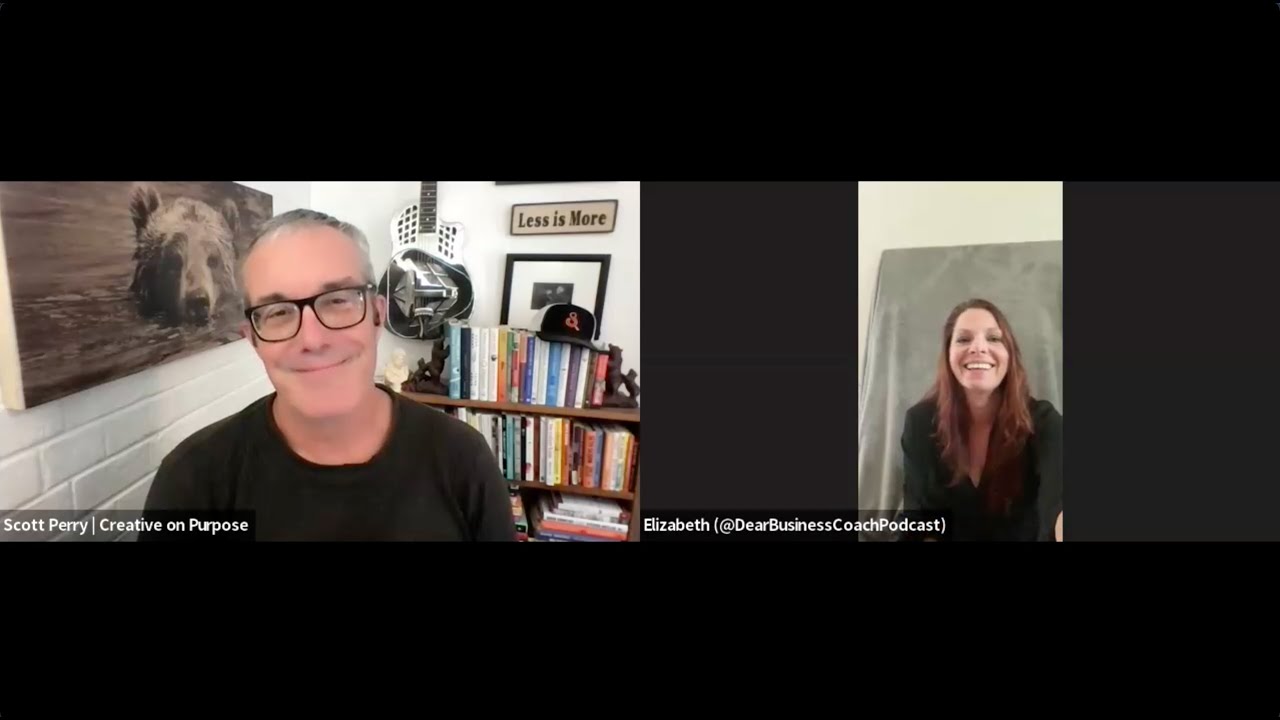
In this interview, Scott Perry speaks with his client Elizabeth Walker, host of the Dear Business Coach podcast and owner of Walker Consulting Works. Elizabeth shares her initial challenge of designing a high‑impact event at the Jefferson Center and her desire to craft an offer that attracts the right people. She chose Scott because his philosophy resonated with her—particularly his emphasis on self‑accountability rather than external enforcement. Throughout their month‑long coaching relationship, Scott’s style of bringing Elizabeth back to focus allowed her to openly discuss obstacles, such as avoiding data analysis, and to develop a repeatable process. The coaching led to concrete lifestyle changes, including dedicating weekly “pool days” to recharge, and a shift toward relationship‑first marketing, leveraging her network instead of costly advertising. This strategic pivot enabled her to allocate resources toward high‑value activities, like a planned trip to New York to meet key contacts. Elizabeth recommends the 50‑minute “Catalyst call” as the entry point for prospective clients, highlighting the value of investing in oneself and aligning business work with personal lifestyle goals.
Chapters
Hey everyone, Scott here with another one of my rockstar clients, Elizabeth. Thanks so much for being willing to share a little bit about your journey and our work together. Why don't we start by having you share a little bit about who you are, what your business is, and what it is that you do?
Yeah, thank you so much. My name is Elizabeth Walker. I'm here in Floyd, Virginia, in the greater Roanoke Valley area, host and producer of the Dear Business Coach podcast and owner and producer at Walker Consulting Works. For business and seminar workshops.
Thank you very much for that, Elizabeth. So tell us a little bit about what was your challenge that you were navigating before we started working together?
Well, originally I came to you specifically to talk about how to create a wonderful experience for my guests. I have an event at the Jefferson Center here in Roanoke, Virginia, in October, and I want to make sure it's the best it possibly can be. So I wanted to get some help from you to talk about how to craft an offer and how to find the right people and where, where to start and what success looks like.
So you decided to reach out to me. We had a Catalyst call. We had a coaching relationship for the past month or so. Why did you decide to go with me over the other choices that you would have had?
Well, highly attracted to your school of thought, I had a chance to learn a lot about you from listening to you speak and paying attention to who you admire and who the authors are that you find value in and the work like that that you choose to bring into your workshops. And specifically, I feel that you would have helped me start making myself accountable to myself. I heard you say before that, you know, a coach is not someone who can make you accountable, right? It's not your coach's job to make you accountable. So I, that's not quite what I mean, but, but close in the sense that in order to, to start formulating a process that would get me to a goal, I needed somebody who I felt could understand, you know, my adventure here a little bit. So I had time to talk with you before we started our actual one-on-one coaching to get a feel of if you would kind of understand where, you know, if you could— when I tell you my priorities, if they would make sense to you. I could tell if I could tell that you really got, you know, what I meant when I shared my priorities with you.
I really appreciate that because you pointed out something that I think is super important. And I don't believe in accountability coaching. I don't— it's not my job to hold you to account. The only person that can do that is the client themselves. And so I really appreciate that that you reflected back that, you know, that's exactly what you felt you were going to get, because that, that is definitely what is on offer. Rather than hold you to account, if the people that come to me, um, and while I only work with people that come to me that are ready to hold themselves accountable for showing up, doing the work, and making meaningful progress to the things that matter to them, um, was there anything in particular about our work together that you found helpful, and why do you think it was so effective?
So part of your coaching style is to bring someone back to focus, or I guess I can speak for myself, right? So I suspected from the beginning that visiting with you each week would be a comfortable place for me to exercise being accountable to myself because I did come to several meetings having not met a goal. You had asked me, you know, to take a look at some data, and I kept coming back to you saying, "Well, I haven't and I don't want to." And so, you know, you and I will still continue to talk about that after our coaching is over. But it was comfortable to be able to sit in that hour with you each week and say why I haven't been looking at that data or what scares me about looking at that data. So being able to be open with you in that way about why are we looking at this data and why does it matter? It's an ongoing conversation. I'm not getting like an open and closed book with you. I'm learning a process.
Well, I really appreciate that. And I, I think it's really important that, you know, coaching relationships shouldn't involve any judgment and they shouldn't, um, encourage any self-judgment. I mean, what happens is what happens, and we're here to sort out what we can learn and what we can do next based on what has happened. So I, I appreciate that reflection and the vulnerability of sharing that. What happened for your business? Since our work together?
Ooh. Well, actually, okay. Does everybody want to know that I have added— well, I started with zero days at the pool and now I'm up to one day every week at the pool, at least 5 hours. And within two weeks, I need to have two days at the pool. So I'm not— staring at my email box all day wondering what to do. Am I doing the right thing? Am I actually achieving anything with the hours that I set on my calendar to do? So that's, that's, I mean, oh my gosh, is that, are we winning the game or what if we can do that? So that's where I am right now. So when I'm actually spending the designated hours in and on my business, I'm talking to the people I want to be talking to, and I don't have a question about that. When I'm having a conversation with someone, I am excited to know about, about their business and if what I have to offer will add excitement, value, and fun to their day and make sure that that's the priority. Um, so, so you told me, uh, the— a couple weeks ago that what I'm doing is optimizing for the quality of relationships. Um, and you're exactly right about that.
Yeah, I love that. I mean, so many people that are like you and me, solopreneurs of one stripe or another, find ourselves actually living to work most of the time. And I love your reflection about pool time because our— the work that we do is supposed to fund the lifestyle that we want to live, not the other way around. And, and so, you know, however people define, you know, success in their lives. That's what your business should be, um, creating for you. So I, I love that reflection. Um, you've already kind of answered the second question, which is about how has your life changed. So congratulations on, uh, pool day a week, and, and I, I am quite positive that you'll achieve that, the, the two, two days a week at the pool very, very soon. So just to wrap up, our, our journey together began when you, uh, you filled out a form and we jumped on a 50-minute call, what I call a catalyst call. Some other coaches might call it a discovery call, but we just, uh, you know, we had a 15-minute chat, and during that 15-minute chat, you decided, decided it was a good idea to go ahead and invest, you know, trust yourself enough to invest in yourself and the work that you want to do and work together. What would you say to anybody that is watching this probably because they're trying to define for themselves, is this Scott Perry character someone that I should consider working with? Should I get on that call? Um, what would you tell them in terms of just, just taking the leap and signing up for the 50-minute Catalyst call?
Well, I have a really good answer for you. Um, so, you know, if you want to talk about money and, um, investing assets and time and Cash even. One of the things that I was looking for and knew that I was going to get out of your coaching was leveraging my network and their network to get to the folks that I really want to spend time with. That not, not because I want to get, you know, a ticket sale out of somebody, but because I want to invite people to my event that I want to meet, that I'm excited to have there because I want to make friends with new, you know, with new professionals that I don't know yet. And so that could look like a very expensive advertising campaign. And so one of the very first structures of building my process, right, is to make some very specific choices about spending dollars or not. On tools and tactics, as we, as we say, and some of them can be valuable. I'm not saying I won't do that. I probably will do a little bit about a little bit of that, but in an educated fashion, building off the network first, building off personal relationships and personal conversations first. So because I did that and because I have a rhythm and a role with that now, instead of a pathway to budgeting for traditional expensive advertising, I now have the budget to go to, uh, New York City for 3 days to meet Clayton Fletcher and Steve Cody at the end of July. So that is happening because I'm not spending money on advertising. I came to your coaching instead.
That's really awesome. Yeah, the recap: we get to decide how we spend all of our valuable resources, and sometimes that's revenue, but sometimes it's time, attention, and effort. And you've done an extraordinary job. It's been such a pleasure to be working with you over the last month, but I know that we remain connected in the Catalyst community and the Substack subscriber community. So just grateful that we'll stay connected there and continue to— I'll continue to be able to follow your progress with your upcoming event, but also, you know, well beyond that. So Elizabeth, thank you so much for your time and for sharing a little bit about your story with us today.