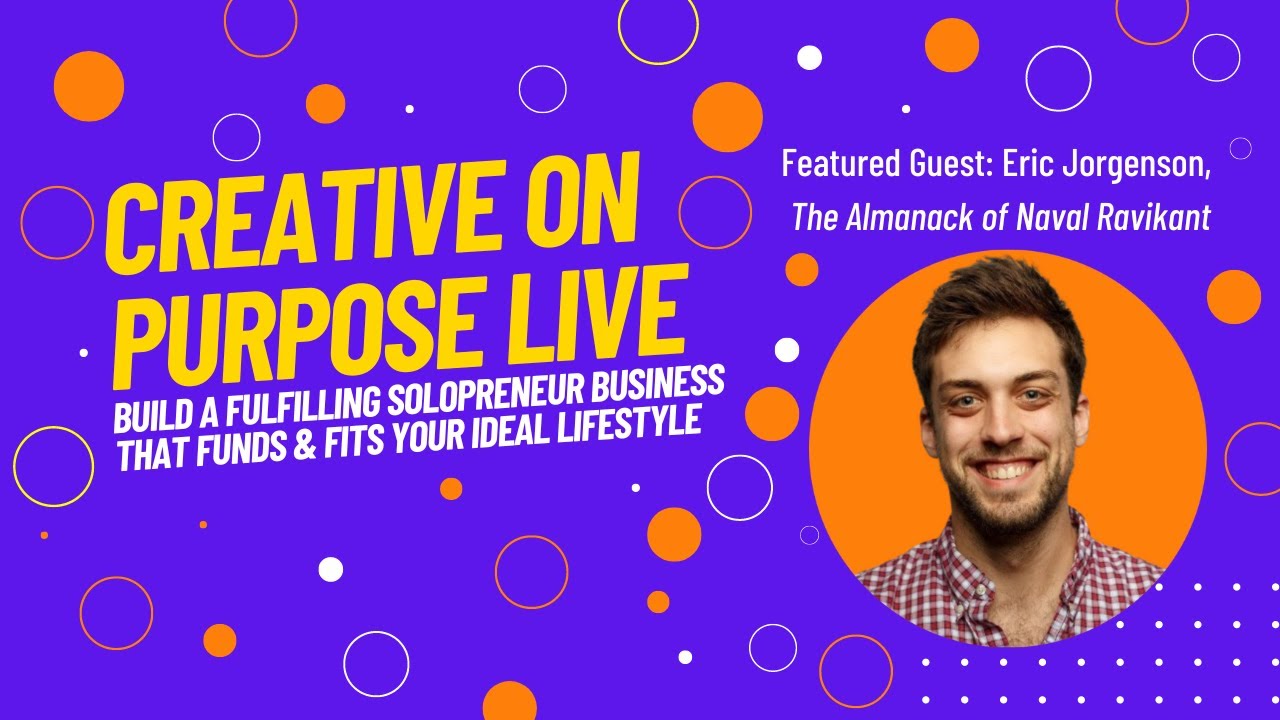
In this interview, host Scott Perry talks with Erik Jorgensen, author of the wildly successful Almanac of Naval Ravikant and CEO of Scribe Media. Erik shares how a spontaneous tweet led to curating Naval’s public wisdom into a best‑selling book, the unexpected path that made him take over Scribe after its bankruptcy, and his philosophy of using books as a force‑multiplier for solopreneurs. He discusses practical focus tactics—using ‘no’ and ‘because’, calendar blocking, and even a cognitive‑boosting drink (Magic Mind)—and stresses the importance of giving proper credit when curating ideas. Erik offers concrete advice on leveraging one’s work, persisting through challenges, and turning a book into a platform that unlocks speaking, media, and consulting opportunities. The conversation blends personal anecdotes, business strategy, and actionable tips for independent entrepreneurs seeking to amplify impact while maintaining a purpose‑driven lifestyle.
Chapters
Hey, oh, look at that. It does look like indeed we are everywhere we're supposed to be. Welcome to Creative on Purpose Live, a show dedicated to helping solopreneurs like you build fulfilling businesses on their terms that fund and fit their ideal lifestyle. I'm your host, Scott Perry, your guide in the Close the Gap 90-Day Solopreneur Success Accelerator. To learn more about the next Close the Gap cohort, You can see the links below this broadcast. Let's meet today's guest, Erik. So excited to meet you. Great to have you here. Please tell our viewers who you are, what you're up to these days, and where can they go to learn more about you and the difference you're making?
Sure. Thanks, Scott, for having me. My name is Erik Jorgensen. I've written two books. I've got a third on the way. I came out of kind of the venture-backed startup world before that. So I've been an investor and operator there. But writing, I wrote the Almanac Naval in 2020, which has been a runaway success beyond my wildest dreams. We've sold 1.5 million copies of that and it's translated into 40 languages. We've given away a few million more copies and that's been, that absolutely set me on the course of like, oh man, I'm going to do this again. So, wrote a second book and I'm working on a third right now actually on Elon Musk, which should be out this coming year. But tho— writing those books led me to actually take over my publisher as it— after it went bankrupt last year. So I am now CEO at Scribe Media on top of, you know, my sort of solo career as a writer and author. And I get to work with a bunch of independent entrepreneurs, coaches, speakers, podcasters in my role at Scribe, which is super, super fun. I get to kind of merge that like creator side and author side and just help other people go through the portal that I went through to become an author, which is great fun.
Yeah. Well, you, you've already kind of leaned into a little bit of, um, what's usually my second question, which is how, how did you come to be doing what you've been doing? I first became aware of you when I stumbled across, uh, a free download of, I think, the audiobook of the, uh, Almanac of Naval Ravikant. And I, I've been a fan and follower of his on, uh, a platform formerly known as Twitter. Uh, and, um, Yeah, it's, it's a fascinating book. And in one of the ecosystems that I spend a lot of time in, the Guardian Academy, which is founded by Nick Peterson and has a bunch of other folks associated with it, including I think Naval's brother is somehow loosely associated with that. It's, it's probably one of the most popular handbooks that gets passed around and shared and recommended in that community. So I find that part of your story really fascinating because you became an author by basically becoming a curator of someone else's tweets. Uh, I don't know what we call them now on the X platform, but, um, and, and you got a sort of an endorsement or an introduction from Tim Ferriss, who never does that kind of thing. Uh, you know, you obviously had some level of access to Naval and, and getting permission for all that. So I'm just curious about like what, what inspired you to reach out to Naval and, and to put together the pro— the, the project? And then, uh, you know, did you have any expectations, uh, for like what you hoped would come of all that and, and, you know, developing that project?
Yeah, I— this is kind of an interesting, like, unconventional story because I did— I had no access to Naval, nothing. I had no, like, special advantage. I just I tweeted this idea for a book that I had, which is, you know, I've been following Naval for 10 years and I've been like tweeting and blogging for 10 years and it just sort of struck me, you know, some of my very favorite books are compilations. You know, I don't know if you're a Warren Buffett or Charlie Munger guy, but like all they really do is write letters and have annual meetings. So aside from that, all the books about them are other people sort of collecting their wisdom and curating it and organizing it. And that's true of a lot of great thinkers. They shared in their format and then somebody else wrote a book or collected a book. And so it just struck me like I had learned so much from Naval over the years. I wanted a project to basically encapsulate that for myself, and I wanted his knowledge to live on in a format that's a little more Lindy, a little more long-term, a little more broadly accessible than just Twitter and podcasts, which are so kind of ephemeral and disappear almost as soon as they're created. So that was the original vision. And I just tweeted this idea and said, should I do this or not? And I went to bed thinking nothing of it. And I woke up and found that Naval had retweeted it and 5,000 people were like, oh my God, yes, please do it. And he said, I'll provide whatever you need, which wasn't a ton. It's not like I followed him around for months. I just used almost like everything that's in that book is public. It's all pulled exactly from public sources, directly from, you know, his phrases. And, um, it was hundreds of sources. Like, it's not like I just like put a tweet on each page and said, here you go. It was thousands of hours of work over multiple years to like get it where we got it. But I think, um, you know, I do think, and it's been proven true, like my wildest dreams for this were a few thousand people would maybe read it who were already fans of Noel. I cannot believe that we're, you know, a million copies in 40 languages. It's absolutely wild to me how far this book has gone and how many people it seems to resonate with.
Yeah, I want to get to the second half of that journey too, which is, sounds like, again, without any agenda or expectations, it led to other opportunities. But I would also like to very organically interject a plug for one of, one of my favorite new products. And I want to lead into that by just asking you, Eric, You know, in a world where we are getting, you know, prone to distraction because of all the things available on the internet, social media, etc., not to mention just the things that go on in our day-to-day lives. And being someone that sounds to me like a fairly purpose-driven type of individual, how do you go about making sure that you kind of limit the distractions, maintain your focus, and and put yourself into an opportunity to experience more flow in the day-to-day of your work?
I would not say I'm particularly good at that. Like, it's a skill that I would very much like to continue to improve. I think the two things that are most useful is probably like just do not disturb mode, like throw, or even better, like throw your phone in the ocean. But like finding ways to eliminate and break the patterns of like, that you have to just seek cheap dopamine on Twitter or Instagram or whatever your drug of choice is. And the other is I am not great at saying no. Like, I really want to be generous with my time and my, like, whatever wisdom I have to share. And I want to answer every email and I want to take every meeting and I want to, and I have to, like, it weighs so heavily on me to say no to some things that I have to, like, outsource the nos. And so I, like, trying to train my EA through Athena to like say no, say no proactively when he knows that I should say no, but don't have like, don't have the heart to do it. Or at least like I will just sit there and stare at it for a month instead of actually just saying no right away and just feel bad about it for a month and then eventually come to my senses. So those are probably the two things that I'm most either have proven effective or that I'm working towards in terms of like protecting that kind of creative time. Because I do think that's important. Trying to calendar block, you know, signing out of Slack when you need to get some deep, deep work done. Using the right playlist, sticking with the, like, you know, stuff of that, some of that stuff. It's basic stuff, but if you do it every time, you start to condition yourself to it.
Yeah, well, I love that share because I think two of the most powerful words in the English language, especially for someone that's an entrepreneur or solopreneur, are "no" and "because." And, you know, sometimes you have to combine those two things to get over your own feelings of shame and guilt about, you know, generosity and that sort of thing. It's something that I definitely practice. I've also been recently partnered up with the fine folks at Magic Mind, and I'm using this little mindfulness shot that they've created. It's called a mental performance shot. I've been a longtime user of, you know, a 10-in-1 mushroom blend that has helped kind of create some cognitive clarity. But in addition to that, what I find with Magic Mind, just because of their kind of signature time-release dose injection, it lasts longer. I take it first thing in the morning because my window of productivity is between 5:00 a.m. and 7:00 a.m. And so if I do it first thing, it maintains— I have that clear, undistracted, focused flow state where I can get everything I need to get done in my business in that 2 hours. And then I get to spend the rest of the day with my grandson, which is not a bad way to be. So yeah, so—
And it's delicious.
And it's delicious. It actually is.
This is full of Magic Mind. You think it's coffee, but it's not. I just, I buy cases at a time and I just fill up my coffee thermos with Magic Mind. I don't know what the recommended dose is, but I think it's a little bit smaller than that.
But, um, yeah, I mean, what I'd love to sort it out, they, um, the reason that they hooked me was they said I didn't have to give up my coffee. I could drink, you know, do this alongside my, my morning coffee, and, and it doesn't give me any of the jitters that I would get from like a power drink or anything like that. So, well, that's— I'd love to learn more about this. One of the things that I find, and I'd love to hear you speak to this from your experience and maybe, you know, people in your network and in your world, people that are kind of purpose-driven entrepreneurs, solopreneurs, we set a point on the horizon, we start to, you know, craft the path and have a daily discipline of small steps that we're taking into possibility every day toward that thing. And then time and randomness do their thing. And sometimes there are obstacles that we could never have anticipated. And sometimes there's opportunities that come across that we never could have anticipated. And it requires us to do some course-correcting or rethinking or recalibrating. And what I find is that people often never don't get exactly where they thought they would when they, you know, put that point on the horizon as a 5- or 10-year plan, or even a 1- or 3-year plan. But they always end up somewhere great just because they're present and paying attention to these obstacles and opportunities, you know. And sometimes obstacles are just opportunities in disguise, and sometimes the opposite is true. So I'm— what I'm hearing and what you shared earlier is you didn't really intend to become a CEO of a publishing house, but somehow that opportunity came about. Tell us a little bit about that and, and, you know, what are your thoughts about how you're thinking about where do you want to be a year, 3, 5, 10 years from now?
Yeah, it's, it's such a funny thing. Like, this is a crazy story, like sort of how I ended up becoming a CEO of, of this company. Um, and it is a, it is both a testament to like I think exactly what you said, the spotting opportunity where others only see problems. Um, and, and just like, you never know where each step is going to take you. Like, I try to position myself to always just like play long-term games and do something that I'm going to be happy doing for the rest of my life, because that's how you like compound that experience in those relationships. But sometimes happy surprises, um, occur, and even happy surprises that look like tragedies. So, um, to set the scene, like, Scribe as a company is about 10 years old. It was founded in 2014 by Tucker Max and Zak Obrahm, and they built a great company. They started sort of answering questions. I mean, Tucker was a famous author at this point. He started getting questions from his friends about how to write books and how to publish books and how to make their books successful. And so he built a company around solving those problems for authors. And especially 10 years ago, I think it was a pretty visionary thing because he saw that the traditional publishers, very set way of doing things that was right for a small handful of people, But writing a book can benefit millions of people. Like, everybody has a story. So many people dream of writing a book, and— but it's complicated, it's hard, it's confusing. You probably do it once in your life, maybe a few times. And so you need somebody who's like done it a few thousand times to help and guide you through. And so rather than say, you know, we're a super elitist publishing house, we only work with a few people, Tucker said, we will help anybody who wants to publish a book publish a book at an extremely high level of professionalism and quality and polish. And instead of like taking control of the financial instrument of the book and owning the copyright, you just pay us for our work. Like we're experts and professionals in the world of publishing. Pay us for our work, we'll do the work. You own the rights, you own the royalties, you do whatever you want with your book, which for so many entrepreneurs, speakers, coaches, executives in particular, like they want to use their book for their own purposes or to build their business. They don't care how many copies they sell. They're not trying to, you know, become James Patterson. They just want to have a book to help them, you know, own their market, raise their credibility, become an authority in a field. And the traditional publishers don't want to mess with those kind of books. And so that's what Scribe does. I thought it was the right path for me publishing the Almanac and Evolve. So it's— I was a customer of Scribe, you know, in 2020 and again in 2023 when Tucker and Zach had stepped back. They left the company and the sort of CEO who took over in the interim, to put it gently, like, it did not do a good job and sort of hid the fact that the company was not doing well. One thing led to another and there was like a very surprising bankruptcy where a bunch of people got laid off and a bunch of authors who prepaid for work didn't get their work. It was a very messy thing. The bank came and like foreclosed on the company. But as an author, I knew I knew how good Scribe was. I knew that this was my path to publishing books. I knew that the team was incredible and the product was wonderful. And so I started making phone calls and I found somebody to, who had some experience working with distressed companies and bankruptcies and who was a long-term sort of good steward of businesses to come in. And what they essentially did was buy the IP from the bank and hire over some of the veteran team members, start a new business. And eventually, to my surprise, like hired me, um, to, to join as CEO. So that was definitely, uh, more than I bargained for. I was hoping to just like keep the company going so that I could keep publishing books with them, um, but now I get to sort of see it from the inside and help other authors. I've always been an advocate and a fan of the business, so, um, I get to do that professionally now. So it slowed my writing schedule down a little bit, but, um, it's a very fulfilling thing, and I'm learning a ton about publishing, and I'm super excited for for the future of Scribe and where we're headed next. I mean, a year and a half into that now, that was summer of 2023.
Really, really interesting. Am I right in remembering that Ryan Holiday got his start kind of with Tucker Max, or maybe that was after the Robert Greene thing?
I think they worked together on, I think like Ryan did some of the, his earliest marketing, like freelancing with some of Tucker's books. Yeah, that sounds familiar.
Okay. Yeah. Just the name and the story is a little bit familiar.
Yeah. Well, they're both in Austin too, kind of that Texas area.
Everybody's in Austin, right? Like you have to be, if you're going to be a famous entrepreneur, you have to be in Austin.
That's at least if you have a podcast. Yeah. As soon as you, um, well, the other, the flip side of all this.
So I think that's really fascinating and I love, I mean, it seems like as the CEO of a publish publication house. You know, you've accomplished something that is really important to anybody that is putting any kind of cause, idea, product, or service in the world, which is you have a distribution channel now. Like, distribution is really an important thing. It sounds very different from this other— well, it doesn't sound very different, but it's not the usual path for someone like you that I'm guessing identifies a little bit more as an author than as a CEO type. And I'm curious about, you know, what's the, how has that kind of dual relationship, you know, CEO and author, how has each informed the other? But also, you know, your first book was a curated collection collection of somebody else's words. My guess is that subsequent books have been more, um, about what you have to, what you have to offer and what you're sharing and, and, you know, what you want to put forth in the world. And I'm just curious about that kind of transition from the, the Almanac of Naval into your second book, into your third book, and how you're thinking about your, your next book.
Yeah, I think the, um, it's, it is kind of funny because I always identified myself more as an entrepreneur than an author. Like, the author feels like the accidental part. You know, it just happens that, like, of all the projects, products, companies that I've started, like, a book happens to currently be the most successful. And so I'm, like, more known as an author than an entrepreneur. But I always sort of studied business. I was, you know, early in startups and, like, trying to start companies. I'm also, like, a investor techno utopian nut job. So like the entrepreneur, the tech entrepreneur, like part of my heart is also planted very deep. I just love books, always have. And I love now that I've sort of had an experience writing a few, I'm like, I find that deeply rewarding. Like it's so fun to work on something that you know is gonna have such a long shelf life and can reach so many people. And I just find it, I love podcasting, I like tweeting, but I find it so much more fulfilling to work on something that has like a really long shelf life. The second book actually, and the third are like, I feel like I really stumbled into an incredible secret with how the Almanac and Naval works. Like there is, I'm so excited to like highlight people that I think are brilliant and sharing useful ideas. And I have no I have no imposter syndrome about like my role as an author or editor because I, I believe so deeply in like what Naval has said and like the package of ideas that we have put together there. So I don't have a like, I'm not trying to be like, here are my ideas. Like I just recognize genius over there and I want as many people as possible to sort of access that genius. And that's how I felt. Um, the second book is the Anthology of Pathology, similar thing. Like I think that person is brilliant. Here are all of the ideas that I think are most useful that you can apply to your own life. And it's gonna be the same. So it's the same format as the Almanac of All. And the same going into the third is the book of Elon Musk, which will be out next year. And it's, I'm not writing about them. I'm not trying to create a biography. I'm not trying to say what I think about them. I'm out of the way. All I'm doing is like collecting what I think are their most useful evergreen important ideas that readers can, take and apply and use in their own life to grow their business or improve their lives or just have a happier sort of internal state. Like, all of this feels like service to the reader and that's like where I come to it from. I can imagine writing a lot of different kinds of books over the years. Like, I've got, you know, I've got a huge, just like I've got my entrepreneur list of companies to start and I got my author list of books I wanna write and both keep getting longer, way faster than I write and/or start companies. But so who knows what I'll do in the future? No set plans on book 4, but I love the medium and I'll, especially now that I've got some additional leverage in the publishing house, I will certainly keep chipping away at whatever the next best idea is that I think I can do.
Yeah. I love the intentionality and the motivation. I just, released a book on Thanksgiving Day that is essentially repurposing wisdom that I've gleaned directly from mentors like Seth Godin and Nick Peterson and Laurel Portier and Randy Massengale and many other people who have all informed a process that I have used and I teach other people for crafting a solopreneur business. That actually funds and fits your lifestyle instead of becoming one of those solopreneurs that works 10 hours a day so they can earn part-time wages, um, and basically become a slave to their, to the job that they started to, to create more freedom in their life. So, you know, I think I love the transparency of your approach too. Like, you know, because so many people will try to repurpose other ideas without giving credit and just, you know, passing them off as some sort of new thing. And I think there's real power, and you create authority loops by fully giving credit to everybody that, you know, inspired any given principle or concept or idea or exercise practice. It's, I think it, it, it really helps elevate you as an author.
It's important. It, like, I don't don't do it to elevate me as an author. I think it's important for the— to give the ideas the credibility they deserve, right? Like, I could have— I could have taken all of Naval's ideas and written a book not acknowledging him or any— like, and nobody would have cared because, like, right, the ideas could be the same, but they're not in the context of, like, here's this person who came to the US as an immigrant at age 10 with a single parent household, and now he's like certainly 9 figures, if not a billionaire, and successful and happy and still an independent thinker and widely followed. Like, the credibility, the credit of the ideas is what gives the ideas merit. Like, we listen to the wise, successful elders because they are wise, successful, and elder. Like, that's, um, it doesn't do any good to steal credit, steal ideas, take anything out of the proper context. Um, I just, you know, I just want to facilitate these ideas reaching more people because they had helped me. And I think that's, you know, to your point, I think there's a paradox there of like the success of the book then led to a lot of opportunities for me that I would not have had otherwise if the book had only sold 500 copies. But that's just getting out of the way and being as honest and straightforward with, you know, the intentions and the project as you possibly can.
Yeah, no, I, I'm totally on board. I think, uh, um, it's, it's, it's vital to give credit where credit is due. And, you know, a lot of the things that, that people like Elon or Naval or Seth Godin or Nick— I mean, they come from other sort, you know, they're repurposed information and insight from other sources as well. Uh, but it, it's that those, um those sphere, circles of network and influence and inspiration, it just really creates more, more leverage. The ideas have more credence because it's not just you, the unknown person that may or may not have the success that you claim to have. It's, you can point to people that have actually done incredible things leveraging those principles and practices.
I think it's very important to learn to separate like learning from practitioners, from learning from expert information presenters. Like the lines are a lot blurry and it's because one side is very intentionally blurring the lines. So like before you follow somebody or get too deep in their content, like just, you know, it's not like everybody who makes their money and makes their living selling media and creating media is a bad person, but like you really want to know whether someone is speculating based on like other things they've learned or absorbed from somebody else, or whether they truly like learned the lesson with a scar in their own body firsthand, and then they're sharing it with you. And the closer you can get to like learning it yourself or learning it directly from the person who learned the lesson, you know, through autobiographies, through, you know, direct, you know, like Elon Musk learned those lessons the hard way. Naval learned those lessons the hard way. Even on social, you know, there's people who like, uh, Austin Allred is a great example, like current CEO and founder also happens to spend a lot of time on Twitter and go on some podcasts, but he's not a professional creator who makes most of his money from just professional creating and never had a startup, you know, grow or be successful or get funded. And like, those are blurry lines. You've gotta really, you gotta really be careful, especially I think in the solo entrepreneur space. Like a lot of people making money only by selling you the secrets of how they make money off of you. There was no other thing that they did that was successful that was hard-won lessons first.
Yeah, no, very well said. And you know, the online space has only made it easier for self-proclaimed gurus and digital marketers to just repackage other people's information or intellectual property, um, and, and sell it as a product or a service, um, and benefit from it. Well, as we're kind of wrapping up here, I'd love to, you know, the audience for this show are more of those independent entrepreneurial types, people that might self-identify as independent business owners or solopreneurs. Some of them are people that have a cause or an idea that they want to spread, and some of them have products and services. But, you know, gleaning whatever from any of the sources that you're writing about and have access to, or your own personal experience, what is, what is one piece of advice that you would give someone that's in, in the grind right now? Most of the folks that tune in actually have a solopreneur enterprise that they really are desperately trying to optimize, as opposed to people that are just getting started. And for someone that is seeking that, uh, you know, that is pursuing that desire for greater effectiveness and efficiency in what they're doing so that they can actually use it to fund the lifestyle that they want outside of the business, is there any particular piece of, uh, insight or advice or inspiration that you would have to share?
Yeah, I mean, one that you're gonna hear from everybody is like, just don't quit. Like, even if you don't get a lot done that day, if all you did that day was just not quit, that's a day well spent. That may be the only thing that matters about today when you look back on it 10 years from now. I think learning to think in terms of leverage was like a real key unlock for me personally. That was part of me writing the book and just learning to sort of see your career and your business, your projects, your life in terms of like how much leverage are you accumulating? Are you actually compounding? Are you moving forward? Are you increasing the total sort of effective capacity of like your little corner of the world? I've written a ton about that. I've got a few podcast episodes about it. The first ideas are in the Book of Naval, but I spent a lot of time expanding on it. And then one that I don't know, like this is just in my wheelhouse, so I don't know if you'll hear it from other people, but I spend all day every day having these conversations. A book can do tremendous things to unlock opportunities for you. It is long and expensive and high effort to write a book, but that's what makes it a good credential. If you write a great book, it is a tailwind to everything else you ever do. It will set you apart from your peers, competitors. You will get yourself invited to conferences, invited on podcasts, invited to speak. Like you will gain media as a result of it. I am so often shocked at how much sort of surface area for luck that creates and how good— I mean, like the number of people who tell me this is the greatest marketing ROI they've ever seen in their life was like writing and publishing their book just because it's a multiplier effect on everything else that you do. So that is what Scribe does. We've done it for a whole handful of people. And I'm happy to— like, there's a bunch of— there's a lot to talk about in there, whether you want to— like, how do I write the book in the first place? What are my options for that? All right, I have a manuscript, now I want to get it published. What are my options for that? And then what do I do with the book once it's completed? How do I make it work for me once it's out there? So those are all three kind of different conversations with different levels of nuance depending on like where you are, what business you're trying to build, what the trade-offs are that you want to make. But that is a, is a journey worth going on. Like, certainly from my personal perspective and from all that I've seen in my role at Scribe.
Yeah, I love that. Well, I love that you mentioned leverage. It's a very important part of the, what you share in the Almanac of Naval Ravikant. And, um, I couldn't agree more that the process of writing a book is the biggest force multiplier to you gaining greater clarity in, and confidence in whatever process or concept you're trying to share. Writing, writing clarifies faster and more deeply than any, any other thing that I've, that I've ever done, especially if the writing comes after you've done some implementation of the ideas and principles that you're writing about.
Once you find yourself having the same conversation, like dozens of times, and you find people responding really well to it, and you have feedback from people that in real life you have, you know, coached or trained or taught or just helped go through something like that is, that is a sign that you are heading down the right track. Um, especially if you're ready to, if you're struggling to kind of break out of that one-to-one relationship between like meeting new clients, like how do you sell without selling? How do you spend 5 to 10 hours of quality time with every potential customer or prospective lead? Like that's an impossible problem unless you create something in a format that they can sort of quietly consume on their own. And then, you know, they'll be reaching out to you with full trust, excitement, understanding of what you do, how you do it, why you do it. Um, and you won't have to sell them. They'll just— they'll— they will have chosen to pick up the phone, call you, and hire you as a result of spending time with all of your ideas. So you put your best self in that book, don't hold anything back, and see how the world responds.
I love that. I just want to highlight that because that is a really crucial insight. Nobody is going to buy your signature framework or brand-new product or service because it's, it's uncertain, it's new. People don't chase after— most people don't chase after something just because it's new. Most people make a purchasing decision or adopt an idea or process because it's become information to them. That they can then understand and implement. So that, that element of creating a book that turns your innovative ideas or process into information so that the right people can actually decide for themselves to take that next step.
Even solve, like, solve their problem. Just solve their problem as, as directly as you can in their book. Like, if somebody can spend $20 on your book, and solve a problem that is to them worth hundreds or thousands of dollars, like, one, you've done an incredible thing. Two, they are never going to forget you. They're going to recommend it to everybody. They're going to have it in their head so that whenever it comes up in the future, they'll recommend their book or you, or the next time the problem comes up again, they'll hire you or they'll consult you or they'll want to repay the favor that you've done them. It is an incredible like, you know, I think books are the product with the highest consumer surplus imaginable. Like when you can get 10 years or 40 years of somebody's wisdom for $20, what a trade, what a bargain.
Yeah, for sure. Well, that's really great advice. I want to thank Eric for being here and for all of you for tuning in. Of course, we appreciate the gift of your time and attention and hope that today's broadcast motivates you to take a bolder step into your potential and possibility. If you are interested in joining me in a 14-day Magic Mind Challenge, you can go to magicmind.com, enter the coupon code COP20, and get a 48% discount on your first subscription or 20% discount on a one-time purchase. I'm really, I'm really liking my experience with this product. More focus, more clarity, less distraction, more flow. It's really helping me, it's been a force multiplier, adding leverage to my journey. So I appreciate anyone that wants to join me in this little adventure. If you're ready to keep go-go-going with defining, developing and delivering the difference only you can make, you can go to creativarupurpose.com and grab a free flowchart and process guide, no opt-in required. And if you're watching on social media, YouTube, please drop a comment, drop a question, let us know. What your biggest takeaway from this episode was. And if you're tuning in on the podcast, please give us a 5-star rating and review this episode. It really helps more of the right people collide with and benefit from this content. Eric, it's been absolutely a privilege and a pleasure to spend this time with you. Thank you so much for sharing your wisdom and insight with us today.
Appreciate you having me.
More from Scott



Stoics Don't Suppress Emotions, They Do This Instead #stoicism #emotionalintelligence #mindset







