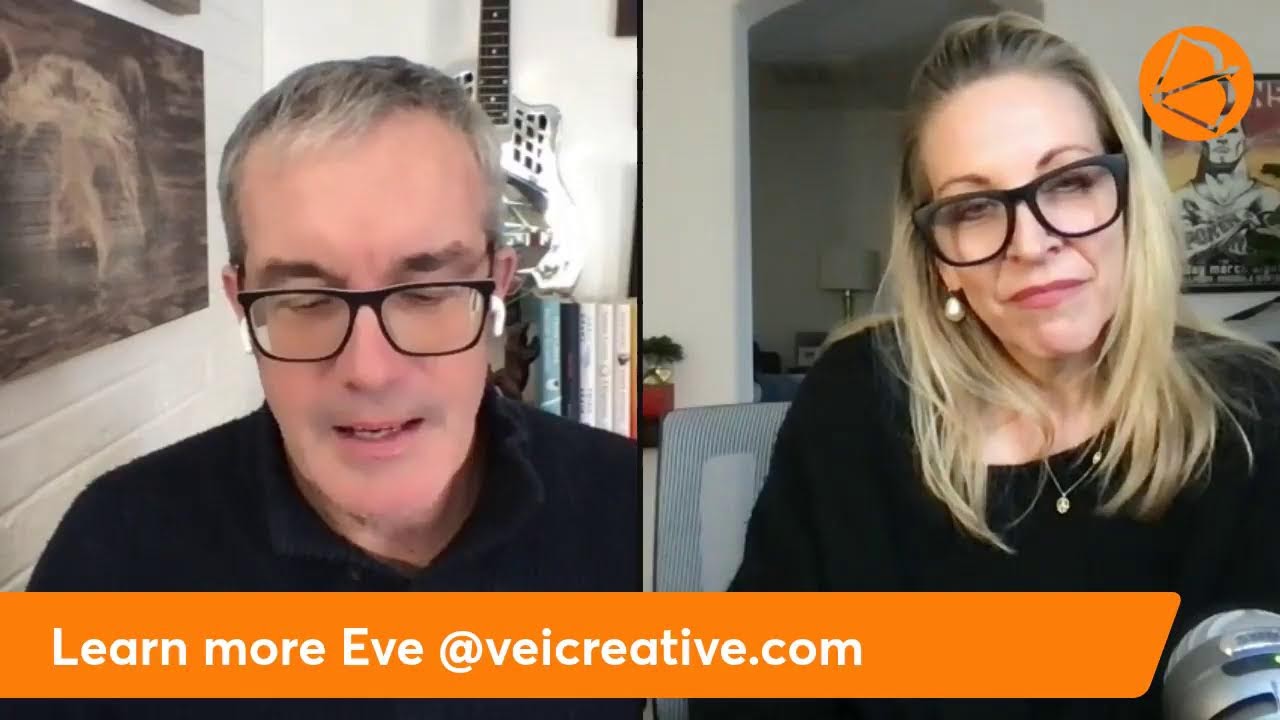
Eve Whitaker, a former broadcast journalist, built her marketing agency around AI tools like custom GPTs and generative engine optimization. She shares a three-step prompt framework for beginners and says AI can cut marketing time by 80%, freeing solopreneurs to focus on their core work.
Chapters
And yeah, we did it once again. Defying all odds, technology man has safely landed the spacecraft on all of its platforms. All right, well, welcome to Creative on Purpose Live. This is a show dedicated to helping seasoned solopreneurs optimize their business so that it funds and fits around their ideal lifestyle. I'm your host, Scott Perry, your guide in the Close the Gap Accelerator, and, uh, you can learn more about that by checking the links that'll be below this broadcast later on. But I want to get right to today's guest. I'm really super excited to have her here. Eve, welcome to the broadcast. Please tell our viewers who you are, what you're up to these days, and where can people go to learn more about you and the difference you're making?
Awesome. Thank you, Scott Perry, for having me. Eve Whitaker. And what I'm up to, I'm up to helping entrepreneurs, businesses, solopreneurs with their marketing and kind of amplifying or using AI to amplify that. Amplify, accelerate, I go back and forth. I think they're both good adjectives. And you can find me at my website and my business is VEI, V-E-I creative.com. And I like to explain what VEI stands for because everyone's like, what is that? And it's kind of the pillars of a lot of my frameworks: Value, Educate, Inspire. So that's where the V-E-I comes from.
Awesome. I did not know that. And I've known you in digital years. We practically went to kindergarten together and I didn't know that about you, Grant. Well, I'm super excited to talk to you because I've been meaning to actually ask you if you've had a chance to connect with Howard Getson. But he's been a guest on the broadcast. He is a mutual friend of our, a friend of our mutual friend, Nick Peterson. And he has been building with AI and had a company, you know, that works with AI for over 30 years. It's mostly in the finance kind of investment world. But we had a great conversation. This is going back at least a year, maybe a year and a half. Um, and since then I haven't really brought on people that are playing with AI for no good reason. Because like, for me, I have for the last year and a half or so been heavily using ChatGPT to help me augment my intelligence and accelerate my ability to close the gap between where I am and where I want to be. And since you and I have become friends and I've been following your work, I see you doing a lot of really interesting things. So, I mean, I'd love to start, uh, there's a lot of things I want to ask you, but I'd love to start with origin story. Like, I'm, I, I pretty much know for a fact that little 9-year-old Eve didn't wake up one day and say, you know what I want to do when I grow up? I want to use AI to build a marketing agency that helps people get the word out about the difference that they're making in the world. So just curious about like how, what's the trajectory? How did you collide with AI and how did you decide to go kind of all in on leveraging AI to help you build your brand and make the difference that you're making in the world?
Great question. Little 9-year-old Eve had one of those cassette that was a radio and like a tape cassette. And I would go around recording sounds and put them together. So like my content making did start when I was very young. I love to play it back, whether it was a toilet flushing, a dog barking, my mom saying something. And I used to think that was really cool. My formal education is in broadcast journalism. I started playing around with a VHS recorder recorder when I was in high school and made a lot of really great movies that are probably living somewhere on a tape. Um, and that led me into going to school. And at the time I went to the University of Montana, there was only a radio television broadcast journalism. And I just knew I liked to edit and I like to play with, um, with story. And so that was kind of where I went and got into documentaries. My first professional stuff was, uh, documentaries and actually radio. A lot of people don't know this, but I used to have a radio show on public radio. It was on 2 AM to 5 AM, so that's why a lot of people don't know about it. We had a lot of bakers listening to us. But then I ended up going to school, media arts. Like, I was in college right when linear, the digital world hit. And that was also kind of the reason I decided to stay in school. It wasn't because I wanted to go get an MFA or a master's or whatever. And that's where really I figured out what I wanted to do, I guess, to a sense, because I knew I didn't want to go in news. I was never interested in that aspect of the radio television department. And luckily I had great professors in radio television that allowed me to explore. And they were like, if you want to make a film, we'll help you, you know. So I actually got into content production way of documentaries and short films. Um, and I love that, and I did that, and that took me to LA. And I worked in LA for about, well, about a decade, physically in LA for about 6 years, um, and then remotely working for a film producer for another 5. And, um, I ended up working on a show that was based— I'm in Phoenix, Arizona, and I came here in 2014 to work on a show called The List. And how that ties in is the list was, we called it infotainment and we pretty much covered trends. And that's how I got into AI because, you know, when like Bitcoin was becoming huge and NFTs and all this like technology, either I was doing stories on it or when I moved up, producers were doing stories on it. And I just remember, you know, about 3 years ago, 3, 3 and a half years ago, producers coming in and being like, you gotta check this out, and showing me whether it was Midjourney or another program, AI program that was now available to us. And so when The List ended after 11 years, I worked for the show for 9 years, which I ended up being the co-executive producer and just learning a lot. And that's all in that whole time, I also was in marketing roles. So it's like, that's, the content, but I, I always gravitated to like, how do we get more viewers? How do we get more people interested? How do we leverage social media to do that? And just kind of was always interested. That's how I met Laurel Portier, who we're both friends with. She worked on The List and now has gone on to do her $7 ad thing and all her Genius stuff with Nick. But, and when I say genius, she's a genius, not to confuse that with Genius Network. But anyway, and so, so when The List was ended, I literally just started doing stuff in AI, like, because I'd already played with it and saw how it would help our show. And at the time, because our show was owned by Scripps, which is primarily a news company, they were very gingerly about what we could do with AI. And I still think that's the case in a lot of businesses. They don't know what we can do or what they should do with it. And it was really just jumping in the pond, like, or the ocean, I guess, would be a much better way to say it. And just beginning. It was literally playing with it like a child playing with a toy. There was nothing about learning it for any specific reason except I was like, that's cool, that's cool. And, you know, I was asked when I was in grad school if I considered myself an artist and I didn't. And it's like, it's funny because today I would say I am, but my medium has always been different. But now with AI, and I'm sure there's a lot of fine artists that are going to cringe when they hear this, but I now can take images and stuff that's in my head and put them out there. And I'm not selling them. And I do— there's a whole bunch we could talk about that, which I won't go down unless you want to. But, um, I can now— I now have my platform where I can't draw, I can't paint, I can't, you know, or I can, but It— what's in my head doesn't come out on those canvases, but using AI it does. And so I've just loved the journey and it's just been one foot in front of the other, engaging the field and kind of figuring it out as I go.
Yeah, I love the— just the immediate reflection that comes up for me is for those of us that identify as creatives in whatever way that is, as writers, as painters, as photographers, or just, um, you know, as creative beings trying to, uh, make a difference in the world through the work that we do, um, that, that idea of just playing with something is really powerful to me. Like, that's exactly how I got into— I primarily have been using ChatGPT. I've tried out Claude for a period of time and Perplexity over a period of time. Tried whatever Google calls itself now. It was Bard when I was playing with it.
Gemini now.
Is it Gemini? Okay. So, but you know, just this idea, like, I don't like, I don't fully understand what this is or what it does, but it's interesting and I'm just going to type a bunch of shit into this box and see what it spits out type of thing. Yeah, that, that has been immensely rewarding just in terms of the playfulness part of it, like just to see what this unconscious insentient thing does with words that I put in due to its ability to scrape the entirety of the internet and find interesting things I never would have found on my own, make connections that I never would have. But the, uh, You know, a lot of the people that will tune into this broadcast are people that have a, uh, kind of at best an ambivalent relationship with AI, ChatGPT, et cetera, because it, at first glance, it looks like it's going to take all of our jobs away. It can make really, like someone with no painting or photo— photographic skills can create a beautiful image, and, uh, someone that has mediocre to poor writing skills can put together, craft an above-average blog post or even an average to above-average book just in, in days, as, as opposed to, you know, weeks, months, years. So for people, for people like that who have this, you know, there's an underlying anxiety about like what AI might do to their livelihood. What, what, what's, you know, what, as someone that has embraced it fully as an amplifier, as an augmenter of what you do, like what's your take or what would you say to someone that's that has that, like, latent anxiety about, like, I don't know if I can play with this. Maybe it's actually the enemy. Maybe I should jump on the bandwagon for suppressing AI so I can just keep doing average work and get paid for it.
Yeah. No, that's a great question. And I get asked it a lot. And, and my answer has changed over the course of the last year and a half. Now, simply learn it. Learn AI. Right? Like, it is going to change the landscape, especially if you are a creative. Um, and when I say especially, that might not even be accurate. That's my world. So yes, it's changing it. Um, but what I say to people is AI right now is compared to where the internet was in 1996. So if you were a business owner in 1996 and you didn't have a website, Not a big deal, but your competitor got a website and now people are only selling on their websites, right? So if you look at it like that, I was also, um, in college when Photoshop became mainstream, and I had a neighbor whose dad was an illustrator. Was his job obsolete? Well, Can you take an illustrator and teach them and give them a new paintbrush and then they become even better? I would think so. Versus the person that just learned Photoshop like me, who really isn't good at graphic design, right? So to me, it's learn it. The jobs that are going to go away and that are going away are jobs that can be automated, right? So if you are a data input person, if you have— and I don't like the word low level or entry level or whatever. But those are the jobs that are going away. But just like any revolution, whether it was the Industrial Revolution, the— any of that stuff, and you go back and you, you really look at jobs disappeared, but jobs also entered, right? And you're gonna be fine. But, uh, I have a friend whose brother was, uh, his entire department was eliminated and it was replaced with AI. And he was that when you were on the phone and they said this is being recorded for quality assurance. He was the quality assurance. Do we want to do that as humans? And that's kind of the argument that I've heard other people talk about where they get really worried about AI. And, and trust me, I even have family members that just aren't— they're not interested in what I'm doing, right? Literally, that's what they said. I'm just not really interested. And I think that what this tool is going to give us, um, and it's not one tool, but just talking about AI as whole is the ability to actually go out and truly be human again. Like, I think that, you know, what are we doing? We're talking to a computer right now and you're somewhere and I'm somewhere. And, and we have become, even since COVID I think the timeline of, of how much we are embracing technology. And so now there's technology that's going to allow us to not have to sit there and do certain things just on a personal level. For me, I say it collapses time, it saves me money, and it gives more value. I can eventually start automating some of the things that I still do manually. And what can I do with that? Well, that's up to me, right? I'm going to spend time outdoors because I'm an avid hiker and I love the outdoors. You might spend more time with your grandchild, you know. So to me, the argument, I can go both ways. But yeah, it is going to take jobs. With the artists, and not to, to go on and on, but I do just want to address, because I do have strong opinions about, um, AI-generated art and stuff like that, because I am in the world of art and I have artist friends. And I— when, um, you and I talked about, you have your bear picture and I have a bear picture, but there was a famous bear, Bear 399, that died and I had this emotional response to it and I created something in AI and I had posted it on a Facebook group that people were like, it looked like a watercolor painting and people liked it. They wanted it. They were asking to buy it. And I was like, this was AI generated and I will happily give you the file. I personally was not going to sell that. That's my choice. Doesn't mean I couldn't or it was right, wrong, or indifferent. But that was something that I chose because someone that is a watercolor artist could do something much better. And that was kind of how I chose to deal with that. So if you do headshots, you might be out of a job because the technology in the last 6 months, you, you and I could take a bunch of selfies and upload them to a program and create very professional headshots. Don't know if we need anyone to take headshots anymore. They look real. People look at some of my stuff and they literally think it's real. I'm like, no, that was created with AI, bunch of selfies and AI. Uh, so there, there's the good and the bad, right? With anything, with anything.
Well, I think that, that last point is really interesting because the way that I have approached this is, well, I'll back up to one of your earlier points, like A steam shovel was an AI that took jobs away from ditch diggers. Now, if you were passionate about digging ditches and your identity was tied to your ability to dig really great ditches, uh, the steam shovel may have robbed you of something really significant. I'm guessing that most ditch diggers eventually got over the fact that they couldn't dig ditches anymore and found something else to do with the time that maybe was more fulfilling and more lucrative.
Yeah.
And so there is that piece of it that is really a recapture and reallocate. Like, will AI spit out a shitty first draft in 10 minutes as opposed to 10 days or 10 weeks or 10 months? Yeah. Does that give you the ability to accelerate your ability and augment your ability to create a better finished piece in less time with less effort? And yeah, that's— and is that not a good thing? Like, I think it can be. But, you know, to your last point, it's— this is the thing that I always come back to. We have to remember what AI is fundamentally, which is it is a tool. And tools are not good or bad. Tools are tools. How people use them can be good or bad. A hammer is a tool. It's not inherently evil or good.
A weapon.
Use it to build a house, that could be a good thing. You could use it to bash someone's head in. That would be considered a bad thing. But the hammer doesn't care. The hammer doesn't have any linked morality that's wound up in it. So part of it, uh, you know what the fundamental point that I'm getting from what you're saying that I totally agree with is it's up to you how you're going to embrace or not embrace a technology that is readily available to everyone. And you can choose to ignore it or rail against it, um, but the people that are embracing it and figuring it out, how to make it do what they do better and faster and easier, are going to leave you in the dust in a very short period of time. And so, you know, I'm, I'm kind of with you on like, what's the harm in just giving it a try, like playing around? Because 90% of the people that I say, just take an hour and have a conversation with ChatGPT like you would a brainstorming partner, a research, research partner, your line editor, whatever, and see if you're not somewhat impressed with the ability, its ability. And then tell me whether or not it's not, not only if it's not the best assistant you've ever had, it will be the cheapest.
Yeah, yeah.
So, you know, why not? Like, why not? And I, I guess the last point that you made, also worth, um, just highlighting, is like, don't, don't be a jerk. Like, be transparent about what you're doing. Like, if, if AI painted the picture, let people know that that picture was painted in collaboration with AI. If AI helped you research, write, line edit your book, like, let people know that this was done with AI. Don't try to pass. And that's the thing that seems like got people so upset early on is a bunch of digital marketers that used to be experts in social media ads suddenly became experts in AI. In a, in a minute and they're publishing like how to make a million dollars in 30 seconds with AI.
Yeah. And so, you know, the quick grabs.
Yeah. Yeah.
Yeah.
So I don't, I mean, if there's anything there that, that you feel like you could further amplify, but I'd also love to get into a little bit of like specifically how are you leveraging AI in the marketing space, because I have done some things in that space as well, just for my immediate clients. But you're, you're doing, doing it at a scale that's well beyond, you know, what, what I'm doing and familiar with.
Yeah, no, I will kind of briefly go over my ecosystem and then kind of add like tidbits in there of kind of how I do it. But like, first and foremost, I do want to go back and just say one thing, like if anyone's watching and hasn't played with AI. I always give the example of if you have a family of 4 and a budget of $250 and you list, you know, 3 of your favorite meals and ask ChatGPT to create a grocery list for you within that budget, looking at what leftovers, if you're only going to use X amount for tacos and burgers or whatever, it will do that for you. I can put, hey, I have these 6 ingredients in my refrigerator and I have 10 minutes to make something. Give me 4 recipes. I mean, it doesn't necessarily— like, it can just be your assistant in everything, you know, that just will give you stuff that—
your domestic assistant, right?
And that's how I kind of got my mom. I was like, look what you can do, you know? And she was like, oh, wow. Like, you know, so it doesn't always have to be a moneymaking or job-taking thing. It can just be like, hey, help me with dinner tonight. Which I think most of us can relate to. So, what am I doing with AI? Well, because I'm in content, I'm in marketing, I have an agency. I say I'm a virtual agency because I'm a one-woman show with a bunch of partners all over the world. And I say all over the world, I really have one partner that's in Australia, but she gives me the ability to say all over the world. And she's kind of my, my automator, like she's really good at automating things. Because, you know, for me, there's so much always coming at you that I can't be a jack of all trades, right? So I find people that kind of understand different things and I just need to know the basics. But what I do is I produce content for clients and I put that content into a strategy. And this isn't in the order. I'm just kind of going through how I would do stuff. Um, and the strategy, whether it's email marketing, uh, SEO for websites, blog posts, stuff on YouTube— getting, um, people have heard of SEO, there's also GEO now, which is generative engine optimization, um, and it's actually how Google is beginning to crawl and start looking for things, um, where if you're not posting regularly on YouTube and actually utilizing like what you put in the comments and in the description. Like, that's all very important to find, um, to find you if website and SEO is important to you. Um, and so what I've kind of done is I've created this, um, really simple— I won't say cookie cutter because it is different for every client, but the very basic client is I go in and I spend about 4 months doing content for them because that really helps me learn their business. And so I will start writing blogs. Um, how I write blogs is very different than just AI writing blogs because a lot of what I hear is it sounds like AI. It does sound like AI if you're using AI, but if you're using the right tools or understanding how to give, uh, whether it's ChatGPT or Claude or Perplexity or whatever— Zimwriter is a great tool— um, the prompts which will allow you to have strikeout words, and there's all these basic words that, you know, transcend, and on the of this and that and a blend of that, you know, like there's all these buzzwords that sound like AI. Um, I hear from a lot of people, they're like, I can tell when it sounds like AI. And I'm like, but what about the AI that you can't tell? And they're like, what? I'm like, there's so much out there that's done correctly that you don't think is AI. You think it's— but it's not. It's AI, you know. And so you just don't know. Right? So very basic AI users or the beginning, if you don't understand necessarily how to prompt using ChatGPT or whatever, that's where you're going to get things that sound like AI and you can train AI. And so what I do is I usually go in and I custom train using ChatGPT. People are calling them bots, they're calling them agents, but I create a custom GPT for each client. I work with some partners on getting their tone. That's something I promised I would do for you so you could test that out. But so it sounds like you, so it doesn't sound like AI. I have a list of prompts where I get to their ideal client because just in basic marketing, this is way before AI. Like, once you understand who your client is and then you get to what, like, what are their pain points? What are they asking? A lot of people, they say, well, what do you know? What are you going to write blogs on? Like, what would you write blogs for my, for my business? Because a lot of them have never had a blog on their website. I'm like, well, I'm going to find out what your client is asking. What is your client Googling today? Because you can look at that, and then I'm going to write blogs answering those questions. So then when they Google it tomorrow, you're going to come up, you know.. And so I kind of have this like system of, okay, let's get your SEO going on your website. Then we repurpose, and this is just a, again, a very broad, but we take the blog and then we repurpose it. And I look at, should you be on LinkedIn? Should you be on Instagram? Like where should you be and why? LinkedIn is a very underrated platform that has blown up since COVID and it is being used incorrectly by about 80% of the people on it. My feedback to anyone watching is you go on LinkedIn and provide value only. You don't ever ask for anything. You don't say what you do. Provide value. If you have a correct profile and you're providing value, if anyone's interested in hiring you, they know where to find you. So it's not about making a sale. It's not about jumping into people's DMs. Just provide value. You'll see it. It takes some time because it's very organic. Um, but so I just kind of do all that and I'm able to do it quickly. And I think that's where for me, because right now one of the things that's important in my life is being able to have time for me. Like, could I keep growing and working? And I'm like, no, I want to stick to X amount of clients, um, because I'm very much in a case study and kind of engaging the field type of thing. Or place in my career where I'm kind of utilizing each of the clients like I'm picking. I'm waiting list on clients because I don't, I don't want to work with everybody. And it's to me, everything's kind of coming together just organically in that sense of like, oh, this is beginning to make sense. This is why I'm doing this. But that's kind of what I do. And then when I learn their systems, what I've been able to do is through interviewing them and doing all the, the things to get that content, I begin to see the inefficiencies in their business and what can we automate. And that's something that, um, I didn't go to school for. I just think working in television for 20-some years, it was always like idea to broadcast, and it was the same equation but always a different assembly line.. And so I learned just through doing it on so many different shows and seeing how each show and each executive producer, showrunner had a different way to do stuff. That, oh, it all is very similar to just any kind of project management. And it's like, there's so many, I tell my clients, it's like, just like football and I'm not even a football fan, but when someone explained it, it's a game of like inches and seconds. I'm like, just having 2 people working on this, or you guys not communicating, or you guys siloing, this is costing you thousands of dollars over the course of years. And so a lot of it's not even figuring out how AI can play into that. It's just stuff that I see and I begin to be like, this doesn't make sense. Why don't we do it this way? Um, and so that's a very long answer to your question.
No, no, it's great. Well, what's I have had a lot of experience using some of the tools that you built for Laurel, um, and, you know, that were shared by Laurel. But I know that you had a hand in creating, um, things like the ideal customer avatar, um, and, uh, you know, and, and, and then building out content based on that. So number one, like, as someone that's been through programs where You could spend not just hours, but probably days and even weeks on identifying your ideal customer avatar. It can literally be done in less than 20 minutes using some of the systems that you've created. And, and so there's this acceleration and, um, uh, piece of it that, that's really helpful. Like, just being able to do stuff. Like, I don't think anybody in my world that's a solopreneur is like, you know what I love to do? I love to do marketing. Give me more. Like, I need to spend more time. I love spending time creating customer avatars. Like, that's my— nobody that I work with feels that way. But yeah, we all kind of acknowledge that it's a necessary evil. And one of the things that I'm hearing in everything that you shared that really ties in with what we're all about in terms of the Solopreneur Success Stack and the Close the Gap program is if you are a person that has a valid— like, uh, uh, uh, has demonstrated that you have a validated offer and a sustainable business just by virtue of the fact that you've been around for a little bit, like you can't survive for a year or two, three, unless you've actually sold some stuff. So It may not be your favorite thing to do, but if you, if you're able to demonstrate that you have an offer that is irresistible enough to an audience that is eager enough, and you really just need to optimize your marketing and sales system that puts that offer in front of that audience and collapses the time that it takes for them to go from, I know who you are and I'm interested in what you do, to I want to invest in the difference you can help me make. Like AI is the biggest boon I can imagine. Um, and the cheapest that I can imagine in terms of being able to, um, eliminate, like literally on an, on an onboarding session, when we identify all of the time that is being spent on marketing and sales activities in, in a typical solopreneur's day. We can eliminate 80% of that. That's time, energy, attention, and revenue that is being clawed back. And you can invest that in the things that you love about your business, or you can just invest it in the things that you love to do outside of your business. And that's, for me, um, the biggest part. And I just, I also wanted to just touch on what you said about, like, I have a— I don't have a love-hate relationship with LinkedIn. It's mostly just like a hate-hate relationship with LinkedIn because so many people do it really terribly.
Yeah.
And I love what you said because it also ties into what we teach around this idea of be a blessing marketing. Like, wherever you are delivering value, just deliver value. The people that want to learn more will Google you or go to your bio. They will find you where you can have that more direct conversation and you can market and sell them stuff. But if you're just, if you're on LinkedIn, give, just, just be helpful, be useful. If you're on Facebook, be helpful, be useful. Do your, you know, I call it do your thing and let them watch. Like demonstrate how you are the best in the world at doing what you do and the way only you can do it. And the people that resonate with that, They'll come find you. So I love that piece of it. Um, as we're wrapping up our, our time together, uh, I always love to end, and you've kind of done this already, but I, you can amplify what you said earlier. Um, but for the, again, the folks on that are tuning in, they are advancing entrepreneurs that want to make a bigger impact. And a better living by doing more of the work they love and less of the work that they hate, optimizing their business. AI, I think you and I would agree, is probably one of the number one force multipliers at your immediate disposal to do that. For anyone that's tuning in that hasn't looked at AI seriously or has some reservations about, um, starting to explore AI, what, what what advice would you give them to just give them a place where they can take a small step and simply begin?
That's a great question. You know, because I want to say play with it, right? But if you don't know how to play with it, that makes it frustrating because it's like garbage in, garbage out, right? You're not going to like it. I would start, and if they can remember this, it's really simple, like a framework of when you can go to the free ChatGPT or Claude or Perplexity. And I say give it— it's a 3, um, it's a 3-prong framework and it's giving the, uh, AI a role. And so if you want financial advice, you're going to tell the AI that they are, um, a financial planner. If you want advice on how to do your social media, Instagram, they are a social media online marketer with experience in Instagram, right? So you give it a role and then you give the task. And the task is where you can just throw up every bit of information that you want, right? So the task I would like you to do is create a plan for, and then you just give it all the information. And then the third part, and I got to give credit to Jonathan Mast. He is my mentor. I follow him. He is all about the value. He started teaching this about a year and a half ago. The third part is what clarifying questions do you have for me? And you can just leave it there or in order to optimize this, and then you're going to actually get the AI to work for you, right? Because then it's beginning, you're training it, and this is kind of prompt engineering where it's going to ask you some questions so it can, so it can give you a better output, right? And then I would say then play with it. Because I think a lot of times people— there's so much you can do, um, and it's— it can be so overwhelming. I agree with you, I'm a big fan of ChatGPT. I would start with ChatGPT because again, there's a free version, and so you're not going to break it, um, you really can't break it, and you can just kind of start playing around with, um, with different ideas. And then You know, if you, if you start following anyone on Instagram, or you can follow me, Eve Whitaker, I'm putting a lot of bunch of stuff up there. Um, the algorithm will start giving you more stuff. And then that's kind of how I did is I just started following different people. That's how I found Jonathan. Uh, he's a great teacher. And so again, I always give him credit because I've learned so much from him. And, um, and I just go into it again with like a childlike mentality of like, I'm not going to get frustrated because I'm not, I'm not trying to do anything specific. I'm just playing with it, you know? And there's so many people out there now that can help you and get a hold of me if you want help. I mean, I love jumping on calls like I did with you when I first, you know, like, yeah, let me show you how I do this. You know, that kind of led us to starting to do jam sessions together. So, yeah, that's how I would do it.
I love it. So give it a role, give it a task, and then ask it to ask you what it needs to do a better job at the task in the role that you just gave it. I think that's an excellent framework. We want to thank everyone for tuning in. Ivan, I really appreciate the gift of your time and attention. We hope that today's conversation inspires you to open a loop, play around with something that maybe you haven't played around with, and use it as a force amplifier to help you get closer to what you want in terms of building a solopreneur business that funds and fits your ideal lifestyle. If you are watching on social media or on YouTube and you have a comment or a question, just drop it below. Uh, we'll be happy to circle back to you if, if there's a question or a resource that we can help you with. And if you're tuning in on, uh, as a podcast, go ahead and give us a rate and review. It really helps more of the right people collide with this content. And get closer to what they want in terms of their life and business. And for now, we just encourage you to take the insight and inspiration that you've received from this broadcast and go out and do something with it. That's the best way that you can learn. Eve said it many times: Engage the field, take action, pay attention to what happens, iterate and improve as you go. Eve, thanks so much for the gift of your time, and I'll look forward to talking with you again really soon.
Thank you.
More from Scott



Stoics Don't Suppress Emotions, They Do This Instead #stoicism #emotionalintelligence #mindset







