Free Coaching: An AMA Episode - Creative on Purpose Live
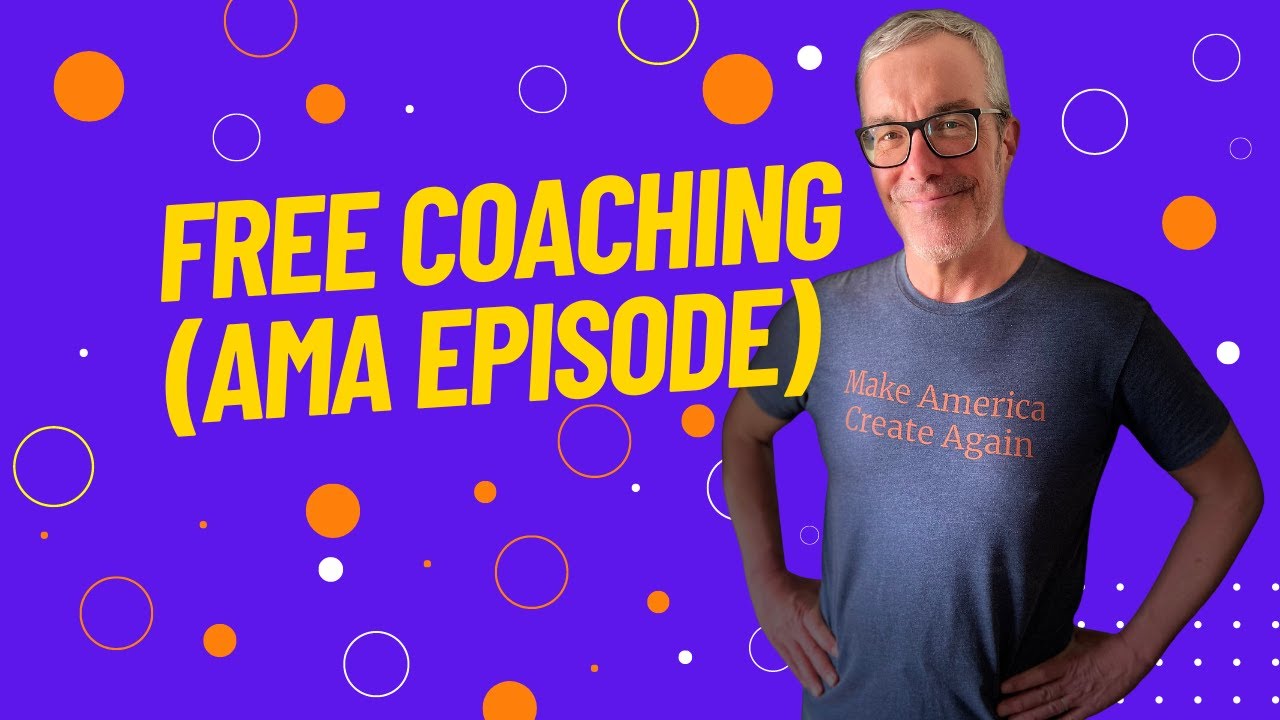
Scott Perry demonstrates his coaching approach with a live client session, showing how he helps creative professionals identify their single priority and biggest obstacle. He uses what he calls empathetic antagonism to push for action, emphasizing first principles thinking and micro-steps over overwhelm.
Chapters
Welcome everyone to Creative on Purpose Live. My name is Scott Perry. I am Creative on Purpose's, uh, lead coach in the Catalyst program. This is a program that offers content and community and coaching that helps high achievers simplify and stimulate their goal achievement system so that they can achieve their life and business priorities, uh, with less risk and effort in less time. And today we're doing kind of a special episode where I am going to actually do some live coaching. So this is kind of a variation of the Ask Me Anything kind of episode that other people do. It's something I've never done before. I'm going to try it today. And it's something that I might actually do much more often because I actually really, you know, the thing that brings me the most joy and fulfillment in my life is actually helping people in a one-on-one coaching situation. And so what I did was I put the word out. Not very long ago. So there wasn't much lead time, just that I was going to be trying this crazy experiment. And what ended up happening is we had 3 people raise their hand and complete what is called the Catalyst Questionnaire. This is just a very simple 4 or 5-question survey that people respond to, just to give me a little context before we jump on one of the free 15-minute Catalyst calls, which is not really a sales call or discovery call in the traditional sense, you know, the way that most coaches think about that. It's, it's actually just a strategy call. It's, it's you fill out the questionnaire. I have some context. I ask you some clarifying questions. We sit there and in 15 minutes bang out a strategy that's going to help you close the gap in less time with less effort with less risk between where you are and where you want to be. And then there's no further obligation. If you're interested in pursuing community or coaching, we could talk about that afterwards. But that's not the intent of these calls. So what I'm going to do is do one of those calls live today. And I offered the option for people to do this anonymously by just presenting their questionnaire, and I'll walk through the questionnaire, or they could jump into the studio live with me. Nobody raised their hand to, to do this live. I don't blame them. This is, uh, this is the first time we're doing this. And here's what happened. We had 3 people reply to fill out the questionnaire. All 3 of them completed the questionnaire. One of those people definitely would benefit a lot more if we did their Catalyst call in a private 15-minute session. So we're gonna move that one aside for now and, and do it in the way that will serve that, that person in the best way possible. Second person filled out the questionnaire, and it was pretty clear to me that it was not the best fit for the kind of coaching that I do. So I referred them to a friend that is much better at the kind of assistance that they need. So want to make sure that people get the best value and have the best experience possible. And so we have one person that has completed a questionnaire that I'm going to walk through and kind of demonstrate in, you know, in a, not, not in an interpersonal way, but in me responding to the questionnaire, how a coaching, a Catalyst call might go. So before we do that, I'm going to walk you through the Catalyst call questionnaire, or the Catalyst questionnaire, calls optional, and just give you a sense of why I ask the questions that I ask. So if you've been thinking about doing, completing the questionnaire just as a, you know, for its own value for yourself, or if you're considering jumping on a free 15-minute Catalyst call to get a strategy for closing the gap between where you want to be in life and business, this will give you a sense of what you're in for. And then I'm going to also, before we jump into the coaching part, just talk briefly about the kind of coaching I do, which I think is probably, you'll find, different than any other coaching that you've experienced. And I'm going to explain what I think of as, as the 3 kinds of coaching that people usually collide with. And there's no judgment here. If you're a coach and you're wanting to see how you fit into these 3, you know, categories that I'm going to share, They're all viable business models, are all great ways of providing value to the people that you seek to serve. There's just one that I favor over the others. So you're going to get a sense of not just, you know, what I do, but how I do it and why I do it the way I do it. So with that, let's go ahead and jump into the Catalyst questionnaire so you can kind of get a sense of what people provide when they're getting ready for this free 15-minute strategy call. So I'm going to share my screen. And we'll go to the survey. And I'm just going to kind of walk through the survey. So you can see that the Catalyst questionnaire— this is an absolutely free resource that anyone can use. It's available at creativeonpurpose.com/catalyst if you want to opt in and complete the questionnaire. If you're ready to take a bolder step into achieving your life and/or business goals, this questionnaire will give you a little bit of context. It'll give you an idea of where you are right now, where you want to be, what's holding you back. And, and if you want to then use that to craft your own strategy to close the gap between where you are and where you want to be, you can do that. If you want to have an absolutely free, no obligation 15-minute Catalyst call with me. I will walk through this, ask you some clarifying questions, and then we'll come up with a plan together. You know, figure out the 3 things that have to happen for you to get from where you are now to where you want to be in your life or in your business. So the first question is, what's your number 1 life or business priority right now? This is actually kind of a really important question because People often get, will add like 3, even 4 or more items here. And I use the word life or business priority, number 1 life or business priority on purpose. Priority is a really interesting word. Until the early 1900s, it was never used in the plural. But now we talk about getting our priorities straight, right? And so people often will have a list of priorities. I'm totally a fan of people being able to accomplish more than one thing at a time or work on more than one thing at a time. But there should be one thing that's the main thing. And the main thing is to keep the main thing the main thing. And so what often happens here is people will list more than one. And part of the call is like, well, let's, you know, you can be working on multiple things at once. But what's the one thing that if you got it done, would move you and your life and/or business the furthest and the fastest forward into the possibility that you imagine yourself. Let's craft a strategy around that, and you can invest more of your resources—time, attention, money, effort, reputation, what have you—into that number one priority. And then you can spend the rest on other things that you're working on. So I have to complete some sort of answer here. So I'm just going to put in "test." We'll save that so I can use it later. Second question is, what's your definition of success in that endeavor? So the idea here is, what's your definition of enough? Because if you're— let's just say that for the sake of argument, someone, a typical answer will be, I want to make more money. Fantastic. How much more money? What is enough? What's the number that if you reached it, you would say, that's it, that's what I wanted? If you're trying to save time, how many hours a day, a week, a month are you trying to recapture so that you can put it into things that matter more to you? So maybe you want to spend less time in your business or less time on social media or advertising and more time with your family. Well, what's, what's the number? How many hours are we talking about? So that's kind of what I'm looking to get to here. Third question: What's missing, broken, or needs work in order for you to achieve this goal? So this is where we're kind of identifying what we might call, in Dan Nicholson's language from the Rigging the Game book, we call it the solvable problem. Like, a solvable problem is one where we have enough data to define a math problem that has an actual solvable answer if The end, if the formula is X plus Y equals Z, that's not a solvable problem. What we want to do is identify what's the thing that needs the most work right now. If we raise the floor on this component of your goal achievement system, would actually start to move you forward at a greater velocity towards the things that you want in life or business. So that's the point of this question here. Moving on to the fourth question: What's the consequence of continuing to just keep doing what you're doing? So, um, you know, there's that famous, uh, Virginia Satir quote— she's a juvenile psychologist— people prefer, um, the certainty of misery over the misery of uncertainty. We actually prefer to just stay with the status quo, to keep going with the devil we know, because we know what's expected, we know where we stand. Uh, people are very generally traditionally, a lot of people are very risk-averse, that they don't embrace uncertainty and, and they don't embrace innovation or new things. But of course, what got you where you are won't get you where you want to be. Every system is perfectly designed to get the results it gets. Whatever system got you where you are is designed to get you those results. If you're going to try to move on, if you're going to try to level up, if you're going to try to step into possibility, you're probably going to have to come up with an, uh, another system, um, or at least tweak the system that you get. So here we're trying to, uh, identify what it would actually cost you in terms of, you know, um, emotion or psych— psychology. Maybe there's a physical cost to it. Of course there could be a financial cost, but, you know, what's the cost of not being able to get what what you want in life. In Dan Nicholson's book, Rigging the Game, he says the greatest risk in life is not getting what you want in life. And so, you know, if you were to project yourself to your deathbed and had that deathbed conversation with yourself, if you have the privilege to do that, what are the things that you would look back on and say, you know, I really wish I had gone for this, that, or the other? What we're trying to do is to end the game of life with as few regrets and as many accomplishments as possible. And then this question is sometimes difficult for people, because sometimes we haven't done anything to try to resolve this biggest challenge. This is kind of a qualifying question for me. You know, the kind of person that I'm looking to work with is someone that is in the arena doing the work, you know, engaging the field and colliding with reality and trying to make a change happen. So they have tried things. Maybe it's been just reading a book and implementing that or taking a course. Watching a YouTube video. Maybe they've hired other mentors or coaches. But I want to get a read on, like, what's their level of commitment? And how invested are they in making the change that they want to make? And then there's the last question really is just, what would you— what else do I need to know? And this is an open-ended question where people can kind of brain dump. This can bring some really interesting answers. You know, this is where sometimes people really open up and kind of bare their soul about what's going on in, in their lives, which is all really important context. Because, you know, I'm not a firm believer in how you do one thing is how you do everything, but oftentimes by achieving your very next priority in life, we will learn the skills and the habits and the attitudes and develop the mindset and posture for solving problems and other areas of our lives, getting the things that we want in other aspects of our life. And then it just comes down to deciding whether or not you want to jump on that Catalyst call. So that's what the Catalyst questionnaire looks like. So if you've ever had any questions about, like, well, what's this guy going to ask me? That gives you a sense of, you know, what's, what's going to be asked. And again, All I'm trying to do is get some context because 15 minutes is not a lot of time. It's, you know, a free use, uh, you're having free access to 15 minutes of my time. Dollar value on that is usually going to be around $75. So if I'm gonna donate $75 worth of my time to helping you close the gap between where you are and where you want to be, I want to be as useful and helpful as possible. So those questions just help me provide the context. And if you decide you don't want to jump on the call, I'm still going to follow up with resources that I think are going to help you. So that's the Catalyst Questionnaire. I want to also talk a little bit just about the kind of coaching I do, because again, it is a little bit different. I see that there are basically 3 types of coaches out there in the marketplace. There are the coaches that coach for agreement. They are, you know, are people pleasers. And I count myself amongst this kind of person. I have been this kind of coach for sure, although I don't consider myself this kind of coach now. But, you know, I want people to like me. I want people to trust me. I want to be a cheerleader and encourage people. And a lot of times, especially at the beginning of your coaching journey, you want people to continue working with you. And so coaching, nothing, again, nothing inherently wrong with coaching for agreement. Um, but what I have found is that when people hire the kind of coach that coaches for agreement, what they're actually— what they're, what they're actually hiring for is to have their, um, it's, it's a confirmation bias move. They just want to continue to believe what they believe simply because they believe it, hoping that somehow there's some sort of magic formula, secret blueprint skeleton key roadmap that's going to help, help them get where they want to go without having to change anything, change anything within themselves, change anything within their lifestyle, change anything in their mindset, or just the way that they show up in the world. Um, I find that to be not a very efficient way to make meaningful change for the better in your life. So coaching for agreement, something I probably did quite a bit at the beginning, something I do very little of right now. It doesn't mean you have to be disagreeable. Just means that, you know, for me, my job is to not just tell you how wonderful you already are and then provide you with some sort of magic wand moment where I can make all of your, your dreams come true. I am working with people that are willing to have their assumptions and assertions challenged, that are willing to embrace the uncertainty and the unknowing of their, uh, of, of how they get to where they want to be and are willing to, in a very strategic, safe, low-risk way, um, start to take microsteps into possibility where they can choose the earned path of earning the clarity and confidence as they continue to microstep and try and test things in real life. In their lives to get where they want to be. So coaching for agreement, all fine and good, not the kind of coaching I do. Second kind of coaching is where I'd say 99% of coaches are, which is coaching for insight. You know, there's a famous coach that I worked with for a very brief period of time that talks about this all the time. And there are many coaches that have made, just developed this really incredible skill for the Socratic method. They just keep asking you questions until you kind of arrive at your own insights, usually the insight that they wanted you to arrive at. So I think questions, you know, the Robert— or not the Robert Frost quote, but the E.E. Cummings quote about the, always the more beautiful question. I think beautiful questions are a great way, a great tool for coaches to have. And You know, clarifying questions are something that I use quite a bit, trying to make sure that we're all talking about the same thing. And, you know, that we all agree that the main thing is the main thing, and we want to keep it the main thing. And that we're not, you know, we're speaking to the question below the question that's really the question type of thing. So, question— it's not that questioning and the Socratic method isn't useful or helpful. However, what I have found is that, you know, and again, I've worked with people that are masterful at this, you know, by using the Socratic method to help you arrive at quote unquote your own truth or insight, you actually end up helping that person close the loop. Because you open the loop with a question, and we all desperately want to close the loop. We want to know the answer. We want to be You know, back to knowing what, what, what's expected of us and where we stand. And so when a masterful coach that is using this method gets that person to kind of arrive at their own insight, they close the loop and the insight feels like the accomplishment. The insight is not the accomplishment. The insight is just, um, a precursor to starting to walk the earned path and do the work necessary to use that insight, leverage that insight to change your behavior and get closer to what you want. So although I employ quite a bit of questions in my approach, I am not coaching for insight. So what kind of coaching do I do? I call it empathetic antagonism. I am Coaching for action. I want you to take the intentional action that's required, the next right step that will help you arrive at, uh, arrive a little bit closer to what you want in life or business, in a way that gives you more clarity about what you want in life or business and clarity about what your next step will be. And by taking these clarifying steps towards an increasingly clarified goal, you will earn the confidence and trust in yourself to be able to close the gap increasingly on your own. My job as a coach is not to coach you forever. My job as a coach is to coach you to the result that you want in your life. So I think of it as I'm coaching— I want to coach myself out of a job. Well, why would I want to do that? Well, because If I can get one person to close the gap between where they are and where they want to be, they're going to show up differently in the world. They're going to behave differently. They're going to have earned a toolkit and an approach to life that they will, um, be demonstrating. People will notice that they can, and they can become a force for making things better in the world themselves by teaching, uh, other people how they can step into remove limits, overcome challenges, step into their potential, and step into possibility. So empathetic antagonism is just this idea that I try to offer insights and shine a light on, on doorways and light switches that you— and get under your skin just enough for you to turn on that light switch, for you to take a peek out that doorway and consider if that's a doorway worth going through., to take that next right step that will help you get a little bit closer or to the possibility you imagine for yourself. There are no secret formulas. There are no roadmaps. There are no blueprints for getting any kind of thing, thing that you want in life because you are a unique person with a unique set of experiences, a unique set of skills and talents. A unique set of values and guiding principles, preferences and prejudices and all these things. So we can't do, create a prescriptive approach for everyone to get the kind of result that they want to get around a revenue goal or a fitness goal or, or what have you. It's only by developing the posture and the mindset, the attitude and the approach of, of a motivated, committed, difference maker that is willing to create behavioral change through new habit development that you're going to get the things that you want in life. So that's where I am. And if you haven't heard a lot of that terminology before, I, I've, I've not heard many people talk about coaching in this way, but that's what I'm here to do. I'm here to help you close the gap between where you are and where you want to be, where you really are and where you really want to be by helping you understand what— where you're really starting from, what you're starting with, what the actual obstacles are, and then set a course with a clear starting point and a clear destination so that we can start to work on getting that vector straightened out between those two points, increase the velocity, uh, to close the gap between where you are and where you want to be, and do that in a way that has very little risk, requires much less effort, is much more efficient, and will cultivate a greater sense of fulfillment, meaning, and joy in your life as you do that. All right, that was a lot of words. Let's jump into the coaching session. So I'm going to again share my screen. I'm going to let this person's identity remain anonymous. I'm I, of course, know who I am talking to, but, um, you should not be seeing their name. So I've already shared the questions with you. What's your primary life or business goal right now? This person said get to $2,000. Um, I'm not sure what MRR— monthly recurring revenue, I guess— by next month and continue to safely drop weight. I am already dropping. Two goals because they're both primary. So this is an exact example of what I see all the time. I asked you for the number 1 priority. And then, you know, in this case, only 2. But to this person, they are equally important. And of course, you know, we can all achieve multiple things in our lives at the, you know, not the same time, but in, in, in sequence together. Here's the thing. Number 1, I happen to know who this person is. I know that previously, they were trying to get to a much higher dollar figure. And so that they've done a great job of already kind of bringing it down to what is maybe a more achievable level. Whatever, if, if your goal is, has something to do with revenue, and a lot of the people I work with are coaches or freelancers or solopreneurs or creatives with some sort of service or product. And they want to achieve, you know, consistent monthly revenue number. For whatever reason, everybody wants $10,000 a month. Sometimes it's— now it's $15,000 or $20,000 a month. Most of the time they're not even at $1,000 a month. Well, if your priority is to get to $10,000 a month, that's not a priority. That's a vision of something that you have never ever accomplished before. And before you can accomplish that goal that you've never accomplished before, you're going to have to take some steps back. So I'd like to, you know, if that's your, your, your vision for your life is that, you know, you got this $10,000 monthly recurring revenue, fantastic. How do you get to, um, $8,000? How do you get to $5,000? How do you get to $3,000? How do you get to $1,000? If you haven't yet hit a consistent $1,000 a month, that's actually the first priority. And so That is something that I have seen and have been able to help clients do in 1 month, 2 months, or 3 months. So, you know, to me, that is one of the things that we have to do is have a reach goal that is not going to have to be a miracle. Going from $0 to $10,000 a month, or from roughly zero or under, well under $1,000 a month to $2,000 a month, That's a big leap. So what we want to do is try to craft something that's a little bit more manageable, a little bit more achievable, and put it on a timeline that is reasonable based on our, you know, experience and gut instinct and guess, best guess and all that. Here's the thing about the fitness goal. This person says that they've already started dropping the weight. If you are already on track, to meet a fitness goal, it doesn't have to be a priority. It just has to be something that you put on a maintenance program, minimum effective dose. If you're already achieving a goal, the worst thing you can do is change what you're doing dramatically. The best thing you can do is to figure out what are the things that are working, which is the least efficient piece of that system, and then raise the floor on that one thing, and you can start to increase the velocity for that thing. So, in regard to this particular person, I would again encourage them to like choose one priority. Since the fitness is already on track, let's get that on minimum effective dose. Let's take all those resources of time, money, attention, effort, and put them into achieving a reasonable monthly recurring revenue in a slightly longer period of time. I'd encourage $1,000 a month. In the next 3 months. If you could do that, then we can, we can try to optimize that from $1,000 a month to $3,000 a month. And I know that sometimes it's like, well, that's not going to work for me, I need to get there faster. Faster is really dangerous. Faster can be faster in the wrong direction, it can be faster going backwards, can be faster going in circles, and it could be faster driving right off a cliff. The point is create a velocity. Or a vector that allows you to increase velocity. Get clarity about your starting points, endpoints. Get clarity about the steps along the way that are necessary. And then figure out how to optimize those steps with the least amount of careening back and forth between chaos and rigidity. Moving on to question 2: What's your definition of success in that endeavor? Getting clear on exactly where I am, what steps I need to take to get to these goals. And here's the kicker. Taking those steps steadily while not burning out and overworking myself, not just in business but just in general. I'm getting there. So again, fantastic news that this person is already identifying that they're making some progress. And that's— progress is all we can really hope for. The process is the shortcut. The process is what will help us make progress. And it sounds like this person understands that they need to take small strategic steps into possibility, do the right things in the right order, in the right sequence, and they will, through that microstepping process, those microsteps will compound over time. And what's interesting here is they've identified that they need to get clear about where they really are. And that's a great insight, because I would say 90% of the people that I talk to are clear enough, and maybe even pretty clear about what they really want. Even if it's that long-term vision of, you know, $10,000 or $15,000 monthly recurring income, they know that that is something that is real, and that they would like to achieve. What is often the case is that people don't really actually know where they're starting from. They don't actually have a ton of clarity about who they are, what their core values are, what their guiding principles are, what are their boundaries and guardrails, what are the things, you know, who are the people that they let in, who are the people they keep out, what are the beliefs that they welcome, what are the beliefs that they, they want to keep away from, what are the tools and talents and temperament that they possess that, you know, can help, that they can leverage to help them get what they want to where they want to go. So where you're starting from, it's not just physically you are here and you want to get there. It's who are you really? Values, talents, where are the people that share your values and need your talents? That's, that's your scene. You have to have some clarity about those things and then do some sort of asset audit, like what are the resources that you possess in terms of time, in terms of focus and attention, in terms of tools and tactics, software, apps, platforms, etc. The more clarity we have about all that, the more we know what we have to work with. We, in my coaching, we actually do an asset audit around time, attention, money, effort, all the places your money is going in terms of software, in terms of apps, in terms of things in your personal life, like streaming services and all that. Because what we find is that we say that this goal is our number one priority, but we spend most of our time and money on things that have nothing to do with that priority. And it can be a real eye-opener to just like understand, like wake up to the fact like, oh, actually I'm, I'm acting in the way that I spend my time and spend my money in a way that's getting me no closer, maybe indeed even farther from my goal. So. That is what comes to me in this answer to the second question. What's missing, broken, or needs work in order for you to achieve your goal? Complete clarity of where I am right now. We've already addressed that. Nothing else, because I know exactly the steps I can approximate to get them there. It's just when I start taking those steps, I blow up and have many burnout downtime. Okay, so I would say that, um, Clarity about where you are right now is really important. I don't think that there's ever absolute clarity about where you are and where you want to be. We have to just start with enough clarity to start making some progress, to start taking those mini micro steps. And we have to have enough clarity about the strategic steps that are necessary. When I'm designing a strategy with someone, let's take for instance this person who is got some sort of service to sell. You know, we just— it comes down to the 3 core elements of my coaching: reasoning from first principles, the system reliability, or system reliability, and then how can we micro-step, have this daily discipline commitment to micro-steps that will help us test our, our hypothesis is what the next best step is in a way that doesn't blow yourself up, doesn't burn yourself out? And how do we get those three things right enough to start making some progress? And then how do we raise the floor on whatever the least efficient or effective component is? The key to all that is get rid of everything that's not necessary. In order to get anything you want out of life, And it's very rarely come up in my coaching that you need more than 3 things to go right. What are the 3 things that you have to get right enough to get from where you are to where you want to be? If you have a business, that would be you need to have an offer that's irresistible enough that you put in front of an audience that's eager enough, with a sales success system that allows you to spend the least amount of time possible doing sales and marketing and the most amount of time possible doing the work that you love to do, whether that's coaching or copy editing or whatever it is. So define those 3 core elements and then it's a matter of testing which of those needs the most work. Now, if you're, um, if you, for example, I had a a Catalyst call with someone not too long ago that is a newly certified coach. And I'm not even going to go down the rabbit hole about how I feel about certification. But if you're certified, that's great. If it helps you, that's great. Is it necessary? No. But you better, regardless of whether you're certified or not, you better actually be really damn good at what you do. And you better have a track record of getting people results. If you haven't yet demonstrated that you can do the things that you're promising people that you can do, you have to stop. And have an honest conversation with yourself about how am I going to earn the allegiance and the trust, um, by earning the experience of being able to do the thing that I'm telling people that I can promise to do. So that's the first thing. And if you haven't done that, then do that. If you have a track record of getting results for people, take a look in the rearview mirror. What were those results? How did you help them get that? You know, get some clarity about who you actually are talking to and what's the offer that will help them close that gap in the least amount of time, with the least amount of effort, with the least amount of risk. What is the most efficient and effective path that you can create your signature formula or signature framework or whatever you want to call it? Um, get those things really dialed in. What it, you know, offers are Offer and audience often work in tandem. It's, you know, how do we, um, how do we identify the offer? Well, who are the people that we want to serve and what do they need? Or what are we good at and where are people that need that kind of work? And so if you get the audience identified clearly enough, then you can get an offer design that is effective enough to help those people get what they want. And then, you know, there's all sorts of nuances, you know, around pricing, around onboarding, about, you know, how you lead them into the sale, what happens after the sale, and all that sort of thing. So you have to get all that right first. The biggest challenge for most people comes around the marketing and sales. And especially in the coaching space, everyone that I work with comes to me initially spending 80% of their time or more on doing work they hate, marketing and sales, and like 20% or less doing the work they love, making a difference as a coach. And so your— the efficiency and effectiveness of your sales strategy will primarily be a function and is fundamentally dependent on the quality of your offer and your ability to identify your audience, getting both of those things clear enough so that then you can start to use what I call, uh, Be a Blessing marketing, which is just doing your work out loud and in public and sharing, uh, the work that you do and the results that you're getting with the people that you're working with. And let that work be your marketing. Let that work bring people into a call already knowing that they want to work with you, just deciding how that's going to be. So lots of— lots to unpack in that piece right there. But, um, you know, number one, you don't need complete clarity. You need to be clear enough because there's no such thing as complete clarity, because that— your, your, your start point, um, is going to be invalidated after you take your first step. That's a— that, that becomes your starting point, uh, your Your destination may change. Your path to your destination will definitely change. And then in terms of the blowout, blowing up and burning out, that's a matter of not doing the right things at the right time in the right sequence. And that's a matter of resource allocation and recapture. You have to be always mindful of where you're putting your valuable time, attention, money, and effort. Those are irretrievable. Once you spend them, they're they're gone. And how can you put them into only the things that are necessary so that you can close that gap in the least amount of time possible? Consequence of continuing to do the same, or not getting what you want: money, opportunities is the tangible ROI, return on investment, of putting in the time and energy, focus in the direction of my path. Towards the ultimate path is $1,500 a month, which means a lot more in a super third world country. So obviously this person is working somewhere where $1,500 might actually translate to $5,000 or more a month. Uh, I won't get evidence of that path I took of skipping my bachelor's. Um, was correct move at the time. Uh, lots of health stuff to catch up with, but no money. So that's all tough emotional wellbeing. And peace of mind. I have an independent safety net for when something blows up in real life. Oh, that is something they want to achieve. So this is all, you know, this is real stuff. And, you know, I will just say that those what appear to be those big important life decisions that may have had a positive or negative impact on our life like around, should I go, should I spend the money and the time to go to college and get a bachelor's degree, or what have you. Decisions are not outcomes. You can make a really good decision and get a really bad outcome. You can make a really bad decision, get a really good outcome. Decisions are just decisions about what you're going to do next. And it puts you— all it does is put you in the next opportunity to make the next decision. If you want to make decisions better, I would say that the best way to do that— I, I wrote a book about this, actually, it's called Trust Yourself— is frame yourself and your situation as objectively as possible. Take out all the adjectives and adverbs and value judgments and lay out all of the options that you can imagine for what you could do next. And then, bearing in mind where you are, where you want to be, What's the next step that if I took it, I feel gives me the greatest probability of moving the furthest and fastest towards the goal that I want, imagine for myself, with the least amount of risk? And if, again, I go into a lot more detail in that process, but don't get hung up on the decision-making process. But don't also be too cavalier about it. You want to be collecting data. You know, one of the reasons I prefer to work with people over 90 days is Sometimes we need just 90 days to collect the data. Like, if you're in a service-oriented kind of online or offline business and you're still trying to reach that first goal of $1,000 or $3,000 a month, like, okay, what's the fastest way to close those kind of sales? It's to have a conversation, whether that's a discovery call or sales call or what have you. How many of those sales calls do you need to close one client. Before you have sales calls, you need to know how many conversations before the sales call you need to have to get that number of discovery calls. And before you have those conversations, you need to know how much, uh, marketing content do I need to, to put out there to get those calls. And so it's— will take often at least 90 days just to figure out a content creation and posting schedule that creates the, a certain number of conversations that lead to a certain number of discovery calls that we can close into sales. Now we have a system. We know how many pieces of content will give us this many conversations that lead to this many calls that give us this many clients. And then we can figure out where the, where we need to raise the floor. Often it's less about creating more content and having more conversations and getting better at the discovery call process. And again, I have a whole approach around that that actually turns sales calls into what I call decision calls. By the time someone gets on the phone with you, they're already ready to buy. It's just about presenting them with the menu of offerings that is best for them to help you help them get where they want to be. What has this person done so far? Write down step by step where they are going to get clear on it. So journaling is a great way to bring in that clarity. I would suggest that trying things on, you know, small testable scales that, you know, give you data would be another next step in this case. And then what else would you like me to know? Every time I try to solve this immediate problem of getting clear, of where I am at. There are 20 fires in the business side and 20 more on the life side I have to put out, and I am just lacking the mental bandwidth to even remember to change my environment for a day to solve this. Just very clever cluttered and overstuffed, um, my head and the environment that I'm in. So this is a really common problem. Overwhelm is a serious thing. Uh, most of us experience it. Um, burnout is a result of overwhelm. You know, there's a lot of anxiety tied to, uh, being a freelance freelancer, a solopreneur, a coach, or creative, um, I would suggest that the place to begin, number one, is again clarity about where you want to be. Enough clarity about where you want to be and enough clarity about where you, you're starting, who you are, what you're starting with, and why is this goal that you set important to you. Clarity about the actual obstacles, Clarity about the actual steps that are necessary. And then a big part of, uh, freeing up bandwidth is get rid of everything that is not a clear, good step to get you closer to what you want. You do not need a YouTube channel, a podcast, a bestselling book, um, a landing page, a lead magnet, uh, an email list, uh, a webinar, any of the things that, you know, the, the gurus teach us in terms of the tactical and toolkit for growing a business. If you're a solopreneur of any stripe, a freelancer, you know, a freestanding freelancer, creative, or coach, You don't have the resources in terms of time, money, or attention to do all the things that you see the big, uh, the gurus doing. And the gurus have lots of money, they have big teams, they have graphic designers, they have social media strategists, they have copy editors, and all on and on and on. You can't play that game and win. And the only way to ensure that you never win your game is if you're playing someone else's. And so In order for your businesses to succeed, you have to have an offer that's irresistible enough, an audience that's eager enough, and a simple strategy for putting that offer in front of that audience. And the simplest strategy I know is do great work out loud and in public with and for people that you care about and engage in as many conversations as you can, solve as many problems as you can for the people that you seek to serve. And offer them access to you as a way of catalyzing and implementing the things that you can do for them that will help them get from where they are to where they want to be, and do nothing else. So eliminate your life and your business of all the cruft. Get rid of all the things that don't give you any return on investment, do not demonstrate any return on investment in terms of getting where you want to be in life, uh, or business. And then, um, the other piece I would add here, uh, is you, you are in charge of where you spend your money, time, and attention. That is up to you. That's, you know, the only thing that's in your control is how you see yourself in your situation, how you frame it. And then the other thing is what you decide to do next. So perception and action is all that you have. And if you feel that your life is out of control, then it's time to set some boundaries. Nick Peterson's book Bumpers is all about this. It's like 100 pages long and $3. Buy a copy of Bumpers, set up your bumpers, set up your dream schedule, and then figure out what are the 3 things that are necessary for me to grow a business from where it is now to where I want it to be that will allow me to live this life that I've just written into a calendar. It takes far less time than you imagine. We always overestimate what we can get done in a day, um, and underestimate what we can get done over a year. And the thing about First Principles Thinking, System Reliability, and Microsteps is approaching any life or business endeavor with those three things Working on those 3 things creates a step-by-step discipline, daily discipline of, uh, committed steps into possibility that compound over time, that increase clarity and confidence over time. And you actually end up with that straighter velo— uh, vector providing you with more velocity. And you will, um, find yourself not falling into the trap of more and faster, which is actually the source of most of our burnout, overwhelm, exhaustion, anxiety, and so forth. So that is— that's a lot. And that's what it's like to work with me. It's intense. I try to be clear, direct, and respectful. I care deeply about the people that I work with, and I want them to achieve their goals. I want them to remove their self-imposed limited thinking and get rid of their biases and false beliefs that are impeding their ability to live a more fulfilled, meaningful, and impactful life. So that's an example of what you could expect if you sat down with me for 15 minutes. I hope that this has been helpful for people. Even if, you know, your situation is different in various ways, everything I talked about can be applied to any kind of life or business enterprise and help you achieve that in less time, with less effort, with less risk, with greater equanimity and joy. We tend to be creatures that really like to overcomplicate things, and things tend to actually be fairly simple. It's just managing our narrative about those things and managing the, our emotional reactions and becoming more responsive to our situation that helps us get there. So that's, that's the end of what turned out to be a pretty long Host on Mic podcast broadcast. If you enjoyed this and you would like to, you know, see more of this being done, then let me go ahead and stop sharing my screen. Then, uh, yeah, I'd love to, uh, I'd love to talk to you. I'll put links down below for, you know, how you can learn more about the Catalyst program. That includes a link to the, um, a link to the Catalyst questionnaire, which you can take and just use on your own, or you can schedule a call with me. Someone left a comment here on YouTube, reminds me of the logotherapy approach by Viktor Frankl. Viktor Frankl is one of my heroes. Man's Search for Meaning is one of my favorite books. And, uh, yeah, uh, Viktor Frankl is deeply steeped in Stoic philosophy, which is at the root of the idea that all we control in life is our perception and actions, and that's all we need, uh, to live a flourishing, fulfilling life in any circumstances. In Viktor Frankl's case, even when he was in, um, you know, a series of Nazi death camps. So I appreciate that comment. Appreciate all of you for tuning in and, uh, listening to me riff-rant my way through some things. And if you're interested in having a conversation, I'm always happy to make time whenever I have time. So drop me a line at scott@creativeonpurpose.com. Drop a comment here. Find me wherever you find me on social media, YouTube, podcasting, or elsewhere. And I hope you have a fantastic day, and I wish you all the very best in all of your life and business endeavors. So until next time, be well, do good, have fun.
More from Scott



Stoics Don't Suppress Emotions, They Do This Instead #stoicism #emotionalintelligence #mindset







