Freelancer Facing Financial Chaos? Here's What Marcus Aurelius Would Do
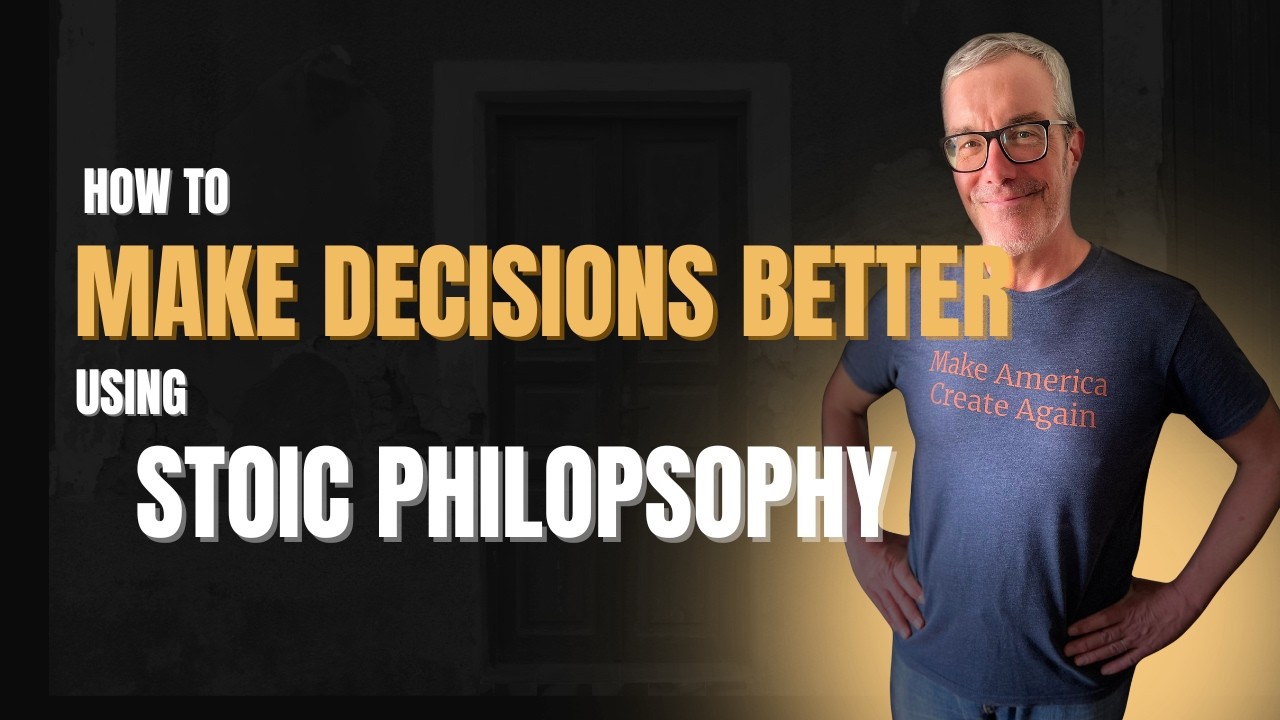
In this live Substack presentation, Scott Perry—publisher of the Creative on Purpose newsletter—delivers a "Stoicism Starter Kit" focused on decision‑making for freelancers and solopreneurs. He begins by introducing Creative on Purpose and his own unconventional career path from professional guitarist to writer and "lifestyle corner‑man." Perry then outlines the ancient roots of Stoicism, emphasizing the Axial Age and the central Stoic principle that some things are within our control and others are not (the "Stoic fork"). He explains Epictetus’s three disciplines—perception (or desire), action, and will (or willing acceptance)—and shows how Marcus Aurelius repeatedly frames them as objective judgment, unselfish action, and acceptance of external events. Perry reframes these disciplines into three practical questions he calls the Decision Triangle or "Stepping into Possibility": (1) What’s now? (2) What’s next? (3) What matters? He describes how this framework, presented in his 2020 book Onward, helps people strip away narrative fallacies, identify concrete problems, generate aligned options, and choose actions consistent with their values. A detailed freelance‑financial‑crisis example illustrates each step: stating the factual shortfall (What’s now), brainstorming possible income‑generating actions (What’s next), and filtering them through personal virtue and goals (What matters). Perry references contemporary decision‑making authors (Annie Duke, Chip & Dan Heath, Shane Parrish) and positions his approach as a simple, missing‑piece solution. He concludes by inviting community interaction, announcing upcoming talks and articles, and encouraging listeners to apply the three‑question process to achieve purpose, prosperity, and peace of mind.
Chapters
Welcome everyone to another pop-up edition of Creative on Purpose Live. Creative on Purpose is a Substack publication dedicated to the collision between the art of living and work that matters. We investigate and navigate where those two things intersect. And today I am hopping on Substack Live with, uh, what might be a recurring Offering the Stoicism Starter Kit. Today we're going to talk specifically about decision-making, specifically how to avoid the trap of making better decisions and how to instead apply the antidote, which is to make decisions better. For those, uh, that don't know me, I'm Scott Perry. I am the publisher and writer at the Creative On Purpose Substack, and I My most interesting thing about my backstory for folks that are usually colliding with my work on Substack is that I used a 7-year association with Seth Godin to navigate and build a bridge between a career as a professional guitar player and guitar studio owner to becoming a writer and what I like to call a lifestyle corner man, someone that helps people figure out where the art of living meets work that matters so that they can make the difference that they are intended to make in the world and the way only they can make it, and how to experience more prosperity, purpose, and peace of mind in navigating that. Got Claire here as well. Great to have you here, Claire. So this whole idea, uh, well, I guess I'll start by just talking a little bit about Stoicism for those that aren't familiar. Stoicism is an ancient philosophy of life In ancient times, whether we're talking about ancient Greece, ancient Rome, uh, the, the Far East, or the subcontinent, there was this period called the Axial Age where lots of people, lots of humanity was navigating and investigating and exploring and talking about what does it mean to be human, what does it mean to be happy, how can we be more of both, and people were exploring this idea of the art of living, or what we might call living the good life and/or living a good life. And Stoicism is a philosophy of life that I have been studying with ever since I first stumbled across it in a 7th grade Latin class when I had a teacher that would help us translate some of the, the, the quotes from Marcus Aurelius's Meditations from Latin into English. He lent me his copy of Marcus Aurelius's Meditations. I read it, borrowed it, and read it many, many times over the course of my high school career. And the reason why I fell in love with Stoicism in particular, although I was also introduced to the Bhagavad Gita, which I also read about and use as a, as a source of inspiration and insight for all the things in my life that I'm navigating, along with the Dao De Ching, another text that I have explored in some depth. But Stoicism is the thing I come back to over and over and over again, in large part because when I was translating those passages from Marcus Aurelius' Meditations, and when I continue to read translations of Marcus Aurelius' Meditations, I hear a voice speaking to himself that sounds very similar to the voice that I hear talking to myself and thinking about things in very much the same way that I think about them. And so fundamentally, Stoicism is a philosophy of life that says that all that is required to lead a life of meaning and purpose and significance to achieve the good life, or eudaimonia, the, the, the, the life of virtue, is virtue itself. All you have to do to live a good life is to be a good person, or to be in pursuit of becoming a better person. And that involves living in accord with nature, and that's not just the natural world, but the nature of the universe and human nature and all of these things. It's a philosophy of life that, um, doesn't require you to get a degree at some highfalutin, uh, college or university. You don't need a piece of paper to certify that you understand the things that the Stoics are talking about, because they are talking about everyday human concerns in ways that are very practical, accessible, pragmatic, and There's just lots of great advice there for how to navigate all of the challenges that we experience in the modern world. So it's a philosophy of life I've been reading about, exploring, uh, and talking about for a long time. And in 2020, when we were, you know, just in the beginning throes of the pandemic, one of the things I was getting called upon to do quite often was help people achieve a greater sense of, of equanimity, of peace of mind, and a feeling of purpose and prosperity when the world was completely topsy-turvy and going sideways. And I found myself leaning many times into the words of Marcus Aurelius. There's a, um, a thing that he references many times in meditation that he's drawing from Epictetus, or Epictetus depending on how you prefer to pronounce it. It's drawn from the idea of the Stoic fork, which is one of Epictetus's seminal ideas. He opens up the Enchiridion, the handbook, with the idea of the Stoic fork. I prefer Sharon LaBelle's translation, which is called The Art of living. When I'm think— uh, when I'm referencing Epictetus's Enchiridion, or Handbook, there are other translations, you're welcome to choose your favorite. But he opens the Enchiridion with this, and it should be noted that the Enchiridion is actually the notes of one of his students. Uh, Arrian was writing down the things that Epictetus said in various lectures because Epictetus left no written record whatsoever of his own thinking and his own interpretations and additions to the Stoic philosophy canon. Um, so what the Enchiridion opens with is, happiness and freedom begin with a clear understanding of one principle: some things are within our control and some things are not. And as I referenced, that's something that Stoic philosophers and scholars often call the Stoic fork. And the Stoic fork is just this, this dichotomy that if we want to boil things down to the essential when it comes to navigating what it means to be human, what it means to be happy, and how to be more of both, we have to be able to separate, distinguish the things that are within our control and the things that are not within our control. In fact, I'll just go ahead and read a little bit further in this opening entry in the handbook. Epictetus says, within our control are our own opinions, aspirations, desires, and the things that repel us. These areas are quite rightly our concern because they are directly subject to our influence. We always have a choice about the content and character of our inner lives. Outside of our control, however, are such things as what kind of body we have, whether we're born into wealth or strike it rich, how we, how we are regarded by others in our status in society. We must remember that those things are external and are therefore not our concern. Trying to control or to change what we can't only results in torment. So what Epictetus is saying is that almost everything in our lives is beyond our control. We can't control what happens to our bodies. We will be subject to illness, disease, aging, health concerns. Decline in our physical bodies, perhaps in our mental capacity, that we can't control other people, we can't control situations like social situations or political situations or economic situations, we can't control the weather, we can't control so many things. So many things are completely beyond our control. And the good news is that all that we need to be able to control to live a good life and to live a life of relative peace and prosperity and peace of mind, regardless of the situations or circumstances we find ourselves in, is we have to maintain control over two things: how we see things and how we decide and do what's next. How, how do we see things? How do we perceive things, what's the story we're telling ourselves about ourselves, about other people, about our situation, and how do we go about determining and deciding what we do next. That's within our control. And so Epictetus came up with these— the— this framework called the Three Stoic Disciplines, and This is something that Marcus Aurelius writes about very frequently in, uh, in, in his Meditations. Uh, he quotes Epictetus from time to time. He certainly references him more than any other source of Stoic wisdom that came before him. My favorite translation of Meditations is Gregory Hayes's translation. I think this is from the early 2000s. Uh, it has a great introduction to Stoicism, and it talks specifically about the three Stoic disciplines. Uh, and just to give you an example of how Marcus talks about, um, the, the Stoic disciplines and how he navigates his life and all the challenges that he was up against. Marcus Aurelius famously was the most powerful person in the world and ruled through a time of, uh, civil war, uh, an attempted usurpation of the throne, uh, through natural disasters including, uh, years of famine, uh, a pandemic or epidemic, uh, called the Antonine plague, Antonine Plague, which claimed his, his life in the end but devastated the city of Rome and much of the Roman Empire. He navigated the challenges that come with the court, the Senate, the people. And so what he says in one of, one of his discussions about the, the three Stoic disciplines is— and this is my, my favorite of his articulations of this— objective judgment now at this very moment, unselfish action now at this very moment, willing acceptance now at this very moment of all external events. That's all you need. And so in this passage, he's referencing the three Stoic disciplines that in the Gregory Hayes translation he, he calls them the discipline of perception, the discipline of action, and the discipline of will. Most other scholars prefer to use the discipline of desire over the discipline of perception. Both Camps use the discipline of action, and a lot of scholars talk about the discipline of assent, A-S-S-E-N-T, as in what you are saying yes to, uh, over the discipline of will. I really like the— just think about it from the lens of the discipline of perception, action, and will. And the way that these things kind of play out, the way that they're articulated and used, is the discipline of perception is how you choose to see things. It's the story you're telling yourself about yourself, about other people, about your situation and circumstances, about what is happening to you, around you, and through you. That's the discipline of perception. We are inherently creatures that make sense of ourselves and each other in our situation through narrative. The Discipline of Perception is how you are framing those stories. The Discipline of Action obviously has to do with what you are deciding and doing next, which can include ignoring what's going on or hiding from what's going on or doing things out of selfishness or spite or jealousy or anger, etc. Or we can apply the discipline of action in a way that is more aligned with our values and expresses our virtue and is done in a way that is more just, more correct, more fair and kind to ourselves and to the people that we find ourselves with. And then the discipline of will is not— it's not willpower, uh, in this translation of, uh, in this passage from, uh, Meditations. He says willing acceptance. And I— that, that's the way that I think about the, the third discipline. The discipline of will is willing acceptance, saying yes to what is actually happening. And not attaching ourselves to our, uh, expectations or our desires or, um, the, the stories that, you know, we— of what we wish would happen, but instead willing acceptance of what is actually happening and what actually results from framing ourselves in our situation to setting and what it is doing next, and knowing that most of what happens as a result of that is beyond our control. Just to reference back to Epictetus's opening of the Enchiridion, where he talks about some things are up to us and some things are not. So what does all this have to do with decision making? I'm glad you asked. So in my book Onward, which was published in 2020 during the pandemic, and it basically came about because I was called to discuss some of the ideas that I gleaned from Stoicism, some of the practices and the, the practical application of philosophical principles to living a life of greater equanimity, prosperity, peace of mind, purpose during times that many of us found very challenging. And what I found myself doing was basically just coming up with new ways of talking about the practical, pragmatic practices and principles that I had learned from Stoic philosophy in ways that were easier to connect with people that didn't really have any familiarity with Stoicism or weren't much interested in what some old dead emperor from Rome had to say. And basically, Onward is a retelling of the 3 Stoic disciplines through asking 3 questions. So just to catch everybody up, we began with Epictetus's opening line from the Enchiridion: some things are within our controls and, and, and others are not. And the idea was that most everything in our lives is beyond our control. Our bodies will be subject to death and disease. We can't control other people. We can't control the weather. We can't control our circumstances. We can't control the political, economic, and social forces that surround us. But what we do get to control is how we see things, which means how we reframe or think about them, and what we decide to do next. So again, the discipline of perception and action is within our control, and we can also control this idea of willing acceptance, that we can accept whatever it is that fate delivers even when we put forth our best efforts. The Stoic, um, the three, uh, Stoic disciplines are the, those disciplines of perception, action, and will— willing acceptance of what happens. And so what I did in Onward is I came up with this decision-making framework that talks about how we can reframe those three disciplines as three questions. So the three questions are: What's now? What's next? What matters? What's now? What is actually happening now? How do we perceive reality? How do we frame what is happening without all of the false beliefs, the narrative fallacies, the cognitive biases, the cognitive distortions? How do we frame things in a way that is reflective of what is truly really happening without all the personal attachments or the, the narration. What's next? What are we going to decide and do next? How do we make those decisions and take actions that are more responsive and less reactive? And then what matters? The discipline of will, willing acceptance. What matters is, again, the Stoics would say, what Ultimately, the only thing that matters is virtue, the content of your character. Did you, did you see, think, act, decide, and do something in alignment with virtue, with nature, your human nature, the nature of the place that you live, the nature, uh, of the natural world and of the entire cosmos. So those 3 questions became just a really easy thing to remember and an easy thing to apply to whatever circumstances or situation you found yourself in, whatever, ever aspiration you're trying to achieve, whatever problem you were trying to solve. And it was something that people found really helpful. I did presentations on, um, this what I called Stepping into Possibility, uh, was the name of the presentation where I basically repurposed the 3 Stoic disciplines into those 3 questions. And I presented that multiple times to students in the Akimbo workshops, to my friends, uh, in, in the Alt MBA, to the the communities that they were leading. I got together with my friend Kelly, and we did presentations about this at organizations and, and in places where military spouses were navigating significant challenges compounded by the pandemic. We actually got called up to present in Arlington, Virginia, the, the Army College brought us up to, to talk to the spouses of newly minted, uh, 1 to 4-star generals, uh, and presented this material there. So it's something that really resonated, that resonated across a wide variety of demographics and psychographics. And a lot of people have found it really helpful, and it's something I've continued to talk about and to present many times. I'm going to do a presentation on this in June. I think it's June 22nd. Uh, it's a Saturday in June at my local bookstore for my friends and neighbors here in Floyd. Um, there's an article coming out a week from Monday that, that highlights this process as well. And if you go back into the Creative on Purpose Substack, you can find a bunch of articles where I've talked about this, and there's replays of various presentations about this. I'm gonna take a quick sip of coffee here. So just to end with kind of a, you know, practical application or an example of this, uh, before I do that, just want to highlight that I've seen, uh, Claire and Kyra and Emma and Alice jump on. They're all members of the Creative on Purpose, uh, Circle or Inner Circle communities, the paid subscriber community. My friend David is here. I just actually went through a week of David's program on Substack Growth. Great to have David here. And we've also had Rudy and Paul hop on as well. Great to have you all here. If anybody has any questions— and you can ask me questions about anything, uh, if you have questions specifically about Stoicism, that might be, uh, useful and helpful to other people, but I'm, I'm willing to spend a little time answering any questions that come up. Either as a result of this talk on Stoicism or something maybe that you've read of mine in the recent past. And if there are no questions, I'll end after this example. So how do you apply the 3 Stoic disciplines and the repurpose stepping into possibility questions of what's now, what's next, what matters in your everyday life? The example that I love to give is that in my life, which has largely been the life of a, a full-time, uh, professional musician, creative writer, uh, coach, corner man— I, I have been a freelancer, a bootstrapper, an entrepreneur, a solopreneur all of my adult life. I had a brief career as a teacher, a brief career in doing a couple of other things. But before I turned 30, uh, I went all in on a music career and had built businesses. I had a brick-and-mortar music store for a while. I built a guitar studio and a guitar studio practice that helped me earn a living and help pay the mortgage and keep the car payments in good standing and put to boys through college and all of that. So I've been doing this for a very long time. I was a musician for over 25 years. And for anybody else here that is a solopreneur or freelancer or a bootstrapper or an entrepreneur, you know that especially for freelancers, you're kind of only getting paid if you've got a gig, right? Doesn't matter if that gig is in a musical endeavor or woodworking or pottery, or it could be web design or graphic design or any of a number of things. If you, if you're only getting paid when you actually have a client that is paying you, it's a stressful way to make a living. And one of the challenges that I would frequently have in my long music career was looking at my calendar, my upcoming performances, and thinking, oh my God, I do not have enough gigs this month to pay the bills. Now, the way that most of our default human programming and conditioning would think about the situation is we go right into narrative fallacy, cognitive bias, cognitive distortion, we tell ourselves a story that is somewhere along the lines of, oh no, I don't have enough gigs, I can't pay the— won't be able to pay the bills, my kids are going to hate me, my wife is going to leave me, uh, I'm going to end up homeless and living under a bridge, and I'll probably die, uh, you know, of a drug overdose or the effects of alcoholism. Your brain just goes down the darkest of all possible rabbit holes. If you apply the, the question "What's now?" and you think about it through the lens of the first Stoic discipline of perception, or the discipline of desire, what it is encouraging you to do is let's talk about what's actually happening. Let's strip away the narrative of all the adjectives and adverbs, of all of the narrative fallacies, and let's just state what's actually happening. Instead of, oh no, my wife's gonna leave me, my kids are gonna hate me, I'm gonna end up homeless and living under a bridge and die an alcoholic— what if we just say, I don't have enough gigs on my calendar to pay the bills this month? That's the problem. We just took something that is a catastrophized narrative that we can't do anything with and turned it into a solvable problem. I don't have enough money coming in this month to take care of all of my financial obligations. And that all comes from just applying that first Stoic discipline and answering the question, what's now, in a way that is stripped of adverbs, adjectives, narrative fallacies, and only talks about what is empirically true. Then we can apply the discipline of action or answer the question, what's next? Of all the things that I could decide and do next, what is the thing that I should decide and do next? So what framing the situation as plainly as possible does is it allows us to open our minds up to all of the possibilities. And You know, so instead of thinking that I'm gonna just have to give up— like, I could give up and get a real job. I could give up and go back to getting a teaching job or getting another job. That would be a choice. I could, uh, I could try to get more gigs. I could call all the venues that are thrilled to have me coming and ask if they have any friends in the business or any of their, uh, any places that they know of are looking for an act like mine. Or I could call all the places that I played in the past that maybe I haven't been in touch with in a while and ask them if they're looking for entertainment. I could decide to go back out in the street and do some street busking, something I had a lot of success with early in my career. I could decide to sell a bunch of instruments that I'm not actually playing. I could actually just sit down with my wife and go through the budget and see where we can trim the fat in terms of our outgoing, uh, discretionary income so that we can recapture some revenue that's being invested in things that aren't getting us closer to what I want. There are a number of things that I could consider doing. And when I write them all down and I look at them through the lens of the last question, the discipline of will, willing acceptance, and what matters— what matters is the integrity of my character and the intention, and aligning that with my intentions and actions. So if I look through all the things that I could do there's going to be some things that I'm just going to knock off the list because it's not the kind of thing that a person like me does. Like, I could claim bankruptcy. Well, that's not something I, I'm willing to consider. It would not be in alignment with my values or my virtues, so I'm going to knock that off the list. Not making any judgments about that, I'm just saying it wouldn't be for me. There are some things that, um, make more sense than other things, like Can I sell a few instruments? Sure, but I'd probably get a lot more bang for my buck if I actually just reached out to some venues that I haven't played at in a while, or asked other venues to recommend venues to me and got myself some more gigs. So I go through my list, I cross off all the things that don't align with who I am and who I seek to be. I then look at the list that— of things that remains, and I prioritize them based on What most aligns with my goals and my aspirations? What's the, the solution to my problem that can be done with the greatest ease and velocity? And then the third part is, well, when all is said and done, when I've made a decision and done what I need to do, what happens next? I have to be willing to accept that I can make the very best decision imaginable and still get a bad result. I can also make the very worst decision imaginable and get a very good result, or I can make a bad decision that gets a bad result, or a good decision that gets a good result. But oftentimes, all the time, what the outcome is, is largely beyond my control. Sometimes I can exert a little influence, and the influence that I can exert is going to come from the discipline of perception and action. So that simple framework, applying, you know, starting with the idea that I have to accept that some things are within my control and others are not— most everything is not within my control. Fortunately, the only thing I need to live a meaningful, purposeful, good life is to know who I am, what I'm good at, where I belong. I need to know what my values are, and I need to conduct myself in a way that aligns with my integrity. And so the way I, uh, the, the things that are within my control are how I see things and what I decided to do next and how I respond after whatever happens next happens. I then apply the 3 Stoic disciplines of perception, action, and will reframed through the questions: what's now, what's next, what matters. It allows me to slow down enough to make the best choice I am able to make, knowing everything I know and knowing who I am and who I am seeking to be, and embrace willing acceptance Amor fati. Love fate. Love whatever it is that fate delivers. Love whatever happens next, because that's the next situation, that's the next opportunity for me to rinse and repeat the entire process. Remember what is and what is not within my control. Apply the disciplines of perception, action, and will. What's now? What's next? What matters? And make the next decision better. So just to wrap it all up, I don't see any questions coming in. The whole point here is that we have this false belief that there is a best decision out there, and that sometimes will cause us to do nothing because we're still trying to figure out what's the best thing that we can do. And sometimes we, in our desire to be for expediency, we do things that are completely out of alignment with who we are and who we want to become, because it's expedience to do something, to make a decision, because it's best for us in the moment that we're in. And if we instead look at this through the, the, the Stoic formula for making decisions better that promote our sense of purpose, prosperity, and peace of mind, we will not always get everything that we want, but we will probably get everything we need. And the most important thing is that we're never putting ourselves in a situation where we're going to burn ourselves out or blow ourselves up or take us— ourselves out of the game altogether. We're going to be able to do the best we can with what we have in the moment we're in with kindness and compassion and a sense of fairness to ourselves and to the other people that are around us. So that's the Stoicism starter kit for today. This is the first of what may or may not become an ongoing series. If anybody has any questions, I'm always happy to, to hear those. I've got Kyra saying thank you, so many helpful perspectives and opportunities to reframe. Appreciate that, Kyra. Um, everyone can stay tuned for the upcoming article. It's kind of a Stoicism 101 article. Basically, it's the presentation I'm going to give in June, uh, in, in, in prose. Uh, there's also an article that I published last week at about the decision triangle, which is what I call the stepping into possibility questions. What's Now, What's Next, What Matters. I think that was published on Monday or Tuesday, um, and it kind of measures that approach to a lot of the popular literature out there. So right now, so Annie Duke is here on Substack. She's written two really fantastic books about decision-making. Thinking in Bets is the one I'm most familiar with, but she's written another one since then. Um, there's a book by Chip and Dan Heath, I think it's just called Decisions, that's also very good. I also love Shane Parrish's book. Um, uh, Shane Parrish is the publisher of Farnam Street. I don't know if he's on Substack, I don't think so, um, but he, he's written, uh, a great book on decision making as well. They're all fantastic, uh, but they're, they all have various elements of them that are kind of, I find, missing, broken, or needing work. Decision Triangle is a process that's very simple and easy to remember, and it patches up some of the holes that I have found in thinking about and learning the approaches of other people. Sarah says, thank you so much, lots to think about. I appreciate that, Sarah. So it looks like there aren't any questions coming in, which is absolutely fine. I'm happy to get on with my Sunday and, and leave you all to do the same. I appreciate the gift of your time and attention. If this is something that has resonated and you would like more of this kind of approach to Stoicism, learning more about Stoicism and how this beautiful philosophy of life can be applied to navigating modern challenges and living a life of greater purpose, prosperity, and peace mind, let me know, and I will make an attempt to schedule future, uh, lives about this. But until next time, be well, do good, have fun.
More from Scott



Stoics Don't Suppress Emotions, They Do This Instead #stoicism #emotionalintelligence #mindset







