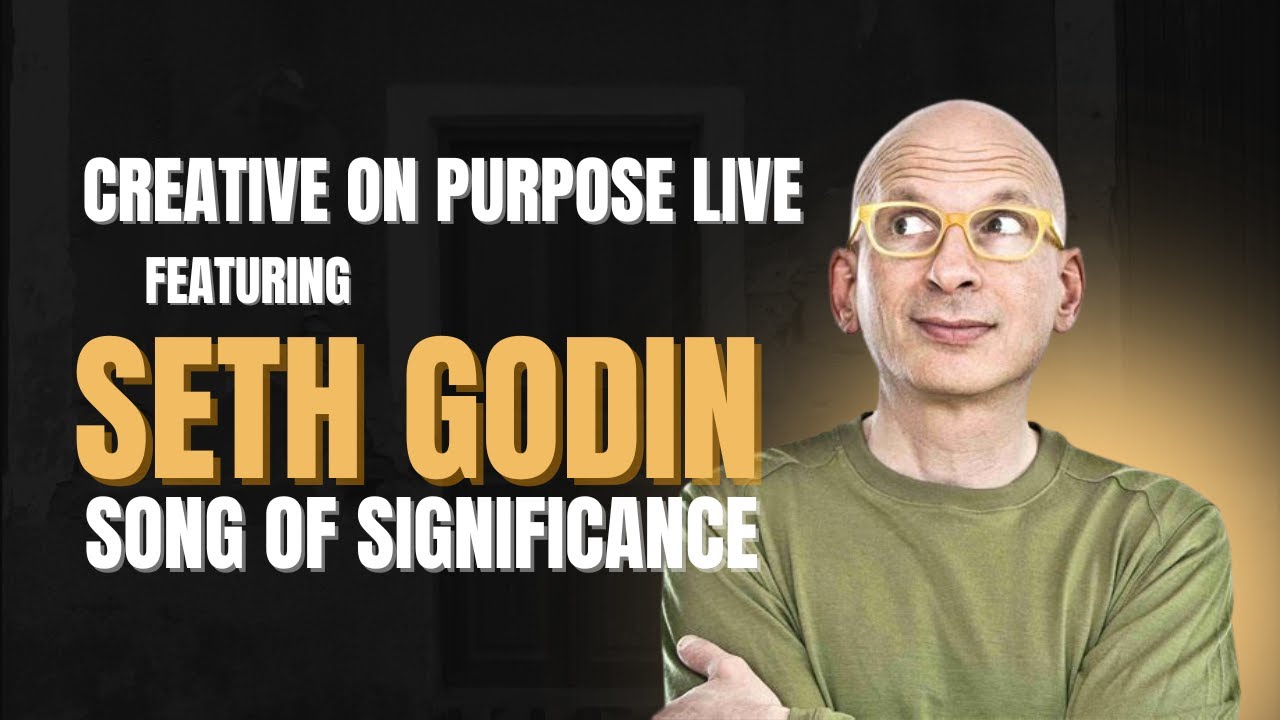
Seth Godin argues the industrial era's depersonalized work is ending, and people can reclaim agency by choosing work that excites them and making mutual commitments. Significance comes from being treated with respect, achieving beyond expectations, and taking pride in projects that change things. He sees AI as a tool to amplify human gifts if you become its boss, not its victim.
Chapters
Welcome to Creative on Purpose, conversations about making a better living and a bigger impact by defining, developing, and delivering the difference only you can make. My name is Scott Perry. I am an encore life coach and author of The Art of Encore Living. Visit Creative on Purpose to get started playing your game today. And let's get to today's guest. I couldn't be more thrilled to have my old friend and mentor, my young friend and mentor, Seth Godin, on the broadcast today. Hey, Seth, how are you? Please tell our viewers as if they need to know who you are, what you're up to these days, and where can they go to learn more about you and the difference you're making.
Long-standing friend of Scott Perry. My name is Seth Godin. I've written a bunch of books. I'm an entrepreneur. I started one of the first internet companies, and I write a blog every day. Uh, you can find out about my writing and the new book at Seth.blog/song.
Awesome. And Seth, what's the name of the book? And why did you write it?
It's called The Song of Significance, and it's my most personal book. It's urgent. It's a rant. It's about the fact that work isn't working, that we forgot to bring humanity to work. It's about quiet quitting and all the turnover. It's about billionaires brutally firing disabled people on Twitter just because it's fun for them. It's about doing work that matters with people we care about. And I think it's resonating with people. And the reason I wrote it as a book is so we can talk about it. So it's a real treat for me to come and talk to you about it. And I'm hoping what it will lead is to other people talking about it as well.
Absolutely. I am super excited about this book because work and why we work has become a topic that is at the center of the work that I'm doing. And I would just like to hear from you. You know, when you talk about work? You know, how do you, how do you define work? And how do you define work that's worth doing?
Oh, what a great question. Okay, so everybody has to put a roof over their head, take care of their family, feed themselves. We tend to do that by exchanging labor and effort to some entity that's going to pay us to do that. And industrialism, which has been around for 110 years, really changed the equation because machines, when they're put to good purpose, can dramatically increase the productivity of workers, which means the workers can get paid more and people can buy stuff for way less money than it would have cost. And when we think about that offer, it got buried deep into our culture. The whole idea that you go to school to be prepped for a test. We ask, will this be on the test? We got to graduate. If you're defective, they put you back a year and reprocess you. And so industrialism created a different kind of work, a brain-dead, depersonalized, impersonal, brutal sort of work. And lots of folks who were lucky, like people like you and me, didn't have to work, at a sewing machine or a punch press. We got to use our minds. We had to make decisions as well as making a living. But we're now at the end of the industrial era. Between AI and robots and outsourcing, lots of big companies and small ones are under pressure to extract as much as they can from their workers. And that's why they call it human resources. Because they're treating people like machines. And so what I'm hoping for is that people can get their arms around the fact that it is possible to have a good day at work. Maybe you already have had one. It's possible to have the best job you've ever had. I have asked 10,000 people and every single one of them knew which of the jobs they'd had was the best one they ever had. So given that life is short, and we're going to spend 90,000 hours at work. Feels to me like it's incumbent on us to help build that, that kind of job.
Yeah, I am pretty sure that you recommended this book to me, and I think it's called Debt, uh, but there's a discussion about work that really just blew my mind, which is that he— in the book, the author talks about All living things work. They exchange energy to do something. Plants take the energy from the sun, water from the ground, nutrients from the ground to create limbs and buds and fruit and so forth. Human beings are unique in that we find significance, we forge meaning, uh, and we find and, and, and build identity through the work that we do, which I'm hearing in, in what you're saying. But I think there's— what I'm also hearing in what you're saying is, it's also about how we show up in the place, how we show up to do the work, whatever that work might be. And sometimes it's the work we get to do. You and I have had this conversation. And sometimes it's the work we have to do to take care of our responsibilities. So I'm just curious if any reflections that you have around, around that, and if I got the book wrong. Please correct.
No, you, you got Graeber's book just right, and I, I didn't remember that riff, but you're absolutely correct. So you, you got the debt part that Graeber referenced just right, and that book is fantastic. Here's the thing: everybody has to work, but you don't have to work here. And that is the giant shift between us and plants, that we have built a world amazingly where you have a choice about where you're going to work, which means at some level work is voluntary. And that notion that you could spend today doing this or doing that makes it incumbent on us to pick a thing that doesn't wear us out but instead lights us up.
I love that. Well, I What you're saying about our ability to choose where we work, uh, is reminding me of a conversation we had a long time ago about agency. And this is one of the things that I think we really struggle with because institutionalized education and occupation has taken decision-making away from us or made just, you know, compliance conformity, competition, control. Here's what you do. Here's how you do it. Don't ask any questions. Keep your head down. We'll reward you with bread and circuses. Um, and, you know, see you again tomorrow. And I, I would love to hear, maybe this is something you're talking about in the book. Um, how do we, how do we reclaim our agency, our authority over the way that we frame ourselves in our situation and what the process that we employ to make better decisions that will help us become, uh, help encourage our health, our well-being, and, uh, stepping into our power to be agents of our own destiny.
So it's 10 after 5 in the morning, back when I used to stay in hotels, and I'm awake and I want to go work out, but often mysteriously the gym is locked in hotels. I don't know what they're trying to secure, but it's usually locked that early in the morning. So rather than waste the trip, I pick up the phone, I dial zero, young woman answers the phone, and I ask her the question, is the gym open? I then discover she's not in the hotel. She's not even sure which hotel I'm in. She answers the calls for all of these bunch of Marriott hotels. And I hear her typing as I'm asking her the question. And then she reads me the paragraph that comes up on the screen. I'm sorry she has this job. And I wonder if she realizes that she's not going to have this job for long. Because once they have routinized it the way they have for her, there's only one step left before she's gone. And I am just talking to a computer that answers my question. She probably is prevented from finding meaning at work because she's not allowed to make any change happen. She's not allowed to interrupt, interact with other people. Let's presume for a second your job has more variability in it than that. What I talk about in the book is a series of mutual commitments, the kind of commitments we made with each other when we were working on the workshops. Right? Criticize the work, don't criticize the worker. Take responsibility instead of seeking authority. That these postures of meaning, of significance, have to be mutual. And so if anyone at your level in the company where you work is finding a sense of meaning in what they're doing, then you can too. And you can do that By making promises and keeping them, by giving away credit, by insisting on being allowed to make decisions, on knowing what change you seek to make happen. If the only change you're trying to make is, I will satisfy the whims of my boss today, then it's really unlikely this is the best job you've ever had.
Brilliant. Excuse me. So we've— you're weaving in this idea of having some intention about what you do and why you do it and who you do it with and, and all of those things. And then having some integrity around taking responsibility, being judicious with the way that you— the words you use and the way that you engage. And I think that's really powerful. It's also something you can practice right now, whether you have your dream job or not. And it's to reference our time together in the Creatives Workshop, you can begin this practice and create some readiness for making better choices going forward in your work so that you can get the significance. And so I'd love to get to the significance piece because, you know, we've talked a little bit about what work is and what meaningful work is. Is significance the result of doing meaningful work with the right people?
So as you correctly intuited, there's a lot of Stoicism in this, and there's also some Viktor Frankl. It's, you can't insist on the conditions, but you can choose your attitude. And if the place where you work does not permit you to find the attitude you need, you should leave.. And once you know that that is an option, it is quite likely you will find, even in the job where you are in, the guts to create that opportunity. Um, significance, I came to the conclusion after surveying these 10,000 people, is being treated with respect, accomplishing more than you thought you could, and working with people on projects you were proud of. But in all three examples, what we see is you made a change happen. Meaning involves agency, and agency and significance require that there be some sort of change you can make to someone. And what the people who would like to be surveilling puppet masters want from you is that you don't make any decisions and you don't make any change you can be responsible for. They want you to be a replaceable cog in the machine. And bosses are surprisingly open to shifting that if the people they work for eagerly seek out responsibility, make promises and keep them. It makes the entire operation far more likely to be something that's resilient and ultimately profitable.
Yeah, well, I love the idea of resilience too, because it's the thing that we need most probably in this day and age. And I always knew that you were a cloaked Stoic at heart, accused you of that many times.
The problem, just to, since I'm bringing Coles to Newcastle today, the Stoics need a brand makeover, because the word Stoicism is just a terrible word.
Exactly right. Well, it's just like all the ancient philosophical disciplines—Skepticism, Stoicism, and Epicureanism—all mean exactly the opposite of what they meant in the Hellenistic age. And so I'm really grateful that you are volunteering to be the rebranding master of Stoicism so that you can help us avoid all this.
From now on, it's called Perryism.
Oh boy, I wouldn't wish that on anything. I, so the thing that you were just touching on that just really resonates loudly with me is, you know, significance in part is how we live our legacy, that the difference that we're making right now is the thing that matters. And the thing that if we're going to be remembered for anything, it will be the the work that we did, the way that we did it, the integrity and the intention and the difference we're making while we had this time on the planet to make it. Is that a fair reframe?
It's terrific. It's great. And so it's a two-way street. Many of the people I talk to about this say, well, how do I get my boss to do this? And I am thrilled and not surprised that you're saying, how do I? Create the conditions for this to happen? And the answer is, it's both. But it has to start with someone, and the one you have control over is you.
Well, and that's super empowering, because what I'm hearing in that is that leadership— and you've riffed on this, riff-ranted on this many times— leadership and authority, right? The boss has authority. He may or may, or she may or may not be a leader. And the worker may not have the authority, but if they choose, they can become and step into leadership and help drive the conversation. That's fantastic. That's a phenomenal insight. The last piece of the book. Title that we haven't really talked about is Song. And I— this— the title is poetic. I know exactly, you know, knowing you and your work, I don't know exactly, but I have a very good idea of what I'm in for when the book arrives. But I am just curious, and I know you're a huge music fan and a friend to many musicians, what possessed you to put song in the title?
You will be surprised at the answer. Uh, it has nothing to do with Herbie Hancock, Miles Davis, or Scott Perry. Okay. Uh, I was running a conference with a beekeeper, uh, in November— in the end of October, uh, for regenerative agriculture, regenerative industry entrepreneurs who were trying to build organizations that would help heal the planet. And, uh, my fellow volunteer, the beekeeper, mentioned something called the Song of Increase. And as soon as he said that single expression, my eyes lit up, and I inquired. It turns out it's not something you can look up in Wikipedia. It's something that was invented by a single human, a woman named Jacqueline Freeman, and she is a feral beekeeper. She's not feral, the bees are feral. And she is helping to regenerate, uh, hives facing colony collapse disorder, which is killing as many as half the beehives in America. And she writes about the Song of Increase. And in her book, which changed my life, um, she talks about what happens right now, this time of year, the end of May, when a hive has survived a difficult winter. And what happens is, first of all, beehives are organized without an organizer, led without a leader. The queen is not in charge of anything except laying eggs. And the council of maidens will come together, survey the hive, and realize that maybe they've got a shot at it. So first they'll build a vertical egg chamber, and they'll encourage the queen to lay and fertilize a queen egg, which is very unusual because only one queen per hive. Mm-hmm. And then they'll instruct all the worker bees, which are actually maidens, to go out and collect as much pollen as they can. And it only takes about 2 weeks to replenish all the honey in the hive. And then something extraordinary happens. In a 10-minute period of time, 12,000 bees leave the hive all at once. They leave behind all the pips, the babies, and the baby queen, and all the honey. They just leave, and they all go to a tree 100 feet away and form a tight ball. That leap is called the Song of Increase, and that tight ball I have named the Song of Safety, because they have to keep it tight to maintain body temperature of 98 degrees. And now they only have 72 hours to find a new place to live, or they will all die. And When I heard this, something really resonated inside of me because we are not bees, but we yearn to sing songs like the song of increase. So then after I surveyed everybody, it occurred to me that the song we want to sing is the song of significance.
That is absolutely beautiful. We, uh, raised our boys on a farm here in southwestern Virginia, and one May had a swarm of bees in our porch, and we happen to live in a rural area where there are lots of beekeepers. Unfortunately, someone came and helped safely move that swarm. And so that's a profound and resonant story for me, for sure. And I love that. You'll be unsurprised that the Stokes talked quite a bit about bees because they're social creatures like we are. But I love, I love all of that, Seth. I am so excited about the book. You've touched on something, just to go down a little bit of a rabbit hole. You have talked a lot about AI in a way that makes a lot of sense to me. I feel like, you know, there's, you mentioned that this woman that was answering your questions about getting into the Marriott gym will soon be replaced by AI. There are a lot of people that feel, um, like whatever they're doing now will become insignificant and actually, um, be done by AI, robots, what have you. I'd love for you to just share a little bit of your riff around, um, AI and how instead of looking at it as something that's going to take things away from us, how we might actually use it as a form of leverage to get, uh, do more of the human work and bring leverage more of our own inner gifts.
So when George Westinghouse was going up against Thomas Edison, Thomas Edison was on the DC team, uh, Westinghouse was on the AC team, and Edison didn't like to lose. So what he did, of course, is he went to some zoos and got some elephants, and then in public demonstrations, he electrocuted them dead. With AC power, trying to scare people about electricity. Think of all the jobs that existed in the world before electricity and how many of those jobs were completely either replaced or turned upside down by the fact that now there's a machine that you can touch that does the thing that used to take you a lot of effort. I don't think AI is going to be as benign a transformation, though no elephants have been killed yet. Um, but I do think we have a choice. You can either say, I'm a victim of AI and I will be replaced by AI, or you can say, AI is going to work for me. And if that's the case, every single thing you do that could be done by an AI You need to hire an AI to do it for you so that you could be the boss of the AI. So for example, if you're a radiologist, AI can now read a typical X-ray better than you can, faster than you, cheaper than you, more accurately than you. And if you're 70, you should retire. But if you're 40, maybe this is a great moment to figure out what a radiologist who has an AI assistant does for a living. Because my guess is you can add more value to more people and generate more for yourself, if you wish, using this tool than fighting this tool. And, you know, I sometimes— I have really good timing. In 1983, I was lucky enough to sit in— 1984— sit in on a PhD-level artificial intelligence seminar at Stanford. And Doug Lenat, the guy who ran it, said everything that is happening now. He was way out on a limb. No one thought he was right, and he described how LLMs were going to work. So I've been thinking about this for 40 years now, and it's not surprising to me at all. It's fascinating to watch how fear turns some people into denialists. Um, it's not going to go away. It will probably be somewhat regulated, but it's not going away. And so then the question is, what are you going to do? I was thrilled to see that, uh, ChatGPT can write a blog post that sounds like me, and I was twice as thrilled to see it's not quite me. But what it reminded me is that a mediocre blog post from me is now completely worthless. Don't even bother.
Yeah, that's amazing. And I love the framing. AI is a tool, and like any other tool, we get to decide how we use it, and we can— or whether we allow it to use us. You famously have talked about social media that way. Social— you can use social media or it can use you. You get to decide which. You spoke to this idea earlier and just now again about safety. And, you know, it's a, it's one of our primary drivers as human beings. We want, you know, we need to, after our existential needs are met, safety is a priority for sure. And we are creatures that make sense of ourselves, our situation, and each other through narrative. Some of us have a victim narrative that we use to protect ourselves. Are to provide that sense of safety. How does, how does safety weave into the Song of Significance? How can people push towards and reach to the edges of their understanding and ability and to get to acquire significance, to encourage significance and maintain enough feeling of safety while they're doing that?
Okay, so let's throw out a couple interesting words here. Uh, stress is bad. Stress leads to trauma. Stress is wanting to be in two places at the same time and feeling trapped. Tension is good. Tension is the feeling of this might not work. Tension is crossing the threshold from here to there. You cannot feel safe when you are under enormous amounts of stress. But to be productive, you need to feel safe when there is tension. You cannot find a good job that has no tension. We need to be able to make a change happen. So, what we need to say to bosses and co-workers is dignity and respect inform us in our interactions to create a foundation so that we can bring tension to the work. But if you're going to say, if I hear you're looking for another job, you're fired. If you're one minute late for work, you're fired. If you ever talk back to me, you're fired. This is a brutal environment, you're fired. No one is going to feel safe enough to bring tension to their work. On the other hand, if you create an environment like some of the tech companies did— that's why they had to lay off 10,000 people— where you have a 5-hour free lunch, 2 hours of massage, and then you get to go home and you're just on standby. Well, those people made a bunch of money, but they didn't do anything significant. And those layoffs were inevitable because they were hoarding people as opposed to creating the conditions for people to produce.
Wow, I love it. Our time together is almost done, um, and I know that I mean, you've already delivered a ton of insight and inspiration that will help the people that tune into this broadcast get a little bit clearer about their gift and how they can deliver that with and for the right people. If there was just one final takeaway from the book or from, from wherever— no Stoic philosophy, please— that would help someone just step half a shade braver into their potential and possibility to make the difference only they can make, what would you share with them?
You know, as I said, why bother writing a book? Because it's such a pain in the neck and it takes so long. Just write a blog post, you reach way more people. And the answer is because the emotional labor and the effort you put into it is a signal to other people, and the signal is Let's talk about this. That what I want to do with this book is not tell people the answer, but to point out that there's 125 or 150 questions in the book. Who are you talking to about what would make your work feel and actually be more significant? Are you ready for the end of the industrial era and the rise of AI, or are you just pretending it's not happening because you're afraid? The only way to go forward is to talk about it. And that's why I wrote a book. That's why I show up. I mean, I would show up for you anytime because I like talking to you, but that's why I show up in public, because I'm trying to start the conversation. But we need to go past this mindset of, well, that guy's a billionaire and therefore they're right, to, oh, that's a good question, let's talk about it. And that's That's what I'm hoping people will do. If you can do one thing, go talk about it.
That's absolutely brilliant. Fastest path to the change you want to make is conversation. Love it. Thanks so much, everyone, for tuning in. Seth and I really appreciate the gift of your time and attention. We hope today's broadcast motivates you to take a bolder step into your potential and possibility, to keep go-go going with the information and inspiration that you took from this podcast. Please visit creativeonpurpose.com. If you're watching—
put the little flag up so people can see it. You're allowed. There it comes.
Here it comes up. I, of course, I hit the wrong button. There we go. And if you're watching on YouTube or social media, please leave a comment with your biggest takeaway, aha, or leave us a question. And if you're watching or tuning in on podcast, please rate and review this podcast so that more of the right people connect and collide with the information and inspiration being shared by my guests. Now take the insight and inspiration that you just got from Seth and put it into your work. Go, go, go. Play your game all in and full out. Seth Godin, thank you so much for sharing your wisdom and experience and time with us today.
Go make a ruckus. Thank you for having me.
More from Scott



Stoics Don't Suppress Emotions, They Do This Instead #stoicism #emotionalintelligence #mindset







