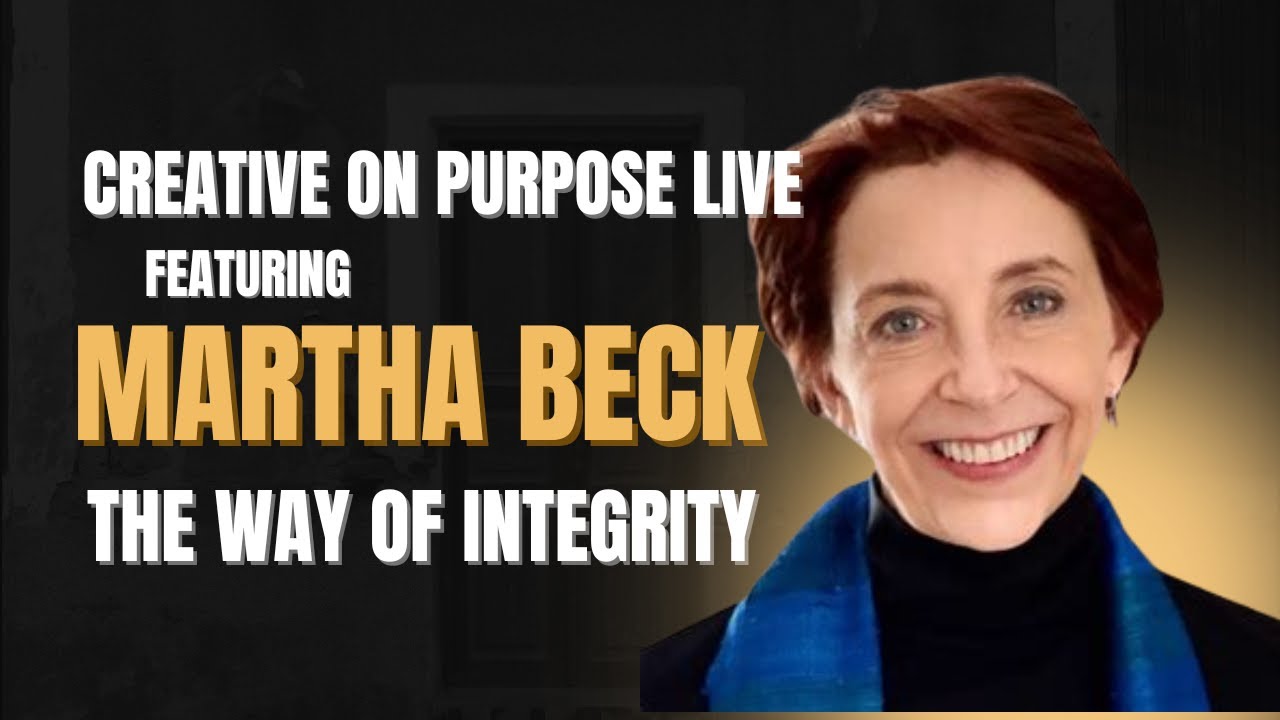
Martha Beck discusses her book The Way of Integrity and how small shifts, like "one-degree turns," can help you live more authentically. Beck moved from Harvard academic to life coach, and explores how integrity and service create meaning and resilience in daily life.
Chapters
We are live. We are live on LinkedIn. We are live on YouTube. We are live on Facebook. And we welcome you to Creative on Purpose Live. These conversations are about flying higher and the difference only you can make. I'm your host, Scott Perry, author of Onward! and A Compass Helping Advancing Difference Makers Live Their Legacy at Akimbo Workshops and Creative on Purpose. You can visit creativeonpurpose.com to learn more. This season, we're drawing insight and inspiration from guests Successfully Embracing Uncertainty and Navigating Adversity and Making Things Better Doing Work That Matters. Let's meet today's guest, Martha Beck. So pleased and delighted to have you on the broadcast. Please tell our viewers who you are, what you're up to these days, and where they can go to learn more about you and the difference you're making.
Who I am? Oh, wow. So many ways to answer that question. I'm a former Harvard academic turned life coach, which is getting just about as far down the prestige ladder as it's possible to go. But I love what I do for a living. I've written self-help books and memoir and a few bestsellers. And my entire life is devoted to figuring out how to be happy and then forcing that upon other people. Gently, gently. So I've just written a book. I can't remember which, how many I've written. Because once I've written them, I'm done. But this one's called The Way of Integrity. There it is. It may come into the conversation.
Yeah, fantastic. And people can learn more about you and the book and the coaching at marthabeck.com. Be sure to go ahead and put that in the banner down below. So I definitely want to talk about The Way of Integrity. As we were talking off camera, I've already let you know that this book had a profound impact on me, and I just— finished reading it not too very long ago, probably just about a month ago. But I am curious about your comment about moving down from Harvard academic to life coach. I would call that a serious upgrade. I mean, certainly, I'm thinking that you are making a much bigger difference as a coach, and I know a little bit about your Wayfinder program, than you would have ever made as a, as a Harvard academic. But I'm willing to hear your side of the story.
Well, it's just from within different cultures, of course, there are different biases. That's part of what this whole book is about. The fact that we are born with a true nature, and then it runs into culture, whatever our culture is, family culture, ethnic culture, whatever. And academic culture has a very strong set of judgments. Most cultures do. And typically we abandon ourselves, our nature, to accommodate our culture. And in doing that, we become split from ourselves, which is— integrity means to be one thing, whole and undivided. So when we're split, we're in duplicity. Not integrity. And that leads to a lot of suffering. So yeah, I abandoned academic culture. When I was teaching students, you know, social science and business, and then I started talking to them about their lives and they were much more interested in their lives, it turned out, than in sociology. So they would, they started paying me to just talk to them about their lives. And you know, I haven't worked an honest day since.
Oh, that's fantastic. I love— well, and I love that one of the things that I've noticed in a lot of the conversations that have been happening on this broadcast, and one of the things that's very obvious to me as I, I read your book, is you have, you have shifted your focus, your direction, your domain, that your endeavor has really changed over time.
Yeah.
I'm wondering if, you know, as someone, as we were talking about earlier off camera, my journey has shifted as well.
Yeah.
And when I think about it, at first it feels like, um, it feels like I've, I've changed direction. Like I've reinvented myself a bunch of different times, but when I take a longer, more thoughtful look back, even though I've done very different things, I see a common thread or theme, and it feels more like a journey of becoming more integrated. So I'm just curious about your reflection on all the different things that you've done and how you see where you are and where you're going.
Well, one of the things that is a cultural bias for us in American culture, but any modern culture, is that there's one thing to do and that finding ourselves is doing one thing and continuing to do it. And that if we do something different, we are changing. I don't see it that way at all. Everything in nature, there are no straight lines or right angles in nature except crystals. Did you know that when you draw or paint a landscape, if you put in a straight line, it looks all wrong. So everything curves, winds, bends, goes into fractals in nature. And our natures are designed to do the same thing. For example, the human brain, we now know, especially children's brains, learns best out of doors, moving through space, using all 5 senses, solving problems that are important to the individual at that moment. Contrast that to how we teach children. We put them in straight lines of children the same age, they learn the same things at the same time. This is a system designed to create factory workers. And it is, you're supposed to punch the clock your entire life and heaven forbid you should go off and do something weird. And then everything took on that tone after the Industrial Revolution, like even academia. You go to the office and you do work and you send it out and there's a system. And I, school originally meant what you do in your free time for fun. Rich people were able to just learn stuff for fun. So, I sort of went back to that. And I think of one's true path through life as winding through all sorts of environments and occupations, but true to the self within. That's the consistent thing, is that you feel like you're in the right place doing the right thing at the right time, and everything else will change continuously.
I love that framing. So the— if, if you start with integrity, if you, if you can, if you can find your wholeness, yeah, then you can show up everywhere you show up just as you are. This is really fascinating. I, I wrote actually about this in my own book, that I, I really suffered for much of my adult life by, because I had all of my roles compartmentalized, like, oh, I'm a husband and I'm a father and I'm a teacher and I'm a musician. And I felt like I was changing hats or switching gears all the time.
Right.
One day I woke up and just said, what if I just showed up as Scott Perry all day long? What would that feel like? And you know what? All the dissonance and all the noise was quieted. And it just— and so this speaks to, I think, one of the messages— well, the message of your book, which is, um, about integrity. And you've already alluded to the the definition, but would love for you to just restate the definition. And then I would love to just hear the origin story. Like, how did you land on the idea that this is such an important thing for us to become more human and more healthy moving forward in our lives?
Sure. Well, first of all, that is amazing that you did that. Almost no one in the world wakes up and thinks, "I'm just going to be myself all day," because that is what culture pushes us to avoid at all costs. Because we might break the rules, right? So integrity for me is not a moral virtue so much as a mechanical thing. If an airplane is in structural integrity, all its parts working together, functioning and interacting well, it can fly. It can do this amazing thing. If it's not in structural integrity, it may not take off. It might not be steerable. It might not go where you want it to go, or it even may crash. And when our internal parts aren't aligned. So you wake up as Scott Perry, who happens to want to, you know, play music that day, but that's a day that you have to go put on another hat and go get medical tests or something. And that's— so you split from the person you are to fulfill the needs of the day. And if you do that unknowingly, there's a division in yourself that you don't— you're not even aware of, except that it will start to create discomfort, first very subtle and then growing and growing and growing through levels of suffering until you may be in complete anguish. And what happened to me, it's much easier to lose your integrity from trying to be good, or it's much more common, than from saying, I'm deliberately going to be bad. I'm going to defy society. Most people don't do that. By the time we're old enough to talk, most of us have already learned how to please the people around us at the expense of our honesty about what we're really feeling. And you know, it's pre-verbal. We don't even understand it until we get there. So that's what happened to me. I was a real do-gooder and I was born in a very, very Mormon part of the world. I'll let you guess which state I was born in. And right in the heart of the most Mormon part of that state. And my father in fact was quite a big cheese in the Mormon religion. So I was, I was socialized into that very early. And it's like, every man who is good will get his own planet with all the wives he wants. And I'm like, okay, I'm 5. What do I know? That sounds good to me. But by the time I was a teenager, I was like, wait. And then I went off to Harvard, which is about as different from Utah as is possible to get in the United States. And there everybody was very much a materialist, rationalist, atheist. Kind of Newtonian versions of the world. And I went there too, not specifically, well, it did make more sense to me than religion, but mostly I just wanted to fit in. I wanted to get the good grades and be liked by my peers and my professors. And it turned out that that way was as far from my true self in some ways as Mormonism was. But now I was caught between two dramatically different cultures. Neither of which was really satisfying my intrinsic sense of meaning, purpose, and the meaning of life, right? So I just felt, I started to develop the symptoms that I call Dark Wood of Error symptoms. I based this book around Dante's Divine Comedy because I read it at 18 as a self-help book because I read everything as a self-help book because the only reason to read was like help. Help! So, uh, he starts in the dark wood of error. He doesn't know where the hell he is. And, um, he— there are people now who come to me. The Divine Comedy opens with this statement: I, in the middle of my life, I came to in a dark and savage place, and I had no idea where— how I'd gotten there or how to get out of it. And most of us have that awakening moment at some point. And we say, this really stinks, I don't like this. And the 6 symptoms that I developed that I've seen other people develop were first a sense of a loss of meaning or purpose, which is, you'd think that if you go to like impoverished people or people who've been through war, that meaninglessness wouldn't be their biggest problem, but it is. Viktor Frankl wrote "Man's Search for Meaning" after surviving Auschwitz because that was, the most important thing. This is not something we are taught in our culture. If we don't pay attention to that, we start to get emotionally, blah. So depression, anxiety, irritability, all the way up to huge mental illness. Then we develop physical symptoms. At 18, I started developing autoimmune diseases that kept me almost bedridden for 12 years. Then we get, things start to fall apart in our relationships and then in our occupations. And finally, we may turn to some kind of compulsion or addiction, develop, develop a compulsion or addiction to deal with the suffering. And this whole time, so all of these things developed in me. And by the time I was 29, I was so torn and miserable with all of these that I just decided all these wisdom traditions say the truth will set you free. Well, okay. The year I was 29, I made a resolution not to lie for an entire year. And I kept that resolution. And my entire exterior life fell apart. I lost, I left my religion, which meant losing my family of origin, which was huge. I left my job and academia, the only way I knew to make money, 'cause I hated them. Oh yeah, I realized I was gay. So that was the end of my marriage basically. I left my home. I left basically everything that made my life look like it was working fell apart. And, um, everything got better inside. I started to feel whole for the first time. My depression went away. My physical symptoms began to resolve. Uh, I was at peace for the first time in the middle of this chaos of losses. So I feel like having walked that path and then spending 30 years trying to be as true to myself and others as I can be, and coming to a place of enormous joy that I want other people who are suffering that way to find out that you don't have to feel bad. So that's the origin story.
That's— there's a lot, a lot to unpack there. I just, I want to first though just articulate, I loved the, the framing of your narrative around Dante's Inferno. I just thought that that was, that was, or I'm sorry, the Divine Comedy. The Inferno is just one of the books, but, um, I just, I found that very, very powerful and impactful. I probably only read excerpts of Dante in middle school or early high school. So it made me really want to return to that book because it is, your, all the metaphors, the way you walk us through the narrative is really, really fascinating.
Thank Dante.
That's right. Well, what's interesting is now that I'm saying that out loud, my last book, I actually based on one excerpt from Marcus Aurelius. We were talking about Marcus Aurelius. Oh, really? Yeah. So there's the three disciplines in Stoicism and Marcus references them repeatedly. And I just unpack those and gave them a modern telling in the book and then revealed line at the end.
So I've got to get your book.
Yeah. Well, I think we can arrange to make that happen. So there's a couple of things that really, really leaped out to me that I'd love to just unpack a little bit more. One of the things I loved about your definition of integrity is that you're, it's beyond morality. It's not like, yes, you know, integrity means you look at the world through this, you know, Christian lens, Jewish lens, Islam, you know, it's beyond the usual definitions of morality around culture, religion, what have you. But I got the sense that there was still, there's still an, there's an ethical quality of the integrity that has to do more with internal character, virtue, that sort of thing. Is that, is that a fair read of where you're going?
Oh yeah, that's very fair. I read it. I I look at integrity as physics. And I say this, it's not morality, it's physics. My life and my psychology and my body work best when I am living in a state of truth. And it's not because it's virtuous, it's just because I'm now aligned with reality. It's like when you fly a plane, if you're not in alignment with the laws of aerodynamics, you can't fly. When you get it right, you can fly, but not because you are a good boy or girl, because it's physics. So I think that there is this very, very complex interactivity between our physical and psychological systems. And when we are out of touch with ourselves, it clunks along very poorly. And when we get it to sort of hum along all together, what happens is that we move into an ethical state, not to be virtuous, not to please others, not out of fear of punishment for being bad, but because it simply works better. Everything works better when you start to live according to the truth, not culturally. So, you know, you've changed courses many times in your life. I've changed course many times in my life. And most cultures tend to look askance at that. Like, how could you have stopped doing what we do? And that's because of a certain setup in the human mind, the righteous brain, Jonathan Haidt calls it, the righteous mind fastens onto a certain way to do things and becomes very dogmatic. And Dante actually encounters that in the Inferno at the level of the violent, which is deep into hell. And to be out of violence in the mind, violence in our lives, we have to stop fixating on one way to do things and become very present with what is. When we do that, compassion arises. It simply does. It does in every culture all over the world. In fact, I think Dante had an experience that we, that as an undergraduate major in Chinese, I lived in Asia for a while and in the, in East Asia, there's this phenomenon called awakening that everybody's familiar with. You're, you, if you look internally long enough and if you live in enough truth and if you align closely enough with reality, you experience this sort of shift away from suffering that is irreversible. And now we know that we can actually find that in the brain. It's a real phenomenon. And one to which the neurologist Andrew Newberg says, we are biologically predisposed to move. So yeah, ethics arises, enlightenment arises, but all as a result of simply trying to feel find the real and stay with the real. So Marcus Aurelius was right up there with him.
Yeah, no, that's, that's, that's fascinating. And the other thing that you— your answer just reminded me of is how in your introduction you talked about how important it is to be of service to others. And this is at the heart of Marcus Aurelius's journey and, and Stoic philosophy, that we are inherently social creatures born with the capacity to reason and should employ that in service of others to make things better. And, and we, you, you were talking about Viktor Frankl, another favorite of mine, and Man's Search for Meaning, which is a book I still read at least once a year. Uh, there's this, that, that, that, that to me is one of the essential things. And I saw this as a thread in your book. Search, forging meaning from every situation. And then, and you went, you, you are very generous and vulnerable and, and laying out all some very serious struggles and traumas that you went through in your life.
Yeah.
And you could have been broken by any one of them and remained broken, but it felt like in one example in particular, you were completely broken open, and that was what brought you a sense of enlightenment. And you you were able to forge meaning and find purpose in that moment. So I would love to just have you unpack that a little bit more. Like, what was it? Was there any conscious effort to make a moment of becoming broken into a moment of being broken open and being able to emerge more with more integrity?
Yeah. Continuous, passionate focused effort. It was almost like, you know, you're a musician, it was almost like I was learning to play meaning in my mind. Most of us use our minds to narrate and recreate whatever our culture has taught us. So we just, we stay stuck in these eddies. Every now and then something comes and smashes us open. And as Leonard Cohen says, there's a crack in everything, that's how the light gets in. So one of mine came when I was a doctoral candidate at Harvard and My second child was prenatally diagnosed with Down syndrome at just the time when I could legally still get an abortion, but very late in the pregnancy. So although I am very pro-choice, I decided not to terminate, very much against the advice of all 5 doctors at the Harvard Medical Clinic and all my academic advisors who said I was throwing away my life. The doctor said it was like having a malignant tumor and not letting them take it out. And yet, my nature was attached to this child. I'd already watched him suck his finger on the ultrasound. And also, I must confess, it's in the book, ever since, from the moment he was conceived, I started having experiences that could only be described as psychic. And throughout the pregnancy, they continued. Pretty dramatically. They tapered off after he was born, but he still has kind of a woo-woo thing about him. Anyway, so that's part of nature too. I mean, the mystery is something that we've sort of tried to wash out of the culture, academic culture, but it's very present in every human culture throughout history. So my natural love of my baby and my curiosity about the mystery led me to keep the baby. And what that meant, I had to find another reason that life was meaningful for my child. Like when you have a kid, you don't even care about yourself compared to what will happen to your kid. So I thought this child can never get a Harvard PhD, which, or be a professor or whatever I had put at the top of my list of achievements. And it sent me on a journey to figure out what I thought a human life was worth. What was the justification for keeping this child whom everybody told me would suffer because he would be inferior? And it finally occurred to me walking around Harvard, looking at all the pinched and anxious faces, that I don't think these people were particularly happy. And Emerson said, "Beauty is its own excuse for being." And I thought, joy is the felt experience of beauty. It's its own, excuse for being, and this person can feel joy. And by the same token, if I never experienced joy, what is my life about? So that shifted me. Um, and then later on during my year of not lying at all, um, I started to have intrusive flooding flashbacks of being sexually abused by my father, which, um, it broke me down to my toes. Um, and then during a surgery that was actually repairing some of the scar tissue left by that abuse, I had what might be called a near-death experience, even though I wasn't near death. I was in total anesthesia, and I regained consciousness, sat up, looked around, and then noticed my body was still lying down and thought, what the hell? Lay back down and saw Right above, between the surgical lights was a ball of white light that was so exquisite. I, it was more fascinating than anything I'd ever seen in my life. And it grew and then it touched my body and flooded me with this incredible euphoria and sense of homecoming and peace and knowing what I actually was. Which was not a person. And I woke up from that with my whole world completely changed. And that's actually what gave me the ability to survive loss of contact with my family and community of origin and all the— I had death threats come at me once the word kind of leaked out. Wrote a book about it later where I really got a lot of death threats and people really came after me. But the thing I got from that light, whether it was a misfire in my brain or whatever it was, was, this is the way you were meant to feel. Now go and do anything that makes you feel this way and don't do anything else. And that, um, yeah, that's what I've been doing ever since.
Well, and that was one of the, the big takeaways from me is that there's the pursuit of meaning and identity, which is, you know, I think, you know, we all, whatever work we do, whether it's the work we do for a living or the work we do that we get to do just in our lives, we are trying to figure out who am I and what is this all about? And your journey. Through all of these, uh, uh, you know, and that last trauma happens kind of is revealed later in the book.
Right.
But the, the through line is a continuing, it feels like is a continuing sense of equanimity, like being still even within the storm of the death threats and, and the trauma and the, and, and all the challenges and, and continuing to lean into uncertainty.— if the, the feeling is that you were— you became increasingly still within that storm.
Exactly, exactly, exactly. And what I discovered is that the emotional roller coaster that goes with having a human limbic system, it will continue throughout life. There'll be happy times, sad times, good things will happen, bad things will happen, COVID will happen, vaccines will happen, and all of this takes us on a sort of emotional roller coaster. But there is a different sense of stillness. Biblically, it's called the peace that passeth all understanding, because it makes no sense that it could be still and holding and, and calm and peaceful in the— in a catastrophic situation. I'm not saying I could hold it in a catastrophe that— like a major one, but I, I've been able to with the catastrophes that have come my way since then. And I fully intend to keep trying until I can handle my own death, because that's something we all look forward to. And we look forward to it with varying degrees of, of fear or anticipation. And to sit calmly in the midst of a life that is certainly going to end, um, it helps me to think that the waveform of that goes birth, death, birth, death, birth, death, but the field through which it travels is life. So there's happy, sad, happy, sad, happy, sad, but the field through which they travel is stillness, and that is inherently exquisite. And once you've tasted it, you want to keep tasting it.
Yeah, for sure. I love that. Well, as we're coming to the end of our time, uh, I wanted to just quickly flash through— we've, we've got some folks that have been tuning in. My friend Sam from Akimbo Land loved your no lie, your year of no lying and speaking your truth. And that was a fascinating experience. So encouraging all the viewers to, if you want to just be entertained by one thing in this book, the journey through a year of no lying was really fascinating. Kathy is really really resonating with the idea of integrity. Couldn't agree more, Kathy. So important. And then finally, my friend and client Andrew is also here taking it all in. So some more, more than the usual number of fans, thanks to you being so, so famous. So thank you for that.
Oh, yeah. I'm very well known among people who've heard of me.
Yes, yes. Famous to the family. Well, what you've, you've shared so much wisdom already. Uh, I do want to just strongly encourage everyone to go to marthabeck.com and grab yourself a copy, or if you want, listen to the audiobook. Martha reads it herself. I've, I've actually done both and, uh, both experiences. And, um, Martha, you also have a, a coaching program, a certified coaching program called Bluefinders. Which looks really fascinating. What I would love to invite you to end on is you've already dropped plenty of, of tips and advice for people like us who want to fly higher in endeavors that make a difference. If there was just one final idea, exercise, tip that you could impart for anyone here that aspires to either start on a journey of making a bigger difference or advance in an in a journey of making a bigger difference, what would you invite them to do?
Right. Well, first, don't go a year without lying. That's— you might as well just go throw yourself into a wheat thresher. It is not the easy way. So in the book, I recommend a very gentle way, which is more authentic. So what I would say is take some time today and tomorrow and the day after that to sit by yourself and notice how you actually feel. And if you feel bad, think, What could I do to make myself feel a little better? And if you feel good, ask yourself, what could I do to make myself feel a little better? And this will begin to slowly return you to yourself. I call it one-degree turns. Back to the airplane metaphor, if you turn an airplane one degree north every half hour, you won't even notice the change, but you'll end up in a really different place. So one degree toward integrity every day. Toward your real self, and, and you can fly anywhere.
Fantastic. That is great advice for wrapping things up. We want to thank everyone for tuning in today. Martha and I really appreciate you lending us some of your valuable time and attention, and we hope that today's broadcast invites you and motivates you to lean into an endeavor that matters with a little more curiosity and courage. You can learn more about Martha and the fantastic work that she's doing at Martha Beck And of course, it's always great to see you at creativeonpurpose.com as well. Now, please take the insight and the inspiration from this conversation and fly higher in the difference only you can make. Martha Beck, thank you so much for your time and all the wisdom that you've shared with us today.
Thank you, Scott Perry. I can't wait to get your book and read it. Thanks so much. Thank you.
More from Scott



Stoics Don't Suppress Emotions, They Do This Instead #stoicism #emotionalintelligence #mindset







