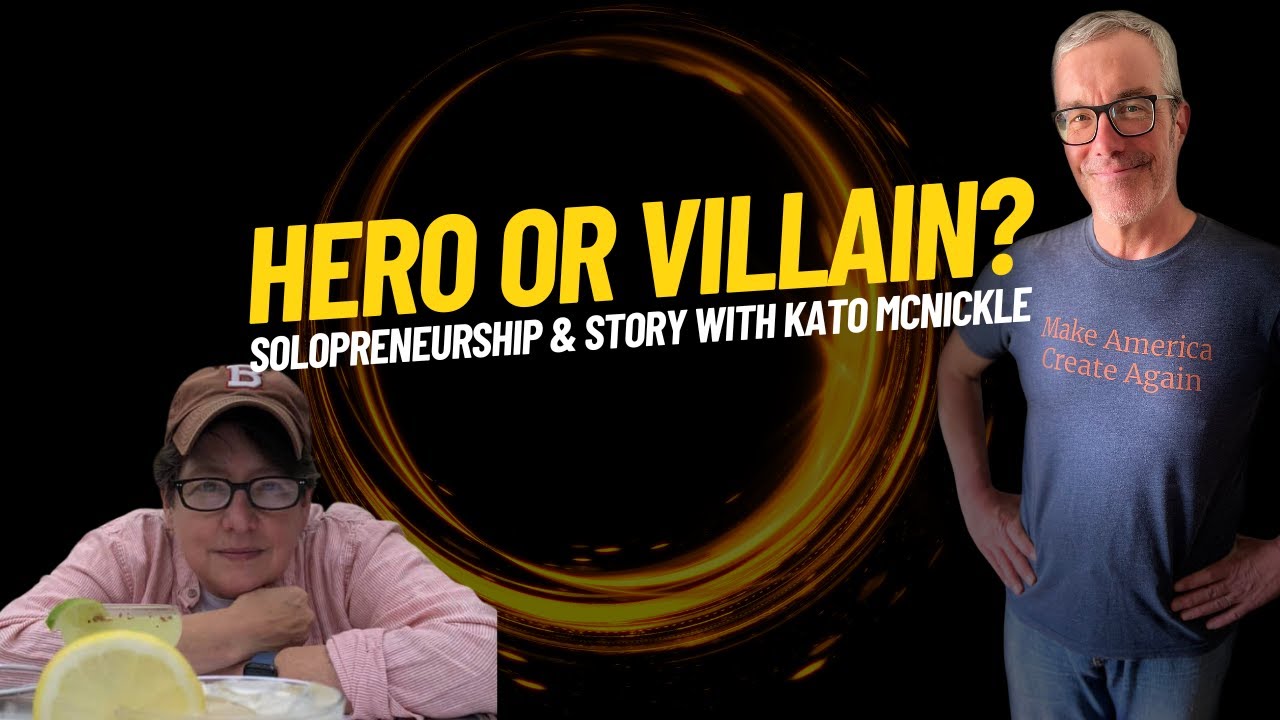
Scott Perry and Cato McNichol discuss how solopreneurs can reframe their inner narratives using storytelling tools. Cato, a former theater artist and illustrator, shares how she moved from shy introvert to confident creator through daily writing and community. They explore Joseph Campbell's hero's journey and the Drama Triangle as ways to escape victim and savior roles that keep solopreneurs stuck.
Chapters
We are live and there's actually already one person watching. So welcome to Creative on Purpose Live. Uh, I'm Scott Perry. I am the publisher of the Purpose Driven Prosperity Model, which is dedicated to helping solopreneurs optimize their business systems to fund and fit the life that they started their business to live in the first place. I am here with a Solopreneur Success Circle member, Cato McNichol. If you don't know what the Solopreneur Success Circle is, it's where all of the coolest The best-looking, smartest, and most creative people on Substack are hanging out. Cato is one of our very first and continuing to be contributing participants and members. And so if you want to learn more about the Solopreneur Success Circle, I'll drop a message in here at some point with links. But this is a series of conversations that I'm doing live with members of the Solopreneur Success Circle, just talking about things that are interesting, at least to the two of us. And Cato, uh, I'm okay. I want you to start by just like talk— just share a little bit with everybody about who you are, uh, what you're up to these days, and where can people go on SubSec to find out more about you and the great work and difference that you're making.
All right, let's see if I can keep all that in my head while I, I think about what it is. So what do I do? I have worked in theater as a playwright and a new play developer, as well as a director and producer, and I have I've since been moving into the space of learning how to create children's books, picture books, and reviving my illustration skills because back in the day before I got into theater, I was studying to be an illustrator of children's books. But basically, it's kind of in the story space is where I live and where— how we create stories. I work with people who are developing new pieces, whether they are in the form of prose or their poetry or their screenplays or theater plays, uh, and that's a lot of what I do. So it's how do we tell stories and what are those facets, and that is— I have been studying that for quite a while. And, uh, so on Substack, because that was one of the questions, where you can find me, my Substack right now is called Nimble Jacks. That's my personal one where I'm writing about what I'm up to, what, what I'm thinking about as a writer or a creator of things. And then I'm also working with a group project called the Wolf Criers Club which is a group of writers and illustrators that we've been together for about 2 years, and we are building a cooperative kind of venture and audience and learning to tell the world about our work together as we start moving into the space of either independent publishing or traditional publishing. And as we learn to navigate that, that world and realm, and that's a bunch of children's book and also graphic novel kind of people. So that's who I've been hanging with in a lot of the Substack space, which there's a really vibrant illustrator and writer community. So I'm very excited about that.
Yeah, I heartily recommend the Wolf Criers Club and Nimble Jack, uh, and just recommend associating with Cato in any way she will allow you to associate with her. Um, it looks like we've got some folks, Parker Arts and Eva have joined. Great to have you with us. Um, let's kind of get to the topic at hand, uh, and, you know, which I— you mentioned story. You and I both come from a world where, um, story— in Seth Godin's ecosystem, uh, creativity, uh, the storytelling workshop, these things that are associated with Alta MBA and Nakimbo, which you and I are both familiar with, um Story is something that is obviously really important. The way I see it, story is how we make sense of ourselves, each other, and our situation and the world in general. And stories often have heroes and villains. Let's talk a little bit about heroes and villains. Okay, and what's your take?
Well, and what had happened, and the reason I even brought this topic up, Scott, is I was recently involved with a development workshop with the people from the Moth Radio. And this is kind of one of these, you learn to tell a story through their method, you're with them in these intensive 3-hour sessions 5 times, and then you do a story slam together with the group that you're in the workshop with. And as I was relating what story I was going to land it on to retell for this, I was telling this to my spouse what my story would be. And my spouse started laughing and went, "Hahaha, turns out you're the villain in this story." And I was, "You're right, I am." Because when we set up our stories, we of course are usually like the hero in the center. And for a lot of my story, I am until I really make a big mistake in it and come down on a person too hard and for the wrong reasons. And let my frustration get to me. And then on my way home, realized that I was in fact wrong and then worked to make amends and apologize for that, which turned out for this, it was a teenager that I was working with at the time, and it was the first time they had ever heard an adult apologize about anything or ever admit they were wrong about anything. And that story has always stuck with me. And that got me just thinking about like, oh, well, you know, it's interesting though, in your story, as you're telling it, is where are the parts where you fail? Where are the parts where it gets to you, where you go the wrong way? And then what do you learn from that? And do you, do you hold hard and fast to that? And your, your point of view, of course, in the moment, you, you're not thinking that you're doing a villainous act or something. You have all the reasons, but then How do you then take that step back for perspective and see what was going on? What is true about it? What— how is it seen from the other side? Uh, and then working to come back from that. So that just got me thinking about aspects of villainy in our personal stories, the kinds of stories we do tell and construct also. Like, how does that fuel, you know, knowing that that impulse is in me? That's the kind of thing that you feed, though, into work that you create, your creative work. And you have to follow it because when you write villains, you have to understand them and you have to enjoy kind of what they're doing in a way or see it from their point of view. And how do you make that happen? And with that, there's the pairing of how does that work within the hero? There's a hero on the other side. Perhaps sometimes you're the hero, perhaps things fluctuate. But what is that? In part because some of the investigation I've been doing lately was at what makes a, what makes the heroic story last? How do they move through time for thousands of years? Why do these things come back? And looking at aspects of the hero stories that really endure have more to do with how the hero's heart breaks and then how do they come back from that? That's their heartbreaks, usually just before they have to move into whatever the final action that, that is going to be their immortal story in some ways. Um, so I was looking at aspects of how does heartbreak function in the hero's story, but even as we're telling our own stories and with Wolf Criers Club, that's what we're practicing, how to tell our stories, but also sometimes it's easier to look at someone else and, and help them frame their story, especially when you're learning how to do this. So, so what are those things? And when we are telling our hero's story, but where, where are those places where villainy creeps in. So that's— that— those are some of the questions I've been asking myself the past couple of weeks.
Yeah, well, I love that. I mean, we often hear gurus and sometimes, you know, elsewhere, people talking about, well, you got to be the hero of your own story. And, and the hero's journey is something that a lot of us have heard about. I fell in love with Joseph Campbell in the '70s or whenever it was when he was having those conversations with Bill Moyers on PBS. And the thing that crept up for me immediately when you and I just started spitballing on this topic is that there's the archetypal hero's journey and we can map that over our own story that we're telling ourselves. We can map that over marketing. There's people that talk about story-driven marketing and making the customer the hero of the story and all that. That's all great for tactical, selfish, transactional kind of dialogue. But the thing that came up for me was Cartman's drama triangle. Like in any situation, in any drama, we have the, the, the victim, the persecutor, and the savior. And what I have noticed is that we actually, in any given situation, can play any of those roles and often move in between and amongst those, all those roles, and we can be more than one at the same time. And so in our community, the Solopreneur Success Circle, I would say that, you know, as a community of kind of purpose-driven, difference-making solopreneurs, creatives, and so forth, like most people probably self-identify as, as like a savior, as a hero, like they want to help, that they're helpers, they're fixers, they're problem solvers. And so we think that like, oh, it must be, that must be a good role. And it's like, actually, in my experience, saviors are often trying to help other people solve their problems to avoid acknowledging and solving their own problems. So in a way they are they are the villain of their own story because by always trying to help other people, they are not taking the look in the mirror and dealing with the demons and the situation in themselves. There's also this coaching framework, and I cannot remember the name of the book or the author, but this idea of an inner saboteur, like we are. Simultaneously the hero and the villain of our story because most of the obstacles and demons that we have to conquer in order to achieve the prize that we are going to bring back to the community, the biggest obstacle is always ourselves, right? So it's our inner narrative, our stories about our own worthiness and/or unworthiness. Our stories of victimhood, our stories about being, needing to be saviors for other people and putting ourselves last. These are all things that really can interfere with our ability to heed the guru call of being the hero of our own journey. So I don't know if any of that resonates, but that's kind of what comes up for me.
Well, one of the things as I work with many artists developing their plays or now also helping with developing children's books and learning to do this myself, one of the biggest things that comes up that I've learned to recognize pretty quickly is when are they the self-saboteur? In part because failure is more comfortable. They are used to not succeeding, and success is frightening. And when you get close to that, it is It can be overwhelming and it's more overwhelming than failure. Failure we're used to, and then you get to have the hard luck story and again, no one understands my thing. You know, because sometimes I would be working with people and for years, turns out for a couple years, I would be sending hand-finding things like, your play would be perfect, send it here. Your play would be perfect, here's what to put in your letter, here's blah, blah, blah, blah. And then 2 and a half years later, this person had then commented somewhere about like, oh, I've been finally sent something somewhere. This is the first thing I've ever sent. And I was like, I have been spending time for 2 and a half years sending you individual things with the prompt, telling you exactly who to send it to, what to say, and you just sent something. And I was shocked, but also like, wow, wow, wow, wow. Uh, and learning to see into that a little better and also have compassion for that. But then starting to understand, "Well, I understand why you're not moving forward and why you think I'm lucky." Because it's not luck that got me to know how to produce plays and how to workshop my own work and how to get it strong and get it out there. It was I studied it, I learned how to do it, and then I made a lot of mistakes trying to get stuff together. And then I would— it's always— eventually learned how to put festivals together, and then people started seeing me as this person that made this stuff happen. And, uh, uh, but it was over many years and also many things that just went wrong for the first, like, 5 or 6 years. And I tried to make different ideas for production companies and things get together, and they would just not go. But they were like that idea of, like, what theater is. This is— I never thought about this quite like this before, because when I was a young artist, I wanted to do all these things. They were big. And they needed money and they needed backing and they needed all the stuff. And it was learning how to just pull back and just make the tiniest thing about learning how to do a good reading, but do a good reading. Like you can make readings so exciting. And when I started seeing how to do that and you can just do it for no money or hardly any money in, because people will give you spaces if you just learned how to talk to them. But I had to get over that because I was incredibly shy. I had debilitating shyness. And I forced myself, as you guys have heard the stories, um, in the— in our circle about where I would go to yard sales and only bring $8, and I would just lowball everything just so I would upset people. Like, because you're disappointing someone, you say, yeah, I know you say $30, but I have— I have $8. Will you take out $8 for it? And they always said yes. So I got like old phones and things we could use in plays, but to go through that discomfort of a long— and it was a long-term plan though. I was like, oh, I'm not going to learn how to do this in a month. This is like a— I literally made a 5-year plan to learn how to get better at talking to people and would go to things and force myself to comment. I would have a pad though, because I'd get so nervous and my heart was like, the thought of raising my hand and doing it was, ah, and I would write it down. So because I knew my thoughts would leave my head immediately. Created the systems to— and then people would enjoy hearing what I had to say, and I was at least had it written down so I could say it. And then practicing that, they would invite me back because they wanted me to come back and talk more about their work. And that was how I learned how to do the thing anyway. And then I forced myself because I— it would have been a disaster had I not figured out tools to have with me to support me. But, but yeah, it's like, no, it wasn't magic right away. I spent 10 years of like barely being able to get something together, but then I worked with some companies and learned how to do— I watched people do things and I used their best practices. But yeah, so we got onto this about like, but like, oh, you know, what are those skills? And then who are you in that? How do you see yourself? But then seeing so many people that just set themselves— they spin in it, or they only write the one thing. And they can— they'll write more after they get the one thing to be successful. But it's like, that's not how you do it. You keep writing more things. So you have like a whole line while you're— instead of spinning, like you just get all this stuff. You can always grab the thing, then the next one and throw it and don't worry about it. And that way also you're not in love with it. When you're in love with it, it hurts if it doesn't— if it gets rejected. But if I've got 10 of them and I'm not in love with any of them, or I know which one I am in love with, like, okay, this one's special. I'm gonna do this a different way. But, um, and to set that one up for, for success or whatever. But most of them are just like, okay, these are just the things I'm gonna throw now and see where they land and who does it catch.
I want to just stick a pin in two ideas that are coming up for me: perspective and attachment. But first, just want to say hello to Claire Charmaine Scott Perry, Molly Perry. Molly is also a member of the Solopreneur Success Circle. Skipper is here. I recognize that name from the Alt MBA and Akimba Workshops. Tess is here. Tess says, I am beginning to visualize success just as one task at a time or a vignette in my mind. I love that. Yeah, that reminds me to talk about Choose Your Story, Choose Your Future. We have Ashley here and Seth is here. So we are talking, you know, when we're talking about are you the hero, are you the villain, are you a little bit of both, um, and we're, we're talking about storytelling and perspective is so important. Like, I think about, um, you know, when I was in middle school, we all had to read Beowulf, and Beowulf is a, is the hero of Beowulf, and Grendel is the villain of Beowulf. But then someone wrote a book called Grendel where Grendel was the hero and Beowulf was the villain of that story. And so there is that element of perspective in storytelling that, like, I have this thing that I first shared, I think, in my book Endeavor, but I've been just building on it over the years since then. Choose your story, choose your future. Human beings make sense of themselves, each other, their situation, and the world they live in through narrative. I'm telling myself a story about myself that I want you to believe. I'm telling myself a story about you that you may or may not agree with. I'm telling myself a story about the situation I'm in and how great I am or how victimized I am and blah, blah, blah, blah, blah, blah. It's all story, story, story, story. And at any moment, by simply shifting my perspective and choosing to tell myself a different story or reframe the story that I'm telling myself, I can actually change the person that I am becoming. And so, like, you are always going to be simultaneously the hero of your story and the villain of your story because the biggest obstacle you have to overcome is yourself, is your narrative around worthiness, your narrative around victimhood, your narrative around being a savior of other people and so forth. And then, but there's also this element of attachment. Like if you cling to, I call it the identity trap. Like if I have this vision of what a hero looks like and what success looks like to me, like a successful hero's journey and I'm attached to that and I don't get it, then suddenly I'm victimizing myself and telling myself a story about being a failure and not being good enough, worthy enough, et cetera. If I get what I want, I might be telling myself a delusional story that I got what I got because of my incredible talent And genius, even though I just really got lucky. All of these things really come into play, but it all comes down to storytelling. Choose your story, choose your future. And one of the things that I heard in what you were saying, Cato, is you became a person that could stand up to be seen, speak up to be heard. By putting yourself in very low-risk situations where you could stand up, practice standing up to be seen and speaking up to be heard. And over time, you became the kind of person that was unafraid to stand up, be seen, speak up, and be heard. It's a process. The process is the shortcut. The process is also the reward. You might not have become exactly what you sought out to become, but the intention and integrity of that effort was its own reward, was in its way its own hero's journey, overcoming your own inner demon, and turned out good for you. You became the kind of person that you wanted to become and you became very successful in, I think as far as I could tell, you've become successful in everything you've ever set out to do. And doesn't mean that you're a household name, but it certainly— famous to the family, as we would say in Seth Godin's world, right?
So, well, also in my community, which is kind of strange. I live in a very small place in Connecticut. I live in the southeastern section, but, uh, over by Rhode Island. So it's not like near New York where it's much fancier, but I, uh, but, but people know who I am. People have read my name and haven't met me. And so when they do hear me, uh, hear my name, hear me introduced, they're just, oh, I've, I've been hearing about you for years. I'm so glad to finally meet you. To the point where now when I go to introduce myself and say my name, I have this subtext in it that is like, of course you've heard of me. Because it's happened so many times. Ah, I've heard of you. And so now it's like, what if I just put that in the confidence of my handshake underneath? And it is fun to kind of just do that because then people go, oh, even if they haven't heard of me, they just start asking me, well, what do you do? What do you do? Because it's like in the, just in the vibe of it. But anyway, it's just this weird little quirk that has happened here. I don't do that when I'm in New York or someplace where I'm just like, of course you have no idea who I am.
I think it's actually fun to do that kind of like, to like, when you, when, when you graduate high school and go to college, like I remember distinctly having like that Oh, maybe I don't have to be, you know, the nerd in college. Maybe I could try to—
Did you rename yourself? Did you rename yourself? The power in names. I always put this in— I almost always put this in plays. So, uh, if there's a chance to like have somebody go through a transition where somebody else renames them or they rename themselves for some reason, what does that start to mean? In part because when I went to college, I purposely used a different name than the one I grew up with.
Oh, that's interesting. Well, I think naming is really important, but again, I think it's also like we forget that the power of and the perils of the identity trap. Like in high school, like you were either a jock or a nerd, and the jocks played sports and the nerds played Dungeons Dragons. And I did both, so I never— like, I always felt like the man without a country. Like I didn't really belong firmly, fully, completely in either camp, you know. And I, but I, I got into college in part because I got an athletic scholarship, so I kind of felt like, oh, I've got to be the jock. And after like one year of college football, I was like, this is bullshit. I, this is no fun at all. I am not doing this anymore. And that's when I picked up my guitar and was like, I'm not doing this football thing anymore, but I've got all this time on my hands. I guess I'll learn how to play this thing. And like, I started to step into that identity of, uh, of being a musician, which became an identity for like the next 30 years. Um, and when I was kind of ready to slough off the skin of that identity, you know, I, thanks to, you know, Seth Godin hiring me to be be a coach in Akimbo Workshops and given me a kind of a 7-year runway, I was able to step into this other identity. And all of those identities are stories that I began to tell myself before they were true. Go ahead.
Well, and part of that makes me think though about liminal space, which is something I am fascinated by. And it is the most theatrical space, like what is that place? Because it's the place in between and when you're in the threshold and what is it like to hold liminal space, in part because just like you, well, in my world, there was the— there were the athletes, which I was briefly on track team. I was a thrower. There was the— this is for high school— there was the whole art crew, 'cause I was an art major in high school. So I took all the art courses. I was the class artist. And that kind of had crossover with drama when I got into that. But also there were the freaks, and they were the smokers. But I, I was remembering this, like, I used to hang out with some of the freaks, although I didn't smoke and do the things that they were doing. But I did know some of them from study hall, and I got along with them fine. And then I would kind of cross over through to my art group, and then there'd be like, well, who was in that? And there's sometimes there's some crossover in that world. But then also then the athletes, there was a But I used to move in the different spaces and I've always done that where I've been able to interconnect teams. And when I was in, I was in a softball league as an adult and people started noticing the team started hanging out together more, the different teams and having different things. And somebody pointed to me once, they told me this later, like, ah, they said they didn't know why this was happening. They'd been going on for years and the teams were always very individual and they didn't know why all of a sudden there were all these like teams that were doing parties together. And somebody pointed at me and said, because I was walking along the hillside talking to different groups and finding out who is who and just kind of saying, oh, they're doing that and they're blah, blah, blah. Oh, there's going to be a picnic at the whatever park. Do you guys want to? Like, it turned out I didn't know I was doing this at the time till this other person told me about it. But I was the new thing in the equation. But I also wasn't that good at softball. Um, I was like the catcher and the backup pitcher. But, uh, the, uh, yeah, so that inner connection, uh, was something I was able to do. And that's something I've always done. I'm also able— what made me a good photographer is until I come forward, you kind of don't notice me. Like, I can come forward very forcefully right away, or I can hang back and people sometimes don't know I've been at a thing. In part because when I learned to take photographs, I don't want to be seen. I want to take good photographs of your event or of your show or whatever, and I don't want to disturb the other people there trying to see the thing. So how do you come in and, and do that and get good photos? You have to get in close, but you also like have to not intrude. So what does that start to do? And you also have to see what's going to set up the good photo, because if you see it before you click, you missed it. So you have to start anticipating like what is happening dynamically to make the shape and the light and all the things that are going to make a good photo later for someone. And, and also be close enough because that's the other key, but not disturb the actual thing you're trying to take a picture of. So, but what you were describing, Scott, just made me think about that. But then also in art stuff or anything, like thinking about the liminal spaces and where are they. And as a queer person, I've always been in a liminal space between worlds, especially growing up, who's it safe to tell, who's it safe not to? We're in a different kind of world and culture now where it's much more forward and you can talk about it and people don't freak out. And how do those interconnect and tie through? But it is very much in the art space and how you How you create, create that, because that is such an interesting space.
Well, I love that reflection because it ties right back into perspective. Like, how do I, like, how do I see the world? How do I see things? How do I want to be seen? How am I seen? Like, and you know, that whole idea of like being in the background so that you can capture moments, um, as opposed to inserting yourself into, into moments. That's, um, it's really interesting. There's also like, you and I share a great affection for, um, the virtue and the value of playfulness. And like, storytelling is like— I, I remember my childhood being a storyteller. Like, I just made shit up. Mostly to get out of trouble with my parents. But I also, I borrowed my father's old Smith-Corona typewriter and I typed out stories and I illustrated them and stapled them together. I created a newspaper for my house and later my neighborhood. And this idea of playfulness in, in the, the idea, like, I don't know if this is going to work, I don't know if I can do this, but I'm just gonna, I'm just gonna play around, I'm gonna try it, I'm gonna see what happens. And when we talk about being the hero of our own story, or, you know, am I— like, the, the story that always comes to mind when we talk about heroes and villains is A Wizard of Earthsea, which is 1,200 times better than the Lord of the Rings dings. I'm sorry, I know that there's lots of folks that just love the Lord of the Rings dings, but the Wizarderversity series is— that is one of the most compelling stories I've ever read. And the first book is all about the hero who also has this dark side that they are failing to contend with, are running away from, and in the final act they, they actually duke it out to the death. But that's, you know, there is this— when we're talking about identity, I mean, that's part of our, one of the main elements of our storytelling and what we're talking about, our identities. Are you the hero or are you the villain of your story? And there's the playfulness comes in, in that all of these roles that we're talking about are in part based on perspective of who's reading, who's watching, who's telling, but they're also— identities are emergent properties. Like, you don't become an athlete just because you bought yourself some soccer shorts and soccer shoes and a soccer ball. Like, that doesn't make you a soccer player. It's something that you have to play your way, earn your way into, and becoming a soccer player emerges. Can't become a writer just by deciding that I'm going to write a book someday. You actually have to sit down and start writing and you become a writer when you start writing, but you become a writer as an emergent identity by doing it every day, by putting stuff out into the world and that sort of thing. So that's kind of what comes up for me. And it's like what you said about your identity around being queer is like, it's fascinating to me how that kind of story has changed dramatically over time, not just for the people that I have that identity, but for the way that they are now perceived and embraced by people that don't share that identity. Because I remember I grew up really middle-class, white, safe. I didn't know what gay or queer or any of that was until I went to college. And when people started coming out, I was like, you can do that? Like, it didn't even occur to me that that was a possibility. And it never was something that I remember feeling threatened by or confused by or anything like that. It was just like, oh, that's really interesting. That's a thing. Like, who'da thunk? But you know, that was obviously not the majority opinion back in 1982.
Well, you know, I was just like thinking the other day, like, you know, though, there is something to like the loss of the secret world. Because there was this secret world that I lived in for, you know, in being a young person in my early 20s and things. And I was like, oh, you know, that was though, it was like, it was kind of cool and hyped up because it was that you went to secret places, you didn't tell people where you're going. And even if you did, they didn't know what it was. And yeah, it's like, oh, but it's no longer this secret world. In fact, there's all this crossover now that there aren't even the gay clubs around here. They've all merged into other things. They're dance clubs and there's things like, oh yeah, just so, okay. So it, but I was like, oh yeah, there used to be this whole secret level that, that part, I'm sure there are other all kinds of secret worlds that I don't know about, but, but I was like, oh, I used to live in one and I don't anymore.
Yeah. I love that idea of secret worlds. I mean, I think again, just reflecting on childhood, like I've always been a person that really loves living up here. Like it's, it's good up here. It's fun. It's interesting. It's exciting. And as someone like you that now spends a lot of my time, you know, living out loud and in public and as a leader of a community, as a teacher, as a coach. It's amazing to me how precious now that my introvert time is. That's, again, identity trap. People often come to me and say, "I want to do this thing, but I can't do it because I'm an introvert." It's like, well, if you're going to cling to that identity and never and talk yourself out of putting yourself out there and standing up to be seen, speaking up to be heard, it's going to be really hard for you to accomplish the things that you say you want to accomplish. But what if it's a— like, what if it's a spectrum? Like, and I think all of us are some— like, yeah, we might have a temperament tolerance, um, around a specific place on that spectrum that leans more towards introversion or extroversion. But as someone that's often accused of being an extrovert If I actually audit my day and how much time I'm spending with my introverted self, it's like, it's a majority of the time I'm over here all by myself doing my thing and loving all of that alone time. So yeah, just, but you know, I mean, I think Pierre Hadot in writing about The, uh, Stoic philosopher Marcus Aurelius talks about the inner citadel. Like, there's this secret world in our minds where— that's where a lot of the storytelling, perspective engineering, um, attachments, you know, that's all happening for sure.
Well, I definitely spend a lot of time thinking things. Or writing them down in my book. I write by hand a lot, so that I enjoy that. That's how I tend to do my— most of my writing. And, uh, in The Daily Habit, actually, one of those—
oh, I was—
I just— yeah, well, sometimes it comes up with people saying, oh, you have to build your daily writing habit. And I was like, well, I, I do write every day. I write something or another, um, some part of it. And sometimes it's larger pieces and some— but it's— but it's I do so much by hand at first to get through, and then comes the typed part because there's this— well, I'm not typing every day when I am writing some of the things or getting my thoughts down. And fortunately, as I was— I've been going through some of my older books. I was looking for actually some story notes I made. I couldn't remember what year my reading was, but I was like, oh, it's before I went to Brown, so it must have been in '04, '05. And I found my notebook and I found like 3 pages of notes that I made because This story, I think, will be very good for a graphic novel. It's not a very good play, but I think it could be a good plot. And, uh, but I was looking through some of these old notes and I was like, man, I'm so glad I built the habit of writing down what I was thinking because those thoughts would be gone or I have to keep them somehow in. And then that wouldn't leave room for the other things because it helps to empty enough to then get the other things and then find synthesis because you're that's really where the breakthrough will come. But in going through them, I was like, I am so glad. It took me a while because at first they were kind of more like diary entries, the first volume of things. But I was like, oh, this habit of just, if I would have an idea, I would stop whatever I was doing, make sure I got to the larger book that I knew I wouldn't throw out or lose and write it down, whatever the impulse was, and kind of flesh out however much I had. And I'm astounded at what is in my older notebooks based on this. But I was like, how? Those before that discipline happened, which grew out of a morning pages habit, which is from The Artist's Way for anybody that's read that and started doing that. But I was, I did that for 8 months and then I transferred because my spouse bought me a really nice notebook. And there's all these things about how if you get a nice notebook, it'll intimidate you too much. I was like, well, what am I going to do with this nice notebook? I'll write about my thoughts about myself and what I think I'm going to be doing. I was like, this will be a move it forward or dream forward, vision forward kind of exercise in this beautiful book that I had that's hand-tooled medieval bound because I like old things. And, uh, so that was what it became and that's how that built. But that's also what changed what I was doing and that's what enabled all of these things about like, well, how can I talk more? I don't talk enough. I've missed these opportunities because of— so I'd be lamenting, I missed this opportunity because I didn't speak up, or I missed this opportunity because I didn't show up. How am I gonna— and then I would create a plan like, well, how will I show up next time? What is the date? How am I going to keep track of this? So I guess I also forced myself to become some kind of organized person. I know from the outside people tell me like how organized I am, and I'm like, are you kidding me? I'm a disaster. But I have actually though created things that keep things from completely falling apart. So systems. But back in the day, it just used to fall apart because I guess I tried to keep it in my head. But I'm very glad I started the recording habit because it's— yeah. And then looking back also, I think I was relating this to somebody else. When I was going through these notebooks, I realized, oh, I always think I'm not doing anything. I always think I'm not moving it forward. And yet I look at my most productive time and I'm still having the same conversation in my head about Why didn't I get this done sooner? Why didn't I? Oh, oh, I always think this. And then I calm myself down. Calm down, Cato. You always think this. It turns out the thing you're doing is the thing that you're doing.
You become the thing by doing the thing. That's what comes up. So I just want a quick shout out. We got Skipper wrote, stories are powerful. They can rewrite our paths. Ashley sharing that she didn't really hang out with anybody at school or in university. Skipper says, "The Venn diagram of this conversation is delightful." As a fan of Venn diagrams, I really appreciate that comment. Ashley has always been an extrovert. "The secret world of endless possibilities. I write almost 20 hours a day." Wow. 4 hours of sleep, 20 hours writing. That's a lot. "Do you utilize journals? Decluttering the headspace. I did start to record my thoughts." Yeah. Well, I think let's wrap it up with a final reflection. I'm going to go first and then invite you to take us home, Cato. But along the lines of this idea of hero and villain and the ideas of perspective and attachment, we often think like heroes do mythic, amazing, epic things, uh, you know, for the good, and villains do mythic, epic things, you know, for ill. And if we reframe, like, we are very sneaky in the ways that we become the villains of our own story by caving into imposter syndrome or anxiety or fear about things that aren't really worth being afraid of. We don't live in a world where saber-toothed tigers come jumping out of the bushes and eat us, but our brains often act as if just the simple act of posting a story on Substack is somehow this anxiety-ridden, fear-driven heroic act. So villains often operate, especially our inner villains operate in really subtle insidious ways that we need to be vigilant of and careful about and vigilant about calling out and noticing and naming. And then acts of heroism, Showing up for a Substack Live when you're not the kind of person that loves to do video, that's a, that's a heroic act. Like, becoming the kind of per— like, just stepping into possibility, becoming the kind of person that you want to become by doing the thing that people that become that kind of thing do, right? So if, I mean, if you're on Substack and you want to be a writer but your inner villain is, um, keeping you humble and hiding you know, thanks to imposter syndrome or fear or anxiety or any of those things. What's the smallest step that you could take to do one little small heroic step that would allow you to test, you know, put on the clothes of the hero and try the thing and do the thing and see whether or not it's worth taking the next step in becoming the thing? So that's my little final reflection share. What do you got, Kaito?
Well, I think on that, because sometimes it's hard to figure out your own story or see your own story, to practice, practice like just who are you hanging with that you would like to celebrate and write their story a bit. Help them see themselves through you. What is a creative, interesting way to do that, to share that, to write about that or draw about that or make that story happen or something that is in your life that that you would like to bring forward, because that's a way to start practicing. And it's through practicing that you start, you'll be able to then eventually map yourself onto it, or you will gain like a friend circle and they can help you see it. Maybe they can help write for you a bit, and then you can help each other with that. And that's always fun. And then you can also have like a really good beverage while you're doing that.
Yes. Really good beverages. Are also very highly recommended. I love that share, Keto. Make it— like, I was having this conversation with someone on Substack today, like, when does art become art? And my, my assertion is art isn't art until it's shared. Like, you can practice your craft alone all day long, it is creative work for sure, but until you put it out and say, here, I made this for you, I would argue it's not art yet.
What?
Because art has an impact. Art changes people. It changes the way they feel, the way they see themselves, the way they see the world. And so that act of what I'm hearing and what you're saying is the power of generosity. Do it for someone else. It'll be less scary. It will tame anxiety. It will curb your fear and it will allow you to create that collaborative space, that connected, collaborative, communicating space that allows you to keep stepping into that identity that you— of the hero of your own story.
Well, I have this mantra that my mom used to buy these boxes of holiday cards with the expectation that she would actually send them, and then she wouldn't, and they'd sit in a box for years and years. But there was this one that she had, and I kept one for a long time. Beautiful art on the front, but inside what it said, and this has been like a mantra I've kept forward ever since I read this when I was 10, uh, to have joy, uh, uh, to, to have joy, one must share it. Happiness was born a twin. Oh, and I have always looked for, ah, something, who am I going to share this with? Find right away. Because in order for the joy to be there, it has to be shared. And that, and that is what art is. Art is about that interpretation or whatever the thing is that you want the observer to experience and feel and wake up in them. But that is that kind of sharing. And in it is either some kind of delight or enticement or joy, or the thing that's going to stop them long enough to then go and recognize the part of them that it wakes up.
Yeah, I love that. Awesome. Kano, it is always a delight to spend time with you and to be in these kinds of conversations. If you like this kind of thing, This is— we do this every Monday and Friday in the Solopreneur Success Circle on Zoom for a half hour. Great way to start the week and end the week, uh, being in good creative conversation with, uh, caring, compassionate, uh, purpose-driven people. And, uh, yeah, we'll be doing more of these in the future. And until next time, everyone, you know, be well, do good, have fun. Thanks, Cato.
Thanks, Scott.
More from Scott



Stoics Don't Suppress Emotions, They Do This Instead #stoicism #emotionalintelligence #mindset







