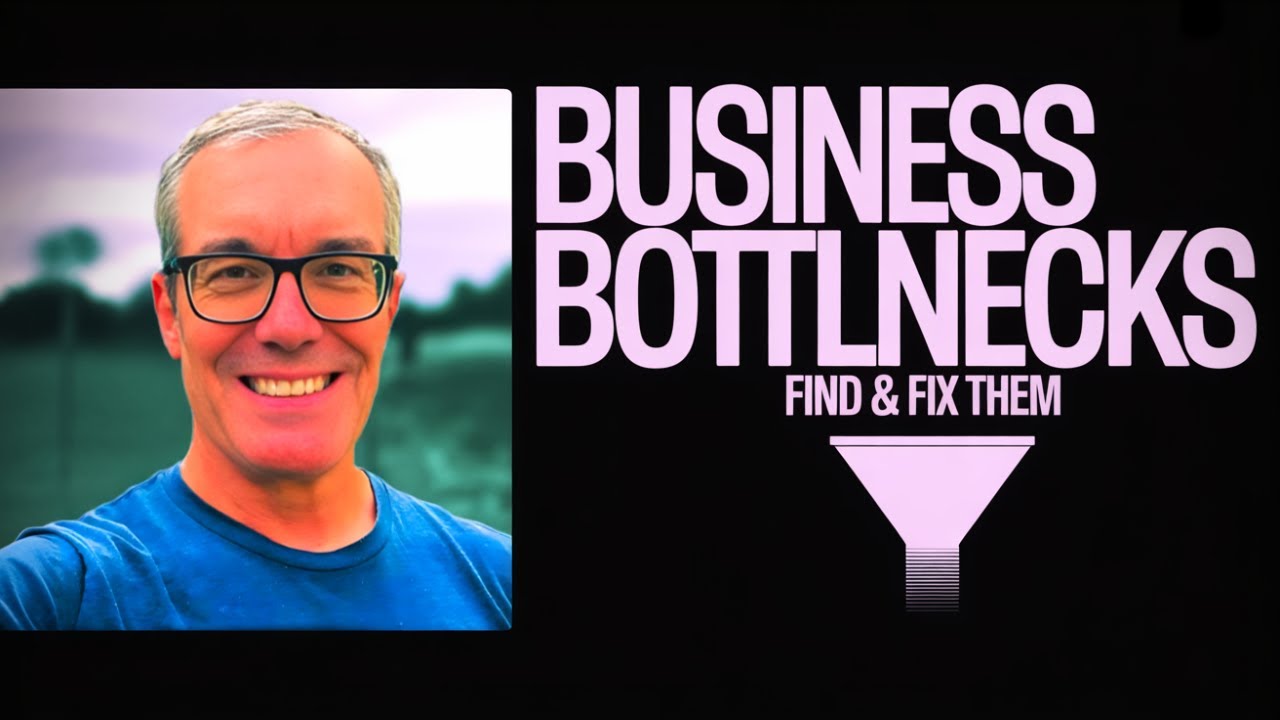
Scott Perry breaks down the difference between immutable constraints (time, money, attention) and bottlenecks you can actually fix. He shows how solopreneurs often waste 80% of effort on false dependencies like websites and funnels, and shares his Forever Offer framework that converts at over 20% instead of the typical sub-2%.
Chapters
Welcome to another pop-up edition of Creative on Purpose Live. These broadcasts are dedicated to helping advancing solopreneurs optimize their business to better fund and fit the life that they wanted to fund and fit when they started their business in the first place. For those of you that haven't collided with me before, I'm Scott Perry. I'm the founder of a brand called Creative on Purpose. I'm a former head coach in Seth Godin's Akimbo Workshops, and I am also the publisher of Transcend Ascendant Solopreneurship, where we are helping folks that are independent entrepreneurs, business owners, optimize their business to better fund and fit the life that they want to live. And we apply something called the Purpose-Driven Prosperity Model. It's a, a series of frameworks that help you build a business that does not require ideal customer avatars, doesn't require power offers, doesn't require funnels, doesn't require launches, doesn't require any content grinding. You can build a flourishing, prosperous business that you find fulfilling and profitable by defining, developing, and delivering the difference only you can make in the way that you can make it. And by doing that, you will attract the right people, whether those are customers for your product or clients for your service or, or people that are enjoying whatever cause or mission or idea you're on Substack to promote. So one of the things that we talk about quite a bit in our community and in other communities that many of my subscribers are part of, like the Guardian Academy, is this idea of constraints, trying to identify what's the biggest constraint to your progress right now, what's the most immediate constraint. And although we talk about this a lot, we've done, created a lot of principles and tools for helping community members, subscribers, and clients to find the most immediate constraint, there's still a lot of confusion around that. And so what I did today was I published an article called Constraints Versus Bottlenecks. And what I have done is redefine what the way we are currently thinking about constraints and turning them into bottlenecks and thereby also redefining what the word constraint actually means. So here's what I would like to propose. The first thing is that when we talk about constraints, We're not talking about something that is inherently negative. It's not inherently positive. It's neither negative or positive. Constraints just are. If you are an independent solopreneur, uh, independent entrepreneur, if you are a solo business owner, then there are some constraints that you need to acknowledge and embrace. There are You know, only 24 hours in a day. There's only so much you can do in that time. There's only so much of that time that you can actually be paying close attention and focus. There's only so much of that time that you have the energy to apply to developing in your business. There's only so much effort that you can expend. You know, there's only so much reputation and identity you can invest in any given moment on any given day. Your resource— those are constraints. Those are finite resources that if you overinvest or poorly invest the assets of time, attention, money, energy, effort, identity, and reputation, you will burn out and blow yourself up. So constraints are the non-negotiable limits that shape reality. That's— those are the constraints. Now, one of the reasons why solopreneurs so often burn, burn out and blow themselves up is they're actually trying to act like they are a big brand, a brand with more limitless financial resources. That are leveraging the compounding effect of employees or contractors. And they just, they have more resources to draw from. But if you're a true solopreneur that is acting like an entrepreneur with a lot of venture capital and a staff and a board of directors and advisors and so forth, you're going to burn yourself out, blow yourselves up. And most of the people that we're paying attention to, that we're looking to for advice or for tools and tactics to help us grow our business, are getting that advice from online gurus and digital marketers who do have more limitless resources. They have a lot of money, they have a lot of employees, they have a lot of leverage that you don't have. And so what we have to do is if we can wrap our heads around and embrace the fact that there are non-negotiable limits that shape our reality when it comes to time, attention, money, effort, identity, and reputation, then we can spend our time identifying the bottlenecks. The bottlenecks are the choke points in our business that you can actually relieve You can relieve those choke points. You can redesign your business to avoid those choke points, or you can just eliminate them because they're actually not things that you have to address. So constraints are the non-negotiable limits that shape reality. Bottlenecks are the solvable problems within your business that you can solve by eliminating them, by figuring out a way to relieve them, or to redesign your business to avoid them. So another way to think about it is constraints are the walls of the room. Bottlenecks is the clutter on the floor. And if you think about it that way, I think you can get a little bit clearer about closer to identifying the most immediate bottleneck in your business and start to figure out ways to navigate over, around, or through those bottlenecks. So one of the things that I talked about in today's article, again, it's the, the today's article. If you go to Transcendent Soul Entrepreneurship and click on the, the article, you'll, you'll get access as a free subscriber to most of it. And obviously for those that are circle members and inner circle members, I give you a deeper dive into these things, but I'm, I'll share some of the premium content with you right now. One of the things that we discussed on today's Friday On Purpose call with the paid subscriber community is that when you are navigating constraints, again, these are not bad things. These constraints can be beautiful. There's a book called A Beautiful Constraint because if you acknowledge or even design constraints, they can help you find more creative, innovative solutions. They can help you decide whether something actually is a necessary thing that needs to be done. What we talked about on today's call is the first thing to do, a— acknowledging that time, attention, money, effort, energy, identity and reputation are finite resources. Do an audit of where you are investing those precious finite resources. Given the 24 hours that you have in any given day, where are you investing that time? How much of that time is dedicated to sleep? That's important. How much of it is, uh, dedicated to social media? To digital marketing, to things that really probably don't fill you with a lot of fulfillment and joy, but you have just adopted as necessary evils that you have to engage in for the privilege of doing the work that you care about with people that you actually care about. And if you do an audit of where you are investing your time, attention, money, effort, et cetera, you probably find that you can recapture most of it. When I do audits with my community members and clients, we often find that we can recapture almost 80% of their time, of their energy, of their effort, of where, where they're paying attention. And if we recapture time, attention, money, and effort, then we can decide to reinvest reallocate those assets into the things that will actually move the needle and help us get clear about closer to the business that we actually want to build and be a part of to fund and fit the life that we want. So auditing where those resources are going is the first step. And what we often find is that most of us, can stop doing about 80% of the things that we're doing around trying to get the word out, promote, or otherwise market our business. Because most of those things that you're doing, there's no discernible way to measure how much they're helping. And if it's— if you can't, if you can't identify that this activity that you do every single day that is not returning any return on investment, And then maybe it's time to just try not doing it for a while and see if it changes anything. Because here's the thing, if you can stop doing half, two-thirds, three-quarters of what you're doing, you've actually automatically boosted the efficiency and reliability of your business system. It's automatically going to be a better system because it's fewer components, fewer places where your precious assets are being invested, which means that you have those in reserve. You have those to invest in things that might actually move the needle. So that's the first thing. When it comes to bottlenecks, there's a couple different types of bottlenecks that I think it's really important to look at. The first is something I just kind of addressed, which are false dependencies. A lot of us as solopreneurs, when we start our business, we start to invest all of our time, attention, money, and effort in these false dependencies. We think we need a website, a logo, a landing, uh, a lead magnet, uh, email, a sales sequence, a nurture sequence, uh, some sort of clever tagline. Um, we start investing in creating ideal customer avatars and start constructing funnels, which are inherently leaky and inefficient. We, we start developing these launch campaigns And that's— none of those things are necessary. The very first solopreneur business I started after I ended my career as a professional musician was built on a Google Doc, which described the coaching offer and had a PayPal link that people could pay for it with. And that's all I needed to a profitable business that required no time invested in all the things that online gurus and digital marketers told me I needed to have. I didn't have to have a website. I didn't have to have a lead magnet. Didn't have to have a funnel. I didn't have to have a launch schedule. I didn't have to create content. I just showed up every day and did my work and let people watch, and the right people found me. And by doing a great job with the people that were hiring me, they spread the word for me. They were my evangelicals. Everything that I did after that only complicated a system that was already working efficiently enough. So identify your false dependencies. What are the things that you're doing that you actually just don't have to do, and you're only doing them because everybody else seems to be doing them, or some online guru or digital marketer told you you had to do them? The only thing that's required to have a profitable business is an offer that is irresistible enough to an audience that is eager enough to give you their awareness, attention, permission, and trust so that you can earn their enrollment and investment in the difference that you can make with and for them. That's all you need. Second type of bottleneck, and these are what I would call reactive bottlenecks. These are the unintentional choke points that, that just kind of creep in to our business plans, our business strategies. So the second, after false dependencies, is what I call validation traps, which are, you know, waiting for someone to give you permission to tell you that you're ready, or giving yourself permission because you've decided that you've arrived at the perfect offer, the perfect landing page, the perfect perfect, whatever. You're never going to get universal approval. If you focus on what Seth Godin calls the smallest viable audience and validate that offer with the people whose awareness, attention, permission, and trust you've already earned, it's much easier to validate an offer or to validate that audience as the kind of audience that you seek to serve and the kind of audience that you have some sort of talent that will enhance their lives by helping them achieve an aspiration or solve a problem. Third type of bottleneck is the most important because it's actually fundamentally always the biggest bottleneck. And that is, look in the mirror. The biggest bottleneck in your business is you because you as a solopreneur are always trying to read the prescription from inside the bottle. You and all of your narrative fallacies, all of your cognitive biases, cognitive distortions. You are trying to reach for all of these digital marketing hacks, tricks, tactics, tools to— as technical solutions to what is actually an adaptive problem. If you are not getting the results that you want with your business today, and you are doing everything that you did yesterday, well, that's what Einstein called the definition of insanity. Doing today what you did yesterday and expecting different results is not a good game plan. And so You have to stop, you have to stop looking for technical solutions to the adaptive problems. If you're going to get different results, you're going to have to see, be, and do things a little bit differently than you did yesterday. And the best way to define how, what needs to change, what you need to stop doing, or what you need to iterate and improve, where you need to raise the floor in your system, is to micro-step your way into possibility and make small adaptive changes that you can measure, collect data on, measure, get the feedback that you need to see if they are leading to system improvements. So again, the biggest obstacle to your success is the person that looks back at you when you look in the mirror. Good news is the person that is going to be the hero, the, the leader that actually helps you truly optimize your system and collapse time to target with your business priorities is also you. But you're going to have to solve the adaptive problem. How do you become the kind of person that can achieve the kind of results that you want to achieve? The fourth bottleneck is what is called the root cause blindness. We spend so much of our time as solopreneurs dinking around the edges by tweaking tactics and tools, trying to, to cure symptoms instead of the actual disease, instead of the actual root cause. Tweaking the colors on your landing page or the calls to action or rephrasing your power offer. These are, these are tweaks that aren't going to move the needle. They're, they're just tools and tactics that, that could just as easily be disposed of so that you can lean into the principles that will actually help you identify where you're actually trying to get to and how you're going to actually get there. So you can spend all day tweaking your copy on your social media posts or on your offer pages or tweaking the color of the, the click now button or the call to action. It's not going to do anything. If your offer is not engaging, then you are not articulating the offer properly, or you're not making the right offer to the right audience, or maybe you're trying to serve the wrong audience. Maybe your offer is actually a solution in, in search of a problem. The way that you can actually solve that bottleneck of the offer isn't being bought, isn't nobody's engaging, nobody's interested, is get involved with conversations with the kind of people that share your values and need your talents to enhance their lives and find out what they actually want to accomplish. And what problem they're actually trying to solve, and then help them achieve that aspiration or solve that problem. Let go of all of your attachments and expectations to the thing that you think people want. They will, if you pay attention, if you are present and engage in active listening and actual care, consideration, compassion for the people that you want to serve, they will tell you how you can help them. And we have a very specific process for how you can engage in those kind of conversations so that you naturally attract the right people as prospects that you can turn into informed leads that become eager clients that are eager to buy without you having to sell them anything. And the final bottleneck is the one that I see most often. Which is people that have a, a client attraction system or a business system that is, that is operating well enough to justify improving. And they try to improve it by pushing on the ceiling of the things that are already working well, working above average. And they ignore raising the floor on the components of their system that, um, that need to be addressed. And if they simply raise the floor on the least effective components of their business system, they would get exponentially better returns than on raising the ceiling on the things that are already working. It costs you a lot more time, attention, money, and effort to push on the ceiling than it does to raise the floor. So if you Look at your business system. You know, what's your offer? What's your audience? What's your means of getting that offer in front of the audience? Which of those things is underperforming? Most of the time, what I find is people have a pretty good idea of what they can offer and who they want to offer that to. And it's the system that needs improvement is how are they putting that offer in front of that audience? And if you're trying to do it all with a power offer, an ideal customer avatar, and a funnel and some sort of launch schedule, you're going to be investing a lot of your precious time, attention, money, and effort, which again, finite resources, into a system that gives you increasingly diminished returns. For those of us that are solopreneurs, we don't have enough time, attention, money, and effort to invest in the kind of digital marketing approach that is most often advocated. Your average lead magnet to offer purchase funnel gets under— it's an under 2% conversion rate. In fact, if you're getting 2% on your average— 2% conversion on someone opting in for a lead magnet to buying on your sales page, you are doing a fantastic job. Most people can't get anywhere near that even when they are spending all day tweaking their funnel, optimizing their sales page or their lead magnet, and fueling it all with expensive Facebook ads. The funnel, the, the, the client attraction process that we teach with the Forever Offer and the Be a Blessing marketing frameworks in the Purpose Driven Prosperity model, I am currently getting over 20% conversion on people that answer a couple of icebreaker questions. That then receive a free diagnostic of where they are, where they want to be, and what's actually in their way. And then moving into a low ticket and then eventually into a, a mid-ticket or high ticket offer, 20% conversion rate. That's a 10x return on the very best funnel that you could hope for using the typical digital marketing technique. So those are all what I call reaction, reactionary bottlenecks. Here's another set of bottlenecks to think about. These are what I call design bottlenecks. Design bottlenecks are, you know, again, bottlenecks, constraints. These are not bad things. These are just things. They, they, they just are the constraints of time, intense and money effort. Identity and reputation, that just, that's, that just is. It's not good or bad. It just is. And if you embrace and acknowledge those constraints, they can actually become force multipliers that help you get closer to where you want to be faster and easier. And same with bottlenecks. You get to define what the bottlenecks are and which ones you address first. And with the design bottleneck, you're actually applying bottlenecks strategically by choosing to impose constraints on your own system so that you're actually able to protect your scarce resources of time, attention, money, and effort and improve your results. So as I shared earlier, one of the things that you can do is audit where all your time, attention, money, and effort is going. Audit your current system and simply get rid of all the things that you don't need. If you prune If you clear the cruft, if you take away all the unnecessary components of your system, all the unnecessary activities that you engage in every day, you automatically optimize your system to perform with greater ease and velocity. Second design bottleneck would be innovation. How can you limit the amount of time that you focus on a bottleneck and, and apply energy to addressing a bottleneck to force you to think in more creative, innovative, and find more innovative solutions to the problem? What if, what if you had to do it with zero money? What if you had to do it in less than an hour? What if you could only afford to pay attention to it for 10 minutes at the beginning of every morning? How would that help you spark a breakthrough, find a more innovative way forward, find a more creative path to accomplishing what you want to accomplish? And then the final of the design bottlenecks is the intentional bottleneck. Okay, this is creating friction by design. This is something I learned when I had my guitar studio. What I did was I, you know, wanted to make sure that I was attracting the right kind of student, students that were going to invest the time and effort into a daily practice that would actually help them get the results that they said they wanted to get when they started taking guitar lessons. And so rather than just accept a credit card from anybody that was willing to pay me for lessons, I conducted a 15-minute— I called it a meet-and-greet call. It was actually a diagnostic call where I was, you know, I was giving them a chance to feel like they were vetting me as whether or not I was a good fit for them. But what I was doing was actually vetting them. I was filtering out the, the students that I thought were a good fit in this student— from the students I thought were a bad fit. And so by creating this kind of diagnostic meet and greet, I was able to make sure that a student had the kind of instrument that they needed to succeed, because so many people buy cheap instruments that they'll never be able to play. You have to start with a, an adequate instrument that fits your body and has good action and so forth. I would talk to them about the, the methodology, the way that my unique approach to teaching people to learn to play the guitar, to make sure that it was the kind of approach that was going to resonate and ring true for them, and, uh, talked about expectations around performing at recitals and practicing every day and so forth. And then at the end of it all I would let people know that right now I didn't have any openings, but I could put them on a waiting list and, you know, give them some time to think about whether or not they felt like I was the best solution to their guitar learning to play the guitar problem or not. One of the things about my guitar studio was I was actually the most expensive guitar teacher in town. There's— and there's— I live in a town with a lot of options. For learning to play the guitar. A lot of teachers here. And oftentimes I would address the pricing objection by just saying, hey, if you think that, you know, that you can't afford my fees, then guy across the street is always taking students. They charge 20%, 25% less than I do. The woman down the street always has openings. They charge less than I do. Feel free to, to try them out first. But by creating this friction through the diagnostic meeting and the waitlist, I was able to only onboard students that were actually ready to do the work and get the— necessary to get the results that they wanted to get. And I eliminated by buyer's remorse. I eliminated all the pricing objections and ended up with a thriving practice that did end up with a healthy size waiting list of people that would stay on the list for months before a spot opened up. And I ended up with students that stayed with me for years and years and years and were thrilled to come in every week. And engage with me in their guitar playing adventures. So constraints, those are the hard and fast boundaries that we all have to navigate and embrace and acknowledge as solopreneurs. They are the non-negotiable limits that shape reality. There's only so much time in a day. There's only so much effort that we can expend. There's only so much attention that we can bring to bear. There's only so much energy and reputation that we can invest in the things that we're trying to accomplish. Those are constraints, non-negotiable boundaries. That's the room. They define the room that we're engaged in. Bottlenecks are the choke points. They are the things that we can actually address and relieve, redesign, or eliminate. It's the clutter in the room. Those are the bottlenecks. And if you, if you embrace the constraints and audit where the assets of time, attention, money, and effort are actually being invested, you can then start to strategically define the reactionary bottlenecks that need to be addressed to create better business systems that help you get closer to what you want faster and easier. And you can also impose the designed bottlenecks that will help you do the same. So that's my little riff rant on the distinction between constraints and bottlenecks. See, my friend Rick has come in. Good to see your name pop up, Rick. Consistent sales for my digital products is a constraint. Current marketing positioning and lack Lacking know-how to share an audio offering. Says Kara, I can't make a video a day, but I can be present weekly. Daily, making sales calls and creating a viable call list. So for all of you that have been generous enough to share constraints, and if anybody wants to ask any questions, this is the time to do it. Or if you have insight to share, or if you want to push back on anything I said, I'm always open to making my ideas better and stronger by listening to other points of view. For Kira and Emma and Bob and Sydney, when you name the current challenge, getting sales, doing sales calls, How you're marketing. Like, think, think when you're trying to identify the most immediate bottleneck, what's the step before the step? Like, before you can address a marketing problem, you know, the difficulty you're having with getting the word out to the right people, the people that would actually benefit from colliding with you and the difference only you can make through the offer that you have. The way that you do what you do in a way that aligns with someone else's values and needs. You have to make sure that you are articulating the offer in a way that attracts the right people and repels the wrong people. I call this the generous side of polarization, the way that you talk about what you do and how you do it. And why you do it is a way that you can get the wrong people to move along and the right people to take a step closer. And so we use the Forever Offer framework to design offers that, uh, that express who we are and what we do and why we do it and how we do it in a way that attracts the right people and repels the wrong people and builds increasing curiosity with the right people so that they continue to step toward us. Try to— they try to— we attract them into, you know, greater proximity and access to us. We use the Be a Blessing marketing approach of delivering real value to these people through conversation. Conversation, I maintain, is the fastest path to cash. It's a phrase I learned from my friend Laurel Portier. You know, how are you engaging in those conversations? How are you getting the word out? Are you going after the hardest audience to chase down by just promoting things willy-nilly on social media or your blog or your podcast or what have you? It's really hard to convince people that aren't even aware of the problem that they actually have. It's a lot easier to talk to people that are problem aware and solution aware, have their credit card out and are looking for who to give it to, to help them achieve their aspiration or solve their problem. The lowest hanging fruit is the people that know the problem they have and are actively looking for a solution to that problem. And there's plenty of ways that you can deliver some free value to those folks that help them clarify what they're actually trying to accomplish and where they're actually starting and what they're starting with and what's necessary to close the gap. And by helping them diagnose that for free, you will earn enrollment. That allows them to invest in the solution that you have to their problem or the, the process you have for achieving their aspiration in a way that doesn't require any selling at all. No power offer or no-brainer offer necessary. No sales page necessary. If you can help people see what they're actually trying to accomplish, where they're starting, and what's necessary to get there and help them actually get a little traction, they will eagerly ask you how they can invest in collapsing time to target, catalyzing their progress by working with you. And you can do that in all sorts of ways. That could be low ticket, mid ticket, high ticket, that require very little of your valuable time, attention, money, and effort. So that's, that's what I leave you all with today. If this has been something that resonates with you, then by all means, go to Transcendent Solopreneurship and check out the Constraints Versus Bottlenecks post that just went out today. If you would like to take a bolder step into possibility, we have a thriving community of purpose-driven difference makers that are making progress every single day and building a business that actually funds and fits the life that they designed their business to give them in the first place. We have calls every Monday, Wednesday, and Friday that you are welcome to join where we talk about principles and strategies that are actually getting people clear about closer to the business that they want to develop. And it will cost you as little as $750 a month to join up to 3 calls a day, do a monthly deep dive with us, and have direct access to me for when, when you need a little additional help. The biggest asset many find in the Circle and Inner Circle communities is what's come to be called affectionately the Scott Bot. This is a coaching GPT built entirely upon my coaching intellectual property that will help you design your forever offer, will help you design a high-performing, be a blessing marketing web, and help you define your number one business priority and the success path that will get you there with the greatest ease and velocity. And you get all of that as a member of our community. So if that feels like something you're interested in, go to today's post. When you come to the paywall, just go ahead and, and subscribe to the publication. Try it for a month. Try it for $9 for 30 days. Join the calls, apply the frameworks, use the, the GPT and, and the prompts that come with most articles, and you will If you don't get the kind of progress, make the kind of progress you would expect to make, then just cancel your subscription and move on. Find, find the solution that's best for you. So that's what I have for you all today. It doesn't look like any more questions coming in. So we're going to go ahead and leave it there. Appreciate the gift of your time and attention in attending this live broadcast. I hope it was helpful and useful. You can reach out to me and let me know. And until next time, be well, do good, have fun.
More from Scott



Stoics Don't Suppress Emotions, They Do This Instead #stoicism #emotionalintelligence #mindset







