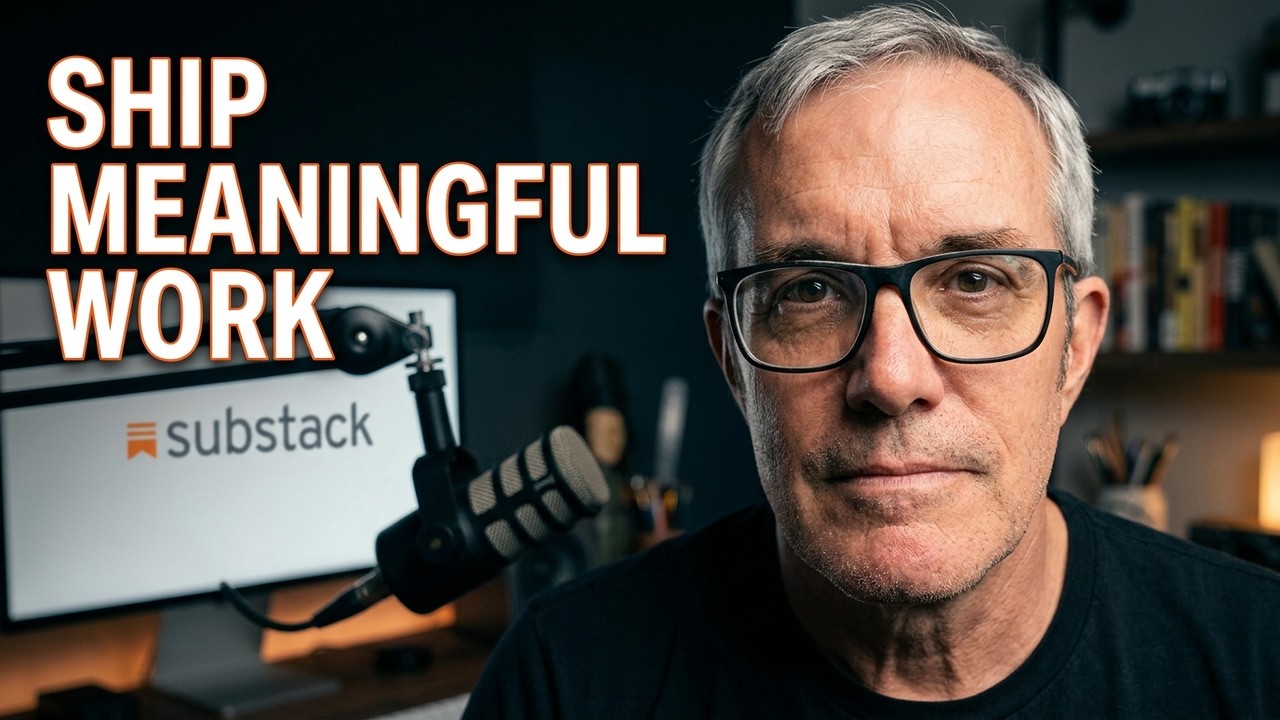
Scott Perry, a former guitarist turned coach, explains how creators can ship their best work by positioning authentically rather than just niching. He advocates for Substack over toxic social media, frames marketing as truthful storytelling, and emphasizes the importance of a "corner person" framework with a mentor and strategic advisor.
Chapters
Starting. I have starting now. Okay, here we go. All right then, hopefully you have that also. You have the live on the counter. All right, very good. Well, um, good afternoon, good morning, good evening, depending on where in the world you are watching this. Um, so thank you, um, to everybody who may be tuning in to watch this. And, um, really have no theme today, but I'm gonna kind of let Scott decide what that is. This is Scott Perry, who, um, I guess it's a disciple of Seth Godin, and he has formulated his own, um, working, uh, method of working with people to help them reach clarity and, um, guidance. I would say guidance on how to best explain themselves to their audience. So, um, yeah, that's what we'll be talking about today because I have some kind of clarity issues of my own, and we'll see how— what we can do for, um, what we resolve in this conversation. And so thank you for joining me, Scott.
Yeah, it's my pleasure. I appreciate the invitation, and, uh, always good to connect with a fellow creative and, uh, seeker in the world. So, um, I'm, I'm gonna play the volley right back to you. I— let's, let's dive into whatever is, is on your mind and of interest to you.
Okay, guys, um, so, uh, what drew me to Seth, and I guess it drew me to speak to you today, is the, um, the part about specificity, you know? Like, I think I know what I want to say I guess when you go online to do that and you kind of feel yourself being pulled in multiple directions, you know, you probably feel yourself being pulled not necessarily into what's trending, but into what may be connecting with people when you start posting content in a sort of little range of topics and then you see something begins to gain attention, but it might not be the thing you want to be known for. You're going to feel yourself going down a stream that you don't really want to be a part of. Put it that way. Yeah. Is that what happened to you when you first came on this platform?
Uh, not when I first came on this platform, but certainly when I was just kind of getting started with reimagining what I wanted the next chapter of my life to look like. So, you know, you've, you've already mentioned Seth Godin a few times. I, I connected through it to Seth's world through my wife, who had been following him for a while. And I was definitely in a moment in my early 50s where I was 25 years into a career as a professional guitarist and owner of an operator of a guitar studio, but feeling like life was maybe trying to speak to me so it could speak through me in a different way. And I had no idea what that was, so Thanks to my wife, I joined Seth Godin's Alt MBA program in 2016. Um, and through that experience, like, definitely felt the shift that I was going to begin a pivot away from what I had been doing, but I really had no idea what I wanted to do next. And so what I did at the beginning is kind of exactly what you were saying. I just started sharing things that were on my mind and sharing a little bit about my journey, which included all the confusion and the uncertainty.
Yes.
And clarity came through conversations, conversations with myself, but out loud and in public on a blog and, and through broadcasting like this, uh, and then eventually, um, you know, through, uh, community that I began to build after the Alta MBA experience. And it, you know, for me it was a— it took a long time. It was probably— I mean, it was certainly 7 years plus before I made a single dollar doing anything with what was shaping up. But, you know, I think a lot— big part of that was I wasn't, I wasn't super clear. But, you know, one of the things that is interesting about what you said is like when we get started Sometimes it's easy to look for external validation, like, oh, this is connecting, this got some likes, this got some reach, this got some comments, so I should talk more about that. It's like, well, maybe, but intrinsically, what is it that actually matters to you? And I think that, you know, Seth Godin talks a lot about work that matters. Um, and there's, you know, but work that matters has to be a collaboration. It has to matter to you, and it has to matter to the people that are connecting with the work. And it— and I don't think that we can measure mattering by the metrics of reach and likes and impressions and all the things that— the easy things that social media makes it easy to measure actually don't matter at all. What matters impact. And it takes— for me, it took a long time to figure out what, what the difference I could make was being called to make by, you know, by life.
Okay. Well, I guess if I were to share a little bit of my background— and hello to everyone who's joined. Thank you so much for joining us today. Great. Hopefully we'll give you something, some takeaways that you can apply immediately. In my own case, so in 2023, I finished a graphic novel. You know, like I'm big on comics. I'm also big on sci-fi and the thriller, the general totality of the thriller, the suspense. And I'm like, okay, I made this. And before that, leading up to that, I've been reading personal growth books because I was always— I kind of admitted to myself like I hide, you know, like I hide. Like, why do you hide? Like, at first I had to admit to myself that I hide, that I tend to play small and shrink.. And once I got past that point, it's like, okay, you know, you are meant to be seen. Whatever it is that you want to do, you are meant to be seen, so you have to stop hiding. That's one. Once I get to that stage, just like, well, I can make things, but I don't really know how to sell them, you know. And I started looking marketing in a very broad way, and, you know, the, the rabbit hole of marketing led me to an interview by Seth Godin. And I like what he said. He made it sound very simple, very accessible, and on the, on the base, uh, on the foundation of be specific, you know, be specific about yourself. And after consuming, you know, quite a few of his interviews, I signed up for, um, the marketing seminar. And that was challenging. It was challenging and it was, um, like self-educational. You learn a lot about yourself by doing that. And I committed myself to that too. It was like a 9-month thing. And every single day, every single day you participate. I'd never done something like that before for 9 months consecutively, just showing up and doing the thing, doing all the homework, doing the things required. And then kind of having a little group, a group of people who participated along with me. We started communicating and I was like, okay, this did something to me. I can't really tell what, but it did mold my brain in some way, in some small way that I can't quite define yet. And so I do that and I, I didn't exactly discover this platform Substack that we're on now, but I found the platform. I started to make headway on it. And then again, I kind of got lured back to, to Twitter. At the time it was still Twitter or it had just become X. I kind of go back to that platform. I start making some progress there, but again, I'm also not posting the things that I care about, like what you mentioned, the things that make a difference and that mean something to you that you're willing to stay with for a long time. And I join a group, I'm— but I'm— I'm doing okay. I'm gaining traction and gaining follows and so on. So I stay with it, and then I kind of have a disagreement with someone who leads a group that I was a part of, and I kind of got kicked out of that group. So that kind of brought me back to Substack, I guess. And I started applying, um, applying myself in a more conscious way, let's say. Like, I was actually listening to what's going on, or rather getting deeper impressions on what each platform does. And I realized I like this platform better. There's no toxicity compared to like X and all the other platforms. You don't really see people debating for days back and forth, and then you get attacked and now you're dragged into this thing for days on end even though you had nothing to do with it. You don't really see any of that going on here. So that, that made me feel, okay, you know, just be more free. Just don't think so much about what to post. Just post what's on your mind. And that combines, I guess, with what I learned in the marketing seminar and encourages me to just not follow trends, to just ignore trends. And those are the things that I follow. Like, I post about now, like, let go of trends, let go of trends. And when it comes to, um, skill, you know, like, practice has something to do with it. But I think it's more, um, remixing and experimenting with the skills that you already have. So talent is something of an umbrella word that I think has different meanings, but in the world of art and creativity, it takes on this, um, almost like a biblical overtone where talent is everything, where the people who are making an impact and gaining attention and all that are the people who are really just freely mixing things here and there, who are making things that may not be considered artistic but connect. Like memes, for example. Like memes, there's a certain art form to making a meme effective. So I started looking at that, I'm like, okay, just, just do whatever the hell it is that you like, the things that you like that you're willing to stay with over and over, and share those. And just stop worrying about this invisible Bible of what art is. Like, because we're in a place now where, because of AI also, the way it's affecting economics and business and everything, it's impacting the definition of what an artist is. So I'm, I'm okay, like, this is pretty exciting. Like, this thing, you can literally mix and match genres in a way that people probably thought they couldn't be done, or that they wouldn't do, because again, being an artist means being this particular thing. You're only a painter, or you're only a writer, or you're only a sculptor. But now, no, you can just mix and match things in a way that I guess it— now people feel more permission. Not that you couldn't do it before, that maybe people felt they couldn't do before, And now AI is saying, no, no, just mix and match it. Just you— there's niches to be discovered yet. You might be the one to find that niche. And that's kind of where I'm coming from. And I guess that generates its own little confusion about what— how to present myself also. So that's what brought me to, um, uh, your profile and what you post about, where sometimes you get that little insight. For example, this morning I read one where you make it a distinction between the coach Um, the mentor and the third person. This third person is something a little different. I cannot remember what you— how you named him, but you said this is the person that sort of pulls it all together, but at the same time makes you not depend on him forever. You know, like a coach, by necessity, kind of wants to keep you under, under, um, thing forever. You were mentioning this third person that is doing the opposite. It sort of gives you that, that, that inner compass, but also lets you go on your way. So, okay, I like that a lot. Like, I, because that doesn't— I don't think that exists in the industry, or if it is, it's a very small niche that doesn't— it's not as popular as like Tony, the Tony Robbins of the world, and people like that.
Yeah.
And I guess that's you. You're kind of becoming that. Maybe you're, you're kind of commanding that place for yourself.
Uh, For sure. That is the intention. So the, the—
OBA is here. Hi, OBA.
The name, the name for that. So just to be clear, I borrowed in today's post, I'm borrowing some of the ideas that Dr. Jeff Spencer, who is the corner man to Olympic athletes, high performers, Yeah. And so he, he defines the 3 roles as a technician, someone that's good at tools and tactics, has a skill where it's very easy to do things for other people. Technicians would be like SEO specialists or social media ad specialists or programmers and that sort of thing. And then there's the mentors, which is where most of the coaching space falls in, where you are teaching other people to do the thing that you have learned to do, uh, and then the corner man or the corner person or the corner woman, depending on your preference, is a person that, according to the way Dr. Jeff Spencer talks about it, is of a certain age, meaning that they have seen the 4 cycles of civilization. The, the cycle of Strong people, or what is it? Strong people create good times. Good times create weak people. Weak people create bad times, difficult times. And difficult times create great people. So the corner person does not necessarily, like, can operate across domains and across is, is basically looking at the world through their experience and their powers of perception and can help people in, you know, multiple, multiple domains. And, you know, for me, it's, it's the navigation of lifestyle or the art of living and, and work that matters, whether that's a business or just a legacy play or a project or anything like that. So, um, yeah, and just to, to hit a couple of the things that, that you, you mentioned, one of the great, one of the ways that we get clarity is through standing up to be seen, speaking up to be heard, doing what we can, where we are, with what we have, for whoever's around. And that is often how we discern the difference that we we seek to make in the world and how we find the unique ability that we have to help people, you know, whether it's through some sort of corner person or coaching or mentoring or, or technical craft or what have you. Um, and Substack is a great platform for this because Substack, better than any other platform that I'm aware of, really leverages the network effect and is, you know, although there's an algorithm involved, it's not driven by ads, at least, you know, for the time being.
For now, yeah.
So we have the ability to build and curate and navigate connections that are mutually beneficial. It helps us get clearer about and closer to what defining who we are, what we're good at, and where we belong, and connect with more of those people whose lives would be enhanced by colliding with the things that we're, we're here talking about. And, you know, one of the other things that you, you mentioned was this idea of niching, and I'm, I'm really cautious about the, the niching, the idea of niching. I mean, I know the digital marketers and the growth hackers tell us that we have to define our niche and we have to niche our niche down to the nichiest niche it can be so that we can, you know, but the way that I think about it is niching is, niching is a way of fitting in. Like you niche so that you can fit into a market and distinguish yourself based on the demographics or psychographics of your ideal customer avatar and all that other thing. And you can do that and it certainly works if you want to just sell a thing. Creating an ideal customer avatar and a power offer and creating a funnel and optimizing it and then powering it with ads is a way that you can make money. I'm not sure it's a great way to, to find meaning or to do fulfilling work, but it's certainly a way that you can make a living if that's what you want to do. But the, the, the alternative approach is to pay more attention to your positioning. And I think that Where niching is where you fit into a market, positioning is how you stand up in a market. And your positioning is based on your core values, your guiding principles, your innate talents and skills, and your boundaries, your guardrails, your non-negotiables. And if you pay— if you're clear about who you are, what you're good at, and where you belong, or not clear, but clear enough, then by standing up to be seen, speaking up to be heard, doing your thing, your people will find you. And the more of your people that find you, and the more that you get the feedback from people that aren't your people who tell you, tell you so and move along, like, it just helps you get more and more clear about what you're actually trying to accomplish, what you're actually good at, and, and who it's for. And I think that, you know, Substack does a pretty good job for those that are willing. It does a good job at either. You can, you can be a digital marketer and a growth hacker here, and certainly there's people on the platform that will sell you a program or a subscription that will help you grow, create viral notes and, and grow your audience at an exponential level and blah blah blah blah blah. But if On the other hand, you're here to share your perspective and connect with more of the right people and try to make a difference. And, you know, to your earlier point, if you're willing to, to stop sabotaging yourself, if you're willing to, to, to leave behind your, you know, that your, your your desire to be humble and hiding, uh, you can actually be present here in a way that will allow you to become the person that you want to become. You know, you become the thing by doing the thing here on Substack, I think, is, is, is what I have found. And just a quick question for you, because I, I don't know if I knew this about, um, our shared, uh, affection for Seth Godin or not, but did we collide initially through the marketing seminar, either when I was a student or a coach in that workshop?
I don't think so. No. What drew me to you was I think you were doing a live and you had mentioned one of the questions that Seth— I'd forgotten about it, but when you said it, I remember, oh yeah, Seth. Well, not just in the seminar, but in multiple interviews, he says that what is the difference you're trying to make? And I get— again, I had to think about that. It was one of the questions that stumped me when I was going through the seminar. And again, it still stumps me now, like, because as I— you remember the reply, like, how do I state my differences? I want to scare people with this thing that I made. That's, that's kind of the change that I want to make. I want to, like, terrify you, but it's going to be a little bit different sometimes. I want to, like, um, tell you the story, but I want to make you feel involved. Like, I want you to not just sort of sit there and consume the story, but like you are a participant also in the story. You're just— it's almost like I'm putting you in the first-person point of view of the classic detective novel. Where you're like reading from Philip Marlowe's point of view or, um, the Continental Ops point of view, and you're learning and piecing together things as you go on. Everything is a little murky, but gradually you start piecing it together. But you have to like be involved, you have to pay attention. And that's kind of where I'm coming from. I'm making, you know, um, stories in different media where you are the protagonist in a way. You have to be— you are discovering, you're piecing together, you're, you're involved. You're not just taking in the, the stuff passively in a passive way.
Yeah, well, I love that. I mean, I, I certainly think that I try to do that in my own writing, is let it be kind of a choose-your-own-adventure and let people, you know, again, I'm sharing, I'm sharing my assertions not because I think I'm right, but because I think I have something valuable to share. And I would, and I always really appreciate when people provide a counter-assertion or find a hole in my logic or reasoning or identify a blind spot that I didn't see in my own thinking, or maybe reveal, you know, my false thinking. Because the points, I think, for folks that have, you know, that are brave enough to embrace uncertainty and unknowing to explore the edges of their understanding and ability. I mean, it's, it's a, it's a fraught endeavor because, yeah, there's going to be people. And I think Substack is a certainly a less, um, is less populated by trolls and troublemakers than some other platforms, but they're still here. I mean, I, I get all sorts of You know, I get messages, um, public and private, where I— clearly someone is just picking a fight or trying to make a point at my expense. And you know that I don't— I don't— regardless of platform, most people are not sociopaths or psychopaths or narcissists. Most people think that what they're doing and saying is right. And one of the things that I learned is from being a coach in Seth Godin's community is to just assume good intent, that for the most part, people don't mean to cause harm, even when you might interpret it as trying to cause harm. Um, and it's, you know, again, another opportunity. Like, instead of, instead of hearing somebody's, an alternative perspective or an argument for a different idea, than the one that you hold. What happens if you just say instead, isn't that interesting, and kind of explore and unpack it together to see, you know, where's the points of intersection, where are the points of differentiation, and what can we learn by just continuing the conversation as opposed to defending a position? I don't think there's very many absolute truths in the world. I think, I think everything is up, up for interpretation and negotiation. And it's, it's often in my mind a lot more fruitful to, to go in with a curious mindset and a little bit of a sense of playfulness. And, and, and be, be, um, you know, instead of trying to be interesting, be interested in what other people have to say.
Um, yes. Yeah, you, um, you said that now, and, um, that reminded me of a quote by, um, Robert Kiyosaki. I'm on the fence about the authenticity of his advice, you know, financial advice, but, um, in his book Rich Dad Poor Dad, there was a— there is a line that I greatly agree with where he says, um, a statement closes the mind but a question opens the mind. And that perfectly ties in with what you just said about keep the conversation going, or at least keep the experiment going. And I think personally for me, like, one element that sort of maybe clashes against that is what you said about how you don't have all the answers, but you feel that what you have to say has value. And I think that's, at least with me, that was first, that was the first step that I had to like, you know, face about myself, that I didn't think that what I had to say had value. So I'm not willing to defend it as much or to even share it as much. So that was one of the first things. To develop that, um, sense of, uh, self-worth, that what you do has value, that what you do has value, however niche or however, um, tiny it is. Like, it does have value. So that's collecting— not just me, but anybody who's confused. And I guess, um, the courses from the Akimbo Seminar, I don't know about you, but like, um, they give you a lot of clarity, but they will not give you all the clarity. Like, um, I guess what you— the next part comes from the experiment and the other— the rest of whatever you're missing, that comes from that experimenting, from doing things, seeing what happens, and just like you said, accepting that it's going to take some time. It's going to take time to, you know, first of all, maybe refine your message till it's clear enough for the people that you're for, and then for that message to travel far enough to— I guess to quote Seth Godin, you know, the spray— like the people will spray it far enough, the sprayers or sneezers, I think it was the sneezers, will get it out far enough till it then it brings back your people. And it It's, it's, um, how would I say it? It makes sense, but it's just, you know, you are the first barrier to everything. Like, are you willing to just, you know, just put it out there, uh, this thing, regardless of how people may react to it? Like you said, like, you get, um, low-key, I guess. Yeah, because it is true. That's one great thing about Substack. You don't really have the level of, um, the intensity of, like, um, arguments that you get in other platforms. It's very rare. And it's almost like they're like, um they don't want to get into it. They're trying to— they post something, it's really skilled actually, it's very skillful on their part. They say something in a way that you kind of have to reply and then it's your fault. They're kind of roping into an argument rather than like outright arguing from the beginning. So that shows a certain degree of skill on their part and how to like, um, um, stage an argument without them looking like they started the argument. So very, very skillful. But it's just that, it's just that initial obstacle of, um, coming against your own resistance, you know, your own internal resistance to sharing and putting yourself out there. And once you do that, um, just, um, staying in that discomfort. Because I think the other thing that the seminar did for me is that it allowed me to just simply— or rather, it taught me to just live in the discomfort, you know. Like, um, every day you're answering questions and you don't have an answer, but we'll put something anyways and then go back and fix it anyways. Because it— the way it's staged isn't It's not like a final answer, like a final quiz. You can always go back and revise your answer. And in fact, it did happen with every new lesson. You would find yourself going back like 3 or 4 episodes back to rewrite what you said. So your thing was always changing, and it was giving me like all kinds of major anxiety to do that all the time. I felt like I was, um, I guess going back on my own thing. I guess I was going back on my own philosophy, but I guess it was trying to break down the idea of philosophy. It's trying to break down the idea of like a foundation, and this is rigid and inflexible. It's teaching you to be more flexible. So in that sense, it teaches you to do that and to be okay with the discomfort that that brings, you know, like that, that discomfort of just not having all the answers, but keep going, keep going. So, um, there was that part of, um, the Alt MBA, because I think I remember him saying once, um, I, I don't know which one came first, but I think one came from the other, like the marketing seminar came from the Alt MBA, or the opposite, something like that.
Yeah, the Alt MBA was the first of the— well, there was actually before the Alt MBA, Seth ran a little experiment with some sort of kind of like a leadership seminar. It was a one-day kind of in-person— not in-person— synchronous online event that used video and Slack channels and other things. I think that was just a way of testing the waters for the development of the Alt MBA, which was a mix of synchronous and asynchronous communication, uh, over the course of 30 days. And then the marketing seminar was the first or second of what came to be the Akimbo Workshops, which was entirely Well, it started off entirely asynchronous, and we eventually built in some live online meetups as part of that. But, you know, to your point, I mean, one of the things that Seth is so masterful at is offering alternative or counterintuitive points of view about things that we think we already understand. One of the things that really blew my mind in the marketing seminar is, you know, my mindset going in was like, I don't like marketing, but it feels like something I have to learn how to do. So I'll take, you know, well, as a member, as a member of the Alta MBA and one of the alternate Alta MBA coaches. I was invited into the beta of the marketing seminar initially and became a coach in the third session. But, uh, you know, I entered to kind of figure out how do I get over my hang-ups about marketing, and it completely rearranged and caused me to rethink what I thought marketing was and how it could be done with more integrity and how it could be done with more empathy and how it could be done more ethically. And, you know, that it's, it's, it helped me evolve my own way of teaching marketing, which I call Be a Blessing Marketing. And, you know, that's one of the things that Seth is so masterful at. If, you know, I saw Duncan was saying I should check out Seth Godin's Books, um, This Is Marketing, which was written as a result of the marketing seminar, is a great one because it's not like you'll— most people pick it up thinking it's a business book or a marketing book, and it's actually just a book about how to tell true stories to people whose lives would be enhanced by hearing them, uh, you know, which is—
yes, yeah, it may be a business book, they'll get something a little different. They're exactly like long text of just stories.
Exactly. So, you know, that's, you know, that's— and it's an expression of what we started the conversation with, which is, you know, work that matters. Work that matters makes a difference worth making to people who are seeking to solve a problem or achieve an aspiration with a little bit more velocity and a little bit more ease and a little bit more, with more peace of mind. And, and the other thing that I just, that came to mind when you were speaking that I'd just like to highlight since we're here on Substack is I think we have this idea that we have to somehow be online on, on Facebook, on LinkedIn, on Instagram, on X. Or whatever in order to get the word out. Um, number one, I, I've had— I've been a freelancer and a business owner since long before social media was a thing. And I can tell you that before social media, we, we were all doing just fine when it came to, you know, operating and building successful businesses. Um, so you don't need any of it. Um, but the other— if, if you're going to, if you're going to make some choices about being on social media, and, and Substack according to the founders is also a social media platform, um, it's important to kind of pay attention to what each platform is designed for and, uh, who it's for. Like One of the reasons I deactivated my, all my other social media profiles and went all in on Substack is the more time I spent on, in, on the other platforms, it's like, okay, well, Facebook is a great place for distraction. LinkedIn is a great place to, for self-promotion. You know, Instagram is a great place to try to, you know, be the, the next influencer. Um, but that means that people that go to those platforms are trying to get distracted or trying to promote themselves or trying to become something that they think is important. But Substack has, has, and, and continues to be a platform for readers to connect with writers and for writers to connect with readers. And by and large, what I found by getting started on Substack about 3 years ago is like my people are more like Substack people. My, my, my people are seekers. They are readers. They are looking, you know, for insights about things that interest them. And I can, I can engage in a way that feels very aligned and resonant for me. And I find myself connecting with more and more of the right kind of people here, even as I'm sure I am polarizing and, and, um, sending the wrong people along the way. But it's much easier here on Substack than it, than it is on other platforms. And by actually discontinuing all the other platforms and not promoting my Substack articles on Facebook or LinkedIn, it's actually boosted my audience growth on Substack and boosted my open rates on Substack because You know, people that come from Facebook to Substack were distracted when they collided with you and they came here looking for more distraction. And if they're not gonna get it, they're not gonna continue to open up your email. So I just, you know, I think it's important to be thoughtful and deliberate about not just how you're showing up, but where you're showing up. And then being mindful about how you're engaging on those platforms because every platform is designed to, reward people that are optimizing for a specific kind of outcome or behavior.
Um, yeah, yeah, um, I think so. Yeah, you just— you just said something very interesting. You talk about, like, um, Seth talked about, like, how certain feedback tells him that this is not for you. And I guess you just did that when someone goes from Facebook to your Substack and you make it very clear that it's this thing and not whatever you thought it was from that. It's, it's a, uh, it's something that is potentially saving you another argument with someone because they feel deceived. And it's, it, it serves as a magnet for the people that it really is for. So yeah, yeah, I guess it's just a, uh, it's a way of a matter of looking at it. I guess you have to see it, uh, it's a blessing in disguise because it's potentially saving you time with wasted arguing with someone. Um, and it's also ethical on your part. Like you were clear, you know, if they misunderstood you, that's on their part. I guess that maybe they need to— they're not understanding what happens when you go from Facebook to Substack. So there's that aspect of it, which also ties into what you said in the beginning about not liking marketing. I felt the same thing because to me marketing was tied to sales and sales has a bad reputation. And in general, I guess it happens. I used to work at a fitness place. I was the maintenance guy at a fitness place and I got friendly with the people who sell the memberships and people had different styles. There was a guy who was really good about that. He really like gave you the tour. He was very personable. He talked about how the place made a difference for him and his fitness goals and all that. But there were other people who were just short of calling you a fat loser to try to get you to sign up. They had a much more aggressive way of doing things. And I think I had that baggage going into this too. And I would make my things— to me, selling felt like a bad thing also. But it's different. It's when you're selling something that lines up with the interest of another person. It's not really a sale, it's like an act of kindness. But, you know, you have all these ideas in your head about what selling is because of the popular conception of the salesman from movies and such, and from personal experience. And you're like, well, no, I don't want to sell then, you know, but I need to sell, how do I sell? So you kind of start falling back on tropes of the artist that you should be like a starving artist and things like that, when it's really just on the— I would say it's a problem of misalignment, that you're just you're not understanding sales, I guess, or you're not understanding how you need to sell yourself. And, and in some ways, that's one of the things that I'm on the platform to— and that what is what drew me to your content, to selling, you know, like selling in a way that is oriented to what they— to, to what people, um, to what you do and who it is for. Selling according to an audience and not pushing a sale, like not hustle, not like desperate sales. It's a very different thing. But again, I mean, I'm making that distinction now. The marketing seminar and consuming content here has helped me make that difference. But before that, it was just this whirlwind of like this high-pressure people and people that you would avoid and, uh, high sales. And I guess you have a background of doing that before the internet too, which is interesting because you had that contrast. You have before the internet and after the internet, you can contrast both styles. So it's a— you have like that sort of, um, I guess a history of sales. You know what it was like before the internet, and you were in the middle of it now in the post-internet, post-social media era.
Yeah, well, I think it's, you know, it's— you have to decide how you're defining your terms. And, you know, when I thought— when I went into the marketing seminar, I thought that marketing and sales were the same thing, and I thought that, uh, sales meant using pressure and force and scarcity and, and all sorts of negotiating jiu-jitsu to get people to do what you wanted them to do, which was to give you their credit card and give them something that may or may not have actual value for them. The marketing seminar really helped me define marketing in a way that makes sense for me. And, and I think of it as marketing is telling true stories to people whose lives would be enhanced by colliding with you and the difference you can help them make. Let's Like that's, and so marketing basically becomes storytelling. And that doesn't mean make it better or easier because you can be, you can, you can be a selfish storyteller or you can be a generous storyteller. But when it comes to sales, you know, sales is the transactional piece. It's sales is when there's an exchange of value. Someone gives you their valuable dollars in exchange for something that they want because it helps them achieve an aspiration or, or solve a problem. And, um, the way that over time, because, you know, excuse me, my phone is ringing. That's my bad. Um, I, I, I I have been a dig— like, I've, I've done digital marketing. I've learned how to use Facebook ads and Google ads and YouTube ads to sell a thing. Um, in the end, it wasn't very satisfying or fulfilling, and, and so I've gotten off away from all of that. But selling is a skill you can learn, um, and I learned it and I was really good at it, but it didn't really get me closer to what I actually wanted, which was to be you know, making a living by making a difference for the right people. Um, the way that I approach it now is the way that I approached it before I ever thought about marketing and sales, which is when I had a business, you know, first as a, uh, as a professional guitar player, but then later as a, uh, music store owner and then a guitar studio owner. Just help people. Like, if you help, if, if you pay attention to what people are telling you so that you can get clearer about what they actually want and what they are actually challenged by and help them close the gap if you can, um, you'd never actually have to sell anything because at a certain point people just will. If you help enough people get clearer about, closer to what they actually want, they will eventually say, how can we speed this up? How can we work together so that you— I can get from where I am to where I want to be easier and faster? And then there's no sales involved. I mean, my assertion is that nobody likes to be sold to. Nobody wakes up in the morning and says, geez, I hope some, you know, sleazy used car salesman sells me a lemon that I really don't want. They, you know, they wake up and they say, I have a, I have a transportation problem. And if you, if you show up and help them get clearer about, closer to the, the solution that best helps them navigate their problem, then they will gladly pay you for your expertise and your time and your solution. And you don't have to sell them anything. They are buying. They are buying because they want to buy. And it's, you know, it's a nuanced dance for sure. But it's also, again, just like sales calls are a skill that you can learn and make a lot of money at, you can also get good at just helping people get clearer about and closer to what they want in a way that gives you both what you want. Like, I like— I feel good when I help people. I find meaning and fulfillment in that, and it helps me pay the bills. Um, and I'm okay with both of those things because the people I work with are equally okay with both of those things. They are— they, they got a bargain because they got their problem solved or their aspiration achieved, you know, and it just cost them a little bit of money, but it saved them a ton of time and it brought them a ton of fulfillment or meaning in their lives. And at its best, I think that's what marketing and sales is really all about.
I guess in some ways that is the cornerstone of marketing and sales. It's both. If you just try to get into that headspace of helping people, and I guess it's going to take some time and experimenting, like you said, to get to that stage where you're like almost telepathically communicating, where there's no the signal-to-noise ratio is near zero. And that takes some time on your part, I guess, on how you present yourself and how you come across. And even, I guess, to mean it, not to just say things, but internally your energy is like, sell, sell, sell. It's like the desperate energy. And that's something that depending on your situation, let's say if you're in a pool of salespeople, you're probably in the middle of a cloud of people who are just desperate to make sales. So it's probably a little harder to keep that, that, that, um, that guiding principle in mind of genuinely helping people in that environment, I don't know exactly what you can do, but I guess when you're doing what we're doing on Substack, just individually approaching and kind of just putting these little seeds out there and just these digital seeds and seeing who takes the seed and comes to the store for more, to the little plate, to the bowl of seeds, that it's something that I guess you can start there and then I don't know, from there, see what it can do in your place. I'm reading here, uh, Magic Mika, uh, what I— oh, I ran someone's mattress store once. What I learned is you really have to lay on a bed for a good 10 minutes to see if it works for you. I guess a mattress sales— yeah, that's another aspect of it, time, you know. You can't— you probably cannot be in a mattress store for too long because, you know, they have other clients and other things. So yeah, thank you for sharing that, Mika. But yeah, it's just, uh, I guess, um, most sales are structured to be, um, time sensitive. You have to— they have goals, quotas, and things like that. As opposed to when you make something and you just start sharing it in like little bits and pieces on the internet, or, or even in a store, I guess. You have your other things, but you're selling this special little thing that you made that's special. So I guess there's no, no straight answer to that. There's no simple answer. You have to just kind of do it. Do it or find a way to do it or restructure your store so you can do that, you can share that little thing.
Yeah, well, I think, um, again, it's— I mean, you pointed to something really important, which is we all are— our antennas are very finely tuned for, for sales. Like, when, when a salesperson is very— is needy And it doesn't have to be a person. It could be a landing page or a website or an opt-in. I mean, we feel it. And needy is creepy. And nobody wakes up in the morning and says, "How can I make, you know, how can I make somebody that wants to sell me something feel better?" Like, that's just not the way. And so, and we're, allergic to giving people, you know, even our email address anymore because we know what a funnel looks like and smells like, and we're just not very eager to give someone our email address so that we can get, you know, some very generic checklist, blueprint, whatever it is that's on offer, and then get pummeled with a 7 email sequence that tricks us into buying something. And if we don't, puts us into a nurture sequence that puts us, you know, back into the funnel to, until we get cycled through to a sale or to leaving. So I think the more that we just, the way I think about it is when sales, when a sale happens for me, It's a naturally occurring side effect based on all of the help that I've already provided, and, and it's just the natural next step in the relationship. And there's nothing, um, sleazy or seedy or needy about it. We're both getting what we want. I want to be helpful and make enough today to do it again tomorrow, and they want to exchange a little bit of cash so that they can collapse time to target to the thing that they're trying to accomplish. And then if that happens, then we all win.
I think so. Yeah, I think that's it. I think it's just, it's a way of selling that is a little different from the standard way of selling, I guess, the, you know, like going to the retail store and things like that. It's a very different experience. And I don't know, I wonder what can be taken from from what Seth teaches into these environments. Because I don't know if, like, um, the people who manage sales teams in these places, if they're, you know, reaching out to Seth to educate their sales team. I get the feeling they're, they're just not doing that. They're probably going more to, like, um, you know, like the, the gurus, like the Tony Robbins and the people who are probably trying to— I don't want to say that, like, you know, high-pressure sales, but it kind of goes in that direction. They're trying to fit with a template that may be outdated too, like, and it may not be effective in today's world, but It's because it's worked for so long, they just don't want to change it. So I don't know, it's a, it's a very different thing. I don't— I have no solutions for that, or suggestions even, you know. Let's see what happens.
Uncle Tony is going to be just fine even as the world is changing around him because he's got the charisma and, um, the, the, the scope of audience that— I mean, he's playing a numbers game. You know, if there's always going to be, you know, 2.5% of the market that's ready to buy whatever's being sold. And if you have millions of people on your email list, you're going 2.5% of them are going to buy whatever you're selling. So Uncle Tony is going to be fine. For those of us that are trying to build, you know, build a brand or build a business. Um, the days of, of, you know, putting up a website and a lead magnet and an opt-in and getting thousands of people to sign up are largely gone. Um, which is a great opera— you know, it's at the same time, it's a great opportunity. Like, in, in a world where you can't count on, um, the easy way by using digital tools and tactics Um, you know, how can we become more human and more connected and more helpful, uh, so that we attract enough of the right people to make a living? Um, and, you know, it's surprising. I— my first year on Substack, I had about 500 subscribers, most of whom came with me from my other platform, and I earned my annual revenue goal in less than 6 months with less than 500 subscribers and probably, you know, 10 paid subscribers. I wasn't making any kind of money off of paid subscriptions. It was all the things that I could do for the people that were subscribed, um, on the back end, not, you know, just the value of the paid subscriptions. And I think that's the opportunity for everybody, is, you know, it's if you If you show up and do your thing with what you have, do what you can for the folks that are around you, and do that in a way— do that with generosity and empathy and real expertise, you will— enough of the right people will want to engage further. And then it just becomes, you know, that becomes the game. Like, how can I continue to be of service and of value to this person in a way that makes us both feel good about, uh, the, the relationship and, and the transaction.
That's it. Yeah, actually, you, um, you mentioned something also, Seth. Um, he— that was the first time I came across the concept of the smallest viable audience also, where— and that was actually very exciting too, because having spent so much time on X or Twitter, and, and you see the people with the hundreds of thousands or the millions of followers doing the thing puts that idea that you need that many. And he was saying, and he was sharing different stories about like a woman who, um, recorded an album independently and she was able to do it, um, and sell it to get like something like 50,000 people. So I was— that was like an eye-opener too, like, oh, okay, so you don't need, you know, hundreds of thousands or thousands upon thousands of people. You just need that very select few who are 100% on board with you. And I guess it takes us back to that concept of self-clarity and projecting that self-clarity outwards too. So yeah, yeah, I guess there's no, no shortcut to this. Like, there's no, um, no hack, you know. Like, you can maybe fool people for a little while, but eventually you'll either get exposed or you'll have a mental breakdown from having to maintain that, that, you know, falseness for, for so long. I remember seeing a, a post like that actually by Alex Hormozi, of all people, because I guess he depends on that. He depends on being online constantly. And he was mentioning something about, um, I I guess mental health issues, because he has to— his business model depends on him being constantly online, and it's maybe starting to run him down a little bit. So it's, um, it's great to know that. Yeah, like, it's great that the opposite of that exists, that no, you don't have to be present all the time, like you mentioned. No, just, um, just be there for those people, and they'll— they, they are there, you know. They carry you, they carry your name over to the person that needs it.
Yeah, very good. Well, I'll I'll provide my final word on all this.
Yes.
I'm going to need to wrap up. But one of Seth's early mentors was Zig Ziglar. And he has a great quote that Seth often would cite, which is, "You can get everything you, you want if you help enough people get what they want." And I'm not— that's not an exact quote, but it's something along those lines. And it really speaks to that idea that If you just show up and serve in a way that leverages your values and your talents, you can find more than enough people to help. You know, if again, you have to have some discipline and you have to have some thoughtfulness about it. But, you know, you can— every single one of us, I believe, has a difference that only we can make in the way that only we can make it inside of us. And it does— it take a little effort to figure out what that is and to figure out how to do that, you know, put that out into the world in a way that is successful. Yes. Is it worth it? Yes. That's like work that matters by definition is it requires that we identify and navigate some challenges. That's why it's That's why it matters. And that's why it's worth it. So I'd encourage anybody that's tuning in to definitely check out the, the This Is Marketing by Seth Godin, any of his other books, or just subscribe to his blog and get a daily dose of wisdom that will help you get clearer about closer to what you want every single day.
All right. Well, that's a perfect place to end it, Scott. Thank you so much for your time. Thank you to everyone who joined us this afternoon. Check out Scott's content. That's fantastic. He gets very granular about everything we just discussed here, and he does it multiple times a day. So thank you again, Scott Perry. I'll be stalking you on Substack and reaching out once in a while.
Great to spend this time with you. Appreciate it. And have a great weekend, everyone. Be well, do good, have fun.
Bye.
More from Scott



Stoics Don't Suppress Emotions, They Do This Instead #stoicism #emotionalintelligence #mindset







