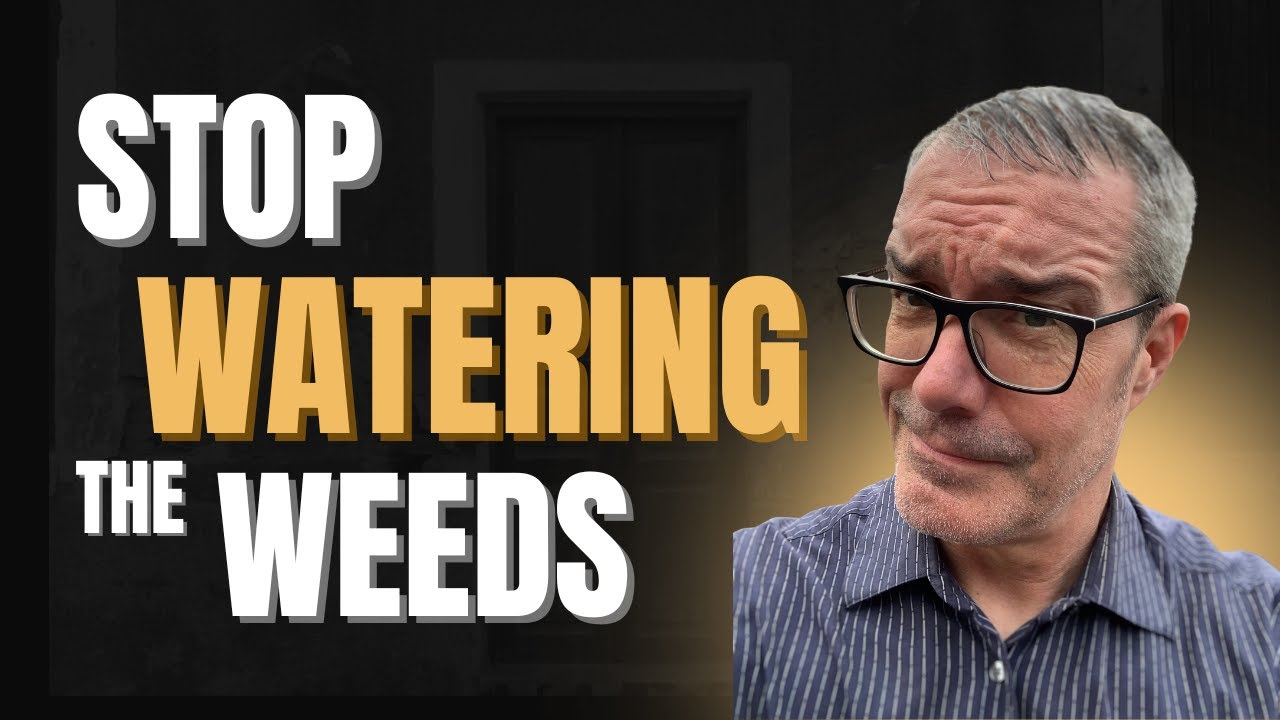
Scott Perry leads a workshop on eliminating what blocks progress. He walks through the "stop watering the weeds" method: define your vision, audit where your time and money actually go, cut the busy work, and focus on the 2-3 priorities that will get you to your goal fastest.
Chapters
All right. We are live. Welcome to another pop-up episode of Creative on Purpose Live. We're going to talk about watering the weeds, things that you need to stop doing before we get into Q1 of 2026. Hello, Alice. Thanks for hopping on. Hope you had a wonderful holiday. From what you shared in the community chat, it sounds like you and the boys had a bountiful and fun Christmas. I imagine not. I don't know. I don't know if you get much in the way of snow in your neck of the woods. We definitely are not having a white Christmas or a white holiday season right here. It's 60-something degrees today. I took a walk in my shorts. Hey, Kira, Kyra, and Emma and Bree. Look at this. We have a Whole bunch of Circle and Inner Circle members coming in today. I'm gonna start talking about the thing that you should stop doing before we get into planning for our Q1 priority and success plan. Yeah, it is really warm. I was just— for those of you just hopped on, I was asking Alice what the what the weather was like in her neck of the woods in Kent, UK. Emma, I imagine you probably had some snow. Kyra, I cannot remember where in the world you are. I know Bree did not have snow. It would be a very unusual thing. Oh, that's great, Kyra. Awesome. Well, while we're giving everyone one more minute to jump on the call, uh, The question that we asked in yesterday's Friday on Purpose call was, what's a remarkable gift that you received this holiday season? So that could be an actual, like, Christmas gift or Hanukkah gift or Kwanzaa gift or whatever it is that you celebrate gift. It could also just be a thing that happened that you see as a gift. But it was interesting. Claire just jumped on. She's our, one of our newer Circle members. She, she was on the Friday Purpose Call yesterday. So just re-asking the question, what's a remarkable gift you received this holiday season? And by remarkable, I simply mean a gift that is worth making a remark about. And that might be something that was just really unexpected, really delightful, really anticipated or helpful or useful. It could also be something that was disappointing or unexpected in maybe not necessarily a positive way. But if you want to, if you want to just entertain me and entertain each other while we give everyone one more minute to join the live here, what's a remarkable gift that you received this holiday season? For me, it was a couple of books. That I received as gifts from my wife, but then I also got a nice gift from my younger son in the package of a book. I was so inspired by some of the books I received that on Christmas Day while we were all just kind of lazing around and reading, I must have pushed out 6 or 7 Substack notes with little hints of wisdom that I received from everything I was reading. So if, uh, if you, if anything, if you're inspired to drop anything in the chat, would also just love to hear it. Did you receive any remarkable gifts this holiday season? Remarkable in that they were delightful. Remarkable in that they were unexpected. Uh, remarkable in that, um, you're— that you just weren't sure what they were. And it doesn't have to be physical gifts. It could be gifts of the presence of family members or that sort of thing. Emma says books as well. That's awesome. Stressless family time. All right. I hear that's hard to come by. We, we, we keep a pretty tight lid on who is and is not allowed at, uh, at the house during family gatherings. So ours tend to be pretty, pretty low stress, uh, in most cases. I'm glad that you had that gift bestowed upon you, Kyra. Ah, Bree got adult Legos to build an orchid. We actually looked at adult Legos and the orchid, uh, package as a potential gift for a family member. I'm glad that, uh, you're having fun with Legos. We still, we, we play with Legos quite a bit. Our youngest or older grandson loves him some Legos and inherited his father's humongous collection of Legos. All right, we're going to go ahead and get started for real here. Got, I think, everybody. Well, we have Azalea, Azalea Lexi. I hope I'm saying your name right. Great to have you here. But Claire and Bree and Kyra and Emma and Alice. These are all folks that are currently members of the, uh, Circle or Inner Circle community here at Creative On Purpose. Those are the paid subscriber communities. The Circle is monthly and annual subscribers, and the Inner Circle, the founder-level subscribers. And, uh, for those of you that have been following along, yes, uh, the value of the paid subscriber tiers has gone up exponentially over the last year because, uh, of people like, uh, Penny, who just jumped in. She's an Inner Circle member. Claire, who just joined. Bri, Kyra, Emma, uh, Alice. These are all folks that have, have been really very pivotal, pivotal and important in leveling up the value of the, of the community membership, the community calls, the community workshops and so forth through their participation and contribution. So if you haven't been paying attention, those of you that are already members of the Circle or Inner Circle community, your subscription rate is locked in for as long as you want to remain where you are. If it's a time where it might be worth considering upgrading to the Inner Circle or going from free subscriber to Circle subscriber. Now is the time to do it because you'll lock in at the lowest rate. There's plenty of information about that on the Substack. Um, but, um, one of the things that, uh, we are gearing up for, uh, right ahead of the subscription, uh, tier pricing increases is on Tuesday the 30th. I think it's at noon Eastern. Uh, we are going to be doing a workshop for all subscribers, free and paid subscribers, uh, kind of an initial priority setting and success planning for Q1 of 2026. And I thought I would jump on today to share this idea of stop watering the weeds. What are the things that you need to actually stop doing ahead of setting your Q1 2026 priority and crafting the path that will help you make your success inevitable and help you collapse time to target with the greatest ease and velocity by just doing the, the things that need to be done and stop doing all the things that don't need to be done. Well, one of the things you're going to stop needing to do is watering the weeds. So this metaphor of watering the weeds is something I picked up from my friend Jeff Moore. Jeff is the person that blurbed the— and left a very nice testimonial that's on the COVID of The Art of Encore Living Handbook. All of you that are subscribers to the Creative on Purpose Substack have access to that The original handbook plus some expanded articles that I've been sharing over the course of the last 7 Sundays, and I think number 8 drops this Sunday and number 9 drops the Sunday after that. Jeff's a really incredibly generous, thoughtful, wise human being, and he talks often about this idea of stop watering the weeds. Like, one of the fastest ways that you can get closer to what you actually want in life is to stop doing all the things that you don't have to do, that you shouldn't be doing, the things that are actually getting you further away. And by— and you should obviously be watering the things that will get you closer. And so, you know, water is a precious resource. It's finite into— to a degree, potable, clear, fresh, nurturing, nourishing water is not— and there's not an endless supply of it. And for solopreneurs, we have resources that are incredibly finite. And if we are wasting those resources doing— by watering the weeds, by doing things that we don't need to be doing, we are on a path to exhaustion. We are on a path to burning out and blowing up. We're on a path to growing a garden full of things that look busy and productive and are not getting, have nothing to do with what we actually want. So if you feel like you're always busy, but things are not really getting better, you're probably watering the weeds. If you feel like, you know, there's all sorts of productivity in your business, but not a lot of prosperity, you're probably watering the weeds. If you feel like the wind's always in your hair and you're in constant motion, but you're not really getting anywhere and you're not getting momentum toward the things that you actually want, you're probably watering the weeds. And this whole idea of watering the weeds is that it keeps us from the work that actually will change the outcome, that get us closer to the outcomes that we want. So The first thing that we will do in the workshop on Tuesday, and again, for those of you that haven't yet reserved your seat or reserved your access to the replay, just look at the Friday post that went out just this past, just yesterday, and you'll see there's very clear directions on how you can reserve your complimentary seat for the live workshop on Tuesday and have immediate access to the replay. But the very first thing that we're going to do is when we are growing this garden of the lifestyle freedom that we are building our business to fund and fit around, we actually have to have a clear vision of what that lifestyle vision is. What's your vision of lifestyle freedom? And it The thing that I see happening over and over and over again with people that are new to the community and when people are new to me as clients is they're just chasing after the dream of more. I need more money. I need more time. I need more clients. That's not a vision of lifestyle freedom that you can accomplish. There's no specificity there. There's no actual outcome there. Like, money by itself doesn't mean anything. Time by itself doesn't mean anything. What would you do if you had adequate financial and time resources? What would your average day or average week look like? What are the things that you would be doing? What are the things that you would be enjoying? So the first thing that we have to do is we have to define our current vision of lifestyle freedom. This is not an absolute thing. You don't have to have this fixed point on the horizon that you're going to grit and grind your way to no matter what. You're not going to put blinders on and not pay attention to anything else but this one singular goal because a lifestyle vision can change over time due to changing life situations and circumstances, can change due to what time and randomness throw at you or over the course of the days, weeks, months, years that go into achieving lifestyle freedom with your solopreneur business. What you need is a good enough vision for right now. And what you need is a vision that is specific, measurable, achievable, relevant, and time-bound. And so one of the very first exercises that we'll talk about on Tuesday is crafting a lifestyle vision in 3 parts by creating a lifestyle vision statement in 3 parts. And the very first part of that statement is, I know I'm successful when— and then describe what that is. And it shouldn't be when I have more money or I have more time. What what does your life actually look like when you're living your ideal lifestyle, when you're living the vision of lifestyle freedom that you want for yourself? Before we can talk strategy and how we're going to get there, we have to actually establish direction. And you can't establish direction with some sort of vague notion of where you're heading. So think about where do you actually want to end up? Again, it's not fixed. It, You reserve the right to change your mind if life's certain situations, circumstances, or opportunities or obstacles dictate that you change course. But we need to know where we're starting because that lifestyle vision will probably get clear and possibly iterate and improve as you make progress towards that goal. So that's step 1. And then, To carry on this metaphor about watering the weeds and how we can stop watering the weeds and how we can start watering the garden of our ideal lifestyle. Once you have that vision of your ideal lifestyle, that's the bucket that you're trying to fill. That's the bucket that you're going to fill to water the, the, the tree of your ideal lifestyle. And we have to, before we can fill that bucket, it has to be a bucket that has a solid bottom, and it has to have no holes and leaks in the bucket itself. It does no good to stick a hose in and fill it with water when the bottom is all rusted out and it's all full of holes. And when you have a lifestyle vision of lifestyle freedom that is unclear and vague and just requires more money, more time, you're never going to fill it. You can pour all the water you want in, in the world into a book with a rusted bottom and holes, and it's just going to all leak out and you're never going to accomplish anything. Get a solid vision of what that lifestyle freedom vision of your life looks like. And then at the other end of this metaphor is the faucet, right? I think of it as like a rain barrel with a faucet on it. I use a rain barrel because we're not— most of us are not entrepreneurs with access to unlimited venture capital and have huge teams that are doing, you know, the various parts of the business like client acquisition, marketing and sales, product design, product packaging, product delivery. We, we do all this stuff by ourselves. We're not operating from the municipal water system. We're operating from a rain barrel. Full of very, a very finite amount of time, attention, money, effort, reputation. And we have to be pretty deliberate and discerning with how we allocate those resources. So knowing that we have a finite amount of time, attention, money, effort, reputation, before we turn the tap on, We want to make sure that the hose is connected to the tap and that the hose is in the bucket. And again, that the bucket has integrity, no rusted bottom, no rust or holes in the bucket, because that's our vision of our ideal lifestyle. We want it to get full and stay full, but the hose is going to always have kinks in it. It's always going to have some holes in it because there is no perfect system. And so when we're thinking about the allocation of our resources, how hard we're going to turn on the tap, how full throttle we're going to fill the, turn on the tap, we have to start thinking about, okay, knowing what my direction is, I know the resources that I have. I know what I have. Where I am and what I'm starting with. I know where I want to be. That's the bucket. This is the starting point and where you are and what you have is, is the resources. This is a tap that's going to have to flow through this hose that's full of holes, full of kinks, and we have to address the kinks in the hose in order, starting at the closest. And so what is normally happening is, and what we need to do first to create some integrity in that hose is we have to stop doing all the things that we don't need to do. And this is where the, this first step actually instantly creates more lifestyle freedom for you because I'm looking at all the folks here that are members of the community and several of you are also clients. I know from the audits that we've done of your current client attraction system, of your offer, of your marketing web, and of your priority and success planning that in every single case, we absolutely found that you were doing way too many things, that all of your resources were being diverted into way way too many platforms, tools, tactics, strategies. You were trying to do all the things, be everywhere all the time, all at once on social media platforms and, and forums and other platforms like YouTube or podcasting or writing a book and all the things. The thing is, you could, if you do an honest audit of all the things that you're doing to try to build a sustainable business. In almost every case that I can think of in working with clients, community members, we could stop doing 80% of the things that we're doing and it would have no net impact on our bottom line. It would not reduce our bottom line at all, which means you could recapture 80% of the time, attention, money, effort, and reputation that you're pouring into those activities and automatically it goes into your savings account and you can decide to spend some of that money on time on things that actually matter to you in terms of lifestyle aspirations. But you could also choose to invest some of that time and attention and some of that money and effort and your reputation into the 1 or 2 or 3 things that need to go right enough for your business to actually start to grow in a way that funds and fits your vision of what lifestyle freedom looks like to you. So we've talked about how busyness and productivity are actually just traps, trying to play other people's game by adopting some digital marketer or online guru's blueprint, roadmap, formula, what have you. You can't win a game you don't want to play, and you can't win your game if you're playing someone else's. Yes, digital marketers by and large are honest brokers. They are selling things that worked for them in the past, and because they worked for them in the past, they think they will work for you now. The problem is they don't recognize that you are not them. And it is no longer the past. By the time they are selling you a LinkedIn DM strategy or a Facebook ad strategy or any of those things, they have already started to return diminished returns on the investment of time, attention, money, and effort into those strategies. Because the more something gets popular and populated, the less efficiently it will work. So that what you need to do is decide what's the game that you want to play? What are, what's your personality and preferences when it comes to operating and delivering and marketing a business? Because if you're doing things that leave you feeling persistently exhausted or depleted, those are probably things that you need to stop doing because they don't actually reflect who you are and who you want to become. You do not have to do any of the digital marketing BS that we're sold in order to run a profitable business. Yes, I have created and generated a lot of revenue by creating ideal customer avatars and power offers and building funnels and doing launches and powering it all with ads and spending 80 to 90% of my 80 to 100-hour work week doing things I really didn't like doing, all for the pleasure of spending 10 or 20% of my time doing the work I actually started my business for in the first place. You can do it that way, but it's exhausting and you will often find yourself doing work you don't care about with people you care even less about. There, the alternative that we talk about in the Circle and Inner Circle community as we're unpacking the core frameworks of the Purpose-Driven Prosperity Model operating system is you can build a business entirely on who you are, what you're the best in the world at, and where you belong. And that you can simply do the work that you love with people you care about as a means of gaining greater preeminence in the market by enhancing your positioning in that marketplace and attracting the people that would be your ideal clients, your actual clients, not avatars, by showing up as you are with what you have, doing your thing and letting people watch and trusting that your people will find you. And so again, we're filling the bucket of our, our, our goal is to fill the bucket of our ideal lifestyle vision. We are recognizing that we have finite resources when it comes to time, attention, money, effort, and reputation. And we have to be assiduous, diligent, deliberate, and decisive about how we allocate those resources. And the fastest way that we can start to clean up and recapture resources that we can reallocate is to stop doing all the things that we don't need to do and double down on the 2 or 3 things that need to go more right in order for us to collapse time to target. So the first step is the audit. We weed the garden. We, we get rid of all those things that are just busy work, things that make us feel productive, feel things that make us feel like we're in motion, but are not actually collapsing time to target. And then we identify the most immediate bottleneck to our success. And the most immediate bottleneck is usually not the thing that you think it is. If you think that the only solution to your revenue problem that will get you the lifestyle freedom that you want is to create a new offer, you are mistaken because creating a new offer takes a large investment of time, attention, money, and effort and reputation. And if you have an existing offer, you can spend a lot less time, attention, money, and effort on optimizing an existing offer that is working, but just needs to be to work better. You can make it work well enough to fund and fit your vision of lifestyle freedom. So I'm going to pause there. I'm going to just again say, if any of you here have any questions about this, we're going to do like a serious deep dive in everything that I'm talking about in the workshop on Tuesday. It is complimentary to all free and paid subscribers. It's gonna set us up for the Inner Circle Q1 priority and planning session that we'll do on the second Tuesday of January. But for all of you that are free subscribers, you'll get the, you'll get the, the core philosophy and the core principles. You have to know what your current vision of lifestyle freedom looks like. What's the bucket that you're trying to fill? What's the actual business or the lifestyle that you want your business to fund and fit around? You have to have an— take an audit of all of your current resources, your time, attention, money, effort, and reputation. And you have to do an audit of where it's already being invested. So that you can stop doing the things that you don't need to do and immediately boost the efficiency and effectiveness of your system. And then we can decide how we're going to reinvest resources, some of those resources into the things that just need to work a little bit better. And when it comes to choosing your priority, it's almost always going to be based on What's my most immediate constraint? If you don't know what your offer is, all the spending time, money, attention on social media or writing a book or creating a podcast is not going to help you. You have to have clarity of what your offer is. What is the thing that you do that you are the best in the world at doing in the way that only you can do? What is your position in the marketplace? What is the thing that you want to achieve preeminence in? If you don't— can't articulate your client attraction system, your marketing web, and how you are attracting the right prospects and converting them into good fit leads and turning those into perfect fit clients, if you can't articulate that, then building your marketing web is your number one priority. And if you have a business that has some success, if you've been in business for 2 or 3 years, you probably have an offer that is good enough and an audience that is dialed in enough. And it's just a matter of optimizing your client attraction system. And the best way that I know to optimize that system is to stop doing all those things that you don't need to do, which is all those the BS digital marketing stuff that we've been sold as being necessary to having a successful, thriving online business, because you don't need any of it. Creative On Purpose has been providing me with my— the revenue that I need in the first 6 months of the last 2 years without any social media strategy. In fact, I'm currently off social media altogether, other than Substack notes. I do not have a funnel. I do not have an ideal customer avatar. I do not have a power offer. I show up on Substack for the folks that have given me the privilege of their email address, and I deliver insights that inspire intentional action that help them get a little bit clearer and closer to what they want. And through the community calls and workshops and content, I have built a very profitable, successful business with just over 1,000 total subscribers and just over 60 paid subscribers. And I only work with people that are Circle and Inner Circle members, monthly, annual, and, and founding level subscribers. It's entirely possible to have an audience that small and have a highly profitable business. It's just a matter of being clear about what it is that success looks like for you and defining the system that will get you there and optimizing that system over time to deliver the results that you need with great— greater efficiency, effectiveness. Ease and velocity. So I don't see any, I don't see any questions coming in and that's totally fine. We can wrap this up. I didn't necessarily intend to go much over a half hour anyways, but if anybody has anything, then let me know. I'll just leave you with this. If you would like some help defining your ideal, your vision of what lifestyle freedom is for you, the the lifestyle vision that you want your business to fund and fit around, if you want to get clear about where you're starting and what you're starting with and conduct an audit of your current business systems and define the 2 or 3 things that you need to do right to accomplish your most immediate business priority, it's exactly what we're going to talk about on Tuesday. And that workshop is open to to all subscribers to Creative On Purpose. Alice, just go ahead and drop your question in the comments here. I'd be happy to answer it. So that happens on Tuesday. If you are not currently a subscriber to Creative On Purpose and you are a purpose-driven difference maker that is interested in building a business that more effectively and efficiently funds and fits the life that you want to have, then I strongly encourage you to subscribe to Creative on Purpose and check out all the content that is under the Transcendent Solopnoir section. Although I think the rest of the content is relevant to that endeavor as well. And if you want some microsteps to think about, just, you know, think about this metaphor of watering the weeds. You know, what's the— do you have a solid vision of the lifestyle that you want your business to kind of fit around? Do you know what lifestyle, a sufficient, good enough vision of lifestyle freedom looks like for you? If you don't, you need to start there. Do you know where your current time, attention, money, effort, and reputation is being invested in? Do you know what the return on those investments are? If you don't know those things, then I would encourage you to get those, do the work to go through that and get those things written down. And then when it, when you look at where you are and what you're starting with and where you want to be, what's the actual most immediate bottleneck to your success? For the, for most of us that have existing business, it will have something to do with the efficiency and effectiveness of your client. Attraction system, and if you're looking for a way to create a system that will optimize over time in the easiest, most efficient way that I have ever seen, then check out the— check out Clients on Purpose, one of the articles and workshops that we did in the community. All right. So Alice says, I was thinking about working with influencers or speaking with people that could Inspire my audience? Could that help me become more visible and credible? But I'm sure that would be in the future. I am just thinking 100 steps forward as usual. Well, I will say this, Alice, you're actually circling around something that is really worth highlighting for everyone in that your relationships are the biggest force multiplier in your business success. And by force multiplier, I mean leverage. Your relationships provide the greatest leverage for your business and life success. And force multipliers can work in both directions. So if, if you have, if you are invested in relationships that are getting you further away from where you want to be, That's a force multiplier moving you in the wrong direction. You need to surround yourself with more of the right people and spend less time with more of the wrong people if you're going to use relationships to power your business growth in a positive direction forward. And I think that when it comes to connecting, networking, collaborating with people that are a little further along than you are. I think that can be a very successful way to connect with more of the right people that would benefit from colliding with you and the great work that you're doing. When I was just getting started with Creative On Purpose back in 20— I guess 2018 or so, I really didn't have any idea what it was. I didn't have an offer. I didn't really have an audience. I didn't really have any kind of plan. Um, but I did have the ability to connect with people on live broadcasts and podcasts, and by inviting them and talking to people that were succeeding in the kind of things that I wanted to succeed in and doing the kind of things I wanted to do, I not only built my audience, but I got a lot of great information. And when you're talking with people that are a little bit further along, you're getting authority bump from that association. Seth Godin appeared on— was a friend and mentor since 2016 when I was in the Alt MBA and I became a coach and then a head coach in Akimbo Workshops. That authority bump or authority loop really helped me. But he also came on my podcast 5, 6 times. And by appearing in live broadcasts and on podcast episodes with Seth, It raised my visibility. It raised my perceived authority and my reputation. It's— and it also helped me get clear about who I was and where I was going and how I was going to get there. So I don't think it's a bad idea to try to be in conversation again. The fastest path to cash is going to be conversations. So having conversations with people that are already in your circle of influence, already in your network, who you already have access to, will get you the clarity and the velocity that you need to build a successful business. But I don't think there's anything wrong with You know what you're thinking about. I would just be care— like, make sure it's not just a diversion and a thing that you're doing because it feels good and it feels productive. You have to have a set, set up the priority in a way that is specific, measurable, achievable, relevant, and time-bound. Like, can you run a little experiment? Can you have 10 conversations with people? And can you set it up in a way that measures how many people, how many conversations you start with the people that connect with those conversations? So that's the way that I would think about that. I don't see any other questions coming in. I've kind of said what I want to say, but I'm happy to sum it up one last time. Jonathan, welcome. You're coming in just as we're kind of winding down. Amit, you, you, or Amit, I'm not sure how to say your name. I hope it's, I hope I'm not, not bungling it too badly. Great to have you here. And, uh, let's see who else we have come in here towards the end. Oh, Richard also came in, uh, as we were getting going. So watering the weeds is when you are spending too much, investing too much of your precious resources of time, attention, money, effort, and reputation, finite in supply for all solopreneurs. If you're investing too much of those resources into busy work that makes you feel good, that makes you feel productive, but doesn't actually get you clearer about and closer to what you actually want your business to fund and fit around in terms of ideal lifestyle, you are watering the the weeds. And you can grow a garden that's full of weeds that looks like it's highly productive and all that sort of thing. But if it's not giving you what you want, then it's just a weed-filled garden. So the thing to do is define what's the lifestyle vision, what's the vision of lifestyle freedom that you want your business to fund and fit around? Make sure that that bucket has got a solid bottom and no holes, that it's clearly defined so that when it starts to get filled, it stays filled. Do an audit of where you're starting and what you're starting with. What are— where are you spending your time, attention, money, effort, reputation currently? And what is the return on those investments? If you're not getting an adequate return, you need to stop doing those things because that's watering the weeds. You will find that you can weed out 80% of the things that you're doing and it will have no impact on your bottom line, which means you've actually automatically boosted your bottom line because you're investing fewer resources to get the same result, which means you recapture time, attention, money, effort, reputation that can be invested into the things that you actually want to enjoy in life. And you can invest some of those into the 2 or 3 things that need to go right in terms of identifying and navigating the most immediate obstacle to your business growth and success. So with that, I'm going to go ahead and shut this down. It's been a privilege to spend this time with you. Great to see so many Circle and Inner Circle members here. And for those of you that are not currently members of the community, if you're not subscribed to Creative on Purpose, I'd encourage you to give that a shot. And for those, anyone that wants to attend the workshop, on Tuesday where we're going to do a deeper dive in all this, just go ahead and look at Friday, just yesterday's post, and it will give you very clear directions on how you can reserve your complimentary seat. And I'll see you all when I see you all next.
More from Scott



Stoics Don't Suppress Emotions, They Do This Instead #stoicism #emotionalintelligence #mindset







