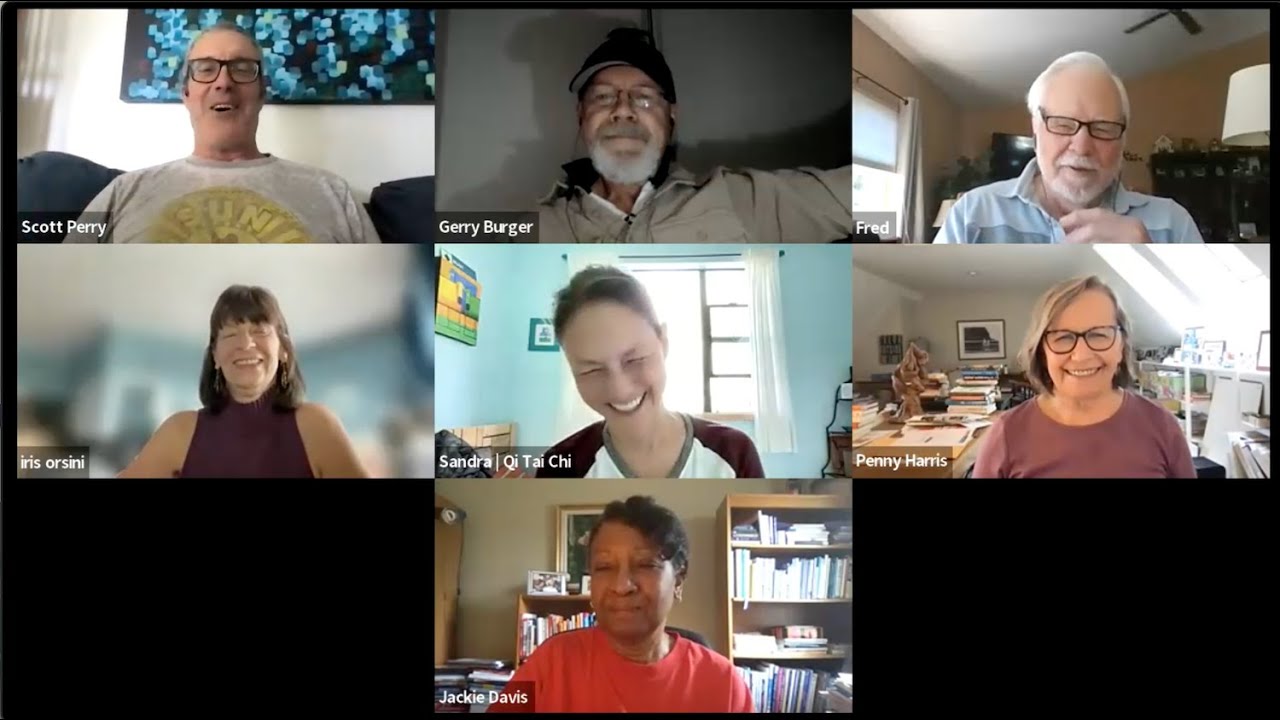
Scott Perry leads a coaching group discussing how to grow their businesses. The session covers three coaching levels, from people-pleasing to empathetic antagonism, and tools like the Skill-Experience Matrix and 4-lens decision framework. Participants work through niching, positioning, and the fear that comes with shifting focus.
Chapters
Hey everyone, it is Wednesday, June 28th at 2:00 PM EST, which means it must be time for our final Catalyst Call of June. We're actually having this a week later than normal because I was away last week. Grateful to have our usual offenders, Jerry and Penny here, and then we have an— oh, and Iris. Sorry, Iris is always here. But we have Sandra and Fred in attendance as well. I don't have like a big agenda or anything in particular that I wanted to share today. So we're going to leave this open to the members that are here to get a little insight, reflection, feedback on anything that's going on in their endeavor to fill their programs and meet their monthly revenue goals and/or just just get greater clarity about their offer, audience, and sales strategy. The only thing that I— so actually, I'll share two quick things. Uh-oh, everybody. Sorry, I have to let her in. But yeah, just so you know, Jackie is here. Everybody be on best behavior because Lord knows Jackie will not be.
Don't say those things.
I was gonna say, oh no, Jackie's here, now I can't talk about her. But then I thought, wait a minute, I always talk about Jackie, even when she is here.
When she's here, when she's not here.
And sometimes it's even true. I mean, the things that I say, so who knows. So just to help set the table for you quickly, Jackie, this is kind of an open session. I'm willing to, for the next 55 minutes or so, just hear what's on your mind. Effectively in terms of where you're at with your coaching business, offer, audience, sales strategy, anything else related to that. The one thing I was going to— two quick things. The first is for anyone that wants to go a little bit deeper, in the month of July, there is one session in the Coaching Business Prescription still available. If you want information about that, just send me a, send me a message. You can do that even while we're here. I'll be happy to send you to a link that will give you more information about that program. If you'd like to hear about that program from someone who is not me, Sandra and Penny have both been there and done that. And I'm sure that they would give you an honest assessment of how that worked out for them. The second thing is I posted on LinkedIn and Facebook today something that has really resonated. I know Iris has commented on it. Penny has shared some insights. This idea of, you know, what kind of coach are you? And so what I shared was basically my experience, not just as a coach, but also as someone who has received a lot of coaching, that what I have found is that people, you know, in the beginning of your coaching journey, you are coaching for agreement. You want people to like you. You want people to stick with you. You are, um, you know, being agreeable, likable, and, uh, nothing wrong with that. I think that's where a lot of us, um, start out. I think a lot of us that get into this kind of business are naturally people-pleasing type of people. Um, And so that's one level of coaching. Um, the next level of coaching is coaching for insight. Now, this is where most coaches end up and stay, which is you learn the Socratic method. You learn how to ask question after question after question that reveals an insight, that shines a light, uh, or shines a light on, on a an issue that the— your client didn't see until you shone a light on it. Shine a light on a door or a light switch that they weren't aware of until you shone a light on it. Um, and then there's the third level, which is coaching for action. And I'm not saying that these levels are mutually exclusive, like you don't have to be a a disagreeable person to be an effective coach. You don't want to stop sharing insights to be a good coach. But if you're going to be a coach that commands a price that creates a livable wage, if you're going to be a coach that attracts and coaches the kind of clients that will give you a feeling of fulfillment and help you forge a little meaning and feel like you're actually making a difference, you have to develop this ability to share an insight in a way that gets under someone's skin just enough to get them to take the next smallest step into possibility. I call that— so I call my process empathetic antagonism. I share an insight, I get, I, I keep nudging at it until you start scratching and, and until you start taking the, the intentional action that will help you start moving toward or into possibility and into solving the problem that you're trying to solve or achieving the aspiration you want to achieve. Um, and The final, the final kind of insight, because I've been working with some clients this, this last month. And a consistent theme I've seen is when, when people sign clients that don't make the progress that they signed up to make, or come, come to the coach week after week with the same problem. The coach goes into blame mode. Oh, why can't I get clients that will actually do the work? You know, I've told this person, you know, I've given this person all the insight they need to make a difference. Why aren't they doing the thing that they're supposed to do? And my response is, well, that's the gig. Like, people are hiring you because they can't do it by themselves. People are doing it because they can't hold themselves. No, and I mean, I put myself in this category. I can't hold myself accountable. I can't motivate myself to do the things that I need to do to make progress. I need someone that will give me clear, direct, and respectful insight, reflection, feedback, and, you know, help me, help me get motivated to make the difference that I have to make, right? You can't You can't become the person that you're meant to become until you not only see things differently, but do things differently. And that's your job as a Coach. And if you find yourself, and I do this all the time, I'm not, you know, I'm saying this because I know it's true, because I not only have been there, but was there this week. When I find myself saying, what the hell is wrong with these people? I know it's time for me to shut up and take a long look in the mirror because there's nothing wrong with those people. Those are people acting like people. What I need to do is take a long look at the mirror at myself, and I have to think to myself, what is the thing that I have to do? What, what do I need to see and do differently to help this person take the step that they need to take to start making progress toward the result that they hired me to achieve. So that's my little riff rant on something that came up for me that I hope is helpful to each of you. And now I'm happy to hear your reflections or pushback on that or anything else you got going on.
I can bring something in here, Scott. I'm going through a real transition stage right now too, and I found that niching, or niching as others might say it, I'm north of the border, so—
Not to be confused with Nietzsche, who is— that's an entirely different thing. Go ahead.
I find that niching really helps when you really dig into your purpose and who it is you really want to work with and who can benefit the most from what you have to offer. Helps. However, I am freaking out because I've figured out my niche or niche and it means tightening out tightening down. And it means that, um, well, I've had— I've already had some long-term students that have been like, I'm sure in their head they're going like, what the hell is she doing now? Like, this isn't, you know, what they signed up for 10 years ago. But what I'm doing now has completely evolved from what I did 10 years ago. Um, so yeah, I am kind of freaking out a little bit, but I'm seeing that I'm seeing where my work is most effective, who is getting the best results from it, and I'm seeing where I'm, like you say, making the biggest difference. But yeah, I'm— well, I am— I'm freaking out at the same time.
Well, I would say, um, you could— so Sandra, you know this from our work together, that the, the, the, that Narrative matters. That's how we make sense of ourselves, each other, and our situation. And so the words that we choose to use to describe our situation will impact our, not only our current experience, but maybe our future. So choose your story, choose your future.
So I'm explosively blossoming.
Exactly. The fact that you're feeling this discomfort is probably a very good thing. The freak— so you're not freaking out, you're excited about a, uh, a new level of challenge. So if, if anyone is not already familiar with it, there's a thing called the Skills, um, Skill Experience Matrix, I think it is. But there's, you know, you are going to be at— in flow when you, um, are doing something that's high skill, high challenge. Now, when you, as you shift to, you know, high skill, low challenge, or low skill, high challenge, or low skill, low challenge, right, your excitement, your enthusiasm, your energy will diminish. And one of the things that we, I think that happens, and Sandra, I know, you know, just from the time we worked together, you went from okay to holy cow, this is— things are going really great. And then I, from staying in touch beyond that, that things continued to go well. The bottom line is what got you where you are will get you where you want to go. And so it is natural at a certain point that you will be in that zone of high, um, high skill, high challenge, and things will feel great. Like, you know, I mean, there's, there's too much challenge and there's not enough skill, but that's a whole, that, that's a whole different thing. But at some point, that high skill, high challenge quadrant is going to now become the status quo. It's going to be normal. Which means you have to decide, you know, am I going to increase skill or am I going to increase challenge? And I, I love your insight about niching, niching, or Friedrich Nietzsche. Um, almost everyone avoids niching at any given level of your growth. Because the more you niche down, the more on the hook you are. The more you niche down, the clearer you are on what success looks like, which means failure is much clearer as well.
Right?
When you define what success is, you decide what failure is. And success is a very narrow thing, and failure is anything but that. And so I would encourage you to— I mean, I think you're doing everything that you need to do, and you need to reframe just the narrative around that. I'm not freaking out. I'm excited about what's going on. And accept that there's going to be uncertainty. There's going to be, at some level, some failure. And you only have to take responsibility for what is yours to take responsibility for. Sometimes we don't get clients the results that they want because the client doesn't do what they said they were going to do. That's not on you. Um, sometimes you don't get the result that you want because it turns out that what the client said they wanted isn't the actual thing they wanted. And, you know, it might be that you help them see what they, they actually want, which is actually a success. So, um, this idea of that's the gig is something that I came up with when I was a musician, because when I was a professional musician, you know, you start off— I mean, I started off literally playing on street corners. And I actually made a living for a little while playing on the streets of Chicago. Um, it's interesting that you had to pay a little tax to the, the, the beat officers on the street, but that's a whole different story. Um, but as I've moved up to each, you know, each level in the business, and, you know, obviously I never made it to Eric Clapton level or anything, but, um you get to a certain level, and at first it's really exciting, and then it's kind of okay, and then it starts— then you find, you know, like, everybody knows the bitter, jaded musician that says, I never, never got the breaks, nobody pays attention, I'm not getting— nobody's listening, blah, blah, blah, blah, blah, blah. Again, that's not anybody's fault but your own. So, you know, when I was at a level where I was playing kind of wallpaper gigs at restaurants and I was just background music I would say that's the gig. I don't— I can't expect people to come here and listen to me because that's not what they came here for. They came here to talk and have a nice meal and have some nice music in the background. That's the gig. So that's the gig I'll play. And when I play a big festival stage and I got to put on a big show, that's the gig. So that whole idea of Maintaining contact with reality. You know, I'm not a huge Katie Byron fan, but the first two questions she asks is, is this true? Is it really, really true? Have always helped me with that contact with reality type of thing. Because what's— what I think is true is the narrative in my head. And what's really, really true is what's actually happened when I take away all the adjectives and adverbs and value judgments from my story. Is that helpful? Oh yeah. Don't you miss me?
Well, I showed up today, didn't I, Scott Perry?
Awesome.
Anybody got anything else for Sandra or something that they'd like to bring up for themselves?
Well, could I comment the thought that I occurred when Sandra was talking about the narrowing down the niche and being a little scared? The thought that occurred to me was it's scary because it's like standing at the edge of a double diamond ski run and you're looking down and going, excuse me, oh shit, what did I get into? But it's the exciting run that comes after that. So as soon as you can face that, you can go. And now you have that challenge that's already there. I don't know if that helps or not, but it changes the narrative in the head. Yeah, it's scary, but it's going to be fun.
I'm done.
Yeah, well said.
Thank you.
So I'm just going to say now, if you're sitting there waiting for a chance to say something, that 5 minutes of I'm going to wrap this puppy up and go away, So don't hesitate if you've got something to share. Share it now or forever hold your peace. Go ahead, Iris.
Sure.
Thanks so much, Sandra. You kind of also were in a similar situation where I've decided to add a skill set this past month. And it's been a stretch. And it's the same thing about niching. And Nishing does come into this skill set as well. And the whole thing about, are you coaching for agreement, which in my translation would be understanding. Does the person understand and agree with what you're trying to talk about? And then the next part, which is insight, the insight is, are we both in agreement of taking on a new belief, 'cause you can't really take commitment or action unless you've like shifted your viewpoint. And yeah, I've come to the realization that the action I provide in coaching always has a design component to it. I know I've mentioned that before, but I'm getting a little bit more clear about that. And because design is always a component of whatever I do, I've realized I needed to add the skillset of being able to make those social media carousels where you step through the 10 slides. And, you know, it's been a lift and I'm just like, okay, I'm doing it. But yeah, it was a, you know, a triple black diamond run for, you know, for a day or two. And I would only be able to do like 10 minutes at a time. But I'm starting to get over the hump of being able to now use the new skill set a little bit in delivering what I need to say. So that's where I'm at, right there with you.
Appreciate that, Iris. I'll just share one reflection that came up while Iris was talking. And this, you know, sometimes people So oftentimes when people say, I don't want a niche, you know, I, what I do can help a lot of people. That's really just a seductive way of, of kind of hiding. Like, I, I don't want to stand in a, in a, in a spotlight so that people could actually find me and work with me. And that's, that's like what is usually happening. But there is, you know, it is possible to build a coaching business without as, you know, without super niching down. If you have, um, no, so, you know, for instance, Iris, um, if— well, and I put myself in this category— if you're on my mailing list, you, you hear me and see me talk about all sorts of shit, you know, because I'm just sharing what's interesting, like what I'm finding interesting right now, and Um, sometimes what happens is people join the list just because they like the insights that I'm sharing, and they will contact me about becoming a client, and it has nothing to do with building a coaching program or finding their, their purpose in the second half of life. They just see me as someone that has a wide range of, um, of, of, uh, processes that lead to the kind of insight that can help them solve their problems. So sometimes there are— they, they're, you know, corporate people, sometimes they're, uh, in educational academic institutions, and they— what they're concerned about has nothing to do with what I'm usually advertising. Um, Jerry and I have a, a a friend and mentor, um, Nick Peterson, who is kind of famous for this. He built a coaching, consulting, online community business by simply sharing whatever he wanted to share at any given time. And over time, more and more people started paying attention.. And then when he comes up with the next thing he wants to offer, and they're not always even in the same category or realm, but they will sign up. Sometimes he doesn't even have to tell them what it is. Hey, I'm gonna be doing a thing, and if you wanna do the thing with me, you can, you can do that with me now for $5,000, and tomorrow it'll be $10,000. And people will literally sign up because he's But he, that's a long, long play cuz you have to show up and do your work out loud and in public and let people look over your shoulder for an extended period of time before you earn that level of respect and authority and, and earned expertise for people to, to say, I don't care what you're selling, I wanna buy. And most of us in this room, I'm guessing, are not. In a position to play a 3 to 5 year, you know, game to get to that level. Go ahead, Sandra.
You just brought up a hiccup that I'm experiencing. So I ran, you know, for years, general weekly group classes. And then after working with you in that, I started niching into a more specific healing program, which is a monthly program that I run. Based on the same principles, but we go a lot deeper and I hold their hand for like 30 days every day through the whole moving energy and healing process. However, when I started communicating more to share more about, you know, stuck emotional energy in the body, what its repercussions are and how to— how you can free up from the limitations of those. People were thinking that I was still talking about referencing my old offers that I've done for almost 20 years now rather than this new program. How, like, how would I— am I— is my question coming through? So I'm communicating in my emails in that and slowly dripping it into posts. Gearing people up to become more aware of a healthy energy body because it's something we don't necessarily consider when we think about our health. And in trying to share more communications to raise awareness in that, people are assuming that I'm talking about my regular weekly classes, not this in-depth month program, the intensive.
So would it be fair to say that even so, this energy element is kind of a deeper thing, but it is still associated with what, what you've been doing. Is that fair?
Yes.
Yeah. So that's a, that's a great question. And I would call that— it's, it's just a, it's a nuanced positioning move. You already— they already have a hook in their head for what you, you know, where they can say, okay, this is what Sandra does. Sandra does um, Qigong and Tai Chi. Um, and now you're saying— now you're, you're saying now there's a, a, another hook or another layer on that where, um, yes, this is, you know, this is help— this, this movement is important. It's also, um, it's tied to energetic healing. And if you want to go deeper, if you, you know, and, and give them? You know, what's, what's the benefit? What's the result they'll get if they want to go on this thing? So sometimes it's— so I worked with a coach for a while. Well, you know, some of the first coaches I worked with were like, Scott, you're a nice guy and you're a smart guy, and I can tell that you really care about people and want to make a difference. I don't understand what it is. What the hell you do? So I've had to come up with something that was, this is what I do. And then over time, um, you know, I was doing things that I was good at, but they weren't really the— they weren't lighting me up as much as things that I was discovering I really wanted to do. And so when I started to, um, offer something else. I was— my coaches would say, don't confuse your market, do one thing and stick with it. And I was like, okay. And I actually followed that advice. Um, kind of made me profoundly unhappy because I was growing out of something that I didn't— you know, it's like, I was a professional musician for almost 30 years. And when I became— when I opened my guitar studio, I thought I had found the thing I was going to do for the rest of my life. And I did it for a long time, and I loved it until I stopped loving it. And everybody that knew me said, Scott, you won the freaking lottery. You know, you're making a living as a musician, you're teaching, you know, you've taught 1,000 people how to play the guitar. Why would you want to mess that up? But I can tie, you know, I'm, I'm not doing anything different than I did when I was a guitar teacher. I just don't have a guitar in my hand. And so it's always about as you're making these transitions, as you're expanding your offerings, or as you're changing the, the lane that you're running in or swimming in, You just have to help people see. And will you lose some people? Yes. Will you get some new people? Yes. And will some of those people that were in that one lane with you want to go with you? Yes. But it's a mat— it's always a matter of being as crystal clear with your positioning and, and articulating what it is that you're doing in a way that helps the people, you know, that helps people wherever they are in your network understand, like, this is what I'm doing now. Does that make sense?
I, I love the statement that you just made. I loved it until I didn't love it anymore. That's perfect. I mean, it just sums up— I think we all go through phases where our purpose shifts, our joy shifts. I speak for myself specifically. I mean, I can remember distinctly when practicing as a chiropractor was not— I loved it, but I didn't love it anymore. I mean, it was been there, done that. It's time for this new challenge. And, um, I think if you resist that change, that, that shift, that new purpose, um, not only psychologically but physiologically, you begin to take on trauma because you're resisting your gift, your joy, and you found a new joy, and that's all it is, and it's perfectly okay. I think we get guilt about giving up what we used to be and don't accept who we are now. And believe me, I'm not talking to you. I'm talking over here into my ears because that's It's, it's accepting that new joy.
Anyhow, I think all of us deserve to have a reserve clause. I believe what I believe until I come across new information, a new situation, a, a reason to believe something different. Like, you should You should reserve the right to be able to change your mind. And, and that's why I think it's important— that guilt that Fred is speaking to is we live it like we live in a very— at least here in the States especially, we live in a very legalistic culture, you know, contracts, and contracts are binding, and contracts can't be broken without real consequences. And, and, you know, we think that if we give our word, that, that is etched in stone and cannot be violated, even if it starts to violate who we actually are. And I think you can enter into agreements, and, and I think you do this as coaches with clients. One of the things that I learned from my time as a guitar teacher was, you know, I would always— I would never take on a new student unless we had a 15-minute meet and greet, because I wanted to— I had to figure out, you know, does this kid want to take guitar lessons, or does this kid's parents want them to take guitar lessons? Because if the parents want them to take guitar lessons, we got a real problem. And so, um, But if I were to take on a student, there would be two conditions. Number one, learning that does not lead to action is useless. I am not going to teach you to play the guitar so that you can play your favorite tunes for your stuffed animal collection in your bedroom for the rest of your life. I'm going to teach you to play guitar because Music is a language, and language is used to communicate, collaborate, connect with other people. And so there's 2 recitals a year. They take place at a club where there will be your friends and family and complete and utter strangers. And we, we are going to get on stage and we're going to play a couple songs together because that's what music is for. And I would say My job is not to be your guitar teacher forever. My job is to be a guitar— your guitar teacher until I get you to where you need to be or you want to be, or I've taken you as far as I can get you. And then it will be time for you to spread your wings and fly, go find your next teacher, whatever. So I, I had—
I—
there was a reserve clause from the very beginning. Right? And, and you— I do the same thing with my clients. I'm not here to be your coach forever. I'm here to be your coach for now, for as long as it's serving both of us. Um, and so this— I, you know, we are in the personal development, growth, personal growth business, and that means that we have, we, we have the right to grow and develop and change ourselves as well. Otherwise, we're not walking our walk.
You want to go, Penny or Jackie? You want to speak up, or do you want me to go first? That sounds like they want me to go.
Go ahead, Terry.
Yeah, I mean, it's fantastic, Scott Perry, you know, your intro. And trying to get your clients to actually fulfil on their own goals and aspirations, it's always difficult at times. And I know myself, and we talked about, we mentioned Nick Peterson, and for those that don't know, he published a little book called Bumpers. It's only 67 pages, but he's built over $100 million platform out of those 67 pages. And I've just been going through a rewrite just recently. And what I've been going through the past couple of weeks is trying to get more clarity and certainty about what I want to offer. And what I've come up with this morning is a Champion Mind one sheet. And what that is, is transitioning from your human mindset, which, you know, we all know is driven by our fight, flight, freeze response. And we want to break through that and get into action mode. And a good example of that is Nick Peterson and his business partner Dan have a sales process and they get their clients to actually sell themselves on the product and service that they're offering. And it's just a simple 4-step process. It's just like, um, Dan will say to the client, well, look, I've just got a simple 4-step process to make a decision. And usually it ends up with an asymmetric upside ratio of 3 to 1. And the components are: are there cost savings? Are there time savings? Is it a revenue generator? And is there a forcing function? And the forcing function is that transition from going from the human mindset to the champion mind. And that little example, when he offers that and says, look, would you like to put this offer through that simple process? And the client will go through that process, and that allows them to go from the human mindset into the champion mind. And so they can iterate and voice, you know, the offer, and it all makes sense to them. And so essentially, the one sheet is what I've come up with, and it looked pretty good to me. So I finally got through you know, making all of these one sheets or pink sheets is what we call them, what we're familiar with, Scott Perry. And I finally got there, you know, just going one step at a time every day. And I finally got the clarity, you know, that I can make that really clear offer. So it's been quite a journey.
Yeah.
What comes up for me, Jerry, from— and I appreciate that share— is so often when I'm working with clients and they're trying to come up with their offer, they want to come up with their offer, capital letters, etched in stone, perfectly articulated. And this is circling back to, um, a little bit of what we were just talking about, which is there is no such thing as a perfect offer. Because number one, there will come a time when the offer that you have is no longer good enough for you because it's not enough of a challenge to you, and you're, you're feeling stagnant in your skills because it's not it, it, it's, it's becoming, um, you know, a situation where we're just kind of coasting, doing this thing that is easy to do, but it doesn't really light you up and excite you anymore. So the, the, you know, what I'm hearing and what you shared, Jerry, and I've been a part of your kind of going, getting to your process, to where you're at now, is you have to share what's— whatever you had And it's good enough right now, because if you share what's good enough, then you can make that a little bit better. And now that's good enough. And then you'll share that. And, you know, you do this work out loud and in public. You do it, you know, you, you, you can do it in through informal coaching or through formal coaching that you're getting paid for. This is again, part of the progression. I don't know very few coaches that didn't start off with a Um, well, I, I know very few coaches that didn't start off just being kind of an informal coach. They were just— they just— that's who they are, and that's what the way they interact, and that's how their, their friends and peers interact with them. And then they decide that they're going to do this thing, and they start off, and it's $50 an hour or $100 an hour, and then you kind of move your, you know, and then as your skill builds and as your clarity around your offer and the results that you can get, you increase your prices and you develop at each stage. What you were doing was good enough, and good enough, what got you there won't get you where you want to go. So when you are no longer getting where you want to go, what do you have to do? You have to see and be and do things differently. So you come up with your next thing. So Kudos to you for, you know, that, that is a— when I articulate it that way, it sounds simple because it is simple, and simple isn't easy because we're human beings and we like to be comfortable and we like to know where we stand and what's expected and, um, and all that sort of thing. And so this is, again, this is the gig. You have to keep being willing to put yourself, um, I call it stepping or leaning into the edges of your understanding and ability. You always want to not, not trying to leap over the edges, but pushing into the edges, micro stepping your way into a better, clearer, more skilled, more efficient, uh, version of, you know, who you're trying to trying to become. So I, you know, I, I, I love that, um, I love that share. Jackie, you know that when you're this quiet, you make me very nervous. I know you're there judging me.
I'm not judging you. I'm just amazed that There's a cat that likes you.
Well, cat's not that bright.
Oh, okay. I guess the only—
and the cat's very needy. I mean, and my wife is not here right now, so I'm all there is.
I see. Well, no, I guess the one thing that I was thinking about as Fred was talking, and you've mentioned also, you know, you love it till you don't love it anymore. And, you know, and then you take your next, you move on to your next joy. And I have found that particularly troubling for me because, you know, I loved it till I didn't love it anymore and decided, well, you know, I was doing marketing and I said, well, no, I think I'm doing interior design. So I had a business for 14 years and then I didn't love it anymore. And I said, well, I'll go back to marketing. And I'm like, hmm, I don't really love that anymore either. So, you know, I almost feel like— well, I don't want to say should, but should, you know, maybe you should keep doing what you're doing even if you don't love it anymore until you find what it is that you love. Or, you know, it just seems to me dangerous to make a shift when you don't know where you're shifting to.
Well, I think it's both/and, right? You can— so I didn't realize that I wanted to stop doing what I was doing as a musician and a teacher until I went through the Alt MBA. And then I realized like, oh, I, you know, I came in here to figure out how I was gonna turn my business into an online passive income machine, only to find out that I didn't actually wanna do the music thing anymore. But I didn't know what I wanted to do. So what do you do? Well, there's the work you have to do to take care of your responsibilities, and there's work that you get to do, which is the work that, you know, that you're, you're, you love, or the, or your search to find that work. And oftentimes I will, clients There's a couple clients that come to mind immediately that are in kind of a corporate thing, and they're like, I just, I want to burn the boats. I want to quit my, my day job, and I want to build this other thing. I don't know what it is, but I know if I burn the boats, I'll figure it out. It's like, um, um, because when you, when you burn the boats then that urgency to make this other thing happen will lead you to make a lot of bad decisions that will get you into something that you hate even more than that thing that you just left behind. So one of the things that I did was, because I had that feeling like, oh, I'll just quit what I'm doing and I'll figure this other thing out because I'm a smart guy and I've got You know, I got things. I, I, I've, I've never not landed on my feet. I'll land on my feet again. But then, you know, when I took a hard look at my age and my responsibilities, was like, I can't really just, you know, I can't go 6 months without making this amount of money. Why don't I just appreciate that there's this thing I get that I have to do that I actually kind of still like to do. And I'll do the work I have to do and be grateful for it because I still am afforded the time to do this, to figure out this other thing. And Jackie, it took me, it took me all of 5 years, took me all of 3 and a half years just to get an idea of what I wanted to be doing. It was 3 and a half years before I, I put together my first $100 an hour coaching offer. And it was another 2 years before I turned that into a, a, a revenue, a monthly revenue level that I could walk away from. Not just the, the, the studio and the performance money, but also walk away from my role as a head coach at Akimbo. Took, you know, 5 and a half, 6 years. Um, do I wish it took less time? Yeah, you know, I mean, it, it is— that was the gig, so I did the gig. So I think again, it comes down— a lot of what we've been talking about today, I still assert, comes down to narrative. Um, I'll circle back to what Jerry was saying in case I'm this other framework might be helpful. The 4 lenses that Jerry just shared come from Dan Nicholson's book Rigging the Game. I've recommended it to several people on this call. The 4 lenses are, you know, this thing that you are thinking about doing— will it save you money? Will it save you time? Will it make you money? And is it creating a forcing function. Is this something you have to do anyways? And so by doing this thing, it will force you to do the thing you have to do anyway. And you want to click— check 3 of those boxes. Another, another framework, and this is my framework that has been helpful for many of my clients, is when you are in this I just call it the wilderness. You're in the wilderness. I know I want to do something else, but I don't know what it is. Or I've got something that kind of works, but it's not working as well as I want it to work, and I need it to work more. To avoid the perils of urgency, you know, trying to force something to work before it's actually ready to work or before you even know it's the actual thing you want to do. Is to frame your situation as objectively as possible. No adjectives. Now we're talking about narrative. No adjectives, no adverbs, no value judgments, no shoulds or any other kind of expectations. What is actually happening? And once you can frame your, your situation, your problem, or your aspiration as objectively as possible, what are the, um, what are the available options that— what is it that you could do next? And what you want to do is try to frame all of those options, and then you go through your list. Are, you know, what are these things that I could do, are things that are not in alignment with who I am or who I want to become, right?
If you're—
if some of these things are not in alignment with your values or the way that you want to be seen showing up in the world, You shouldn't do those things. Um, which of these, and you know, then you can go through and say, well, which of these things, if I were to accomplish it, would move me the furthest and the fastest towards where I want to be? Which is the one which is— and then of the things that are left, what's, what's the, the next step, right? Because it's not going to be It's not, that's not true. You can swing for the fences and hit a home run. And if you do that, fantastic. We all love to cheer the person that swung for the fences and hit a home run. Unfortunately, 999 times out of 1,000, you will not hit a home run. You will strike out. So, you know, strategically, the smallest step that you could take. That will not put you in a situation where you are betting everything on, you know, black 36 and spinning the roulette wheel and with the possibility of blowing yourself up, but instead give you, uh, Jerry referred to asymmetry to the upside. How can you mitigate the risk so that you don't hurt yourself and give yourself a high likelihood of achieving an outcome where you, you've just put yourself in this position to do the whole process again. What's really going on here? What are the next possible steps? What's the smallest step I can take that will move me toward the, the, the result I want? Um, and so, you know, I am a big believer in putting— defining the goal, uh, uh, uh, uh, You know, there's the vision for what you want, Jackie. You wanna, you wanna figure out what this new thing is gonna be. Don't know exactly what it's gonna be, but you know, it doesn't, you don't wanna do interior design or marketing again. So congratulations, you've just eliminated two options. Um, and you should probably reserve the right to change your mind in case, you know, something avails itself that makes you get excited about those things. But you know, what's the, What's the little experiment that you could try that would, you know, like, oh, I had this idea that maybe I would like to do this. So how can you do the smallest version of that where you can test it, experiment with it, see what happens, see how it lands, um, and then check your energy level and, and see if, yeah, that was kind of exciting, I want to do more of that, I'm going to, you know, continue to build this thing out. But small deliberate steps developing a practice of doing something every single day that will help you, um, put yourself in the next best situation to make the next best decision, and then do the thing that— the smallest thing that you can do to, to help, um, you know, step into the possibility that you imagine for yourself. The last thing I will say is you've all seen my Venn diagram In that Venn diagram, what I encourage people to do is figure out who you really are, what you're really good at, where you really belong. What are your values and guiding principles? What are your talents, the innate, human, real soft skills that you are just kind of naturally good at, or, you know, the, the harder skills that come easy to you that not everyone finds easy? And then where are the people that share your values and need your talents to enhance their lives? If you figure out something, if you pay attention to the intersection of those 3 things, you will start to figure, find things that people, that you're, that you like to do, that you're good at doing, and that people want. And you can run tiny experiments. What's not inside those circles? Prosperity, purpose, passion, and prestige. These are the things we are taught to chase. Chase the fame, chase the fortune. Find your passion, find your purpose. Purpose and passion are prosperity and prestige are side effects of doing things that are worth doing. If you are, if you have enough clarity about who you are, enough clarity about what you're good at, enough clarity about what you belong, and you start to do things that tap into those three things, prosperity, prestige, purpose, and passion will become naturally occurring side effects that now are renewable resources that you can put back into your efforts to get more clarity and become more successful in whatever it is that you're building.
Jackie, I just gave you a note in the chat, a totally different subject. I love all the books in the background. I feel so comfortable because I have piles of books everywhere.
And I was like, if only she had read any of them. If only she had read it.
Okay, Scott, if you— I actually have two bookcases on the other side of the room too.
Oh God, I love you.
I am cleaning out my office. I am getting rid of— and I have so many books piled up. I said, I need more bookcases. And then I said, no, you need to get rid of books.
Right.
Less is more. I'm not sitting in front of my sign today, but less more. All right, this was a great session. I, I, um, when you all signed up for this, you all understood that, you know, these videos, um, may be used for, um, marketing and promotional purposes. I'm gonna— I have not yet done this, but I'm going to be sharing this session publicly. The link will be in the, um, our recorded, uh, replays, but You know, if, if, if you know of people that would benefit from being a member of this community, feel free to share the link to this video and encourage them to join. I will see you next. Uh, I think we're back on next week, but it's, I think our calls are the first and third Wednesday. Art of Encore Living is the second and fourth Wednesday. Um, so. I'll ping you all when this replay is available and then look forward to seeing those of you who can make it next time, next time. But I appreciate everyone's sharing and being a little bit vulnerable and also being incredibly generous with your time and your stories. Enjoy the rest of your day.
More from Scott



Stoics Don't Suppress Emotions, They Do This Instead #stoicism #emotionalintelligence #mindset







