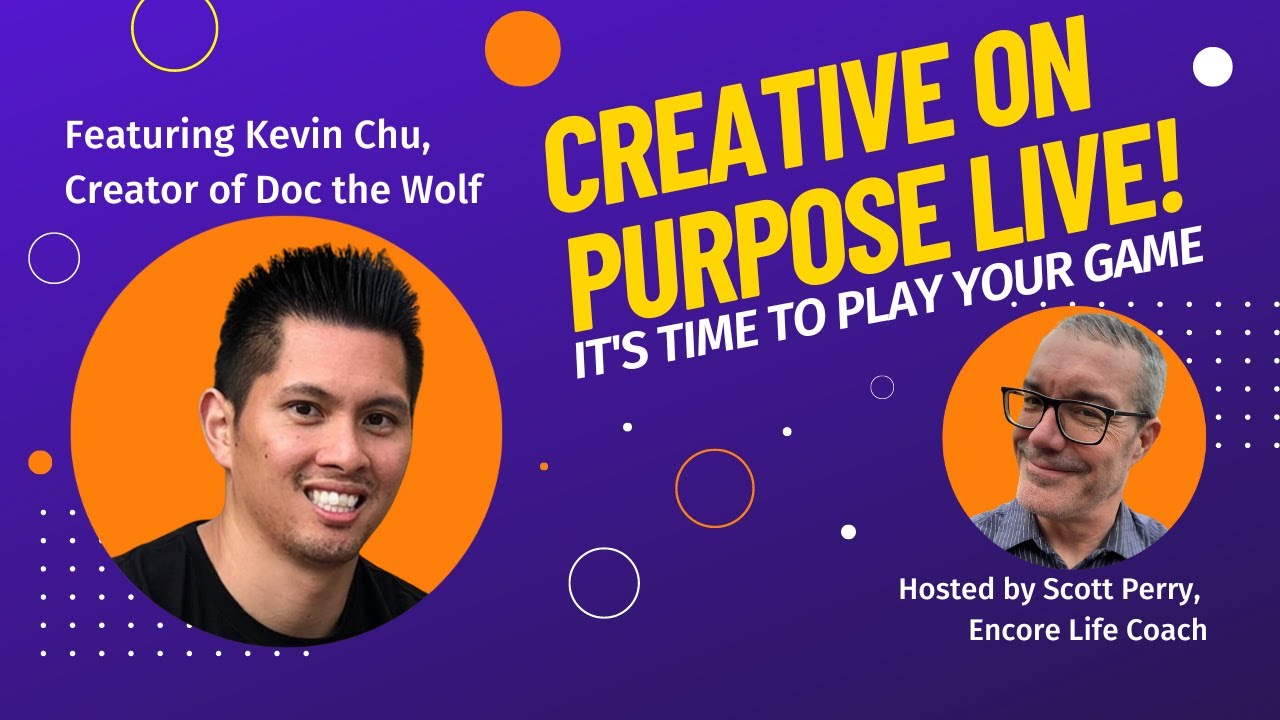
This content was created by Scott Perry. This content was uploaded by Scott Perry. This is a YouTube interview/broadcast (Creative on Purpose) titled "Kevin Chu - Creator of Doc the Wolf," recorded June 16, 2023. Host Scott Perry interviews guest Kevin Chu about his transition from a physical therapy practice into Web3, the genesis of his children's book Doc the Wolf (Turning Pennies into Dimes) drawn from Wolf Den NFTs, the Guardian Academy/Wolf Den community, the 6-word update practice, creativity and storytelling, and practical habits like microstepping. The excerpt is an on-camera conversational interview aimed at creators and parents, drawing from Web3 projects and personal development themes.
Chapters
zipping across the ether at the speed of bytes. And just like that, we are everywhere we're supposed to be. Welcome to Creative on Purpose, conversations about making a better living and a bigger impact by defining, developing, and delivering the difference only you can make. I'm Scott Perry, Encore Life Coach and author of The Art of Encore Living. If you're ready to play your game and live your legacy, visit creativeonpurpose.com to get started right now. Now let's meet today's guest. Kevin, welcome to the broadcast. Please tell our viewers who you are, what you're up to these days, and where can people go to learn more about you and the difference you're making.
Thank you, Scott Perry. So my name is Kevin Perry. I am a husband, father of two amazing girls, and these days I am currently working within Web3. I also have a basically a business that has developed from this Web3 venture. And it is a children's book called Doc the Wolf. Essentially, the book is titled Turning Pennies into Dimes, and it was a creation from inspiration from this Web3, one of the Web3 projects that we are currently working with from the Wolf Den. So taking an NFT of a wolf from the Wolf Den, turning that into a children's book hero, I would say. And, uh, now diving into this, uh, what we call the Web2 world, basically the internet, right? Uh, and helping to integrate people from this Web2 world into this Web3 world that really everybody is starting to move towards. Uh, you can find— sorry, if you can find more information down below, I think, um, drwolf.com.
Yeah, so I love your project, um, and there's— I have so many questions just from that brief introduction, but I'd love to just get a little bit of your background and origin story. What got you to this place where you're working in Web3 and writing a children's book? I'm guessing that little 9-year-old Kevin Xu didn't wake up one day and say, you know what I'm going to be when I grow up? I'm going to be a Web3 developer and write a children's book. So I'm just curious about the journey to where you're at right now.
Yeah, well, that 9-year-old Kevin Chu wanted to actually be a ninja, so it didn't really go that route. Um, and then, um, from, from a young age, parental-wise, I was pushed towards the medical field. Um, and so I actually graduated. I, I am still a doctor of physical therapy. Um, up until 2 years ago, I was still running my own practice. Within physical therapy. So I was treating CrossFit athletes and strongmen, getting them back from injury into more of a, what we call like a peak performance state. So improving their ability to, to train without injury, right? Uh, so went from a business owner, a brick-and-mortar business owner, to now a Web3, um, I do a bunch of different things within Web3 that actually didn't have any of the skill sets for, I would say. Um, so I'm doing imaging, image creation, writing, uh, which led to the children's book development. And so very, very, uh, I would say far-end shifts from more of a, um, rigid research-based medical practice following kind of like these guidelines, as well as like, um, structured plans of like, if this, then kind of do this, uh, and then now more into this creative side where I really have this freedom to develop and, and create what it is that I want to be able to make, um, image-wise or, or word-wise, right?
Yeah, I love it. Well, and because a lot of the people that are tuning in are going to be my age plus or minus 10 years. I'd love if you wouldn't mind just sharing a quick, um, to find some terms for us. When you say Web3, what does that mean and, and how is that different from Web2?
So Web2, we would classify as more of like the internet, um, so day-to-day things. So if we think of like big Web2, we can think of like Amazon, um, Google, right? So those would be your day-to-day navigation of, of the world really is, is Web 2. It's seamless. You really don't even know that it exists because if you pull out your phone and you have smartphone, you're already integrated into Web 2. Web 3 would be what we call blockchain. So it's really the, the next advancement from the internet is utilizing blockchain technology to essentially— eventually it will be running pretty much everything that we're doing now without even having the knowledge that Web3 is what's going on, right? Same like the internet.
Yeah, fantastic. Well, I really appreciate that. So, you know, blogs and forums and YouTube channels and all that Web2 stuff, Web3 being built on the blockchain. There's lots of conversation currently about the blockchain that we don't need to get into. But, you know, it's, it's the future, it's coming. And so just encouraging the the folks that are part of the Creative On Purpose community to, um, you know, open, open some loops around in this embrace of, of where things are moving toward. I think there's a lot of exciting things happen, and you and I collided in a Web3 project. Um, the Wolf Den is part of it, the, the Guardian Academy, and, uh, you know, this seems to be an integral piece, um, in your move from traditional kind of sports medicine business owner to, uh, now being a full-fledged creative author of a, of a really popular children's book and some other things that are coming out of that. So maybe just, uh, share a quick reflection on, um, the Guardian Academy, the Wolf Den, your role in those two things and how it inspired and influenced your move into becoming a children's author.
Yeah, great. So initially when it started, it was Nick Peterson really leading the charge with things, and he was responsible for a lot of my growth in terms of like learning about these different skill sets. And he would go live on YouTube pretty much daily for, I mean, he pretty much did that for like a year. And he would create these massive long contents. So it'd be like 20, 20 minutes to an hour sometimes. And for me to sit there and try and digest all this information, because keep in mind people were paying, I mean, upwards of like $100K to, to be with him, and I got the opportunity to just listen to him educate on these topics. So I was like, I'm trying to coming from the research background, it's like internalize all this, like absorb all of it like a sponge, right? And so the best way that I could do it, because I don't really, um, resonate— what my learning style is not very audio-wise. I much prefer visual reading. And so in order for me to actually understand these concepts that he was talking about, I felt like I just needed to type it and write it all down so that I could go over it again. And so what happened was, as he was doing these long-form contents, I would just start typing, basically like note-taking, right? And so these notes were done in a way that I could understand it. So it wasn't necessarily like, um, word for word for what he was saying, but kind of summarized into a better way that I could understand later on. And eventually I just started putting these together with little funny gifts, and we put it out there for people, and, and they seem to resonate with it too. Similar, like, the people who, who weren't very audio-based learners, they resonated well with what I was doing from a written visual point of view. And basically I got in like a year's worth, hundreds of hours of just repetition over and over, of just learning how to write from his audio cues. And from there, I think that sparked a little bit more of that creative side of me in terms of being able to write better. Not at all professional, I would say, or elite. I'm still a student, still a learner, right? It's just putting in the reps. Yeah, I love it.
And for those, if you're in the Creative on Purpose community, you're familiar with Nick Peterson and the Guardian Academy, 'cause I do refer people to the Guardian Academy. Community in the Success Finder app and to some of the things that they're putting out there, most of which are generated by Nick. But for those that aren't familiar, a lot of what's going on at the Guardian Academy is preparing people for Web3 by boosting self-awareness, self-efficacy, your ability to take responsibility for yourself and what you're doing., and build yourself kind of from the ground up so that you can enter this exciting new world, uh, you know, ready to play your game on your terms without compromise. And Kevin, uh, is vastly, um, under-crediting himself for what he did with, uh, those articles that I entered the ecosystem through Kevin's articles, uh, and, and they're just a phenomenal resource, uh, for learning these principles and practices, some of which will sound familiar to some people and some of which, you know, were certainly brand new to me, that will, you know, make you a better person as you try to be and do more and better in the world. So you've referenced a few times, Kevin, this, you know, kind of leaning into this creative edge and finding this creativity within yourself, then leaning into that edge. And we're on a broadcast called Creative Our Purpose. I'm always interested in kind of defining our terms and getting, you know, a perspective on what my guests think of when you say creative. And, you know, you referenced that the work that you had been doing as a, in sports rehabilitation was, you didn't feel like that was very creative. I would disagree with that. But we don't have to have that conversation. But, you know, What, what about— how do you define creativity, and what have you found to be the benefits of leaning into your creative, um, uh, interests and edges?
Yeah, so definitely within the medical side, there is a little bit of room for like creativity in terms of each person that you see is going to be unique. So there, there is a creative role that you need to fill for like what it is that they need. But I think from the writing and illustration side, the creative means to me currently allowing me to utilize my imagination a little bit more in terms of how do I put specific scenes together? Or like in the, in the case of right now, Doc the Wolf has these collectibles, it's 365 days of what we call 6-word updates. So this was adopted from the Guardian Academy and originally from Certainty U, right? Um, and so from there it's basically summarizing a point in 6 words, right? Can you take a thought and distill that into 6 words? And so throughout this 365-day progression, it's really starting from enjoyment, and then Doc hits basically this like dark period where things don't go well for him and he's having trouble with basically finding motivation, right? Very similar to how a normal person would if they want to undertake, let's say, learning a guitar, right? You're initially on the excitement is there, 2 weeks in, you're doing great, and then something happens and you fall off. And it's like, how do I get back onto this wagon? And so this progression of creativity lies in how do I string along 365 days of showing growth and the ups and downs of what people normally go through into this like 6-word phrase and then creating an image that goes along with that 6-word phrase to basically highlight or make it a little bit more fun. So, and so that's kind of like how my thoughts of creativity have evolved is where can my imagination go? And then can I have, can I put together an image and thoughts that go along with where my imagination is right now?
Yeah, I love that. At Creative on Purpose, we frequently reference creativity as the ability to make a change worth making happen. And, you know, creativity is, is an inherent human capacity that we all possess. Sometimes it gets beaten out of us, you know, by institutionalized learning or socialization or institutionalized occupation. But it's— I love that, that you really recaptured this creative instinct of yours and started putting it into this endeavor. There's a couple of things that you mentioned that I'd love to tease to go a little bit deeper with. One is, but before then, just to give a little context, tell us, um, the, your, your first adventures of Doc the Wolf is called Turning Pennies into Dimes. Explain a little bit of the context, like what is, what does that mean and what's, what's Doc's first adventure and, uh, all about. Cool.
Yeah, thanks, Scott. So for the initial book, I get a recapping, um, the, the character was derived from an NFT, a wolf From the Wolf Den. I ended up creating the likeness out of that NFT, the silliness. But really the thought frame was modeled after something similar within my life, right? So Doc, the character, is modeled after me for that first book. And in the book, he's going through work, basically. Like, if you imagine 365 days, it's work day in, day out trying to make pennies turn into dimes, right? Trying to get more money. And during that process, this is something I think that, that's very common, is that people lose sight of why they're trying to make the money in the first place. They make money, then they figure out that they can make more money. But why are they making more money, right? And so what ends up happening is they sacrifice the things that they were trying to make money for to get them out of. So a very common example usually is, uh, parents will want to say— so, so the— it is a children's book. It is geared— the illustrations are, are like colored brightly because these were actually images that my daughter enjoyed. I like tailored them after her. So it's like I would ask her whether or not she liked these colors and like how the scene was set up. So, so visually it was set— and my daughter is almost 4 now, one of them— so it was tailored for her. So within these images, but then the words are really there for the parents or the educators that are reading them over and over again, right? If as a parent, you know that you rarely read one book just once. The child will want to read it again, right? Day in, day out, right? So it's that repetition of these words that will start to just solidify within the child's mind, but also the parent will start to basically be a sponge and just absorb it all, right? And it— and so back to the point, it was, um, if we pursue money for the sake of money, we often forget that why we are actually trying to make this money in the first place. So the book's premise is, are you getting closer? Are your actions getting you closer to what you say that you want in life? And again, this is the huge concept that I learned from the Guardian Academy. And really, it's something that I internalize every single day. Are these actions that I am taking getting me closer to what it is that I say I want in life? Using the, using the parent example again, I want to spend more time with my kids. But yet I take a job that has me travel 2 hours away or has me travel frequently so that I can't actually— I make 2 times the salary that I make, but I actually don't spend more time with my kids. I spend less time with my kids, right? So if that's what you say you want, then why are you doing— why are you taking actions that lead you further from that?
Yeah, well, what I love about your book and this idea of parents and children both engaging with it, and they're engaging, you know, often at different levels. But what your book is teaching is to have some intention and integrity about what you're doing, how you're spending your time, what you're putting, you know, how you're using your energy, and, and, and how you're— and the goals that you're setting for yourself. It forces, forces you to really think, um, and you can think at multiple levels about these things. But it's a, it's a really, uh, powerful book, you know, not just for kids, but I think, uh, a thoughtful adult will, will take, will actually get much more out of it. And, um, so one of the things that happened, um, you know, I follow you on Instagram and Twitter and, and, uh, other places, and I You know, I witnessed Doc's journey getting a little bit dark, and I actually remember reaching out to you at one point like, hey Kevin, you okay? You know, so, but that was number one. I just want to highlight like that was such a masterful stroke because, um, it, it obviously was great storytelling. It drew me in. But what I also love about that is You know, Doc's journey is not just all roses and unicorns and rainbows. It's real. And anybody's journey in, you know, whether it's in personal development and the pursuit of things that are worth pursuing is going to be fraught. There will be challenges. You are entering or needing to embrace uncertainty. You will experience failure. You will experience a loss of motivation, all these things. And so, um, I'm just curious about that piece of it because I— it is one of the most engaging parts of following you on social media. I love the authenticity and honesty, um, about presenting that, you know, to, to kids and the parents who love them. Um, how did you come to, to, to that piece of it?
Yeah, so the, the darker times, a lot of the themes were also still just mirrored from, from what it is that I was experiencing, uh, raising my daughter Katarina, right? So going through the twos, the threes, I, I drew back to those times where, like, it, it is incredibly difficult to, to, to raise a kid, like, but it is the most fulfilling thing that I think that a parent or anyone will ever do is raising this little one, teaching them, and then helping them grow and start to create their own path. But I remember that not everything is rose-colored. Like, a lot of the influencers will want you to believe that every single— as long as you do this one thing every single day, that with this child will be amazing and easy. Your road will be Fantastic. It, it might work like one or two times to, to try this, this new way, but then the child soon adapts and, and figures out a different way to, to, uh, I would say push your own but— push your buttons, right? And so it's going through those dark times was just a, a reminder to myself that, uh, this is what we went through. Not every day is going to be perfect, but as long as you continue to try and improve to help someone, right? In my case, it was my daughter. Then everything will start to get better over time, right? But you just have— sometimes you do have to go through these dark times to understand what it's like to not be in a dark time.
Yeah, it's really powerful storytelling. Just want to give a quick shout out to my friend Lorenzo, who is in the audience and wishing us all a happy Thursday. Great to have you here, Lorenzo. So I want to, again, I just want to, I can't, this, this piece of your storytelling is done so masterfully. I think it's so important. And that, you know, that lesson, um, you know, there's, there's this piece of, of that trajectory, which is helping teach, you know, like this will pass, like this too shall pass. Um, it shall also come up again. And, um, that, you know, it's teaching the need for, um, you know, embracing all of life's victories and, uh, vicissitudes with some curiosity, um, and some consideration and some courage so that you can become a more resilient, antifragile human being that can continue to pursue things worth pursuing. Um, building, you know, building your character. And, and the, you know, when Doc comes through the other end, it feels like he is, um, he has got a little bit more equanimity. He's got a little bit more, uh, clarity about, you know, who he is and what he wants. Um, it's just really fantastic storytelling. You, you mentioned the 6-word updates, and this is one of my favorite things about following you, is I, I love the 6-word update as a creative. Exercise. This idea of encapsulating an often complex principle in just 6 words is a great, beautiful constraint that really encourages creativity and also encourages learning. And so, you know, we've been talking recently in the Guardian Academy and the Wolf Den about this difference between knowledge. So your book provides a lot of knowledge, a lot of information a lot of insight, but the learning happens in, uh, acting upon that knowledge, applying that knowledge. Um, and, and, and that, that piece of it I think is really powerful. Um, so what are the, what are the, the, the ways through the book and, and through your social media, um, you know, what, what are you learning as you actually help us learn the principle, articulate the principle, and then apply the principle. What are the things that you're learning as you, as you see readers and followers, um, go on this journey with you?
Yeah, perfect. So the 6-word update is something that— same, same with, with you— that I recently learned about, right? So I mean, it's probably been a year or so, so it's very, very recent for me in terms of time frame, right? Um, and what I want to convey is that the repetitions of, of integrating this 6-word update into my life has been, I think, one of the most impactful things that has happened. Because one, if, if we take it as— let's talk about two different things. So one is going to be using the 6-word update to distill information that you've recently learned. So let's say you attend a seminar or you're listening to this like masterclass. How can you distill what you learned and put it into 6 words? It is extremely difficult to do that, right? But if you can start to really learn and master that skill, you're going to take away something that can actually help you within your own journey rather than just listening to information, right? We all don't need more content. Maybe if you want to do something specific, yeah, you'll initially need some like content to learn what it— what it's about. But most of the time we need action steps, things, things that we can do to help solidify what we know, the knowledge, turn it into wisdom. And the only way that we're going to be able to do that is application of what we're learning, right? So one simple way that you can do that is just distilling the information down into 6 words. If you've never tried this before, give it a shot, right? Just, uh, try to distill some sort of complex thought into 6 words. Okay, the second way is these daily 6-word updates, and this is more about like, how am I feeling throughout the day, uh, as a way to just basically encapsulate my day in 6 words. And that's where that— the daily 6-word update, um, collectible from Dr. Wolf has emerged from. And this is a little bit different in terms of like, it's not trying to summarize a complex thought, but it's trying to internalize and dig deep into how you are actually feeling and what was the most impactful thing for you that day and distilling that into 6 words. Both I think are important practices that have shaped like my daily routine.
I love it. Well, again, it's, it's, it's helping encourage self-awareness and owning your, your journey of becoming, helping, helping people actually take the steps into possibility for who, you know, who they wish to become. Our time is, is starting to, to come to an end here, Kevin. The last question is, is always the same. You've already shared several ideas and practices, exercises that people can use and apply to their lives right now. This show is, is really for people that aspire to or are advancing in a journey of defining the difference only they can make and turning that into some sort of meaningful endeavor that helps them become a better version of themselves while they help other people fulfill their potential as well. If there's just one final idea, exercise, quote, principle, practice that you have to share with someone that would help them step into possibility half a shade braver and with a little bit more curiosity. What would you share with them?
I think the other impactful concept for me would be to microstep into whatever it is that you are doing. So let's say that I, I wanna start a side hustle, uh, from— how do I go about doing that? Right? It, it can be very intimidating to just straight up and leave, uh, the business that, that, that I have right now. Right? So what is one small thing that you can do currently that can move you towards what you say that you wanna do? So if it's in the case of opening up your own side hustle, figuring out what is that one thing that can help you to eventually move from the side hustle, if you will, if it becomes something that you're passionate about that helps to bring out your creativity, to move that into more of a full-time thing, right? Uh, very similar to when I was writing, uh, when I was just typing up these articles, or the, the creation of the book didn't start from, oh, I have an idea of I'm going to create this book one day. It, it was the repetition of these micro steps of writing, summarizing articles over the course of a year, over and over again. And then from there, I took the NFT art and I just started drafting things for the art. I didn't just go right into writing the book. It was these small little steps that I took every single day, just doing something to help improve the process for what it is that I want to do later on.
I love it. Yeah, microstepping is such a powerful approach to making meaningful change happen. And it sounds, maybe doesn't sound as like it's a fast track, but slow is smooth and smooth is fast. So I really appreciate that, Kevin. I want to thank all of our viewers also for tuning in. Kevin and I really appreciate the gift of your time and attention. We hope today's broadcast motivates you to take a bolder step into possibility for yourself. To keep go-go going with defining, developing, and delivering the difference only you can make, please visit creativeonpurpose.com. If you're watching on social media or YouTube, leave a comment, share a question, or just leave us your biggest takeaway from this conversation. And if you're listening as a podcast, please go ahead and give it a 5-star rating and a brief review. It really helps more of the right people collide with the conversations and with the difference that my guests are making. Now take the insight and inspiration from this conversation and play your game all in and full out. Kevin Chiu, thank you so much for the gift of your time, attention, experience, and wisdom today.
Thank you, Scott Perry.
More from Scott



Stoics Don't Suppress Emotions, They Do This Instead #stoicism #emotionalintelligence #mindset







