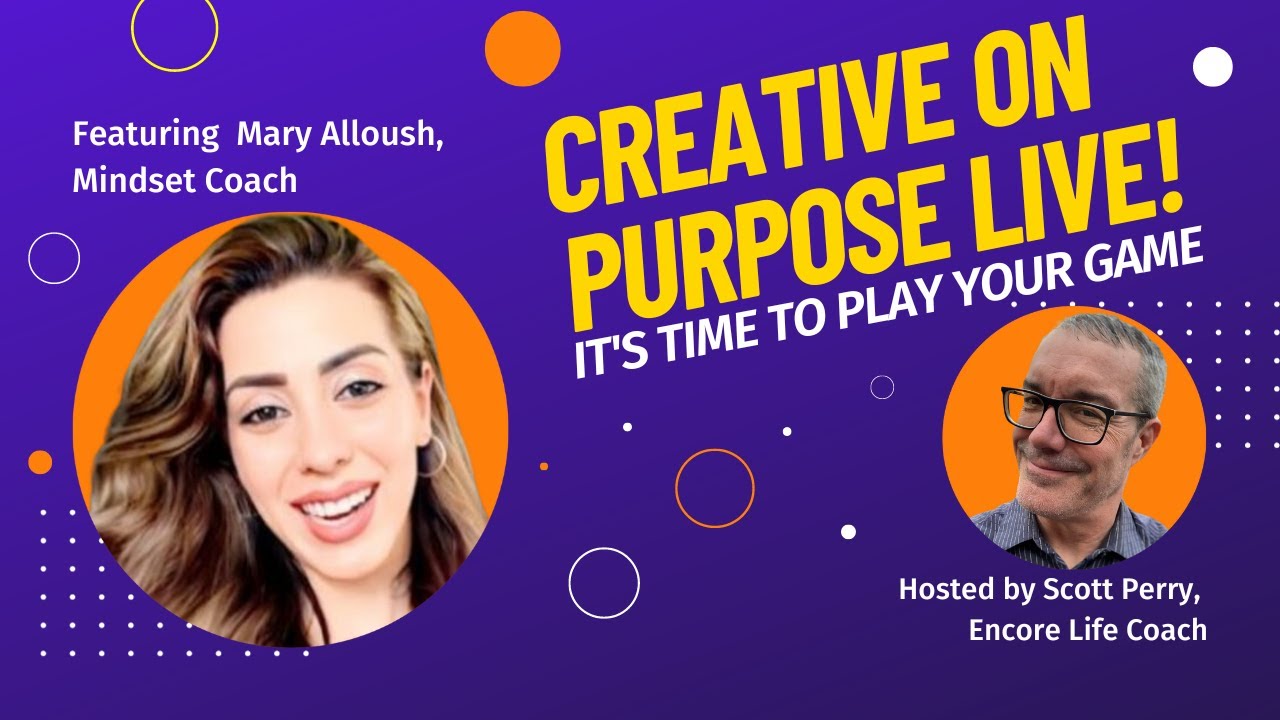
Mindset coach Mary from Ottawa explains how COVID pushed her into coaching and why entrepreneurs' business problems are really mindset blocks. She walks through practical shifts: journaling to spot limiting beliefs, replacing them with affirmations backed by real actions, then repeating until new patterns stick.
Chapters
There, at the speed of bytes, and just like that, we landed everywhere we're supposed to be. Welcome everyone to another episode of Creative on Purpose Live, conversations about making a better living and a bigger impact by defining, developing, and delivering the difference only you can make. I'm your host, Scott Perry, Chief Difference Maker at Creative on Purpose. If you're ready to get clearer about who you really are so you can get closer to what you really want in life, visit creativeonpurpose.com. Today and get started playing your game on your terms without compromise. Let's meet today's guest, Mary. Welcome to the broadcast. Please tell our viewers who you are, what you're up to these days, and where can people go to learn more about you and the difference you're making?
Yeah, absolutely. Thank you so much, Scott Perry, for having me on the broadcast. So I am Mary, Mindset Mary. I live in Ottawa, Canada, and I am a mindset coach. So let's see here. Where should I start? So what do I do? I coach mostly entrepreneurs on life and on mindset. We go through a lot of visualizations and exercises around who they are and what they want and what is getting in their way. So what's holding them back? What are some of the— so building a lot of awareness around the things that, you know, they need to pay more attention to. I enjoy coaching. I've been coaching for a few years now, and I really came into this space during COVID when, you know, COVID really disrupted most people's lives. And for some people, it allowed them to get a lot of clarity on what it is that they really want to be doing with their life. And I think that I definitely fell into that bucket. Where I knew like I have a, you know, a very great successful career, but I know my heart's not totally into it. And I just know I'm made for more, you know, more contribution, more impact. And I just wasn't sure how I could make that happen. And COVID really allowed everything to slow down and businesses to shut down and schools to close where I really got to just get on the computer and start searching and taking courses and learning more about myself, taking personal development training and realizing, oh my goodness, I am so interested in the space of coaching and what it does to a person personally, in the sense that like I'm learning so much about me, right? And what it is, what I value, what I want to be doing. And it just led me down the road of obtaining my professional certification. And, and I have not stopped ever since. There's not a day that goes by where I'm not doing something related to coaching, whether it's coaching someone, learning something, participating in masterminds and bettering myself. And just the, you know, the whole field of self-improvement is a beautiful one because it's really, there's really no destination. And the beauty is always seeing how you're changing and improving and progressing from the day before. And, and I love when that happens for me, but I absolutely light up when I get to participate in somebody else's journey and helping them move forward with their life. So, so that's what's led me to coaching. Um, it's, uh, it's, it's definitely something that I'm super passionate about. I think I'm very passionate about really just connecting with people and really getting, uh, you know, to a level where of like deep, deep understanding and, and being able to help move them forward. I think that there's no better feeling than, than chasing that addictive feeling of being able to help someone and, and feeling really great about it. So it's almost like a selfish journey. I'm helping. But at the end of the day, I think it just, it just feels good to me to know that I'm living in my purpose and I'm helping others find theirs as well.
I love that story, and it's so interesting that, um, COVID, you know, was this incredible forcing function for a lot of people. Um, you know, we never know what time and randomness has in store for us, and, and, you know, when something like that causes everyone's lives to kind of get upended or disrupted to a certain degree. It sharpens the focus and makes us, almost forces us to have that introspective moment like, well, I can't just keep doing the same thing that I've always done, which I find comfortable and maybe even rewarding. You know, what am I going to do? And so what I was hearing a little bit in that origin story was You already kind of had this, uh, desire to explore personal development and to, you know, pursue this instinct that you had that you were capable of being and doing more and better. Um, so, you know, what's— I understand that it feels selfish, but I think that almost all of us that are in this space end up helping people, um, by, by sharing with them shortcuts that we've learned solving our own problems, scratching our own itch. And so I'm just wondering if, if that experience rings true for you, that, you know, yes, you've got to explore your potential and remove some limits from your own growth, but, um, you know, that's— that also enables you to, to do it for other people with less, with more ease and more effectiveness.
Oh yeah, I would absolutely agree. I agree with you, Scott Perry. I mean, it's like in order to help someone go through something, I think that you probably should have gone through it yourself. So, you know, like in that you kind of really understand what it is that they would be going through and you understand what it is that you went through and what you were facing, what you were feeling, the challenges, and also how you navigated out of it. Right. Like, I find like when you navigate out of something, I think it's almost natural to want to turn around and help others along the way and help them navigate out of the same type of circumstances. So I think that that is super— it's super useful to have that kind of like real life experience because like also, you know, if you're trying to coach someone out of something that you haven't really experienced yourself, I think that it would almost be like the blind leading the blind in a sense, in that, you know, you, you, you really don't know if, if your coaching is going to be effective or if you're, you know, whatever your advice may be, if that's even going to work on them because it hasn't even worked on you. So I like, I truly believe like I, that I always want to stay kind of within the realm of what I've experienced and help people, you know, give people perspective on my experiences and see how that's applicable to their experiences and what learnings that they can take from that. Because really, at the end of the day, you want to help people shortcut the process, right? Like, if it took me 5 years to get out of this particular challenge, I'd like to help someone get out of it, you know, much, much faster. Because, because most coaches don't want to— like, they've experienced some level of pain or discomfort in their life, and, and their intention is to help ensure that that doesn't happen to someone else, because they're trying to help them navigate through that just so much faster with a lot more clarity and understanding of what needs to happen. So I mean, yeah, it's, uh, coaching is super rewarding in, in, in that it also provides the person or the coach that's gone through that experience with meaning. Like, this happened, but the meaning that we assign to it is that it's because it was meant to help others, you know, um, either not go through it or go through it faster or get more clarity from it. But it's like, you know, and then you go through it and you say, okay, yeah, that did happen, but here's how it's helped me, you know, become a better coach, right?
Yeah, I really, I really appreciate that because I think that's the whole— I mean, human beings are creatures with a unique relationship to this idea of work. We all, you know, all living things work. We exchange energy to, to make some sort of change happen. And if you're a plant, you do it by gritting, flowers, and, um, oh, if that's Hollywood, tell them I'm ready.
Um, he's ready, Hollywood, he's ready.
Um, but, you know, human beings are unique in that we, that, that we, we forge identity and meaning from the work that we do. And you referenced that you work primarily with, or work with a lot of entrepreneurs, but you also pointed to the idea that you help them with their lives. And I— that, that really intrigues me because as someone that also works primarily with solopreneurs, yes, um, you know, what I find is that as we are, you know, they sometimes— they are hiring me to, to, um, get clarity and create more certainty and collapse time around a personal challenge. And sometimes it's around a professional challenge, but whichever one we attack first, we always end up attacking the other as well. And so I'm just curious about your experience around, like, what are some of, what are some of the things that these entrepreneurs are coming to you with? And how do you find that it's not just their entrepreneurial challenges that need to be addressed, but the personal challenges actually help them with those professional challenges and vice versa?
Absolutely. Yeah, I agree. And I think that, like, Like it's hard to sort of say like, oh, I only help people on their business or I only help people in their personal, because it's all intertwined, right? Like whoever, whatever challenges you're experiencing in your business, you bring that into your personal life. And then whatever challenges you're experiencing in your personal life, it creeps its way back into your business, right? So it's like, it's intertwined in one of the same. So it's, you have, you know, like as a coach, I have to be prepared to attack both simultaneously. And like, you know, I can give you like a most recent example where I'm coaching someone who had like a nice big exit from their company and has taken like a leave of absence or, you know, like they're, they're so they're not running the company anymore. And, you know, the complexities of running a company, employees, you know, it's very high stress or it was very high stress. So now that that's gone, it's allowed them to sort of step back and really reflect on taking some time out and really just needing someone to help them gain clarity on like, what's next? What next business am I going to start building? Because he had built the business from the ground up. And so, and it's, and yes, although we're coaching around like, what business are we going to build? What are we going to create? We also kind of have to go back into the basics of like, What is it that you actually want? Like, what would be success? What would be defined as success for you? What would you define as a successful business or a successful life? Because, you know, if you don't know what it is that— like, what is your end goal? What is it that you want to be doing, experiencing? You know, what are the relationships that you want in your life? It's like, how can we build a business if we don't know how we're going to first build our life? Right? And then our life fits within a bit and like our business fits within our life and not the other way around. So it's, you know, and it's interesting because when we started coaching, you know, he had all these ideas around the types of businesses he wanted to build. But then with, as the months went on and he started to get more clarity and more introspection around like, what is the meaning of life? What is my purpose in life? What am I here to create? What am I here to contribute? And really got deep into to what he actually wanted, you know, then things started to change in terms of the business he wanted to build. And now the business is taking form with a lot more meaning. And, you know, there's an aspect of philanthropy, there's an aspect of helping, you know, people that are underprivileged and, you know, don't have the same opportunities. And how do we help people who don't have, say, father figures and mentors in their lives? And, you know, and he's started to connect a lot more with the next big thing that now he's building than when, you know, it was just sort of like, okay, let's look at, you know, what's missing in the market, where are the gaps, what does the market need. So when you start to like integrate the head with the heart, the outcome is that you're going to end up building something that's actually very meaningful to you, right? Like there, there's a big why to why that person wants to now proceed on this path. And with building any business, it's not gonna— it's gonna be difficult, right? Building businesses is not a walk in the park. But as he, you know, connects why he's building this specific business to service this particular market, I think that there's a higher level of commitment because it's connected to something a lot deeper. So I think that, you know, um, it's just completely natural to, to coach both aspects of, like, you know, the person and the profession. And, and really, at the end of the day, the best— you know, I, I personally think, like, the people that thrive the most are the people that don't have much of a distinction between their work and their play, because their work becomes their play and their play becomes their work, and, and there's so much congruence and alignment between who they are and what they do.
Yeah, I love that. I, I, I'm a big believer that work-life balance is kind of a delusion that you— that is really just an invitation to shame and suffering. I've never met anyone that's been able to attain, or at, at the very least maintain and sustain work-life balance. But if, if you take an integrative approach and you're just trying to You know, I think I shared in our last conversation, one of my clients revealed that they are, they're actually the CEO of a pretty famous brand. I didn't, that I just didn't recognize at the beginning. I couldn't, my imposter popped up and said, what the hell are you doing with me? And, and their answer was, you know, What I know is that if I'm going to become better, a better business person, I'm going to have to become a better person first. And you can help me with both of those things. And I think that speaks to that integrated approach, you know, that you were just speaking to. And the other, you know, the whole, the whole conversation around mindset is really intriguing to me. And so I would love to just, you know, since, since your branding is around mindset and it's one of the things that you really talk about quite a bit in, in your YouTube channel and, and your social media posts, I would love to have you speak to, like, when we're talking about mindset, number one, what are we talking about? And then what are, what are just maybe one or two takeaways that you can provide listeners that, you know, are trying to resolve some sort of mindset issue that they're having that's preventing them from stepping into their limitless potential?
Yeah, no, for sure. I do. I do talk a lot about mindset only because I struggled, right? I struggled so much with my own particular mindset. And that's why I've, you know, I'm really just dedicating this next chapter of my life to like really understanding mindset, figuring out how to always be in constant pursuit of upleveling one's mindset and then how to help others in really detecting what their mindset is and how do they uplevel their life. So, you know, like, mindset is really like, you know, it's basically like our attitudes, right? And what we believe to be true about the things in our life. That's how I explain it. And we have opinions around things, right? Naturally, we have opinions around things. And it's really like looking at, okay, as we build these opinions and ideas that we have around the world, around us and ourselves, we really have to start taking a look at, like, is our mindset actually serving us and moving us forward? Or is the way we look at things and the world actually hindering us and keeping us in our place or perhaps even holding us back? So taking a really deep look at, like, what are our values? What are our beliefs? What do we believe to be true? And I personally think that, like, we all have mindset based on our life experiences, right? Like we think certain things based on, you know, what people have told us and what we believe to be true, or just the things we've gone through in our own life. And it's really like, for me, the biggest thing with mindset is awareness. Like, what is my mindset on this thing? What do I believe to be true? Do I believe that I can make this happen? Do I believe in myself? You know, or not. And, and our mindset will, will either bring us closer to the thing that it is that we want, or keep up boundaries and barriers from what it is that we actually are trying to achieve. And for me, it's really about building awareness in terms of takeaways, like how do you build awareness? How do we start really examining? Because the biggest thing with mindset is thoughts,, right? Like, what is the thing that I'm thinking on a continuous basis? Because as they say, like, you know, if we're having, say, like 60 or 80,000 thoughts a day, the majority of them are the exact same as the previous day because that's the thing. It's mindset is your mind is set. It's set to a specific way of thinking and it's set to a specific way of feeling. It's set to a specific way of behaving. Right? So it's like building awareness around what it— what are our patterns. I think the biggest thing with people is that they tend to live in certain patterns, right? Patterns of thinking, patterns of feeling, and patterns of being. And when we want to create a transformation or we want to create change in our life, we have to be able to detect the pattern, um, stop the pattern and replace the pattern, right? So it's really taking an inventory of like, what are those thoughts that I experience on a regular basis that are negative, right? What are those limiting beliefs that I have about myself or the world around me? And really, like, and if people say like, well, I don't know what they are, okay, well, every 30 minutes stop and write down what's in your mind, right? If you can just write, like, keep an inventory of what you're thinking every single day. If it's every 30 minutes, 15 minutes, on the hour, every hour for like 2 days, do that for 2 days. And you'll start looking at your paper and you'll start noticing your own patterns, right? And most people know what some of those patterns are, or they know what some of the things that they tell themselves are. And in terms of the mindset, it's like, how often do we actually look at that and say, is that true? Like, go in and critically examine. Like, just because it's us who came up with the thought does not necessarily mean that it's even true. And a lot of our thoughts are actually false. It's just that we haven't really examined them, right? So the ability to go in and examine those thoughts will allow us to detect the thought, right? And then stop that thought and replace the thought. Like, if that's what I'm thinking, what would the opposite look like? Right? What would the opposite look like of that thought? How— what if this were not true? What evidence is there in my life right now to say that this is actually true? And like, what evidence is there to say that's actually false, right? So to be able to go in there and make those critical examinations of what our thinking is, and then who would we be without that thought? If I wasn't thinking that, where would I be in my life? Where would I be in my relationships? Where would I be in my business? If this disempowering thought was not a part of me, right? So sometimes, you know, we get stuck in creating a construct, right? A reality that we personally think it's true because this thought's been programmed into us. When if we can just be curious enough to go in and take a look at those thoughts and identify whether or not they're true, and also identify how life would look different if we were to actually replace them with something more empowering, like a whole new world, a whole new world of possibility would actually open up for us because we're now open to something different.
Yeah, that's so great. I just, I, I have to highlight, um, one thing that you said, which is the, the importance of awareness. I, I don't know if you're familiar with, um, Anthony de Mello's work, but, um, I've been rereading some of his, revisiting some of his work, and there's a series of excerpts from talks that he gave called Awareness. And it's all about this idea of, you know, just— this returns us really to the beginning of our conversations. Like, sometimes it takes an external force to make us, you know, a forcing— an external forcing function for us to start rethinking the way that we live our lives. And yeah, 60,000 to 80,000 thoughts a day. 95% are exactly the same as yesterday, and 95% will be the same tomorrow unless we bring that conscious awareness in, um, and pay attention in the present moment to what's, what's going on. And then we get to decide, yes, we want to just make a decision about where we want to go and what we need to do next in order to do that. And so even though we're coming towards the end of our time together, but I would love to just get one more take on this because I think, um, you know, Dr. Jeff Spencer operates in the world that you and I inhabit around the Guardian Academy. He talks about the human mindset versus the champion's mind, um, and he speaks to quite often, you know, the, the importance of of, of habits. Like, what are the things that are you're doing that's helping you reinforce? Yeah, you were saying earlier that, that new mindset that you are, this new approach, this new attitude that you bring to your life. And so what, what do you see, and what are some insights that you can share around how can we, um, how can we change our mind by changing the way we do what we do, or changing the some of the things that we do in our day-to-day? Yeah.
Um, so yeah, so I did touch on that first thing, which is of course the awareness of like, you know, we can't change something when we're not aware of it. So for sure it's awareness. Um, and also like, I think that, you know, when people are trying to change their thinking around certain things, there's a few things that can be done. First of all, it's like, for me personally, I'll do like affirmations. Right? Like, I'm gonna listen. Like, sometimes I'll go on YouTube, I'll listen to some affirmations and really, like, take them in, right? Like, not just listen, but believe. Like, say, like, I am this. So if I say, like, I'll tell myself an affirmation, something around, say, I'm abundant, right? I am abundant. Okay, great. I am abundant. Do I believe it? I might not. So, okay, so we really need to back up our words with actions, right? So if I say I am abundant, what is it that I'm going to stop doing to prove that I'm abundant? And what is it that I'm going to start doing to prove that I'm abundant? So I might say, okay, I'm gonna stop having a scarcity mindset around, I don't know, money, or whatever it may be, you know, like, what is it? And then what is it I'm going to start doing, right? So that we're actually lining up our words with actions. Another thing is, is like repetition, right? So it's like, if we're going to be building a habit, okay, well, how many times am I going to do this? How many times I'm going to practice this? How am I going to embody this? So being able to like not say, okay, I'll listen to a video once a month and hopefully my affirmations will come true. It's like the affirmations will only take you so far. It's the actions that you put behind those affirmations are the ones that actually create who you are, right? Another thing is really critically examining, like, who am I in this moment? Like, what am I becoming? What is my being? Like, what— who am I, right? And really getting, like, strip away all the limiting beliefs and the negative thoughts. And if we can strip all of that away and just go right back down, right down to our core of who we think we are, what is our essence, you know, what am I here called to do, you know, and if I can really just like anchor myself in my being and also my intentions, what do I intend to do if I'm not getting the results I'm looking for in my life? Yeah, okay, great. But what's my intention? And can I anchor myself in my results and what I'm trying to achieve or the good that I'm trying to put out in the world? And it's like if, you know, if all signs are pointing to like you're not making the progress you want in your life, then start looking at, you know, what it is that you're trying to create and what your intentions are in making that progress. And if you are, if you do have good intentions and you intend to do good and you intend to serve, then, you know, if you can try to anchor that gratitude and the fulfillment into the intentions that you have, then you're basically anchoring your results within yourself and not external to yourself. Right, so that, you know, um, we're able to move forward, uh, in full control of what it is that we're trying to create.
Yeah, I love that. So important to remember that our espoused values or affirmations or whatever by themselves don't really matter much if they don't align with the things that we're actually doing in our, in our day-to-day life. So that alignment of values, um, and actions is, I think, how we express virtue in our lives and how we become the person that we want to become. Really, really powerful stuff, Mary. As we're coming to the end of our half hour together, if there was just one— and you've already delivered plenty of nuggets of wisdom here— but just if there was just one final quote, practice, principle, something that a viewer could take with them and do something with right now that would help them improve their mindset, what would you share with them?
Yeah, um, gosh, that's a good question. What would I share with them? I think, I think I would say like, if you're trying to improve your mindset, get really, really clear on what it is that you actually want for yourself in life and take an inventory of all the things that are going to come in the way, that currently come in the way of what it is that you want. I think the more we can create awareness around those roadblocks and the things that are really holding us back, the more we have control to be able to actually address them and change them so that we can get— we can start closing the gap between where we are in life and where we want to be in life. And really just taking an inventory of, of, of all the mess that's in our minds that we're trying to remove step by step so that we can get closer and closer to what it is that we actually want.
Really, really great advice. I appreciate that. I want to thank everyone for tuning in. Mary and I really appreciate the gift of your time and attention. We hope that today's broadcast motivates you to take a bolder step into possibility, to keep go-go going with defining, developing, and delivering the difference only you could make. Visit CreativeOnPurpose.com. And if you're watching on social media or YouTube, leave a comment, share a question. Or tell us your biggest takeaway from this episode. If you're listening on a, as a podcast, leave us a 5-star review. It really helps more of the right people connect and collide with these conversations. Now, take the insight and inspiration that Mary just shared with you, and please go out and play your game all in and full out. Mary, thank you so much for lending us some of your time and expertise today.
Thank you for having me, Scott Perry. Thank you.
More from Scott



Stoics Don't Suppress Emotions, They Do This Instead #stoicism #emotionalintelligence #mindset







