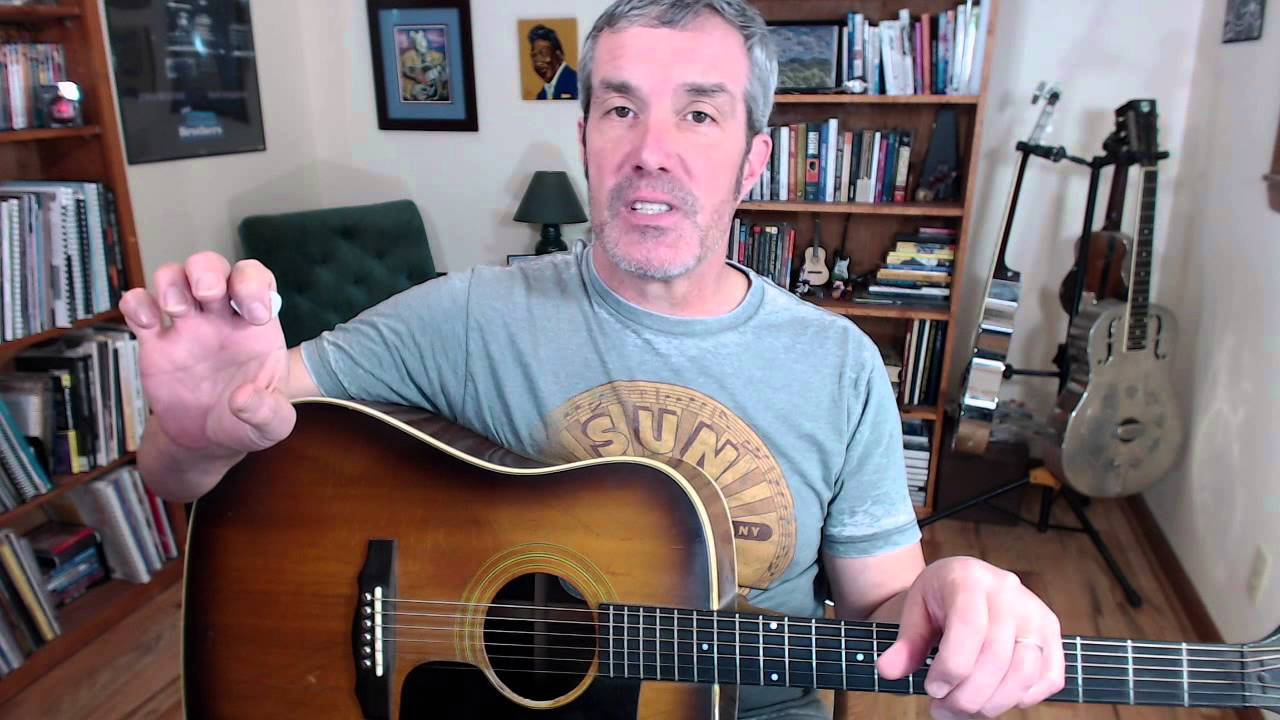
Scott Perry explains the AAB lyrical form in blues, using W.C. Handy's "St. Louis Blues" and Robert Johnson's "Kindhearted Woman" as examples. Not all blues songs follow this pattern: Sonny Terry & Brownie McGhee's "You Hear Me Talking" drops it entirely, while Chuck Berry's "Johnny B. Goode" uses a verse-chorus structure instead.
Chapters
Hey gang, Scott Perry here, vintage blues guitarist and creator of guidedguitarlessons.com, with another free video lesson in the series Monday Morning Blues. These are short video lessons based on answering your questions about the blues and about blues guitar playing. Really glad that you're here. Let's dive into today's question, which comes from my student Hannah, who after watching the first video in this series asked, do all blues follow the strict AAB lyrical form? It's a really great question. Let's go ahead and unpack that a little bit. So for the purposes of this lesson, we're going to talk just about the 12-bar blues song structure and changes. And the basic AAB lyrical form is where you will have, within that 12-bar framework, the first 4 measures will have a line sung over called the A, and then in the second 4 measures, that line will be mostly repeated. There may be changes in phrasing or perhaps some interjections of some sort. And then the final 4 measures, you're going to have the B or a completely different set of words. A great example of this is one of the very first blues tunes ever recorded, and that's W.C. Handy's "St. Louis Blues." I'll play through a couple of verses of that just so you can hear the AAB song structure and lyrical form put together.
I hate to see that evening sun go down. I hate to see that evening sun go down. It makes me feel I'm on my last go-round. If I feel tomorrow like I feel today— If I feel tomorrow like I feel today—
<LYRICS>I'm gonna pack my trunks and make my getaway.</LYRICS> So this form is sometimes called the strophic form because it's just verse after verse after verse telling the story or conveying the emotion that— or doing whatever it is that the song wants to convey. So The A repeats, and then there's a B line that complements or completes that idea or that part of the story, and then it goes to the next. And each one of those AAB 12-bar runs will have largely the same melody, but there will be different words every time. Now, sometimes those— the AAB form can follow kind of a strict question and answer or call and response type of form. So an example of call and response would be a tune like Robert Johnson's "Kindhearted Woman," where he's just— the call is the A section, which is then repeated, and then the response is some sort of wrapping up of that idea.
So in "Kindhearted Woman" would be something like, uh, I got a kindhearted woman Doing things worth me. I got a kind-hearted woman doing things worth me. But you know, you evil-hearted woman, Mama will not let me be.
So that would be like a call and response type of AAB and a question and answer Answer might be something like Robert Johnson's Sweet Home Chicago, which we've covered in previous lessons, where you have a question that's then repeated in the second A and then the answer in the B. So that would be, I say come on, baby, don't you wanna go? That's the question. We'll repeat it.
I say come on, baby, don't you wanna go back to the land of California, sweet home Chicago.
Now it's possible that you can, in a 12-bar blues song structure, completely abandon the AAB. And for instance, in the course Shuffle Starter 101, one of the bonus lessons is Sonny Terry and Brownie McGhee's song "You Hear Me Talking." If I were to play that in A like I do in that, in that course, you'll hear something that doesn't sound like an AAB. So here's that.
I got a girl in Atlanta, 2 2 in Alabama, 3 in Mississippi, and 4 Memphis, Tennessee. You hear me talking, you hear me talking to you. Well, don't let your right hand know what your left hand do. I got 3 old women live on the same old road. One does my wash, one does my iron, one pays my room and board. You hear me talking, you hear me talking to you.
<LYRICS>Well, don't let your right hand know what your left hand do.</LYRICS> So in that type of song structure, you still have the strophic form. It's verse after verse after verse telling the story, but there's a line and then there's this refrain that's repeated, the "you hear me talking, you hear me talking to you, don't let your right hand know what your left hand do." Good advice, cautionary tale there. So there we have an example of the AAB structure being abandoned in favor of doing something else. Another great example of a 12-bar blues song structure that doesn't use the AAB lyrical form was employed by the great Chuck Berry in tunes like "Johnny B. Goode." There he used the 12-bar blues song structure and changes to create a verse-chorus type of structure. So you have an A, a verse, that is a set of words repeated over a specific melody, and then a B section, a chorus, that is repeated over and over throughout the song using the same melody and the same words, followed by another verse using the melody of the first A section but different words. So I'll just give a quick example of this. I don't know the song this well, so I'm going to be looking away at some words. Chuck Berry played in oddball kind of jazzy keys, and this, I think, Johnny B. Goode, if I remember right, is in the key of B-flat.
Deep down in In Louisiana, close to New Orleans, way back up in the woods amongst the evergreens, there stood a log cabin made of earth and wood where lived a country boy named Johnny B. Goode. Never did learn to read or write so well, but he could play a guitar just like a ringing bell. Go, go, go, Johnny, go, go, go, Johnny, go, go, go, Johnny, go, go, go, Johnny, go, go, go. Johnny B. Goode. He used to carry his guitar in a gunnysack, go sit beneath the tree by the railroad track. Engineers would see him sitting in the shade, strumming with the rhythm that the drivers made. People passed by would stop and say, oh man, that little country boy could play. Go, go, go, Johnny, go, go, go. Go, Johnny, go, go, go. Go, Johnny, go, go, go. Go, Johnny, go, go, go. Johnny be good.
So I hope that gives you a little more insight into not just the strict AAB lyrical form but all the possible variations. It's really useful. One of the beautiful things about the blues is that the form is And not just the song structure, but the lyrical form and the changes are so elastic and plastic. They can be altered and varied, and you can really find your own individual way of playing things and writing blues songs because of this elasticity. It's one of the great aspects of blues music. By the way, that tune Johnny B. Goode is another tune that's taught in the bonus section of the Shuffle School 101 course. If you want to check that out, you can do that here at guidedguitarlessons.com. So I hope that that helps deepen your understanding of the AAB lyrical form and all of the other possibilities that can be used to sing over the 12-bar blues song structure and changes. I'd love to have you, if you're watching on YouTube, subscribe to this channel and comment below. But even better, scoot over to guidedguitarlessons.com. You can enroll in this course, Monday Morning Blues, for absolutely free. Just plug in your name and your email address and you're in. You can see all of the videos, you can download any PDFs that are associated with them, but most Most importantly, you can join the discussion that's happening over there and be part of a community of blues guitar lovers and players that are all helping support and encourage each other in their guitar playing journey. The best thing that you can do is ask your questions about blues and blues guitar playing, and I'll turn it into the next lesson in this series, Monday Morning Blues. Look forward to seeing you next time.
More from Scott



Stoics Don't Suppress Emotions, They Do This Instead #stoicism #emotionalintelligence #mindset







