Motivation Isn’t the Problem—Commitment Is | How to Begin Even When You’re Afraid
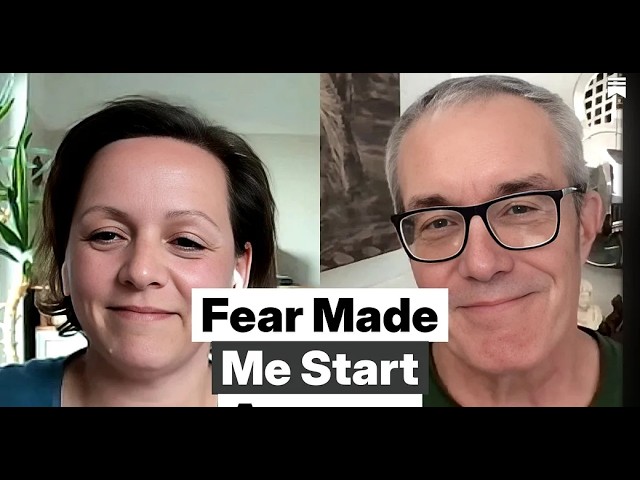
Scott Perry discusses his book Intrepid: Dare to Make a Difference, arguing that commitment matters more than motivation. He explains how fear works as a compass, why small iterative steps beat waiting for inspiration, and how the stories you tell yourself sabotage your work.
Chapters
So I think we are finally live after some little tech difficulties. We made it. I'm very proud of us, I have to say. So welcome everyone who is joining us to this live about the loving self that you need to begin even when you're afraid, or especially when you're afraid. My guest today is Scott Perry of Creative On Purpose. And we will talk about his new book, "Intrepid: Dare to Make a Difference." The book asks one question 27 different ways, "Do you care to commit?" I'm Judith, creator of The Ocean Says Hi, and I help people rediscover their inner compass and take the next step toward realignment. So I've been a member of Scott's Creative on Purpose community since the beginning of the year, and I also had the honor of being one of the early readers of your new book. So welcome, Scott. Thank you for being here and taking the time.
It is great to be here. And just for the record, that introduction was as good, if not better, than the one that we did.
Yeah, thanks. Yeah. So in the next 20 minutes or so, we will be talking about why motivation isn't enough for us purpose-driven difference makers, how we tend to self-sabotage, and what our honest next step can be. So Scott Perry, when you first announced the book's title to our community, I was very relieved that I wasn't the only one who had to look it up. It's a little uncommon. And so my first question for you today is, what does it mean to you and why did you choose it for the title?
Yeah, I'll answer the second question first, which I've written several books, but two of my most popular books are one-word titles. The first is called Endeavor. And the second is called Onward. So I have this love for words that are not frequently used and that most of us think we understand or know what it means, but then when we are asked to define it, might stumble a little bit and figure out that we're— we don't have as clear an understanding of what, what the term means as we might have thought. So for Intrepid, Intrepid, for a lot of people, people think of Intrepid as courage, but more courage almost as recklessness. The idea of charging into the front lines, you know, with, you know, even as the machine guns are blazing or the lances are drawn. And Intrepid actually is something that means more doing what needs to be done even though the fear exists. So we can't get rid of the fear. That's, uh, that, that's something that, um, it's kind of a fool's errand. One of the things I love about your positioning around you know, having— helping people find their compass is that, um, fear is a compass. Like, fear shows up when we are pointed in a direction worth exploring. And if we are intrepid enough to take small steps toward the possibility that fear is pointing towards, we have the ability to transform and to grow and to become the person that we want to become and make the difference that we want to make. So that's the, that's the distinction I'm trying to make in the title, is let's, let's talk about the fact that work that's worth doing by definition includes the fear. And just because fear is part of the menu doesn't mean that we have to decide that it's the, the entire first course, or that we need to decide to go find a rest— a different restaurant. That if, if you are, if you're feeling some anxiety about the direction you're pointed, congratulations, you're pointing in a direction worth exploring. And the other thing about intrepid is it's actually not up to us. Like, being intrepid is how someone else describes what you are doing. And so Intrepid also has this inherent relationship quality, relational quality. And so that is also, as you know as a member of our community, something that I'm really a big booster for, proponent of, is the being a solopreneur doesn't mean you have to do it all, all alone. And if you do the work that you do with and for the right people and you surround yourself with enough of the right people, it's a lot easier to become intrepid, and, and you'll be recognized by the others as being that kind of person.
Yeah. So I have the book here, and I want to just tell you that I really love the, the image that you chose, because it's not only a light, but it's a kind of light that only shines the next step. So if I imagine myself being in a cave somewhere, not knowing my way, it is exactly what I need to see to take the next step. Not further, but still enough, you know, to take the leap of faith and to be courageous. Yeah.
Well, I really appreciate that. Thank you.
Yeah. So when I first started out with The Ocean Says Hi last September, I did not have a motivation problem. I had a different kind of problem that I couldn't quite grasp. There was something holding me back because I knew that I wanted to change people's lives, help them change it themselves step by step to make it a little better every day. And I think that is the definition of my intrinsic motivation. So that wasn't the problem at all, but there was something else. And then I heard you say people don't have a motivation problem—relief on my part—they have a commitment problem. So what is the difference?
That's a great question. And it speaks to a couple of ideas that I've, I've explored in other books and in other blog posts. The motivation is kind of like inspiration. We think that if we're going to do something that's worth doing, if we're going to do work that matters with people we care about, if, you know, we're going to engage in some sort of endeavor, we have to sit around and wait for inspiration to come visit us. And once we get inspiration, then we'll have motivation, and then we can do And I don't think that that's the way inspiration works. I love Elizabeth Gilbert's TED Talk about this, where she talks about, you know, inspiration is, is always in the ether. It's always circling around looking for the people that are already doing the work, the people that are already in the arena, that are already putting in the blood, sweat, and tears. Because what inspiration wants is for its idea to be brought into the world. And if it goes and gives the idea to someone that's sitting on the couch, they'll always just keep talking themselves until, you know, well, that's a good idea, but now I have to wait for the right moment, or I have to do some research or take a course or get a guru, or, you know, whatever. Um, inspiration more frequently comes to those of us that are actually you know, we're starting before we're completely ready, before the idea is perfectly formed, before we have the, the process perfectly developed, uh, because the, the process is, is the shortcut. We become the thing by doing the thing, and inspiration will come, uh, comes to those that are, you know, pointing towards something that, that's worth doing. So, you know, I'm also touching on this idea that, you know, and I'm Sorry if I offend any of the mindset coaches that are tuning in, but I'm just not a big fan of mindset coaching. I don't think that, um, you have to get your mindset right before you can do anything that's worthwhile or meaningful. I think that it actually works the other way around. You don't get your mindset right and then you do something. You do something and your mindset comes along. Your mindset follows behind. If you want to become the kind of person that is committed and intrepid and, and doing work that matters, then You have to start acting like that before, before that intrinsic motivation or compass will appear. And that doesn't mean faking it till you make it. It just means being disciplined and diligent and committed to taking, like you said, those little microsteps into possibility that help you create the clarity and the, and the confidence and clarify your direction and become confident, increase your confidence that you can become the person that can get there over time. And so motivation is not a problem. Uh, commitment, commitment for a lot of us is a problem because even though as human beings we're programmed to be aiming aspirational creatures, um, We are also programmed to want to be safe, and we think that standing still or waiting for someone else to tell us how to do it, or making sure that other people prove that it can be done first, uh, is the way to go. And that's, you know, nothing meaningful happens if you're just gonna do what everybody else is doing. You can't win a game you don't want to play, and you can't win your game if you're playing by someone else's rules. And the only way to figure out what your game is and to play it on your terms without compromise is to start, you know, following some of your gut instincts, but do it in a way that is, again, disciplined and lets you collect the data and lets you refine and improve and iterate what you're doing and how you're doing it and why you're doing it and who you're becoming while you do it. As you go.
Yeah. You're also formed by the people that you interact with on the way. So you cannot know under any circumstances where you're going to end up. And I also find it's way less stressful to not have this grand plan about where to be next year or in 5 years, but to only see the next step that is lit.
Yeah, yeah, well, that's, that's a really excellent point because there are gurus out there that say you have to have a big, bold, audacious idea and you have to do whatever it takes, you know. And, you know, some people follow this ridiculous advice and it destroys their relationships, you know, maybe with their, their family, their spouse, their, uh, you know, their friends and whatnot. Um, and and then, and then they burn out and blow up before they ever achieve something. It's— you can— I'm not saying to not have a vision for the world that you want to help co-create, or to have a vision for what you want your life to look at— I look like— I think that's really important. Um, it's also important to understand that you can't possibly have an absolutely clear idea of the vision of the world that you want to co-create, or the kind of life you want to live right now, because between here and there, there are so many obstacles and opportunities that you cannot see. And some of those opportunities are actually obstacles in disguise, and some of those obstacles are opportunities in disguise. And to your point about relationships, by taking small steps into possibility and, and defining the most immediate bottleneck, working within your constraints, clarifying your most immediate objective and in a way that's specific, measurable, achievable, relevant, and time-bound, and finding the others that can help you clarify and execute the path that will close the gap. That's how you make progress over time. I just posted a note about this yesterday because I was talking to a prospective client that was like, let's just get going, like, I'm ready to go right now. It's like, well, we don't yet know where we're going, and so we can't start right now. Because, like, I know how to make people go fast, but if you're going fast in circles or towards the wrong target or off a cliff, going fast is deadly. Uh, you know, let's, let's figure out the vector first. Where are we actually— what are we actually trying to accomplish? And where are we starting? And what, what are we starting with? And what's necessary? Because if we can define all that, we can actually save a lot of time, attention, money, and effort by stop doing all the things we don't need to do, and collapse time to target by just improving the 2 or 3 things that we're already doing that need to be done just a little bit better to get closer to what we're actually trying to accomplish.
Yeah, absolutely. Yeah. So what is the most common way in, in that smart, capable people sabotage themselves before they begin?
Well, it depends on the person, and it depends on where they are in the journey. Um, I think some of the most common culprits are the, the basic human need that comes from our programming by biology and evolution and our conditioning by institutionalized education and occupation for certainty. There is no certainty, period. Like people say, the only certainties are death and taxes. Well, Apparently, there's lots of folks that aren't paying their taxes and that seems to be fine. And I don't know what happened. Like, I'm a big fan of, you know, when, when someone asks me, how's life? I say, ah, beats the alternative as far as I know. Right? Because I don't know. Like, who knows? There are no certainties and knowing, and I think if you embrace the fact that there are no absolutes, it's actually really liberating because then you are— the invitation is, can you tap, can you tap into your inner sufficiency and the fact that you already possess everything you need and know everything you need to know to start making, uh, clarifying what you actually want and start to get there on your terms? And so letting go of our attachments to certainty, but also to results and outcomes that are beyond our control. Like, so many people come to me initially saying, I need to make $10,000 a month. And if I ask them why they need to make $10,000 a month, they say, well, I have to, you know, I, I want to be able to pay all my bills and, and buy a beach house or buy a Maserati or buy you know, whatever it is. It's like, well, what happens if we actually audit where all your money is currently going and eliminate all the expenses that aren't doing anything to move you toward the thing that you say right now that you want? And in most cases, people recover enough revenue right then and there in an hour's worth of auditing and, and recapture and reallocation work. To start closing the gap in that moment. And, you know, this idea that we have to come up with a new audience or a new offer or build a product or a service or a course or hire a guru or whatever it is, that's— you're just adding more. And the thing about system reliability is the more you add to the system, the less effective and efficient it becomes. So it's never, uh, about, like, it should not be about chasing these arbitrary goals. Instead of saying, I need to make $10,000 a month, what's $10,000 a month get you? Instead of saying, I want to spend more time with my family, like, well, you know, I bet you I could sit down with you and we could cut enough of the stupid work that you don't need to do out of your schedule and the stupid meetings that you participate in out of your schedule to capture more than a couple hours a that you could spend with your family. Like, we have to get really clear and specific about what we actually want, and once we do that, then we are more likely to create a solvable problem and can craft a path that will close that gap with the greatest ease and velocity. But it all comes from, um, you know, the, the I guess it's a long rambling way of arriving at an answer to your question, which is the things that most commonly get in our way are the stories we tell ourselves, because we tell ourselves a lot of really stupid stories. And we are meaning-seeking creatures that make sense of ourselves and each other in our situation through narrative. So if you want to live a better story, you have to start telling yourself a better story. And tell yourself a truer story. So, you know, choose your story, choose your future is, is the bottom line. So when it comes to getting in our own way, it's, it's mostly the narratives, it's mostly the false beliefs and the cognitive biases and distortions that are impeding our progress and not our innate abilities or, uh, knowledge. We possess everything. To make progress right here, right now. We have to— it's more about stop doing things than it is to add new things to do.
Absolutely. I totally agree. And that's what I'm, I'm really passionate about, about this, this inner wisdom, or I call it inner compass, that we have and we come to this planet with. Um, and I, I see this especially in raising our 4 kids. That they are of course very different and they have a very specific idea who they want to become until we start, well, filling the empty vessel that we think we have in front of us. So that actually started my whole journey. When I look back on, yeah, on, I asked myself today, when did it actually start? And it started with that, even though I'm just going public with it right now, but that was the beginning, the fascination with our inherent wisdom. And that's what I have, what I want to help people know and get back to. Yeah. Well, I love that.
Just, just real quick. Yeah, sure. Marcus Aurelius has a great line in his meditations and is very much interested in this idea of the Stoic cardinal virtue of justice, which has nothing to do with law and order. What it means— the virtue of justice has to do with our social imperative and how we interact with each other and how we treat each other with empathy and kindness and compassion. And you really hit the nail on the head with You know, you got started by just doing something that is an inherent quality of every human being. We are born to make meaning and to support each other and to nurture each other and to see, hear, and understand each other and to work together towards things that are meaningful. And you don't need any certifications or special trainings to do that. You know, you, you're a mom, you're a great mom, and you didn't go to school to become a mom. You didn't watch a lot of YouTube videos to learn how to be a mom. You didn't read— maybe you read a few books, but you, you know, you certainly didn't learn anything in a book that you didn't inherently know how to do. And I'm, you know, my, my babies are 30 and 35 years old, but, you know, as you know, I take care of an 8-month-old and 4-year-old grandson every day. And so I see the same thing that you're seeing. Like, these kids, they possess everything they need. They just need a witness and a guide and that person in their life that will provide— your title of your talk here— a loving nudge to start exploring the edges of their understanding and abilities about themselves so they can become the person that they've always been, you know, meant to be, become.
Yeah, and as a consequence, we all, when we are grown-ups, we still have that. It's still there. Oftentimes it's covered by thick layers of dust, but it's still there and it can't be taken away.
Yeah, well, I always say, and obviously you can look at me and see that growing older is not an option, but growing up is optional.
So there you go. I love that. Yeah. So my last question for you today is, um, so if somebody in our audience today or somebody watching the replay is wondering, so what, what do I do now? So how do I take this honest next step?
Well, one of the, the, the, the big message of Intrepid Dare to Make a Difference is that you cannot do this work by yourself. It's— there's nothing that you can do that you can do completely on your own. Solopreneurship does not mean working all by yourself or being alone. Um, whatever it is that you were doing, you did not arrive at the idea for that in a vacuum. So what we do and how we do it and why we do it, it's all informed and inspired by our relationships. And so relationships are the real secret ingredient. It is actually the force multiplier that's most available to every single one of us that will propel us forward with the greatest ease and velocity. So The, the thing that I would say, uh, you know, I give a different answer to this every time, but today my answer is, if you don't know what to do, start going— start thinking about your relationships. You know, who— we all get to choose how much time, attention, and effort we invest in the people that are around us. And so I am— it's, it's actually not true that you are the average of the 5 people you spend the most time with. You are the cumulative average of everyone that you spend time with and everyone they spend time with and everyone they spend time with and everyone they spend time with. And there's lots of scientific evidence that if you hang around smokers who hang around smokers who hang around smokers, that you will become a smoker. That's just the way it kind of works. So if you are wanting to become something different, if you feel like you were born to be and do more and better, I would say you are absolutely correct. And if you want to know how to get there with the greatest ease and velocity, pay attention to the people that you're spending time with. Who are the people that you're learning from? Who are the people that you are practicing with? Who are the people that you are teaching as you learn? And if you align yourself with more of the right people, the people who share your values and need your talents to enhance their lives, then you will make progress. And you don't have to purchase my book or, or find a corner man like me to, to get started. Go ahead and begin. It's one of the chapters in the book: every moment of every day is a chance to begin and begin it again. I would begin with paying attention to who you're spending time with. And since we spend a lot of time with ourselves Maybe it's time to take a long look at the mirror about the conversations that you're having with yourself. And are you actually treating yourself with the kind of kindness and empathy and compassion that you would hope to practice on other people? And if you're not, then there's some work to do there.
Yeah, absolutely. Ja, so we're at the end of the official part. Is there anything anyone wants to ask in the chat, maybe? But you can always get back to us afterward, right? So we're happy to answer questions that you might have. Yeah, so I think that's it. If you want to add, if you missed anything that you might want to add, Scott Perry?
Um, I just, I mean, the whole relationship thing, little rant that I just gave, is being expressed in real time, in real life, right here now. You are one of the early adopters of the book. Claire and Alice are here. They also had early access to the book, and you all helped make that a better book, and you all helped make that book successful by sharing the book with the right, you know, more of the right people. And so I would just, you know, number one, thank you to, to you and to, to Claire and to Alice for being a part of the journey and for helping me make this thing. Um, and for anyone that's watching this, whether now live or in replay, this is, this is the proof. If you needed it. That meaningful work is always made better and done easier when it's done with and for the right people. So go find the others and do your thing. Let them watch. And I think everything, you know, that your people will find you.
Yeah, thank you. This has been a pleasure. Yeah, always. I'm really glad we did this. So I want to leave everyone with this, that you already know everything you need to know, and don't let fear hold you back.
So I second that emotion.
Yeah, so see you soon, Scott, and thanks everyone for being here.
Thanks very much, Judith.
More from Scott



Stoics Don't Suppress Emotions, They Do This Instead #stoicism #emotionalintelligence #mindset







