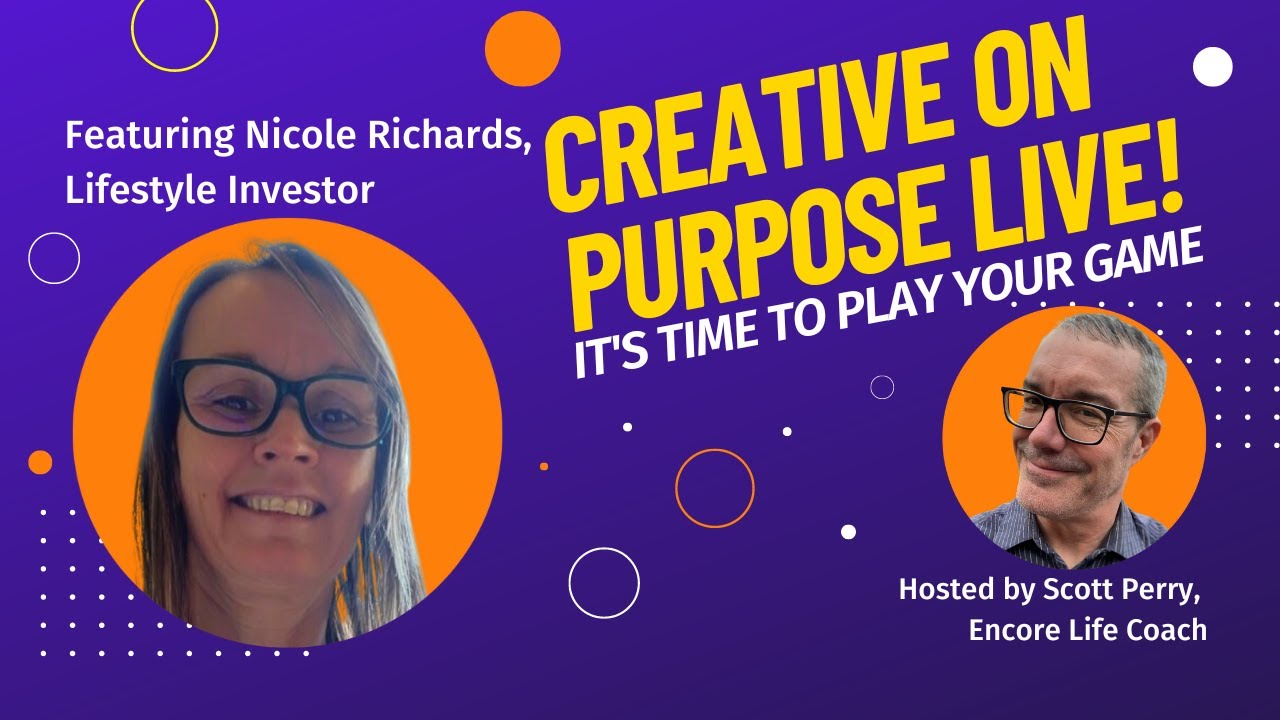
In this episode of Creative on Purpose, host Scott Perry interviews Nicole Richards, a former short‑term rental property‑management entrepreneur who is pivoting to a personal‑development and neuro‑education coaching business. Nicole explains how a series of life events—including a serious neurological brain injury—prompted deep self‑reflection, the shedding of a people‑pleaser mindset, and a commitment to helping others recover physically and emotionally. She describes the importance of knowing oneself before defining purpose, and how ancient principles like “know thyself” guide her transition. Nicole highlights the role of mentorship and community—Guardian Academy, Dr. Jeff Spencer, the Wolf Den, TGA, and the Certainty Certified Advisor (CCA) program—in providing support, collaboration, and structured frameworks. A central theme is her practice of “open‑loop learning,” which she cultivates through extensive walking, journistic writing, and intentional collaboration, allowing ideas to mature without premature closure. Throughout the conversation, Nicole shares practical advice for listeners in liminal career phases: take time, embrace open loops, prioritize self‑knowledge, and simply “be you.” The interview concludes with a concise, empowering tip for the audience: authenticity is the most powerful catalyst for stepping into one’s second act.
Chapters
Fasten your seatbelt, we are zipping across the ether at the speed of bytes. And there we are. Welcome to Creative on Purpose. It's a show about making a better living and a bigger impact by defining, developing, and delivering the difference only you can make in the second half of life. My name is Scott Perry, Encore Life Coach and author of The Art of Encore Living. If you're ready to play your game and live your legacy, go to creativeonpurpose.com to get started right now. Let's meet today's guest. Nicole, welcome to the broadcast. Thrilled to have you here. Please tell our viewers who you are, what you're up to these days, and where can people go to learn more about you and the difference you're making.
Hi, Scott. Thank you. I'm Nicole Richards, and, um, I am in a transitional period between businesses. I have owned and operated a short-term rental property management company for several years. And just exiting that business currently. And, and, and I'm in the process of launching a business for, uh, personal, personal development coaching along with also some neuro, neuroeducation-based training— how to better improve your, your thoughts, your body, and your physical health.
Nice. So Nicole and I are, um, old friends in digital years. We've known each other ever since last November, uh, when we both joined a program called the Guardian Academy, which we would both probably recommend that you check out. Um, and, uh, we've been doing some weekly broadcasts together on Twitter and a Twitter Space Jam. And one of the reasons I'm really thrilled to have Nicole on here is this fact that she is kind of in that liminal period between what she's been doing and what she wants to do next. I have a sneaking suspicion that more than a few of you tuning into this live or in replay are in a similar situation. It sounds, Nicole, from what I heard you say, that you're shifting into kind of a coaching space, personal development, also exploring some ideas around helping people explore their neurodiversity. Just curious in terms of like origin story, how do you come to be pointing yourself in that direction right now? I'm guessing that 9-year-old Nicole didn't say, you know, after a long career in real estate investment, I'm going to go into this completely other direction and help people help themselves. So I'd just be curious, like what brings you to this moment?
Well, there's many things that bring me to this moment, but I would say the thing that sticks out to me the most is just the— just life, you know. Um, at every stage of life, there's been definite circumstances, definite events that have just really kind of formed who I am and what I— how I look at life and how I choose to proceed in life. And this is just one example of that. And through— throughout the process, I've really gotten to know myself on a deeper level and understand people as a whole on a different level. And, and really, that's just what's led me to the transition into what I really want to do instead of always chasing more, always trying to people please. And, um, I'm just excited to move forward in a much healthier and more productive way, both personally and professionally, where I can actually step into playing my game and helping people.
Yeah, I love that. Well, I love that you threw in there this idea of knowing yourself. It's one of the ancient principles that we teach in my coaching program, which is we have to begin with who are you before we can define what it is that you want. And So the other thing that I was hearing in what you're saying is just, it sounds like in some ways, you know, one of the things we do at The Art of Encore Living is we help people hear and heed the call of vocation, follow their dharma, reconnect with or find their kind of sacred duty, that unique gift that they've actually always been meant to you know, bring forth into the world. And it sounds in some ways what I'm hearing is that you are hearing, um, whether it's the voice of vocation or purpose or calling, whatever you want to call it, um, and, and deciding like, okay, there's something, something is, uh, speaking to me because it wants to happen through me. And so I'm going to start exploring that path. Is that a fair reflection?
Yeah, absolutely true. Um, And just going back to my introduction, that's really what I've been led to through experiential resources, and it's also what I've been led to through some influential people in my life. And really, it has, it has been a beautiful bringing together of resources and information that I've learned throughout the years. So yeah, that's completely accurate. And I really just want to be able to full-on help people with physical and emotional recovery processes and just really help them learn who they are so they can full-on play their game and be the, be the, be a version of them, best, their best selves.
Yeah. Well, I also love the part of your reflection where you talked about being a recovering people pleaser, because I am guilty of that as well. And, and, you know, that part of the, the, you know, so Know thyself is, is the, the aphorism on, uh, inscribed entrance of the Oracle of Delphi that everybody knows about. There's a couple more that are also at the entranceway that, um, that, that we find useful in the work that I do. But, um, just to lean into that edge a little bit more, like, what in this, you know, the first step is to kind of recognize these things about ourselves. Like, you know, when I kind of admitted that I was a people pleaser, that was the first step to recovery. Um, and so curious to hear about your process for, you know, as you, um, were doing this kind of self-discovery, this archaeological dig of who you are and what you believe and what your values are and what your guiding principles are and where you want to go. Um, how did you navigate the, you know, the— when you found, you know, I'm sure you found lots of strengths that you wanted to use as leverage to propel yourself forward. But if, if you're at all like most of the folks I work with, you probably found some stuff that you felt like needed work. And how did you go about articulating that and, and working on that so that you could become that better version of yourself that you were talking about?
I— well, to start, I've always been that person that has thought we can all always be a better version of ourselves and continuously improve. But on some level, that was pretty shallow thinking in my younger years. And what really kind of led me to that possibility and, and the possibility of being a recovering people pleaser was a pretty serious physical trauma in my life that really made me have to focus on myself, have to take care of myself, and have, you know, like, I, I do not want to be the person that left in that stage of life, that I was going to be stuck there forever, both physically, emotionally, and mentally. So I really had to make some hard choices to put myself first, not do things to please people because my, my recovery just downright depended on that process. And it took every ounce of energy and all of the time that I had to really facilitate that and to move that process forward.
Yeah. I, I appreciate the generosity and vulnerability of that share. And it's something again that frequently comes up with the people I'm working with, you know, who, um, You know, their, their connection with me and, and this desire to discover who they really are and what they're really meant to do is often precipitated by, um, some sort of, you know, trauma, failure, fall, whatever. And, and, you know, that these are things that we're all going to experience. Some people, um, you know, are broken remain broken and stay in that victim kind of mindset and, you know, never are never able to recover. And some people, um, are able to embrace being broken and, uh, or being broken and use it as an opportunity to be broken open to new possibility and to, to new ways of being. And so just curious, um, about that part of, of your journey, you know, I know for me, I had that experience as well, and I was— I stayed broken for the better part of a couple of years before I was able to navigate my way through that, being broken open and exploring new possibilities. Just curious about your experience and/or timeline with, with that piece.
I love that question. Um, first I want to say I don't really— like, it's not a process that I'd recommend. I'd recommend people paying attention to what's happening in life and really starting from the place you are instead of having to go through the process. But, um, oh, like I said, it was just— it was such a journey. And really, it's been a pretty— it was a pretty tough journey for about 5 years because I had some very physical things to deal with that were really out of my control due to a neurological brain injury. And so, you know, like, it was a long journey journey to come back to figuring out how to take the next step in life. It's like how to navigate all of that, and then really just having to learn how to relearn was a big journey. And so that was quite the process. And once I really stepped into that process, I started realizing the importance of it, and it really changed who I was on so many levels because I did get the opportunity to realize that life is short. We're never promised another day or even a moment, and to really just full-on live. And, and, you know, like, after that initial 5 years, it just became so obvious to me that, um, like, we really do have to make a conscious choice every moment of every day to step into what's next, no matter how scared we are, how painful it is, how unpeople pleasing we're going to be, and all of those different, um, criteria that we tell ourselves that we must meet or fit into this world. Because ultimately, we're all unique. And when we do step into those possibilities, our own creativities, our own potentials, we get exactly what we had been fighting for prior to doing that. And so, you know, like I guess my journey still continues, and, um, it will probably just continue to continue because I really enjoy just being able to help people and take that to a deeper level and really making the process about them and how can we really help them facilitate their own journey. Because in— for, for my perspective, you have to facilitate your own journey. It can't be done for you. And you have to step into it for yourself.
Yeah, I love that. And just to circle back to something you said at the very beginning, you know, you, you alluded to, you, you made some connections in the, in the last year or so that have really helped you arrive at this moment where you're, you're willing to relinquish what you've been doing so that you can actually step into your potential more fully and the possibility that you imagine yourself more fully. And it brings to my— you are, I know, a huge fan of Dr. Jeff Spencer, and I've spent some time with him. I finally got to do an interview with him, or get to meet him in an interview yesterday that's going to be posting tomorrow. And one of the things that he says that I love to repeat over and over is that no one Wins Alone. And, you know, he talks a lot about how, how to be a good teammate. And so I'm guessing that that's part of your strategy for exploring what's next and, and how you're going to, you know, step into that. But I would love now to just kind of shift gears and look forward. So we've got a sense of where you've been and kind of where you are right now. As you're thinking about what's next for Nicole, what, what, what she's gonna do in this next chapter of her life. What are some of the, you know, the strategic and tactical things that you're doing to, to define where you're going and to get yourself there with, to quote one of our friends, Dan Nicholson, who was also a guest on the show earlier, to get there with the least amount of risk, the most, least amount of effort, the most amount of opportunity and possibility going forward?
Oh man, that's like opening a big can of worms. I love it. Um, so what's next is I'm really just taking my time. Um, I've been very well educated around, uh, in many areas of life, and, and really the, you know, like the injury facilitated a lot of that. And so I'm really just revisiting all of that on a deeper level, and except this time viewing it from the perspective of somebody else's healing instead of my own healing, because I've, I've done it, I've been through it, I continue to do it. And so I'm just like viewing that a little bit differently, um, and, and really just trying to sink into that and consider what I felt through the process and recognizing that other people are going to have very similar reactions and feelings and as well as some additional ones. And, um, another area I've really leaned pretty heavily into in the last even 6 months is really just, again, taking care of myself on a much deeper level. I've received some coaching from Dr. Jeff Spencer that has— like, that weekend in itself is just completely life-changing and an experience that, um, I wouldn't trade for anything in this world. So that first and foremost, that. And then, as you know, we have an amazing community with, um, the Wolf Den and TGA and all of that. And, and that has also been so supportive with just really allowing me to step up my game and, and be who I am and just putting it all out there and with complete acceptance. So that's really been a huge step for me as well. And the third piece is just, well, back to the TGA community, like the collaboration inside of that community with the different community members is just incredible and worth every— for every minute I put in, I feel like I get 100 minutes back at least. So it's really just, it's just really an incredible experience. And then you mentioned Dan Nicholson, um, him and Nick Peterson have a CCA, Certainty Certified Advisor program that I've also, uh, chosen to be part of and just really learning how to look at things through different lenses, different structures, and really be able to put perspective around those things in a much different way than I have in the past. Has really been a powerful shift. And it's, it's a— I hate to call it a system because there's, you know, like, it's not a system, but it is a system. So I hate to call it a system, but within the system, it really does just give you kind of a structured way to be able to look at things and filter things and decide if it's part of being who you are, part of playing your game, and if you're going to somehow wreck yourself or if it really is setting you up to win.
Hmm. Yeah, I love that. Several things to just kind of threads to pull on. One is our mutual friend Jake Anderson, who was a guest on the show previously, also was at that session with Dr. Jeff and had an equally profound kind of transformative experience as a result of all that. We got to chat with him a little bit about that yesterday on a call. And one of the things that Dr. Jeff said in the conversation I recorded yesterday, his parting advice was actually kind of reflected in Brandon Stross's wisdom, which was take your time. He said, don't— Dr. Jeff said, don't step on the field until you're ready enough. And I love that you kind of reflected that, like, right now, I'm taking my time and I'm looking at my options and I'm, you know, connecting with and collaborating with, uh, you know, people to try things, try things out, try things on. Um, I think that's just so really, really important. Um, and then you also talked about acceptance and, and I'm also hearing this theme of, um, kind of checking your expectations, like I don't get the sense that, you know, we talk oftentimes, you and I, about open-loop learning. And one of the ideas we got from Dan and Nic that's associated with the "How to Teach Smart People to Learn" article from the Harvard Business Review. And, you know, in Dr. Jeff's language, our human mindset wants to close the loop. We want to check the box. We want to, you know, we hear something we don't understand, we Google it, we say, got it, and then we move on. And we don't like hold that tension and sit in that tension of not knowing. We're not often very comfortable with not knowing. And in the face of not being able to know, we'll just make stuff up. And so, you know, there's That piece I would love to hear just a little bit more about because you, more than many of the people I know, have this ability to really keep the loop open so that you can cycle over and over and over again until you've really baked a concept or a principle or practice into your way of being, and then you can move on to the next step. So how, how do you go about Um, you know, thinking about open loops and how do you cultivate that kind of posture in your day-to-day life?
Wow, that's a loaded question. Um, open loops has really just had a big part in transforming who I am because I always just wanted to stick to like, let's strategize this next serial business entrepreneur thing and let's execute it. And since I've been utilizing open— the open loops mentality, meaning yes, there's information there, and it's, it's an old concept but kind of a new concept in how I'm processing it. I really intentionally— I have to intentionally, very intentionally be like, okay, I'm, I'm going to leave this loop open. I'm not gonna do anything to close it, and I'm just going to continue to observe observe some more, see what information shows up, and see how it shows up. And I do that in many different ways, and which I'll get to here in a second. But probably the biggest thing that I've realized from leaving those open loops is what I had personally planned for next steps in my head, in my human mindset thinking, is, is never what it turns out to be. And almost always it ends up being something that I had better than I had ever even anticipated. And so that has been proven over and over again to me, and it doesn't matter how big or small the, the open loop is, it still holds true to this day. I've not yet to see that fail in a 6-month time period. So it's very interesting, um, and you know, like, some of the ways I leave the loops open is I go for a lot of walks, and I mean a lot of walks, because I find that It just lets me kind of decompress, get out of my own headspace. And through, through the cycle of the movement with nobody else around me, I really just have the ability to let information flow in. And so that's been really, really powerful. Some of my best thoughts and ideas come in that moment. And I've learned that I used to carry my phone with me and, you know, like type them in a note in my phone so I could remember them. I don't even do that anymore because I've now learned that if I just let the thoughts flow, the ones that are supposed to stick in there are going to stick in there, and the ones that are probably useless are just like a pass-through thought. Uh, so that's one way. Same thing, I— maybe the top of my list and favorite thing to do is I love to write and journal. So I, I do so much writing and journaling continuously. Um, and that really filters the same process for me, gets me out of my own way and really lets the information start to flow, the creativity to start to come out, and the thought process to really become, uh, very, very clear in what my next step is. And then of course I have all of the system processing to put it through to see if it's a viable next step or not, and great people to collaborate with to get feedback from and see if that resonates with what I'm really thinking, or to see if I really need to consider my process within that. And so really it's just open loops, open loops, open loops, and without closing them.
Yeah, I love that. I mean, you know, before I learned about open-loop learning, um, two of the foundational principles, um, that have been a part of the Creative on Purpose ethos forever are Curiosity and consideration. This, you know, the ability to not decide or not to, you know, have value judgments right away, but to be open to not knowing and embracing not knowing. And then the consideration, not just consideration of all your options, but consideration of all the other perspectives out there. And Those two words came to mind as you were speaking, along with courage and creativity. So, you know, four C's. I'm always thinking in alliterations, but that I love the way that you use walks to create space to allow creativity to come, which is such an important piece because it's probably the the human instinct that we need the most right now, maybe along with critical thinking, that is in the least supply, at least based on, you know, what you might see on social media or traditional media. It just seems as though we don't have a lot of curiosity, consideration, creativity, or actual courage in the world right now. So I love that you're kind of embracing all of those at once. So as we're kind of winding down our time together, I did want to— there's always the final question is going to be for you to provide some final advice for anybody that, like you, is in that liminal period and looking for how they're going to, you know, establish what, where they're headed next and their, their, their strategy to get there. But you mentioned, systems, and it sounded like you were a little uncomfortable with that term. And I'm just curious if we were to replace systems with process, would that make it easier to embrace? And, you know, if you have any thoughts about how you think— because I think sometimes we think of systems as fixed things, but they're actually not. Systems are organic and fluid as anything else if we pay attention. You know, one of the things that we've learned is system reliability is about having only the essential components and getting them to perform as efficiently and effectively as possible. And so as you're, as you're coming up with your system, your process, you know, what, how are you going about distilling things down to what's essential and how you might be able to do it a little bit more effortlessly.
Yeah, um, so to clarify, I actually love systems. I just have to be really careful not to get stuck in the rigidity, rigidity of the system because it can squash my creativity pretty quickly. So I hesitate to use that term. Same with processes, you know, like I haven't found a term that I love, but, um, Really, that just goes back to going for walks, journaling, uh, through the correct collaboration, not necessarily in a consensus way, but just through the correct collaboration and really listening to the feedback I get, um, from the people that I choose to collaborate with is, is probably key for me because I can quickly see if I, if I take the time to really go through my own processes and ask a good question through the collaboration, then I, I really can get super, super good feedback. And it doesn't mean that I have to accept that feedback or do anything with it, but with that feedback, I can always clearly see, yeah, this is something that I can tell was not really on my radar at all. How do I put it on my radar? Do I put it on my radar? Or, oh, that is the piece that I feel like is missing that I could step into next. And so then it goes back to the exploration of what that piece may be. And so really, I mean, I guess I would just invite people to step back, really get to know who you are. Don't think there's a big timeline or deadline that you have to meet. Really just take your time, go through the process, because once you start to really get into knowing yourself, taking the time to do that, so many things are going to become apparent that you couldn't have forced to happen in a million years.
Yeah, so keeping open loops about systems and processes, I get it. Absolutely. I love it. Um, so Nicole, you know, people tuning in to this, uh, live broadcast and the replay and they're going to also get it in a podcast and, and through the email list and the blog. They are people that are probably very much like you right now. They are in that liminal transitional space. They're contemplating what's next, you know, what the next chapter of their life is going to look like, what they're going to do, how they're going to find fulfillment and forge meaning and make a difference in their life's second act. If there was just one, one tip that you would provide that would help someone step into their power a little more fully and step into possibility with a little bit more courage and boldness, what would you share with them?
Just be you. That's the most powerful thing you can do is just be yourself and don't compromise on who you are.
Love it. That was succinct. You may get the reward for the most succinct response for that. There's a huge cash prize. I'll put the check in the mail. All right, everyone. Well, it's— we want to thank you for tuning in, Nicole, and I really appreciate you giving us the gift of some of your valuable time and attention. And we hope today's broadcast motivates you to take a bolder step into possibility and your potential and the difference only you can make in the second half of life. If you're ready to keep go-go-going with the defining, developing, and delivering the difference only you can make, visit creativeonpurpose.com to get started. If you're watching this on YouTube, or social media, please leave a comment, share a question, or just share your biggest aha lesson or takeaway from this conversation. If you're listening to this as a podcast, please give us a 5-star review and leave a review as well. It really helps more of the right people connect with this content, with the conversations and with the guests and the difference that they're making. Now, Nichole and I want you to take the insight and inspiration from this conversation and play your game. All in and full out. Nicole Richards, thanks so much for your time today.
Thank you, Scott Perry. It's always a pleasure.
More from Scott



Stoics Don't Suppress Emotions, They Do This Instead #stoicism #emotionalintelligence #mindset







