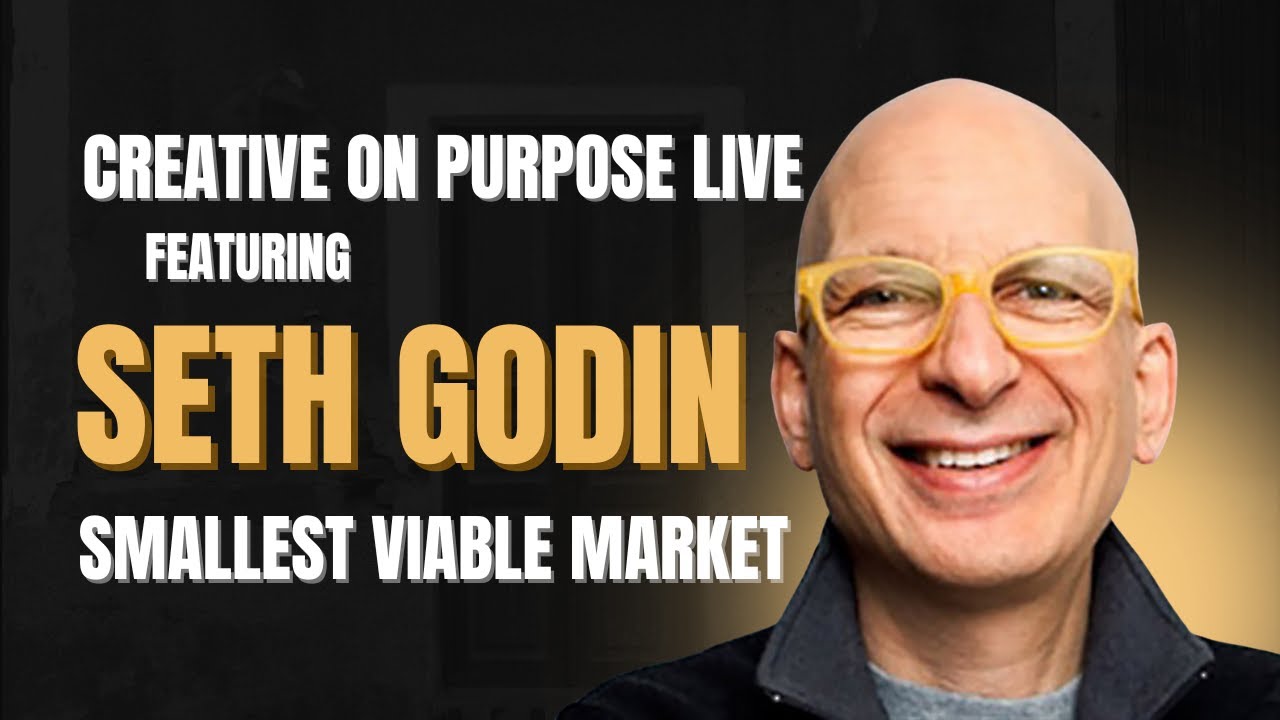
Seth Godin explains his "First 10" principle: share new work with ten trusted people for feedback before scaling. He argues for a "Smallest Viable Market" of 100-200 highly specific people rather than chasing mass audiences, and says purpose emerges from practice, not destiny.
Chapters
And defying all expectations, Technology Man has safely landed the ship everywhere it belongs. Welcome everyone to a special episode of Creative on Purpose Live. In this series of episodes, I am getting together with some of my friends and mentors whose ideas have influenced and inspired some of the ideas in my latest book, The Coaching Business Prescription. I'm here with my friend and mentor Seth Godin. Welcome, Seth. Great to have you with us. Please tell our viewers that— the one viewer that doesn't know who you are— who you are, what you're up to these days, and where can people go to learn more about you and the difference you're making?
Okay, so for the other viewers who do know who I am, I will take my allotted time to say the following: watching a video about your book is not the same as reading your book. And if it's worth your time to watch this conversation, it's worth your time to go click the link and buy the book right now. Because the idea that we can get an idea, just one, from spending a few minutes at our own pace working our way through a book is priceless. Don't hesitate, just go do that.
Thank you very much, Seth. I appreciate that. Well, the idea that I— there's, there's kind of 3 ideas. 2 I attribute directly to you, and 1, um, is someone else's, but I learned from you. And they're all around this idea of going small, which is counterintuitive and definitely in defiance of all the gurus who are, you know, the sultans and sultanesses of scale. And the, the primary— so it's talked about in the book, but it changed my life when I came across your idea of First 10, and I'll explain how it changed my life, but I'd like for you to first share a little bit about what does— what do you mean when you say get your First 10?
Okay, so for context, it wasn't, um, as frustrating to live in 1975 because Walter Cronkite wasn't going to put you on the news, and you weren't going to get called by CBS to make a television audition show. So there was this huge gate, and there were gatekeepers, and you weren't getting through it. So you could go back to doing what you were doing all day. And part of the seduction and indoctrination of social media was everybody has a camera, everyone has a keyboard. The only thing that's keeping you from being famous to everyone is your own laziness. And that helped people fall in love with the path of being a Kardashian. The problem— there are two problems with being a Kardashian. Number one, we didn't even need one Kardashian. And problem number two is we already have one now, so we don't need a second one. It feels like if you have an infinite number of followers and attention being paid, it doesn't matter if only a tiny percentage care about you. That's still a big number. So First Ten is a response to that. It's a response to people who say, well, I have to spam everyone, I got to get the word out. Well, actually, no. What you need to do is tell 10 people, 10 people who already trust you, who already know you, who are already in the group that needs the work you're doing. If you tell that, your idea, if you share it with 10 people— write your novel, just give it to 10 people— if they spread the word Ask for more. Tell the others you got it right. If they didn't, you either have to make better work or find different sorts of people. But taking your probably mediocre work to ever more people isn't the solution. And, you know, the evidence is really clear. The average video on YouTube is going to be seen fewer than 5 times today. Probably zero. That's the average. I love it.
So we've got some names that you'll recognize from a purplish space that you and I frequent that are liking the conversation already. And yeah, so when, when I think it was in the marketing seminar that First 10 might have come up, come about, maybe it was in the Alt MBA. But the thing that, that flipped the switch for me was Because we're all programmed by nature and evolution to chase more. And we are also, and it's a seductive way of hiding. Like if we just keep chasing more, it prevents us from doing the better work that is necessary to get actually more of the right people. But this idea that all you need is 10 to get started is how I wrote my first book. There's a story between Seth and I there that I won't bore you with now. I've talked about it many times. But the very poorly named Stoic Creative was put out on an Amazon sales page and 10 people said that they would buy it before I even wrote it. And that put me on the hook to write the book. And the book was written. And then, of course, a few more books were sold after that. So just that idea that you could validate an offer, an idea, a creative endeavor by just getting 10 people to raise your hand and say, yes, I would follow you on this journey was really, really powerful. And then there was this other idea that, uh, you unpack definitely in the marketing seminar, uh, which is the idea, and it's associated, I think, with First 10, but the idea of the smallest viable market. And when you talk about that, Seth, what specifically are you talking about it? And why is it the better approach than the scale approach of most of the gurus?
Okay. So I want to just put a pin in a couple things. The first one is this idea of getting— of being small as opposed to seeking scale. I almost never embrace the word small when I have the ability to use the word specific instead. The problem with trying to be big is you have to be general and you have to be average. The, the scary thing about the smallest viable audience is you have to be specific. If you can only pick 200 people that you're going to amaze, that you're going to create something remarkable for. If you're going to name them, you're on the hook now because you got to pack the house with the best people. If it doesn't change their life, that's about your work now. Whereas if it's a big, big crowd, you can say, well, it's on them. No, it's on me because I picked this viable audience. And what it frees us to do is not only are we on the hook, but we don't have to constantly dumb it down, speak in complete sentences and leave out the jargon. We can say, for the people like us who get where we are going, this is what we are doing. This is what things are like around here. It brings enrollment with it. And That shift is critical because it lets you do your work. And there's all this pressure to average it out and dumb it down and make it more convenient, but the people who succumb to that pressure almost always fail. Someone's going to succeed, but it's probably not going to be you.
So I love that, and I appreciate the, the, the pointing out of the specificity. If there are 100 people. They know you and you know them, and everyone's on the hook. Everyone knows when someone is missing from the room. And, but I think the other thing is it becomes sort of a leverage point, a force amplifier for taking— at least in my experience, I tend to be— I had the thing that I want to do, and I had the thing I want to create, and I want to create that thing, and then I want to give it to you. And instead, when this, this dynamic that you are suggesting, it's like, well, instead of starting with what I want and what I want to do, why don't I turn my attention to you? What do you need? What, where do you want to go? Where are you right now? And how do I help engineer, or how do I help, um, us co-create a path that will help you get from where you want to where you want to be that leverages my skills.
Except you gotta— you left out the key step. You get to pick the audience. So if you show up, uh, at an Accountable convention and ask people what they want for lunch, that was your choice to show up at the Accountable convention. So you don't get to complain afterwards about what— that no one was a vegan, right? That When you get to pick the people, you are choosing your future. Choose your customers, choose your future.
Yeah, I remember that. It's a line that's really stuck with me. And yet, so these ideas are just true because they are self-evident. I mean, I think that the practicality of these things that you have taught us is just undeniable. And yet we frequently find ourselves falling back into old habits and getting, being complicit and getting in our own way and, and putting up unnecessary obstacles or limits. Um, and I think that speaks to the fear, the resistance, all the things that we, uh, our friend Sonia talks about, um, mastering your disguise. So how do we Even if we know these, have these ideas at hand, and we believe these ideas, these assertions to be true, how do we keep ourselves on that path and not fall prey to the resistance and the fear?
Well, if I could answer it in 45 seconds, I wouldn't need Steve Pressfield. But I guess what I would say is there's other questions that I can put on the table. The first one is this: do you really care about making a change in the world, or would you just like to be applauded for trying? If you really care about making a change in the world, you need to announce who are you seeking to change and what change are you seeking to make. If these are generous changes, then you are like a lifeguard who is standing on the dock and someone 4 feet from you is drowning. Is there somebody more qualified than you to save that person? Of course there is. There are people who did better at their water safety test and everything else, but they are not standing where you are standing. They are not in the space you are in. You are. So if you're serious about being a lifeguard, you better jump in the water and save the person. So if the shift we seek to make is a generous one, if you believe that your jazz quartet is going to make a difference for the people in the audience, well then you're doing it with and for them. You're not doing it just so you can buy yourself grilled cheese sandwiches. And as a result, you need to get on stage because if you don't, those people aren't going to get what they need. And that shift from introspection to generosity has always been a powerful force for me. When I started, I was trying to pay the bills. And the harder I was trying to pay the bills, the worse I did. And when I was able to shift and say, I picked you as my customer because I think I have something you need, things got much better.
Yeah, well, and it speaks to the, you know, so sometimes I think we, we ignore the advice to take the specific approach and take small steps into our potential and possibility, because then we build in deniability if we don't achieve. I mean, that's one of the biggest dangers, I think, of defining success is once you've defined what success looks like for you, you've just defined the infinite number of ways failure looks like to you. And it's, uh, and it, it can be very fraught, which speaks to something else that you talk quite a bit about.
But hold on to that thing. Hold on to your question, because first, I'm thrilled that folks are here engaging with this, and I know it's easy to feel insufficient in the face of all of the leverage and choice that we're describing here, because no one can say no if you get rid of the gatekeepers. I'm not name-dropping here because I'm not going to drop the name, but last week one of the most famous people in the world came to see me for coffee with his producer, and I just described to them for 20 minutes what you and I talked about. The thing he did that made him famous happened 49 years ago, and you could just see she understood it. And he refused to acknowledge that any of this mattered. He just wanted to know where does he find the publisher for his autobiography and where does he find the producer for his Broadway show. And I'm like, there isn't a publisher who's going to take your autobiography and there isn't a producer who's going to take your Broadway show. What you're going to need to do is find 50 people where you can do your work that will change their life so much that they will find you 50 more people. And you have to do that again and again. I know you've earned the right to not want to do that. I know you've paid your dues. I know that the next thing should be like that first thing was. It's not going to happen. So if it's— that's the position he's in, don't be surprised if that's the position you're in, right?
And it's the, the, the receptivity, like how keeping the open loop, you know, we are, we are designed to close loop. We want to Google the answer. We want, we want the roadmap. We want the system. We want the formula, the secret, uh, key, whatever it is. And we refuse to— we're not programmed to leave that loop open. And I think we also fail to recognize how important relationships, the relationships, the people we surround ourselves with. You talk a lot about affiliation. And I think affiliation is built into some of these ideas like First 10 and Smallest Viable Market. How, what are some, what's some pragmatic advice you would have for helping people be a little bit more discerning and, uh, discriminating in the proper sense of the word about who they, who they spend their time and attention with.
You know, something I've noticed about freelancers, and I'm, uh, going around a circle here, but some of the things I've noticed about freelancers is if you ask a freelancer how often do they hire freelancers And do they pay them well? The answer is, well, I can't possibly do that because I'm struggling, blah, blah, blah. And so we have this mindset as we struggle that the customer is someone else, some philanthropy-minded person who's going to pick us and give us the runway to get to where we're trying to go. And if you hang out with other freelancers who act and think the same thing, you're just going to reinforce that. So part of it is, how do we find ourselves in the room? And that's usually by inventing the room where the people we seek to be next to are next to us. And I've told the story of Tom, uh, when I was at building one of the very first internet companies, AOL was our biggest customer, and they had a conference and they invited their 100 biggest vendors to come. And Tom took a suite with money he probably didn't have, and he invited 8 of us to come hang out that evening. And we all shared our contracts, and we all shared everything we knew, and we didn't hold anything back. And being in the room with those 7 other people, all of whom were struggling, but all of whom knew something that the other 7 people didn't know— creating that peer circle, that was priceless. And one of the reasons Silicon Valley works It's not because there's a geographic reason for it to exist anymore. It's because the other people are right there at Trader Joe's. They're right there at the gym. And you can organize that. You can figure out, who do I need to be around? Who's going to push me into a discomfort so I can level my game?
And you're speaking to something that I think, um, we often don't pay enough attention to, which is When we look at what we are able to control in our life, what we actually possess agency over, it ain't much, you know, outside, you know, other people, situations, events. There's many forces that can conspire in our favor or disfavor. But there's a couple things that we do possess agency over that we don't always, that we don't always step into and stay in, which is we, we actually possess the ability to decide how we see things, how we frame them, and what we choose to do and then do next.
And okay, folks, that is what Stoicism actually is. So why don't you, why don't you say it again slowly? Because people miss this every time.
Yeah. So, uh, there, there, there's almost nothing within your control, but yet you control the two things necessary to live a joyful, flourishing life. You possess control over your perceptions. The way that you choose to see things, and you have control, control over and authority over your decisions and actions, what you choose to do and do next. And if you marry that to what Seth has been saying about taking, being specific about who you are spending your time with and who you're doing your work with and for, and you take micro small steps into possibility every single day through a daily discipline, a practice of your craft, you will make progress. And you will make progress at a pace that probably doesn't scare you back into being stuck, because you are earning confidence and a little bit of courage as you have every little— make every little step. So Seth, if you don't mind, we're going to fly through. I'm not—
I'm sorry, I've been talking too much. Go for it.
No, no, no, this is— I just wanted to say, so, um, Mariana is, uh, here with two of her favorite people. I'm sure they're both—
where are they?
Uh, Sonia David, shout out to Sonia, whose book, uh, Master Your Disguise just went out today. She was featured on my blog today, so check that out. Um, yes, answering the question, what do you make, uh There's— I'm going to skip across a couple here. It sounds like holding on to the humility of each of our being one in 8 billion. I love that. Actually, I wouldn't mind hearing you speak to that a little bit as well, Seth. I think there's— we're always kind of toggling, you know, we're, as human beings, we are always very interested in our personal significance. And we are always aware of our cosmic insignificance at the same time. How do we, how do we balance, or not balance, but how do we find harmony with those two ideas?
Harmony is different than consistency, right? Harmony is about two things that don't match that fit together well enough that we can make music with them. We can't help but be witness to what's in our field of vision. There are people on other planets— not people, species on other planets. We have no idea if they're suffering. We have no idea if they just had a flood. But we can see with our own eyes what happened to our neighbors or to our friends in Hawaii or somewhere else. And it's very easy in those moments to feel powerless, to feel bereft. If it causes you to take action that makes those people's lives better, then that's worth it. If it doesn't, if it's just part of your narrative of endless doom and gloom, well then what's it all for? What we have is a very limited period of time to make a difference for other people. And what Western culture has indoctrinated us into doing is beating the others and acquiring a bigger pile of stuff by trading our time and our, our joy for it.. And I think a whole generation of people is waking up and saying, we're tired of the caste system and we're tired of the status game and we're tired of the accumulation. What can we do instead to make things better? Yeah.
Quick, uh, final shout out to Sanya, who is grateful for the shout out. Uh, there's a name that will be familiar to Seth. Uh, we have, um, Aiman, I hope I'm saying that right. And then Tom Trainor, always too kind, Tom. We appreciate you. And of course, there's another name you might recognize, Seth. There's Penny. So you spoke to this idea of making a difference. Do it and doing work that matters is probably that phrase alone is what drew me into the altMBA back in August of 2016. This idea, and because I think If we can just nudge on over to a topic or to your book, we are creatures that are in search of significance. One of the perennial books of all time is Man's Search for Meaning by Viktor Frankl. We are meaning-seeking creatures. And one of the ways that we can do this is doing work that matters, making a difference, to use some of your terminology. And I'd like to just piggyback onto that, this idea, this, this idea from ancient spiritual and philosophical traditions that there is this difference that only you can make, your life's calling, your vocation, the work that you are meant to do. Um, any insights on, you know, if you're, if you're going to do work that matters, how do you find— how do you align that with, um, the work that you were meant to do, or the gift, the, the gifts that you have?
Well, I learned so much from when I talked to you, but also you're great at driving StreamYard. People can learn a lot from you. And also you're great at setting me up for things that we can actively disagree on. I don't believe anybody has a calling. I think our gifts are limited to things that probably don't line up with vocations and professions. And I think that we let ourselves off the hook when we say, I was born to play the clarinet in a reggae klezmer band, and if I can't do that, I'm giving up. You weren't born to play the clarinet in a reggae klezmer band. You just weren't. These are choices we make based on the cards that are in front of us. Van Gogh was not— would not have been an oil painter if he was born 20 years ago, or if he had born— been born 200 years before, same parents, same DNA? No, that was a situational choice. And if the choices you are making aren't getting you the results you seek, we can rail against the unfairness of the universe because it is unfair, or we can make different choices. And that is at the core of what I've learned from you about Stoicism. Is stop talking about your calling. You— who's calling? No one's calling. You have a chance to speak up and offer. Talk about your offering. And if you can make a different offering that's going to help more people in a better way, please do. And this is super critical. We quit things our whole lives. Very few people who are on this call still wear tutu and take ballet lessons, and very few people on this call are, you know, doing 5-cent magic tricks. We did that when we were 6 years old. We don't do it anymore because we made a choice. And the problem with this buffet that's in front of us, of all of these choices, is they overwhelm us, so we don't make any. And the idea of local leadership, which I think is different than the denigration of leading from the bottom— bottom of what? It's local. It's local because we get to, to assemble the circle. It can have a huge impact. Alcoholics Anonymous started with 12 people. We don't even know who's in charge. It's anonymous. But someone showed up and showed up and showed up and made a change happen.
Yeah, I appreciate that perspective. I'd like to dig in a little bit more on that because I think this is one of the things that this points to is it's not that we're, we're never really taught. There are not many absolute answers. So it's not this way or that way. Many times it's a both/and. But that idea, that vocation or purpose— let's talk about that just for a second. Again, it's something that can really fuel and drive us and give us a sense of fulfillment and meaning and purpose in our lives. And it's something that we can use as a seductive to hide from our limitless potential and our inner greatness. And one of the things that I have found is that when I stopped thinking about purpose as a destination, something out there on the horizon that I had to go, like, I have to go find my purpose and then I'll figure out what to do with my purpose, or the other approach, which is to look within and excavate your purpose from inside you and then figure out what to do with it. But instead, treating purpose as an emergent, emergent thing, which I think is speaking a little bit to what you're talking about, which is, if I simply bring purpose to the work I'm doing, the work right in front of me, to the conversation I'm in, to the relationships that I'm in, if I, if I bring intention, and I bring integrity to the things I'm already doing. Purpose, passion, all these things that we're often chasing, uh, to, and, and causing, making us suffer because we can't find them and we can't, and we're clinging to these ideas. They disappear. They become emergent properties. And then the journey becomes the reward as opposed to that result or outcome that we've been chasing to no avail.
Yeah, I think that's very smart. Here's the thing: if you have a mission or a purpose, show me how it is helping you make difficult decisions. So Johnson Johnson has a mission statement, but they're lying. That's not really their mission. If it was, they could point to difficult, expensive decisions that they have made based on that. Actually, their purpose is to maximize shareholder value and to please the boss by doing something the boss wants them to do. Those two things fit their narration all day long. And the same thing is true for individuals. We reverse engineer what we say our purpose is based on what we think is going to make our decision easier going forward. So, you know, I've had this really lovely, luck-filled, uh, career, 35 years or so of being in some sort of media. But when I was in the computer game business in 1982 or '83, oh, my purpose was to help science fiction authors bring their work to life in interactive stuff, right? Because I knew these guys, Michael and Ray and things. So I had to make up a story about— that was my— well, I haven't done anything like that in 30 years. So what had happened to my purpose? So when Sonya asks about gifts If I had been born in a different country or a different time or with a different skin color or a different appearance, I am certain my life would have been very different. So the, the— my limited attention span, which I think of as a gift, would have doomed me if I worked on a farm in 1941. And so we've got to just decide. We have a bunch of tools. There's a tool chest. Sometimes we have resources we can go and buy new tools with. What are you building? Which marble are you taking away so the statue will be left when you're done? And the arc for me has been 35 years, but I also have 3-week arcs. And we pick our arc, we pick our audience, we pick the change we seek to make. That and the story we tell ourselves are up to us. And if your excuses are helping you, go for it. And if they're not, then what are they for?
Yeah, well, it speaks to the, you know, another misconception I think that there is that purpose is a singular thing, like you're only meant to do one thing. And that's probably not true. We, you know, we are iterative, evolving creatures. We go through seasons and different phases of our lives. And I'm of the conviction that purpose is not singular. That we can— purpose can evolve day to day, situation to situation, role to, and goal to role to goal. But it's, purpose almost becomes for me more of an attitude and a posture, a way of approaching doing whatever it is that you need to do right now. And it becomes a renewable or renewal, renewing property. It's just more bringing purpose to what you do begets more purpose, and then you can bring that into your work. So we got off on a, on a great tangent there. I appreciate that. This is— as, as the founder of Creative on Purpose, Seth, you know, purpose is a topic near and dear to my heart. I have missed a bunch of the people that have been leaving comments here, and I apologize to all of you for that. I'll get to you in the comments, but I want to be respectful of your time, Seth. Again, this idea of first 10, smallest specific viable market. These are ideas that I have found to be profoundly useful in the building of my own business. But, and there are things that are taught in the book and this idea of significance that we've been talking about here towards the end is a topic that you cover in your latest book, The Song of Significance. I'm going to put links to both books in the—
Say the name of your book. Slowly, and where is the best place to buy it?
The best place to buy The Coaching Business Prescription is at amazon.com. It's the only book by that title. Might have been done on purpose. I don't know. As Seth knows, I don't— not everything I do is on purpose. Seth, I say this at the end of every conversation. Your mentorship, your friendship has changed and transformed my life in ways I could never have foreseen and in ways that are miraculous and have really just been of extreme benefit to me and my family. So I want to thank you again for all the differences that you make in, in the world, in the lives of the people, many of them here on the call. And just thank you for being a force for goodness in the world.
Well, thank you. I couldn't do it without you, Scott Perry. All right. Make a ruckus, everybody. We'll see you.
More from Scott



Stoics Don't Suppress Emotions, They Do This Instead #stoicism #emotionalintelligence #mindset







