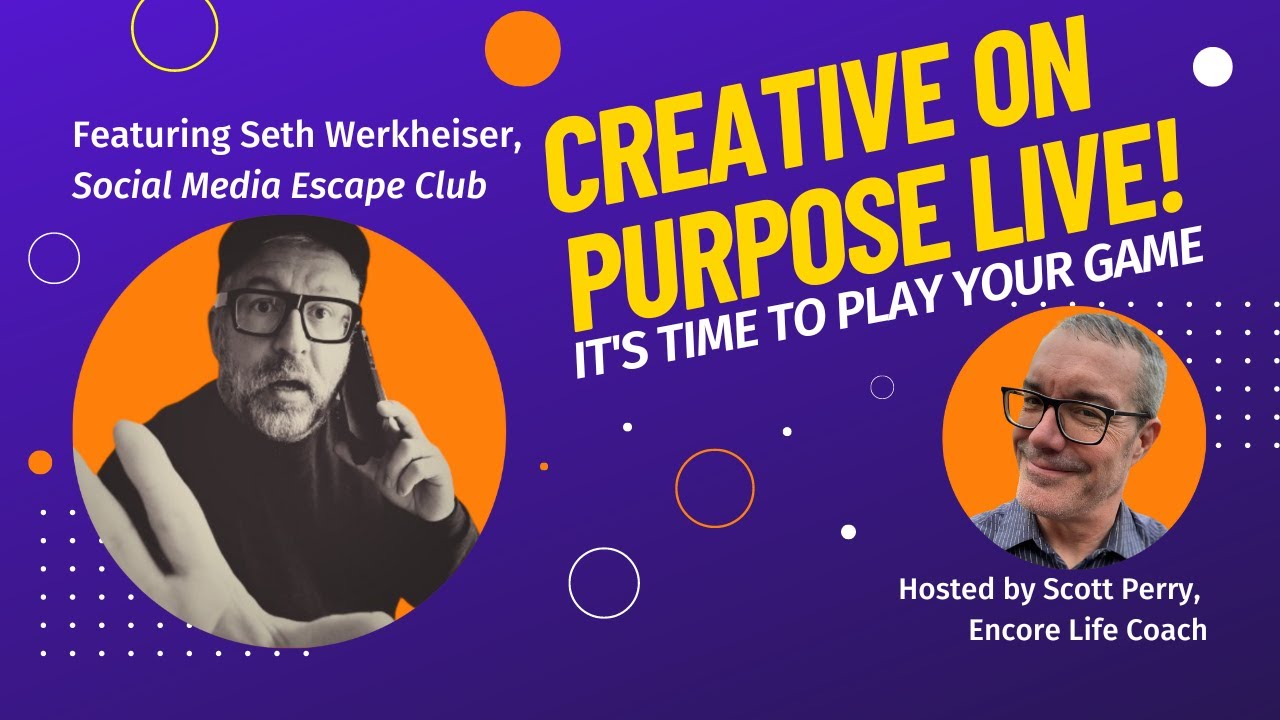
Seth Werkheiser talks about his Substack newsletter Social Media Escape Club and why email still beats social media for musicians and creatives. He warns against mullet marketing, pushes regular mailing and personal engagement, and explains why newsletters build real community where algorithms can't touch you.
Chapters
And just like that, we did it again, ladies and gentlemen. We are live. Welcome to Creative on Purpose Live, conversations with insightful difference makers that inspire a life of greater intention and impact. My name is Scott Perry, Chief Difference Maker at Creative on Purpose. If you're ready to get clearer and closer to what you really want in your life's next chapter, visit Creative on Purpose to get started today. Let's meet today's guest, Seth. Welcome to the broadcast. Please tell our viewers who you are, what you're up to these days, and Where can people go to learn more about you and the difference you're making?
Wow, thank you, Scott Perry. So fun to be here. Haven't done a live thing in forever. This is super exciting. I write a Substack called Social Media Escape Club, and what I talk about a bunch and what I've been talking about for years, it started on Twitter like 10 years ago, me yelling from the rooftops Hey, get an email list. Social media might not be around forever. And I think we're seeing that more and more clear each day. And finally, I took my own advice and started a newsletter in 2021. And yeah, and that's what I do. And for my day job stuff, I work in email marketing. So I do it both as, you know, pay, keep the lights on, pay the rent. And also, I just love helping especially creative people, artists, illustrators, photographers, musicians, like, because we're not all social media experts and/or managers. Those are full-time jobs. And so I really try to help people, give them a bit of inspiration to like, okay, let's figure this thing out. How do I reach my audience?
So love that. I always like to find out a little bit about the origin story behind how my guests came to be doing the work that you're doing. My, my guess is always that, you know, the 9-year-old version of you did not dream in, you know, their bedroom about becoming the anti-social media guy or the email marketing expert to future star creatives. So how did you, how did you come to be, you know, Social Media Escape Club is the thing that I want to touch on the email marketing too, because I think that that's something that there's a lot of misinformation about that as well these days. But how did, how did, how did you move into this Social Media Escape Club? Endeavor of yours?
Well, I mean, a lot of it had to do with a lot of the artists that I was talking to throughout my conversations. You know, at one time Twitter was a great place for conversations and meeting people and the serendipity— the serendipitous nature of that, of like you casually running into people and having these conversations. And so the idea for it was it wasn't that like everyone wanted this idea of like, wait, tell me about email marketing. They were just like, yeah, like it just kind of felt like social media kind of feels weird a little bit. And so, uh, or I'm not having the impact that I used to, or, you know, it's, it's a bigger challenge. Uh, oh, should I sign— you know, this would be years ago— should I sign up for TikTok? And then, you know, we see the news today of TikTok, like it's gonna be sold or something or other, like. So I really got into it from— and you know what, this goes back to 2001 when I started a music blog, um, because I found out I wasn't gonna be a rock star, so I started writing about music. But I wanted to write about a lot of the bands that I didn't see other outlets writing about. And my whole focus from 2001 through today has always been kind of I just want to help bands sell more albums so they can keep doing the stuff that they're doing. And that kind of has morphed into, I just want to see artists keep doing what they're doing and, and have hope that they can reach an audience so I can— it's selfish— so I can still see their art and see their music videos and, and all that fun stuff.
So yeah, I love it. Well, one of the things that obviously that I love about your story is we have this kind of shared musician past. And, you know, maybe we'll touch on that a little bit as well. But one of the common themes that I find in the conversations that I'm having with folks like you is that you created this sort of solution to other people's problem by solving a problem that actually was your own problem to begin with. And I'd love to just get— so in transparency, I have, I have had— I sometimes say I don't have a love-hate relationship with social media. I kind of have historically had a hate-hate relationship with social media. So I am one of those people that I've actually not taken one but two different courses on how to exit social media altogether. Obviously, they didn't stick because here we are on Facebook and LinkedIn and well, YouTube's not really social media, but, um, but, you know, there is— when we talk about social media as like it's not a monolithic thing, and what it is now is really a lot different than what it was when we all first signed up for, you know, Facebook or Twitter or now X. Talk about you know, things changing. So like, give us a little bit of the arc of your journey coming, like, you know, what interested you about social media at first? You know, why did you come in? When, you know, what are the changes that you've noticed? And why now do you think that it might not be a bad idea to think of an exit strategy from that whole, you know, all these platforms?
Yeah, no, my big one from the start was Twitter. I got on Twitter in 2006. 2006 when it was still based off text messages, uh, when it was called TWTTR. There were no I's. Uh, I was one of the first 3,000 people to sign up for the service. Like, I— and I was like, this is really cool. And I remember talking to, um, a music, uh, friend of mine, music industry friend of mine, uh, worked at a record label. We were like, wow, imagine if bands were on this. They could like tweet like at the show like, hey, it's so cool to see you, or this or that. And like, so it was really a draw like, uh, community-wise, like building audience-wise. And I really, you know, I was bouncing around on there for years, but it was finally in 2011 when I, uh, got this idea because I had run music blogs and I ran a music blog a metal blog for AOL Music called Noise Creep. And the premise of the music blogs over the years has been, here's this big 500-word article, and then you would go on social media and beg people to come and read it. Um, my idea in 2011, after I left that job, was I want to put the thing right here, like on your phone. Like, while you're at the show, you can— that, that's it. You don't need to visit another site. You don't And I was like, well, how can I do that without writing blog posts that are 500 words long? I was like, I'll do metal trivia. I could just write these one-liners and questions. And I did that, and it found an audience. And it was a lot of fun because people just came out of the woodwork and started answering questions. And this, this has always been a big theme of mine with social media, was the delight was there, the joy was there. Like, you didn't need You didn't need to like sell anything. It was just like, no, here, I wanted to elicit an emotion. And people loved answering questions. I wrote them in a way that they could excitedly say like, Megadeth, like, and that was so much fun. But then this is the arc, and then we come down was after a while I started looking at like the stats, like the comments were fun and stuff like that, but it was just like, oh wait, like only 30%, you know, this reached only 30% of all the followers I have. Why, why isn't this growing? Oh wait, now it's only 20%, now it's 10%. I was like, this is a big bummer, like I'm doing all this work and no one's seeing it. So that was, uh, 2017, '18, and that's— yeah, so I, I was getting really vocal on Twitter about that, my own personal account. That was like This doesn't seem to be working anymore. Like, this is, this is hard. And I'm just trying to do the joy thing right here and not getting you to click somewhere else. And like, so it was like, we gotta figure something out.
Yeah, I love that. I mean, well, I don't love it. But it, you know, I think that it's hard to, at this, at this point, because, you know, digital years like dog, dog years, maybe double dog years or something, because it's like, it changes so, so fast. It's hard to remember back. But I mean, there was a moment when all of these social media platforms were actually social, like you could actually follow people and the people that you wanted to see would appear in your feed. And as ads became, you know, more prevalent and And then the social media companies were, you know, more invested in maximizing their profits rather than maximizing the product or optimizing product. I mean, things just really have changed. And there's been a, you know, there, what happened for me was I think, you know, I wanted to exit from social media because it wasn't doing what it used to do. And I was frustrated with that. But something that I've sort of arrived at is that social media is just a tool. And like any tool, it's only, you know, its utility is actually based on who's using it and, and why. And so, um, you know, you can, you can buy a hammer and build a house. You can buy a hammer and smash someone's skull. That's kind of up to you. I mean, the hammer is just a hammer. And I think that, you know, social media has— a few platforms have remained a place where I feel like I can, I have enough leverage to justify showing up and doing some stuff there. But I'm certainly not investing in it the kind of time, attention, and effort I used to. And I am relying more and more on Substack and Substack's network effect and the direct connection that I have with readers through their email functionality. And I know, you know, that's part of your background and part of, a big part of what you do in terms of keeping the lights on. But, you know, according to what they're saying on social media, Seth, email's dead. So what's up? Why are you and I succeeding with email when it's obviously on life support?
Yeah, it's weird. Uh, I— me talking to any bands about that, you know, email's dead. Anyone that buys your record on your online store has to check their email for the shipping info. When's my record showing up? If you buy a ticket to a concert, what do you get? You get an email receipt. So people are eager to go and open those emails. So you just need to make an email that people want to open. Because I've also met the people that say, oh, email's dead, email's dead. And then they're like, well, I used to have an email list, I only had a 10% open rate. Well, write a better email, man. Like, I don't know, do better. Like, if you write bad songs, oh, I'm not getting any gigs. Write better. Try— let's start writing better songs. Like, in any of this. And so yeah, the idea that email is dead is, is It could feel like that, of course, because it's not— because social— a lot of people on— so that work at social media companies get paid lots of money to make you believe that, to make you believe that if you're not investing your time and energy and resources on social media, if you're not there, you're wasting your time, you're missing out, and you'll never amount to anything. Forget all that other stuff. This is your home now. And it's like, they are incentivized to make you believe that. And it's not true. And the work I do, the clients I work with, there are many dollar signs to go with that. So that, that they, that they make from work that I do. So, and on the social media side can, can sometimes be an afterthought in that world.
So yeah, well, I think I really appreciate that insight because it totally resonates. And one of the things that I know I have to do some deprogramming with in terms of my clients, you know, who, you know, will come to me with kind of similar stories like, hey, email doesn't work, my open rates are dropping, or social media doesn't work because my, my follows are, you know, not following me and, and so forth is, um, they're actually forgetting, like, what— when you're talking about email and social media, you're talking about connection. And, you know, the more fulfilling, delightful, meaningful you can make those connections, the more collaborative that you can make the conversations, the more people are going to want to find, like, try to stay connected despite whatever the algorithm is doing, and the more that they actually will connect when they do see your email or your social media feed. And, you know, we— it's so easy because we are creatures that are kind of programmed to be enamored with more. Like, it's all about the reach, the number of reactions, the number of— like, it's those All the metrics matter because metrics must mean success in some way, shape, or form. Um, but we forget that, you know, what human beings ultimately crave is being seen, heard, understood, and feeling, and, and, and belonging. And if your email open rates are dropping, then you've probably taken your eye off the ball in terms of what email is really for, which is having meaningful exchanges with people who you care about and who expect you to deliver relevant, relevant content to them. Not that email somehow is a failing tool, because all it is is a delivery system. The messaging and the intentionality and integrity of your emails, that's kind of up to you. And that's the same with social media. So I, I'd love to hear, I mean, because you're in, you're helping people with this, you know, especially around email marketing, um, what are the things that you find are helpful, um, either to remind bands why they had email lists in the first place or to, um, get people that are coming in and just getting started, like how do you help them, uh, find what email is really good for and stay the course in terms of using email for the purposes of meaningful connection and collaborative conversation?
I tell them what it's not, and it's not mullet marketing. And let me explain. Mullet marketing, as we've heard, is business in the front, party in the back. And so often social media channels, bands, artists, anybody, it's party time. It like, you go on those social feeds and it's awesome photos, it's, you know, uh, images that like from this, or, or stories, or what, like all these big elaborate things. But then when it comes to the email, it's just business, and it's just, here's an image of what I have for sale. Here's a buy now button. Goodbye. And that's mullet marketing. And what I try to get people to understand is like, you've already done two things. You've already done the hard work. You're already the artist, you're the photographer, the musician, the coach, whatever. That's the hard work. You've done that. The easy work now is just translating like what you've seen done and maybe had success with on social media. Everyone's had something that, that did well on social media that got 50 likes, 100 likes, 1,000 likes. Okay, yeah, move that over to the email list. Because I tell people too, like, a lot of the social media images and, and stuff that you post are seen by 10% of your audience, if you're lucky.
Yeah.
So take that and put it in your newsletter then, where, uh, you know, 99% of your audience can see it. So it's, it's that, like You don't have to reinvent the wheel. You've already done the— like, you've already seen how it works. Photo, text, photo, text. Like, that, that works great. Instagram made that a thing. We're all reading it on these. And like, yeah, you don't have to reinvent the wheel. That's the thing. Like, take what has worked for you in the past and just elaborate on it a little bit more. If you wrote a 30-word caption, make it 60. Like just write a little bit more, tell a little bit more of your story. You're allowed to put another photo in there, you know, like, and have fun with it and see what happens from that. Because, and I'm sorry to pour so much onto this, but like, it's almost a fire hose. But like also too, you can't just do that once a quarter. You like, if you play one, I hate to also to always use the musician reference, but if you play one show a year or one show every 6 months, you're not going to learn like how to be a performer or how to be a songwriter. You're not going to see what resonates, what works, what doesn't. So send an email frequently, at least once a month, please. Like, because then you're going to see what works, what doesn't, what feels comfortable. Is this sustainable for you even? And go from there. So that was a fire hose of a bunch of stuff, but no, it's, it's, it's all great stuff.
And I think, you know, again, we get like enamored of the tools, like, oh, You know, here's TikTok, I need to learn TikTok now because TikTok is gonna somehow solve all my problems. And all it's done is you've added another tool to a system that's already probably pretty bloated and congested with tools that aren't really working that well for you, not delivering any kind of return on investment. So, you know, adding more tools is actually just making anything that has been working to this point work less efficiently and effectively. What oftentimes what we need to be reminded of is, you know, from a philosophical and principle-based perspective, you know, how does this, how does this work, or does this even work? And, you know, I think for me, when I'm talking to clients about, you know, what they're going to leverage in terms of trying to get the word out, It's the things that have— the things that work now are the things that have always worked. Like, have a great offer, product, service, idea, cause, and be able to tell a good story to people that are already eager to hear it or hear it from you. And give them a reason to care or continue the conversation. It's like, we've been— I live in this tiny little town, you know, and the, the car dealership survives because it continues to take really good care of everyone that walks through that door. You know, they don't come to them with a set of keys and say, "Hey, hand me a check, and I'll give you the keys, and then you can get the hell out of here." It's like, you know, they sit you down, they listen to your needs, wants, dreams, and desires, and they show you some options. And then when you ask them for some, you know, some insight, some guidance, they will actually tell you honestly what they— because they know they're going to see you in the grocery store later that week, and they're going to bump into you at the post office, and they're going to have to look you in the eye and know that they didn't, uh, You know, they weren't trying to scam you or trick you or hack you into a sale just because they could. So, so often I think we just, like, if we actually just imagined that everything we were doing was having a conversation with someone that was sitting directly across the table with us, we'd probably do less stupid shit and probably have a lot more success with, you know, whatever the ultimate whatever the ultimate result we want is. I think that, you know, my contention is, regardless of where you're having these conversations, if you just try to have the most meaningful, helpful, useful conversation you can, the results will take care of themselves. You don't have to try to reverse engineer everything to, to eventually land on a buy now button. It can't just be being useful, being helpful, being of service, what we call "be a blessing" in the Creative On Purpose Community. And if you do that often enough, sooner or later, those people are going to have suffered enough around whatever dream or desire or challenge they're experiencing to say, "Hey, can you help me with that?" Yep.
I mean, yeah, hugely on the social media side. I mean, social, to not use it as a billboard all the time. Here's my thing, here's my thing, here's my thing. What if you just replied to 5 people at a time? Set a time. I wrote about this before. Set a timer for 15 minutes and just reply to people. Go to other people's posts. And now of course, that's like— there, there are people already doing this, and it looks ugly. It's a growth hack, which is hard. It's You can see it from a mile away. People that just go to big popular posts and reply, great post, cool post, so insightful— it's worth nothing. But like, people that actually go in comment sections and like have conversations, like actually leave— like, because you can't just do this for all these big giant people. There's all these people here at our level, other creative people, other coaches, other this, other that, the photographers just comment on their work. What lens did you use for that? What this, that, and the other. And now all of a sudden, this, it's a community. And like going back to your car dealership, I always, I always liken it to a coffee shop. You walk into a coffee shop and they don't say, hey, what do you want? And they're like, hey, how you doing? Hopefully they say, hey, how you doing? It depends on if you're on the East Coast or not. But, but I mean, but there's so there's in my hometown, there was a coffee shop that opened up and this guy Dan, he was the nicest, sweetest guy. And he would— we would always just talk, and it would be like 5 minutes later, he's like, oh, can I get anything to you? Which was the greatest. And I still think of that guy, and I occasionally order coffee from him. Like, they ship it around the world. So like, but that all started because that dude was like a nice guy that took a minute to talk to me and find out like what I'm up to and this and that. Like, and you can now take that to social media. Like, even with reach as bad as it is, this, that, and the other, you could still comment, you can still DM people. And that, I think, is, is the gold mine right there. Not to do it in an AI-helped way, not automated, but like spend the time going on there and doing that.
Yeah, well, I wanna— you said something really insightful that, um, I, I definitely want to highlight, is that that last point that you made, which is, um, you, you want to, you want to make sure that it's actually about helping someone, not about just trying to— it's a, it's about the connection, not the transaction.
Absolutely.
And if you take care of the connection, transactions will take care of themselves. When it's appropriate. And the other thing about all of this is, you know, if you're always in sell mode, you're also always inviting buyer's remorse, which means that even after the sale, you're going to have to deal with refund requests or complaints or just, you know, just bad feelings. And that, you know, you can destroy goodwill through a successful sales funnel, right? So, but if if you're, if you're able to just, um, show up and do good work and share good work and, and, and again, help people, when the sale happens, there's no, there's no buyer's remorse because they're actually eager at that point for you to take their credit card information so that they can get the song or the print or whatever it is. Um, so that's, that's really Powerful. And I love the example of the coffee shop, because again, I think it really fundamentally just comes down to that, that interpersonal connection and treating everybody, you know, like, like it's all about human-to-human, you know, it's not about your CRM and your B2B and your B2A, you know, it's—
Too many of those. Yeah, too many acronyms. Right.
Well, as we're coming down to the, the end of our 30 minutes together, Seth, the last question is always kind of just to help the people that are tuning into this broadcast with an insight or a tip or even a quote exercise, anything that you can think of. You know, most of the folks that are tuning in are either advancing freelancers, solopreneurs, creatives, or coaches, or they aspire to start some kind of business around, you know, the difference only they can make or their passion project or what have you. And so for the folks that are here that are ready to, you know, take, take a step, a bolder step into possibility with their own thing, what is just a final idea or exercise or share that you would provide to help them, you know, just step forward half a shade braver than they did yesterday?
I would say whether it's social media or an email newsletter, because there's so much like, well, how do I get started? How do I do this? You know, the newsletter thing itself can be confusing. Do I use this? Do I do that? Use this service, that service. My thing lately has been like, well, there's, there's, you're either going to make dance videos on TikTok all the way to, well, I'm not going to do anything. I'm paralyzed, I don't know, I'm not gonna do anything. There's a whole bunch of space in between there though. And so my thinking has, has been like, the— what work— what in that space— there's got to be something that works for you, that, that feels good for you, that feels right, that lets you sleep at night, that doesn't feel like you're being a used car salesman, that doesn't feel like, oh, I'm being too salesy. There's so much space in there. And there's— I think that's true for anything that, that anyone's trying to do, sell, what, make, put out in the world. And it's just trying to find that. And I find a lot of that— and this goes back, Scott, to what you offer with, you know, your— with your Substack and with your day, your weekly calls. It's about getting together with people and just like talking about that stuff. Like, we could sit here, like, I could get off this call and like think and think and think what's going to happen next. But more often than not, doing any kind of 30-minute, 15-minute, whatever call with someone, even if it's not an expert, a social media coach, email marketing coach, even if it's just another artist that's also struggling with it, just talk to them about it. And because you come up with so much more, at least knowing you're not alone in this, you're not struggling, you're You're not bad at it. Like, we're, we're all learning. And I think so much of that is just part of the community and finding people that you can talk about that with. Again, from real big coaches to people, you know, doing the same thing you're doing. So I would encourage that. Find some people to talk to. Subscribe to my newsletter. I love talking about it. And there's always people talking in the comments section like, oh my God, I hate social media. I— and there's community there and it's really fun. So Yeah, find a nerd like me to talk about that with. I am happy to listen. Absolutely.
So beautiful. Well, I really appreciate that, and I do encourage everyone to take a look at the link below and connect with Seth on his Substack. It's really fabulous. He's also masterful at some of the things that I'm just wrapping my head around, like the, the notes feature and so forth. Plus he takes some really cool pictures on his daily walks, so love that as well. And we want to thank everyone tuning in. Seth and I really appreciate the gift of your time and attention. We hope today's conversation motivates you to take a bolder step into possibility with whatever life or business endeavor you're trying to further. And to keep go-go-going with defining and developing the difference only you can make, please visit creativeonpurpose.com. And if you're watching on social media, heaven forbid, or YouTube, be sure to drop a comment, drop a question, hit that Like button. And if you're tuning in on a podcast platform, please make sure that you give us a 5-star review and leave a written review as well. It really helps more of the right people connect with this content. Now take the insight and inspiration from this conversation and go play your game all in and full out. Seth, thanks so much for your, the gift of your time and wisdom today. Absolutely.
Thanks for having me.
More from Scott



Stoics Don't Suppress Emotions, They Do This Instead #stoicism #emotionalintelligence #mindset







