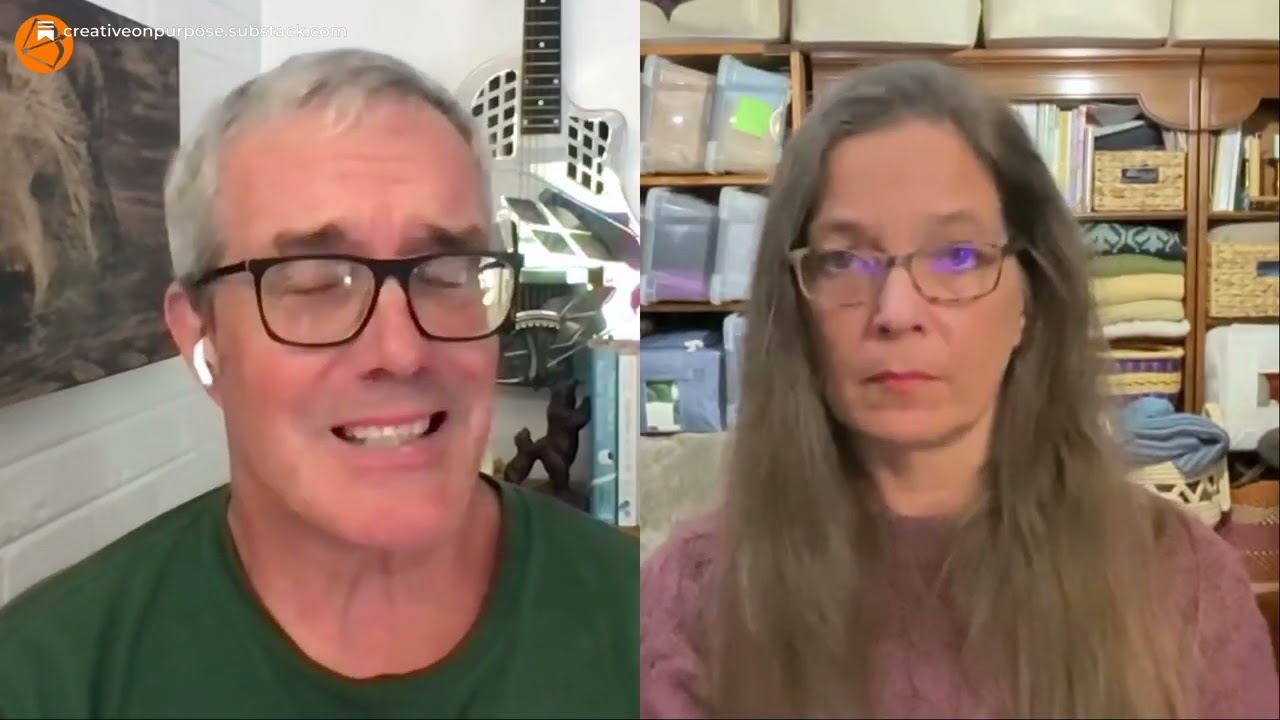
Scott Perry talks with a musician and coach about building a business aligned with your values instead of chasing hustle culture. They explore Stoic philosophy, the Bhagavad Gita, and how to know when you're burned out using the Zespirometer framework. The conversation covers what to offer free versus paid in a values-based coaching practice.
Chapters
I really want to kind of get into what it is that you do and why you were doing what you're doing, because what you were writing about on Substack is so profound and in a lot of different ways even very vulnerable. And in that directness, but also in the vulnerability where you're sharing not just what it is that you do, but also your personal perspectives. I really admire that.
Oh, well, I really appreciate that.
It's—
I guess it's the only way I know how to be. Uh, you know, I'm someone that even as a very young person was very interested in the idea of personal development. And, you know, one of the things I write about frequently is my affection for Stoic philosophy, which I was introduced to along with the Bhagavad Gita and the Tao Te Ching in the 7th grade. And those, those 3 philosophies or spiritual traditions have informed and inspired a lot of the way I pursue everything. You know, it was the way I pursued sports as a student athlete, as academic academics, being a school teacher for a short time, and then, you know, through a 30-year career as a, as a professional musician and a guitar studio teacher owner. Um, and I've never— I mean, just to speak to what you're highlighting, I never saw the value of trying to be something I wasn't and this whole idea of like fake it till you make it. And I mean, right now it looks like even here on Substack that the people that get rewarded with lots of attention and bestseller badges and all that sort of thing are the people that have all the answers. And they have these perfect blueprints and roadmaps and systems that guarantee that you can, grow and get your bestseller badge by just following the same roadmap that, that they followed. And, uh, as someone that did— before I came to Substack, pursued the path of the digital marketer and did it very well and achieved all the things that digital marketers want to achieve around, you know, monthly revenue goals and, and mastering funnels and Facebook ads and all that sort of thing. What I discovered was it works, like anything works. You're joining someone's notes mastermind, if you do it the way that they tell you to do it, it will probably work. Learning how to master Facebook ads and funnels can work. And sometimes that's how, just to circle back to our the beginning of our conversation, when God wants to punish you, he gives you everything you want. And what I found was that becoming the effort and the attention and the financial resources in addition to the time resources that must be invested to make digital marketing hacks, tricks, and tactics and tools work, will help you become an expert at something that you really don't care that much about. And you can find yourself having a lot of success working with people you don't really like doing work you don't really care about. And so I am pretty transparent about what my experience was like as a successful digital marketer who burned himself out, blew his business up because he couldn't stand what it was doing to a soul. And that has enabled me to share the journey that I've had on Substack, which is even without the bestseller badge and without the crazy growth hacking numbers or the viral notes and all the things that I was told that I had to have to succeed, I've earned a very good living for the last 3 years doing exactly what I wanna do. Spending very little time doing it, but doing work that I care about with people I really admire and love to work with. And so I think that's possible too. So, you know, that's the edge I'm leaning into by sharing kind of both stories. Like, yes, you can do it this way, didn't work out so well for me. If it's what you want, godspeed. And if you want to pursue an alternative that allows you to play your game on your terms without compromise and build a business that funds and fits the life that you want, you actually want, that's possible too.
Yep. I wanted— I'm sorry, just that very last line I think is probably the most important. You got to do it your way. We can try all the different other options that are available, but ultimately, because I tried all of these different tools that you had available, it was going to be you gotta have notes this many times. In the beginning, you couldn't even schedule your notes, so you had to actually be online to schedule the notes. And I started to say, you know what, I don't have the time to be in front of social media to engage like this. And I remember during one conversation with Suzanne Tyler King, I was questioning the method of why do I need to be all over social media. I don't like it. And there was one thing that kind of stood out in that one conversation where, why are we going online so often? What happens when you get the reward, when you get that label, when you be a top seller? And all of these different rewards that come with being seen and heard. And that is in our brain. We are being— we having these endorphins released, and it's pleasure. And I said, I think I want to be included in that. And I started to withdraw from social media and decided that I don't want to be part of that particular engagement. It was a very conscious decision because I then also needed to decide how I wanted to run my work and how I wanted to be seen, be heard, and kind of reach out. So it's kind of one of those balanced things. It's Yes, you can try everybody else's model, but ultimately you need to run your business the way you want to, not based upon what somebody else's, because it also depends on your content. Um, my content is definitely not something that would be, I don't know, um, of a mass production. I, I doubt it, um, because to your point, um, I have the Shiva Purana that I kind of relate back to along with the Bhagavad Gita. And then I also look at a few other things, especially from the Shiva Purana, where I'm comparing what Arjuna would do. So a lot of people may not know how deeply involved and how much of a foundation these scriptures lay out for everything that, that's a framework that I have created, because a lot of it comes from those original scriptures. So I didn't know about you and the Bhagavad Gita. I did not know about Stoicism. I did not know that And thank you for sharing that.
Yeah, well, I think one of the things I learned early on, because I did actually kind of start my, my brand as with waving my, my Stoic flag very loudly and proudly, and what I learned was that there was so much that even though Stoicism appears to just keep growing in popularity these days, it's still vastly misunderstood. The ancient tradition and the things that it actually teaches and the principles that it encourages you to follow are vastly misunderstood. And it, in many ways, just becomes another kind of growth hacking tactic, the way it's, Presented by mostly guys that are— people that look like me, but maybe are a lot younger than me. So I don't wave my philosophy flag as loudly and proudly as I have. I've decided to actually follow the advice of one of my favorite Stoic teachers, Epictetus, who said, "Keep your philosophy to yourself for a little while and just live it and present it rather than talk about it. Uh, it's actually going to be one of the things I, I talk about in my article coming out on Monday. Um, and the— however, it's all really important to me. Like, you know, your brand Dharma Funder, you know, that, that word dharma is a really powerful, important word that defies easy translation in any other language. And, you know, the way that I've been fortunate to have had a couple conversations with Stephen Cope, who has written quite a bit about Buddhism and is a member of— I can't remember what an emeritus presenter at one of the more famous Buddhist retreats. He wrote a book called The Great Work of Our Life, and he talks a lot about the Bhagavad Gita and about dharma and the way that he— one of the many ways that he frames it is sacred duty. And that translation really resonates with me because as because it resonates, it rhymes with what the Stoics said. The Stoics did not— they defined the good life based on virtue, being a good person. And being a good person means not just being a good person to yourself, but being a good person to other people. And at the same time, where the cynics said, all you need is virtue, so don't do anything else, like live in abject poverty in a barrel with your worldly belongings slung over a sack over your shoulder. The Stoics said, no, it's actually okay to pursue political life, social life, pursue business and wealth and all these things as preferred indifference. Just understand that they're still indifference. They don't really matter. It's just that they are not necessarily by themselves bad or good. They are just things that may happen. And what actually matters is the quality of your character. Do you behave with wisdom, with temperance, with justice in the form of fairness and kindness, with courage, doing what needs to be done even when it's unpopular and so forth. And so, I think, you know, when you talk about sacred duty, what, you know, what is your duty? All these things are reflected in large part through the work that we do. And again, if you are pursuing your dharma by doing a lot of things that don't align and create dissonance with your values, and your guiding principles and your boundaries, is it really sacred? You know, I would argue maybe that's worth looking at. And so this idea of pursuing worth, work that matters, work that you find fulfilling and that aligns with your values and your talents and the gifts that you can bring to others and help enhance their lives, you know, Yeah, then, uh, you know, I think that's what it's actually all about. So my work is really built on entirely around— if you have— if you know who you are, what you're good at, where you belong already, fantastic. Let's stop doing all this stuff that you don't need to do that actually is hurting, not just hurting your character, um, but it's, it's actually hurting your business too. And if you don't yet know who you are, where you belong, and what you're good at. Let's figure that out first, because if we can get that right, then we can establish a direction and a gap that we can close through some really basic fundamental ideas like generosity and connection and care and consideration, and just show up as we are with what we have and do what we can with the people that are around us and trust that everything else will just kind of sort itself out. And that's been my experience, and that's been the experience of a lot of the folks that I work with. And I just, real quick before I turn it back over to you, Dom, I want to say, um, we have Penny and Suzanne and Claire who are all members of the, of the Creative On Purpose Circle community or inner circle community that are here. So I just want to give them a quick shout out.
Yep. I I kind of wanna— I have two questions for you. When it comes to generosity and when it comes to being of service, there is an intention behind the Dharma Funder. There is a very big intention behind it because I was given the name Dharma about 23 years ago, and it took me a while before I was willing to actually carry the name and allow people to call me Dharma, because to your point, it is not for me, it is a different purpose. And when you are talking about generosity, my question to you would be, where is the distinction between generosity in being taken advantage of?
Yeah, it's a question I have been asked many times. I would say probably on a daily basis. I'm, you know, looking at Penny as someone that I've— we've had this conversation many times because when you are, when you are advocating a posture of generosity as a way to actually build the connections that will help you build a sustainable, viable, profitable, prosperous business. It's easy to overcorrect and turn, you know, I call it the distinction between generosity and promiscuity. If you are literally giving everything away, then it may feel like generosity, but you're actually causing yourself harm because obviously, as a solopreneur, which is what many of the folks that read my work are. You can only give and give and give so much before you just completely give out, and then you're not useful to yourself or anybody else.
Exactly.
And it's also— it's actually not truly generous to the people that you serve. So I think when it comes to generosity, You want to— I'll use myself as an example. Everything that I, I talk to my clients about, all the information, the entire process, all of the principles, all of the strategies, most of the tactics and tools are available for free because it's just information. And Information by itself is actually useless. Uh, learn— uh, there's a— uh, Epictetus says learning that does not lead to action is useless because information by itself doesn't change anything unless it's applied with intentional action. And it's actually a— the, the generosity of sharing all of my processes and principles actually is a huge boon to my business because what I am clear about is I will, I will help you get clear about where you actually want to get, where you are and what you're starting with, what you can stop doing so that you can close the gap without doing anything new, but by actually stop doing all the things that you don't need to do. And I will help you identify the 2 or 3 things that if you continue to improve your ability to execute those 2 or 3 things, you will make success inevitable. I'll give you all of that for free. If you want me to help you implement that information and be available to you to, you know, brainstorm or refine revise, improve, iterate your approach, then that's something that you're going to have to pay me for because it's not an investment in me, it's an investment in your success. And the only way that you're going— and it's a marker of that intentional action. I trust myself and this process enough to actually invest something meaningful, time, and money and a guide that will help me close the gap with greater ease and velocity. So it's actually the pricing and the clarity of what's paid and what's free and what you do and what you don't do and who you do it with and who you don't do it with, all those things. Those are actually acts of generosity, even if it feels like, well, I'm actually also being exclusive, like you can only get this much of me for free, or, you know, and only this kind of person is the kind of person that I'm willing to work with. And so, you know, that's the way I think about it. And one of the real motivators behind the community is that number one, you're not gonna become a client unless you're a member of the community because I can't help you until I get to know you and I get to know what your business is and get a sense of your direction and what you're currently doing. And what I want to do is help you get traction before you pay me a single dollar for any coaching. But it's also even more important within the community We have calls that I'm not actually a part of the conversations. It's the community talking amongst themselves with each other. Those conversations inevitably lead to conversations outside the community container. And it's a way of— I call it, you know, the ROI that I'm interested in is, is not return on investment. It's ripples of impact or ripples of influence. So I help people as much as I can. For free. I have a select number of people that I'm working with for pay because they're getting a deeper level of proximity and access and therefore a deeper level of impact on their own businesses and lives. But the whole point is, if we're gonna work together, my job, if you wanna call me a coach, I call myself a corner man. My job is to coach myself out of a job. I want you to start succeeding on your own, on your own terms, because then you can teach all, it's more like a lineage, like you're, all these ideas will live on. And whether I get credit for them or not, I'm not really concerned about, I'm just concerned about helping as many people as I can get clearer about and closer to what they actually want in life in a way that aligns with their core values, guiding principles, boundaries, and guardrails. That employs their actual talents and allows them to succeed on their terms and play their game without compromise.
Absolutely. I do very similar. My goal is not for you to be attached to my hip for the rest of your life, because the goal is for you to become fully self-sustainable so that you don't need me, but that you can take whatever you get from here and you can use it somewhere else. I really appreciate your insights. I have— does anybody have any questions? Please put them in the chat. But I have one last question for you. So Stoicism says govern the self under load. The Gita and the Shiva Purana say the self under load is the problem. Do you need to just release it and dissolve it? Are we managing an ego, or are we clearing it? Or can you do both?
I think it's always a both-and situation. Um, I mean, I, I'm not familiar with that phrasing, under load, so I guess I would want some clarity about what that means, or at least what that means to you.
Um, being—
I'm happy to comment.
Yeah, under load would be in a situation of stress. We're under pressure, or we need to perform faster. We need to come up with an answer immediately because the expectation is, is that we are supposed to be delivering immediately, and the pause is the danger. So that's what I mean when you are governing under load.
So, and the governing is self-governing?
Yes.
Yeah, okay. Yeah, well, I think it's a beautiful way of putting it. Um, I mean, that's the, uh, the, the sage, which is kind of what the Stoics would call the ideal Stoic, is someone that can maintain their equanimity, their peace of mind, their sense of flourishing eudaimonia, eudaimonia, under all of life's trials and travails. And, you know, one of the examples I cite quite often is Viktor Frankl, who endured 7 years in Nazi concentration camps, 4 different camps over 7 years, emerged a complete and maybe one, one could argue an enhanced human being from a situation that did everything in its power to strip him of his humanity.
Yep.
Uh, and he did that through the employment of Stoic principles and the— and, and largely through the idea of making himself a vessel for the service of others, to help others persevere through these situations. That is a human being maintaining their humanity, actually enhancing their character and their potential under unbelievable load, unbelievable duress. And at the same time, there is what you're speaking to in terms of letting go, you know, letting go of your expectations, letting go of your desires, right? Like, I'm sure Viktor Frankl really wished that he could no longer be there and that he could be reunited with his wife who did perish in a camp. Um, but he let go of his desires and his expectations and his ego concerns for getting what he wanted, and instead surrendered himself to the situation he was in and employed the innate gifts that he had to make life better for other people. And that is what gave him the sense of purpose and meaning and fulfillment that allowed him to continue to live with, you know, what you could call equanimity or peace of mind or stoic joy, whatever word you want to use. He persevered through all of those things. And, you know, I think that's a big, you know, in the Bhagavad Gita, you're encouraged to surrender to your dharma, to your sacred duty. And it's not about— doesn't mean that if you were born a noble, you know, in a class, and that your sacred duty involved leading armies against members of your own family, it was letting go of your whatever ego concerns or desires, like that's the whole point of the Bhagavad Gita is Arjuna is, uh, in crisis. Yeah, because he doesn't want to be doing this.
Yeah.
And his, you know, Krishna the archer says, hey, you know, too bad.
Yep, this is it.
This is, this is what you, this is what you are called to do, and you can, you can do it and fulfill your dharma, or you can refute it. And that's, you know, that's going to be its own punishment. And this, the pursuit of, you know, beyond the Bhagavad Gita, the battle doesn't go well, it doesn't end well. But that's not the point, because you're not— the Bhagavad Gita says, you are entitled to your labor, not the fruits of your labor. You're not entitled to expectations, goals, rewards, outcomes that you want. You are entitled to the process, to the journey, to the duty. And that's all you get. And that is also the reward. And that's exactly what the Stoics are saying as well. Like, you may get some of those preferred indifference around reputation or remuneration, and you may not. It doesn't really matter. What you— all you really are entitled to is what it— the impact it has on the content of your character. And I think that, you know, that to me, that is really liberating as a musician that was surrounded by and friends with people that were signed to major record deals and achieved all sorts of fame and fortune. You know, I had to face like, oh, I'm not getting any of these things that all my friends are getting, but I get to do this for— like, I get to do this. I get to do this work that I love and still have a family and still pay the— like, be a responsible adult and take care of all my financial obligations. And that's okay. Like, that's good enough. I can live with that. So I think, you know, that's my response to the paradox that you shared. It's both and.
And I agree, because if we allow one to be the driver, the other will tag along automatically. It's not one or the other. It's working with individuals and seeing how it is no longer the performance that is important. It is actually being able to come out on the other side and being able to live with it. Even the cost of what that actually may have been is easier to surrender to because the results and the outcome is no longer attached to an expectation.
Yeah.
So yeah, I, I feel you and I see you and I hear you because it's not often that somebody would agree with me that no, you actually do need to let go and you do need to work out and not let the ego be the driver because the ego wants the recognition, the ego wants the results. So when we stop chasing and we allow to stay in the space of the pause, it actually shifts. So Duncan the Sage has a question: What methods do you use when dealing with burnout?
It's a great question. Um, my take is that burnout is not a disease, it's a symptom. And the tool that I use is the Zespirometer. If I am feeling a persistent or consistent feeling of exhaustion or depletion, then it's an indicator that one or two things, one of two things is happening. Either I'm doing the wrong thing, Or I'm doing the thing wrong. And again, to reference Dharma, Dharma has a funny way— your sacred duty has a funny way of calling you, speaking to you, and getting you to head more or less in the right direction. The problem is that you can be at 1 or 2 degrees off and it will feel like you're completely lost and miles away from what you're supposed to be doing, away from the path. And so more frequently, it's that you're doing the thing wrong. And it's, you know, again, to use myself as an example, I was achieving all the success that people want, $10,000 a month, month after month after month, working 10 hours a day grinding out content for Facebook and tweaking a funnel and paying Zuckerberg for the privilege of the attention I was getting that was putting this money in my bank account. And that I felt the burnout and I did something that I'm not necessarily proud of, but it felt like what I had to do at the time, which was just blow that business up 'cause I could not stand it anymore. That's doing the thing. I was doing the thing wrong. I was doing it for the right reasons. I wanted to make a difference. I wanted to do this work that I felt I was born to do. It was just that in order to do that work for a couple hours a day, I had to spend 8 hours doing stuff that was completely out of alignment with the way I wanna show up in the world. So if you are feeling the early signs of burnout or even feel like you are all the way there, the question to reflect on is, am I doing the wrong thing or am I doing the thing wrong? And it's probably gonna be the second one. It can be the first one. And that, you know, speaks a little bit to, um, Amixentel's question: do you always play it safe? I, I personally, you know, there is no safety. Like, safety is a delusion.
So there is no safe. It's just you take a step forward.
The safe thing is to play a game that you didn't sign up for by somebody else's— I mean, that's the way society programs and conditions us, right? Like, get the good grades, you'll be rewarded by getting into a good college. Get more good grades, you'll be rewarded with a piece of paper that helps you get a good job doing things. Like, again, a lot of the time you're doing things that you don't want to do. You're playing a game that you didn't sign up for by rules that you don't agree with. And the question is, can you win a game that you don't want to play? And if you wake up to that The riskiest thing in the world is to say, I'm going to not play the game that I inherited. I'm going to figure out my own way to figure out who I am, what I'm good at, where I belong. And I'm going to turn that into something real that provides me with meaning, fulfillment, prosperity, doing work that matters with people I care about. That's That's a pretty risky proposition in my book. And so, but the whole point about like, there's the risk that some entrepreneurs advocate, this whole burn the ships, no exit plan, just go all in and grind it out until you succeed. It's not a great way to be. It doesn't end well for 99% of the people that do it. And it also defies history, 'cause the only reason that Cortés burned the ships is 'cause he was told if he came back without having succeeded, conquest, he was going to be put to death. So it was the lowest risk play to burn the ships and force his men to succeed or die. On the peninsula rather than go home and to certain death. But the good news is that for most of us, there are so many ways to mitigate the risk of pursuing the discovery of who you are, what you're good at, where you belong, and turn that into a viable enterprise that allows you to make a better living and a bigger difference at the same time and fund and fit the life that you want. Um, but that's, that's probably a whole nother conversation.
Yeah, my mind was going to who defines the risk, right? Who is defining whether or not you are playing it safe or not? Because if I am playing in accordance to my own game plan and my own rhythm. Yes, I would probably never play it safe because the path that I have been intended to actually pursue in this lifetime is not necessarily an easy one. Like we first started out with, is that life is not always easy, and it's not always been easy to live the life that we have led because The challenge is, in my case, what I enjoy. I like the challenge. I like to be kind of pushed and pushed a little bit further so that I have what I need to help others. That's the way I look at it. If I have a challenge or if I have something that is really uncomfortable I go inward and I start to research it and I look at what is actually going on. Is that playing it safe? No. But I want to find out if I am feeling like this because this happened to me, then what can I do to help others so that they don't have to experience the same thing?
I think that's a, that's an excellent final takeaway, is that this, this work is so much easier when you are doing it with and for the right people. And that doesn't mean just the people that hire you, that means your peers and who you select as your mentors and who the fellow travelers are. There's a great principle taught by Frank Shamrock, who's a mixed martial artist person. I don't follow any of that. I just am familiar with his framework, and it's plus minus equals. If you're going to succeed in a skill that matters to you, you have to have mentors that are above you, pluses. You have to have equals, peers that you are practicing with, that you are, that, that you are honing your skill with. And you have to have people below you that you are teaching because nothing reveals the holes in your skillset or your ability to execute more or faster than teaching. And so, you know, that's one of the things that Kyra has jumped on since we started as well. You know, all these folks that are in the Creative on Purpose Circle community, this is what it's literally all about. Like, we have a complete range of journeys. There are some people that are just trying to, just figuring out like, what's the business that I wanna start? And there's some people that have been in business and succeeding for a very long time and everything in between. And it's, Anybody that comes in and says, well, there's not enough high performers here, it's like, okay, well then this is not for you. Because if you're the kind of person that just wants to take what's good for you, what you want from the group, then you don't belong here. Because we all have something to share, we all have something to teach. We are all here to support and encourage each other. And wisdom comes from multiple perspectives. And so you have to have it all. So I think what you just said is one of the most important thing 'cause the biggest force multiplier that we have available to us all the time is the quality of our connections. You control who you spend time with and who you don't, who you pay attention to and who you don't, and how much you invest your time, attention, and effort in, and who you don't.
Exactly, because when Duncan is asking, what is your take on a hustle culture, um, I do believe that a lot of people are stuck in a hustle because we have to deliver, and it takes courage to actually step out of that, um, hamster wheel. Yeah, and stay true to ourselves, because once we do It is a completely different ball game. It's a completely different way of life. And yesterday I had a conversation with someone where we were discussing whether or not some of the things that we also point— touched on earlier is that the generosity. And there's one very clear prerequisite that is becoming very clear to me for what I need in a relationship would be you got to remain curious. And the willingness, to your point, is that if I am never striving to become better than what I am currently at, because I know I am by any means not perfect. And then to your point, I want to make sure that I'm able to practice it with equal peers, respectful individuals who are equally wanting to explore the growth, the expansion, and pursue something that is outside of the comfort zone. But I refuse to remain in the hustle. I refuse to stay in that space because it doesn't benefit me or anyone else. Even just talking about it, I get this knot in my stomach. Oh God, can you imagine? It's a wheel and just kind of run, run, run. No, but it takes courage to get off and seek out like-minded individuals and allow ourselves to fail, but fail forward so that we do learn and we do grow because Knowing that we always have space and opportunity to be curious and learn, that just makes life so much more interesting.
Yeah, that's really well said. I think hustle is a very risky proposition. It's a trap because hustle is the feeling of the wind in your hair that, you know, faster is somehow better. Um, the problem with most of the advocates of hustle cultures, they never talk about the importance of establishing direction first. If you don't know exactly where you're going and where you're starting and what you're starting with and paying attention to how you're closing the gap, you can hustle your way right off a cliff really fast or hustle your way backwards double time or down a cul-de-sac, you know, down a sidetrack that's not going to get you closer to what you actually want. I love the saying, slow is smooth and smooth is fast. If you establish direction and you have clarity of where you're going and clarity of path, you give yourself enough time, success becomes inevitable. And it doesn't require hustle. And it also allows for the presence to address the inevitable opportunities and obstacles that you will not be able to see when you start and navigate those with intention, with integrity. And often the obstacles are opportunities in disguise and vice versa. And if you're hustling, you're not— you're going to miss all that.
Yeah, it's, um, It almost brings the entire conversation full circle because what we started out is the acknowledgement of, yeah, this is where we want to be. It's done with intention. And I would be lying if I were to say I am in the same place as I was a year ago. And that's the beauty of it. Is that allowing ourselves the growth and the expansion to just go with the flow, stay with the river, and experience life wherever it may take us. Yeah, I think I could continue having this conversation with you for— we've already been talking for an hour, and I want to be respectful of your time.
And everybody, we'll save some for next time. This has been delightful. It's a privilege to get to to spend this time with you. I appreciate you persevering through all the technical difficulties. Um, and for those that arrived late, the replay will be available on both of our feeds. And, um, yeah, I just— I, I really, I really appreciate not only the questions but the insights and reflections that you shared. I appreciate the way that you're showing up and making a difference. It matters, and, uh, and we're grateful for it.
Yep, likewise. And it was an honor meeting everybody in the room. And who knows, maybe now I feel more comfortable joining for a circle.
The invitation is open. You can come check, check us out. No, no, no strings attached. Uh, that goes for anybody else that's watching. Yeah, they're, they're— well, that's exactly, you know, again, you, you brought it up. Having an attachment to an outcome is— and trying to engineer outcomes is a path to suffering. I only want the right people in the room. And so if you want to give it a try, just let me know. And that goes for Duncan and Omic Intel and all the other folks whose names I recognize. The same goes for you all. All right, Dharma. Thank you so much.
Thank you. Enjoy the weekend, everybody, and, uh, I'll see you on Substack.
More from Scott



Stoics Don't Suppress Emotions, They Do This Instead #stoicism #emotionalintelligence #mindset







