Talking Art of Encore Living With Angel Shannon, Founder of Seva Health
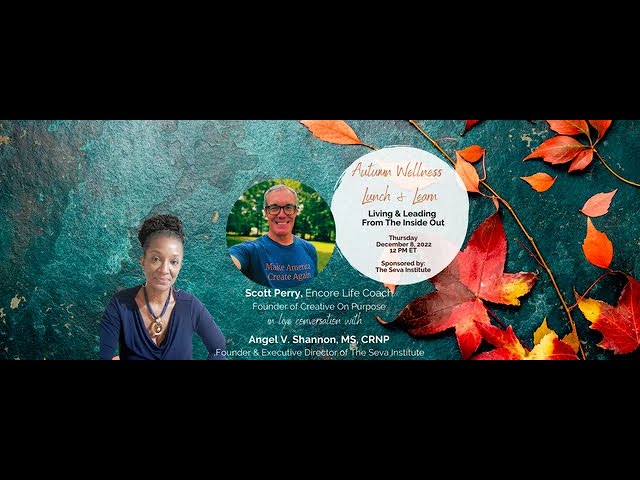
In this Thrive Thursday podcast episode, host Scott Perry (Encore Life Coach, founder of Creative on Purpose) converses with Angel Shannon (founder and executive director of SEVA Health/Institute) about how to design and live an "Encore Life"—the purposeful, fulfilling second (or third) act of one’s life. They explore the philosophical foundations of their work, drawing on Stoicism (Marcus Aurelius) and the Bhagavad‑Gita, and explain how these ancient teachings provide a grounding for personal responsibility, virtue, and resilience. The dialogue moves through the role of creativity and play in reconnecting with one’s innate gifts, the importance of identifying core values, character strengths (VIA) and talents (CliftonStrengths), and finding a community or "tribe" where those intersect. Practical coaching tools are described: a Venn‑diagram of values‑talents‑tribe, small‑step prototyping, risk mitigation (raising the floor, limiting downside), and the distinction between viability (making a venture work) and sustainability (long‑term impact). They critique the modern hustle‑culture focus on certainty, money, and guru‑driven tactics, advocating instead for intentional, low‑effort offers, clarity, and a memento‑mori mindset (Marcus Aurelius quote) to clarify legacy. Throughout, both hosts stress the need to subtract unhelpful habits, cultivate play, and use coaching to translate purpose into viable, enjoyable work that can be scaled modestly (e.g., 10 clients, 10 hours/week). The episode ends with actionable tips and resources (creativeonpurpose.com, SEVA Institute) for listeners to begin their Encore Living journey.
Chapters
Welcome to Creative on Purpose, a show sharing insights and inspiration for defining and delivering the difference only you can make in the second half of life so you can live your legacy. I'm Scott Perry, Encore Life Coach and Chief Difference Maker at Creative on Purpose. Today's kind of a special episode because the tables have been flipped. This is a conversation that I had with my friend Angel Shannon. She is the founder of Siva Health, and, uh, we talk about how to master the art of encore living, how to define and deliver the difference only you can make without burning out, and lots of other topics that I think you'll find really interesting. So without further ado, let's get to the conversation.
Scott Perry, thank you so much for joining me today. Wow. Happy Thursday. Thank you so very much for being here.
It is a privilege and an honor to be spending some time with you today, Angel. Thursday is as good as any other.
Yes. Thank you so much. And thank you to those of you who are joining us today for Thrive Thursday event that I am so super excited about because I'm joining someone who I have tremendous respect for, who I am connected to on LinkedIn, thank goodness, and all my socials. Because this guest who is going to share time with you today is doing something I think is so important and so crucial, and I just want to jump right in. Let me go ahead and introduce my friend and, you know, just co-traveler on this planet, Scott Perry. Scott is an Encore Life Coach. You're going to learn something really important today— what Encore Living is all about, what an Encore Life Coach does, which I think is some really special work in these times that we're living in now. Scott is also the founder of Creative on Purpose, where he talks about something I think is so crucial is living your legacy, living on purpose and for a purpose to forge your life's meaning, to find fulfillment, and to make a difference in your life's third act. And I also say maybe even in your second act, depending on when your acts began, right? And so the question I get a lot in my work is How can I even think about tomorrow and my second act and third act if I am just surviving today? And I want Scott to share with you just his very unique outlook on life and how to start weaving in some of that work and that thinking so that you are moving toward your full— to your full purpose and potential in life every single day. So I'm going to turn this over to Scott just a moment to just more formally introduce himself and to talk about his work, his life's legacy, and how you can begin to forge meaning and find fulfillment in your life today. Scott, thank you again so much for being here.
Angel, that was a beautiful introduction. I don't know how much I have to add to that, but it's a thrill to be with you. I think, um, you know, my— I always introduce myself first as a husband and a father, and I can now add grandfather to that. My wife and I care for our grandson on the weekdays while the kids working. Um, and you know, one of the things that I've done in my Encore Living journey is carve out a way that I can make a living and make a difference, um, in a lifestyle business that fits around my life instead of the other way around. So I'm able to craft a full-time living just working a few hours a day, could spend all day with my grandson and my wife. Um, and that's the kind of thing that I think is really available to everyone. To your point, if we think about life as having a first half and a second half, then the first half, we're usually following the script and the roadmap that was delivered to us by our parents, our peers, institutionalized education and occupation expectations of society where We want you to go to a school, do what you're told, get good grades, go to another school, do what you're told, get good grades, go to get a job, do what you're told, get promoted, retire, and die. That's, that's, that's what we're, we're fed. And then this— and the second half of life for me can begin at any point. I have people that I work with that are in their first act, their second act, their third act, but what they've done is they've woken up to the fact that they've really been have bought into a false bill of goods, not through any fault of their own, but because nothing was ever— an alternative was never made available. Nobody ever asked them, what do you think your unique gift is? What's your passion? What purpose do you want to fulfill? And so a lot of us, for a lot of us, it's midlife when we kind of wake up to this idea that, you know, I've done everything I'm supposed to do. I have all the trappings of success. And yet I'm still profoundly unfulfilled. I'm unhappy. And I don't know what to do next. And so Encore Living is about dialing in the difference only you can make, that unique gift, your soul's purpose, your calling, your vocation, whatever you want to call it. And what I do is I have a process for helping people dial in who they really are, what they're really good at, where they really belong. At the intersection of that is that unique gift. And then we explore your promise and potential and crafting that into an endeavor of your choosing. For some people, it's like me, something you turn into a full-time living. For others, it's a part-time thing, or it can just be a cause, a hobby, anything that you want. But that's, that's what I'm all about.
Yeah. And, you know, I want to— I should do this too. I want to welcome our guests who are attending today, whether by livestream, also who have registered for our event. And I'm always a little tense with the technology. So I should say, to introduce myself more formally for those who may not be aware of my work, I'm Angel Shannon, founder and executive director of SEVA Health and the SEVA Institute, where we put mindfulness and compassion in action to help you live longer and live better. And that is why I really wanted to talk with Scott Perry today, because he said something that's really important. It's about what you can do today. It's what, what you can do now from where you are. That's a lot of the intersection of our work. What are the things that you can do right now today to start moving in that direction? And it isn't about sort of like wishing and waiting for retirement. My work, you know, wishing and waiting for retirement when I'll start exercising or wishing and waiting for, you know, retirement when I'll take up that new hobby. Oh gosh, I've always had such and such on my vision board. I'll get to that when I retire. So the, the commonality of our work is all about, you know, seizing the day. And what's interesting about many of the posts that I read, Scott, that you add on your socials, is Stoicism seems to be where you're like sort of very firmly grounded. So I wanna take a step back and just say, how did you get here? Like, you know, I know we don't have a lot of time to tell the full story, but why is Stoicism— what draws you to that as sort of like your grounding place? Um, and how does it inform your work with your clients?
The, the origin story of that is, is, um, actually pretty, pretty quick. Uh, when I was a young man, my family moved around quite a bit, and I— we moved to a brand new town as I was entering the 7th grade, which is a terrible time for a young person to have to make new friends and be the new kid. And, you know, my response to that, uh, going to public school was In the classroom, I just kept my mouth shut, sat in the back, and tried to not, you know, get picked on. Um, but out in the world, I was, um, you know, acting out. I was a little bit of a troublemaker. Um, and, you know, I was getting into enough trouble that my parents were really concerned, and also concerned about not doing well at school. And like going to parent-teacher conferences, and the teacher would say, who, who, Scott, who? I don't, I don't think they're in my class. Um, and so the It just so happened that in this— we lived on a, on a dead-end street, and across the street from us was the headmaster of this little school that had very small classrooms and a really dedicated group of teachers. And they just said, listen, is there any way that you could help us out? Is there some scholarship money? Is there a way that, you know, our son could attend the school in town? And he took a liking to me. He found some money, the Wallace Scholarship Fund. I'm ever, um, just grateful for them. And I went to this little school starting halfway through 7th grade, and I was literally in a 2-room schoolhouse with 2 teachers, one of whom ended up later also being my Latin teacher and the other my English teacher. But in that 7th grade setting, we did an introduction to language which included Latin and my teacher gave me a copy of Meditations, Marcus Aurelius' Meditations, which is a primary Stoic text. And my other teacher in a world religion class gave me a copy of the Bhagavad Gita. And those two books have informed and inspired everything that I have done since. And for those that are curious about just a thumbnail sketch of Stoicism, it's a beautiful ancient Hellenistic philosophy started in ancient Greece. Moved into ancient Rome, that promises that a fulfilling life is possible if you live in accord with nature, not just human nature or the natural world, but the, the entirety of the cosmos, that we're all interconnected, everything is one. And that virtue, the content of your character, is the only requirement to live a good and fulfilling life. And, and that if you practice, uh, the virtues of courage and self-control and justice— meaning treat others the way that you would want to be treated— and wisdom, that, uh, you can achieve a greater sense of equanimity, fulfillment, find your purpose, be a force for good in the world. Um, and that's all that's actually required to live a good life.
That is so beautiful. I have like the chills just listening to that because for one thing, your ease with which you describe this tells me that this is something you've been living your whole life. Like, this isn't just, you know, walked into the bookstore and decided this would be good for your brand. Like, clearly this is something that you've lived and it's informed your life. And I always find that it's so— it's just so interesting how the things that happen in our childhood really do pave such firm foundation for much of what becomes our life. And when we just go back, as you describe that origin story, like, This was such a crucial moment in your development, in your youth. And as you said, thankful that this person came into your life, these teachers, and this has been foundational. And I imagine not even just foundational in your work, but even probably in your personal life as you govern yourself as a pop and now a grandpop with your beautiful grandson who's so adorable, that it really does inform much of your life. So thank you for sharing that. You also mentioned you, you, well, your business is Creative on Purpose. How does creativity, and I, I, I can imagine the answer to this, but I really love for you to speak to it. What's creativity mean for you? You know, especially with adults who've navigated so far away from play and creativity, how do you weave that into your work and what does it mean for you?
Yes, that's a great question. And, um, one of the things, one of the ways that I approach everything I do is just first principles. And first principle sometimes just means, what does this mean and what's it for? And for me, creativity is simply the human act, the natural human impulse to bring forth something new to— into the world and to solve interesting and even wicked problems. And it is a natural human impulse that we all possess. We all in our childhood created a walker from a non-walker, a talker from a non-talker, uh, you know, an eater from a non-eater. I mean, this is, this is just, this is just, you know, the basis of— it's, it's a, it's, it's an inherent quality of, of of being human. And to your point, you know, again, institutionalized education, occupation tends to beat this out of us metaphorically, hopefully metaphorically. And so, you know, oftentimes part of this whole process of defining the difference only you can make, finding your unique gift and calling, is involves, you know, I call it the art of Encore Living, because it is an art project where you are the work of art of concern. And we have to create that from the ground up. And a lot of times, and you referenced this just in your reflection earlier, you know, about our childhood so often informs and inspires who we become, who, you know, how we emerge into adulthood. And we can be knocked off of that by institutionalized education and occupation. But when I am working with clients who say things like, I don't have creative bone in my body, I don't really have any sense of who I am or what I want, we begin first just, you know, where we are. We can, we can start with what, what are the values we hold near and dear now? What are our guiding principles? What are our dreams and aspirations? What are innate talents and our soft skills and our— and the hard skills that we've learned in school and on the job. But then I love to look back. You know, what are the things that lit you up when you were— what are your earliest memories? What are your earliest memories of being inspired, filled with awe, wonder, feeling like you were completely immersed in the experience of whatever it was that you were doing? And that, you know, some people say, well, I love to finger paint, but I don't think I want to be a painter. It's like, no, it's not— has nothing to do I'm not saying, right, finger paints, you need to go to Paris and learn how to paint. It's, it's just reconnecting ourselves. You know, I, I like to say we can become who we are meant to be by being who we have always been.
Oh gosh. Oh, priceless.
Yeah. So it's, if, if we start to think about, you know, remember all those things. They— it's not that will absolutely define your new identity or your unique gift, but they all point towards it. You know, you and I both share an affection for the Bhagavad Gita, and that, that dharma, your path, your calling, your vocation, your gift, um, you know, that's it. Dharma is always helping is pointing you in the right direction. It's not giving you a revelation and saying, here, this is what you're supposed to be now, just go off and do that. Um, we have roles to play in our life, and I think that's why I love both of those, um, you know, the ancient spiritual text, the Bhagavad Gita, and the philosophical text Marcus Aurelius' Meditations, because they both talk a lot about personal responsibility.
Yes.
And the importance of defining and finding your game and then playing your— that game all in and full out.
All in and full out. Absolutely. And to your point about who you've always been, you know, designing your way forward— my, my— in my community where we do a lot of just, you know, visualization map, vision mapping, you know, creative visualization, and it's just touching that still point. You and I have a shared connection. Kathy Robinson talks about the still point, you know, and I think it's just such a beautiful word, the still point, touching that still point of who you've always been, who you are and who you've always been. And as you mentioned, this has nothing to do with, you know, and we teach our clients, this has nothing to do with becoming a painter or becoming a musician or becoming anything else, you know. But it's about touching that still point and what that means for you as you're engaged in the process of that. And I think creativity and play are two very powerful tools for awakening that, you know, because there is no— there's no perfect, you know, answer. There's nothing that you get wrong. You know, there's no wrong answer. Let me put it that way. You know, what you design or create or what you find through creativity is yours and yours alone. But what I will say is that people often discover something that's always been there. It's always been there. Yeah. So I want to ask you this. You say in your— in a lot of work, you said mastering the art of encore living begins by reconnecting with who you really are, what you're really good at, and where you really belong. That word belonging stands out for me. Because again, we're living in a time now where many people are still trying to figure out where they belong in a new landscape. A lot of communities have changed. Virtual communities are popping up. Work definitions have changed. Things that people have put their whole— have gone all in, lock, stock, and barrel, are no longer there. So how do we find that piece of, you know, that puzzle where you belong? And I know we're going to open up so that you can sort of reveal your process or map for finding that too.
Yeah, well, that's— I appreciate that. I do want to pause for just a second, just because you said something really profound that I want to make sure is highlighted. And that is the importance of play when we're talking about creativity, because that's the big difference. I think, you know, when we're children, we're not having internal dialogue with our imposter, or with our inner sense of unworthiness, you know, how I'll never be a walker, I'll never know how to walk, and I'm not worthy of walking. I mean, You, you just, you know, you start crawling around, then you start standing up and falling down, and after a while you can take a step and fall down, and then it's two steps. And but, you know, if you are lucky enough to grow up in a supportive, nurturing household, there's a lot of laughing, a lot of encouragement, um, and it is very much a playful enterprise. And that We carry that into all the things that we learn to do. We do them, we embrace the fact that we do them poorly in pursuit of doing them well. And that childlike sense of wonder, awe, playfulness is available to you whenever you're ready to acknowledge that it is just a part of who you really are, and that this is the way every innovation has ever come about. Nobody just goes into the woodshed comes out with a finished brand new idea, invention, what have you. Um, they, they test a lot of, a lot of bad ideas, a lot of bad iterations, uh, in pursuit of doing, doing it well. To your point about the, you know, how do we find where we belong and the process that I use, there's first of all several, several tools that I use that, um, are just scientifically vetted assessments. The Values in Action Character Strengths Study is one. The CliftonStrengths is, you know, a great one for finding your core talents. Values in Action is a values determiner. And those two things, and there's other pieces too. I think that having conversation with people that really know you and will reflect back to you, like, I don't know what my values are. What do you think my values are? I don't think I have any talents. What are my talents? But, you know, those two steps are really important because you have to define the, you know, for me, the five core values that you hold near and dear to your heart. Now, those are things that you have to pay attention to because that's how you can live a life of virtue, because your virtue is your values in action. And then your talents has, you know, maybe you are a great accountant or have learned to, you know, create fantastic graphic design, web design or whatnot. That doesn't mean that that's the work that you're meant to do, and that you'll, you'll find even greater fulfillment by turning it into your endeavor. But, you know, more often, it's, it's those forgotten talents, those things that we, you know, have always just been kind of naturally good at, you know, we all are born with different temperaments, tolerances, and talents. And so having a sense of who you really are, what your values are, what you're really good at, your talents, will help you find that belonging piece because you belong with people that share your values and need your talents to enhance their lives. And so we have a Venn diagram that we use to illustrate this and processes to define all this. At the intersection of those three circles— values, talents, and, um, tribe or circle, whatever your preference is— is where the difference only you can make can be found. And then it's a matter of, of taking small steps, it's a possibility. You know, we, we do not decide that we are going to become a violinist and invest the next 10 years in learning to play the violin. We try some things on, we, you know, do things, we do little tests and experiments, um, because what we have to do is kind of— part of it is we're going to be building new habits, and you have to do that in small incremental steps, otherwise it's, it's just too, too hard a lift. So yes. That's, um, that's, that's the part of the process that we, you know, begin with. And then, uh, just small step by small step, turn that into whatever kind of enterprise you, you are looking for to find that fulfillment, build an identity. Um, because we are— we humans are interesting creatures. Everything works. Work is just a transfer of energy. Plants do it with sunlight and water and nutrients. Yeah, create chlorophyll. Humans, for, for humans, work is how we define ourselves in large part by what we do and what we, and what that gets us. And so if you're going to, um, if you're going to work, and that may be a hobby or maybe a, a full-time enterprise, um, and we can find that thing that fulfills you and gives you meaning in your life, then you'll be building an identity that will help you live your legacy to something that is worth remembering and passing on.
Yes. So much in that, so much in this segment. Because I now want to touch back to what you said about play. You know, this is a lot of talk these days about, you know, imposter syndrome and all these kinds of things. And through creativity, we can remember that time in our lives when those things didn't exist, when we didn't question, you know, whether this was good enough, or, you know, who would like it, or what it would be used for, for goodness sake. You know, I remember in elementary school, working with clay, and just loving the process of making bowls, you know, bowls for my mother, containers, you know. And so, you know, she had— she still has them, and they're so childish, you know. They're just with my little thumbprints in there. And thankfully, my mother loved everything that I made. Like, it had a place, you know. And so that in itself was the reward, seeing it coming. You know, I grew up in a time where we had woodshop classes, and we had, you know, art classes, and, you know, clay, and all this other. And we worked with plastics and all this kind of thing. And so I still have many of those things all these years later. And it just sparks that remembrance that we can do something that you just mentioned, which is prototype, right? Because that's ultimately what we're doing is we're prototyping. We're trying these things on. At least in my own coaching work in the community, we talk about just trying it on. Start with your core values. And I'll make a point about that because you said something really important. But start with your core values. That's your north star. You know that, right? And so if you can start with what is important to you, what matters to you, how that ties into your purpose, your identity, it's such a rich starting point, um, that's accessible to anyone, anywhere, anytime. You don't need any tools for that other than maybe just a pen and paper, or if you can draw that out in some way, whichever way you can, you know, sort of think your way forward or design think your way forward to just explore that one thing for a little bit. And I find that's kind of tough with adults because we want to get to the other side, right? But I think it's worth spending time with, whether it be through journal practice or art practices or music, whatever way that you can sort of get to that. And you said something to virtue, and correct me if I got it wrong, but virtue are values in action.
Yeah, um, that— it's interesting because that piece, I wrote something, um, I can't remember if it was in my first book endeavor or my second onward, um, but it started off as a blog post and it is by far the most popular blog post I've ever written. Even though it's years old, it's still, uh, when I check my Google Analytics, it's always that page that is number one.
And I need to grab that for you to provide in the notes Oh, absolutely.
Absolutely. So yeah, so, you know, virtue— when we start talking about things like values and virtues, they can be, um, they can sound very kind of, uh, intangible and maybe a little bit woo-woo. And, um, and, you know, that's in part because it's, it seems like people are being rewarded for not actually having any. And if by rewarded we mean success and success financially and reputationally, maybe short term, but long term, one of the things that Marcus Aurelius wrote in his journal over and over and over again was the fact that his life and his name would have no meaning and no remembrance beyond his life. And yet, by being a person who, despite being arguably the strongest, uh, or most powerful person on the planet in his time, at least in the Western world, um, he reminded himself and exhorted himself over and over and over again to treat others with compassion and kindness, to, um, have, you know, be have sobriety and self-control over his emotions, over his impulses, over his, um, you know, needs, wants, dreams, and desires. Um, and that's what we're really talking about. You know, your values are— speak to who you really are. Do you, do you value honesty? Fantastic. Do people that see you out in the world think of you as an honest person? Do your actions speak to this value of honesty? Because if you don't, then you have a— there's a disconnect between who you say you are and the way you act out in the world, between your values and your virtue. And that disconnect has a terrible impact on you yourself. It's not just your reputation out in the world. It's not just about what others were saying about you, but it's, it's creating a lot of cognitive dissonance, and a lack of connection, you know, with yourself. One of the things you put in the description of this is living and leading from the inside out. And I think that's really important. Above the Oracle of Delphi in the ancient world, everybody knows, or many people know that it was inscribed, know thyself. And it's something we attribute to Socrates and Thoreau and all these other great thinkers. But there was two other things that were, um, above the, the door as well. One was nothing in excess, meaning you have to have some self-control, and certainty is ruin. And that piece is the most important, uh, after know thyself, I think, because again, we seem to be living in a time when we reward certainty Even when people are certain about things that are scientifically impossible and factually untrue, if we have certainty, we— they, they seem to be rewarded with high position, with financial remuneration. Um, but do they seem like happy people? Do they seem like fulfilled, flourishing human beings? Uh, do you want to emulate them? Are they going to be remembered kindly? You know, over time? I don't think so. And, um, you know, that's, that's why I think talking about values and virtues and encouraging people to explore who they really are, uh, what they're really good at, where they really belong, is so very important because it puts us back in touch with the key elements of what it means to be live a good life, be a good person, and do work with and for people that you care about that makes things better.
And that is so important, you know, because I think it's, you know, in my work I always try to tie it into where people are. And I think that is some of the ajita, you know, that is what some people, you know, many people are feeling is doing work for and with people that you really want to be working with, who exist for a larger purpose outside of themselves, who are values-driven. Redefining work, workspaces, that's a whole nother conversation. But the other thing about this is something that you just said as well, is certainty. You know, we're human beings. Obviously, there's a certain degree of certain— there's a— there's desire for certainty, for knowing, for predictability, for things to be as they are, and the way that I left them yesterday. Right. And so there's that tension there that I think exists, you know, because to a large degree, to be creative is to accept uncertainty, to accept that there's very little in life to be certain about. Clearly, these are teachings that are in line with the Dharma about, you know, and we You know, Pema Chödrön writes about the wisdom of, you know, the wisdom of letting go and, you know, living in an uncertain world. And my latest podcast was just about karma and, you know, the sacred pause and just wholehearted living in a brokenhearted world. And knowing that there's very little that is certain, there are very few people who can claim to be certain, because certainty in and of itself is sort of like a, you know, a non-existent thing. Um, and so in your work in coaching, how do you approach the fear of uncertainty, the, the not knowing, like, wow, if I embark on this for my, my, um, second act or third act, how do I know if this venture is gonna work? Mm-hmm. You know, do I go— when you say go all in, lock, stock, and barrel, all the cards in, especially for people who who are driven toward having certainty in their lives, how do you approach that, um, in a place that helps sort of get past that fear, that, that not knowing?
Yeah, that's a great question. So just to refine some of the things that I've said, um, because you've asked some really good questions, when I say go all in and pull out, I'm talking about going all in and pull out and being who you really are.
Yes.
What you're really good at and where, where you really belong. Going going all in and full out with your life's true calling, your soul's true calling. Um, that doesn't mean taking unnecessary or dangerous risks. I am not a— not a burn the boats person. I mean, that, that's an interesting story. Um, the reason Cortés burned the boats is because he was told if he came home without a victory, he would be put to death. Yes, he and his crew. So burning the boats was the least risky move because if there was no possibility of returning unless you were victorious, I mean, there's a good possibility of death on the island, but there's a certain possibility of death if he goes home. And entrepreneurs like to cite this as a way of going all in despite the downside of risk. So when we are talking about uncertainty, when we are talking about trying things that might not work, work, when we are failing forward in our pursuit of creating this new identity, this fulfilling, meaningful life, we have to understand that risk has an upside and a downside. And while we do want to leverage for the upside, we can do that by mitigating and raising the floor on the downside, on the risk. And if we are thoughtful and deliberate and take small steps into our potential and possibility, we we will not risk blowing ourselves up with this burn the boats, you know, approach, you know, full steam ahead.
So that's why I asked you that question.
Yeah, so I, I, I appreciate that because I— that there is a real distinction there. The way that I help clients, um, is we, you know, in this work of defining who we really are, what we're really good at, where you really belong. We also are defining what do you want? What do you really, really, really want? And if someone says, I want to make $10,000 a month or $100,000 a year, or $1 million over the next 5 years, you know, I just say, well, that's— I can't help you with that because that's not a good goal. That, I mean, that's, that might be a way to get to what you get, what you really want. But, you know, money is a construct. It means actually absolutely nothing, and having more of it doesn't seem to be making people happier. Um, what do you want? Like, I want to spend more time with my kids. I want to, um, I want to build my dream house and, and have parties with my friends coming over where we can talk philosophy and shoot off fireworks. I don't— I'm not here to judge your, your dreams, wants, and desires. I— but I do want to know what they are. Because we can't get from where you are to where you want to be until we define where you are and where you want to be. Because then we can increase our confidence in getting there by taking a clear-eyed, measured look at each step and the risks, uh, and the risk involved, the upside and the downside. And we want to make sure that we are stepping into possibility one measured step at a time, a daily discipline of steps that, um, that are leveraging the upside and mitigating against the downside so that when we fail, we don't fall all the way back down to zero or die or blow ourselves up financially or what, what have you.
So clear out the life savings, so to speak.
Yeah. And, you know, I'll just weave this thing in because you said something else really important earlier about you know, our, our stories around, um, imposter syndrome, burnout, all these things. I mean, these, these are, you know, these are human impulses that exist for a very good evolutionary and biological reason. It's one of the ways that we have kept ourselves alive, especially early on in our existence when everything else on the planet was bigger, stronger, and faster than us and wanted us for lunch. You know, that's how we became problem-solving, conscious, creative creatures, right? Um, so, um, you know, the, the, the thing is that to get closer to what we want, to make progress towards our, our goals, our worthwhile goals that will provide meaning and fulfillment in our lives, we actually probably It's more about cutting things out of our lives that don't serve us or serve our dreams and aspirations, um, and doing a few essential things, uh, to the— and practicing them until we can do them effortlessly. And that is, you know, my approach to helping clients, um, not just reach their, their goals and achieve their dreams, but um, make it— that process is also clarifying. So it's closer. It's not about adding things to your life. Yes, about subtracting things from your life. And then again, each of those things that you're doing has a, um, a percentage of effectiveness, of efficiency, and we have to raise the floor on all those pieces so that we build a system that gets you from where you are to where you want to be. Faster and more effortlessly. And oftentimes, uh, yeah, it's just, just a matter of the clearer you can get. There's clarity and confidence are not destinations, they're processes. Yes. That we— they're practices that cultivate these, these things. You will achieve greater clarity, greater confidence, um, and all the other things that you need by, you know, these are not mindset issues because we think that, you know, we have to get our mindset right and then we'll be able to do the thing. But it's actually doing the thing that gives us the mindset that allows us to do it again and do it a little bit better. So that's about that.
Yeah, we have talked about that. What comes first, the mindset or the doing, you know? And, and Depending on the person and where they are, I guess it could go either way. But I do like opening up the thinking process around that, that they're not mutually exclusive and that it can be fluid. There can be times in your life or situations in your life where it does require just more doing, because you gain the skill through doing. Some things are just— in my— I've been a student of tai chi and qigong now I guess maybe about 8 years or so. And one of our senior instructors always says that tai chi is not an intellectual exercise. It's an embodied practice. You know, you, you learn by doing. You can sit and talk about tai chi and, you know, the wisdom teachers all day long, but at some point it becomes getting on the floor and allowing the experience of tai chi, um, you know, experiencing tai chi in the body and embodying the practice and the teachings as well. And to your point, though, I want to ask this because this is, you know, about— I want to just touch back on this idea when people say they want more money, especially at this stage in life. You know, there are people— I have clients who have worked their whole lives in, you know, different professional fields and are ready to make transitions. And they do have to be wise about their decision-making because they're just right at that point where they've got maybe 5 more or 6 more years to go. Go before retirement. It's where do I put my time now? Where do I put my attention? And I think you're absolutely right in it isn't about what more do I need to be doing. It's sort of like what less— what do I need to take away? Where have I been pouring my energy, pouring my time, my attention? What am I doing? Who am I doing it for? Is it pushing me forward toward this encore life? But let me say this, as a woman, uh, more specifically, you know, at this stage in my life, I do have to think about those things as it relates to my working years. You know, I know that for me in clinical practice, you know, there's going to come a day I'm not going to be seeing patients anymore, right? And so am I building forward towards that level of income that I need for a comfortable encore life, um, in a way that makes sense? Or am I— so, so where, where can I get my mindset sort of aligned here with that? Because that is— I'll be honest, that is something that I think about.
It is a great question. And, and part of, you know, one of, one of my premium programs does, um, help people that are building their, you know, their vocation. I help them reach a very specific, you know, agreed-upon monthly revenue number in a matter of 90 days. Because, of course, you have to make, you know, in order to, in order to do the things that you want to do, you have to also make a living, you have to take care of financial responsibilities. And so there's a couple, couple threads to weave together here. The first is the reason why I don't allow money, a money figure to be the goal is because it's not ultimately the thing that brings fulfillment. Fulfillment comes through achieving whatever it is that you're seeking to achieve in terms of, you know, personal connection or geographical location and all these other things. But what I have found is that when people align who they really are, what they're really good at, and where they really belong, and they intentionally and with integrity build an enterprise to fund doing that work, not only does prosperity become a naturally occurring side effect, but so does passion and purpose and prestige, the things that we're normally chasing as ends in and of themselves. So it's putting things where they belong. And, uh, so if— and, and I can't, you know, it's just anecdotal evidence, but I— this has been true for myself, and this has been true for dozens of my clients. When we stop worrying about the money yes, and crafting the endeavor in a way that is fulfilling and meaningful, and then figuring out how to turn that into a viable, prosperous business, sustainable business, then the money eventually does come. Because what happens is when we treat money or time or attention or passion or purpose as finite resources, we will run out of them before we get to where we want to go.
Yes.
But if we focus on the essential steps, learn to do them effortlessly, and, um, and do this with, you know, personal and integrity and, and intention for ourselves and the people that we want impacted by our work, Again, we're taking a lot of things away and they don't require our resources anymore because we're not doing them anymore. And we just, we open up the possibility of having this meaningful work done with other people. And, you know, the flip side of this, and this is why I think coaching can be so crucial to this process, is I have shared my processes all over, all over the web. You can get every— everything I'm sharing here today and the processes that go with them are available for free. The reason why people hire me as their coaches, because just to your point, because we have to also, before we can get to sustainability, we have to get to viability.
Yes.
If we get viability first and then we build in sustainability, then we can decide How much are we going to optimize these things? And how do we optimize and maximize them to align with who you are, right? Because turning your hobby into, uh, your full-time job is a great way to start hating your hobby.
Yes.
You know, when I was a full-time musician, uh, for, you know, I was a musician for 30 years, and people come up to me still and say, I, I I want to do what you did. I want to, I want to do music as for a living. And I just say, don't, don't. And they say, why? I say, because what you're— because number one, you're not going to get famous. That, that happens, you know, that's a one in a million.
Yes.
Um, and if even if you got famous, it probably wouldn't work out that well if you look at all the— our famous, uh, heroes. And, you know, in order to make a living as a musician, you have to accept that you're going to only be spending about 10 or 20% of your time doing the thing you love, making music, and 80 to 90% of your time doing things that you probably don't love, that you probably don't— booking venues, getting paid, dealing with bands, traveling, distribution. Exactly. It's, it's, it's a lot of work. Why did I do it? Because I couldn't not do it. Quit. I tried to quit. I tried to just get a legit straight job. Sometimes it didn't work, right? And, you know, so for me, I found a way through Stoicism and through the Bhagavad Gita to navigate all the uncertainty and adversity inherent in being a full-time musician and still have a thriving, flourishing existence doing that. And that applies to what we're talking about here.
Yes.
You have to be— you have to have clear-eyed, a clear-eyed view of what's involved. And you, you know, I think it's actually— you have to embrace a certain amount of surrender.
Yes.
Right. Which is, you know, to, to embrace that there's so much that's uncertain, that there's a real possibility that things work won't work out the way you want. But if you are on the path with intention, with integrity, you'll probably get to where you belong. And those things will, again, that, that you think are the goals of, you know, prosperity and so forth, they'll just become naturally occurring side effects that you can— now they're renewable resources, not finite resources. I was just gonna say, invest them in the thing that you're doing. So yeah, I mean, I was So my approach to helping people build encore lives around some sort of business is I think it's possible, and I know it's possible for me. I think you could make a really good living. Everybody wants $10,000 a month. I don't know why, but that's the number.
Right. That seems to be the going number.
But you know, you can do that by— in my experience, I, I, I can achieve that number by working with just 10 clients a week.
Yeah.
And working just 10 hours a week with the right clients. Exactly. But did I get there overnight? Of course not.
Right.
And, um, it's also what I have found is you, you have to stop paying attention to all the gurus and the influencers and the experts because all they're doing is selling you what worked for them in the past, which means it's probably not working for anyone anymore. And they're not that they're bad people or taking advantage. I mean, yeah, there's some charlatans, but there's also well-intentioned people that just are not understanding that, you know, for most of us that are independent operators, building funnels, creating content to blast all over social media All these things that we're told we need to do are actually unnecessary. In my process, what you need is an offer that's irresistible enough, an audience that's eager enough, and a sales strategy that you can spend 30 minutes a day on that gets that offer in front of the right people. And then it's all about the conversations that lead to the closed sales and then doing great work that creates evangelicals that help spread the word, um, so that it becomes again much more effortless.
Right. And I think, you know, to, to your point about, you know, offers and, and, and the noise on social media and this sort of fear of missing out, and, and people burn themselves out early in the, in the entrepreneurial process feeling like they have to be on every platform. And we see what that has led to, the demise or you know, I feel demise of Twitter and, you know, TikTok, these algorithms that you can never really predict. Whereas if you really just take that step back and be intentional about doing the right things for the right people for the right reasons, and letting go of the need to do everything for everyone all of the time everywhere, you know, that's part of the process too. I am so grateful. I know that we're getting to our— the top of the hour, and I want to be respectful of your time as well as the time of our attendees. So I just want to do that final round, the wrap-up, what I call TTS, Tips, Tools, and Strategies. Scott, if you can just share one little tip that you want folks to tune into, even if it's a link on your website, if it's something that you want them to, to just bring them into your world of offerings and what you're all about, what can they do? Just one thing today to just take that step forward and start thinking about their own encore life.
I'll come full circle and leave you all with a quote from Marcus Aurelius that has been on my mind since the 7th grade. And that quote is, "Think of yourself as dead. You have lived your life. Now take what is left and live it properly." And this is a practice of memento mori, the Romans called it, remember that you die. And, you know, we live in a culture that has a great fear of death, but death is perhaps the only certainty, as far as we know. And, you know, if you have that conversation with yourself, you know, that deathbed conversation with yourself now, you can save yourself a lot of heartache and suffering and get a lot of clarity about what you want to do with whatever time you have left. And so I It's an exercise I start a lot of my clients with, you know, to help them define what they really want. So, you know, I write about this quite a bit on my blog if you want to go to creativeonpurpose.com. But I think just keeping that quote close at hand and in mind, you know, I run at the cemetery every day. That's part of my practice is this is where you end up and how are you going to live your legacy today? That's, that's literally why I run at the cemetery every single day.
Yes, I love it. I love the quote, and I don't see that there are any questions. I'll just open the floor. If there is a question for Scott, please do just go ahead and email it to me. I'll make sure that we get it to him if something arises after this presentation. Those of you who are watching the recording after the fact, if something comes up, please do share it with me. I'll be sure to get it over to Scott Perry. Scott Perry, thank you so much for your time.. You can find Scott on LinkedIn at @ScottPerry. I believe that's your handle on LinkedIn. On Facebook, same place. And just go to his website, uh, creativeonpurpose.com. Creativeonpurpose.com. If you want to explore encore living, living your legacy, living on purpose, for a purpose, with a purpose, all of that good stuff. Scott has a number of books. I think a new book coming out. Out on Amazon as well. So a number of books to explore, as well as his podcast. So lots of wonderful offerings, everything and more in that place. So just tune into that, creativeonpurpose.com. Scott Perry, thank you so much for your time, your wisdom, and your friendship.
Well, Angel, it is— again, I will say, it's a privilege to know you. It's always a privilege to be in conversation with you. You are making a profound difference in the world. And you, you do so with a great deal of passion and purpose and, uh, just doing so much good and doing everything you can to make things better for the people that you serve. And so it is my privilege and pleasure to know you and to have had this conversation. I hope your viewers get some value from it.
Thank you so much. I will see you soon. Take good care, my friend. Bye-bye.
Thanks for tuning in. We appreciate you lending us some of your valuable time and attention and hope today's broadcast motivates motivates you to take a bolder step into possibility, developing your potential and living your legacy. To keep go-go going with the principles and practices like the ones shared in today's episode, visit creativeonpurpose.com and sign up for our weekly newsletter. If you're watching where you can leave a comment, please share a question, lesson, or takeaway from this conversation. And if you're listening to this as a podcast, please leave a 5-star review. Now, take the insight and inspiration from today's show and start flying higher in the difference only you can make. It's time to be creative on purpose.
More from Scott



Stoics Don't Suppress Emotions, They Do This Instead #stoicism #emotionalintelligence #mindset







