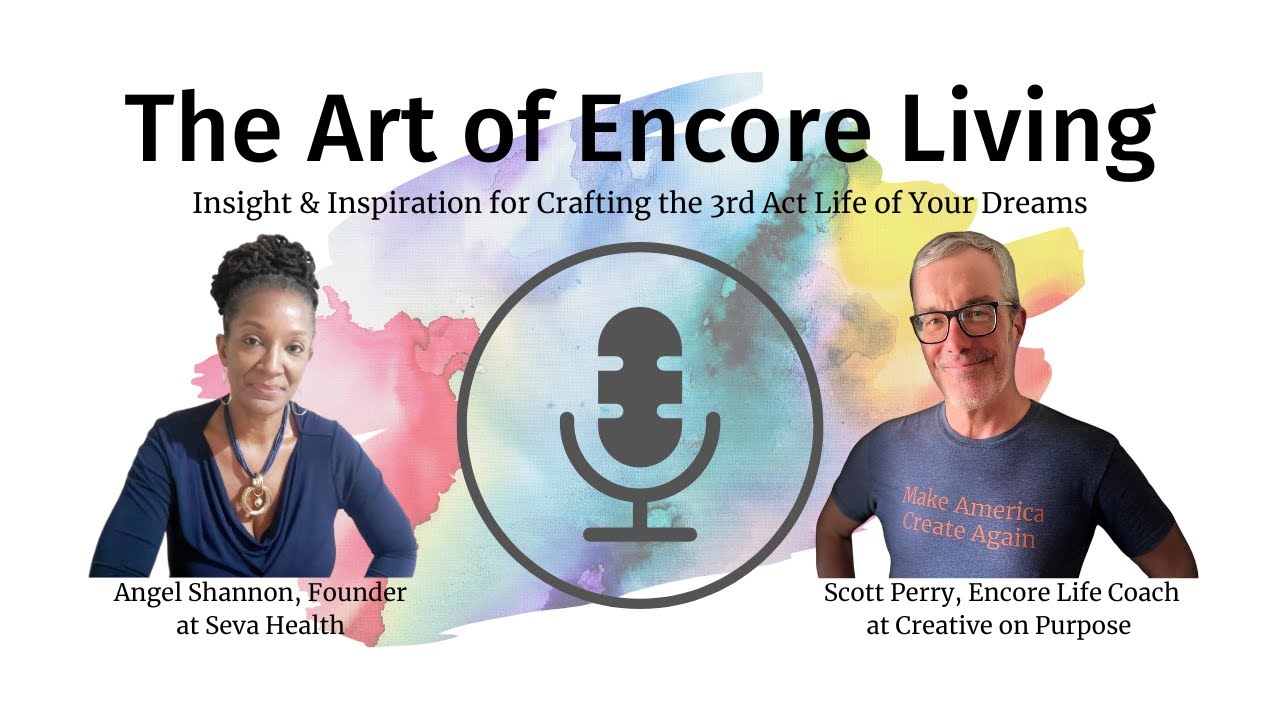
This content was created by Scott Perry. This content was uploaded by Scott Perry. This is a YouTube episode titled "The Art of Encore Living" (published June 17, 2022). It's an interview-style broadcast hosted by Scott Perry (Encore Life Coach at Creative On Purpose) with guest Angel Shannon, founder and executive director of Siva Health / the Siva Institute. The conversation covers Angel's personal origin story and career reinventions, the Siva/Seva branding and service-oriented approach, lifestyle medicine, mindfulness paired with self-compassion in action, practical habits for reducing overwhelm (the one-priority mindset, "enoughness", 5-minute practices), and coaching tools to help people close the gap between intention and action. Metadata: content_type=YOUTUBE, title="The Art of Encore Living", thumbnail provided.
Chapters
We get no— just like that, ladies and gentlemen, once again, defying all expectations, we are live. Welcome to The Art of Encore Living, insightful conversations with inspiring difference makers to help you live your legacy. I'm your host, Scott Perry, Encore Life Coach at Creative On Purpose, where we help people like you find fulfillment, forge meaning, and make a difference in your life's third act. Visit creativeonpurpose.com to grab your free copy of Master the Art of Encore Living Quick Start Guide. Let's meet today's guest, Angel Shannon. Welcome to the broadcast. Please tell our viewers who you are, what you're up to these days, and where can they go to learn more about you and the difference you're making?
Scott, thank you so much for such a wonderful invitation and introduction. I'm Angel Shannon, founder and executive director of Siva Health and the Siva Institute, where I like to say we put mindfulness and compassion in action. At Siva Health, we really, really, really do believe that good health is health is so much more than an annual physical and the weight on a scale. It's also the sense of balance, peace, purpose, and fulfillment we feel in our lives. And Scott, as you know, closing the gap between knowing and doing and living a healthy lifestyle is not easy. So at the Siva Institute, we focus on courses, community, compassion, and coaching to help adults live longer and live better with lifestyle medicine.
Love it. I'm curious, always with my guests, about how they came to be doing what they're doing. I'm guessing that you didn't wake up as a 9-year-old angel and say, you know what I really want to do when I grow up? I want to start Siva Health Institute. So give us a little bit of the backstory. What's the origin story of Siva Health?
Scott Perry, you must be looking through my window because I was literally— I'm working on a book and I was literally writing this out last night. And, you know, I'm up to draft number 5 of this, and you're absolutely right. It's so funny when we dig into our origin story, our beginning, you know, we uncover so many little pearls and things that we've long forgotten about. And so because my book really does focus on radical self-compassion and reinvention, particularly for Gen X folks, I had to think about the fact that, you know what, I really didn't think that I would be here where I am now. I started out in my 9-year-old bedroom really wanting to go into corporate law, to be absolutely honest with you. I was— I graduated high school a year early. I was on that fast track, wanted to go to law school, applied to St. John's University in New York. Got accepted, and then somewhere along the line decided it was a good idea to move out of my mom's house, move in with my boyfriend, get married a little too soon, move out of the state. All kinds of crazy stuff that you do when you're in your, you know, the, the, those first experiences in your teens and 20s. And I had a friend who said, you know, why don't you think about nursing? Because I had to get back on track, right? I knew like I've got to reinvent myself. This is not working. This marriage isn't working. Wasn't a good idea to move out of New York. So for— to make a long story short, I said, you know what, I'm going to try this out. I can do this in 2 years. I can get this done, start working, make a reasonable income. So I did that, graduated 2 years to the date, decided— sorry about that— uh, decided, you know what, I'm going to go into ICU and critical care like she was because that sounded super exciting. And then the real world of healthcare hit me like a freight train. I wasn't going to save the world. I wasn't going to be, you know, Nancy Good Nurse who goes in with her pill bottles and person's cured and they go home and they live happily ever after. The real world of healthcare hit me hard and fast in the ICU and the trauma units in Baltimore City. By that time, I was married, two young children, and it wasn't working because it wasn't true to what I wanted to do, wasn't true to what I understood as good health being the first wealth, because that's the household that I grew up in with my mom. And, you know, my mother was very integrative, very holistic. My grandparents were farmers, lived off the land, built their own house. So everything that I saw in the hospital was the exact opposite of what I knew. The sixth child of six children growing up. You know, and so I knew that there had to be a better way. I knew it wasn't the way I wanted to live. I was stressed out, burnt out, 12-hour shifts that turned into 16. Who am I helping? You know, that was my question. Who am I helping? And my second reinvention, or third reinvention, came when I decided in the middle of a blizzard, worst blizzard 2009, Mid-Atlantic. 16 inches of snow still coming down, 16-hour shift, and being told that if you don't stay, you'll be terminated. If you don't come back, you will at best be suspended, at worst you'll be terminated. And I knew it wasn't the kind of life I wanted to live. It wasn't honest, it wasn't true to who I am. I wasn't helping people, I was actually making them sicker. There's a lot to be said about, you know, conventional medicine, I'll leave that for another conversation. But for the most part, I decided there has to be a better way. And, you know, started to live on purpose, as you often talk about in Creative on Purpose.
Yeah, I love all that. And it's— there's a couple things that leap out to me. One is you've used the word reinvention several times and having gone through that. One of the things that, um, I often want— because as someone who, whose life looks like a long series of reinventions itself, um, one of the things that— an epiphany I had in the last few years is even though I have done many different things— school teacher, restaurant manager, um, radio ad salesperson, professional musician, guitar studio owner, and now life coach. Wow. You know, those all seem very disparate. But when I took a look back, and I had this epiphany when someone just like you was talking about their journey and their reinventions, and I began to see a common theme, a thread that was running through that. And I'm just wondering, You know, what's, even though you're doing something dramatically different now, it's really very much the same thing you were doing. It's just actually doing it the right way, as opposed to buying into a systemic situation that promotes more unhealth, promotes sickness more than health. So I'm just wondering if, um, you know, if that, if that resonates and if there's, if you do see that there is a thematic coherence to your entire life's journey?
Absolutely. And such a great question because, you know, I was just listening to a really good teaching by one of my wisdom teachers about the journey, you know, the journey of healing. And I really do believe that ultimately when you're doing healing work, health work, you know, there's a part of ourselves that we're also working on, right? And every journey to heal any part of ourselves holds the potential to stir up our own vulnerabilities, to really sharpen our awareness, and as you said, to really recognize that connectedness between every step along the journey. I was a really creative kid, you know, I loved drawing and painting and, you know, making mud pies, so to speak, and, you know, cooking for the dolls and all that kind of stuff, a little bit of grass and some mud pies. And, you know, and then as I got into elementary school, junior high, I was on music and band, and then French. So I've always been really, really creative. And I think that one of the things that the thread throughout all that I've done is always thinking, having sort of this design thinking mindset. How can we do this differently? How can we look upstream? How can we prototype? And make this something that actually works, right? And so whether that is through health, you know, and actual healthcare. So just, you know, something really practical is teaching people how to monitor their own blood pressures or how to get creative with, oh, I can't remember when to take my medications, or I can't remember, you know, when to exercise. Well, how about you do a couple of squats while you're brushing your teeth? Oh, I can do that. So it's always this sort of design thinking that I'm always leaning into in every part of my work. And it really spills over into my own life. So there's this duality. I'm doing that in my own life. And it makes it so much easier to do it in my work. And lately, Scott Perry, late last year, I was thinking about my theme word for the coming year. And just that word creative, creativity, creation, it just kept coming up. So I put it on my vision board, started doing these vision board parties, and just having so much fun using vision boards as a tool in my coaching work and even in my clinical practice to help people start thinking about the way that they can design their way forward to better health and well-being.
Yeah, well, the Something else that just leapt to mind is, um, you know, one of, one of the, the, the ancient, um, texts that really informs my work is the Bhagavad Gita, which is really just a story about hearing and heeding your soul's true calling. And you at one point, several times in, in talking about your origin story, talked about it didn't feel true to me. And One of the things that the Bhagavad Gita teaches around this idea of living your purpose, of heeding the call of vocation, is you can miss it by just a little bit and create a lot of suffering for yourself. And you, you know, in your first career, you came so close. You were in, pointed in the right direction. You were just 10 degrees off center. And so I think in the Bhagavad Gita, they talk about like a shadow. A shadow vocation or something along those lines. So, you know, it's again really interesting to, to see this theme of people that are just a little 10 degrees, 15 degrees off, and they just need to get— do a little course correction to be heeding and hearing their true soul's calling. Um, so I think that's really fascinating. I'm also just curious about Siva. What, what's the origin of um, the, the branding Seva Health?
Oh, so Seva is a Sanskrit term which means to serve without expectation of reward. And speaking of the Bhagavad Gita as well as yogic teachings and Ayurveda, part of my survival story— because we need something to help us survive these, these crisis moments that we're in— is yoga. I found yoga at a— at just the time that I know I needed it most as a new mom, new parent, balancing all the newness of that experience. Right. So there's householding and there's, you know, working full time and whatnot and just a lot of energy stirred up around just all that was going in, going into the hospital, going on in the hospital setting. And I reached out to a local yoga studio, just really fascinated about yoga itself. Just for the physical practice. That was all I wanted, just the asana practice. And my teacher, I'll tell you, she was just phenomenal. I mean, she really took us into theory and practice and, you know, bringing it off the mat and into the world. And Seva is one arm of yoga theory, yoga practice, which is service, right? And so when I started my practice, I really wanted to be rooted in serving a particular population that was older adults, seniors. So I started off with that and it was just all about doing house calls. I was just doing house calls for older adults, people who could not get out to the office, suffering, you know, just like my grandparents when they got older, given that good old-fashioned, just, just like that little country doctor with the little bag. And I'd go out and do house calls. And how it grew into what it is now is because for every older adult you care for, there is a sandwich generation adult who is, you know, likely stressed out and in need of some good, you know, some good primary care as well. So then I wound up with two sets of patients, my, my sandwich generation folks who really do need that good lifestyle medicine and also my seniors who, who, who who really do need good service. So that's where the name came from.
That's really brilliant. I love the branding and knowing the backstory behind that. Really, it feels really perfect.
Thank you.
One of the things that you began with is helping people close the gap. And I think this is true of a lot of people that are in the coaching consulting space. We help people get from where they are to where they want to be. One of the things I'm curious about and something that I see in my own work is Sometimes people don't see the gap yet. They just, they feel an incongruity in their life. They feel like, you know, they're not living in a consonant way with their values, their beliefs, their, you know, what they want from their lives, but they can't see what's in their way. And more often they can't see how they are complicit in getting in their own way. Of fully thriving and living into their potential. I'm just curious if you have any thoughts or processes for helping people see the gap so they can start to cross it.
Yeah. Fantastic question. I really lean into the teachings, the Integral Coaching Method, which I think is really fascinating because it really is about holding the space for the client's experience, their embodied lived experience without, as you know, without judgment or suggestion of where you need to go. I always say, I can tell, I can point to where you need to look, but I can't tell you what to see. What I really enjoy about my training is that it really is about First and foremost, for me to understand where the person is, what the person is feeling without suggestion of what the outcome needs to be, what it could be. It's totally different work from my clinical practice because you can be, from the client's perspective, you can be either in the way or on the way. So in the way or on the way. And we really look at mindset. Is the mindset in the way or is it on the way? And helping people to tap into the distinction between that mindset being in the way or on the way really is the first part of the journey. What are your thoughts? What are your core beliefs? Let's understand how your what your inner landscape looks like. And we don't do enough of that as a society, right? Outside of just coaching or healing work or anything, we're so busy. We're so busy being busy. And helping people gain the tools just to touch their lived experience, to find out what their beliefs are, what their inner narrative has been, what their inner landscape looks like is a lot of the work. And what most people don't realize is that they are living and walking the answers. They really are. It's just getting to that landscape and cultivating the tools. This is why I say mindfulness and compassion in action, because I think once you join mindfulness, with self-compassion, so many beautiful things can flourish from that. And I do think there's a big distinction between the two, mindfulness and compassion.
Yeah. Oh, I love that. So just, I want to highlight that. I think it's so powerful for anybody tuning in. Mindfulness, compassion, action. There's a lot of alignment with what we teach and our process here at The Art of Encore Living because we It is our, our minds, mindset that is often getting it, you know, causing us to get in our own way. Um, and it is, it is, it is actually very simple to change your mind. You have control over the, your thoughts and your perceptions and, or your value judgments about them, or, or your ability to, um, disassociate from your value judgments. And even though it's simple, it's not easy because we are creatures of habit. And we often, you know, will, would prefer to stay where we are even when it's not serving us. And the action part for, you know, and we talk about living from the inside out. You can't, um, you know, I'm sure the people that you work with, I'm sure that you are a person that is often generous and giving and outward-facing. So there's a lot of energy going out, but you also have to remember to take it in, fill your tank before you can give out. But that action piece at the end really strikes me because I find that action informs mindset, not the other way around. In other words, I mean, you can realize that there's a mindset issue, but you're going to change your mindset by putting in to Action.
Absolutely.
It means new relationships, new habits, and that sort of thing. So I, I really, really love that. I'd love to also, you said, um, we're busy being busy and that just, you know, really hammers home is true. And what we, what I have found for myself and for the folks that we work with that, you know, some of the things— the first step is to not give people more things to do. Look at the things that you're doing and let's put some things on your stop doing list.
Yes.
So I'm curious about, you know, how do you help people who feel overwhelmed, distracted, burnt out, anxious, all these things that we're hearing about all the time now? How do you help them see what's truly essential and help them let go of things that they really need to stop doing.
Oh, Scott Perry, you've said so much. Like, you and I could talk forever. You know, I want to just say one thing. Action informs mindset. You know, there's this— when we talk about like fitness, exercise, and people struggle and whatnot, I always say, do it when you don't feel like it, because the more you do it, the more you will feel like it. You will feel like it when you do it. Right? It's not an intellectual exercise. It's, it's, it's physical, right? Because the more you think about it, whether it be lifting weights, tai chi, yoga, Pilates, anything— it's not, it's not— there's philosophy and there's intellect involved, you know, and theory behind what we do in yoga and whatnot. But at the end of the day, it comes down to just getting on the mat, right? Or getting on the machine. And the more you do it when you don't feel like it, the more you will feel like it when you don't do it, right? You will yearn for what your body feels like. So I love that sort of somatic visceral thing that happens between mind and body when we start putting in action. Now to your bigger question about what to do, because that's what people want. Give me— tell me what to do, right? We're very do-oriented. And I have this little, this little sticky notepad thing that I came up with. Today I will not write. And then literally it just has lines. I give that out to clients. Just pick one thing you will not do today. It's really reversing. It's reversing that propensity to always have something to do. There's another thing I, I think a lot about my own path in overcoming what I call enoughism. There was a time where I just always felt like I needed to do more, give more. I'd be working harder than my patients. I'd be in the middle of the night coming up with resources and tools and they'd come to their appointments and like, did you do any of the things that we talked about? No, but I'm working harder. I had to overcome that enoughism. I also have another little sticky thing that I give to folks just— and I just give them a little marker, give sticky pad, just write enough, right? Just take that word enough, write it on your sticky pad, post it in a couple of places as a reminder that you are always enough and you are always doing enough. And I think just rewiring that mindset of doing, doing, doing is, again, just another first step. Give me one thing you absolutely have to do today. Just one thing. And that's hard work for people because they want, you know, we, we, we have the word priorities, plural. No, I want you to set one priority, just one. And doing that work, just training them week after week, day after day, their mindset toward the one thing mindset. And there's even that book, The One Thing, which I use in my work a lot to help people really drill down into what's essential, what's most important, and What aligns with your core values? Because a lot of times people are really working against their own core values. You know, they're saying one thing and believing one thing, but then doing another.
Yeah. Well, you've said a couple of things that I just want to highlight. The first is this idea of enoughness or sufficiency. And we live in a very achievement-oriented society, and success is measured by how much status and stuff you have. And Human beings, one of the, one of the characteristics of being human is you can hold opposing ideas in your head at the same time and your head won't explode. And that, you know, I think embracing this idea of you are sufficient even as you strive and that those two things are always true. And I look, you know, Parker J. Palmer talks about the hidden wholeness we all possess. We were born. Entirely whole. Everything that we ever will need was with us at the moment we exited the womb, and it's up to us, you know, how we stay connected to and what we do with that in our, in our journey from, from womb to tomb. And the other is this— you said set one priority, and it's so interesting because the word priority literally meant one.
Right.
Until very recently, like this, in the last 100 years or so, somehow it became a plural when for thousands of years or hundreds of years it was only in the singular. So I really love that. We're nearing the end of our time together. And so before we get to our very last question, people that are tuning into this broadcast are people that either aspire to, like you, hear and heed the call of their life's vocation, their soul's true purpose, or they seek to advance in something that they're already doing. For those folks that are, you know, really looking for just one piece of insight or inspiration that will help them take the next step into their potential in encore living, what would you share with them beyond the gems that you shared so far?
I lean into my self-compassion practice physically, mentally, emotionally. And I'll tell you what that looks like really quickly. Friday, the clock gets turned off, the computer gets turned off at a certain time. The office gets closed. I bring out my win journal. I write down my core wins for the week, things that I'm really super proud of. This is going to go into my win journal for the week. Because, you know, meeting people and talking about things that I'm deeply passionate about is a huge win for me. And then I make that transition. I have a ritual that brings me right over into the weekend. And that space of the weekend from, from Friday evening to Sunday evening going into Monday morning is my self-compassion time. And what that looks like is self-compassion is what do I need? What do I need? And do I need just quiet? Do I need just you know, just some, some, some, a walk in the woods or walk in the park. People have to get still long enough to hear that inner calling because it's not going to come crashing down. It's not going to be FedEx ringing the doorbell. It's going to come from in here. And you have to have a ritual. You have to have a practice that makes that sitting and waiting for that knowledge to show up apparent, right? And I think that from a universe perspective, I think that the universe honors silence, honors inner science— that's silence. So I'd say even if it's nothing but, you know, 30 minutes on the weekend, 10 minutes a day, have a regular period of stillness. And I'll tell you, it is truly a fact, it will bubble up. It will bubble up. It will become more apparent. Questions will arise, honor the questions. I love that you said you can have two opposing ideas, and your head won't explode. And that's okay. And I also just add journal, journal, journal, journal, right? Get an old notebook, go to the dollar store, get something that you can write down so that you can preserve what's coming up for you in real time.
That's really, really great advice. And I guess I have to ask you one more question because as you were talking about this idea of self-compassion, compassion from the inside out, um, taking time for yourself to recharge, to check in and see what you need, um, I am totally on board with all that. I also, um, am aware from working with hundreds of clients myself that especially for women, you know, culturally are expected to be the nurturers and the giving until they give out. Um, it's really hard to, for some people, women especially, I think, in, at least in the United States, to give themselves permission to take time for themselves, to take care of themselves. And what's, if you just have one last piece of advice for, for those folks that just have a really hard time, um, acknowledging that Yeah, you know, they have to put the oxygen mask on themselves first.
Absolutely. Yep. And thank you so much for honoring that because that is very true of our society at large, but more specifically for women. And I do have a course that I'm going to be offering in the fall specifically for this, you know, a 5-week journey of radical self-compassion to renew, refresh, and reinvent your life. I'm going to take a deep dive into that, but I'd say Start with 5 minutes, 5 minutes a day. That is literally, you know, I always call it prime real estate. 8:00 in the morning on Monday is my prime real estate. Nobody gets on my calendar at 8:00 in the morning unless it is— I mean, the house has to be on fire for you to get on my calendar because it's precious real estate time for me. I plan a lot going on. Have some prime real estate in your day. Just 5 minutes and build on that. Because whenever we say take time for yourself, what women hear is, I can't take a retreat. I can't go away for the whole week. I can't. And I know it because I've raised children and I know you can't. But I do know that you can take 5 minutes. And once you take the first 5, it will make it easier and easier to take another 5 and another 5. I'd never ask you to do 50 sit-ups if you've never done sit-ups before, but I will ask you to just do one. Just one. Start where you are with what you have, and 5 minutes out of 24 hours— because here's the flip side of that: what is it costing you to not do that? What is it costing you? And is— and Scott, you talk a lot about legacy, living on purpose— is that the legacy that you want to leave behind of not caring for yourself. Because children become what they learn at home, and they learn through what they see. And as a mom, I think one of the greatest gifts we can give our children is an understanding of what self-compassion really, really looks like. Not the same as self-care, but self-compassion. Yeah.
Well, I just want to highlight that, um, That, that I think that last point that you made is, is an essential one. What are you teaching through, through your actions? If you are teaching, um, teaching others, your children, your friends, your, your, your loved ones, um, to give until you give out, that's not a helpful lesson for them any more than it is for you. So modeling this idea of self-care, self-compassion, is a great gift to the people that you really care about. That's really, really powerful. And also just want to highlight, you've said over and over again, this idea of take the smallest step, the one-minute habit, the 5-minute habit that will get you started. Because that's, again, posture informs mindset. If you can take one step, the likelihood that you'll take another step is very, very high. Well, I want to thank everyone for tuning in. Angela and I really appreciate you lending us your valuable time and attention. We hope today's broadcast motivates you to take a bolder step into possibility, living your legacy. You can learn more about Angela and the difference that she's making down there at SivaHealthGroup.com. Got it right. And of course, it is always great to see you at Creative On Purpose as well. If you are listening somewhere where there's an ability to leave a comment, please leave a comment or a question. And if you're leaving, listening somewhere where you can leave a review, please leave a 5-star review. It really helps more of the right people connect with the insight and inspiration delivered by our guests. So with that, take the insight and inspiration that you just received from this conversation and fly higher. The difference only you can make. Angel Shannon, thank you so much for sharing your wisdom and experience and for the difference that you make.
Thank you so much, Scott Perry. Thank you for holding this space.
More from Scott



Stoics Don't Suppress Emotions, They Do This Instead #stoicism #emotionalintelligence #mindset







