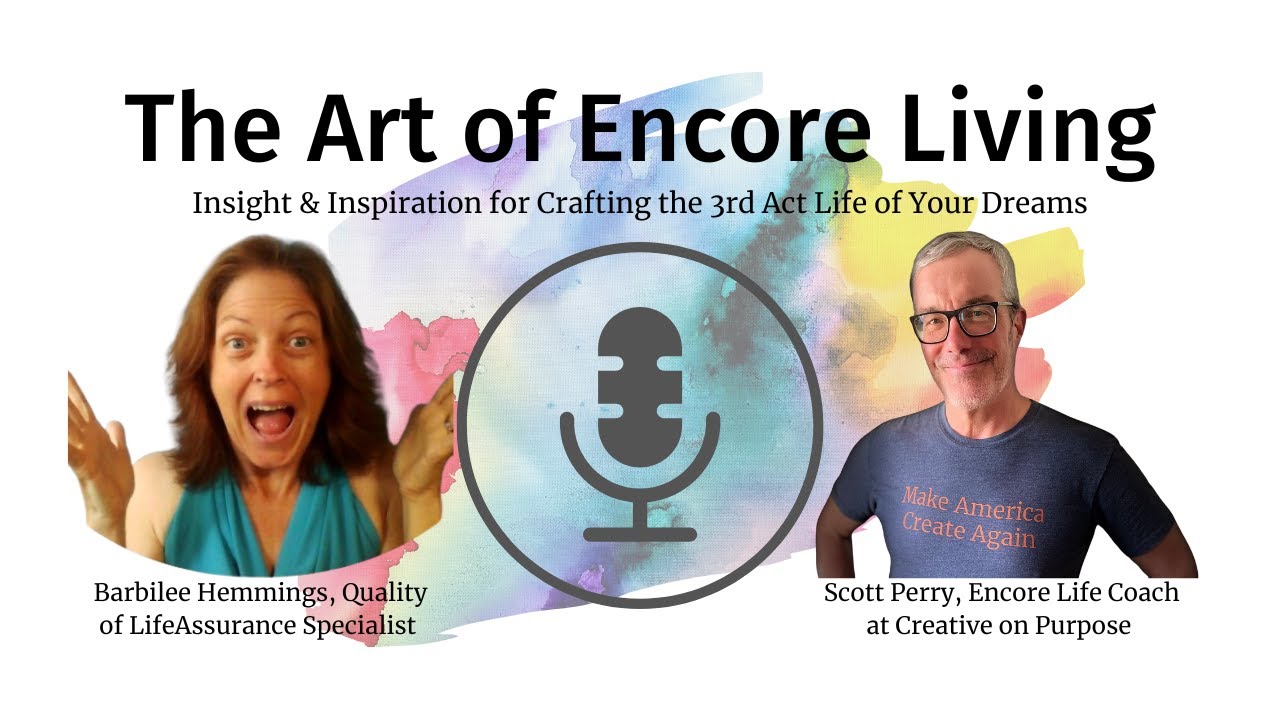
This content was created by Scott Perry. This content was uploaded by Scott Perry. This is a YouTube interview titled "The Art of Encore Living - Barbilee Hemmings" (published 2022-06-24). It is a conversational broadcast where host Scott Perry (Encore Life Coach at Creative On Purpose) interviews guest Barbara Lee Hemmings about living fully in life’s "third act." Topics include quality-of-life assurance, self-care framed as "selflessly selfish," boundaries and saying no, habit formation and discipline (tiny steps), reframing will/willpower, accepting death as motivation to live well, and practical, everyday tips (e.g., "take time to pee"). The episode references both guests' personal stories and promotes resources (barbaraleehemmings.com; creativeonpurpose.com).
Chapters
We are zipping through the ether at the speed of bytes. We have a Houston, we have a problem, but it's been solved. We are now connected to Facebook, LinkedIn, and YouTube. Welcome everyone to The Art of Encore Living, insightful conversations with inspiring difference makers to help you live your legacy. I'm your host, Scott Perry, Encore Life Coach at Creative On Purpose, where we help people like you find fulfillment, forge meaning, and make an impact in your life's Third Act. Visit creativeonpurpose.com to grab a free copy of The Art of Encore Living Quick Start Guide. Let's meet today's guest, Barbara Lee Hemmings. Welcome to the broadcast. Please tell our viewers who you are, what you're up to these days, and where can people go to learn more about you and the difference you're making.
Thanks. Thanks for having me, Scott. This is, this is really exciting, actually, because when you're saying live your encore, you know, your third act, I love all that about you. Because my tagline is fully live until you die. And I'm all about your quality of life. So at barbileehemmings.com, nice and easy, it's my name, just go there and you can click on different things. You can click on quality of life and, you know, but I'm all about this juicy and delicious life and making sure that I tell people I am selflessly selfish. I take care of me so I can better take care of you. And that's how I like to live my life. And this is what I like to do to help people find the ways to dive in so that when they, you know, lay their head on the pillow at the end of the day, they can go, "Dang, that was a good day!" And when they wake up in the morning, they go, "Ooh, goody!" That's kind of me in a nutshell.
That's fantastic. Well, you've already peeked a couple of questions, but before we get to those, I would love— you know, I'm always really interested in people's backstory or origin story, how they got into their encore career, their third act endeavor, their second half of life project. And I am guessing that when Barbara Lee was a 9-year-old, she did not say, you know what I want to be when I grow up? I want to help people live well before they die. So just give us a sense of how did you get to be doing what you're doing now?
Good. Thank you. It's a great question. I love the journey. Because I'm all about setting goals, but it's the journey that brings me to who I am, right? And got me to be who I am and what I'm doing. And, and, you know, there was a time where I finished high school, I'm like, I'm done, I'm just gonna work and travel, that's all I'm gonna do. And then my sister, whom we'll just say we're, you know, we're family, but, you know, she said to me one day, well, you're too stupid to go to university. I'm like, I'll show you. So off I went to university, I got couple of degrees and a teaching degree. And I went teaching because I knew I wanted to change lives. And at that point, that's all I knew I knew how to do, right? Go and change children's lives. That's their future. This is a beautiful thing. And about 12 years in, I got pretty sick and just mentally, physically exhausted. I'd gone through a rigor of medications and specialists, and they just kept plugging me full more and more drugs. And I was just like, that is not who I want to be. And I had a really good friend show up at my doorstep and said, shut up, let me take care of you. Let's just do this. And we did. And here I am. And that was about 16 years ago. And the interesting part of when I was sick, nobody gave a crap what I was eating, what I was thinking, what I was doing. They want to know what medication I was on to treat different symptoms. And I can say that I rarely even put an aspirin in my body right now. Because I truly want to live a juicy and delicious experience. And that's, that's how I got where I am.
Well, something that's really fascinating about that is I also exited college and started off in education. And one of the things that I love doing, you know, with people that I meet, who are really deeply engaged in this idea of living fully in their life's third act and making their biggest contribution in the second half of their life, is looking back and finding the theme, the common thread, that of the arc of their journey. Because oftentimes people say, oh, I reinvented myself after my heart attack, after I quit my, my law practice, or whatever it is. But if you look back, even all the way back to childhood, you can often find that there's this common theme or thread that runs through their lives. And so you know, someone that began her career as a teacher the way I did, you know, I see you as a teacher still. It's just you, you made a course correction so that you were teaching the right thing to the right people. And, uh, I think it's the Bhagavad Gita that talks about like how you can, you can miss your soul's, your true soul's calling by just a few degrees and it will, will cause you suffering. I'm sure you were a fantastic teacher of young children. But, you know, just seeing you talk about what you're doing now, and the way it really lights you up, I can see that you're really living your true soul's calling. I'm really interested. Another thing that you and I share in common, and why one of the reasons I asked you to be a guest is what I saw on your LinkedIn profile about living this idea of living well before you die, because one of my favorite quotes is Marcus Aurelius's quote about, think of yourself as dead, you have lived your life, now take what is left and live it properly. And I see that as a theme of your work. I'm just curious, you know, how did you arrive at this idea that, you know, death is, is not this sad thing that we need to be fearful of, but this motivator to live well while you have the opportunity? How did, how did that come to being? Was it just the experience you had as a schoolteacher?
You know, great question. Thank you. I I'm a unique cookie, I tell people all the time. When I was 11, my mom was going in for major surgery and she made up her will. She sat us down, we had a conversation about death. She was a single mom, I'm the youngest of 4, and she didn't die. And, you know, it was great. But every year on her birthday, we had what she affectionately called the Dot Party. We had to show up at her house for dinner. We talked about death, she updated her will, if she had anything new in the house that we wanted, we're supposed to put our color of dot on it. So talking about death, I grew up with it, okay? My fifth, probably fifth, sixth year of teaching, I had a young student that I organized a trip to Europe as a French teacher. So, you know, we wanna do a school trip. And one of the young girls wanted to go and her mom said no. And she said, "Mrs. Hemmings, will you talk to my mom?" I said, "Okay," and convinced mom that it was okay for her to go. I ended up not getting to go because I was pregnant, so that really kind of sucked. But my student got to go, and that was a spring break trip in April, and she was killed by a drunk driver in June. And so because of that, you know, she, she had this phenomenal experience because I'm like, you just never know what's going to happen, you know. And just little things like that have kind of sparked through my life, and you just never know. A friend of mine just recently Her husband went in for knee surgery, got a blood clot, and never came out. You know, like these things happen and it's death and it's sad. And I'm excited. I decide I'm going to live to 123. It's my party's going to be like, 1, 2, 3, go, and she went. And they're not going to know when, but sometime in my 123rd year, I'm assuming I'm going to be dancing with some man named Juan and he's going to dip me and, you know, I'm just going to not wake up, right? But for me, life is all about this living experience. I do not know if I step off the curb and a bus takes me out, or I'm on my motorcycle— yes, I drive a motorcycle, you know— and someone's going to turn into me. But I don't want to live in fear of dying because I only die once, but I get to live every freaking day. So what am I doing with it? And so when I bring that into even, even my one, the one branch of my business, my quality of life assurance, Like everybody buys insurance, you know, just in case something goes wrong. Ooh, car insurance. Who benefits? The guy who fixes your car. You have medical insurance. Who benefits? Well, the guy who fixes your heart or whatever's, you know, gone wrong. What are you doing to assure the quality of your life? You know, that's one of my, my passions, to talk to people about figuring it out.
Yeah, that's— well, I love that, and it brings to mind just the way that you're speaking about it. Um, I think in North America in general, the United States in particular, we are— we do have, um, not a love-hate relationship with death, but a hate-hate relationship with death. It's kind of culturally— we're culturally attuned to, um, try to— I'm sorry, my—
I cannot figure out how to get my No one wants to communicate with you. Maybe it's the angels.
It's always my, you know, my son always decides that it's when I'm online that he wants that. Now we must talk.
Anyway, your son wants to talk to you. That's a brilliant thing. Do not despair. Celebrate that.
But yeah, just this, you know, we, we tend to be forward-facing and thinking always in the future. And it's just-in-case kind of thinking, like you were saying. And but life is lived in the, in the here and now, in the present moment. And so I love that idea that, you know, that's when you can start to connect with and embrace the assurance, or there, that's where the invitation is, like, you can, you can live right now, you don't have to worry about what's going to happen in the future, that's actually not up to you. That's going to happen. But in this moment, you have the opportunity to embrace life fully and to live into your potential and step into possibility and all that. I also loved what you said earlier about taking care of yourself first, because at Creative On Purpose, we talk a lot about doing everything from the inside out— empathy from the inside out, compassion from the inside out, empowerment from the inside out, leadership from the inside out— because I don't think that we can fully— I think we are born to leverage our gifts to serve and enhance lives of others, but we can't do that if we're not fully— if we're not filling our tank first and taking care of ourselves first. I would love to hear just any insight you have on how you arrived at this idea and/or how do you, how do you make sure that you're practicing filling your tank before you share the excess with others.
You're going to be like my best friend because you ask the greatest questions, because these are things I love to talk about, right? So, yeah, you know, on the airplane when they drop the mask and, you know, they say put it on you first and then tend to people— when I used to travel with my kids, I'd be like, hell no, those masks are going on my kids, you know? And then when I got sick and I didn't know what was going on And I got to a place in my world where I didn't want to wake up the next day. And I looked at all the medications on my side table and I was like, geez, so if I just took them all today, does everything just go away? You know, that's where my thinking got because nobody cared about me. And I'd spent so much time, I'd been teaching for years, I've been a mom, and I spent so much time taking care of others. So when my girlfriend like literally showed up on my doorstep with some items and said, shut up and eat this, it's not going to kill you. I was like, oh, okay, somebody finally telling me like to take care of myself. So I did for 30 days, 60 days, 90 days, dropped a bunch of weight, dropped— started seeing a chiropractor, started seeing a naturopath, and started taking care of myself. And then this Barbie Lee emerged that I knew was in there, and I could give so much more. I was such a better mom, I was such a better wife. I was, you know, I went back to teaching for a little bit and decided this isn't where my gifts are best served. And, you know, dropped into my new profession now of network marketing. And, and I just moved into these places. And then I was on a plane one day and I heard the mask. I'm like, oh hell yeah, it's got— yeah, I'm getting it first because I am strong enough to take care of 8 of you when I am strong enough, and maybe 10 on a good day, you know. And that's the way I look at it now. Because when I'm coming from a depleted place of, oh, I'm trying to be the martyr— which, I'm sorry, women out there, you, we do this, we try and give from this empty bucket, and then we want— we under— we don't understand why people aren't giving to us, and we don't understand why our husbands don't understand us, or our kids take advantage of us. Well, you created that. Take care of yourself first. I call it selflessly selfish because I'm being selfless taking care of myself, knowing that if I am not good, I cannot be great for anybody else. And it's selfish because I'm taking care of me first. And sometimes, you know, you know that last piece of pizza and everyone's looking at it, I'm like, mine, dibs, I'm calling it if I really want it.
Yeah, I'll take a little piece of it.
I'm okay with that.
I really appreciate you. I totally agree. And in my experience, um, in working with clients, you know, women in our culture do tend to not just behave this way of giving until they give out, but it's almost, uh, it, it's imprinted by, maybe it's in part biology and evolution, but it's also societal and cultural. And it is, can be really challenging to help people learn this mindset shift of you're actually not fully serving the people that you love and care for if you're not fully loving and caring for yourself first. And, you know, burnout is when you are trying to give something that you no longer possess. So if you've depleted yourself fully of all of your attention, all of your focus, all of your energy, all of your love, and you're still giving, you will give out, um, and And it does play into that victim mentality that you were also referencing. The other thing I love, I love the oxygen mask analogy, and that one's really common. There's another facet of that that I'd love your insight on, and that is the metaphor of the lifeguard. So when you're a lifeguard and you're taught, when you swim out to sea to save a drowning person, you don't give them your hands, because they will grab you and drag you under with them. You actually swim out to them and give them your feet so that you have your hands free to swim back to shore. So to me, it's, it's not just, not just how you approach how you help others, but also, like, who, who you're surrounding yourself with. You can't be a resource for everyone. And I'm just curious about your thoughts about, like, you know, it sounds like you have put a lot of integrity and intention into framing your offer and framing your program and, um, and defining your audience. Uh, you know, how do you, how do you make sure that you're doing your work with and for the right people? And, um, you know, what do you do to encourage the wrong people to move along and find someone that actually can help them?
Yeah, thank you again, great question. One of the things that one of my coaches said to me, they're like, do you know the word no? I'm like, yeah, but do you know the word no? Have you had this intimate relationship with the word no? I'm like, I think so. And they said, no, no, no, if you don't think you did, you don't really know the word no. And the word no is not a negative, it's not a deterrent for anybody. It's knowing myself, the K-N-O-W, that I can say no, this isn't for me or this isn't for you. And that's the piece of being selflessly selfish, is knowing who I am, what I'm able to give to somebody else, whether I want to or not. Because I'm going to be honest, sometimes I don't want to. People reach out to me and sometimes they reach out to me like when they're in a really bad state health-wise, for example, and they'll say, "Well, what should I do?" I said, "Well, you should have called me 5 years ago, but you didn't. So now we need to know what will you do because there's no more shoulds allowed." This is the will. So it's about me knowing who I am and my boundaries about what I want, who I want to be for other people. And I prefer the word "no thank you." I'm Canadian, you know, so we're a little more polite. So we don't just say no, we say no thank you. But really defining who I am helps me define how I will help others. And I used to be a drama teacher. There's a thing that we used to teach our kids. It was an improv game. It was called Yes, And, and a lot of people know it. So it's yes, whatever somebody says, yes, da da da da da, and so yes, I would love to help you. And at this point in time, I don't have the capacity in my schedule. So let's talk about exactly what you need, and I'll hook you up with the right person because I have a good— I have a good, good reference pool to draw from. And that's a part of it too, is knowing who my support team is. And if I don't know, I can call this person because they probably know. And in this field, I call this person and they probably know. I don't mind connecting you. That, that's, that's the whole piece of— I can't be everything to everybody. I'm not even everything to me. I have to look outside of me in the sense of, um, you know, to get my groceries. I don't, you know, do my own farm forming and stuff. I, I need other people. So in all areas of my life, I need other people, and I help others understand that as well and not go looking like— oh, sorry, a little aside back on the whole woman thing. We tend to sometimes as women look to our spouse or our significant other as that person that's supposed to give us everything. I'm like, oh no, no, no, no, no, no, no. My spouse has this very specific role. I like to have all these other little pieces with him But he feels this. If I really want to have a deep spiritual conversation, I call my spiritual soul sisters. You know, if I want to talk, you know, just whatever it is, there's certain people that I have those, those connections with. So just knowing that piece as well. Did I answer your question?
Yeah. Well, yes. And there's a lot of layers there, um, that are worth highlighting. The first one is the, you know, we, we often, everyone, um, can be guilty of conflating generosity with promiscuity. And I know promiscuity is a weighted word that, but what I mean is by overgiving. And so, you know, overgiving is not generous because if you're overgiving, then you will deplete yourself and burn out and be of no use to yourself or anyone else. And sometimes the most generous thing you can do is to say no, because you are protecting your primary asset, which is yourself, your time, attention, and energy, um, and freeing yourself up to work with people that are ready for whatever help it is that you can give. The other is, um, you know, again, mostly in the United States, but North America, the Western world in general, you know, we conflate productivity with progress. So we put a ton of things on our to-do list but we never actually make any progress in our, in our enterprise, our endeavor, never really reach our goals, because we're just doing busywork instead of the real work that needs to be done. So along the lines of saying no and saying it with kindness, you know, reference, refer someone if you can. I think even if you can't, saying no with kindness at least allows you to free up your bandwidth and encourages them to find, find get the help that they need. And the— I guess the last thing is, you know, priorities, you know, and making yourself the priority. Priority— priorities is an interesting word, because the plural never existed at the beginning of this century, right? Or of the last century. It's only recently been that we can have more than one. So I just, just to clarify what's on your to-do list, but more importantly, what can you put on your stop-doing list? I think that could be a really powerful thing. You also— I just want to use— you, you mentioned, you said not what should you do, but what will you do. And just, you know, the other meaning of the word will is having the volition, the character to actually do what needs to be done. So I think that's another layer worth exploring. How do you, how do you work with people that either have the will to do what needs to be done, or how do you help them cultivate the volition to do what needs to be done?
Thank you. I love words. Okay, so I am a— I took some linguistics class in university because I'm a French major, right? That's so I parlons français, je t'aime, as a teacher, a French teacher. So words really, you know, come into play in my world. And that's why I love my quality of life assurance, you know, because it's like, whoo, are you paying attention? Anyway, so a word like will, and you use the word promiscuity, and again, it's like consequence. We tend to put negative connotations on certain words when really that's not what it is. It's just a word. So when it comes to the word will, I might catch some flack for this, but, you know, people always like, oh, you know, we have free will, and, or, I have no willpower, or they say words like that. And I was like, you know, take a look at the words. So when it comes to no willpower, for example, because I'm in the wellness industry, right? Oh, I have no willpower. No, you have no discipline, because willpower to me doesn't exist. If I want, if I really want I have a boo-boo finger and I really wanted potato chips yesterday, so I went and got potato chips. I have the willpower. If I'm sad and I want potato chips, I'm gonna go and eat potato chips, you know. To me, it's, it's a reframing of everything. It's not looking at one thing, right? So when my clients will say, what should I do? Well, it's not— it's what will you do? What are you going to do to make that change? Are you going to wake up this morning and drink a glass of water with lemon? Will you do that? Can we start there? Well, I can do that. Great, but will you? I know you can. We can do so many things, but will you? Fine, I'll go get that glass of lemon water and put it by my bed right now. Great. And when you wake up, will you roll over?
Fine.
You know, and it's, it's baby steps. And once they do it once, they go, that feels kind of good. Then we do other things. But it's always about those little tiny steps. I, I read a lot about, you know, we either change in small increments or because something really serious happens to somebody. I don't want something really serious to happen to you or anybody. So how can we fully live until we die? How can we every single day really take care of ourselves? So, you know, this is 10 o'clock my time when we started. I'm like, okay, what time is my shake? What time is my snack? I got to fit it in between, you know, because 10 to 11, I might be busy, 10:30. I'm like, okay, I'll have my snack right now. Okay, so I have to have my shake by 8:00 so I'm not too hungry, so I don't get crap. Like, it's how I do every single day. How do I take care of me and what I'm willing to do? And yesterday I was willing to eat potato chips.
Well, I really appreciate the framing of discipline. And the even bigger takeaway from what you just shared is we often when we are trying to change ourselves, we'll say, okay, I'm going to wake up and I want to lose weight, so I'm going to wake up at 6 in the morning and run for 3 miles a day. And you know, you, if you make it past 3 days, you have beat almost 99% of the population that, that says that. And the way you were framing it is, what's the smallest version of this habit that I can create?. And so, you know, putting a glass of water next to your bed takes less than 30 seconds. Rolling over in the morning to drink it takes less than 30 seconds. So you've just created a 1-minute habit that anybody can do. And if you can do that, then you can build from there and build the routines that will promote your health and happiness and wellbeing, promote the behavior that you need, to do the bigger and bigger things. And I, I also just want to highlight something else that you said that I really love, which is, yes, you know, oftentimes the second mountain, as David Brooks calls it, is ascended after a catastrophe of some sort. Sometimes people are broken and they remain broken, and sometimes they are broken and broken open. Um, and the other way that transformation happens is a series of small transitions that we would hardly even notice unless we really thought about it, that finally reached a tipping point. And then suddenly, it feels like all at once, this transformation took place. But if you look back, it was probably a series of small transitions, small daily habits, intentional relationships that got you where you, where you want to be. So lots of wisdom. In what you just shared. We are nearing the end of our time together, Beverly, and the last question is always— you've shared already several really valuable lessons and nuggets that people can take away and start to weave into the life they're already living and live with more quality assurance. If there was just one final idea, maxim, quote, exercise that would help someone take half a step, half a step into possibility with a, you know, half a shade braver, with just a little more integrity and intention? What would you share with them?
Take time to pee. No, seriously. Okay. So we have to pee about 5 times a day. Right? If you're not, there's a problem. Drink more water. Okay? But at least 5 times a day is pretty much the minimum. Take the time. Go into the bathroom. Go pee. Women, don't squat. Sit. Relax. Allow. Don't press. Just allow. Boys, don't be looking around. Do your thing. Right? Wash your hands. Play with the bubbles. Sing Twinkle Twinkle Little Star. Take a minute. As you're walking out, take 3 to 5 really good belly breaths. And move on with your day. Just take time to pee.
I love that. It helps bring in at least 5 moments of intentional awareness and mindfulness to your day. And that will make a great headline when I put it in the blog. Take time to pee.
I actually do a course called Take Time to Pee as well to help people figure it out.
That's awesome. That's awesome. Well, I want to thank everyone for tuning in. Barbara Lee and I really appreciate you lending us your valuable time and attention. We hope today's broadcast motivates you to take a bolder step into possibility, living your legacy in the difference that only you can make. You can learn more about Barbara Lee and the difference that she's making right— whoops, excuse me— right there at barbaraleehemmings.com. And of course, it is always fantastic to see you at creativeonpurpose.com as well. Now take the insight and inspiration from this conversation to fly a little bit higher in the difference Only you can make. Barbara Lee Hemmings, thank you so much for sharing your wisdom and time with us today.
Thank you.
More from Scott



Stoics Don't Suppress Emotions, They Do This Instead #stoicism #emotionalintelligence #mindset







