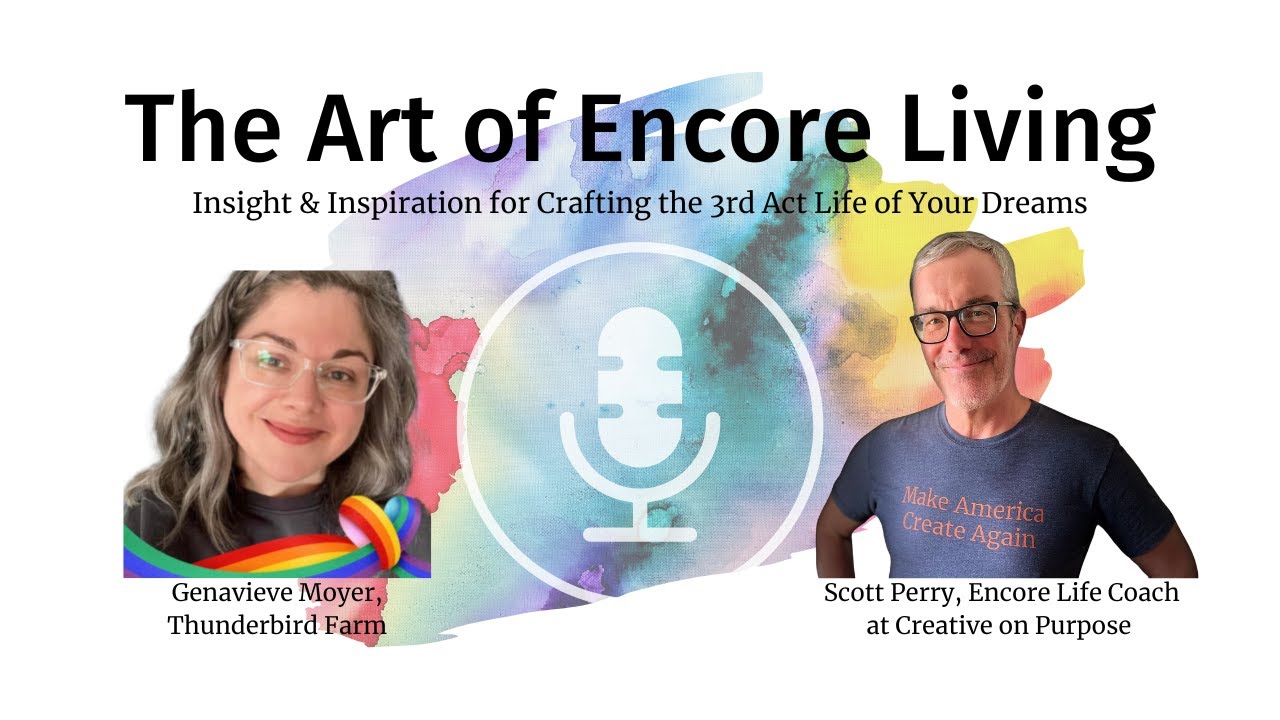
In this episode of The Art of Encore Living, host Scott Perry interviews Genevieve “Jenna” Moyer, co‑founder of Thunderbird Farm, an unconventional family farm in Pennsylvania Dutch Country that offers glamping, handcrafted art, women’s wellness, and creative retreats. Jenna explains how her family’s pre‑Depression‑era values and her husband’s mechanical background inspired them to transform a historic dairy farm into a series of heavy‑duty canvas‑tent glamping sites that cater to urban families, outdoor enthusiasts, and groups of friends seeking a hassle‑free nature experience. She details the upcoming “Camp & Create” retreat—a small, women‑focused wellness and creative‑business program designed to help female makers set boundaries, combat burnout, and reconnect with purpose through nature, hands‑on creativity, and community. Throughout the conversation, Jenna shares personal insights on overcoming burnout after leaving corporate sales, the importance of establishing routines and guardrails, and the healing power of three‑day nature immersion, citing research on brain‑wave changes. She also emphasizes the role of genealogy and ancestral awareness in shaping her creative purpose, urging listeners to explore their own family histories to gain confidence and clarity. The interview weaves themes of legacy, purposeful living, and the restorative synergy of creativity and the natural world, concluding with Jenna’s advice to “know thyself” by doing both present‑day work and past‑work.
Chapters
time, and we're going to try to mitigate that. No, Facebook. Oh, Facebook, finally. Thank you, Mark Zuckerberg, for letting us in. Welcome to The Art of Encore Living, presented by Creative On Purpose. The show is for encorepreneurs, people in midlife building a part-time online lifestyle business that helps you make a difference while you make a living. I'm Scott Perry, Encore Life Coach, helping people in midlife to find the difference only they can make and turning it into a fulfilling part-time coaching business that funds their retirement. Visit creativeonpurpose.com and get started with the free Art of Encore Living Quick Start Guide. Don't die with the difference only you can make. Still in time. It's time to live your legacy. Let's meet today's guest, Jenna Moore. Welcome to the broadcast. Please tell our viewers who you are, what you're up to these days, where can they go to learn more about you and the difference you're making, and, uh, and and then let's chat.
Awesome. Well, thank you first, Scott, for having me on the show today. Uh, my name is Genevieve Moyer, but everyone calls me Jenna. Uh, and my husband DJ and I, we are the co-founders of an unconventional family farm here in Pennsylvania Dutch Country called the Thunderbird Farm. And instead of crops or livestock, we are striving to define what it means to redefine what the family farm is through our glamping experiences, handcrafted art, women's wellness, as well as creative retreats designed specifically for those who are seeking time to slow down, time to take care of themselves, soak in some healing and creative vibes from nature, as well as connecting with maybe their own history and their community to know a deeper purpose for their own lives. So they can find us on, uh, thethunderbirdfarm.com is our main website, has all the different links to all the other things that we offer. I I do provide a YouTube channel that's specifically for handcrafted makers where I share my background in creative business marketing. I'm a sew artist, which is, I guess, a new term. My husband's like, sewist is not a term. Yes, it is, honey. It's because I'm a sew artist. I'm also a community herbal entrepreneur as well. I've been studying herbalism for the past year to really link with our farm and share kind of the native plants in the area and just how nature can really provide those healing and inspirational and creative qualities just by knowing what is in your own backyard. And my husband DJ is an electro auto mechanic tech, uh, and so as you can believe, we, we had to think a little creatively out of the box since we're not farmers. How do we create this legacy, uh, here on our farm?
I love it. So no cheese wheels to be found at Thunderbird?
No, no, unless it's bought at the local supermarket or one of our, one of our surrounding farms. We try to really support our other local farms. But, but yeah, no, we're not farmers by any means. Uh, my husband maybe at one time in his childhood, uh, watching his grandfather farm, had thought about that. But, um, yeah, no, it's not, not in the cards for us. We have to think a little bit creatively.
Well, as, as someone who, um, who, who with his wife raised two boys on a farm in, in Southwest Virginia and you can, you can be an unconventional farmer and still have lots of plants growing around you. So yes, I'm really excited to dive in to learn more about, you know, what you're up to over there at Thunderbird Farm. But I'm always really curious to start, just, I'm— I doubt that little 9-year-old Jenna sat in her room with her stuffed animal collection and spoke to her dollies about how she was going to grow up and start an unconventional farm with Yeah, um, the love of her life. So just give us a little sense of the origin story. How did you come to be doing the thing that you're doing right now with your husband?
Well, definitely marriage is one of those things, um, and grandparents as well. Um, so DJ's grandfather, who was the original proprietor of this farm, he was a dairy farmer, um, and we've lived here on this farm for the most of our 20 years of marriage. We had left for a little bit and bought another property and then, and then came back here, um, just because we both felt very connected to the farm. Um, when his grandfather had passed in 2017, um, we connected with a startup company called Tenter, uh, which is very similar to Airbnb but it's for glamping and camping. Um, and we built our first site in 2018, our second site in 2020 because everybody was seeking retreat, um, from the cities and the surrounding areas. Um, we're fairly decently close to access points for kind of like New Jersey, New York, Philly, all of those areas. And now we're in the process for our third site. Hopefully by next summer we'll be opening that. And, you know, every site we set up with a full, you know, everything but what you're going to eat for your time there. But where our grandparents come in there is really we were both raised by pre-Depression era grandparents. We're only children. And so kind of our core values of living growing up, I might not have imagined. I wanted to be Bob Ross. My 4th grade yearbook has a picture of me painting with a camera. I'm definitely the happy little cloud. And I would say my husband's more like Spock. He's the logical, very, you know, so we work well together. But if when we're on our own paths, it's very different yin and yang. But we have kind of those core values of what I would say the pre-Depression era young people had that, because they, my grandparents were in their 20s during the Depression, very much about like, how can we have a purpose-driven life that leaves a legacy for future generations? But also, how are we living on purpose that matters right now? Because it's kind of a necessity that what we're doing also is is creating some type of purpose within our community and, and, um, people right now.
So I love that. Well, and it speaks really— it really resonates with the way that we talk about legacy at Creative On Purpose and The Art of Encore Living. It's, it's what you're doing now that is what you'll be remembered for, not so much money and the monuments that you leave behind. And so I— and I love, um, the reference to Depression-era grandparents. My wife and I's grandparents were adults, um, during the Great Depression. And, and, you know, having spent a lot of time with them, you really get a different sense of— really, we live in a world of such abundance and opulence now, right? You possess enough money to watch this on a device. You have, you know, so much more than anyone in the 1920s or '30s would have ever dreamed of having.
The stories that I would listen to on a Sunday after church at 15 that I thought, gosh, this is so boring. Why am I here? Right? At 15, you're like, I don't want to even— like, I don't understand these people now. And I would say it hit me more even in my younger, younger age, you know, my 20s, when we were first like kind of starting our family. The things that I learned just by association of sitting around people who had experienced just very transformative things at such a young part of their life, and hard work for a purpose at a young time in their lives. It just leaves an impression that that's one of the core things that kind of holds my marriage together, even, because my husband and I understand that. And so, yeah, definitely, I think those core values of we want other people to feel that when they come to our farm or when they purchase something from what we have to offer or I share, you know, any type of knowledge that I've gained over the years in fashion and marketing and startup support for businesses. Like, we really just want people to see that there is a purpose to what you're doing right now, and sometimes it just requires you to take a little bit of time, stop, breathe in, self-reflect. And nature is such a perfect I guess prescription for that. Yeah. And so we really found ourselves— I was, I was in corporate America in sales and marketing. Um, like I said, my husband's a mechanic by trade, so we definitely were not like, you know, tree-hugging hippies. And there's nothing wrong with that either. Um, but we just both love this land so much and what There's just a feeling here that we can't quite describe, and we really believe that it's— now that we know more of the history of the land, we realize like there's— there was something planted in the land that is connected into the roots of who we are. And we find our campers who come here, people who purchase our products, those are some of the things that they share with us afterwards, that they— like this feeling that they feel like this just reconnected me to more of myself or help create a connection within a friendship or a relationship that, that they felt maybe wasn't being cultivated like it, like it was after they were here.
So, yeah, well, you've, you've brought up, you know, purpose several times. And what I'm hearing is, again, really resonates with the way that we approach it at Creative On Purpose, which is Purpose is less of a destination that's out there for you to find or something that's inside excavate, but it's what you, it's the, it's, it's the intention that you bring to the thing that you're doing right now, to the conversation, the activity that's right in front of you. Um, and that purpose begets more, you know, if you, the more purpose you bring to whatever you're doing at any moment, the more purposeful you'll be in everything that you do. And you also I just have to ask because, uh, I am like— my wife and I both have had traumatic experiences with camping as kids, and neither one of us have ever had much interest. So our boys have, you know, we got on our farm, we had a little cabin that was built, um, away from the house by a pond, and we would camp by going to the—
to the—
yeah, yeah, this other structure. Um, and sometimes we would sleep on the deck in our sleeping bags to look at the stars, but Yeah, um, there's also this other word that you brought up called— that I've heard before, but I don't really understand what it is. So glamping, what is glamping?
So there are multifaceted layers of glamping, Scott, and we would be, we would be the probably next step up from a camping trip that you would take your own tent and take all of your own supplies right? And you would go out, find a campsite somewhere, and set up your campsite, right? What happens with— for our guests is they can come with just a cooler full of food, and we have heavy-duty canvas tents. It's not your, your typical, like, touch the sides and the rain comes falling in, right? It's a heavy-duty tent that has a bed with you know, extra supplies and toiletries and all sorts of things. Free firewood. My husband chopped so much firewood over the summer. Um, now the 16-year-old is also taking on that, that job. Um, just everything that you would basically need to have a camping experience without the hassle of setting it up yourself. Um, and we find it for the most part, our guests are either one, people who do not have the space to have all that gear. They're outdoor enthusiasts, but they just don't have all that gear. Um, first-time families, like you're saying, like bad camp experiences as, as kids themselves, and they're like, oh, I want to take our kids out in nature and have an experience, um, but I don't want to invest all that money until we know. And then also just, um, I find a lot of women a lot of women who meet up with a girlfriend from college, um, you know, like kind of reunion-esque type of people. Guys who, who meet up with their friends from college, um, and so, so yeah, we get a lot of people who— it's kind of like this retreat without the hassle, uh, there's, there's all different layers of glamping. I mean, we don't have running water, we don't have septic systems. There's a toilet, but it's a— I call it a space toilet. Everybody— it's so funny because my— our daughter, as you know, wants to become an astronaut, and the question that is always asked of astronauts is, how do you go to the bathroom? Um, and so we always get asked like, what's the bathroom situation? I promise it's not anything that, um, to scare you away from it. And, and then we have well water that we provide in coolers but most people bring bottled water and, um, yeah, everything you need except for your food.
Yeah, that's really amazing. Well, and I know that you also, um, you have a retreat coming up. Do you want to share a little bit about—
we do. We're finally— yeah, we're finally at this place. This has kind of been the dream. I mean, like I said, we're not farmers, so to preserve 96 acres, um, in today's corporate farming world um, we, we definitely knew to preserve this farm both for our family and also environmentally, like, is really important to us as well. Um, we really needed to be creative, so we've been dreaming of getting to the point where we could offer a retreat. Uh, and so next June, June 2023, we'll, we'll be having our first Camp and Create. Um, it's a women's wellness as well as creative business retreat, um, and it's specifically focused on the female creative entrepreneur or the small business maker, um, because that's primarily, um, definitely where my background, um, kind of shines in the fact that I've worked in, um, impact business. Um, so social impact is a big buzzword, but it's basically making your business have a purpose, like, so your profits have a purpose. Um, and, and also in the creative realm, um, and, and in events. So I'm very excited to host it because I feel like there's so many women that are, um, I'm not a one, one-woman show. I obviously, my husband is chopping wood, my kids are helping, but for a lot of women creatives, um, they are the one-woman show with a couple little helpers, right? And, um, it becomes very difficult as a creative to balance the two areas, the business piece and the, and the creative piece without taking time to seek yourself. Um, and because my background is in business, like, that's my education background, and I wanted to be Bob Ross. I, I really think that the artist part of me is in my blood. Both my dad owns an art gallery, my mom was a potter. Um, so like, it— the creativity part is just naturally there for me. It really has helped me to help a lot of women, um, in my past career lives, um, to, to figure out how can I make these boundaries for myself and take care of myself so that I can build this business with purpose. That is my— and have my creative spark still be a part of that too. Um, so that's who we're focusing on. It's, it's very small, um, and limited. We'll probably have at max 12 people stay on site because again we have 3 sites Um, we do have a hotel close by, so we'll probably open another 12 tickets for someone who does not want to do the, the glamping experience with it. Um, but, but yeah, we're gonna, we're gonna try a small retreat, but it's really been a dream for both DJ and I to be able to think of how can we invite more people here, because we really find this— so many people feel, um, so different after they stay here. The experience that they have, but then also use the other skills and talents that we both have. Yeah, with people.
I really love the way that you're bringing this, you know, these ideas around creativity into a setting that's, you know, very natural and set in nature. It just sounds like a really profound experience. I also, I'm just intrigued a little bit to just pull the thread of what you're speaking to in terms of focusing on what women who are makers— because one of the things that those of us that are coaches that serve that demographic, it is whether it's cultural or something else, women often do have difficulty, it seems, or at least women of certain generations have difficulty investing in themselves. They're always putting, you know, their spouses or their kids or their partner, uh, first. And so I'm just curious how, in terms of your marketing and your outreach, um, you know, how are you, how are you framing this so that, um, women— you kind of alluded to this, you know, you're helping women recharge their batteries so that they can actually be of even more service to the people, right? Love and care for, right?
I mean, I think, I mean, this is kind of a buzzword, but it's a real thing right now is burnout. And I think, and if you're a female entrepreneur or a creative entrepreneur in general, whether you're male or female, however you identify, you're seeing all over the place burnout. And I think some of that has a post-pandemic piece of the puzzle, but I also think for for women entrepreneurs, um, because this online creative market, um, of women being able to work from home and create kind— there's just so much more access to it. And I know just from when I left my corporate job in 2015, um, it took me a good year and a half to, to create the boundaries, to learn how could I structure my day, um, so that I was not working 24/7. Um, and, and I went through a period of burnout as well, of— and, and then I had to realize, okay, wait a second, I'm no longer getting up at 6 AM and going to a job and coming home at 4:30. My job is now all around me all the time. And when you're passionate about something and you're also creative about something, it's so much easier to blur the lines of what is my passion and what is my work. Um, and you know, so for me as a sewist, I need to have time where I'm sewing just for me or spending time just kind of, you know, jiving with whatever my creative thoughts are and not having that connected to anything yet about the business for me to fuel my tank to be able to keep going with what we've planned and strategized about and, and so forth. And I, I really find nature in many ways has this really healing effect. I know it does for— doesn't matter what sex you are, um, but for women, I've done— I've hosted women's circles this summer, um, specifically for women's wellness. And what I see with women when we're out in nature is that connection to say Mother Earth, whatever you want to call it, but kind of this almost, um, it is a like a motherly care of themselves, right? Like, um, which we don't— for as women, if especially if you're a caregiver of some sort, we don't take a lot of time to think about caring for ourselves. Um, we're caring for everyone else, uh, and What I found after those women's circles were those women who, who maybe were not creatives, maybe they were a teacher, you know, a high school teacher, would reach out to me and say, I just felt so much more able to go back and do my job the next day, or to plan out whatever I needed to plan out, or to go and face this situation that I had to face. Um, and, and I really believe for creative entrepreneurs, whether you're a writer whatever. Um, studies have shown— this is science, and I'm— again, I wanted to be Bob Ross, so I'm no scientist, but I have read— there's a great book called The Three Day Effect, um, and it's basically how does 3 days in nature heal parts of your brain, um, from whatever traumatic events are going on. And by 3 days, those brain waves have changed. Um, and so they've used it on, on soldiers, women who've been through horrible traumatic domestic violence situations, and artists who are at a block. And so, I mean, we read all the stories of authors who went off on retreats to, you know, write their amazing, you know, books. So I really believe that having some time to do other things with your hands, with your, with your thoughts. Um, and the end result will be after those 3 to 4 days that we have people here, I really think you'll see people be able to go back to their everyday rejuvenated and regrouped. Um, but also creating the next amazing purposeful thing that's gonna, you know, light other people up. So that gets me excited about it.
Yeah, well, I did a lot of workshops also around burnout during the height of the pandemic. And, you know, one of the things that was revealed is that, you know, burnout is not really a disease. It's a symptom of you're either doing the wrong thing or you're doing the thing wrong. And the antidote is just, just as you articulated, it's You know, we all have the work that we have to do, but we also have to leave time for the work that we get to do. And it's, it's the boundaries and guardrails that we put around our time and our attention and our energy that allow us to show up fully for, in all of our roles. But the other thing that you shared that I just think is so powerful is, you know, the, we are all connected, um, including connected to the natural world. And our modern lives really, um, divorce us from spending a lot of time. And it's, it's so— we forget how restorative it is to just simply spend time outside. Uh, you know, it could be— you and I have joked in the past about my cemetery run, which occurs in a very natural setting, but, um, You know, that's, that's a very intentional part of my day because if I don't spend that hour outside, right, you know, my wife will be the first to tell you I'm not a very pleasant person to be around for the rest of the day. So it's so powerful what you're— I think through the retreat and through your work in general, yeah, the blending of the creative and the, and the natural is, is, is really, really important.
And that will be definitely one of the workshops that, um, we're going to have is going to be the how do we build the boundaries and routines, um, as a creative entrepreneur. How do you build those boundaries and routines to have the restorative peace? Because I think, um, like, I, I'm graced with teenagers and one in college, as you have older children as well, um, and the beauty of looking back to when you had little tiny ones who were always taking your attention. I see a lot of young women creatives kind of get deflated in, in what they are doing because they feel like that season is never going to change where they have like space or capacity. And I think the beauty of what I learned with boundaries and routines was that those will evolve and transition with those seasons. It's just a— it's the time you take to just stop and say, where are my pockets of time? Where are— where is the space that I have that's away, um, from the hustle and bustle of, of that work, um, so that when I have the space for the other work, it— I, I can feel ready to sit down and do it and not like, man, I'm so drained just from, from the day. Um, so, so that's really To me, that's a lot of where my heart is, is really empowering and encouraging other women to see that their skills and talents are the things they've purposely been given to share with others, um, and not to— and that, that will give them that energy, that'll give them that, um, that push. So yeah, I'm, I'm really looking forward to it. It's, it's kind of, you know, in business you work so hard at things and you feel like time is standing still And then when you get to kind of like, oh wow, we've been doing this now since 2017 basically, um, and everything that you've done up to this point has led you to where you're at.
Yeah. Well, you've referenced Bob Ross a few times, and you know, one of the things that, that one of the many lessons that he teaches us is that, um, the creative process is messy and it's supposed to be fun. You know, there's an element of play that we have to bring into— because if we take ourselves and our work too seriously, it's just a recipe for—
yes, yes, there's no wrong stroke of the brush.
That's right, that's right. And always put in a fluffy, fluffy cup.
Yeah, happy little trees and fluffy little clouds. And that's where, like, my husband, he says all the time, I'm the cinder— he says he's the cinder block to my fluffy little cloud, because my fluffy little cloud will continue to drift.
Yeah, yeah, I get it. Well, Jenna, our half hour is about up, but we always end with a final question. You've already shared a bunch of wisdom and insight that will help people who, like you, would like to step a little bit more boldly into creative endeavor and into the difference only they can make. If there was just one final tip, piece of advice, maxim, quote, exercise idea that you have to share with folks that would like to, like you, craft a life around their purpose, around their passion, and do work that matters with the 4 people they care about? What would you share with them?
Oh, wow. That's a— that's a— I think that's a very deep— for me, for me, a lot of me realizing what my creative purpose was and how I could create purpose, help create purpose for other people. It required me to do some, I would say, genealogy and history of my own family, of the women in my family. I think, you know, in today's— especially as I was growing up, you know, everybody's like, go to college, get a degree. And I think education is actually one of my primary things I advocate for. I think education is wonderful, but I think some of the education you can do yourself on who Who were the people who came before you that have created who you are? I have indigenous heritage, and I know one of the pieces for me of getting to this point of feeling very confident in what I'm meant to give to the world is because I understand that history. I understand the trauma that happened to my ancestors. I also understand the very strong bold, brave, creative women that are part of my lineage. And, um, I feel— this is kind of wooey— but I feel like those people, those women, are with me in the things that I'm doing, as they will be with anyone that I touch. So with what I know and what I share, so I would say learn a little bit of your history, know your past, and not just your own, but those people who have really created who you are.
I love that. We've been talking a lot in our community about, you know, we're always, especially in the United States, we're in Western world in general, always looking into our becoming, and we don't spend enough time in our being. But a lot of times, um, you know, we can only become what we're going to become in the here and now and the being, but it's often the past, it's what we've been that will inform that. There's, you know, just to clarify the woo factor, which I'm all in on the woo, but there's actually a lot of science now that says that we are who we are and our disposition, character, attitudes is very much informed by things that have happened in the past that we may or may not even be aware about. So I love your— Thanks.
So much understanding of yourself. And forgiveness of yourself. I think there's so many things that I— that as I learned, as I did that exploration into my heritage, that were not just about, um, other people. It was about forgiving some of the things I had on me, you know, that inner critic part of myself, um, that I was able to release in that. So I highly recommend do, do the you work, do the being work, but also do the past work. Like, look into your past and and you'll recognize yourself in so many people that came before you.
So, yeah, well, I think there's a reason why on the Oracle of Delphi, the opening line is know thyself. So good advice. We want to thank everyone for tuning in. Jenna and I really appreciate you lending us some of your valuable time and attention, and we hope today's broadcast motivates you to take a bolder step into possibility, living your legacy. You can learn more about Jenna and the difference she's making right down there at thethunderbirdfarm.com. And of course, it's always great to see you at creativeonpurpose.com as well, if I can click the right link. And if you're watching where there's a place to leave a comment or a question or a lesson or a takeaway from this broadcast, please do that in a comment. And if you're listening to this as a podcast, please consider leaving a 5-star review. It really helps more of the right people connect with the content that we're sharing here. Now take the insight and the inspiration from this broadcast and fly higher in the difference only you can make— Jenna! Thank you so much for sharing your experience and wisdom with us today.
Thank you, Scot Perry. This was great.
More from Scott



Stoics Don't Suppress Emotions, They Do This Instead #stoicism #emotionalintelligence #mindset







