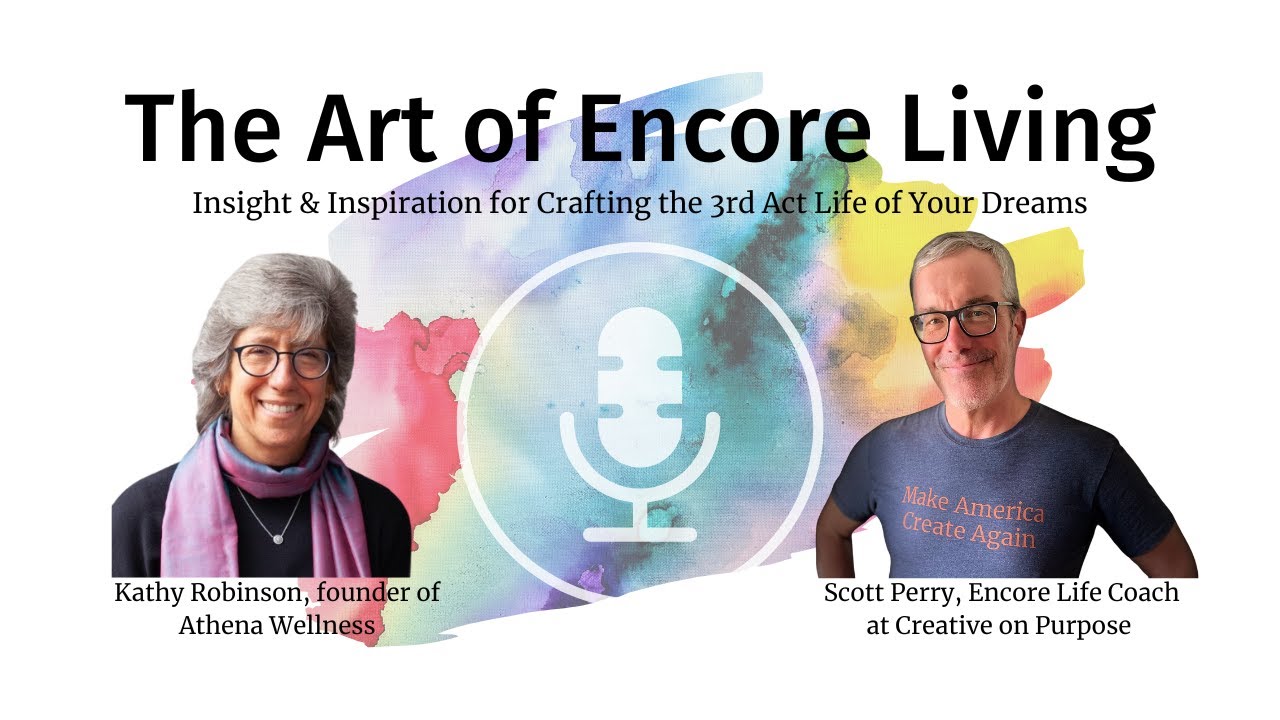
In this episode of The Art of Encore Living, host Scott Perry interviews Kathy Robinson, founder of Athena Wellness, about her journey from a high‑level corporate executive to a wellness entrepreneur focused on midlife professionals. Kathy explains the inspiration behind the Athena brand, emphasizing the Greek goddess’s qualities of strength and wisdom as a mirror for clients. She outlines her five core wellness principles—self‑compassion, intention, consistency, growth mindset, and accountability—framed within a holistic mind‑body‑spirit approach. The conversation delves into her "Type A to Type B (B‑E)" framework, which guides clients to consciously descend the corporate ladder, create liminal space, and shift identity from a productivity‑driven self to a heart‑centered one. Kathy shares her origin story, describing the internal prompting she felt around age 50, her experimentation with ultra‑endurance sports, plant‑based nutrition, meditation, and ultimately discovering wellness coaching as a new vocation. She highlights practical habits such as starting with five minutes of daily reflection to hear inner whispers, and discusses how fear, failure, and the dissolution of old identity are integral to the transformation. The interview closes with two favorite quotes—"The life you live is the lesson you teach" and Antonio Machado’s "Traveler, there is no path; the path is made by walking"—offering listeners a concise, actionable mantra for embracing possibility. Throughout, resources like athenawellness.com and creativeonpurpose.com are mentioned for further learning.
Chapters
Welcome to The Art of Encore Living presented by Creative On Purpose. This is a show for encorepreneurs, people in midlife building a part-time lifetime online business that makes a difference while you make a living. I'm Scott Perry, Encore Life Coach, helping people in midlife define the difference only they can make and turning it into a fulfilling part-time coaching business that funds their retirement. Visit creativeonpurpose.com to get started with our free resources. Don't die with the difference only you can make still inside. It's time to live your legacy. Let's meet today's guest, Kathy Robinson. Despite all of our difficulty trying to get this thing going, here we are. Tell our viewers who you are, what you're up to these days, and where can they go to learn more about you and the difference you're making?
Well, first, thank you so much for having me today, Scott. I really appreciate it. I'm a former executive who left corporate life at the height of my career to become a wellness entrepreneur. And so now I'm the founder of Athena Wellness, which is a company that helps professionals stay well as they ascend the corporate ladder. And then when they're ready, helps them mindfully descend the corporate ladder and invite what's next. I spend my days helping successful professionals design and create holistic life plans for themselves through online courses and coaching. I also host the Athena Wellness Podcast, which is focused on living wholeheartedly. And I'm the author of a book, The Athena Principles: Simple Wellness Practices for overworked professionals. And people can find me at athenawellness.com. There, there's a bunch of free resources and downloads. You can sign up for the newsletter as well as take a look at the current offering, which is a class that I'm facilitating virtually in September, and it's called From Type A to Type B— B-E— How to Mindfully Descend the Corporate Ladder and Invite What's Next.
Fantastic. Well, there's a couple of things that I love about your brand. The first is just that Athena is in the branding. And as a longtime student of Stoic philosophy and lover of Hellenistic history, I'm just curious, give us a little context for why Athena Wellness as part of the brand.
Yeah. You know, when I was creating the company, I realized that there is little I can tell someone to improve their life. What I can do is act as a mirror. And try to help them see two of Athena's strengths. One was strength and the other was wisdom. So how can I bring that out in my clients? And that's kind of where the name came from.
That's fantastic. Well, I just want to highlight, you said something really important, and this is for all the coaches out there, and a lot, there's a lot of them that will be tuning into this broadcast. When you are selling coaching, the, the— we always concentrate on that transformation, that, that end result. The thing that most people want to know is that they have all the answers within them. Your job is to just help them bring out, uh, what, what they need, help them fulfill their potential and possibility. And I love the way that you articulated that and the way that you go about doing what you do. I'm also just curious, you know, I got the sense that when you were talking about helping people in corporate maintain their health and wellness on the way up and out of the business. I get the sense that you're not just talking about their physical health or medicinal health. What's— are there other components woven into that as well?
Yeah, absolutely. And it is a holistic approach. It's mind, body, and spirit. And what I found when I was leaving corporate is that while a lot of people will talk about their physical health, And now it's more common to hear about mental and emotional health, which wasn't the case when I started in corporate way back when. You were hearing a little bit more about the spiritual side and it not being so woo-woo anymore, more of a balancing act. And so it really is a mind, body, spirit approach. To your point in not telling people the answers, the book has a principled approach so people can bring their own life experience to it. And the course has more of a framework that people can walk through. Again, meeting them where they are. So for those folks that are trying to stay well in, in corporate, the principles very succinctly are: the first one is self-compassion, and I put it first because it's the one that I came to last. That's a hard one for Type A's like me to get a hold of. The second is intention. The third is consistency, which is really the secret sauce there. The fourth is growth mindset. And the fifth is accountability, how we show up for ourselves. And so very briefly, those are kind of the principles that we work through and we work through with practices to help us not only take small positive steps, but to kind of reinforce that for whatever the issue is that people are working through.
Well, I love— I'd love to actually unpack each of those five a little bit more because they resonate really strongly with the work that we do here at Creative On Purpose and the art of Encore Living. Um, and it speaks to the, the other really intriguing part, um, that you, you, you shared about your brand, which is you take people from Type A personality, Type A thinking, or, or being, to Type B, B-E, as in to be or not to be, uh, living. And I, I— so important. And so, uh, you know, really the solution to a lot of our woes is to be in the here and now and not be attached to the negative stories that we tell ourselves about our past or the expectations we have for the future. And your first, you said, was self-compassion. That seems, seems really important. One of the things that we say at The Art of Encore Living is you can't be fully showing up and understanding someone else's situation and being prepared to do something to help them if you can't practice that same thing on yourself. And my guess is that this self-compassion piece is first in your set of principles for a reason. Do you find that your clients in the corporate world are not always telling themselves the healthiest and happiest stories about themselves to themselves?
Yeah, and I was my first client, right? I mean, this is all— I call it me search, right? That's what brought me to write the book. And so, yeah, that's not our greatest strength. And the way The way I define self-compassion is it's the care for your own well-being in the form of self-acceptance and nurturing support, whatever that means for the person, again, where they are. And where this comes into play, when we're looking to make a change, especially a big behavioral change, where you are today in relation to where you want to go, there's a gap there. There's always going to be a gap there. That's growth. And so how you navigate that, if you can do it with some self-compassion, it makes for a much easier journey.
Yeah, absolutely. Well, you know, Choose Your Story, Choose Your Future. You're in charge of the narrative inside your head, for better or for worse. And so I love that, that call to action to help them, help clients tell stories that will fuel their happiness and greater wellbeing. And then you mentioned, I think the second one was intention. Do I have that right?
Exactly. And that's when we start to get into the heart-based. And so, I work a lot more with people who have left corporate, like this journey from head to heart. It's hard to embrace that when you're on that treadmill, although it's helpful to start. And this is like a little small step toward that. So, I view intention as this heart-based why. What's the urge behind this need to transform? That's what gets you out of bed in the morning at 5:00 AM if you're trying to get to the gym and you don't want to, having to have to go only takes you so far. If there's an emotional why behind that, that's kind of what pulls you forward. And so it's, and it also helps Type A's get from goals to more of this sense of why do I want to do this for myself? What good is this going to do in my life?
Yeah. Well, I love that because it speaks to the idea. I think it rhymes with The idea of calling, which is what, how we kind of talk about what happens in midlife or as we're exiting our role in making a living, however that's done, into our life's third act. It's an opportunity for us to listen to your heart or listen to your soul's calling or to think about like, what am I going to do with the rest of my life? I really love that. If I remember correctly, the next one was consistency.
That's very good. Yeah. And this is about how you choose to show up for yourself and stay committed and engaged throughout the process, especially during challenging times. Right. That tells us a lot when you don't want to do something for whatever the reason. Sometimes it's not because you are, you know, running out of desire or fuel. It's because this is a growth spurt. You know, this is an edge that you're coming up on and having that mindset to be able to push beyond that. Sometimes it's just showing up and doing the best you can that day.
Wow, I love that. So it sounds like you're helping people establish routines and relationships, habits that will help them lean into the edges of their understanding and ability, which is where the growth is going to happen, and help them find, find their way to their way, whatever the calling is. I love that. I think I, so I scored 3 out of 3 so far. And now I know that I've forgotten 4 and 5. So just remind us what number 4 is. Absolutely.
Number Number 4 is growth mindset. And that's the lens that you choose to view this journey. You know, how you're viewing it will determine your level of progress and most importantly, enjoyment. You know, you always hear, well, bring joy into your life. Well, there's a reason for that because that's the fuel that keeps you going. And so I define that as a positive attitude plus constructive behaviors. That's growth mindset. And a lot of people think, well, positive, you know, positive attitude means this. I've got to see everything with rosy glasses and it's like, that's not the case at all. People who have this kind of mindset are very resilient, and so it doesn't mean that they have less setbacks or there's less resistance, but they find ways of moving through that. And the more you do that, the more you realize, well, I've ridden this wave before, like, I can get through this. I've done it before. You have examples in your mind of times when you have been successful, and you're able to pull that from your experiences to know that I'm gonna get through this as well. And I'm going to be better as a, as a result on the other side of that.
Yeah, that's really, really helpful. I love that you wove in this idea of behaviors are informing your mindset, because often I think there's a real misconception, like, if I just get my mindset right, or if I just, if I just stay positive, or I say positive affirmations to myself, somehow I'm going to lift my mood or change my behavior. But it's usually the doing of things, the posture informs mindset, usually not the other way around. And of course, when posture informs mindset, you have a new mindset and it will start showing up in the world in a better way. So I really, I love that you wove in that because I think that's the missing piece in a lot of the literature out there is you have to be doing things differently, if you want to start to think about things differently. And if I'm not mistaken, and I probably am, the last one was self-awareness?
Close. Accountability. Accountability. And so this is just a systematic way of checking in. What I added in, which I was never really good at doing, was celebrating the wins and then compassionately adjusting where needed. So if you've fallen short, In this past week, how can we adjust? And it brings compassion back in and brings us right to the top of the 5 principles. And we just kind of keep working through them and adjusting as needed.
Yeah, well, those are 5 really powerful steps. And I think that they're helpful to anybody that, that's tuning in. I love, I love the process and the structure that you have. I'm guessing that You know, when Kathy was 9 years old, she didn't wake up one day and go, you know what I want to do when I grow up? I want to go into corporate for a while, and then I'm going to pivot and become someone that helps people in corporate navigate their health and wellness. So just curious about the origin story, like how did you make this transition? What was the moment like, or what was the thinking, if there was any? You know, in your move to transition kind of out of this traditional corporate role into a kind of a freelancer or entrepreneurial role where you're helping people in corporate?
Yeah, you know, there was some, some thought when I turned 50, or when I was approaching my 50s, I felt like there was this, this, you know, this wind at my back, like my, my corporate life was going better than ever. But I knew that there was something else that I wanted to do. And I gave myself that time to explore. And one of the things that I coach the folks who have left corporate, who were kind of feeling stuck, is the question that I really held for quite some time, which is, how do I want to spend my time? I never asked myself that question, as sad as that sounds, because you're executing, right? You're productive. You're doing the next thing. It's the next promotion. It's the next presentation. And so having that time to think about, How would I spend my time if I didn't have to come here? What would I be doing? And so I started doing things like, um, I, I got into ultra-endurance sports. I got into how to prepare plant-based food to keep inflammation down in a 50-plus-year-old so she could do, uh, those kinds of sports. Um, I took a look at my bookshelves and what I was reading on all these plane rides that I was taking to do my corporate work. It was all about, you know, besides the training and the eating, there was meditation and being in nature and creativity and writing. And all of this stuff fell under this umbrella called wellness. So after a few years of experimenting and doing different things, I did a Google search that said wellness, and wellness coaching came up. And I said, that's interesting. And from wellness coaching came, well, maybe I'll create a wellness company. And it kind of evolved from there. What I didn't know when I left, like, so when I turned 55, I thought I was going to kind of do maybe do some blogging and some writing and do some parallel. But when I turned 55, I was, I was, I was like, I'm done. I, I was just done. And I had the opportunity to retire. I had the right numbers. I was 55 and I had 10, you know, 15 years with the company then. I said, you know what, I'm going to give this a shot. And I feel now that I'm a few years out I don't even feel like this is an encore. I feel like my corporate career prepared me for what I was put here to do, which is what I'm doing now. And to be able to get up, it hasn't gotten old to be able to get up and do the work that I do. So, so that's kind of the origin story, but it came out of my own. I had a few wellness turning points during my career, which is where the book came from, How I Kept Myself Well While I Was on Wall Street for 18 Years and then 15 Years for a Fortune 250 company, how I was able to go from not being very well, working hard and playing hard as we used to do on Wall Street in the '80s and '90s, to the, you know, being able to run an ultramarathon at age 54. Like, those two worlds, like, what was that story? And that turned into a wellness business.
Yeah, really, really powerful. And the thing that I think will resonate most with the audience that's tuning in, because we talk about it so often, is You know, you were in a situation, it sounds like, where your things were actually going okay, actually quite a bit better than okay, but you were still— had enough stillness or enough presence, enough being to hear, you know, the whisper of this, that there might be something else. And that resonates with me profoundly because I had the exact same experience at about the same time in my life where I had a very successful music career going as a performer and as a guitar teacher. There is no reason to change anything, but I couldn't ignore that voice in my head that was saying, I think you could do more and better with and for more and better people. And I just, I, I just started exploring that until you know, the path revealed itself and it was the same thing. Lots of writing, lots of conversation. Um, and so just a, just a cautionary tale or, or an invitation to people that are listening that, you know, if, if you have that nagging sense that there might be something else, um, calling at your attention, to pay attention to that and find strategic small ways that you can explore that.
Can I add to that? Because that was really important, Scott Perry, what you just said. So in taking clients and students through this Type A to Type B process, the very first thing is creating space. And I will tell you, out of all of the steps, that scares people the most because that's not how we've been wired, especially if we're in the corporate world or if we're in some professional world where we are on this ongoing productivity treadmill. And so it actually is a skill to stop and to listen because, as we mentioned before with Athena, right, the answers are within. And the only way you can do that is to establish some practices and to carve out some time. I started with 5 minutes when I was in corporate. I didn't have time to do some of the things that I'm able to do now. 5 minutes a day consistently, but that kind of tunes you into what are those whispers. So that was just beautifully expressed. I just wanted to reflect that back. That's exactly the beginning of the process.
Well, I appreciate that. And I love— there's, there's something that you're touching on that I think is also worth just sharing. Those of us that are— you called it the treadmill, the productivity, productivity treadmill. A lot of us experience that here, especially in the good old US of A. And it's not your fault, because that's the way you've been brought up through institutionalized education and occupation. We conflate the idea of progress, meaning, and identity with how much stuff can you get done. And, um, that, that's, I think, the invitation that you heeded and I heeded and others heeded. And as we're entering midlife is, oh, maybe there's this— maybe there's another way for me to be in the world that will be actually more in line with who I really am, what I'm really good at, and where I really belong. Not that there's anything wrong with the way everything is going. You're taking care of your responsibilities and all that. But, um, you know what, I think you, you were speaking to this directly. We first have to overcome all that programming. Part of it is biology and evolution, and the other is what society and its institutionalized learning and working has instilled inside of us.
And you have been saying cautionary tales. Just to be very frank with your listeners, when you do that, the old identity has to dissolve before the new identity can take shape. And so throughout the course, we use the metaphor of the caterpillar to the butterfly. But the cautionary tale is that the caterpillar just doesn't be— just doesn't sprout wings, right? There's this cocooning process, and there's this process where the caterpillar actually dissolves into a pool of DNA goo. So we— and I think even though I was prepared, you're completely dissolving your old identity. And it's really interesting when you're in that— I call it liminal space. You're not the new— you don't have the new identity yet, and you no longer are part of your old world. And so I think that's where people get really scared, confused. There have been articles in the Times and in the Wall Street Journal about the biggest group of people going back to work are those in the— in their 50s, because they left during the pandemic and wound up in this space not prepared for it. And what do you do? You go back to what's safe. It's like, where's my old identity? Let me go back there and kind of figure it out. So it's just interesting to see as we as a society are kind of— we were moving toward this more. We had this option. Some people took that option, which was wonderful, and others were just like, what is this? I need to go back to, to what I know. And so just for people to be aware that as you— when you really start to go through this process, you do lose the old. But there are ways of working through that. So you can question the old assumptions. So you can start exploring new activities, give yourself permission to not be on that treadmill. And there is, there's a lot to unpack in that space.
Yeah. Well, what I love about the work that you do, and we do try to do this as well, is that liminal— Chip Conley's been on the broadcast and he uses the idea of liminal space as also part of his metaphor for You know, this is what is happening, um, in midlife as we're entering that phase where we're either exiting or thinking about exiting our role as a breadwinner, or maybe it's raising a family, but your identity is really shaken. And, you know, so what ha— so this is the, the origin of the midlife crisis, right? We, the way we've defined ourselves is suddenly no longer going to be available to us. And so if. We can't define ourselves by our role as a parent or provider, what the hell are we? And the invitation and the work that you're doing is to hold space for exploring the possibility and the potential. And I was having this conversation on LinkedIn today. I don't think we have to explode ourselves, our relationships, our lives in a, through a crisis. If we find a trusted guide, we can navigate the inevitable identity crisis in a way that will prevent us from having to be broken before we can become broken open to possibility.
Yeah. Yeah. And that is this journey then. We don't have to be the logical type A self. We get to choose if we want to live a different way. And I can tell you being on the other side of that now, and it's not that I don't have type A tendencies. You can tell just by the way I talk, I do. But being able to come from the heart and having that choice, oh, it is so freeing. And to be able to be aligned with the things that really matter to you, as you well know in the work that you do, there's nothing like it. And once you taste that, there's no going back. But it is a journey to get to— from the old identity to the new one.
Well, that's— I love that. Kathy, because we all are born with innate temperaments and tolerances. Some of us are just naturally Type A type of people, and we do get off and identify by our capacity, you know, by our vitality and our ideation capacity and our ability to do a lot of things and do them pretty well. But this other way of being that you're talking about It's just a, it's just a skill that you can get better at by practicing this other thing. So it's, you're, there's nothing wrong with you if you're a Type A. It's, it's, there's a lot of, there's a lot of good qualities in that. But if you can weave into that some of the principles of the Type BBE, what you'll really do is find yourself fully leveraging the best of your Type A. And into this new way of being that will help promote your health and happiness in this journey where you're not going to get the validation, the external validation that you got in school and on the job. And, you know, I love, again, circling back to your idea of self-compassion. You start living from the inside out. And I just think it's a recipe for greater joy and equanimity in all that you do, not just whatever you end up doing, you know, work-wise. So I love all of this, Kathy, and we are approaching the end of our time together, but two last quick questions. The first is, when any of us make this shift from the safety of what we've been doing into this new way of being, this new way of doing, there's inevitably going to be some missteps, some failures, some— or what may feel in the moment like mistakes or failures. And oftentimes we can leverage those as learning opportunities or opportunities just outright. I'm just wondering if there's any moment in your transition where there was a moment where there's a mistake or failure that provided a really powerful learning opportunity or turned out to just be an outright opportunity once you flipped it.
Yeah. How about, how about a moment of outright paralyzing fear? Would that work? Just before I was about to tell the board that I was going to be retiring, about a month before that, I was getting ready for work one morning and I was gripped. Like, I'm not somebody who's prone to panic attacks, but I guess this is what it was. This sense of, are you crazy? There you have had a reliable ATM machine for 33 years. You talk about the self-critic, right? This is the woman who already drafted a book about self-compassion. And I was just all over myself. And then there was a moment of pause. And suddenly, this sense of calm came over me. And I thought, 'If you were going to hire anybody in the world for your new company that I had started, you know, off to the— who would you hire?' So I would hire me. I would be the one. And then it was like, 'Okay, and then let's take a look at your career. Been pretty successful. Like, have you really ever felt something you really put your mind to— have you really ever failed at something like that?' And the answer was no. And it's Why would this be any different? And that completely changed the equation around of why wouldn't I succeed, not what if I fail. Why, why wouldn't I succeed? And from that point on, and that was probably 2018, from that point I have never— even though there are moments, and this has not been— I probably work harder now than I, than I ever did, and I worked pretty hard when I was in corporate. Because it's your own thing and it's your pride and joy. But there's so much joy that comes from it and this sense of you're doing good work in the world. It's all going to be fine. But it wasn't without that moment of like, I could hear my mother who had passed not too long before going, are you not? She was, she was born in the Depression. Are you crazy? So the answer is it may feel like that, but when you connect to that calm spot, going back to that, you know, going deep within. When you really connect with that, that true guidance, it is always a calming effect. Not a rosy one. Doesn't mean like, oh, you're going to be able to be sipping margaritas all day, Kath. Don't worry about it. No, you're going to be working really hard, but it's going to be okay.
Yeah, well, I love that because what you're, you're speaking to are things that we talk about quite often at, um, The Art of Encore Living, which is Well, it's all wrapped up in the Goethe quote, "As soon as you trust yourself, you will know how to live." And so before we can invest in ourselves and the difference only we can make, we first have to trust ourselves and trust in our ability to do what we've always done, which is figure out how to do hard things and figure out how to solve interesting problems. So that's really, really powerful. Well, you've delivered a ton of insight and wisdom already, but the last question is always just something for us to share on the blog and with the newsletter. Newsletter. And that is just one, one final— if it could be a maxim or a quote or an exercise or a habit, but something that for people tuning into this broadcast would help them, like you have, just step into possibility for themselves, half a shade braver into the difference that only they can make. What's one final thing that you would share with our viewers?
Yeah, there are two brief quotes that are intertwined. And the first is, "The life you live is the lesson you teach." And I think the best way to make a difference is by living an integrated life, one that's congruent with your values, one that's brimming with vitality, what I call wholehearted living. And so if you want to live your best life, figure out what that is, start there. And then the second would be, it's a quote from poet Antonio Machado, and he said, "Traveler, there is no path." The path is made by walking. By walking, you make the path. And so only you know your next step. And I would offer that as you continue on this journey, you're not going to have all the answers, but the clarity comes in taking action. And so what's most helpful, as we talked about, is the mindset of having curiosity, of wanting to explore, of wanting to discover and learn something new. And so I truly believe that our best years are ahead. And I wish you, Scott Perry, and all of the listeners today, the best of health and wealth and vitality and to, to stay and be well.
Love it. Well, we want to thank everyone for tuning in. Kathy and I really appreciate you lending us your valuable time and attention. We hope today's broadcast motivates you to take a bolder step into possibility, living your legacy. You can learn more about Kathy right down there at athenawellness.com. And of course, it's always great to see you at creativeonpurpose.com as well.. If you're watching where there's a place to leave a comment, please share a question, a lesson, or a takeaway from this conversation. And if you're listening to this as a podcast, please consider leaving a 5-star review. It really helps more of the right people collide with this content. Now, take the insight and inspiration from this conversation to fly higher and the difference only you can make. Kathy Robertson, thank you so much for your time today.
Thank you.
More from Scott



Stoics Don't Suppress Emotions, They Do This Instead #stoicism #emotionalintelligence #mindset







