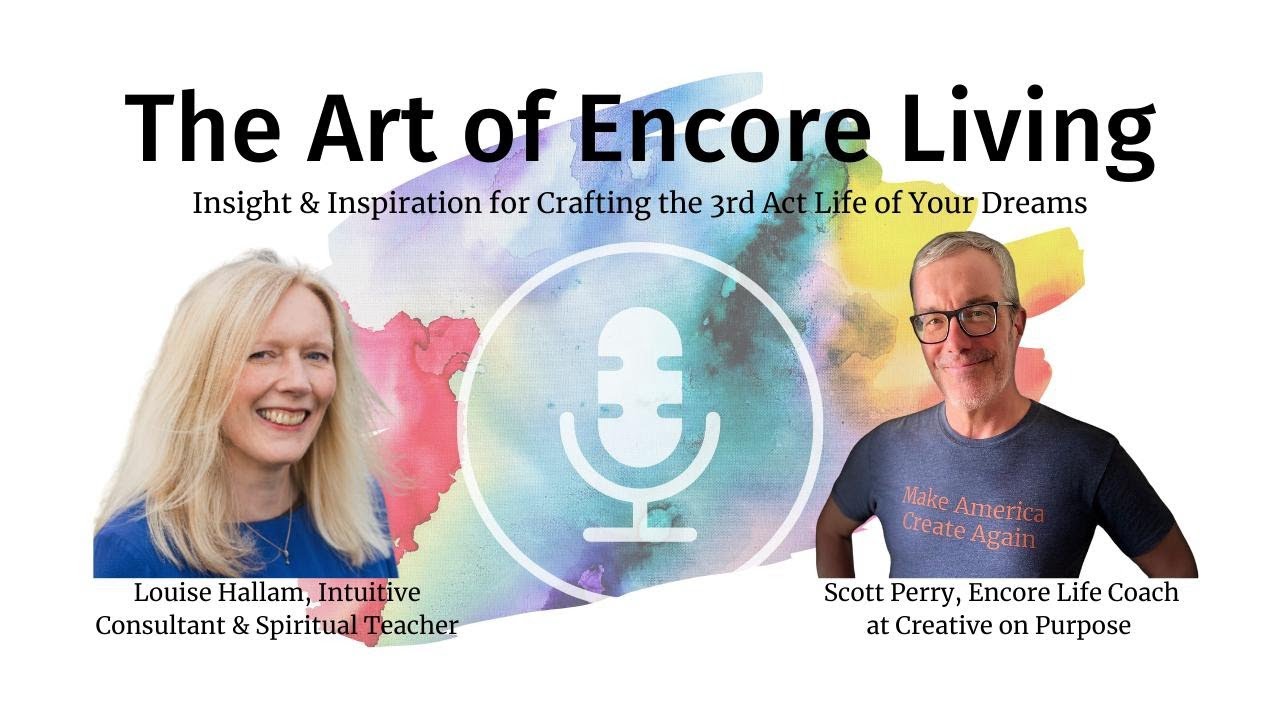
In this episode of The Art of Encore Living, host Scott Perry interviews Louise Hallam, an intuitive consultant, spiritual advisor, and storyteller who helps sensitive leaders and changemakers unlock dormant gifts, manage energy, and reconnect with their purpose in the “third act” of life. Louise shares her personal journey from a corporate background to a spiritually‑focused practice, describing how meditation and a mentor sparked her shift toward intuitive work. She explains the role of an intuitive consultant—tuning into subtle cues, asking probing questions, and reigniting passions that have been set aside. The conversation explores broader themes of retirement as an encore, the importance of an inner compass, and the interplay of trust, faith, and surrender drawn from Stoic and Bhagavad‑Gita philosophies. Both hosts emphasize that there is no wasted time; experiences accumulate into a unique blueprint for later‑life entrepreneurship and service. Practical advice is offered: rediscover what brings joy, use it as a gateway to purpose, and seek guidance from trusted mentors or spiritual advisors. The episode concludes with a call to action for listeners to take a bolder step into possibility, visit Louise’s website, and engage with the Encore Living community.
Chapters
Welcome to The Art of Encore Living. Are you a retiree starting or scaling an online business? The Art of Encore Living delivers insight and inspiration to help you find fulfillment, forge meaning, and make a difference in your life's third act by creating and scaling an online business that helps fund your retirement. Don't just leave a legacy, live it. I'm Scott Perry, Encore Life Coach, helping retirees create and scale a fulfilling online business that helps fund your retirement. If you're ready to take a bolder step into possibility in building a fulfilling online business that helps fund your retirement, The Art of Encore Living offers one-on-one coaching, an exclusive community, and premium content. You can visit theartofliving.com and get started with the Art of Living Quick Start Guide. Let's meet today's guest, Louise Hallam. Welcome to the broadcast. Please tell our viewers who you are, what you're up to these days, and where can they go to learn more about you and the difference you're making?
Thank you so much for having me, Scott. It's an absolute joy and pleasure to be here. My name is Louise Hallam and I'm an intuitive consultant. Um, I work with sensitive leaders and changemakers who want to use that sensitivity as their superpower. I'm also a spiritual teacher advisor and, um, and a storyteller.
Fantastic. Well, we have, um, many things in common. There's a certainly a storytelling aspect to what I do and, and a spiritual element as well. Uh, I also want to, um, just kind of start with maybe going back to how you came to be doing this work that you're doing. My guess, and I may be wrong, uh, is that little 9-year-old Louise probably didn't wake up one morning and say, you know what I'm going to do when I grow up? I'm going to be an intuitive consultant and spiritual advisor. But maybe I'm wrong. But I'd love to hear just a little bit about your journey to where— how you got to where you are.
Yeah, you're absolutely right. Although a lot of my storytelling recently has brought me back to that, my younger self. And that's a really interesting aspect of, of what, what you talk about. Um, but really I did what, um, a lot of people do, is go into a number of roles, um, in sort of a corporate background, but never really fitted in. And only really in the last 4 or 5 years, um, the introduction of kind of meditation into my life was the key really to start that journey towards personal development and leaving that corporate world and really starting to embrace the purpose that I was here to do. Again, like a lot of people, when you sort of have chance encounters, which aren't chance at all, and I met, um, a beautiful kind of spiritual mentor who really connected me to my purpose, to my wisdom. Um, and really since then it's been an evolving journey of helping other people to unlock their dormant gifts and talents, to be able to express and manage and balance their energy and emotions to be the most effective person that they can be, to unlock that unlimited potential. And that's really kind of the journey that I'm still, still on. Yeah, very much.
I love that. And you've shared a couple things that I just want to highlight because again, they align very much with the work that we do at Creative On Purpose and The Art of Encore Living, which is unlocking potential. And you've alluded to, you know, we, we lose track of during our, um, you know, indoctrination by institutionalized education and occupation. We lose track of who we really are and what our true talents are. We, we forget that we were born sufficient and whole with everything that we ever needed to thrive and, and flourish in the world. And what I'm hearing is that you help people tap into that. Limitless, abundant potential that they have and see the possibility of reconnecting, um, with their— you called it purpose, we could call it lots of things, I'm sure. But, you know, it's, it's a powerful, it's a powerful thing that I have found in the people that I work with. Um, we often come to this later in life because we're just kind of programmed to first, we're First act is we're going to get educated. Second act, we're going to get a job and raise a family. And then at the, you know, as our third act begins, we're thinking, you know, I'm not sure that this is all that life is supposed to be for me. Um, and so circling back to what you said at the very beginning about being an intuitive consultant, I'm intrigued by that, um, branding of, of what you do. And I'd love to have you unpack a little bit of what that means and how that helps people return or reconnect with who they've always been meant to be.
Yeah, so I guess this is one of those gifts that I have come to recognize as my own. And, and that's really a sense that if I connect with somebody, or I speak with somebody, maybe they connect with me, that there is— that there's something else there. There's something underneath the surface that they haven't, um, accessed for a long time, or they've never accessed. And really, it will just come through as a— as a feeling, as a sense of, um, something not quite achieving what you could. And that often— see, I get that like massive vibe tingle through my body even when I talk about it. And that's probably— and that's also another sign, you know, it's usually that, okay, there's something I need to explore with this person, there's something I need to talk to this person about, which could be a skill, it could be, um, something that they used to do that they no longer have connection with. It could be an instant or an event or a belief that they hold so strongly that it has kept them from that connection. So it could come through in any of those ways, really. And then really, that will start to unfold in terms of maybe asking a question. Um, an example, what could I do? So maybe, oh, you enjoy 'You really enjoy baking, but you don't, you don't do that anymore. Why is that? Have you always liked— you used to paint. Is there a reason? You know, something tells me that you like being creative.' And then it's letting them tell the story of why that is no longer a connection, to ignite that spark and passion again and really just start to unpack what it is that it has been taking them away from it, for any number of reasons.
Yeah, I really appreciate that because it really rings true to me. A lot of, a lot of the work that I do is based on the philosophical tradition of Stoicism. And and just this, our role is to tap into our talents and serve others out in the world. And then the Bhagavad Gita from the yoga tradition talks a lot about dharma. Like, your duty is to live your soul's purpose. And that's kind of what I hear in what you're encouraging people to access. And I'll just share what bubbled up for me. Um, in the Bhagavad Gita, they're talking about vocation, the work that you're meant to do. And, you know, when we have that, you know, when, when a client comes to you with that inkling or that instinct that I'm not living the life I was really intended to live, or I'm not happy, joyful with the life that I'm living, um, I think of that as You know, I think your life is always trying to speak to you because it desperately wants to speak through you. But as we enter the third act of our life or the second half or whatever you want to call it, we have less time to futz around. And so I think the urgency of that call to, hey, I'm here and I want to speak to you about how we can, you know, get aligned and working together. So I don't know if anything comes up for you from that, but that's— that just kind of bubbled up as you were speaking.
Yeah, and, and I get that. And, and I think, um, you know, the way that you work, say, with— you say with people in the third age is really, um, is really aligned, I think, with the fact that we don't even start to kind of mature spiritually until we're, we're entering our kind of 50s. We don't, um, necessarily know how to use that wisdom that we've been given. So we wouldn't have been given it any sooner than that. And I think that hopefully helps to give people some reassurance that you're in the right place at the right time. Because I think otherwise there is a tendency to go, 'Oh, I spent my whole life doing this thing, and now what? I've wasted all that time.' You know, there is no wasted time, energy, skill, experience, because the beauty of it is that it's all going to contribute. It's also all going to weave in and out in terms of what you've learned and what you've experienced. But, but, um, you will now have the, um, the, the strength, the emotional strength to hold what is given, what has been given to you. Your blueprint to unlock it. And that would— it happens for some people who do it much earlier, but it's much more likely to happen at a later point. But I get that, I get that, that then get that— you get that concept of running out of time. You know, I haven't got the time to learn a whole new thing Um, you've got all the time in the world.
I, I love that because I, I, I think that, that rings true to me too about how for many of us it, it does, it, it really can't happen until later in life. There are some, you know, I think of, um, uh, Greta Thunberg as being someone who's very spiritually evolved you know, kind of arrived much sooner. But that's the— I think that's more the exception because we live in a society that actually starts muting our creative impulse and our love of, you know, of awe, wonder, joy, play, you know, by putting us into institutionalized school systems that tries to make everybody just like everybody else, and then into jobs that just reward, you know, that are based on chasing salary and stuff and status. And, you know, just to highlight again what you were just saying, because I think it's really true and important, there is no wasted time. Wherever you are, there you are. And you can only make change, you can only do the work, the real work of finding your soul's true calling and living into that in the here and now. And so you mentioned, you know, and I see this too, sometimes people feel immense regret over all the squandered time and lost opportunity, but that's, that was just, that's just part of the journey. There is no, um, you know, regret is an invitation you don't have to accept. It could be just, this is, that was, I needed to go through that to get here. And now I have whatever time I have. Most, most of us don't know. And now, in the here and now, what are you going to do? I also really want to get into the spiritual advisor part of what you do. And I think I'm guessing that what you've shared so far ties into that. When you, when you say spiritual advisor, help us, help us understand, you know, what, what's on offer if someone wanted to come to you for spiritual advice?
Yeah, it's, it's a, it's a strange thing to give an title too, because I think for a lot of people it has very different sort of connotations and, um, aspects. For me, it's that strength of connection to your inner self, your inner guidance, your higher self, if you so wish, this— your, um, spiritual guides and support team. Who, especially if you're stepping into a brand new purpose, you're gonna need those guys to help you, um, just to help you navigate some of that, the stuff that you will experience. And yes, of course, you need people in the human world to support you too, but quite often the experience of going through, as you say, this this, um, manufactured way of being has so far disconnected people from their ability to tune into any of that that they're very logical. They're thinking very logically. They may not make decisions based on risk but based by fear. So there has become a very narrow view of what is possible for them. Whereas if you start to see that actually all of your answers are already there, you have the possibility, you have the potential, you just need to understand it and access it. You can kind of breathe again, you can start to Okay, the pressure's off me. And the, you know, building the strength of that connection is really a part of my role, and holding the space for somebody as they go up and down the roller coaster. That's what I do.
Yeah. Well, there's, there's a couple things that I think are really, you know, I love that articulation. Um, there, a quote popped up, and I cannot remember who said this, but it was along the lines of, we're not, um, human beings having a spiritual experience, we're spiritual beings having a human experience. And you said, you used the word navigate, which I think is actually really important to highlight, because we live in a society, largely in the West especially, where, you know, like, give me the roadmap, tell— give me the step-by-step system that I can follow to get from where I am to where I want to be, even though I don't have a clear sense of where I want to be. Um, when really your life can only be navigated with a trusted guide, as you said. Um, you know, hopefully some fellow travelers that are supporting and encouraging your journey, and a compass you know, and you were talking about, you know, the inner work, you know, you have to be able to tune in to this inner compass, which is, you know, all of these things are not going to provide you with a straight line. One of my favorite words is an Old English word, cottywomple, which is to travel purposefully towards a vague destination. And I think that's what we're all doing. But it's— we can embrace that embrace the uncertainty, navigate the uncertainty, and do that with a sense of, you know, fellowship, fun, play, creativity, and all those things. It's much easier to do all of that, I think, you know, when, when you're doing it with others.
Yeah. And that analogy, so today it felt very much around this inner compass and Um, it's funny when you, you know, you say the things that I'm gonna say, um, which is the, the kind of connection around me making sense, but it's, it's almost like having the compass but not knowing where you're going and using the compass to constantly realign yourself back to north. This is the analogy that I was given. And I'm often given analogies and not always the most straightforward ones, but, um, and people will try and take you off that point of north because they won't understand where you're going and they won't see the changes within you because the changes are in you. And so when they come and question you, your compass needle wants to move. It wants to move closer to them, or it wants to move further away. And all you need to do is keep centering your compass and following it wherever it takes you.
Yeah, I, I totally agree. I often talk clients, I can't— our job is not to plan the perfect strategy that's going to get you where you think you want to get right now, because that may or may not be the place. But if we set a point on the horizon that's worth traveling toward, and we, um, you know, we— I mean, the thing for me is, when you are starting this journey, there are going to be both obstacles and opportunities that you can't know are going to cross your path. And at least here in the United States, we have this put the blinders on and hustle and grind your way, irregard— like, never quit, go, you know, keep going to that end. I tend to, you know, I'm all for having a vision, a point on the horizon you're heading to. And as those obstacles and opportunities come and we navigate our way around them, you know, ignore some, adopt some. Our, our, our compass is going to take us, you know, we're going to tack, then we're going to shift our focus and our destination, and we're going to still not get somewhere great, but we're actually probably going to end up where we were really meant to, to go all along. But you speak to something that's really, um, profound and helpful is You know, we have to understand that the destination is not the ultimate reward. It's the way that you're engaging with the journey and the experience that you're having as you step into those possibilities.
Yeah. And that is a real— it's not the way that we have been brought up and educated to be. You know, we, we need the security of knowing what we're doing and what, what we're kind of aiming for. Um, and yes, you know, you do want to have a vision or a, a sense of what it's going to be like. What is the growth that you want to experience? Um, but everything else will be taken care of. And this is, I think, the hardest thing that we are being taught in terms of being held and supported and guided, because it takes an enormous amount of trust and, and faith to, to say, well, I, I don't know what my next thing's going to be. And walking with somebody can often make that easier. Yeah.
Well, I love that you wove in trust and faith, to which I would only add surrender. And that is, you know, this idea from one of my favorite Goethe quotes is, as soon as you trust yourself, you will know how to live. And so few of us actually You know, I think that's— I've been chewing on that quote since I was like in the 7th grade, and I still haven't gotten all the juice out of it. And it's a lifelong, you know, process just, just to practice that, to trust yourself, to invest in yourself, you know, which is what people like you and I are asking people to do, invest in themselves and the journey that they want to go on. By working with a trusted guide, spiritual advisor, intuitive consultant, what have you. And then, you know, the faith part is— I love that too, because, you know, a lot of— oftentimes, I think we're practicing hope, like, I hope I get there, I hope I figure it out. But if you have, you know, hope is not a strategy, it can be a very, very worthwhile tactic from time to time. Sometimes hope is the only thing that will help you get through. But if you have trust in yourself, or enough trust in yourself, you will have enough faith that you'll figure it out as you go. And if you surrender to things as they happen without attachment to results, you will be able to, to use your analogy, navigate your way somewhere great and maybe, and perhaps exactly where you were always meant to get in the first place.
Yeah, because quite often now, even when we open up to our purpose, and we go, okay, you know, I can, I can kind of put my flag in the sand and go, this is what I'm going to do. As soon as you start to go, well, this is what my purpose looks like, this is the 'extent of which I'm going to make a difference,' um, you, you have limited your potential, and you almost have to nudge up against that and expand that belief. And this— that's, that sounds like one straightforward thing. And what that is, is the unraveling and the layers and layers of beliefs and experiences and, um, control that you have placed upon what you think is possible for yourself. And then realizing that you can break through that. And once you've done that, there's actually another level, and then there's another level, and then there's another level. Um, I think sometimes people go, oh brilliant, I found my purpose, I'm gonna do that, and it becomes one-dimensional again. You know, you're just reapplying the same conditioning onto it. You need to do something different. You need to start to move the shape of your potential and make it tangible. Um, it's like walking, walking through the mirror. Ah, what I've been given. So you can see it, but you, you need to go beyond it. You need to go beyond your wildest expectation. And know that beyond that are different realms of mystery, of possibility, of sensuality, which I use the way that that's been given is in terms of enjoying in the experience. I guess that's why they've used that word. I'm not allowed to change words. I've done it before. I get into trouble. So yeah, so it's a whole different way. This is what I've been given. It's like, you know, like a bubble machine, and it creates those bubbles that are the massive shapes, and they kind of grow and expand and they morph. So this is, this is how you do it. Otherwise we're back in the same place, we're back in the old system, we're back in the old way of doing something, but we've just planted our purpose in it. Yeah, it's got to be more sort of psychedelic.
Yeah, no, I, yeah, I, I totally agree. Um, and I mean, that's one of the, I think, one of the reasons why, um, you know, psychedelics are coming back and, and becoming more mainstream is that, you know, the, um We know that they help us see not only the abundance of our potential, but our— the interconnectedness and oneness of all things. And it's, you know, can be profoundly empowering and, you know, can help expand consciousness, of course. But it's, it's doing amazing work in helping soldiers overcome PTSD and things. And so you're really, you know, as we're coming to to the end here, you're circling back to one of your opening points, which is, uh, I think a lot of our job, uh, you know, as, as conscious spiritual coaches helping others see and step into their potential, I mean, that's the first step is to, to, to help them see, uh, overcome their certainty, which again, indoctrinated in, in us by society, education, occupation. And reconnect with that childlike sense of wonder, awe, curiosity, creativity, and courage to step into, you know, something that is not guaranteed, but is far, far safer, I think, than we might believe. I would love to— I always wrap up with One final question with, um, guests. You've, you've already shared a wealth of, um, of insight and information to help anyone that is in their Third Act and ready to step into their potential in an endeavor that will tap into their purpose and serve others. If there was just one final piece of advice or a quote or a practice that would help anyone tuning in take the next step into their potential in an endeavor that makes a difference? What would you share with them?
And they say this, there's so many, but I think it's a starting point. I think it's rediscover the things that, that really bring joy into your life, because the things that bring you joy are often the things that can spark that passion, purpose, and potential, but, um, we've become, you know, we got very serious at some point. So, um, yeah, do, do what brings you joy, and the rest, the rest will, will appear.
I love that. Well, I want to thank everyone for tuning in. Louise and I definitely appreciate you lending us some of your valuable time and attention. We hope today's broadcast motivates you to take a bolder step into possibility living Your Legacy. You can learn more about Louise Hallam and the difference that she's making right here at louisehallam.com. And of course, it's always great to see you and hear from you over at creativeonpurpose.com as well. Now, take the wisdom and the insight and inspiration from this conversation and live into your potential. Take a bolder step into possibility. If you're tuning in on a podcast, please leave and consider leaving a 5-star review and If you're watching somewhere where you can post comments or questions, please do that as well. We always love to hear what your aha lessons, takeaways, or questions are in these conversations. Louise Halem, thank you so much for being with us today, sharing your wisdom and insight, but also for the difference you make.
Thank you.
More from Scott



Stoics Don't Suppress Emotions, They Do This Instead #stoicism #emotionalintelligence #mindset







