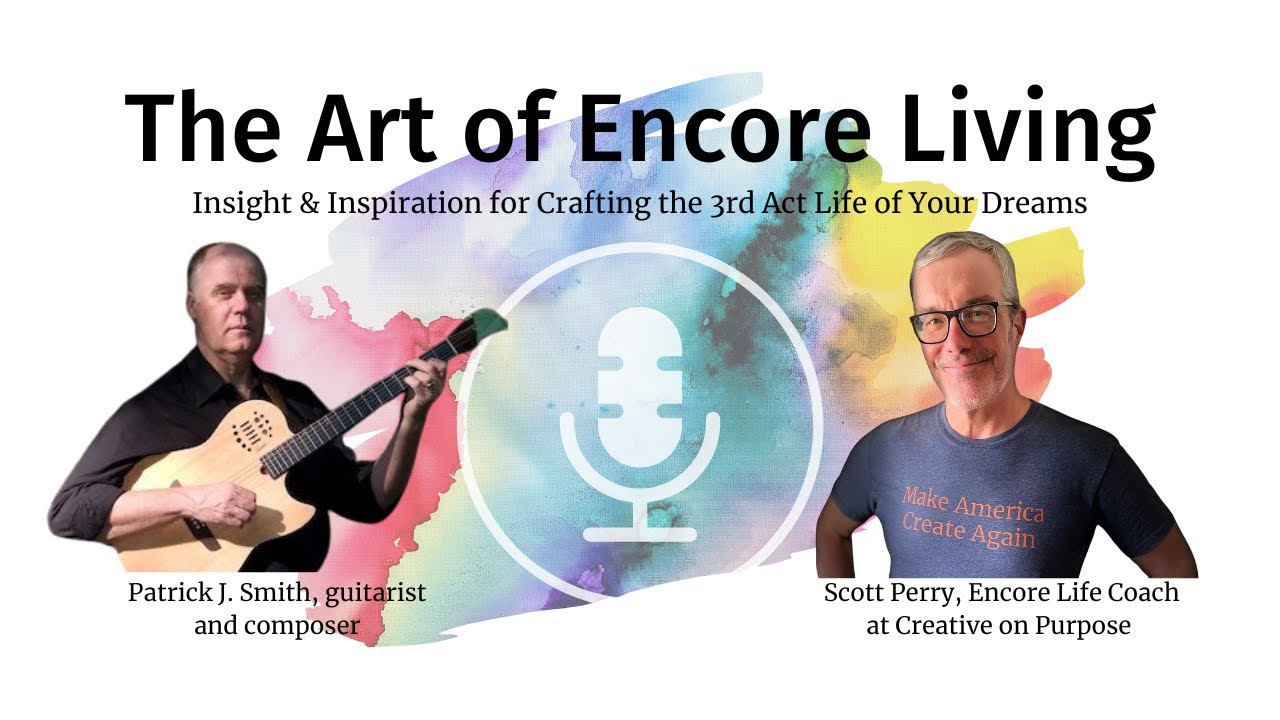
In this episode of The Art of Encore Living, host Scott Perry, an Encore Life Coach, interviews guitarist and qigong teacher Patrick Smith. The show, aimed at mid‑life “encorepreneurs” building part‑time creative or coaching businesses, explores Patrick’s journey from a childhood fascination with 60s rock to a disciplined musical career after retiring from business. Patrick recounts early struggles with inadequate guitars, his shift to classical lessons, and a pivotal Guitar Craft course that introduced a “sitting practice” of stillness, which transformed his relationship to music, performance anxiety, and presence. He describes a daily routine that blends technical exercises, improvisation, journaling, meditation, and Qigong, emphasizing that consistent practice creates receptivity for inspiration. The conversation also highlights the impact of his teacher Robert Fripp and the collective energy of Guitar Craft, the importance of good tools and mentors, and how mindfulness extends into everyday tasks like cooking. Patrick shares his latest album “Fences, Frames, and Alleys,” available on Bandcamp, and concludes with advice for listeners: “establish the possible and move gradually toward the impossible,” encouraging incremental steps toward big dreams. The episode weaves themes of presence (Kairos vs. Kronos), performance mindset, and actionable guidance for creative entrepreneurs.
Chapters
Maybe there's some connectivity problems which giving us some flack, but now, you know, technology man can overcome all obstacles, even those imposed by Mark Zuckerberg. So there we are. We are indeed live. Welcome to The Art of Encore Living presented by Creative on Purpose. This show is for encorepreneurs, people in midlife building a part-time online lifestyle business that helps you make a difference while you make a living. I'm Scott Perry, Encore Life Coach at Creative On Purpose, helping people in midlife to find the difference only they can make and turning it into a fulfilling part-time coaching business that helps fund their retirement. Visit creativeonpurpose.com and get started with the free Art of Encore Living Quick Start Guide. Don't die with the difference only you can make still inside. It's time to live your legacy. Let's meet today's guest, Patrick Smith. Welcome to the broadcast. Great to have you here. Please tell our viewers who you are, what you're up to these days, and where can they go to learn more about you and the difference you're making.
Well, thank you, Scott Perry, for having me here today. I am Patrick Smith. These days I am primarily a guitarist, although I also teach qigong. Um, I retired from business 8 years ago and have been able to devote myself to music pretty much full-time since then. A little time off for injury, that kind of that kind of stuff. I only play my own original compositions. I remain mystified for why music chooses to come through me, but I'm very happy and grateful that it does. And I'm even more happy and grateful when people share with me that the music touches them. Um, what more could I ask for? Well, I know what I could ask for— tons of sales, that kind of stuff, but, uh, you know. But if I can touch someone's heart, that's what's important to me.
Well, that's all really awesome stuff. And so just in the interest of full disclosure, Patrick and I met at— in the Creatives Workshop where I was a coach and he was a student. And I'm thrilled to have you on and was thrilled to meet you in the program just because, you know, part of my, uh, one of my dirty little secrets is I was a professional musician for 25 years, and, uh, I am a huge fan of Patrick's, uh, work. I did do the, um, the new album, which is called— go ahead, Patrick—
Fences, Frames, and Alleys. It's basically a reflection on where I grew up in Southeast Baltimore in a factory district. The various factors that framed me— family, education, dark alleys, that kind of stuff.
Yes, us musicians are very familiar with what goes on in the dark alleys, for sure. Um, so anyways, that's available wherever you are streaming music. I listen to it on, um, the, the, the dreaded, uh, Spotify. Um, fantastic album. I, I love getting a little context about that particular album. But I'd love to just go in first with— I'm always interested in people's origin stories, and especially for creative people. Like, how did music become a part of your life? How did you— how did you begin your journey in music making?
Well, as a kid, you know, I was born in 1956. So in the '60s, when the Beatles, the Stones, King Crimson, all that kind of stuff, Jimi Hendrix was breaking, I loved it. Um, my buddies and I, we would spend every spare moment we had listening to music. And at one point, I decided I wanted a guitar, and, uh, and I told my mother that, and my cousin Johnny brought me his used Sears guitar, which was so pathetic, you know, the action was like this, you couldn't play it. But we took it to a teacher and he said, you can't play this. So we rented an acoustic for 6 months to see if I was serious. And then my mother bought me a beautiful guitar. And this went on through high school. And when I went to college, I didn't want to take my Fender Jag to the dorm. I was afraid, you know, it could get ripped off or something. And, uh, and the rock and roll lifestyle got in my way. And, uh, fast forward a few years, I had my act together, and one day I went to a classical guitar duo and said, I'll probably never play like that, but I could play again. And so I began taking classical guitar lessons. I bought a classical guitar, and then fast forward a few more years, I took a guitar craft course. And that changed everything about my life, internally and externally. And I was— I just got very dedicated, devoted, disciplined about practicing. And while working full-time, I practiced almost every day for at least an hour. And then eventually I got to leave the workforce You know, I played in various groups, and eventually, you know, you know, being in a group, it's, it's tough to keep them going. So eventually I found myself just making solo music, and I've now had 3 solo releases. Fences, Frames, and Alley available over at Bandcamp site, uh, is the third one. The first was Scattered Hearts, and the second was The Call. Support musicians. They need it, you know. Spotify, like, 3/10 of a cent per play, and they take about 5 months to get that to you. If you know a musician that you like, it doesn't have to be me, but support them, buy a download or something, you know.
Well, I love the, uh, there's a lot of things in there that are worth I'm just reflecting and amplifying a little bit because I think it pertains to anybody tuning in that is seeking to make, to define and develop their gift, whether it's, you know, creative endeavor or coaching or teaching or what have you. And one of the things that you mentioned early in your journey is, you know, your first tool was not adequate to, you know, for, for you to learn on. Um, and that's something that I frequently had to talk to parents about when they brought in their, you know, kid to learn on a Walmart guitar, which never could be put into tune, never mind stay into tune. Um, and I think most guitarists have that story about the, the guitar with the action, you know, 3 inches high. Um, but, you know, the tools that you choose or, you know, that you begin with are really important. You don't need— you don't need your Fender Jaguar when you start, but you do need something that's a step up from the Sears and Roebuck cardboard guitar with the high action. So I, I, I love that part of it. Um, your second album, The Call, also kind of speaks to me because here at Creative On Purpose: The Art of Barncore Living, we talk quite frequently about the call. And you, you know, the call of vocation, the call of the difference only you can make, whatever it is, um, the call to access your gift and share it with the world. And you said something in your introduction that speaks to that a little bit. I'd love to hear a little bit more about, which is— I don't— you said something to the effect of, I don't know why music chooses to, to, you know, to visit me or to speak through me, but it does, and I'm grateful. Um, tell us a little bit more about, you know, your creative process. Like, what— how do you interpret what is going on when music comes to you and, and you, you know, kind of refine and polish it and deliver it through you?
Well, as I said, I was disciplined, practicing every day, and at one point the person who was assisting me on this journey as a guitarist told me I was practicing exercises too much, that I had to spend part of my day, whatever it was, 20%, improvising to see what the fruits of those practice— of the practice was. And so I began doing that, and now it's usually how I begin my practice because I'm not— one, it's early in the morning, my mind is fresh. I've been doing the practices that I do in the morning, journaling, meditating, Qigong. I'm in the right space, and every now and then I hear something and I pursue it. And that pursuit might last 30 minutes, or it might last the next 4 or 5 days until the idea comes out. And sometimes it doesn't come out. I have journals, you know, folders of unfinished ideas, and that's okay because to me that's all part of the learning process. They may never become a complete piece of music. I revisit them from time to time, but they're all feeding that part of the brain and the hands that become receptive. I can't guarantee that space, but if I don't show up, I can guarantee I won't be in that space. And I can recognize it sometimes, and when I do, I know to just stay with it. You know, not, it's not the time to go call my buddy or something or something, you know? Yeah.
You know, well, I, what I'm hearing, and this is something that, you know, we both experienced through Seth Godin's, uh, um, Creatives Workshop is, you know, having a practice, a daily discipline of showing up to do your work, to practice your craft. Um, is preparation for when, whatever your definition is, the muse inspiration, um, comes to visit. You're, you're already ready and receptive. Um, and, you know, I, I love the Elizabeth Gilbert, um, TED Talk where she talks about, um, you know, inspiration is kind of floating through the countryside and, um, you know, if it, if it lands on you but you're not, you know, you're not receptive, it'll just continue on, you know. The idea wants to be born, and if it's not through you, inspiration will find someone else that's, that's ready. So I, I really love that, that part of it. You also, um, referenced, uh, I think— I can't remember if you said it was a course or a workshop, but something, uh, something that you took that helped you with the internal and the external preparation for the work. And I'd love to hear more about the internal work. What, what, what internal work did you find, um, necessary to kind of work on? Uh, you know, a lot of guitar players— I, I remember very specifically starting to play the guitar because, um, I thought it was going to be the way that I was going to meet girls. And when it didn't work, I turned to football instead, which actually didn't help me get girls either, and it just gave me bad knees and a lot of concussions. But, um, I should have stuck with the guitar, uh, but got back to it eventually. But, you know, I think in general a lot of us are very goal-driven, outcome, results-driven, um, and we forget that it really has to— that anything worth doing has to happen from the inside out. So I'm just curious about some of those internal things that were revealed to you that you worked on and how it helped you get the results you wanted, more as side effects of doing that important internal work?
Well, the most important thing I took away from my first guitar craft course was a sitting practice. Um, you know, I took the guitar I had at the time, flew to California, paid a good sum of money to be on this course, and the first thing we did was the practice of doing nothing. I was sitting there, what was I, 32-ish? Still a lot of, a lot of energy. And I'm thinking, I paid all this money, you want me to sit here and do nothing? But by the end of that 5 days, 6 days, whatever it was, that was— it changed my life. And Through practices like that, that I've explored since then and continue to practice regularly, I've seen things about myself, my body, my mind, my spirit, and I've found ways to embrace and develop those characteristics which are what I deem good for the world, and a way to let go of some of those things— fear which for me translates into anger a lot of times. Dealing with performance anxiety, I— woof, that was a journey that took a lot of time, a lot of time. But now, you know, most of the time I'm comfortable with the guitar and people watching me or listening. So it's that the most important thing was the sitting practice and Yes, the technique, how to hold a pick, how to use my fingers, how to stay relaxed while playing any kind of music, especially difficult music at times. And of course, all these things, nothing is perfect. You know, I have to let go of that. Going back to your Elizabeth Gilbert quote real quick, the person that I've studied with has a quote that music is a presence. It's constantly available to us, but we are seldom available to it. And so my job is to make myself available for whatever that might be— music, or if you're a writer or a business person, what, what is really needed out of there that I can provide, you know? And where am I getting in my way, right?
Really love that reflection. What I'm hearing is the sitting practice helped you be present in the moment, aware, and it sounds like, you know, holding that space allowed you to think about what you're doing on a deeper level. One of the things that I, when I was, uh, you know, I had a guitar studio for almost 20 years, and part of the way I, I taught my students was to let them know that, you know, at some point, two, two times a year, we're going to put you in front of people and you're going to share this gift of yours, because that's what music is for. It's for connecting and communicating with other people, not playing to your stuffed animal collection in your room. Nothing wrong with that, but, um, and, and the, the pep talk I would always give them before their first live performance is, right now you're really concerned about how you're going to look and how people are going to feel about you, and what people are really here for is what you're going to give to them. So I would tell them, here's, here's the secret. Serve the song, don't make the song serve you. This idea that they're sharing their gift with other people, that it's, it's for the song, for the audience. And if you focus on those things, it really seemed to help. And I have experienced this myself. It starts to cut down all the static and the noise in my head that's usually coming from attachment to ego, desire, and not so much to the real craft of making music. So I'm hearing a little bit of that kind of idea in what you're sharing, this idea of letting go of perfection but sharing what you're able to share in the moment.
Yeah, you're right. And it was quite the journey for me because the first time I had to play, I was challenged at one point. It was maybe my third course to play every meal for breakfast, lunch, and dinner. And there was like 90 guitarists on this thing, and, and most of them were fairly proficient. And my response was, well, I don't have any music to play. And, and the response I received back was, well, that's not my problem now, is it?
Just out of curiosity, who was the chief of Guitar Craft?
Uh, Robert Fripp is the man's name. He's quite well known out there in the world. He's an amazing, amazing human being doing great work for the betterment of humankind, and, uh, and made me understand that, though I didn't believe it at the time, that I could actually have something to offer to the world musically.
Well, I'd love to unpack that relationship a little bit because I, I was familiar that you had been had studied with Robert Fripp some. And that speaks to another part of this, you know, when we talked about you need to have the adequate tools to, to deliver the difference that you're, you're trying to make. Um, you also have, have to have a great teacher. I mean, it's, you know, in this day and age, I, I often, when I was teaching, other guitar teachers would say It's impossible to make a living anymore as a guitar teacher because it's all on YouTube for free. And I'd say if you can't compete with YouTube, you've got some problems. You know, YouTube is not your problem, you're your problem. Um, that's just information, and information by itself is pretty useless, right? So I'm just— I would love to hear more of your experience with, you know, finding a great teacher, and, um, you know, what, what do great teachers provide? And maybe if you've had experience with not so great teachers, um, you know, were there any lessons that you were able to derive from those experiences as well?
Well, the first classical guitar teacher I had taught me to practice 20 minutes a day because when they— she said an hour, I'm like, oh, I got a job. And the magic of that, when she said just do 20 minutes, that I found was if I could do 20 minutes, I could do an hour, because by 20 minutes I was into it. And with Robert, he gives us exercises, he gives us examples, music. What I was drawn to— I mean, I knew who Robert was since I was a child, and I knew I had no business, I felt, I had no business to be in a room with a guitar with that man. But I went to a performance of him with what was called Robert Fripp and the League of Crafty Guitarists, and there was something there that pulled me. Usually I, in my life, I've been guilty of overthinking things. I saw this performance on a Saturday or a Sunday, I think it was a— I wrote a letter that Monday and put it in the mail to apply. A few months later, when the logistics were available for me to go, I went. And, um, and like I said, it changed everything. I, I don't have enough time to elaborate on it, but, uh, he's a very intelligent, generous, kind person, uh, that opened up things inside of me, um, him and other people. I mean, it's a, it's a group collective energy thing that happens, just like when you meditate with a group of people. I mean, it's, it's hard to encapsulate in a few minutes, and I don't want to just go on and on and on, but, uh, well, I just would be curious, some of the thing—
I'll just reflect some things that I've noticed and working with good teachers to see if this is your experience as well. What I'm hearing in the way you're describing Robert's teaching is, you know, part of it is just holding a space, you know, for people to show up, you know, with curiosity, with courage, and to explore, you know, the edges of their understanding and ability, which is where learning actually happens. Always. So I think, you know, that's a hallmark of great teachers is, you know, we've— many of us have had that experience of starting with piano lessons or maybe guitar lessons with a real taskmaster, someone that's, you know, I mean, my first teacher would actually swat my hands when I made mistakes. So, uh, different age, But, uh, you know, there's, there's real power in, I think, finding someone that, um, embraces that the journey is going to be messy, that you're probably a little bit anxious, and puts you at ease and allows— lets you know that this is a place where we can make mistakes because that's where growth happens. But the other thing is that I've always found in great teachers is, um, that they're encouraging without being permissive, I guess, is kind of, you know, like there's certain expectations are set, but underneath it all is always this idea of you can do this, and a great teacher will help you take the next smallest step into your potential possibility. So I don't know if there's anything that you'd reflect back or add to that?
Well, what I would add to that is one of the things I learned in guitar craft is how I do one thing is how I do everything. Ah, interesting. And so, personally, professionally, I worked in the food service environment. I was not a working chef, but I can hold my own. Um, so a very easy place for me to apply some of these principles and practice presence was in the kitchen. So how I chop a piece of garlic or an onion or a carrot, am I there with it, or am I thinking about last night, tomorrow, you know? Um, but all those things can feed that ultimate, which for me would be, can I be present with a note? Um, because when one is present with a note people hear it, you know. I mean, when you're not, people may not notice it, but they know when you're present with it. And perhaps when you're present with chopped onions and garlic, people taste it. It's a little more subtle, um, but, you know, so that idea of it's how I live my life, it's not just that time of the day when I'm practicing or performing. It's everything that leads up to it. Does that address your—
Yeah, no, I think that's really— I love what you said, that the way you do one thing is the way you do everything. Because I think we have kind of temperaments and tolerances that are inherent and I think you're absolutely right. We kind of, you know, we do everything with a certain attitude. But that's something also that you, as you demonstrated in your story, that you can change. You can practice mindfulness, practice presence, and become a more mindful, present person. It reminds me a little bit of the Greeks had two different kinds of time. Kronos and Kairos. And Kronos is the chronological— it's the time passes the way time, uh, it passes in a very specific denomination that you can't stop or create more of. But Kairos is kind of, uh, a moment where time does expand because— and it usually has a lot to do with being present, being in flow, all these things that help us feel what I think you were speaking to, which is when a performer is really in the music and with the audience, the room kind of levitates, time feels a little bit suspended. So I just think that your point is really important that, you know, we can't stop time, but we can expand or amplify the moments of time that we're in and make them more meaningful.
Absolutely. Absolutely.
I love that. Well, Patrick, we're coming to the end of our half hour together. I would love to, you know, this is a show for people that are defining and dialing in and developing and delivering the difference only they can make. Some of them are artists of various stripes, and some of them are doing it in other creative endeavors like coaching and and teaching and so forth. If there was just one final, uh, piece of advice or, um, a quote, a maxim, a lesson that you've learned that would help someone tuning in right now, um, fly a little bit higher in the difference only they can make and, and step, um, into their potential just half a shade braver, what would you share with them?
What I would share with them is what was shared with me in guitar craft, which is establish the possible and move gradually towards the impossible. So whatever your vision, dream, hope, goal is, you know, establish that and then keep taking those small possible steps. And before you know it, they, they amplify.
I love that. It's, it's kind of also sums up great coaching or teaching of any kind. You're helping people build a bridge from where they are to where they want to be.
Right. And if you don't know where you're going, you'll probably get there.
Right.
You want to go.
Yeah, if you don't know where you're going, any, any ship, train, or path will get you there for sure. I love that. Well, I want to thank everyone for tuning in. Patrick and I really appreciate you lending us some of your valuable time and attention. And we hope today's broadcast motivates you to take a bolder step into Possibility: Living Your Legacy. You can learn more about Patrick and the difference he's making right down there at patricksmithguitar.bandcamp.com. Purchase his new album, it's fantastic. And of course, it's always great to see you at creativeonpurpose.com as well. If you're watching where there's a place to leave a comment or a question, please do that. And if you're listening somewhere that allows you to give a review, please leave us 5 stars and help more of the right people connect with the lessons and learning that are happening in these conversations. Now, take the insight and inspiration you've gleaned from this conversation so that you can fly a little bit higher in the difference only you can make. Patrick Smith, thanks so much for lending us some of your experience and wisdom today.
Absolutely, Scott. Thank you and keep doing the great work that you do.
Appreciate it.
Appreciate it. Take care.
More from Scott



Stoics Don't Suppress Emotions, They Do This Instead #stoicism #emotionalintelligence #mindset







