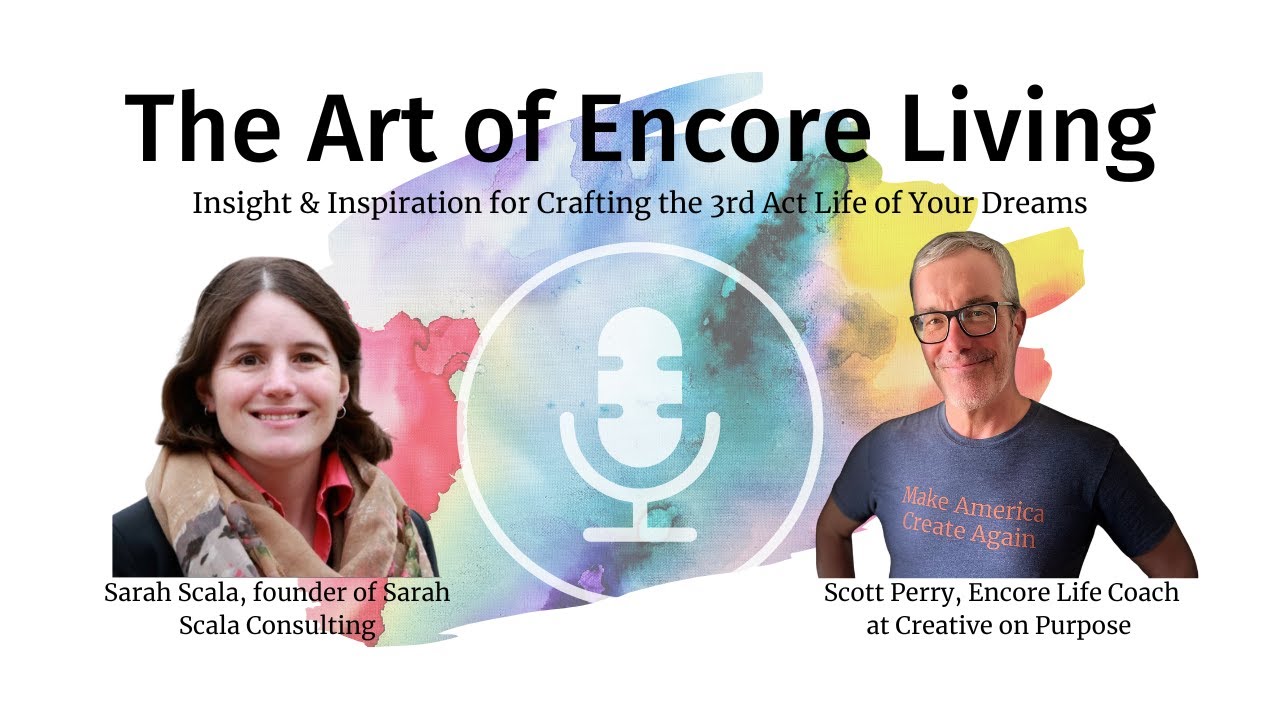
In this episode of The Art of Encore Living, host Scott Perry interviews senior talent management consultant Sarah Scala. Sarah shares her unconventional journey from adventure recreation studies to leading a talent development firm, highlighting how early experiences with ropes courses shaped her passion for team building. She explains her philosophy of work‑life integration, notably taking every Friday off for outdoor recreation, and argues that intentional downtime fuels sustained high performance for solopreneurs and leaders. The conversation delves into her definition of leadership as empathy‑driven influence rather than positional authority, and she stresses the importance of leaders being deep listeners, coaches, mentors, and friends. Sarah outlines current organizational challenges: remote onboarding, team development, and a surge in demand for LGBTQIA+ coaching and inclusion work. She educates listeners on LGBTQIA+ terminology, pronoun etiquette, and practical steps allies can take to create psychologically safe environments. The episode closes with her advice to aspiring difference‑makers: take small micro‑steps, seek feedback, and never fear trying.
Chapters
ether at the speed of bytes. And of course, we have what appears to be an error, but now we are live. You know, technology, it's nice when it works, but not always. Welcome to Creative— I'm sorry, let's pause and try that again. Welcome to The Art of Encore Living, a show for encorepreneurs, people in midlife building a part-time lifestyle business that's fun, fulfills your soul's calling, and Fund Your Retirement. I'm Scott Perry, Encore Life Coach at Creative On Purpose. Visit creativeonpurpose.com to get started with the Art of Encore Living Quick Start Guide. We don't want you to die with the difference only you can make still inside. It's time, folks, to live your legacy. Let's meet today's guest, Sarah Scale. So grateful to have you on the show. Please introduce yourself to our viewers. Who are you? What are you up to these days? And where can people go to learn more about you and the difference you're making?
Hello everyone. My name is Sarah Sculla. Today I'm headquartered in Boston, Massachusetts, where my home office is. I am a high-energy senior talent management and development leader, and I'm really focused on helping clients increase, increase revenue, reduce turnover, and create business value. And I do this through executive and leadership coaching, organizational change, learning strategy design, LGBT coaching, and public speaking. And I've been doing this work now for over 20 years, Scott, and running my own company now for 10. It's wonderful to be here.
Yeah, it's fantastic to have you. I'm always really interested, uh, you know, your work sounds really profound and important, and I know, uh, because I follow you especially on LinkedIn, I know that you are really making things better out there and having a huge impact. I'm always really interested to hear how people came to be doing the thing that they're doing now, because my guess is 9-year-old Sarah didn't wake up one morning and say, you know what I want to be? I want to be an executive coach when I grow up. So give us a little sense of how you arrived to be doing what you're doing now.
Yeah, that's a great question. And I honestly get that question about once a week, whether I'm speaking at global events or working with new potential clients. And I get the question so frequently, Scott Perry, that I wrote a blog called How I Got Here, and each year I update it. So that's on the website, of course, on my About page. To answer your question, I had a pull towards leadership and team development from the time I was 17 years old and in high school. I went to high school at Falmouth High School on Cape Cod, Massachusetts. Go Clippers! And, uh, at school, as part of our phys ed or gym classes, we had the opportunity to do Project Adventure. We had high ropes courses, low ropes courses, and we had team building programs right in school. So when I was about 17, you know, experiencing these programs and enjoying the climbing and the ropes courses and all that business, I thought, hmm, I wonder if there's a way I can make money doing this. Looked into it a little bit as I was exploring potential colleges, and I found one in Vermont, Green Mountain College, that had a bachelor's degree in adventure recreation. Now, my parents, having worked hard to help fund college, said, well, that's nice if you want to go play and kayak and climb in college. We'll support that, but you also have to get a business degree. So at Green Mountain College, I got degrees in adventure recreation and business management. From there, in my career, I did— I've done work running corporate team-building businesses and consulting firms and started my own company 10 years ago. In addition to that shift from undergrad, when I ran the Kohler Experiential Learning Center, which is a P&L company of the Kohler Company, world leader in sinks, toilets, baths, golf courses, etc. I also was able to pursue a master's in org development and in adult learning. So that's where I am, loving life, happy to help others and businesses really thrive and flourish.
I love that. You know, one of the things that really strikes me about following you, your work on LinkedIn and getting a little bit of a sense of your backstory and just thinking a little bit about my own experiences, how, how frequently people that appear on this show seem to be following a path of work-life integration, rather than work-life balance. And, you know, it just, every, everything that I see you posting on social media, I just, I see Sarah doing her thing. And sometimes that's in a kayak on a river. And sometimes it's in a boardroom. And sometimes it's on stage with the speaking thing. And, you know, I think, number one, I want to just acknowledge and applaud that if I'm reading that correctly, because I think, you know, in this country in particular, you know, we have been fed this, this false promise that there's this elusive work-life balance. Somehow we can have two buckets in our lives and we can fill them equally, and that's how happiness is achieved. And what I'm seeing with the people that I speak to is that happiness is actually coming from just being fully standing in your power as you are, who you are, and sharing that power to make a positive difference in others. And I'm just curious if, if I'm reading that correctly, and if so, um, you know, has that always been the case, or how did you, how did you find that way of being in the world where you could just be the same person everywhere?
Yeah, great question. So even earlier in my career, and I think my background in adventure recreation really led me to understand the importance of taking breaks, of spending time outdoors or in the community volunteering. And so very early in my career, I prioritized those areas of life, giving back and playing outside. And so today, having run my company now 10 years, I take Fridays off for 10 years. Depending on the season, I'm kayaking or I'm biking or I'm skiing or snowshoeing or traveling. And that really helps me to have more of an integrated life where I know if I work really hard the other days of the week, I can have some playtime and an extended weekend. And so, I think having that as kind of a rule that very rarely will I break, helps me to keep things grounded. I work my tail off the other days of the week. I think we have to as entrepreneurs, and I really try to enjoy the long weekends for sure.
That is really awesome. So I just want to highlight how— what you're saying, because it's so important, because I think you're absolutely correct. Most of the people tuning into this broadcast Most of the people that are engaged in working with me are in some way, shape, or form solopreneurs. They are free, you know, independent freelancers, solopreneurs building a business online or elsewhere, or creative entrepreneurs trying to get their creative work out into the world. And it is very easy to get sucked into a tempo where you are basically working 10 hours plus a day and you're working 7 days a week.
Week.
And, you know, we all have different temperaments and tolerances. Some people can do that for years and not burn out, but at some point, if you give and give and give, at some point you're just going to give out. And so, yeah, you know, I, I love that you've— it sounds from what I heard like for 10 years now you have set really firm boundaries about when you work and when you don't work, and you use that rejuvenation time, or that, that downtime to rejuvenate, clear, clear, clear the decks. Uh, and, you know, I think that's just so powerful and so important because we can't work all the time and be at our best. And so often I hear, I see people missing this fact that we have to serve from the inside out. We have to lead from the inside out. We can't take care of others fully unless we are fully taking care of ourselves first.
Yeah, I completely agree. If I'm not well, no one else can run my company. No one else can volunteer and give back in the roles that I'm in, in my communities. No one else can be a good member of a family or support others, friends. No one else can have time to play outside if they're burnt out. They're spending their time, you know, resting and sleeping to catch up. And it's interesting because as I think back on my career at the Kohler Company, then, you know, at other firms that I've worked for, Fridays are days off for me now. But even when I was an employee at some businesses, I'd be allowed for me to work 4 10-hour days and I'd get Fridays off. And then at others we had partial or hybrid, even 15 years ago, work structures, and I would always have Fridays from home. So that at least I think was a good stepping stone running my company where I have that break and that 3-day weekend.
Yeah, I love that. Well, I'm curious, you know, as someone who is doing a lot of work with people in leadership positions and organizations and corporations, institutions, what have you, I'm, I'm just interested a little bit in what, you know, we, you see a lot of people out there calling themselves leadership coaches. We talk about leadership. It's probably one of the most popular hashtags on LinkedIn and everywhere else.
Yeah.
How do you define leadership in the work that you do?
Yeah. So for me, leadership is the ability to have empathy and influence others that want to follow you. You cannot be a leader if no one wants to follow you or if no one wants to walk beside you in work or in challenges. It just doesn't work. So although I think many folks, especially earlier in their career, may think, oh, I have this title, that means I'm the boss. Maybe it does on paper, but it's really about the culture that you're creating and building either in your workplace, organization, or community that really determines who really is the leader and who is an effective leader, who's doing a great job, hitting it out of the park. And who is not. And it's pretty easy to see who is not because we can look at metrics on turnover or transfers out of departments. So just some thoughts around that.
Yeah, for sure. Well, what I love that you, you highlighted is we conflate authority with leadership. And, and, you know, if you have a title that does not entitle you to respect, that does not actually make you a leader. It makes you a person with a title. And that's a very different thing than leadership, because some of the best leaders that, that I know are people that have no title. They, they are people with an authority figure over them, but they are actually able to step into their power as leaders. And the other thing that I'm curious about from, from your perspective and, and just from your experience in doing this work is You know, what do you think the role is for leaders to empower others to step into their leadership, their, you know, that idea of authority actually comes from, you know, the root word is author, to be the author of their experience and the shepherd of their experience and the captain of their destiny.
Yup. I think leaders can be effective at helping those who they lead with moving or evolving into higher levels in a few ways. The leader, I think number one, has to be a really effective deep listener. If the leader just wants to talk and tell but doesn't have a good open ear to listen to the employees or their teams, that's a real recipe for disaster. I also think the leader's role as a coach, as a guide, is also incredibly important. And sometimes that's as— sometimes it could also be as a mentor, as a friend, as a colleague. I mean, people, at least in the United States over the past couple of years, have suffered losses, grief, turmoil, either from the pandemic or racial injustice or political you know, aggression. And so sometimes people need a friend, sometimes they need a coach, sometimes they need a mentor. So I think the leader needs to feel comfortable not always taking the dictator role, but really, again, being an effective listener, being someone that can be trusted and that people want to go to when challenges come up. As well as successes and solutions.
Yeah. Well, I love that you highlighted the importance of leaders learning the skills of coaching because one of my favorite books about coaching is The Coaching Habit by Michael Bungay Stanier, who's been a two-time guest on this podcast. And, you know, a leader's job is to help people get from where they are to where they want to be, to get the organization from where they are to where they want to be. And it's much more effective and efficient to do that by working in collaboration with, with others and not trying to drag the organization into the possibility that they, that they see for themselves. Along those same lines, I'm just, you know, around leadership. What do you see as the primary challenges around that, that, you know, people that organizations are bringing you in to help them navigate?
You know, these days it's a number of things, from having new employees get immersed in the culture, especially since many were brought in remotely during the pandemic. So there's that getting acclimated and navigating what are— what is our company, what is the culture, how do I How do I move successfully through this organization? I'm also getting a lot of requests lately for team development, which earlier in my career especially was my focus. And still today, people want to do assessments to understand about similarities and differences on their teams, or they want to have events, virtual or in person, where they have an opportunity to learn more, to ask hard questions, to solve some problems, either business-focused or experientially, where they can really build relationships and get more comfortable. So that for sure. And another area that I've just had a ton of demand and requests for, especially the last few years, are my LGBT solutions. And that includes things like speaking at global conferences like Out and Equal, which is the largest global summit for LGBT folks and allies in the world, to being brought in to work with employee resource groups or business resource groups to run workshops during Pride Month, or any month of the year where they're working on building their employees, building their competencies, and giving them a safe space to be themselves and to learn. And in addition to that, one of my coaching niches is supporting LGBTQIA+ executives and leaders. And I get a lot of people asking, well, what's so different? Why, why do you have that as a specialty? I wrote a blog on that as well, but really I deal with the typical business coaching topics that come up in addition to things like coming out at work or not, microaggressions, people being misgendered. So some of those areas or topics that are very specific for folks who identify as LGBTQIA that want to work with a coach that understands what it's like to be in their shoes and has that empathy, because I am also a member of that community. And so the demand for that specific type of coaching has just gone through the roof.
Yeah, well, I'm really glad that you brought that up because I, my part of my background is as a head coach in Akimba Workshops. And, you know, when the George Floyd incident came up, we came, you know, there was a reckoning for us around just not just, you know, the diversity racially of our organization, and not just, you know, administratively, but also student body, but also, you know, diversity in general, be it gender preference, race, etc. And it was, you know, I'm just gonna be straight up, it, you know, for a lot of us, because we were a majority culture, you know, very, very much just a majority cultural organization at that time. There was so much that we didn't know. There was so much that we didn't understand. And of course, as, you know, people that are trying to do work that makes things better in the world, we had a deep desire to be a force for good. So I guess, you know, I'm again, I'm just going to be transparent. So I have, you know, when, when we hear the initials LGBTQ and then you, you added IA, I'm not familiar with, um, the IA part. And I wonder if you could just educate me a little bit.
Yeah.
Why that terminology and what that terminology means.
Happy to do it. So let's take LGBTQIA and the plus and let's talk about what that means. And the good news, I guess, is that you're not the first person that has asked me on podcast or in a conference or an event. So L stands for lesbian, G stands for gay, B stands for bisexual, Q stands for queer, and then I stands for intersex, and A stands for asexual. Intersex are people who have body parts that match or have pieces of both genders, male and female. So that is intersex, and you may not know they're intersex, or they may be public about it. Asexual is someone that doesn't have a romantic or sexual interest in pursuing a relationship like that. It doesn't mean they can't be married and, you know, have a life and have a relationship, just there's not that same Paul.
Interesting.
And the plus is for all, every, everyone else that sort of fits under that umbrella that is LGBTQ.
I, I appreciate that. I'm not sure if you, you hit on the T, but the T is for trans.
Absolutely. And I apologize if I—
Oh no, no, you may have caught it and I just missed it, but I just wanted to make sure that it was all out there. And so for someone that, like me, is, you know, a representative of the dominant culture, you know, male, white, straight, older, um, cisgender, cisgender, thank you, um, who is interested in, um, you know, educating themselves and doing what we can to help improve our organizations or just our own relationship with diversity, equity, and inclusion. You know, of course, that also comes with, well, geez, I don't want to do or say anything stupid, or, or give out the signal that, you know, I don't know what I'm doing, and I don't really belong in this leadership position, or, you know, doing what I'm doing. What, what would you, what would you do for someone like me that would like to be, you know, that is curious and is interested in learning and also interested in not losing face. But, you know, just help me.
Help you. Happy to do it. So in many and most of the public speaking events and workshops that I'm leading now, a lot of the organizations are saying, can you open with pronouns? Can you help us to understand what those mean, gender pronouns, do a quick crash course on that, and then let's do the workshop on psychological safety or emotional intelligence or optimism, resilience, and grit or diversity at work. But we need help there. And so my name is Sarah Scala, my pronouns are she/her/hers. Just by saying that, by having it on my signature, on my profile, I think it's a good way to let the world know that it's safe to talk to me. I'm not a therapist, so I don't, you know, expect to hear all of your details, but just simply knowing that because I've maybe introduced myself or been introduced at events using my pronoun is a huge step towards helping others say, "Oh, okay, she's safe. She's on our team." And so that, although it may seem small, is actually quite huge. I Another way that you can help folks, maybe it's in a meeting, feel more included is if you ask if anyone in the group is wanting to share their pronoun as well when they introduce themself. I'm not in favor of forcing and requiring pronouns either on signatures or in intros because I don't wanna accidentally out someone. Outing someone is not okay ever. And so it always has to be the person's choice where, when, and how they want to share that information. But by opening the door to say, would anyone like to, you know, when we do intros, if you want to share your pronouns, sounds great. Simple little things like that that we can do really help people feel safe. The other thing I think that's important to keep in mind is that a person may be out, out to their friends or out to their family or out to maybe their team at work. That doesn't mean they're publicly out to the world. World. And I also think that many people don't realize how frequently and how often folks who are LGBTQIA+ have to make the choice to come out every single day. Is it safe? Do I trust this person? Is this something I want everyone to know? Is it not safe? Are these not the right people for me to come in as an LGBT coach and just simply come in as a speaker? A facilitator. And so we're always— I'm speaking on my behalf, but I know my friends who are LGBT, we've talked about this— we often have to do a quick pulse check in every environment we go in to ensure that we feel safe first before we come out. So I think keeping that in mind, that just because someone came out once, you can't out them. It's not okay. People have to make that choice.
Yeah. Well, I'll just share two quick experiences of my own that I think that helped me a great deal and may help someone who looks a lot like me. And that is, you know, when it came time to make a decision, you know, at Akimbo as a head coach, you know, couldn't help but notice that some people were putting these pronouns after their name. And I was really unsure, like I was, I just, I didn't understand. And I had a friend, a friend who helped, you know, talk to me about a little bit and helped me understand, like, you know, why it might help provide a signal for safety, or at least understanding to people. But, you know, another friend said when I was asking her about it, she was telling me about her experience with her kids, and, you know, one of whom was, you know, was not attracted to the opposite sex. And she said, you know, it doesn't cost me anything to put my pronouns after my name. And that's the thing that really flipped the switch for me, is like, yes, I want to be generous and let people know that I am a person that at least is interested in, um, in understanding and being inclusionary. But that idea that it doesn't cost me anything to put my pronouns out there, and if it sends a signal to someone that wants to judge me because I have my pronouns there, well, that's great, because now I— now we don't have to have a conversation, we don't have to have a connection. And the other is, um, you know, as, as all this was happening, I still had my guitar studio I live in a very small rural area, but there were a number of my students that were very young and were, you know, choosing to not have their gender match their sex, that were transitioning. And I didn't understand. And when I was trying, having a conversation with a trusted friend about my just, you know, I don't understand how someone can make this decision at this young age. She said to me, Do you have to understand? And that was, that was a profound moment for me. It's like, oh yeah, it's like just one of a bazillion things that I don't understand. Um, and it's, nobody has to explain this to me. Nobody, nobody owes me an explanation. Nobody has to educate me on this. It's actually kind of almost none of my business. Um, and I can still work with someone, love and appreciate them for who they are. And, uh, engage in them in the proper role that I have as their guitar teacher and be sensitive enough to use the pronouns that they prefer to be acknowledged by. So if that's helpful for anybody, I put that out there with a little bit of vulnerability. Sarah, we are quickly coming to the end of our time, and, uh, I want to wrap up with, um, a final question that I ask all my guests at the end. You've already shared a lot of experience and wisdom with us around that will share insight and inspiration for someone that, like you, would like to build an endeavor where they are leveraging the difference only they can make to help make the world a better place. Is there one final idea, quote, lesson learned that you would impart to someone who wants to to step a little bit more bravely into their potential and possibility as a difference maker?
I think I would say we always fail if we never try. If we never try, there isn't even that possibility. So give it a try. Take small micro steps, but try something. Get feedback. Have mentors or trusted friends that can give you some insights. And nothing is impossible.
I love that. I love that. Thanks everyone for tuning in. Sarah and I really appreciate you lending us your valuable time and attention. We hope today's broadcast motivates you to take a bolder step into possibility, living your legacy. You can learn more about Sarah and the difference that she's making right here at sarahscala.com. Of course, it's always wonderful to see you at creativeonpurpose.com as well. If you're watching where there's a place to leave a comment, please share a question, a lesson, or a takeaway from this conversation. If you're listening to this as a podcast, please consider leaving us a 5-star review. It helps more of the right people collide with this content. Now, take the insight and inspiration that Sarah's offered in this conversation and start flying a little bit higher in the difference only you can make. Sarah Scala, thank you so much for lending us some of your wisdom and experience today.
Thank you so much.
More from Scott



Stoics Don't Suppress Emotions, They Do This Instead #stoicism #emotionalintelligence #mindset







