Scott Perry walks through the fundamentals of building a coaching business: crafting an irresistible offer, finding your audience, and building a measurable sales strategy. He covers system reliability and Seneca's barbell, then introduces his paid cohort accelerator with a 3-day sprint format.
Chapters
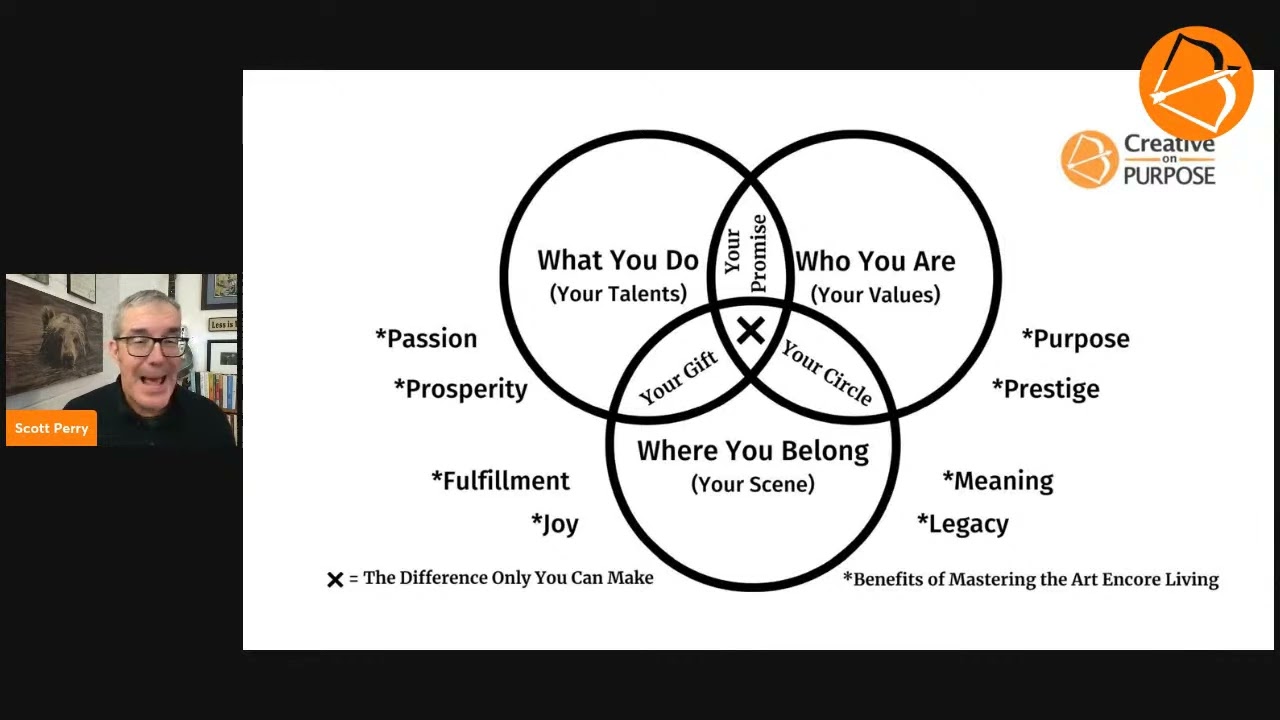
Welcome to the Coaching Business Prescription. This is a short 30-minute workshop that is going to help you find, fix, or fine-tune whatever is, whatever is missing, broken, or needs work with your coaching offer, audience, and sales strategy. And we'll get to exactly who this is for here in just a second. Let's go to the next slide. So, who is this for? Why are you here? Who are, who are you? Why are you here? And what to do next. So, if you are an aspiring or advancing coach, teacher, or healer, then this workshop is intended for you. It's— I'm going to share foundational principles that really apply to all businesses in general. And actually, what I have, uh, been most, um, thrilled by is that people that go through this program find that the principles and practices that I'm going to share actually apply not just to their business, whether it's online or offline, but also to their personal lives, personal development, relationships, etc. So wherever you are on that spectrum, uh, I'm really hopeful that you're, you're going to get a lot of value and get some actionable principles and practices that you can start to apply to your business and your life right away. If you are ready to identify what's missing, broken, or needs work in your business so you can fi— fine fix or fine tune it so you can spend more time doing the work you love, making the difference only you can make, and less time doing the work you hate, marketing, you're in the right place. And if you're ready to take some notes and do something with the things that you're going to learn here, you're definitely in the right place. Those of you who know me, Scott Perry. I am a husband, teacher, musician, uh, from Floyd, Virginia. Recently also became a grandfather. Some of you may know me from some other things. We'll get to that in a minute. But if you know me, you know that one of the things I'm most fond of saying is that learning that does not lead to action is useless. Learning can become a very seductive way to hide from actually doing the work that you need to do to enhance your life and elevate yourself and your business. So my hope is that you will do something with the things that we're going to talk about today. Who am I? Why am I here? And what's next? So I'm a former musician and Akimbo Head Coach. If you're not familiar with Akimbo, those are programs created by Seth Godin, now an independent B Corp. But I've, I've turned Encore Life Coach. I help people in the second half of life identify the difference only they can make, and if they so desire, develop that into an online part-time coaching business that can help fund their retirement. A little bit of my background is I've had a coaching business for several years now, but last summer when my son and daughter-in-law announced that they were pregnant with our first grandson, my wife and I immediately raised our hand to become full-time grandparents, meaning providing daycare 5 days a week for 8 or 9 hours a day. And right after we volunteered, we realized, my wife and I, that we were going to have to make some profound shifts in the way that we approached our, each, each of our online businesses. It wasn't going to be possible for me to spend 8 or 10 hours in my business if I was going to spend quality time with my grandson and also, you know, with my wife in the afternoon. So I created this forcing function where I had to figure out how I was going to go from spending 10 hours a day in my business where only 2 hours was spent doing the work I love, coaching, and 8 hours was spent doing the work I hated, content creation, lead magnet, lead gen, uh, creating funnels and, and all that sort of thing. Um, and so that is how I came to the principles and practices that I'm going to share with you here today. I want you to know that Those you seek to serve need you to succeed at the same level that I'm succeeding now so that they can collide with your coaching and have their lives enhanced by the difference only you can make. And you can take everything that you're going to learn here and immediately apply it in a do-it-yourself fashion. If you choose to want to catalyze your progress, there is an accelerator program called the Coaching Business Prescription that's enrolling starting today. It starts on January 6th, actually opens up a couple days early for those that are interested. No hard sell here, nothing. If, again, you're going to get everything you need to start applying these principles and, or all the principles and practices that you need to start finding what's missing, fixing what's broken. And fine-tuning what needs work in your coaching business, online course, healing program, or any other kind of business that you have. So the Difference Only You Can Make is found— for those of you that haven't really identified what this, you know, Difference Only You Can Make is, what I, you might call it your vocation, your calling, your passion project, your purpose, whatever you want to call it. If you haven't found that yet, I'm just going to give you a quick overview. We do have a program that goes into this in detail. If you're interested in that, you can, there's information for how to connect with me at the end of this program. But for those of you that are trying to fine-tune your offer, audience, and sales strategy, for those of you that are trying to find and dial in your offer, audience, and sales strategy, the difference only you can make is found at the intersection of who you really are, what you're really good at, and where you really belong. And from this, you can create your signature framework for how you solve the problem those you seek to serve have and achieve, help them achieve their aspirations for which they strive and solve their problems. And the way that that looks is highlighted in this Venn diagram. It's the, the difference only you can make lies at the intersection of who you are, what you do, and where you belong. And when you do that, you find the promise that you can deliver based on your unique gift and the inner circle, your circle of people that you are designed to help. And at the intersection of that is this thing, the Difference Only You Can Make. And what you see on the outside of this Venn diagram, these are the side effects of doing work that aligns with who you are, what you're good at, and where you belong. You'll get more passion, more purpose, more prosperity, more prestige, and fulfillment, meaning, joy, and legacy. So often we search for these things as ends in and of themselves. And if you are applying passion to trying to build your business, at some point you're going to run out of passion. Uh, if you're doing just purposefully grinding your way towards a goal, you will run out of purpose before you achieve your goal. What I have found is that if you start from within, doing the internal work of defining the difference only you can make based on who you are, what you're good at, and where you belong, then Purpose and Prestige become renewable resources instead of finite resources that you can continue to bake into your business. Again, we have programs that help you dial in the Difference Only You Can Make and start to craft your offer. This, this program is designed for people that are a little bit further along in that journey. So for those of you who are coaches, teachers, healers, or have a business that's not succeeding, there are 3 reasons for why that business is not succeeding, why you're not making a better living while you make a bit bigger difference, why you're not filling your programs and hitting your, uh, monthly revenue goals consistently. And that's because your offer isn't specific or irresistible enough. Your audience isn't defined or engaged enough, and your sales strategy isn't a sales strategy. It's a bloated collection of marketing tactics. So how do we define how we do that? So your lack of success isn't your fault. You're programmed by biology and evolution to seek more, even though this actually moves you further away from your goal. So if you're like me, uh, you, you started a business because you had this really profound desire to help people. You had felt like you had a unique, um, signature framework, uh, perspective approach to helping a specific kind of person make the kind of change, um, that only you could help them make. Probably a problem that you had solved for yourself at one point. And you started to do all the things that all of us do, which is we add more things. We start with an offer, an audience, a sales strategy, but pretty soon we're adding social media platforms. We're adding, uh, lead gen and opt-in and building an email list and having email sequences and on and on and on. We keep adding more things to our to-do list. And instead of getting closer to making a better living and while you make a bigger difference as a coach, teacher, or healer, you're actually getting further away because the more components you add to a system, the less efficient it becomes. We'll get into more of that in just a second. So what I did was use this idea that I, um, got from Nick Peterson, but he got it from, uh, Nassim Taleb, uh, who wrote Antifragile. Uh, he also wrote Black Swan, and in both of those books he unpacks this a little bit. It comes from ancient Stoic the ancient Stoic philosopher Seneca, Roman consultant to Nero, poet, playwright, business person. And he had this thing, this process for how he built his assets. You have something that has potential, meaning it has the possibility of an upside. Thing about things that have an upside is they always also have a downside, so they are risky. And What he did was he figured out how to make asymmetry to the upside in these investments and move them all the way across the barbell to proven assets. And what I have found is that with coaches, what they end up doing is they will, you know, start building these assets that have potential to help their business, but they only move them halfway across the barbell. And so what happens is, you know, you You start with, uh, a, a kind of a, a beta test offer. You might fill that program or sell enough to validate the offer, and you're trying to scale to sustainability and you decide, okay, well, what I need now is a logo. And you start working on a logo, but you keep playing with it and tweaking it and changing the colors and changing the font and all this type of thing. You never move it all the way over to proven. And then you do the same thing with your website. You're constantly changing the copy, changing the imagery, uh, fine-tuning, uh, the website over and over and over, building the email list, creating lead magnets, creating content that you share across Facebook, LinkedIn, Instagram, TikTok, what have you, creating your YouTube channel, uh, and on and on and on. So all of these things eventually become a full-time job. Now you are do— you are working on all these things that are about marketing your business and you're doing less of the work that you love to do, which is the actual coaching. This is one of the most profound things that helped me when I identified that I was spending all of my time in productive work and making no progress with, uh, growing my business and consistently hitting that monthly revenue number. I realized that I really had to change some, some things. And my guess is if you're watching this video, you're experiencing something very similar to this. So what I did was I went back to first principles. What is actually essential to having a thriving, prosperous, profitable coaching business that I wake up and am eager to engage in, where I'm spending very little time on the marketing and sales and most of my time doing the work I love, coaching? And what I came up with was a thriving coaching business is made up of 3 things: an offer, an audience, and a sales strategy. So what is an offer? What's an irresistible offer or irresistible enough offer look like? It must be something that you can share and articulate in just 1 or 2 sentences. People are busy, people are distracted. They don't have time for you to unpack, uh, you know, give a lengthy explanation about who you are and what you do and who you seek to serve and the promise that you can make them. What you need to be able to do is have a headline that lets people know who it's for and what they— and, and are that speaks to their desire, the, the result that they want, the problem that they want solved, or the aspiration they want to achieve. You have to deliver a promise of value, the result that you help them get. And then you have to give them a call to action. What's the next step into your ecosystem, into your offer that you want them to take? Your audience has to, um, be defined by both demographic identifiers and psychographic identifiers. The demographics are things like age range, gender, geographical location, ethnicity, education, occupation, income, relationship status, etc. And then the psychographic identifiers includes wants, needs, dreams, desires, worldview, personality, values, and etc. And then, where does your audience gather and how do they recognize each other? You really have to have these things dialed in, in order to make sure that you're marketing to the right people. The other element of your— well, we'll get to that in this next section. So the final piece is the sales strategy. You must clearly define and measure how you are putting your irresistible enough audience in front of an eager enough audience so that you can get the right people to start thinking about and talking about and leaning into The, the difference only you can make. So your sales strategy is made up of your current brand marketing strategy, which is the things like blogging, podcasting, and sharing content on social media that are just building awareness and attention to your brand, uh, maybe leading to permission and trust, maybe getting them onto your email list. And then your direct response strategy are activities like list building and engagement, mini workshops, webinars, sales funnels, and discovery calls where you're going from awareness, attention, permission, and trust to the next level, which is enrollment in the journey you want to take them on, and then actually investing in the difference only you can help them make. And then where are you currently getting new leads and clients through warm traffic sources like referrals and, uh, and then cold traffic sources like organic or paid social media marketing. Now, once you have defined your sales system, you, you have a clearly defined audience that you seek to serve, you have an irresistible enough offer that you can share with them, then it's about the sales strategy, getting that system in front of them. And so system reliability is this idea that the effectiveness of any system is the product of the efficiency of all its components. This is where we get to that less is more, uh, idea and the idea that more does not equal closer. Because when we are— we, we think that our system is additive. If we just keep adding pieces to it, it will be— it will get closer to what we want. But the opposite is actually true, because we— the system is not an— is not an additive type of situation. Each component of the system is— has a percentage of how effective it is, and it's the multiple multiplication of all those fractions that determines how efficient the overall system is. So just to give you an idea of how this looks in practice, let's just say for the sake of argument that 50% of the people, of the right people who see my offer, understand it and are interested. And 50%, uh, and I get it in front of, uh, people that would actually benefit from it 50% of the time. Through a sales strategy that is 50% effective. Now, these are very generous numbers. Most coaches, teachers, and healers do not have even 50%. They probably have low double digits or even single digits in some of these categories. But if, if I can get to the point where 50% of, uh, I have my, my audience 50% dialed in, I 50% of them understand and need the offer, and my sales strategy gets it in front of them 50% of the time. My overall system reliability score is 12.5%. That means that that's how effective I am, how efficient my system is, which is not a very efficient system. What, what do you do? Well, we think we need to add a funnel. And the funnel is 90% effective. If you multiply not 0.9 times that 12.5, you're going to drive that number down, not up, because the only way to maintain system reliability is to have it be 100% effective. Nothing is 100% effective, and to improve it would have to be more than 100% effective, and nothing is more than 100% effective. So System reliability is really important. It helps you define what needs to be taken out of your system because it's driving down the efficiency. And then how do you raise the floor on the least reliable elements? Because if I can raise the floor on just one of these things from 50 to 60%, this score over here goes up and it goes up exponentially by just raising the floor instead of trying to push the ceiling on things that are already working. So again, what to do with a, a system that's not reliable, your sales strategy, say. Eliminate the unnecessary components. Do you really need to have that YouTube channel? Is the podcast really bringing you in some business? Does the funnel— is the funnel, your leaky funnel, actually getting more of the right people in front? Maybe those things need to be eliminated. And then other things that remain, how do you raise the floor on the efficiency of those weak components? And then finally, now know that you are the most unreliable component. The least reliable component of any system is the human being Punching the buttons and operating the system. So how can you change your behaviors so that you can be, uh, increase the efficiency of the overall system? So here's the conclusions. What ails your business is one or more of the following. Your offer isn't specific and irresistible enough. Your audience isn't defined and engaged enough, and your sales strategy isn't lean and efficient enough. Taking inventory of all your activities and assets on the barbell will reveal that you're spending 80% or more of your time on things that don't work and underleveraging the 20% or less that do work. Auditing your offer and audience will reveal that both are probably good enough and both would benefit from defining more clearly and specifically. Less is more is the message here. So you can dramatically improve the business, your business impact and prosperity by pruning all the unnecessary components of your offer, audience, and sales strategy, raising the efficiency of any weak components, and investing in a system and a coach that can help you see your biases and blind spots and provide the support and feedback that will catalyze your progress. So you can take what you've learned here. And try to DIY it. Again, there is an opportunity to work, uh, with me in a very cost-effective way. I do want to say, um, it doesn't look like there are very many people here on the live call, but for those of you that are here, if you drop a comment or a question in the, in the comments below where you're seeing this video, I'll be happy to circle back through a few times and answer any questions. Um, if you've watched this video to this point. I would love to hear what your biggest lesson, aha, or takeaway is from this presentation. And then it's time to make a decision. What are you going to do next? Are you going to keep learning instead of doing? Are you going to continue to do it yourself? And if that's been working for you and you're making steady progress, then by all means keep doing it yourself. If you've been DIYing it, uh, for a long time and you're not making any progress, maybe you're actually getting further away from your goals maybe it's time to think about catalyzing your progress by investing in yourself, in which case I would like to invite you to consider joining the next cohort of the Coaching Business Prescription. This is a program that's limited to 9 members. This is the 3rd cohort. The first 2 sold out in less than 4 days. Um, and it's a 3-day sprint. You've got access to prerecorded content for 3 days. Day 1 is working on your offer. Day 2 is working on your audience. Day 3 is working on your sales strategy. The entire process takes about 90 minutes. Um, and there's bonus material that happens on the front end where I talk more about system reliability, Seneca's barbell, first principles. Um, also other things like forcing functions, force multipliers, and other things that are really help— helping you close the gap from where you are to where you want to be in terms of filling your programs and meeting your monthly Revenue goals. And then there's, uh, also bonus material on the back end that will help you with, uh, social media, organic social media strategy that actually will get you into the conversations that will lead to discovery calls that will get you the clients, the right clients into your programs. And so if you're ready to consider any of that, just leave an I'm ready in the comments or share it by, uh, direct message. You can also email me at scott@creativeonpurpose.com. I'll be happy to, um, tell, share more details about the Coaching Business Prescription Accelerator program. I want to conclude by just reminding you that those you seek to serve need you to succeed so they can collide with your coaching and have their lives enhanced by the difference only you can help them make. Coaching Business Prescription is a great program for catalyzing that progress, building a, a business where you get to make a better living while you make a bigger difference, doing so in a very short period of time. Um, and these are things that are the things that we're teaching in this program. There's nothing really new here. These are fun, foundational, fundamental core principles of building any kind of thriving, flourishing business, but you're going to be able to do them with some support and accountability. There's group coaching as part of this program. So you get to get on a call with me twice a week for 2 weeks, uh, to get your questions addressed and answered. And if that sounds interesting to you, then again, leave, I'm ready in the comments. Or by DM, direct message, or send it to Scott@creativeonpurpose.com. Be happy to share that you can take some of these ideas in terms of Seneca's barbell, systems reliability, focusing on just the 3 core first principles, reasoning from first principles around your offer, audience, and sales strategy. And you can start building a runway to make 2023 the best year ever in your coaching business. It's been my pleasure to spend this time with you. Always eager to hear your comments, your questions, your reflections and feedback. You can share that in the comments or with me directly. Wishing you all the very best in terms of peace of mind and prosperity in your endeavor. I see my friend Lillian is here. Hey, Lillian, great to have you here. And yeah, enjoy and looking forward to seeing you succeed in the, in the new year.
More from Scott



Stoics Don't Suppress Emotions, They Do This Instead #stoicism #emotionalintelligence #mindset







