The Human Advantage: Substack, AI, & Purpose-Driven Work
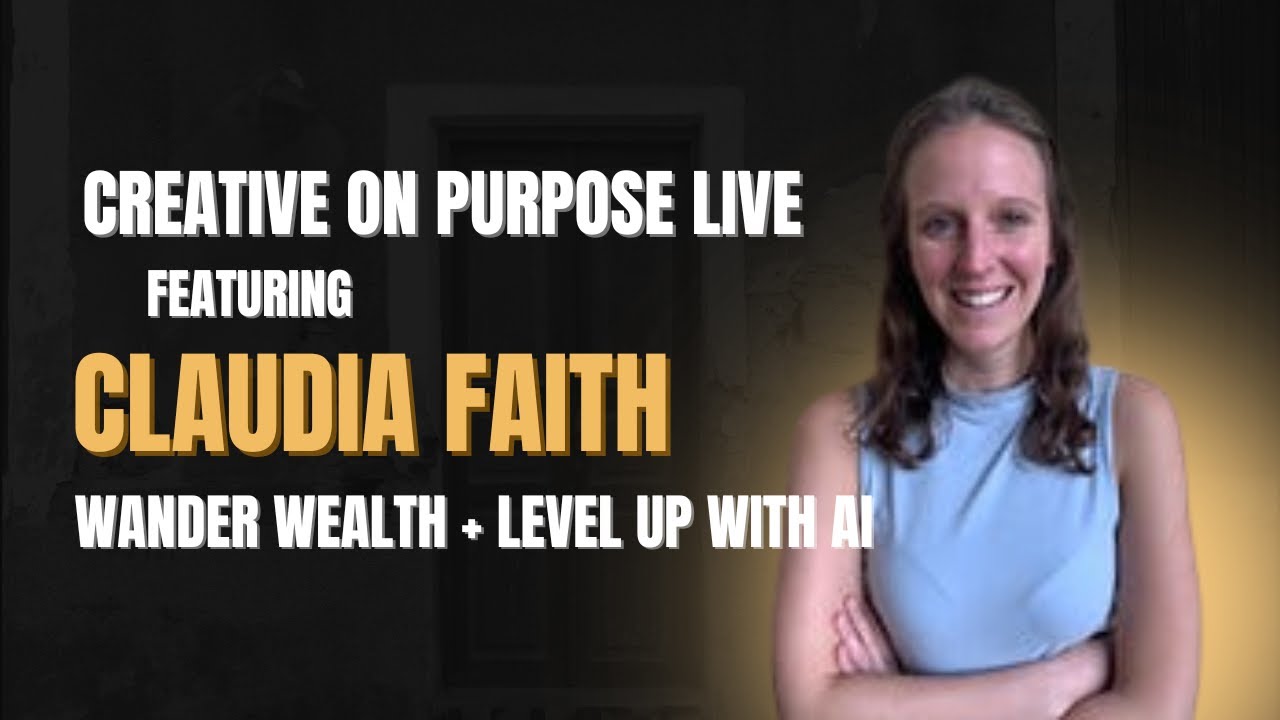
Claudia Faith, a healthcare founder turned Substack writer, discusses building freedom and impact through purpose-driven work. She uses Substack Sections to run multiple newsletters, views AI as a tool that amplifies rather than replaces her voice, and measures success through human connections that make readers smile. She also co-founded Cozora, a community focused on ethical AI use.
Chapters
Welcome everyone to Creative on Purpose Live. This is a show dedicated to sharing insights from inspiring difference makers who are doing work that matters with people they care about. I am thrilled today to have my friend Claudia Faith here today. Claudia, introduce yourself to everyone that's coming in and tell us a little bit about who you are, what you're up to these days, and where can we go to learn more about you and the difference you're making.
Yeah, thank you so much for having me. Also for people listening, please, I mean, I hope that's okay, but feel free to write things in the chat. I always love to have the live sessions a bit interactive. So if you want to know more, just jump in and ask a question. But yeah, so I'm Nina Claudia. Claudia is actually my second name and I am from Germany. So I'm right now in Berlin in Germany. Very gray December weather. And, um, yeah, I write, uh, Wonder Wealth and Level Up with AI, which I just rebranded yesterday, uh, on Substack. Um, and one, so those are my two publications. It's a little bit into writing, community building, uh, earning online with your words. And then the other one is really into, um, AI and, uh, yeah, basically making things work with AI nowadays. Um, my background is a bit different. I'm actually a classical entrepreneur, um, founded startups before. I have my healthcare startup that is still up and running. Um, but was very tired and stressed by investor updates, investor emails, investor pushing. And, uh, yeah, so I, last year I decided to go, um, my solopreneur journey and here we are. Here I am.
Well, you gave us a little taste of some of your background, but I'd like to go a little bit deeper because one of the things that I, I often find with people that are entrepreneurial or solopreneurial minded is that a lot of, you know, I don't think that any 9-year-old wakes up and says, oh, you know what I want to be when I grow up? I want to be a solopreneur. But there are hints about how we come to be doing what we end up doing. In our childhood interests and desires and affections and all that sort of thing. So I'm just curious, what are the elements of your personality, your preferences that you think really inform and inspire what you're doing now?
Yeah, I mean, I think it started, I mean, so I come from a family with very strong healthcare background. So I was always on the edge between like, hey, do I want to go the medicine route? I got into university for medicine, but then decided somehow that's not really what I want because I wanted it to be a little bit more, I don't know, I wanted more freedom and more like willpower of doing things on my own. Um, I got into consulting. It was my first corporate job with, um, KPMG in one of those big consulting companies. And I absolutely hated it. I found myself crying in the bathrooms. It was really like just a horrible experience. And, um, and I said, okay, this is not for me. Um, and then I jumped more into the startup world and said, okay, this is so much more my thing. Uh, ended up in one of those big accelerator companies that just like pump out companies every 3 minutes. Um, and felt very much, again, this doesn't have any impact. I actually built like price comparison websites for Southeast Asia. I don't know, it was horrible. It just didn't have any impact. And so it was, thinking I want to do more with healthcare, more, yeah, somehow like changing or, yeah, just having an impact on people's lives. And yeah, I don't know about my childhood if that was already a thing back then, but that's a bit my, my journey of how I ended up here.
That's really fascinating. Well, there's, there's two, two themes, two strings to maybe tug on a little bit. One is you, you talked about the desire to have more freedom for yourself, but you also wanted to have a a greater impact on other people and those around you. And I think that a lot of the folks that are drawn into the Creative on Purpose Substack are self-identifying as purpose-driven solopreneurs that would like to just make a slightly better living doing work that matters with people they care about. So I'd love to just hear a little bit more about when— I think the other thing about your story is also true for a lot of us is we figure out what we want to do by, by first doing a lot of things that we never want to do again. And so it sounds like your journey helped you define freedom as a goal and impact as a goal. But how do you define freedom as a solopreneur? And what does that look like for you on a day-to-day basis?
Before I answer that, can I just ask a question also to you and just Because I'm curious, when you say a lot of us have to go through things and find out things that we don't like, do you have some examples for yourself about that?
Oh, for sure. I graduated from school thinking I was going to be a schoolteacher. I actually got a job at a very well-known, famous private academic institution. I worked there for a few years and realized that as much as I love teaching and working with young people and helping them, you know, define their purpose in life and help them step into possibility with their lives, that the admin part of it and dealing with administrators, dealing with entitled parents, you know, it was not— the juice was not worth the squeeze. And so I tried a bunch of other things, including being a manager of a startup restaurant, which was very very profitable for me, but also very stressful. My first son had just been born. I had a cardiac incident at the ripe old age of 26. And the doctor that examined me said, "Hey, if you want to live to see your 30th birthday, you should probably find another line of work." And that was all I needed to decide that I really wasn't cut out for working for other people and that chasing money or status was not for me. And that's when I decided to become a musician. And I decided that my wife and I just had a conversation. If I can make enough today to do it again tomorrow, I'll do it until I can't do it anymore. And that was the only permission I needed. So I've never looked back. I've been I had a 30-year, uh, profession as a professional guitar player, guitar teacher, guitar studio owner, um, and now I'm doing what I'm doing now thanks to a runway that Seth Godin provided me with when I, uh, through the work I did with him. Um, but yeah, I first had to get— learn that hard lesson. Like, this is, this is not who you are and this is not what you should be doing.
Yeah. And are you still following that musician path on the side, or is that something you don't do anymore?
I, I, I was a professional musician for almost 30 years. I had a studio for over 15 years. I still teach a little bit on the side because I want to be able to keep my skills up to teach my grandsons. But, um, you know, I did music until music was no longer my calling, and that's a big theme of my life is I listen for what life is calling me to do, and I figure out how to make that calling work for me and for my family. And so now music is still an important filter for how I think about the world and make sense of it. And it's definitely everything I learned as a professional musician and how to make a living and make mortgage payments and car payments and put kids through college, even, you know, without being a household name or signing with a major label, still informs and inspires what I do with other purpose-driven solopreneurs today.
Yeah. Wow. Have you ever done a, a Substack Live with you playing guitar?
I actually started one off playing the ukulele, and the microphone settings on Substack Live do not play well with musical instruments or singing. Um, we have to fix that. But yeah, you never know. I— there's actually a secret project at the background, uh, where I'm going to be doing some, some music-related things, but I'm waiting for Substack to catch up.
Yeah, hopefully they do.
So enough about me now, Claudia. Quit avoiding the question. I want to hear about you. And what does that freedom look like for you? And how do you define it and how do you live it every single day doing what you do now?
Yeah, I think freedom, I mean, there's a more practical level and then there's a more abstract level, I think. But I think in more practical terms, I really can't stand it if my time is dictated by someone else. And that starts with, you know, somebody books calls for me that I don't want to have, or somebody tells me, okay, this and this time you're not allowed to go on holidays. And I mean, it's so, I don't know, it's so, I mean, obvious you, obviously you can work in a team, but I think, you know, this standard, um, employer-employee, you know, relation, it's so, it's so weird. I feel like we lost all kind of. Humanity there, you know, like you're really dictated by someone else's ego and rules and, and I don't know. So I think for me, freedom is really very much just being able to structure the day, the week, the life that I want on my terms. Um, yeah. And then on a more abstract level, it's, you know, if you look at, I don't know, like some of your life values that you may have defined for yourself. Being able to bring them together with work values, you know, like the, the things that you value about your own working time. And yeah, so I think that's, I don't know, more practical and more abstract definition for me of freedom.
Yeah, well, I think that's fantastic. I mean, we think of freedom often as like freedom from doing the things we don't want to do, or freedom to do the things we do want to do, or freedom of in the United States, freedom of assembly and so forth. But then there's just freedom. Sometimes when people ask me what I do, I just tell them I do whatever the hell I want because my schedule literally looks like I spend every weekday morning with my grandsons taking care of them. And then in the afternoons, I have what I call flex time, which is if I have some work to do, some client work to do, I will do that. And my wife will take, take over the grandparenting duties. But if I don't have any work to do, I can, I take naps with my grandsons. We go to the, to the playground, we go to the coffee shop for treats. And, and that's like literally my schedule because my work is done in that 5 AM to 7 AM window that begins my day. And so everything after that, and that's Kind of leads us into the, you know, what you just shared about freedom leads us into the impact piece because the other piece of working for someone else or in someone else's business is, you know, you're running a race that oftentimes you don't want to be in and you can't win a race that you don't want to be in. But, you know, when you're doing your own thing, not only do you have the opportunity to create time freedom, maybe revenue freedom, but there's also that freedom to actually make a difference for your— to build a life of fulfillment and meaning doing work that matters. And so when you talk about impact as one of your core reasons for doing what you do now, what does that look like for you? How do you find impact and what's the impact that you're trying to make?
I think maybe on a smaller scale, but just having a tiny positive influence in someone's life and it could literally, and that's why I love actually Substack so much. It's really, if your words can reach somebody and just make them smile or just make them, you know, feel a tiny bit better about whatever it is about their day, about their situation, about whatever they're in. I think that's an amazing impact to have, you know, and I feel One example I love to share is, you know, my community on Substack, they give me so much incredible positive feedback and it's so, so fun to interact with them and I don't know, and that's something that I think in the beginning of my Substack journey, because I don't have any online solopreneur community writing experience, right? That's actually not my background. Um, and when I started that journey last year, I was really thinking, okay, this is insane. Um, I've gotten within a few months, so much positive feedback I've never gotten in my entire life from any team or management or whatever I've worked in, you know, and that's crazy. So the impact I may have, it's coming right back at me, um, which is so motivating and inspirational to me.
Yeah. Well, I love that. This is one of the reasons why I'm so drawn to your work and follow your Substack and have implemented some of the tools and tactics that you teach in that unlike a lot of other folks that are in the kind of Substack growth hacking space, You keep underlying the possibility and the virtue of doing what you can with what you have with the people that are around you. It's not about scale and trying to reach and all those things that we normally chase. Like you said, if you can make a difference with one person, if in one conversation you provide one insight that helps, and you've done this for me, that has an impact on their pursuit of prosperity and purpose-driven work, then that can be considered a win. And the other piece that I'd love to hear more of your take on is what, as someone that also tries to, tries to live the virtues of going small, like smallest viable audience, smallest viable offer, smallest viable step into possibility every single day. The things that we don't see are the ripples. It's like the, the real ROI, not the return on that investment, because that will come. It's the ripples of influence. Like if you have a positive impact on one person and that person has, has an impact on another person, and of course you and I are, are going to have more than one person impacted by our work on any given day, but if So if we help 10 people and each of them helps 10 people, then we just initiated a virtuous cycle of generosity and impact that is 100x. And we can't tell how many circles of influence that ripples out into. So when you think about that, or when you— and just curious if you see that in the things you're doing, and then I'm going to share an example of something that you shared with me that had a a big influence that is already impacting members of my community?
Um, you're asking me if I have an example of that?
Oh, just, just how you think about that. Like the fact that you're, you're willing to just go small and say, I'm just going to try to help the people that are showing up that are here right now with what I have, do what I can and trust that everything else will play out in everybody's favor.
Yeah. Yeah. So, oh, I 100% believe in that. I really think the— I like to also, I mean, I'm not, I'm not actually a very spiritual person, but I like to believe in karma. And I really think that good things happen to good people. And, you know, if you just show up by yourself and you're giving, something will be given in return. And of course, I mean, you can say all those things and still treat it also as a business, right? I think like those things doesn't have to contradict each other. Um, but yeah, I 100% believe, you know, if somebody likes what we do, then they recommend it to the next person and then, you know, it does, it does have a compound effect. Yeah. Let me just say one thing because I, I saw Magic Mika, uh, uh, right in the chat and now also, uh, De-Stress Your Mind. I am reading all your comments and I'm very thankful for you guys being here and writing. So yeah, just that in between.
Yeah, likewise. I have not been shouting out because in case you can't tell, I'm quite a bit older than Claudia, so I don't see on this mobile device as well as she does. But I've seen Magic Mica being very active and we really appreciate that. And if you do drop questions in, for either Claudia or myself, I will do my best to look at that section of my glasses in my bifocals that let me see. I guess one of the things that you helped me with very recently, and I'm actually asking, I'm maybe asking for a little free coaching on this too, but you I had no idea. I'm someone that teaches more from the place of philosophy and principles. And so I definitely am always interested in what are the strategies, tools, and tactics that will help me better live my principles and help me accomplish the things that I want to accomplish or that I believe I can accomplish. But I'm not I don't spend a lot of time exploring note strategies or, uh, how all the tools within Substack for how you can make your publication look. And you sent something out not too long ago about Substack sections, and it blew my mind because I didn't even know that sections existed. I didn't know that we could create those calls to action for subscribers on our homepage and so forth. And I had literally just started a second publication because Although I love helping other purpose-driven solopreneurs attain greater prosperity and optimize their business to fund and fit their life, there are other things that I have done and love to do along the lines of helping people navigate life transitions and live with greater purpose and prosperity in whatever their what's next is. And so, when I saw the sections and what you were doing with them, I said, oh, I didn't have to have a whole additional publication. If these two things are related enough, I can have a section that's just talking about Transcendent Solopreneurship and have a section that's just talking about The Art of Encore Living. I can even have a section talking about the random stuff that comes into my brain, you know, as, as the founder of Creative On Purpose. So I completely redid my homepage. I created the sections and it helped me organize all of the content. I had 2 years worth of content, 2 years worth of podcast episodes. And it has been an incredible boost to my sense of fulfillment because now I can express everything that I want to talk about and everything that I do. And at the same time, it's now all in one place. So, I don't feel my attention and energy being scattered through all these multiple publications. And now, all of the members of my community are, you know, their ears pricked up and they're like, "Hey, can you teach me how to do this?" And I usually just say, "Well, you should really talk to Claudia because this is obviously not my thing since I'm so late to the party." But, I wanted to share that in part because it really did help me navigate through a difficult patch where I was not necessarily wanting to do a second publication, but also couldn't ignore the fact that I wanted to talk about an adjacent topic, but not something that was actually on topic. And we already have people asking about sections. So maybe you can speak a little bit to that.
Yeah, yeah, for sure. I mean, thanks for sharing that. That's awesome. You never know who, like what impacts who and if they talk about it. So yeah, that's awesome. I mean, sections are in the end, it's just a way of categorizing your posts and you can create those little, it's like tags, but it's not tags, but you can make a post stick to a section. And the beauty about it is that then you can actually, it's automatically, you know, creating a kind of like a landing page with all the posts being like listed underneath that category, underneath the section. And you can then structure your publication homepage with the sections. And that's, I think, very helpful. So in my case, I have posts for getting started on Substack, for example, and then Substack tips and tricks. And so by setting the section to each post, it then, you know, takes the post and puts them in the right category, in the right section of, uh, on the homepage. And it's just, uh, very helpful. Yeah.
Very, it's spending it to my understanding. It's really only easily visible when you're on a desktop device and not, not, not a mobile device, but for those of you that are asking additional questions, if you go to the Creative on Purpose Substack, you'll see that there are very clearly defined sections for the, all the various kinds of content that I'm putting out, and it might help you make sense of it. And if you have additional questions, Claudia has already written a fantastic article that I used exclusively to blueprint mine. So that, that leads us to another question I had for you because you did talk another thing I saw when I was starting my second publication, which is now no longer and wrapped into my initial publication, is when you start a second publication, it's going to probably take longer to get some traction and build an audience and all those sort of things. But you have created one on AI. AI is a topic that we discuss quite a bit in my community. It's something that My friend and mentor Seth Godin has recently been writing a lot about something that he and I talk about a lot because it's, and it's something that you see, I think, as kind of a somewhat polarizing device issue on Substack there because Substack is a writer's platform and nobody wants to read AI, your AI-generated slop and so forth. It's like, well, yes. And you know, there, So I would love to just get your take. I would love to hear what the underlying purpose of your second publication around AI is, but I'd love to get your insights and your perspective on how even writers can employ AI tools ethically, transparently, and use it to create even greater impact and on, on their audience and the, and the people that they're serving through their publication?
Yeah. I mean, first of all, let me say that I don't think there's a right or wrong. Everybody uses AI or doesn't, don't use AI the way they want to. The way I see it, is, you know, it's a tool and you can use it to amplify your voice, you know, and I feel that actually it just makes us all stronger because if you're a thinking human being, um, and you put your own words, your own experience, your own stories out there, that now is almost like your superpower, you know, and if you use AI or not, I mean, the thing that it will help you do is just really amplify your uniqueness and you can use it to, if you want to, to write more or longer or help you structure it or help you be slower or help you be quicker. It can create images that you feel like you always wanted to create. It can help you create headlines that you feel, you know, this is really something that I don't know, I didn't know how to do in the first place. So. It reminds me a little bit because my startup journey is in, um, in healthcare and in, um, in, uh, in health tech. So I've been working in digital health for now 10 years, and it's the same with physicians, you know, like digital tools. It's so hard to break this through that, you know, it's not replacing physicians, not anytime soon, but it's supporting them, you know, it's supporting them in documenting. It makes sense of data. It makes sense of things that, you know, human can err and make mistakes, but, you know, digital tools can help them just be, you know, helping you live healthier. And in a way, I feel that's the same happening with AI and writers now. It's not here to replace anybody, but it's here to just, you know, support you wherever you need it. And that's my take on AI.
Yeah. Well, I really appreciate that perspective and I couldn't agree more. I think AI is a tool and it, you know, people can argue that it, it, it's perhaps a more dangerous tool than other tools that we might use. Um, you know, atomic energy is a tool and we can use it to power our homes and industries, and we can also use it to blow the world up. But yeah, and AI, there's all sorts of apocalyptic possibilities for what AI may or may not do coming down the pike. But one of the things that I'm hearing in what you're saying that I truly believe in is that a tool, the efficacy of a tool is really up to the user. I mean, if you're using it to try to trick and manipulate people into believing that AI-generated content is your content, it's probably not really going to end well for you because at some point you're, I mean, we can all tell when AI has played a role. And the other thing is, and I'm interested in your take on this, one of the things that I discussed, uh, with Seth Godin on a, on a call when he was doing a, a workshop in the Purple Community around AI is right now there's a lot of folks that are trying to use AI to just create more average content to, to win this like content game. Like if, if I get more of this average or slightly above average content out there, maybe I'll get more attention. Maybe I'll attract more awareness for me and what I want to do. And that's— and the other part is automation. Like, oh, now I don't have to talk to people. I'll just put them into these, you know, AI-driven automations that will push them through my funnel and force them to buy my thing. And that's that's only like one piece of the AI puzzle, and it's not the most interesting piece for me. I'm always thinking about what can AI do, and you said this earlier, to augment and amplify the difference I'm already making so that I can have a greater impact in helping the people that I serve collapse time to target between where they are and where they want to be with greater ease and velocity. And that has nothing to do with generating more average content or trying to automate things that shouldn't be automated. Because the thing that AI can't do right now is what we're doing. You know, we can't— they— it can't connect on a human-to-human level. It can't communicate. It can't collaborate like humans can, and it can't yet create or co-create. It can be a co-creating partner, but it can't create like we can. And so I'm always thinking, okay, so of all the things that I'm still better at than an AI, how can I leverage AI to help me amplify and accelerate that so that I'm still leading the pack in making the difference only I can make in the way that I can make it and do that in service for the people that I want to help. So that was kind of more of a ramble than a question, but I'd love your take.
Yeah, no, I, I 100% agree. I mean, I, I think that's exactly it. And really, I like to emphasize the point that I think with all this AI content out there, um, it's really gonna be your superpower to be human and to write your own stories and to show up, to show that you're real. I think that's also why, I mean, maybe, but I, I think Substack is pushing so much for more live content, uh, content like we're doing now. Um, to also, I mean, they want to be like a whole online platform and like your online home, but also to be like, hey, this is also what connects humans to each other, right? Like it's different than just reading words that with or without AI has been written. But, um, yeah, so I think, I think it's going to be more your power if you just show up and be yourself and show that you are. Not a bot.
Yeah. Yeah. Well, I think just to underline a thing, couple things that I think we're both saying. The first is if you don't want to use AI, don't use AI. Like the whole premise of my business is you can build a business that funds and fits the life you want without doing anything that you don't want to do. And so there's a great, this is a great positioning move moment, like there's nothing about what I do that's touched by AI. Like there are people that want that experience. And at the same time, if you are using AI, I think one of the questions you can ask yourself, or one of the things you can filter is just because I can doesn't mean I should. Like, do I need to generate more content with AI? Because you probably don't. You probably need to create more connection with the content that you're already creating. How can AI help you with that? You know, do I, do I need to offer more ways, you know, create more offers with AI, or do you just actually have to help people get clear about closer to what they want through your offer, your existing offers leveraging AI tools? So there's, there's lots to chew on and lots to think about there, but I love the things that you're, you're writing about in that publication. Do you mind just sharing the name of the publication again for those that are tuning in?
Yeah, since yesterday it's now called Level Up with AI, and actually it fits quite well because before it was called The AI Soloist, and it was kind of, you know, like how can writers and creators use AI to to be quicker and faster and whatever. And I kind of wanted now to position a bit away from this because it's exactly everything that we just shared is, you know, people can use AI or they don't. And I will also continue to write some helpful tips here and there, how I use AI in my writing journey, but essentially where I think right now it makes the most sense is I think I want to help more companies adopt AI, you know, because I think that's less, and I think somebody wrote a comment earlier about this. Um, then it's more like for a, for business where, you know, AI automation, all those things really can make a difference, just like digital tools have. While for your creative, more individual journey, it's actually quite nice to not overuse AI. And that's a little bit how I'm positioning myself more and more. And that's why since yesterday I rebranded it. Um, And, uh, and yeah, and you will also find some content on there about Cozora. Um, Cozora is something that I co-founded, uh, 2 months ago with, um, 2 other Substack writers also. And there we're actually creating like more of a community around AI and we bring in people every week who share their screens. Literally, we had a session last night where, uh, Jenny Ouyang shared her screen and just shows how she uses AI. And I love it because it gives you more of, um, insight of what can be done, what shouldn't be done. We have an open discussion about it, and that's something I'm very proud of because I think it's a really cool project, actually.
Yeah, I love that. Well, I, I have lots of other questions for you. I do, I do want to be respectful of your time, but, uh, I have a final question if you don't mind. But I also wanted to— is there anything that you would have liked to have talked about or were hoping that we would talk about that we haven't addressed yet?
Um, to be honest, not really. I came with a very open mind and I'm very— I, I love this, this talk. I thought it was very nice. I loved also that we talked about freedom, uh, about impact, about purpose. So yeah, no, I think we touched everything. Yeah.
Well, a lot of the folks that are part of the Creative on Purpose community as free subscribers or Circle and Inner Circle members, are leveraging Substack, uh, as part of their business growth strategy, but they're not really focused on the paid subscriber model. And, and it's something that I'm not necessarily concerned about because I'm able to make plenty of money on the back end through offers that, that, that happen. And so for— and I, and I know that You know, you have, you have a bestselling badge, obviously you, there's that recurring monthly revenue and that's wonderful and, and to have and so forth. But I do know that you also have a model that allows you to earn much better living regardless of whether or not you maintain a certain number of paid subscribers. So I, I'd love if you don't mind to just kind of close with your thoughts or strategies about how, how can someone leverage the audience they already have, even if it's just, you know, a few hundred or a few thousand, but they don't yet have that bestseller badge, but they still want to leverage their SubSec publication as a tool for revenue generation, business growth, and attracting more of the right people into their offerings.
Yeah. Um, yeah, I mean, my first thought is it's good to diversify your income. So only, you know, relying on one thing never makes a lot of sense. Um, and paying subscribers can be, um, a part of your strategy. And I still think that it probably should be at some point if you want to make Substack your online home, just because I think that's how Substack makes money, right? And I think the more the platform grows, I think they have to somehow prioritize or push the thing that makes money for them unless they go into the route where they push ads onto the platform. Yeah, then this doesn't matter anymore. But as long as they don't do that, I think they, you know, I think going with a paid subscription model is not a bad idea, but it doesn't have to be the only thing you do. You can do, and I think especially having talked about AI, um, offer more and more things that are community-based and that are human-based. You know, you can start with offering like a free— I have some premium members that offer for their communities like free member calls. You can create a connection with people, um, some kind of coaching calls. Um, and then you can know, you can build it step by step into something that pays, but you have to have this initial trust within people, between people, you have to somehow start building community around yourself. And it always starts with you, you know, in the beginning, I also didn't know what it means to, to show up and build your brand. Um, but it's really, you know, just show up as human, be yourself, be authentic. And that's how you're going to collect the right people around you. Yeah.
I, well, I really appreciate that insight because it's actually my entire business model. Which is show up as you are with what you have, do your thing, and let people watch, and your people will inevitably find you. And that point that you're making that I think is one of the primary takeaways from this conversation is that as AI plays more and more of a role in all of the tools, tactics, and strategies, the thing, the edge to lean into is where is the human-to-human connection, communication, collaboration? And certainly it's a big piece. The primary benefit of Circle or Inner Circle membership for Creative on Purpose is we meet 3 times a week. There's 3 calls that you can join and 2 of them are just like Hey, let's just go into breakout rooms and talk about interesting things that might inspire us to show up half a shade braver and more purposeful in what we're doing. And the third call is you can sit in and watch Scott Perry coach his one-on-one clients in hot seat sessions and learn over the shoulder. And those three simple benefits cost me less than 2 hours a week. And it's the 2 hours that I look forward to most every week. Those are the things that really matter. And so, and I love your point too about diversifying income. Like if you're going to build a business around paid subscribers and something happens to Substack, you're going to be in a world of hurt. And every Substack goes, or every platform goes through a cycle and there are some that are longer around. So Buyer beware. So, as we're wrapping up, Claudia, I always like to end with one final insight from the folks that I'm talking to. If there was just one final quote or principle or idea that would help the people that are tuning in now and tuning into the replay step into possibility with a little more courage, a little more purpose, and step into a life of greater prosperity and meaning, what would you share with them?
Yeah, I share what I, what really became my motto over the last years, and it's just 3 words, but it's so true. It's, uh, trust the process. And, you know, it's so, I mean, and you laugh at it. Is that also part of your—
it's, it is part of, it is part of our, our mantra because, and it's something I learned again from Seth Godin. It was It's on a coin that he gave us in the alt-NBA. It's somewhere on here. It says, "Trust the process." But we also have a saying in our community that the process is the shortcut. And that's something that I borrowed from the Guardian Academy community. And in order to trust the process and allow the process to be the shortcut, you have to also learn to trust yourself.
Yeah, that's nice. Yeah, great words to end this. I think that's perfect.
Yeah, exactly. Well, I really appreciate the gift of your time and you lending your experience and wisdom with us, Claudia. It's been delightful to have this conversation. I've been following you ever since I got on Substack, and it's really had a huge impact on my prosperity and informed the purpose of my publication. So, We thank you. We thank all of the folks that have joined in. We see a lot of you are joining in right now. And I'm sorry that you missed the meat and potatoes of our conversation, but it will be up in replay very, very shortly. And we'll look forward to seeing you all wherever we see you next. Check out Claudia Faith and her two Substack publications. And of course, you're always welcome to check out Creative on Purpose. And so everyone have a wonderful weekend. And until we see you next time, be well, do good. Have fun.
Thank you. Bye-bye.
More from Scott



Stoics Don't Suppress Emotions, They Do This Instead #stoicism #emotionalintelligence #mindset







