The Surprising Truth About Making Decisions Nobody Tells You
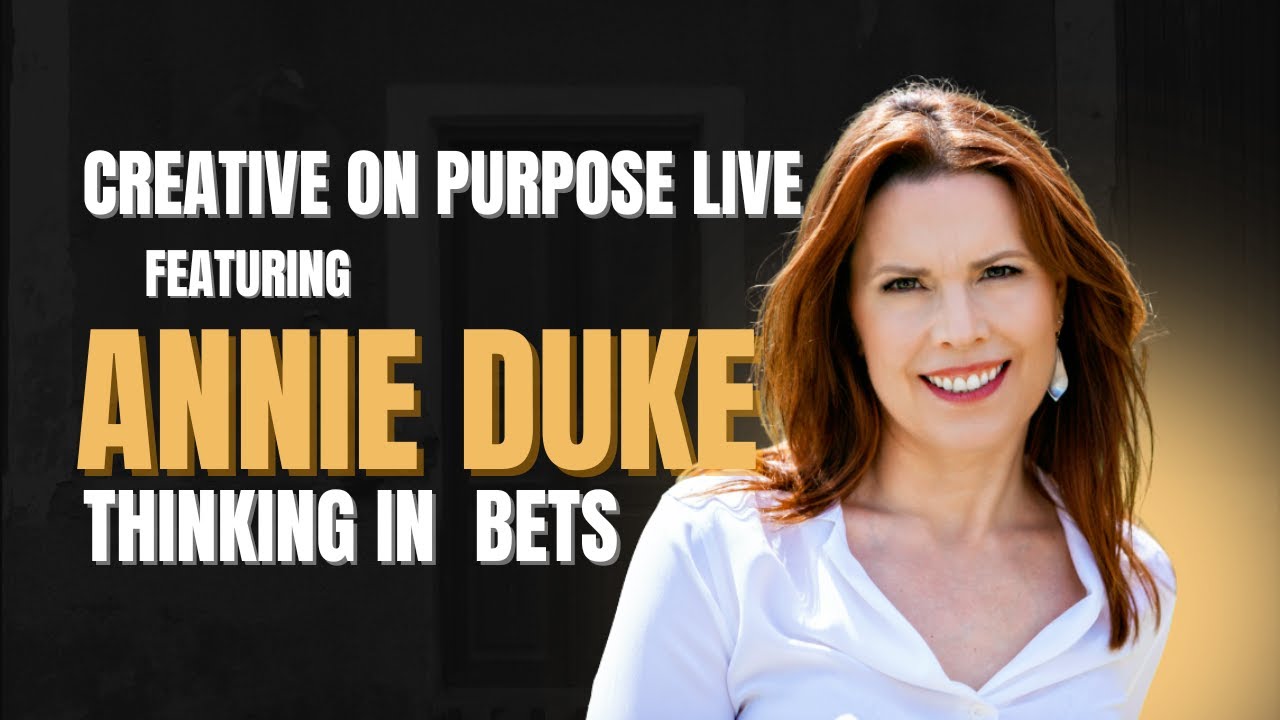
Annie Duke, a former poker champion and cognitive psychologist, explains why we mistake lucky outcomes for good decisions. She describes three biases that trap us: resulting (judging decisions by their endings), confirmation bias, and availability bias. Duke's concrete fix: start with base rates, get outside opinions before sharing your own, and separate facts from opinions.
Chapters
for StreamYard to say that we are live. Check your pulse, Annie. It says we're live. I feel alive and grateful to have you with us for sure. I want to welcome everybody that's tuning into the broadcast and welcome you to Creative on Purpose Live. To learn more about Creative on Purpose, visit creativeonpurpose.com and get going with the difference only you can make. Remember that this broadcast is also an iTunes podcast. Check it out and leave a 5-star review. 30 seconds of your generosity helps spread the goodness delivered by my guests. Let's get to today's show. Welcome to Creative on Purpose Live. These conversations are about flying higher and the difference only you can make. Endeavor better. It's time to be creative on purpose. Are you ready? Let's go. I'm your host, Scott Perry, author of Onward and Difference Maker Coach at Creative on Purpose and Akimba Workshops. Visit creativeonpurpose.com to start doing better work by By making better decisions. This season, we're drawing insight and inspiration from guests who are successfully embracing uncertainty, navigating adversity, and making things better, doing work that matters. Let's meet today's guest. Annie Duke, welcome to the broadcast. So great to have you with us. Please tell our viewers who you are, what you're up to these days, and where online can they go to learn more about you and your fantastic work?
Oh my gosh, that's actually a little bit of a harder question than you could think, 'cause it's on so many different things.
I'm a little scattered.
No, I'm focused. So yeah, so I started off my life as an academic. I was studying cognitive psychology. I did 5 years of PhD work at the University of Pennsylvania, and then took, I guess, what you would call a hard left and became a professional poker player. And I did that for 18 years. I won some world championships. That was pretty fun. But about 10 years— about halfway into my poker career, I started actually thinking about cognitive science and behavioral psychology, and particularly decision-making under uncertainty. And I started giving talks and writing about it and started to consult about it. And then in 2012, I retired from poker and started focusing on decision-making under uncertainty and, and that consulting work and academic work that I kind of come back to. I wrote a couple of books in that period since then. Thinking in Bets, and then my new book, How to Decide. I'm working on my next book already. And I consult and I teach and I'm doing research at UPenn. And yeah, and I'm also a mom of 4 kids that I adore.
Wow. Well, I did not know about that last piece. And one of the things that I just learned is that the interest in psychology and neuroscience came after you had already had your career as a poker champion. Am I getting that right?
Actually, no. So it started before that. So what happened was I was intending to become an academic. So I did 5 years at UPenn studying cognitive psychology. And under the umbrella of cognitive psychology would be learning, decision-making, that kind of thing. And I was thinking about those issues of how do you learn under uncertainty. And then I took that hard left into poker. And what happened was in 2002, I got asked to come— speak to some options traders in finance. And they wanted me to talk about how poker might inform their thinking about risk. I sort of ended up tangentially talking about that because what I really talked about is that this conversation that poker, which is obviously the ultimate decision-making problem under uncertainty, right? There's lots of luck. You can't see the other player's cards. And you got a lot of money on the line in terms of that decision-making problem. So you have to get pretty comfortable with making decisions without very much information. You sort of have to let go of at least short-term control of your outcomes in order to get to those long-term wins. And I thought about how that actually sort of had this very interesting conversation with the cognitive science, the Kahneman type of work, for example. That is what I actually talked to them about. And then I start— I just realized like, oh my gosh, like, this is my thing. Is I happen to have done these two things in my life. They interact in this really interesting way. And I just fell into it and ended up really focusing most of my time on that from that point on.
Yeah. Well, I love both of your books. I just finished How to Decide and had read Thinking in Bets prior to that. And I see them as very two different books, but also very complementary. So just for viewers that may not have tackled either one of those yet, can you kind of share like what the distinction is between the two titles and how they might work together?
Yeah, sure. They actually— they're actually meant to work together because the reason why I wrote the second book, How to Decide, is because lots of readers of the first book were essentially asking me to. So the first book is really talking about, you know, the problems that we have with making decisions. When two things are true. One is there's just luck, right? So, you know, I can— simply put, I can go through a green light and still get in an accident. And that's a pretty simple decision. So when we get to more complicated decisions like who to hire or what job to take or what college to go to or, you know, who to marry or anything like that, or even like, you know, what strategic plan should we, you know, which things should we develop, what products should we engage in, should I start a business? You can imagine that If there's so much luck intervening and just getting through an intersection, think about how it explodes once you get to more complex decisions. And then the second problem is, and this is true of an intersection as well, that when we're making decisions, there's just a whole bunch of stuff we don't know. Like the stuff we know sort of would fit on the head of a pin and the stuff we don't know is the size of the universe. And you can see that like when you go through a traffic intersection, here's what you don't know. You aren't 100% sure that the light is working. Right? Like, it could be that the light for the people coming from the other direction is green when yours is green. You, you actually kind of don't know. You don't know what kind of repair the other cards are in. Yeah, like, you don't know if someone's drunk. Like, there's just a lot of stuff that we don't know. And again, when you start to get into things like— think about just something that you do a lot of, like hiring, right? There's so much you don't know about that candidate because you don't have a time machine and you're not omniscient and you don't know how that person is going to perform in the job. Which is part of the reason why half of hires are kind of failures. Not surprising because these types of decisions are just really tough. So Thinking in Bets is really walking through what are the problems that we have as decision makers because of this uncertainty, those two forms of uncertainty, hidden information and luck. How are we supposed to process the outcomes in our life when it's hard to know whether that outcome is because you know, we got bad luck in the case of a bad outcome or good luck in the case of a good outcome, or maybe it was because we made a great decision that got us that good outcome, or we made a bad decision that got us the bad one. And that's actually a really, really hard problem to untangle that makes it really hard for us to kind of figure out what's true and what types of decisions would work in the future. Should we repeat a past decision or not? So that's really what Thinking in Bets is talking about, is talking generally about that problem with what I would say is like a smidgen of some ideas for solutions. So what happened was people started asking me, hey, could I get more than a smidgen? Like, I'd really like to understand, given that there's so much uncertainty and given that we have this problem of like, you know, what's luck, what's hidden information, how do we become a better decision maker in the environment that we have to make decisions? How exactly would I go about doing that? So I realized that I had written this big why book with Thinking in Bets, but probably I needed something that was more of a how book along with it. And that's what How to Decide is. So How to Decide does cover lots and lots of new material that enhances, I think, the themes of Thinking in Bets, but it also has a very, very practical component that actually walks you through what a good decision process would look like. So I think you could read them just one or the other, but if you companion them, you'll probably get a lot more out of them.
Yeah, I couldn't agree more. I did see Thinking in Bets as more like of a meta thing. And How to Decide is just very practical and tactical and lots of— and what I also love about that book and both books really is you bring in lots of scientific proof and lots of case study, some of it from your own, you know, experience as a poker player, but other experiences as well. So it's not just theory, it's actually scientific provable viable information that you can start to approach your own decisions with. What do you think? So you've touched on this a little bit about what conspire— what's the thing that really conspires against our ability to make decisions? Do you think that human beings are programmed to be decision makers? Is it the stories we tell ourselves about the decisions that we're making, or is it the conflating of decisions with outcomes that's getting in our way?
Oh my gosh. Well, I think that they're all related to each other. You know, I think that the problem is that the kind of time horizon through which we think about our individual decisions is a little weird. It tends to be a short-term time horizon. And if you think about it, that's not surprising. Why would you have that pressure on a person? Well, you know, the way that I put it is like if you're on the savanna and you hear rustling in the leaves, you probably shouldn't spend too much time trying to figure out whether that's actually a lion. Like, our ancestors who just ran away did better in that situation, right? So we can think about like a life is built out of every day that you survive. And so we tend to have these very short time horizons. That's kind of number one. And then number two is that we really have this need to have a positive self-image. Right? So we get these kind of reinforcing patterns where we like to reinforce the beliefs that we already have. So this creates a twofold problem. One is when we're looking at other people and their decisions, we get this resulting pattern. And that resulting pattern comes from the fact that decision-making is really messy. It's really hard to know if I'm looking at a decision that you made or like the example that I use in, in Thinking in Bets is Pete Carroll calling the pass play at the end of the 2015 Super Bowl that gets intercepted. Now, the decision process for him is actually quite complicated. I would have to draw out a decision tree and there's lots of probabilities in it and I have to bring options theory in it. And if I did all of that, I could show you that that was a good decision. But because the ball got intercepted and he lost the game, we do what Kahneman would— Daniel Kahneman would say is a substitution. Bad outcome, so we'll substitute that in for the more complicated judgment of whether the decision itself was good. And that makes us be able to be speedy, even though we would really need to look at that in the aggregate, or we could do a simple thought experiment to say, if it was caught for a touchdown, don't we think it would be the best decision ever? So we tend to tie those things too tightly together, a little bit because, you know, we'd like to conserve energy, we want to survive to live another day. And so those kinds of quick decisions can serve us well in some circumstances, but obviously not in the long term. Now, when we get to our own decisions, this is where we really get a problem, which is that we really reason to affirm the things that we believe. We want to feel good about ourselves. We want to have a positive self-image. And what happens is kind of twofold. One is that when we encounter information, we'll pay more attention to the stuff that confirms our beliefs and will really work to discredit or disprove the information that doesn't confirm our beliefs. So we think that the information is in the driver's seat. Like, if I see information, obviously I'll just update my beliefs. But it's actually the reverse. Our beliefs are in the driver's seat, and we sort of update the information to conform, or our thoughts about the information to conform with our beliefs. And then we have sort of like this apex belief, right, which is, I'm a good decision maker. And that then creates another problem, which is because of uncertainty, because of luck and hidden information, when we have a bad outcome, we could all— we always have the option to say, well, I just got unlucky, or like, how could I have known? And when we have a good outcome, we sort of ignore luck and we say, oh, that was because of skill. And I think like one of the best examples of this is if you look at people who get in car accidents and you look at their insurance reports, almost 90% of them say it was the other person's fault. Now notice that allows me to still believe I'm a good driver. Now this is the really nutty thing. If you look at single car accidents, I'm the only one on the road, 39% of people say it wasn't their fault. So like, even in a case where you don't even have another person to blame, you still somehow manage to find a way to it not being your fault. Now, this is what I'm saying about the time horizon, is all of that serves us really well in the moment, right? I get to continue to feel good about myself, I get to maintain my beliefs, I don't have to rethink my identity, all of that. But in the long run, that's really bad because we end up just taking all of these really bad lessons. If the car accident is your fault, I should, you know, I should want to know that so, so that if it were my fault, I can then change my driving habits. But I give up that long-term benefit for the short-term benefit of saying I didn't do it.
Really, really fascinating. So just want to say that as a longtime Patriots fan, I think that Pete Carroll, former coach of the Patriots, made a great decision and it resulted in a great outcome.
Both things can be true.
That's exactly right. Exactly right. I love, I love all those distinctions. So I want to get a little bit into your story too, but one, one last question about the book and something that people watching can take away right now. So if you could only offer like what, like, so we have all these biases that we're born with and that we cling to and we cling to our beliefs and cling to the stories we tell ourselves about ourselves and about other people in our situation. And, you know, we want to always in terms of status B, feeling pretty good about ourselves. What is a, uh, a tip, a trick, a hack, whatever you want to call it, that will help us cease that self-fulfilling self-narrative and start to look at things a little bit more objectively and start to make decisions based on the facts as we know them, um, or the situation as it really is, as opposed to the stories that we're telling ourselves?
Yeah, so this is interesting. So I think that people kind of had the intuition that once you learn about these things— like, what I described was called resulting. I know the result. It was an interception, so therefore the decision must have been bad. Obviously, that's silly, because if I get in a car accident, we don't know why. I'd have to know more detail. So when we get into things like resulting and confirmation bias and availability bias and all these things— for anybody who's read Thinking Fast and Slow, you'd be super familiar with these biases. I think that we have the intuition that once we know about them, we must be cured. And it's actually not so. These things are really, really deep in our mindware. These types of biases and heuristics are there for a reason. Evolution put them there. They select— it selected for them. So I think that the best tip that I have is to recognize that on your own, you can get a little bit better at it. But if you really want to get good at it, You have to figure out a way to, to do two things. One is to have as part of your decision process, always trying to see what's true of the world in general, number one. So that would be like, uh, let's say that I want to— here's a good example, and we can always see this in other people. Like, someone like wants to open a restaurant in non-corona times, and they find this location where the lease is really inexpensive, but there's been 5 restaurants in that spot before them in the last 4 years. And they're sitting there saying, "No, I'm going to open it there because the lease is cheap and I'm such a great restaurateur and I know how to do this. And I think I have like a 90% chance of succeeding." And of course, when we see that from the outside, we're like, "Have you seen what's true of the world? You think the last 5 people who opened restaurants here were worse than you?" But that understanding that no restaurants in that location fail, If we can include that in our process and say, you know, what's happened to people who are in similar situations to me, right? Like, how has that worked out for them as we're trying to make decisions? That's like a really good thing that you can do. And then understand that you can't possibly be that special. You could be a little bit special, but if every restaurant has failed, maybe you have a 10% chance. Is that worth getting the cheaper lease? Probably not. And that can help you with your decision. That's the first thing is what's true of the world in general and other people who've been in my situation, and include that in your decision decision process and don't rely on your own intuition there. The second thing is to understand that other people will view you differently. Other people will view your situation differently. Just in the case that I just said, right, when I'm watching someone who's going through all that rationalization about opening something in that location, I can see it pretty clearly. So one of the things that we really need to do is seek out outside advisors. And then here's the key: This is the biggest tip I can give. When you're asking their opinion about something, don't tell them your opinion first. Like in the restaurant case, what we might say is like, I want to open it here, but here's the differences between my restaurant and this is how successful I've been with other endeavors. And you'll tell them all the reasons why. And so I think it's a really good idea because the lease is going to give me a really big discount and I'm only losing a little in the chances of success. And I'll go through the whole story. And then I'll say, hey, what's your opinion? But it's better if I say, here's this location, here's how many restaurants have opened in the last 4 years in that situation, um, they've all failed, but the lease is really inexpensive. What do you think? Do you think that's worthwhile? Now notice I've only given you facts. Now I haven't actually injected my opinion in it, and it's not a natural way that we talk. Like, Oh, have you watched The Queen's Gambit? It's so amazing. Her story is so incredible. Oh my God, that last scene in the first episode just hooked me. And then what? I don't know. I thought the ending was really interesting. Why did it sort of stop there? What do you think? Right? When was the last time you said, hey, have you watched The Queen's Gambit? I'd love your opinion, without injecting any of your own in it. That's the best thing you could do for yourself is stop telling people what you think.
Yeah, I love that. So what I heard is try to look at things objectively, try to gather other insights, but when you're asking for those insights, only state the facts that you did in that first step and get their actual perspective and opinion, as opposed to trying to reverse engineer the result that you're trying to do by telling them a story first and then get them to agree or disagree.
Right. And And it's not like we're manipul— it's not like we're doing it on purpose. Like, we actually think our opinion is valuable, that it's important data. I mean, think about it. When was the last time, for your listeners, like, when was the last time you were in a meeting where, like, leadership was presenting options to you and they didn't tell you their opinion on the options first before they asked you yours? Like, it's not that they're trying to persuade you. It's not that they don't care about your opinion. It's that they think that their opinion is actually important to the discussion. And at some point, it's important to the discussion. But not before I find out what you think. And that's kind of the thing is that what we're trying to do here— here's the thing, human beings like to live in, in the areas of agreement, right? Like, this is— we can see this like on Twitter, right? Like, I mean, sure, there's fights going on, but if you look at your follows, you're mostly following people who agree with your points of view. I'm guilty of this myself. If you look at your close friends, how many of them have really strong disagreements with you? We like to live in agreement. And when we're in meetings at work or when we're having conversations with friends, we tend to linger on the areas of agreement. But the thing is, the areas of agreement aren't that interesting, right? Like, okay, so we both believe the Earth is round, who cares? But what I care about is the areas of dispersion of opinion. Like, where is it that we disagree? Because if you're really smart and well-informed and I'm really smart and well-informed, which I assume we both are, and we have differences of opinion on our perspective on something, whether it's a strategy decision or even like the route that we should take to work or whatever it is, or a TV show, I want to dig into that and I want to understand why those differences occur. Because the fact is that if we're both really well-informed and really smart, probably the truth is somewhere in between the two of us, and we should want to really calibrate our opinion. And that's how we learn. That's how we figure out, oh, you know what, I found out that you disagree with me. We've now had a big discussion about it, and it doesn't mean I'm going to do a 180, right? But I might now, like, have different nuance to the way that I think about it. I may come away just understanding your side better. That's not a bad thing. The other thing is that even in the case that I'm right, having had to explain what I believe to you is going to improve the quality of my belief. Because we hold all sorts of beliefs where we don't even even know where they came from, right? Like, I, I have a slide when I give talks where I say, like, you know, basically I'm asking how many people believe that if you want to know if a man is going to go bald, that you look at their mother's father, right? And everybody's like, yeah, I totally know that. And then I ask people, where did you learn that? And they're like, like, no, they don't even know. But this is a belief that they have, and, and the fact is that that belief isn't true. So Uh, it, you know, and you might think, well, that's not a really important belief, but there's all sorts of things like that where we don't really know why we believe them. I can't give you a good explanation of why the Earth is round outside of like, I've seen the pictures and scientists have shown me. Now, that's not a really high-quality belief. So if you don't believe that and I have to then explain my belief to you, that's going to improve the quality of my own belief. So that's the minimum thing that's going to come out of that discussion of where we have differences.
Yeah, love it. Just want to say that as a guy that's very concerned about hair loss, that, that one really hit home. Um, I— before we pivot to, um, the next question, I just— what I love about what you were just sharing is that it's very process-oriented. And if you kind of— if people can focus on the process and the journey of making the decision That's where all the joy is. And you can end up somewhere great, even if it's not exactly where you intended with the decision, because you are engaged in a process where you're both bringing the best that you can, putting forth your best effort towards getting the best result by making the best decision that you can from an objective human point of view, as opposed to, this is what I believe, you're stupid, and this is what I'm going to do. I wanted to, um, One of the things that's really coming up with guests this season is that people begin their journey somewhere and then are currently in a very different domain. And this is very true of your journey. Wanted to be an academic, became a World Series of Poker champion, and now is a bestselling author and leader in the space around decision-making. And I'm just wondering if you have— when you look back, it always, I think, makes like we see the linear quality of it. But of course it's not linear when we're living it. How do you— do you see this as like you've been reinventing yourself along the way, or do you feel like you're becoming, or is it just you're following your interest in deciding that, yes, I'm going to pursue this direction?
Yeah. You know, I mean, I think that this is something that I can only see in retrospect. Um, so there was— I, I had a dislocation happen in my life, meaning I was going to become an academic and then I got really sick and, um, I needed to take a year off. So I actually like had all my job talks lined up, like I was going to be a professor. Um, and I can tell you at that time, if you asked me how many books I was going to write in my life, my answer would have been zero. Um, I wasn't intending to— I mean, I assumed I was going to publish papers and, you know, maybe I would write a book, but it would be like a, you know, a book on an academic press or something like that. I was thinking about being a teacher. I suppose that that's a thread that I've pulled through my whole life, but I certainly didn't intend to become a poker player. And I can tell you, business consultant? I grew up in a family of humanities people. Like, business consultant? That wasn't— what? No, I wasn't ever going to be a business person. And of course, poker is absolutely like entrepreneurship in a trading sense. It would have never occurred to me. So I have this dislocation where I get sick, and then I just need to find something to do for that year. And that's how I started playing poker. And of course, that ended up being a very big part of my life. And then I have this, again, this accident, which is somebody asked me to speak. I wasn't trying to promote myself as a speaker. I wasn't even necessarily explicitly thinking about the way that those things talk to each other. So they asked me to come speak and then I thought, oh, that's kind of an interesting, like, oh yeah, I should think about the way that my academic stuff that I did so long ago, at that point it felt like it was 8 years from then, you know, speaks to this topic. And then I just sort of like fell into it headlong and went on that. And then I retired and then I really wanted to write this book. I wanted to found this nonprofit, the Alliance for Decision Education. And then I said, I'll just write that one book. And now I've written this one. I've got 2 more on deck. And obviously, I've been consulting in business, which is amazing. It's so much fun for a long time. So there's a couple of things from that. One is that I realized that there's 2 threads that pull through all of that. And I can only see that in retrospect. One is dealing with uncertainty and decision-making under uncertainty because every single thing that I've done, including what I studied in graduate school, is about that problem. How do you deal with uncertainty? How do you decide? How do you learn? And that's literally the poker problem, right? That's what you have to do. You have to become better somehow, even though you're in this environment of uncertainty. So that's kind of the first piece. And then the second piece is teacher, because even when I was playing poker, I was still teaching poker. So there's been this teacher thread that has kind of gone through it. And, you know, I love to teach, mainly— actually, mainly because I like to have conversations about these things. I can't find any better way to learn than to teach. And that's a lot of why I write about these topics as well, because, you know, the book that I'm working on right now, I was telling somebody, this is so much more fun for me than How to Decide. And they said, why? And I said, well, How to Decide, I was writing like a companion to Thinking in Bets. And that was its own problem and its own challenge that I loved. But this new book, I'm just learning, like, because I can't write it without learning. So I think it's like learning and then uncertainty that sort of pulled through it. And then the one thing that it's really made me understand is that we have this desire in the moment when things happen, like I got sick and ended up in the hospital and needed to take a year off. We have the desire to close that as good luck or bad luck, a good break or a bad break. We want to be able to label it. And what I've realized, because my life has taken so many different weird turns, is you can't label it because you, you won't know. Like, time will tell. Because I can tell you now, when I look back at getting sick, I'm like, wow, that was so lucky because it made me go explore these other things that I might be doing, right? Like, that might be the luckiest thing that ever happened in my life because it forced me to explore. And at the time, I can tell you, I thought I was really unlucky. So, so I liked it, you know, it sort of made me sort of sit back and kind of You know, it's this real acceptance of luck that luck is just luck and we don't really know what it is. And we need to kind of accept it into our lives and include it in our decision-making process, but not judge it in the same way. Yeah.
Reminds me a little bit of the story about Pete Best saying one of the best things that ever happened to him was getting kicked out of the Beatles. You know, it's, it's really comes down to the way you decide to frame a situation, whether or not it projects as a misfortune or an opportunity or not. It's— you get to decide if there's a silver lining or a lesson, or actually you can flip an obstacle into an opportunity. Right.
By the way, the world will just tell you, right? Right. Like, sometimes it's not even the way you frame it. It's like you thought something was good luck and then the world lets you know actually that was bad luck, or vice versa, right?
Well, and still opportunity, because you can decide to use that as a moment to build to practice the virtues of patience, humility, acceptance, and build, you know, the resilience that will allow you to make the next decision, because another one is coming. Always. I really, I want to be respectful of your time. And this has been a fantastic conversation. And just in kind of wrapping up, you've shared so much goodness about how we can become decision makers, but also make better decisions. It feels to me like you're What I'm hearing in everything you've shared is that decision-making is a skill. And like any skill, we can get better at it by deciding first that we are going to practice this skill. And in the pursuit of making decisions, we'll make some bad decisions along the way, but we'll get better at making better decisions. So I really appreciate that. Would love for you to just end with the question I always end with, which is, if you could only share, if you, if you only had one piece of advice or one tip to share with people, whether it's around decision-making or just about trying to make the difference that you seek to make in the world, what would that piece of advice be? How does somebody that's tuning in and has their own endeavor lean into the obstacles and adversity, but also into the opportunity and the difference that they seek to make?
Yeah, I think that it would be just like that old, the, you know, aphorism, the perfect is the enemy of the good. And I think that that runs throughout my work and the way that I think about how do you actually make progress, right? So on a sort of microcosmic level for yourself, it's what I said about we're fallible human beings making subjective judgments under uncertainty. So you're not going to be ever perfect at it. There is no decision that's going to be perfect. But the point is, if you can be a little bit better, you should judge yourself compared to how were my decisions last week or the week the week before, the week before, and try to think about— I don't want to think about like, did I get this one right, but am I getting better at it? And try to sort of take that longer time horizon and understand that small differences make big diff— you know, small changes make big differences over time. And, and stop worrying about getting to 100% because you can't. And then I would take that on a macro level as I sort of see what's happening in society where everybody's so sure that they're right and they need everything to be exactly their way. And somehow like compromise and small changes and progress toward a goal has become a dirty word. And just as, just as that's absurd for you personally, that, that's going to paralyze you. And also it's going to cause you to have a tremendous lack of compassion for yourself because that's just setting yourself, yourself up to fail, right? Because you can't be perfect. It's going to make you be very discom— like, lack compassion for other people as well because you're going to view them as failing all the time, particularly because you can see the decision clear, more clearly than they can, just as they can the decision more clearly than you can when they're looking at you. And then, you know, on a society level, I think that we can see a lot of failures from that kind of attitude. You know, as everybody entrenches into their camp of knowing that they're 100% correct. And then how do you actually create progress and understand that if you can create small change, that over time, that's what progress is. That's what gets us to these really big seismic shifts that you can't see until you take that really big time horizon. So as for yourself, as for society, is what I would say. And, you know, just remember, like, we're all just trying to figure out what's true and what to do about it. And we should all have a lot of kindness for that problem because it's a hard one.
Oh, I really love that. Really love that. A little less value judgment and reaction and a little bit more consideration and in response. So love, just really appreciate all of that, Annie. And want to thank everyone for tuning in. Annie and I really appreciate you lending us some of your valuable time and attention. We hope that today's broadcast motivates you to lean into an endeavor that matters with greater curiosity and courage. You can learn more about Annie Duke at annieduke.com. And of course, it's always great to see you at creativeonpurpose.com. Now take the insight and the inspiration from this conversation and fly higher. And the difference only you can make. Annie Duke, thank you so much for your time and all the wisdom that you shared with us today.
More from Scott



Stoics Don't Suppress Emotions, They Do This Instead #stoicism #emotionalintelligence #mindset







