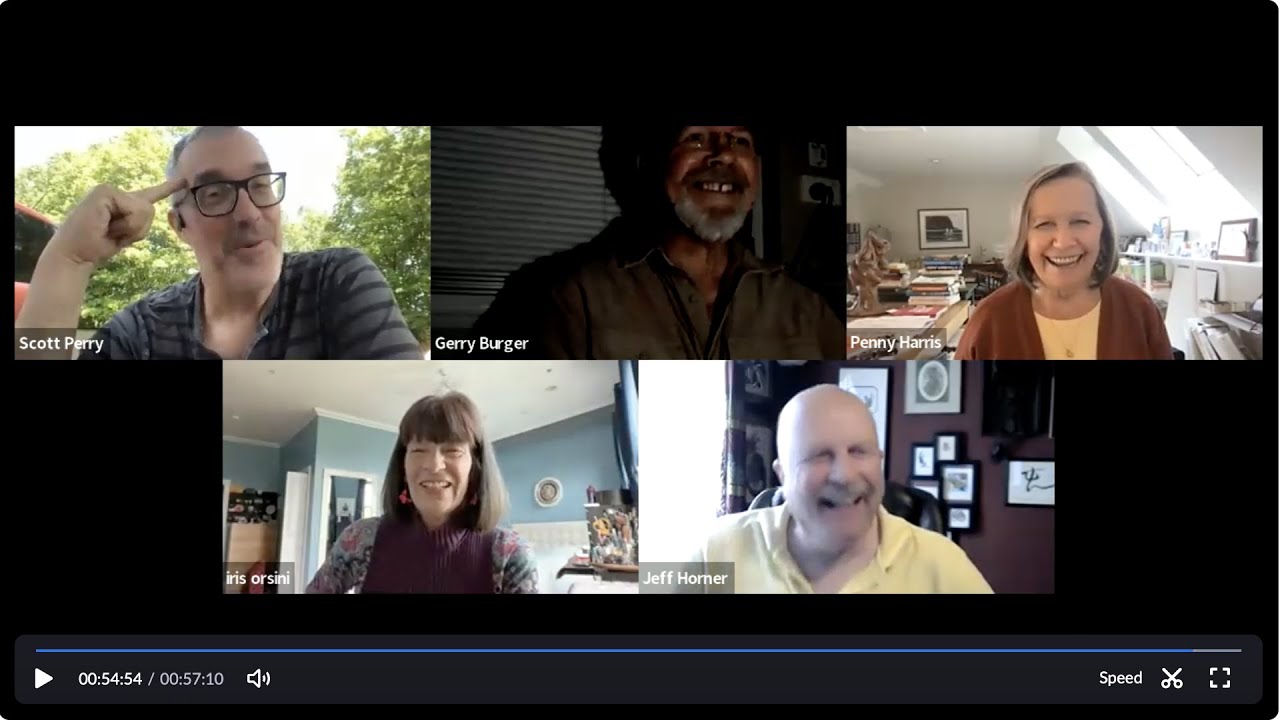
Scott Perry walks through tools for finding your unique purpose at the intersection of your values, talents, and sense of belonging. He recommends assessments like CliftonStrengths and the Enneagram to clarify strengths, warns against getting trapped by labels, and teaches a simple decision method: notice, name, navigate. The goal is building an internal compass instead of following external maps.
Chapters
I wanted to just kind of, you know, to give everyone here, but also the people that are tuning in and replay, some tools, you know, so most of the folks, most of you all on this call have some idea of, and some of you have a pretty clear idea about what is the difference only I can make and how am I going to leverage this to live my legacy. And some people in this community are here because the idea that I could have a unique gift to develop into some sort of meaningful enterprise that would give me fulfillment, give me meaning, give me identity, and, and feel like my time here on earth is well spent. Resonates, but they have no idea what that is. So I want to give you just a bunch of places where, or a place to start and some ideas to help you go further. So the first thing I want to do is share the difference only you can make Venn diagram. This is in The Art of Encore Living book. It's actually— I've been playing with this Venn since I wrote my first book in 2018. And it's been part of at least 3 of the books that I've, I've written. And so it's iterated over time. But this idea of what is the difference only you can make, what's my calling, vocation, purpose, etc. I, I'm asserting that it is at the intersection of who you really are, your values, your guiding principles, your vision of the world that you would like to live in and work towards. What you do, your inherent talents, the, the things that have always come naturally to you, the thing, the things that are effortless for you. Now, it could also, you know, sometimes the skills, the things that you learned in school and on the job, are reflections of that. And of course, sometimes the skills that you learned in school and on the job, those hard skills can, can become part of your talent kit bag. And then of course, your soft skills can be part of that as well. The human-to-human skills that we all have been practicing since we exited the womb around connection, communication, collaboration, creativity, and all those sorts of things. And then the third piece is where you belong. And my assertion is you belong with people who share your values and need your talents to enhance their lives. And maybe you need their talents to enhance your life. And this whole idea that, um, The Art of Encore Living is built on is that you will get more fulfillment, um, find more meaning and build, uh, an identity that you, uh, are proud of. By doing work that enhances the life of others. And that work should be a reflection of, um, of, of your unique gift, your— the difference only you can make, your unique mechanism, uh, whatever that is. And so just a place to start. There are great tools that you can use to— if you, you have trouble with dialing these things in, I recommend highly the Values in Action Character Strengths Survey, via.org, I think is the website. For talents, I love the CliftonStrengths survey. That is— requires payment, but it's not very expensive. And if you buy the book, you get a free coupon. And then, you know, where you belong is, again, that's, that's the easiest part. Because once you really have an idea of what your values and talents are, you belong with people who share your values and need your talents to enhance their lives. This is just a starting point. I'm not saying that if you get these things, take these surveys, and do these things, that your purpose is going to leap out right in front of you. But it's a, it's a wayfinding device to get you somewhere in the neighborhood. And started. So beyond that, you know, lots of other tools out there that you can use to dial these things in. What I would warn you against is when you are using these very powerful tools, these scientifically created surveys, and the Values in Action is vetted by time-tested wisdom and neuroscience and positive psychology. CliftonStrengths is something that's been around for a long time. It has got a lot of data to support its accuracy. And some people like to use the Enneagram, and some people like to use Myers-Briggs, and some— there's all sorts of tools. The Kolbe test is another good one. Don't fall into the identity trap. Because sometimes when we dial these things in, we start to say, well, I'm, you know, in Enneagram, there's this, this, I'm this person. And people just kind of, and almost religiously, are fanatically, are religiously fanatical about this is who I am. What you want to do is keep open loops. You want to hold these ideas that you're playing with, you want to hold them loosely. They are assertions that you're holding out to be tested, to be questioned, to be interrogated, to be shared so that you can listen to the feedback and help you come up with an even better assertion about who you are, what you're good at and where you belong. So the identity trap is when we cling too firmly to any identity we may have. That could be racial, that could be spiritual, that could be gender-related, orientation. Yes, you are a many-splendored thing, lots of facets, and you are a work in progress. So keep open loops, hold these things loosely, and continue to explore them. And You know, Jerry was mentioning microstepping, taking small steps into possibility, because you're, because you're evolving work in progress, your vocation, calling, what have you, is going to probably iterate over time. Your vision of what you want your life to look like, or the point on the horizon you're stepping into, will be refined and clarified, and you'll get more confident about it over time. Another idea that you can use to explore what am I here to accomplish, what is my vocation or calling, is thinking— and Laurel spoke to this really beautifully on the call— what's the gap that I that I've recognized in my life that I've helped myself bridge? What's the gap that I have a unique perspective, experience, or approach to filling that I can turn into some sort of, um, calling, some sort of asset that I can use, uh, as leverage to build a business or build a cause or, um, build a community around. That idea of finding and filling a gap can be super powerful. The other thing I, I didn't have it on my list in the community chat, but Brandon had a really interesting point that I want to, that I want to highlight. He says, allowing something to reveal itself is a powerful tool in many domains. Often we try to force function in order to get an outcome we believe is best, and in reality that could work, but either way we could come with frustrations on different levels. I love that reflection. I love that insight. I have this phrase that I use all the time to remind myself to not overly fixate on a goal and then try to reverse engineer it and force fit myself into an identity that may or may not actually be for me. And I call it don't push the river.
Right?
The—
I think it like Jeff was speaking about flow. Flow is a real thing.
We—
flow comes to us when we are immersed in work that leverages our interests, our talents.
When—
and the thing about flow is it can, it can expand time. Like we talk about in this community, you know, don't die with the difference only you have still inside. Like this idea that, you know, we have limited time, we don't want to waste time, time's the only asset that we can't have more of. It's not exactly true. Because when you are doing meaningful work with and for people you care about, when you are achieving a flow state, time expands. And so even though chronologically the time, it takes the same number of seconds, it feels like it's— like there's more of it. So in, uh, the Greeks had two words, or they had several words for ways of thinking about time. One was chronos, the chronological passing of time, and kairos, the moments of time. And moments of time are more expanded, expansive, and we have a greater sense of flow. And so I think that your journey— I think Brandon is spot on— a journey of becoming should be, should feel like a journey of emergence. And what, when it doesn't feel that way, it's because you have too much attachment to an expected outcome, a desired result that may or may not be of your own creation. Because sometimes what we're really doing is measuring our progress against other people, and we don't actually know what that journey is like. And it's not even really worth comparing because every journey is going to look different. So, um, just to circle back to thinking about like, what's my life's true calling? I also had this thing I say where your becoming lies in being, in being more of what you've always been. So, uh, I don't think— there are some people in this community, Jeff, uh, and Helen who have been going through my, my premium program and the full process, one of the things we do is this archaeological dig. I want you to go back and I want you to think about as far back as you can to your childhood. What are the activities that really lit you up? What, you know, what were the moments where you experienced the greatest sense of awe and wonder? What were the activities that, you know, where you felt fully immersed and, you know, your parents had to come looking for you and drag you to the dinner table because you just couldn't stop doing whatever it was you're doing. And sometimes those are just activities, sometimes they're hobbies, sometimes they're athletics. There's all sorts of ways to look at it. Not saying that any of these things is pinpointing what you should be doing with the rest of your life, but if you look at all of them, you will find common themes and a silver thread that kind of weaves its way through them and helps you get clear about your innate talents that we were talking about earlier. And then just a reminder, I kind of indicated this earlier. You're not going to find your calling by following someone else's roadmap. There is no, there is no system or 12-step process or any of those things that's going to get you from where you are to where you want to be. It's not about following a plan or following a roadmap. It's about, it's about finding your inner compass and, and finding your own way. And it's going to take time. And if I'm truthful, I don't think any of us ever feel like we've reached our final destination, because the only final destination I know of is the one where you end up in the place where I go for a run every day. And I'm not convinced that that's the final destination. We don't know. And so it's all about, you know, Jerry's familiar with this phrase as well. The process is the shortcut, but the process is also the reward. So it's about finding and following your compass and getting closer without expecting that you're going to actually arrive anywhere, you know, as a final destination. Two more things: zest barometer. As you're going through things, you will find yourself, as you're going through this process, and Penny can probably attest to this as someone that's been at it for a long time. I was at it for a very long time, and I found myself frequently feeling exhausted, depleted. Put a lot of effort into something and never felt like I was getting any closer or clearer about where it was that I actually was meant to go or wanted to go. And I used to think, okay, I must be doing the wrong thing. I'll find another thing to do. And I would blow something up and start over. After finding myself coming back to something that I had been doing before, I realized that actually sometimes it's not that you're doing the wrong thing, sometimes it's that you're doing the thing wrong. And so checking your zest barometer, your energy level, your enthusiasm, your excitement, ask yourself when you're feeling a little depleted or exhausted, am I doing the wrong thing or am I doing the thing wrong? If you are doing a lot of things, it's probably that you're doing too many things. And it's about finding what's— what are the essential things that I need to do and how do I learn to do them more effortlessly? And then finally, I would say one of the things that you're going to have to do along this journey is figure out how to make better decisions. Better decisions will help you make a bigger difference, and it will help you, help, help you get where you want to go with greater efficiency and effectiveness. How do you make better decisions? So the simple— my simple process is notice, name, navigate. First of all, you have to notice that it's time to make a decision. You have to notice that there's a situation that's causing you anxiety, stress, fear, whatever it is. All of those things are signals that, um, that this is something worth paying attention to. Fear, anxiety, those are comp— that's a compass. It's pointing you, it's, it's letting you know that you're pointed in a direction that's worth exploring. And then when you recognize that, when you notice that, then you have to name it. And I say name because You have to name what's actually happening and not fall victim to the stories that you're creating in your head. When you are in a state of fear or anxiety or stress, your amygdala is hijacking the, uh, the decision-making process, and it's fight, flight, or freeze. And that comes from our lizard brain, our prehistoric brain, where we were not the strongest or fastest thing on the planet. And if we didn't react quickly with fight, flight, or freeze, we would become someone who was bigger or stronger's lunch. We don't really have that problem right now because everything— we've turned everything else into our lunch. If we want it. So how do you pause, zoom out, and frame what's going on without value judgments, without adjectives and adverbs, as objectively and plainly as possible so that you can stop the narrative in your head that's telling you that, you know, if you don't do something about this right now, you're going to die? Because you're not. So that if you can frame the problem plainly and objectively, you've set yourself up to work the problem instead of letting the problem work you. And then you can choose how you're going to navigate. How do I look? How do I create? How do I see all the options available? Which of these options can I pick that will require the least amount of effort, provide— has the least amount of risk, and provides the most amount of optionality going forward? And if you make decisions based on that criteria, they may or may not turn out to have been the best decisions, but you will not— never blow yourself up and put your— put yourself out of the game. You'll always be in a position to make the next best decision that you can make. All right, so that turned into a 20-minute rant. And I'll share some resources that will help articulate some of those ideas, because I know I went through that all really fast. But in our last 10 minutes, open to any reflections, questions, additions, comments, criticism, vegan recipes, I don't care, whatever you want.
I don't know, I don't know who actually said it, but they talked about the difference between a compass and a map is that a map is what someone else wrote that you were following, whereas a compass is your own direction.
Hmm.
It may have been you, Scott. I'm willing to give you the credit, but I'm pretty sure it sounds—
that sounds like me. I've been, I've been ranting about roadmaps and compasses for a long time, and it came out of an argument I had with another coach in the marketing seminar way back when. And I'm so grateful to her for, um, arguing on behalf of roadmaps because it's what helped me refine my thinking about this. Roadmaps can only take you where other people have gone or where everyone else is going or has been. Only a compass can help you get from where you are to where you're meant to be.
I'll just show you my compass and maps, Scott Perry. This is what I do every day. And it's just a framework, you know, it's just library of ideas, you know, that, you know, and it's just that micro step that's climbing the mountain every, every step of the way. And yeah, that compass and map analogy is fantastic.
And that's the workshop that you did that Penny attended in the Wolf— what's the community?
Yeah, in the Success Finder. Yeah.
But which community is it? It changed names.
Oh, the Wolf Den. The Wolf Den. I mean, Inside the Den.
If you go to Inside the Den community, Inside Success Finder, there's a replay of Jerry walking through that for— I think Carla, Carla and Penny were, were that— were at the workshop.
Yeah, Carla.
I know, inside the den, you said.
Yeah, inside the den.
Look for inside the den. The replay is still there.
Okay.
And we've— I've threatened to bring Jerry in to do it for, for our group as well, so we may, we may get our own version of it, and, and he can walk you through it.
Okay, I, I couldn't go. I had it and then I couldn't do it, so I don't really think I did it.
Oh, I can't remember.
I thought it was you and Carla, but I could—
yeah, it is. Yeah, yeah, Penny was there. Penny and Carla.
Oh, I was at one, but I'm not— I didn't know. I thought there may have been another one since.
Oh, there was, there was another workshop, uh, that, that Jerry hosted in Inside the Den, and that replay is up as well.
Yep, more than happy to help you out with that, Scott, if you want to.
Well, let's do this. Let's go ahead and pencil in— what's today? Is this the third week of May or the fourth? So will be our next— our next call will be the second Wednesday of June. And if you want to, if you want to do your workshop, then we can, we can arrange to just go ahead and put it on the books.
Yeah, sounds good.
Second Wednesday in June is the 14th.
The 14th. Okay, Jerry, I'll confirm all that with you by email.
Sure.
Iris, Penny, any questions before we wrap up?
Yeah, what just came up, the compass versus the map, is wonderful. And I've added some words to it, um, internal irrational compass versus a rational external map. And as a mapmaker, I think what we were talking about earlier, I, I think I build other people's map documentations.
Exactly. So, so your comp— with, with your compass, you can draw your map.
Right. But I can help other people document their map. As you know what I'm— I was referencing earlier. I mean, I've been a mapmaker. So I think that ties in with the type of design I do for people.
Yeah, that's beautiful. Well, and I love also that you referenced this idea of internal, external, right? One of the things that I talk about all the time, uh, with my clients is, you know, this idea of leadership. Leadership is something you, you can, you can and should assume. It's not something that's given to you. Um, that's called authority. Um, and, uh, leadership is done best when it's done from the inside out. Take care of yourself, figure yourself out first,. And then you're in a better position to help lead others. The, you know, the best leadership is not about having a title, having authority, and being able to tell people what to do. It's about helping people see, step into, stay in, and share their power to do the work that they need to do. We got 3 minutes, Penny. Oh, go ahead, Jerry.
Oh yeah, just a couple of words for Iris as she was going through her thing, you know, without some of the words I wrote down. You know that formula, anxiety equals uncertainty multiplied by powerlessness? So some of the words I wrote down was anxiety, entropy, frustration, uncertainty, and powerlessness. You know, maybe you could have some of those words without, you know, one of those words, something like that.
Any, any final thoughts or questions from you, Penny?
No, I just think how helpful it is now to see it. I think I followed that process of trying to do what people were saying and structure my thing with to do it that way. And then I, whatever happened, I threw it away, and I've now started what really fits for me. So I think that's, that's probably a pretty typical process, I guess, for all of us. It seems like listening to—
Be a rebel, Penny.
Make your own road. Oh, Penny's making a ruckus for sure. Um, yeah, I, again, I really love that Brandon brought that idea of going with the flow and this idea of emergence. It's, you know, and to which I would only add and end on this thought. I think it's supposed to be fun. I think it's supposed to be fun. And we forget that because, you know, we are just programmed to—
But we got to give ourselves permission to have fun.
Oh, no, you don't. You've known how to have fun since you exited the womb.
Well, when we were little.
I watch Jasper. Jasper has more fun getting his diaper changed than most people have in a day, waving his arms in the air and laughing and giggling. And so it's time to go get an ice cream cone. Well, all these— this, this is a great place to end. That idea of you're becoming lies and being more of what you've always been.
I like that.
When you were When you were an infant, you were a fearless creative. You were a— you created a walker from a non-walker, a talker from a non-talker, not by following a map, not by getting instruction, not by waiting to get validated by external authority. You did it poorly until you could do it well. And you didn't care what other people thought. I mean, hopefully you had loving parents that were encouraging you or, you know, loving adults in your life that were, you know, providing some assistance and help. But this journey of, you know, mastering the art of Encore Living is mostly about going back to all the things that we've always naturally been good at. And we just need to reconnect with that childlike sense of awe, wonder, curiosity. Consideration, creativity, and all those things. All right, kind and generous people, great to spend this time with you. See you the second week of June. And until then, keep chatting it up in the community.
All right.
Thank you. Thanks, Scott Perry.
More from Scott



Stoics Don't Suppress Emotions, They Do This Instead #stoicism #emotionalintelligence #mindset







