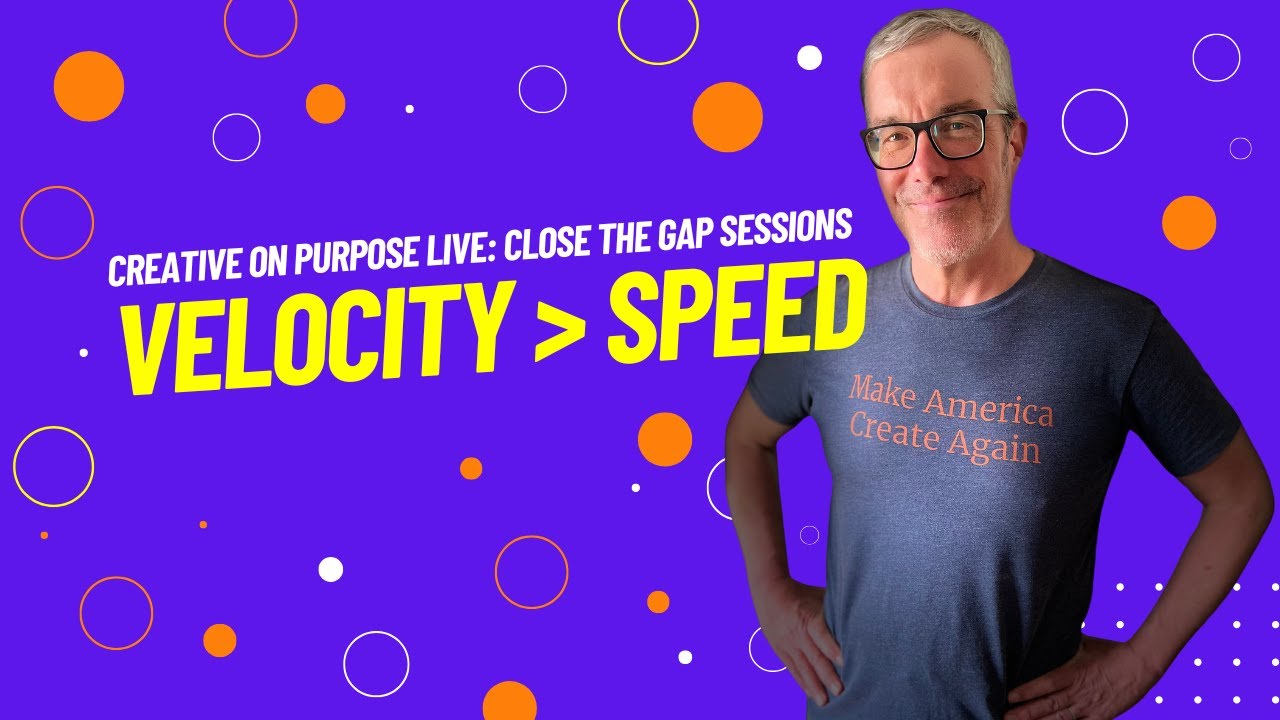
Scott Perry and Sandra discuss why solopreneurs burn out by moving too fast. They cover setting clear goals, taking small compounding steps, and raising system performance without adding complexity. The Close the Gap Accelerator uses 90-day goals to close the gap between where you are and where you want to be.
Chapters
Welcome to Creative on Purpose Live, a show dedicated to helping solopreneurs like you build a fulfilling business that funds and fits your ideal lifestyle. I'm your host, Scott Perry, your guide in the Close the Gap 90-Day Solopreneur Success Accelerator and author of the upcoming book, Close the Gap: How to Build a Fulfilling Business That Funds and Fits Your Ideal Lifestyle. To learn more about our next Close the Gap cohort, see the links in the comments below this broadcast. Today we are talking about the need for speed, and this is one of the many perils that solopreneurs often are engaging in, is that we think if we just keep adding things to our, uh, system to spread the word to new prospects and generate more leads and convert those leads into clients, that somehow miraculously this will make our business reach its revenue goals. Or hit our client acquisition numbers, or we simply are trying to step on the gas too frequently, too early, too often, too hard. And what we find is that in most cases, folks that are just trying to go faster all the time end up going fast. Unfortunately, they're going fast in the wrong direction. They're going fast in circles. They're going fast backwards, or they're simply going around in circles and getting nowhere but exhausting their very precious and finite resources in terms of time, attention, money, and effort. So how do we avoid the perils of trying to go too fast, too often, too frequently? We have to actually remember that in order for speed to work in our favor, We need to have a vector. We need to have direction. We need to have a clear destination that we're heading for. And we have to have a clear starting point. If you think about how, as an analogy, if you want to, if you want to go fast in your car, you can simply step on the gas. You will go faster. You may go faster into a tree. You may go faster off a cliff. You may go faster in circles, backwards, etc. But if you want to go faster toward a destination, it helps if you enter that destination in your Google Maps, and Google Maps will automatically tell you where you're starting from, and it will help you navigate the most effective and efficient path to your destination. You get to decide how fast you're going— try to keep it under the speed limit for your own safety and the safety of the rest of us on the road— but that's the idea. And as solopreneurs, what I see over and over and over again is too many of us, myself included, are simply stepping on the gas without having clarity about the direction that we're going in. And so the idea here is, okay, what is it that I'm optimizing for? What's the destination that I am trying to reach? So we start with what is the ideal lifestyle that I would like my business to fund and fit around? We have to know what it is that we want to achieve for our lives through our business. And then after we have that established, we can decide what are the, what am I, where am I starting from? And what am I starting with? What, where am I at? How close am I currently to that destination? And what are the assets and resources that I already have that I can leverage to close the gap to get me where I want to be? And then we establish the 2 or 3 things that need to go right in order for us to achieve that lifestyle goal. And along the way, through the Close the Gap Accelerator Program, what we're doing is we are setting these 3-month quarterly, 90-day markers, goals, objectives that we are, that we are working toward because they will help us get closer to what we want in terms of our ideal lifestyle. And it gives us an opportunity to collect data to make sure that we are making discernible, measurable progress toward that goal. And once we've accumulated that data and analyze that data, what we can do is figure out how to strategize, raise the floor on the least efficient parts of our system so that we can increase the velocity. Okay. And so this is really the crux of the, this whole discussion. What we are seeking as solopreneurs is not speed, because speed often kills. You can go really, really fast, deplete all of your resources in terms of time, attention, money, effort, reputation, and end up emptying yourself of those resources, which means that you've exhausted them. You're going to burn out or blow yourself up, and you're not going to get anywhere closer to what you were actually wanting to achieve with your business. In fact, you'll get much further away. Whereas if we establish a clear starting point and ending point, establish the 3 things that we need to make right in order to get there, we've established direction, which allows us to think about velocity. We can micro-step our way, constraint by constraint, identifying and navigating those constraints in the right order so that we can increase the flow and increase the efficiency and the effectiveness of reaching our goal. So what we're always talking about in the Close the Gap program is clarity of direction, meaning starting point and ending point, clarity of system, the process that is going to help us get there. And then how do we increase the efficiency of that system by making sure that we don't add unnecessary elements, that we don't get distracted, and that we're raising the floor on the things that have to be improved in order to increase flow, increase Efficiency, increase velocity to target. So that's a little, a few thoughts on the whole idea of the perils of speed. We have Sandra in the house. I'm going to bring her in. Sandra, long time no see.
Hi, Scott.
I'm going to shut up, give me some of your thoughts on Speed. Speed.
Uh, well, with your guidance since, um, from coaching that we did earlier on in the year, since probably late spring, I've really slowed things down. And, um, I've been concentrating on, rather than getting new emails, you know, trying to put more lead magnets out there to get people's emails to increase my list, I've been focusing on treats for my list. So I have a handful of things, um, that I'm going to be, uh, giving access to for people who are on my list, and then go from there and see what happens. And so far it's been working. Like, my list is growing without my focus even being there because I'm concentrating on the people who already know me. But also working on engaging the field. I've just started with the group and done, you know, a workshop for them, for a separate group external that asked me to do something for them. And so my list is growing from that too, just without me really putting a lot of time and effort into it.
Perfect. Perfect.
So I will say though, slowing right down felt like going backwards. So if that helps anyone, it really did. It felt like, okay, I'm taking all these baby steps, but I talked with you about that, Scott Perry. I, I said, like, I feel like I'm taking all these tiny steps, but not really getting anywhere, even though I knew where my vector was heading. And you assured me that something is hap— oh, I felt like I wasn't getting any onwardness with all the tiny little steps because I was snailing. I was just going so slow, but getting things done just at such a different pace that it, it did actually feel like going backwards instead. And now it's paying off. Like, um, things that I put out, you know, videos with health tips that I did, I think, 4 years ago are gaining traction again, like, without me doing anything 4 years later. So all the things, just to assure people that all the little things that you've put in place to date, like, if you keep at that slow pace and bit by bit, like, it does, um, something does emerge and come to fruition later on.
I, I love what Sandra shared because it's a really— this is why the the need for speed is such a common peril for solopreneurs is, you know, we are as solopreneurs, entrepreneurs, we tend to be doers. We tend to be early adopters or innovators. We like to explore new ideas and try new things. We like to feel the wind in our hair. And that's why this, the need for speed is so seductive because it makes us feel like we're making progress, when we can actually simply be feeling the wind in our hair. Because again, going in the wrong direction, going in circles, or heading for a cliff. And so one of the things that I know has been very helpful for me is understanding that when I am taking these microsteps and trusting that microsteps and small viable steps are going to compound over time and that, that will increase my velocity, meaning close the gap and collapse time to target to where I actually want to go, is that I can't focus on the gap all the time because there's always— we're never going to end up— we're never going to really fulfill our ultimate destination. Because even when you accomplish, you know, your most immediate objective, there is this greater goal that you're trying to achieve in terms of your lifestyle, or you're always thinking about what's the next thing. So if you're always looking ahead, you're always looking at the gap, like, I'm not where I want to be yet. And one of the things, and we may have talked about this, Sandra, in our work together, is like, you have to check the rearview mirror. Because when you look in the rearview mirror, very often we see that we have actually made more progress than we might have given ourselves credit for. We just haven't been aware of it because we're always focused on the gap, always focused on looking outside at that window. But what I also love about your share is that you, you know, found things that you were wanting to test, things that you knew you, you, and, and leveraging assets that you already had. And, and that's always the, the best place to start. Like, if you just, again, looking in the rearview mirror, if you look at the things that have worked in the past and spent time iterating and improving those systems, You— it's much more efficient and effective than trying to create brand new things from whole cloth and get them launched and get them going. That requires a huge investment of time, attention, money, and effort, whereas improving and iterating, improving systems that are already working but trying to get them to work a little bit better requires much less time, attention, money, and effort. So Often that's what we talk about when we're talking about raising the floor. Like, if your system is working, the worst thing you can do is try to create a new system or add things to that current system. System reliability tells us that anything we add to a working system complicates that system and decreases its efficiency and effectiveness. What we want to do is eliminate any unnecessary elements from that system and then start optimizing whichever elements are the least efficient part of those systems, and we will automatically be increasing velocity. And it's, uh, you— I always like to cite the old saying, slow is smooth and smooth is fast. And you have to trust in the, the science and the historic success of the compounding effect of small viable steps into possibility, leveraging a process that is already working, that already has traction. Easier to optimize and gain momentum in a system that has already got some traction than it is to get something going from the get-go. I'm going to mute myself, Sandra, and just give you a chance for any last reflections.
No, that's pretty well about it.
No. So just, just for the record, Sandra has never had this, this few words to say in, in past conversations. But, uh, um, I really appreciate, Sandra, that you coming on and sharing, um, your insights and some of your experience with us. I want to apologize to everybody for the rough start and the rough middle. Uh, hopefully this landing that we're about to do is going to be less rough, but That is the wonders of technology. I'll get these things sorted before we get together next time. But what we're doing in this series of broadcasts between now and the launch of the book on Thanksgiving Day, USA, is having conversations about the principles that the book shares. If you're interested in learning more about Close the Gap, the program or the book, or just want to get more insight and inspiration for how you can build a solopreneur enterprise that better funds and fits your ideal lifestyle, subscribe to the Creative on Purpose Substack. Again, there's a link below. And if you'd like to start reading the chapters that are already available, you can do that. You'll get a— when you subscribe, you'll get a welcome message that gives you access to all the chapters that are already publicly published. If you want a full advanced copy,, just become a paid subscriber to the Substack. All of my paid Substack subscribers, the members of the Solopreneur Success Circle community, already have begun reading and implementing all the principles in the Close the Gap book, again, published on Thanksgiving Day. So Sandra, thank you so much for your time. Great to see you again. I understand that we might be seeing you again more frequently. We're excited about that. For those of you, um, that are listening on LinkedIn, YouTube, or Facebook. Appreciate you tuning in. Again, apologize for all the technical difficulties, but we'll look forward to seeing you next time.
More from Scott



Stoics Don't Suppress Emotions, They Do This Instead #stoicism #emotionalintelligence #mindset







