What's the hard part of leadership? - Ruckus Makers Roundtable
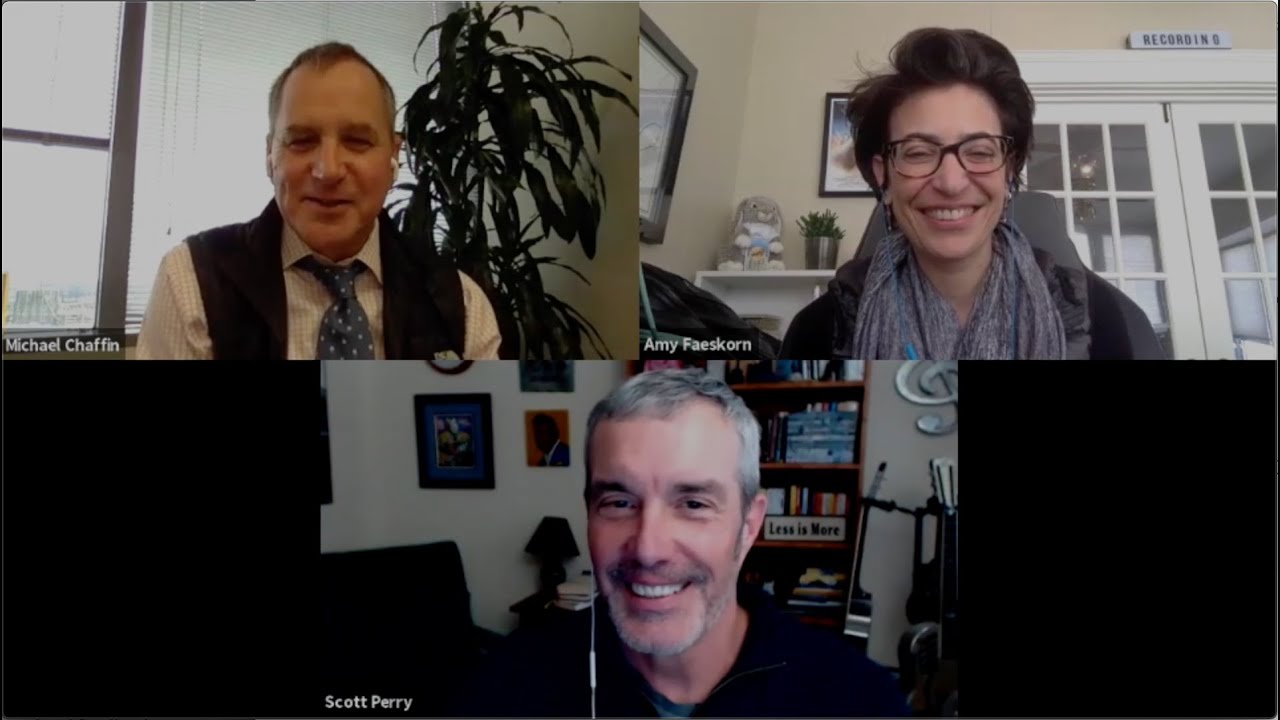
In this recorded Ruckus Makers roundtable, host Scott Perry (Creative on Purpose) brings together alumni Michael Chaffin and Amy Fayskorn to explore what makes leadership difficult. The conversation begins with personal introductions and quickly moves to defining leadership. Amy frames it around integrity—being true to oneself and others, speaking hard truths with respect, and balancing the “light” and “shadow” of leadership. Michael adds that leadership is fundamentally about creating voluntary change with a group, not merely managing or following a corporate agenda. Scott synthesizes these ideas, describing leadership as an act of generosity, vulnerability, and embracing uncertainty, contrasting it with the predictable, rule‑bound world of management. The panel then delves into the hard parts of leadership. Amy discusses the tension between the light and shadow, the need to acknowledge both, and the difficulty of staying intentional amid resistance. Michael highlights two core challenges: taking personal responsibility (showing up, keeping commitments) and enrolling others voluntarily, which requires deep trust, cultural alignment, and the willingness to forgo authority‑based directives. He shares a practical habit—rigorous, values‑focused interviewing to ensure “right people on the bus.” Scott expands on this, emphasizing the importance of aligning on values before mission, and the need to be clear about who you do NOT want to lead. The conversation weaves in examples from art and photography (Vivian Maier) to illustrate intentional vs. unintentional leadership, and the role of visibility and audience. The participants agree that leadership is a continual performance: showing up authentically, delivering one’s best effort, and accepting outcomes without clinging to them. Scott shares his personal struggle with work‑life integration, noting that trying to balance multiple identity “buckets” is a delusion; instead, showing up as his whole self reduces exhaustion. The roundtable closes with each guest sharing their online presence and a final affirmation that leadership is a professional responsibility that demands showing up even on the hardest days.
Chapters
So welcome to Facebook Not Live. This is Creative on Purpose Not Live, and this is a show about flying higher in endeavors that make a difference. Step into possibility with integrity and intention. It's time to be creative on purpose. Are you ready? Let's go. So normally these shows are broadcast live on the Facebook, on the Creative on Purpose Facebook page, and that's just not possible today. So we are recording this conversation with Michael and Amy, and it will then appear in replay for those of you that have been waiting expectantly for the wisdom that Amy and Michael are gonna impart. So this season features the Ruckus Makers Roundtables, conversations about questions that matter with friends and fellow travelers from ForwardLink, which is the alumni community for Seth Godin's Alta MBA and Akimbo Workshops. I'm your host, Scott Perry. I'm the Chief Difference Maker at Creative on Purpose and author of Endeavor. And I am also an Alta MBA 6 alum and head coach for some of the Akimbo workshops. You can learn more about me and my work at creativeonpurpose.com. Today, I am very excited to be joined by Michael Chafin and Amy Fays Gorm to discuss what's the hard part of leadership. Michael and Amy, before we dive into today's discussion, please introduce yourselves to our viewers. Who are you? Which programs have you been a student in? What are you up to these days and where can people go to learn more?
Ladies first.
Okay, thanks, Michael. Um, so my name is Amy Fayskorn. Um, I am a coach, writer, and facilitator. I live north of Boston and I am an alum of the Marketing Seminar 6 and the Freelancers Workshop. Um, I've been really diving into this question of leadership a lot in my coaching practice, and I've been trying to, you know, just figure out how best to keep serving people and keep getting my work out there. And I'm really excited to be here and to talk to you about this today. Such an important topic.
Go ahead, Michael.
So I'm Michael Chaffin and I am a graduate of, let's see, the Marketing Seminar twice, although I quit the first time. And I did the Bootstrappers. I don't think I did Freelancers, but it's possible that I started it and didn't finish. And I am a graduate of Alt MBA, proudly. So those are my akimbo workshop credentials. I, um, my day job is leading two groups of wonderful people, one at a hotel in downtown Little Rock, Arkansas, and the other one at a golf— private golf club out west of Arkansas, Little Rock, Arkansas. Um, I also So I coach a lot inside those walls of those two operations, but I also am right now about to launch a leadership workshop for those groups of people, which then I hope to move outside of those walls at some point. I, I get my daily dose of joy from my wife and three children and a dog named Daisy, and I play around with Cycling, running, photography, guitars, model railroads, and Mini Coopers.
And that's it. Well, fantastic. So we're here to talk about the hard part of leadership, or what is the hard part, but I think it would be really helpful for us to define what we mean by leadership. So starting with you, Amy, just What does it mean in general, or what does it mean for you in particular?
Yeah, so I think a lot about this, and I don't have like a final definite— oh, it's always a working definition for me. But I would say lately I'm trying to lean into this idea of integrity, that when you're in integrity with yourself and with others, that becomes an act of leadership. And I think being willing to lean into kind of hard truths and being willing sometimes to articulate them while being detached from how people will respond. I mean, doing that with respect, of course, but, you know, not shying away from potential conflict. As a result of that. But really this idea of integrity, because I'm— in my own life I have seen how when you, when you focus on that, how people are attracted to that in a way that helps them.
Love it. How about you, Michael?
So yeah, I actually addressed this and I I've asked myself a lot, what is leadership for? You know, what's it meant to do? Because I think a lot of people see it as a fancy word for management. It's a sexy part of management or something like that. You talk because it gets thrown around a lot, this word leadership. And I think it carries a lot more weight than that. If it's put in the right context. I'd say that it's, it's for making change, and, and, and really it's about making change with a group of people and doing it in a voluntary way so that it's not this thing that I have to do, you know, because because it's the company line or because it's my boss or because it's my wife or what, you know, it's about change and voluntary.
I love what you both said. I think about leadership a lot along the lines of what Michael was saying about, you know, a leader is somebody that makes change happen and that change should be for the better. So true leadership involves, to Amy's point, that has that level of integrity. And when I think about all of that, I think of leadership as someone that has a clear enough sense about who they are and where they want to go and then layers in this invitational component, letting other people know that this is who I am, this is where I'm going, and inviting other people on that journey. And so in a lot of ways, just like, you know, we all do some coaching, it's, it's the age-old coaching, uh, motivation of helping people get from where they are to where they want to be, which is hopefully a better version, to a better place or a better version of themselves. So I love that, those two themes of change and integrity. I think that's, I think that's both really important components, which then begs the second half of our query, which is, so what's the hard part of leadership? Back to you, Amy.
Well, I can only speak, you know, for myself and kind of the term itself for me has been very loaded, right? It's been very like, I put distance between myself and people that I think like embody leadership, right? And that you know, it's like a historical figure, you know, like MLK was a leader, you know, but, and it's been really helpful for me to make it less hard, I guess. I've tried to distill it down to these very small moments of daily life. Like I'm also a parent of two teens and, you know, just sometimes seeing how a subtle shift in my behavior will shift their behavior, not always, because they're teenagers. But sometimes you can see how something resonates and leads to a shift that is positive, right, when you have that positive intention. But I— the other piece for me that's been hard, um, is real— in my view, is realizing that for every light there's a shadow. And it's really important to not disown the shadow or pretend that you can improve it away, and it doesn't exist anymore. I don't think that's— I think that's just as dangerous as people who live entirely in the shadow as leaders. You know, in history, we could probably point to many of those people. So the hard part for me is balancing, acknowledging the two sides of leadership, and trying to stay on that side of light. But And also realizing that it's not like Michael said, this thing for like, you know, managers and corporations. It's this very basic form of human behavior that becomes a conscious choice. And anybody can do that at any time, in any context. And that's very liberating. But it's sometimes hard to come back to that place because those voices come up, you know, those resistance voices. So yeah.
Well, and Amy shared a book with me, um, and Amy, you can go ahead and— it's the fifth— it's 15— what's the name of the title of the book? Is 15 Commitments, I think, to Leadership or something of that nature.
Yeah, I'll look that up.
Um, well, anyway, we can drop that in somewhere, but yeah, the point, because you were reflecting on that about the light and the shadow, which I think is so interesting. We often talk about leadership like it's this place we all, we aspire to get to, and then that once we get there, that's where we're these new people and that we don't ever fall in the traps of the old people. And in that book, and I think it's the foreword that you had me read for the first chapter, what was really insightful there was that We, we go in and out of these, these tendencies and these, these ways of doing things, and it's okay. That's kind of— that's normal humanness. We can be working to be better at a skill of leadership, but the fact is we're not always going to be in this perfect spot, and we're not going to be these perfect people. That are perfect leaders, right, if there even is such a thing.
Yeah, I did find—
I was so really, it was like brilliant. I'm like, wow, that's, that's really good.
Yeah, so the name of that resource is The 15 Commitments of Conscious Leadership: A New Paradigm for Sustainable Success by Jim Dethmer, Diana Chapman, and Kaylie Warner Klemp. It's part of a whole— that was part of their book, right? That I sent you.
Right. It was brilliant. So I'm going to— that book is on one of my many lists of books to read and knock out. So for me, the hard part is, I think, a couple of things. One is taking responsibility. It's way easier said than done in a lot of ways. So I— it gets talked about a lot. It's really hard, uh, to— and it's, and it's certainly hard to teach, um, but if you're going to be effective in getting people to go somewhere with you, you, you— they have to believe that they're not going to be left out there exposed when this— when it— when we don't arrive, when we go to a different place, when it doesn't work, when the failures happen. And you— so you've got to make that commitment, and you have to live that commitment and show that you live that commitment and how you behave and what you do. Because talking about it is one thing, right, but doing it is another. So showing a track record of, I take the response, I'm the one that's going to be on the hook here I'll be with you, don't worry. That's really hard and it takes practice, it takes time, experience. That's not something you just, you know, have on a piece of paper and say I'm ready. So that's one thing. I'd say the other really hard thing that I have found is, and it's the reason that we have so much kind of what I would call, I guess, the management way of doing things, which is go do this because I said to do it, you know, because, or there's some other intrinsic fear in I won't get paid or I'll lose my job or my status will go down with the group or whatever those, all those other psychological things are. This part about enrollment and getting a person to believe with you and go somewhere, well, the first part of that process is seeing the others first, right? So first you have to— first you have to decide, I'm, I'm never going to tell anyone to do anything again. That's really hard, you know. OK, now I'm committed to a path, and I'm going to just work at it, work at it, work at it. Because it takes so much more time. It takes so much more effort. It takes patience. It takes experience. It takes failure. It takes getting ridiculed and being exposed as this sometimes lunatic. Why are you doing all this? Because in the end, I'm going to show you how this is— there's a light there. So being committed to, to this voluntary method, I think, is really hard in the— in most of the places that we operate in, both personally and professionally. And then when you decide to do that, the first thing you, you have to do if you're going to do that is to earn the trust. And the only way to do that is to see people for who they are and where they are going. And you have to spend a lot of time on that before you go Okay, well now let's go over here, because otherwise you have to use, you have to use probably more authority than you would like to get someone to go somewhere. Does that make any sense?
Yeah, well, I just, I've already written a whole page of notes based on what the two of you have shared so far.
So yeah, yeah, and I can, I can only write when Amy's talking, so I only have her side. So I'm glad you have mine. Well, I'll forget.
I think you're both pointing towards— so I love that we're differentiating leadership from management or authority, because I totally agree that it's a very different thing. You can be a leader who possesses no title, who possesses no actual authority over other people, and you can inspire and incite people to seek better for themselves and for others. Um, the, the key to me, the, the real hard part and the, the, the defining thing that differentiates leadership from management or authority is this, you know, authorities and managers are dealing, are dealing with known systems. They're closed systems where we all, all know the rules of engagement, we know what the expectations are, um, we know what the outcomes, you know, the soft outcomes are, and you know, where you're just trying to get from point A to point B, and both of those points are clearly defined. Where leadership is all, to me, all about embracing uncertainty. And nothing throws us into a tizzy faster than facing the unknown and contemplating, you know, the maxim of our friend Seth Godin, "This might not work." And in the face of this might not work, You know, you, you then have the challenge that Michael was pointing to of earning the awareness, attention, enrollment, and investment that makes change possible. And so, you know, leadership is much more an act of generosity, service, vulnerability. To Michael's point, empathy, being able to see, hear, and understand where somebody, you know, is coming from, but also have the compassion to commit to an action that will help them get from where they are to where they want to be. And we're, with all of this, we're dealing with, we are human beings dealing with other human beings. What could be possibly more complicated or hard more difficult than that. You know, difficult, you know, human beings leading other human beings. I, you know, what leaps to mind is the blind leading the blind. So, but still it's that posture, you know, that posture, although it's, you know, this is the flip side of all of this talk around uncertainty or around hardship is it's also what makes it such a beautiful pursuit and, and why we are in awe of people that can do it well. And oftentimes those people are not people that have succeeded, quote unquote, with their mission. It's the fact we respect their dedication to the craft and the effort of leadership. So I'm wondering— well, I'm happy to field responses to and push back to what I just said, but, you know, I think it would also be really helpful for us to share some of the tools and skills that, you know, we've learned along the way as leaders and, you know, things that might be worth cultivating for anybody that's contemplating this path of, you know, taking the chance and, you know, being a leader that's leading him or herself and others into the unknown.
Um, so I, and I'm happy to— Amy, if you want to dive in, dive in, or I'm happy to— I have a thought on this. So I've been doing this kind of work for over 30 years, 35, I guess. It's been a long time, and The thing that I— the one thing that I could say, hey, if you're going to do— if you're going to have an— if you're going to be more than a driftwood sculptor by yourself on a mountain and you're going to organize groups of people and go somewhere, the most important thing you can probably do is make sure that people are like-minded enough culturally at the core before you decide to get together. Um, because in every case where it hasn't worked for me, um, it's all been about that. I can always point— I can always find my way back to that, right? It's not about how much time we had, or did we have the right resources, or enough money, or runway, or skills, you know, certain technical things. None of that. I mean, it was— sure, those— it may seem that way, that those things were keeping you from going somewhere, but really what was keeping us going and going places was when we had people in the, in the team that were not like-minded. They weren't necessarily wrong or bad people. They just weren't— they weren't— didn't have the same beliefs and ideas about, okay, we're Where do I want to go? It could be as simple as people that are either on a path of forward motion or not, you know. So, so I, I spend a fair amount of time, a lot of time, um, interviewing people that want jobs in these two places that I work at. And I interview everyone, and I interview them first. And that people— that's weird for people because they show up to the interview and it's rare that the man, you know, that the person they see— I hate organizational charts and I hate being referred to as the person at the top because that's just against my nature. But for the sake of describing what I'm describing, you're they feel strange that they're sitting in their very first encounter with anybody with me. And then about 40— they usually last anywhere from 30 minutes to an hour. And they— we, we end up talking about nothing that, that they expected to talk about, because all we're trying to do is learn who they are, where they're going, and why and how we could possibly help them get closer to where they're going. And it's a pretty amazing thing. I mean, probably 75% of the time we've had people crying and, you know, it's just amazing what people want to talk about and, and how they are very appreciative. And these are sometimes people we don't even hire, you know, because we realize we Well, no, it's not going to quite be— it's not going to fit. But they're still— they walk away from this and they go, that was different. Wow. That's cool. We haven't had one person that, in all the time, I think that's said, you know, God, this has been horrible. We should never do this again. So that's my granular takeaway. You know, that's my thing that I would say. If you want to start with, you know, some of the building blocks of leadership, well, Make sure that— I think it's Jim Collins that references getting the right people on the bus. Who cares where they are on the bus, but get the right people on. It's so true.
Yeah, I like, um, so there's two things that— two main things leap to mind based on what you just said, Michael. The first is, um, I, I love that— well, three things. The first is interviewing is a really crappy way to determine, you know, if a long-term relationship as an employee or employer is going to work out. And there's a lot of science that actually backs that up. But one of the things that we do know from, you know, psychology and from team building and research around that is that alignment around important things like values is, is really important and is a determinant, is determinant in how successful or long-lived any, any relationship is going to be. And so I love what you were saying about the Jim Collins reference because I think it's, you know, we're, we're often, as in leadership, it often seems to be about— we talk a lot about mission and vision. But it's actually, you know, instead of starting with the why, it's starting with the who's. Like, if you get the right who's together, they will find their way to a great why. As opposed to if you get— have a great why but you get the wrong who's, they're gonna— they're not gonna get anywhere good, and, um, they're probably, um, not gonna last too long. And then the other, um, The other— there was a part that you were speaking to that made me also think about, you know, leadership is not just about who you want to lead, but being equally clear about who you do not want to lead. How about you, Amy?
Well, it's interesting for me because as Michael brought up that example of the driftwood sculpture on the top of the hill, I had this perspective because like, you know, a lot of what I feel is my mission, what kind of my intention or kind of what's up for me around contribution is this notion of creativity, artistic expression, right? And so many of the people I follow are artists, you know, and that's a— I'm defining that very widely. Not just, you know, visual art, but really anything where you're creating something as a form of expression and statement-making and all that. So my thought was, the only thing that doesn't make the driftwood sculptor on the hill a leader is that maybe nobody knows where to find him. Because the fact that he's— to me, that's an act of leadership, right? Creation. So Is it a question of access and visibility? And those are things that also for me are really uncomfortable, right? It's like, you know, it's very easy to kind of do your thing in your corner and say, well, that's enough. It's enough that I'm doing this little— I'm on the mountaintop and I'm doing my thing. But is it, right? There was a case of this photographer in Chicago. I forget her name. But she died. No one knew about her. And when she died—
Vivian Maier.
Yes. And they, right, and they discovered all of these photos that were just like phenomenal portrait photography on the streets of Chicago. And it was a classic example to me of leadership that was maybe impacted by the time-space continuum, right? She's leading in absentia with what she left behind. But what would have happened had she either had herself the courage to share and put her work out there or become part of a community where her work would have been widely known and appreciated. I mean, who knows, right? But I think about it a lot in that context and it's probably my background isn't in business and isn't in like Michael's context at all. So I recognize how it plays out so differently in these different ways. And I just love the idea of how can we merge those approaches of being intentional about the who, but also being intentional about the what, being that form of expression. So I'd be curious to know what you think, Scott, because I know you are an artist, you know, you're a musician and you also play in this realm of business and entrepreneurship. So what's your take on that?
Well, first, I think what you just articulated is, brilliant, and I just want to underscore it. It's like leadership has to be out loud and in public, otherwise it's not really leadership. If you're not leading anybody, if nobody's following you, you're not a leader. Um, and, you know, our— you know, as a musician, as a teacher, uh, of, you know, guitar and other things, I, you know, I definitely feel that because— and again, speaking to the vulnerability and generosity piece— you're, you're sharing your gift as an artist, and you are trying to make a connection with an audience, and you're trying to help an audience get from where they are to where they want to get to through artistic expression. And it's a fraught process. And so, you know, oftentimes even when it should work, it doesn't work for reasons that you can't even fathom. But, you know, for me, at all points, I— it all comes back to the same thing for me, whether it's failed leadership or successful leadership in terms of whether, you know, I get people where they want to go. It's the quality of the effort. And back to your point, Amy, about integrity. So I think it, you know, for me, it's intention and integrity, like having a clear aim in mind. And being clear on, you know, who I am and who I want to serve, and then accepting, you know, whatever happens. Because I don't really ultimately— I can influence to the best of my ability through my effort and through my preparation and all that, but I can't, I can't guarantee an outcome. And so I think a lot of it comes down to your question, Amy. It's about agency and ownership. Like the agency of like, I'm putting myself on, to Michael's point, putting myself on the hook. This is who I am. This is who I want to serve. This is where I want to take you. And then taking ownership of the result. And if you get the result that you want, having the humility and grace to say, whoo, we got really lucky. Look at us, where we meant to be or where we aimed for. And at the same time, having the, um, the humility and the resilience to, to make sense of a failure. If you don't get to where you intended to be able to say, this is, it's still okay. Because we learned something, we formed a team, we— and now we can set our new aim and our strategy for getting to the next destination. And so it's, you know, to both of your points, it's this ongoing process, you know, the journey that never ends.
Yeah, it's possible, I guess, you know, using the photography analogy there because I think that Vivian Maier story is fascinating. I mean, I've taken a lot of pictures and someday someone may find them all because I don't share a lot of them, you know. I actually take, um, truth be told, I may— I take— when I'm running, I take pictures. I pick up trash and like for the last 10 years I've like taken a picture of all the trash I've picked up and maybe someday somebody will put a coffee table book out about all this. And it'll be— and it may change someone, right? It may— someone may go, well, that was so cool that he did that. You know, we should all do that, kind of, or whatever. So, but the difference, as Scott pointed out, it's— I think when we say— when we draw a line in the sand and say, or wherever, you know, the line, and say, We're going over here and not over here. And we're accountable for it. We're taking responsibility. And we're defining it. We're going through that hard part of— I'm thinking back, if I'm a— let's say I'm that sculptor, right? So sure, my work could change some— probably will change someone. But did I set out doing that work to make change, and if so, what kind of change, and how am I on the hook for it if it doesn't happen? Does that make any sense? I'm not trying to make— by the way, I think artistry is wonderful, and it moves and changes all of us, and it's definitely necessary. I guess I'm just trying to differentiate between, between that type of work and the change it makes, as opposed to a leader who, who, who basically, um, is putting them— it puts themselves on the hook for all— for all— for a specific outcome and is professional in a sense that they have to show up no matter what to make that work.
One of the things that I'm hearing in what you're saying and the example of Vivian Myers, like, you know, I just, you know, wax poetic about the importance of intentionality as a leader, but Vivian was kind of an unintentional leader. Like, she didn't intend, you know, she just took some damn pictures and then after her passing, she becomes an inspiration and has an impact.
So, but she was intentional. She wasn't about her craft, her act of her craft, and she was constantly working at— you can tell she was working at— I mean, and she was quite bold in the way she did it, you know. It was actually the fascinating, just a remarkable story of, of how this This woman, you know, who you wouldn't— during that time back in, it was in the '50s or '60s, right?
Yeah, yep.
Yeah, yeah, taking pictures was actually, took some skill.
Exactly. And the way she took the pictures, all these, she went about, she bought a, she specifically bought a box camera because she could take street photography and not be doing this, you know, because then people act differently. So she was very intentional about capturing the type of images that she wanted, that she knew would change someone. I think for her, it was for her. She didn't have to worry about, I wonder if this is going to work. I wonder when I put this up at the gallery if it's really going to have the effect that I'd like it to have. She didn't worry about any of that.
As we're coming to the end of our time together, I want to throw out this, this thought that's coming to mind because based on this wrinkle that we put in, you know, so we have this example of somebody that becomes an unintentional leader, and we've talked a lot about the importance of intention, you know, for somebody that's a point of themselves to leadership. But, you know, there's the issue of leading the most difficult follower. And I would argue that that's the person that we look at in the mirror.
You know? Yeah.
But I was going to— something that came up for me as you were talking too about— and this whole notion of intentionality, it's like, I think that any artist, the intention of any artist is to do that. I want to hold— the change I want to make is to put up a mirror such that people can see what I see. Right? And that's— I think that's true at any level. It's like even in an interview, like Michael's talking about giving, holding space as he does for these people that don't even know him to surface their story, which is a form of mirroring for them. Right? It's like, it's all part. All part and parcel of that process. And then it's just, how do you know if it's stuck? Like, how do you know, right, if it occurred, if there was impact? That is where it, for me, it always feels really murky. And you never know, you just never know the extent to which it's impacted that one person, and then beyond that, who they interact with, or whether it's at one, you know, in one moment impacting a lot of people because it's highly visible. Like, you just don't ever know. And it goes back to that, for me, the whole notion of detaching from outcome and just trusting that whatever impact it's meant to have, it's having. And then, like you said, Scott Perry, and then it's just about dialing in the commitment to keep doing that, right?
Yeah, I agree with that wholeheartedly. And the piece especially about not attaching to, not clinging to preconceived outcomes because we can't know. And then, you know, the other part to speak to this unintentional leadership is, you know, being able to sit with that tension of this might not work, or this appears to have not worked, and I may never see this person again, or I may, you know, never know if any of this, you know, is going to work out. Which to me just points back to the point I made earlier. It's, you know, it's the quality of the effort that ultimately is the important part. It's putting forth your best effort as a compassionate human being, somebody that, you know, recognizes that the, you know, the whole defining element of being a human being is that we are We are born for each other. I mean, that's— we survive as a species because we are social creatures. If we were not, we never would have, you know, we never would have walked upright. So how about you, Michael?
Final thoughts?
Yeah, I—
okay, final thoughts. So the one— the last thing, and it plays right on— it's right there, you just said it. So I think we have a responsibility to each And I think these leaders that we see, sometimes they're, they're people that, you know, they're famous, and sometimes they're not famous, they just happen to cross through our lives. These people that we look up to as great leaders, they, they treat it like they— it's a profession of responsibility to us. So They— we actually talked about this, I think, in the last Monday Morning Meetup, and we talked about it in our little subgroup about you don't get to not show up. You know, if you, if you look at being as being a leader as being as a profession, whether it's at home or in school or in your class or in an artist workshop or whatever it is. It's exhausting because it is a profession. It is taking responsibility for doing it like it's the very last performance you're going to give. You know, I, I, I, in doing those interviews, I do them with the HR person and we do them together because we play well off each other. We've been doing them for years now, so it's really fun. It's like a little show. But sometimes we have to remind each other that this might be the last one we ever do. And these people that come to that, that person came here. Of course they didn't have this expectation, but they deserve our best performance. And then we— so now we like grade each other. We talk to each other afterwards. How do you do— how did we do that? You know, was it a good one? Was it not good? You know, you know, and then we'll like admit, well, I, you know, I wasn't— I was distracted, I was tired, or whatever. And then when we— man, when we nail it, you know, it's so cool. And I'm— Scott, I'm sure I'm playing right into your wheelhouse there with, with, you know, your— some of your work. But acting like a professional and showing up even when you don't want to, or when you don't feel good, or when, you know, it's— you're supposedly off the clock or whatever, that, that doesn't— you don't get to do that. Yeah, that's the other hard part about this.
Right, and that plays into the whole, like, with, you know, Scott Perry's work with stoicism, like the whole memento mori, you know. And when I coach people, I sometimes live on this edge of, this might be the last time I talk to this person, the one and only time I talk to this person. How brave can I be in sharing what I see? No, again, knowing like there might be this space, this pause where it's like something has really, like the earth has moved and it's a real disruptive feeling, or, but it can also be a very, you know, empowering feeling and being willing to live with that uncertainty and yet still try to serve at that highest level in that one moment, right? As a coach, I feel like I'm still learning that. I feel like it's extremely humbling because it doesn't always have an a nice ribbon and bow on the end of it. Sometimes it's great, it's exhilarating, but like you said, any professional performer knows that you have really good nights. I'm sure Scott Perry has had his share of tales to tell, right?
Still waiting for a good night. But we're all performers in that regard.
We're all of us are performers. We're on a stage all the time. We're— you are with your, you know, your clients, and I am with all these people, and Scott Perry is, and the work he does both onstage and off. So we're all performers, and everybody deserves our very best performance all the time.
Yeah, the last thought I'll share is just, just came up, and it's funny that it came up so late because I actually was ranting about this on a Facebook Live earlier today. And this, this idea of being a fully integrated human being, my signature line forever since I've had email has been Scott Perry, husband, father, teacher, musician. And in the last several years, I added difference maker at Creative On Purpose. And so I had 5 buckets and I spent a lot of time and spun a lot of cycles trying to make sure all the buckets were equally filled. And then one day I realized, I don't, you know, it's impossible. This work-life balance thing, that's a delusion. I can't, you know, some days I must just be a husband or just be a father. And some days I had the privilege of really leaning into being a musician or a teacher or a coach at Creative On Purpose.
But the—
ultimately, I show up as Scott Perry wherever I go. And when I allowed myself to just show up as me and I didn't have to, like, change the costume or the mask or the posture, just because I happen to be in a different role than I was 10 minutes ago, it was so liberating. And to your point, Michael, it became far less exhausting in every exchange, even the challenging ones, even the hard ones, the difficult conversations, the challenging work, the impossible tasks became energizing because I knew that I was doing my best. Or, you know, the best that I was capable of doing at that time. Um, and that, you know, fate permitting, I would live to see another day and have another chance. And if fate not permitting, hey, I've earned a good long rest. Um, oh, this has been, um, yeah, it's been a really fascinating— so these conversations are just killing me because they— each one is better than the previous one, and the previous one is so phenomenal. So these— I want to just acknowledge and express my generosity, my gratitude to you, Amy and Michael, for being willing to follow my lead down the primrose path of let's have a conversation about stuff that people don't really know anything about and to somehow come to some clarity and hopefully some meaningful takeaways. So thank you both. Very much for your time. I'd love for you to just end by making sure that people know where they can connect with you and your great work. So a blog, a website, a Facebook or a social media profile, wherever you want people to go. You first, Michael.
MichaelChaffin.com. That's simple. Then from there you can find my blog, you can track me down and ridicule me or whatever you'd like to do, have a meaningful conversation. Love, love the chat. There you go.
How about you, Amy?
So I'm on ForwardLink, you know, for any alum of the, that universe that doesn't even know about it. That's a really great place to find the like-minded people kind of out of the box, right, Michael? And I'm on LinkedIn, and I enjoy connecting with people there. And on Medium, I repost my blogs, and my website is also my name, amyfacekorn.com.
And highly recommending that you go and visit them both where they live online, and of course as It's always great to see you at creativeonpurpose.com as well. And thanks so much, guys.
Thank you, Scott Perry. Thank you, Scott Perry.
It was great.
For doing this, for being so bold and so daring and doing all this great work.
You made it easy.
Pleasure. Thank you.
More from Scott



Stoics Don't Suppress Emotions, They Do This Instead #stoicism #emotionalintelligence #mindset







