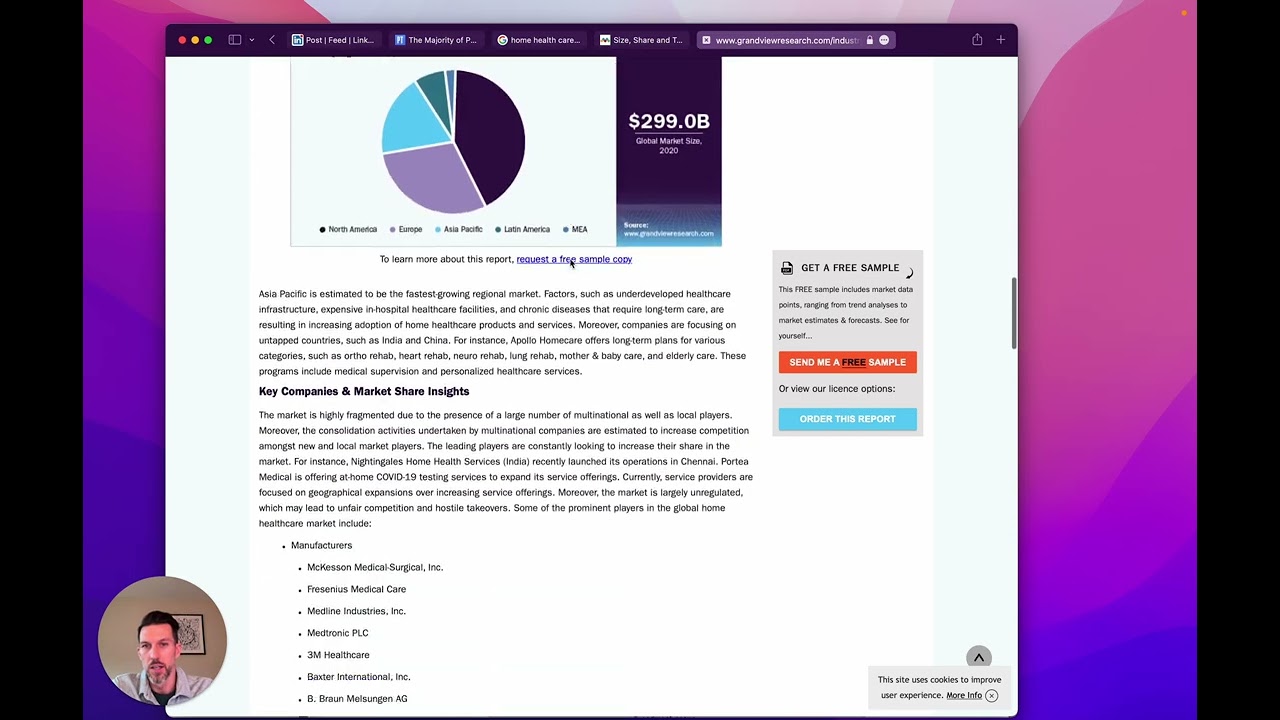
The host explores two potential niches: introverts (defined by how they recharge energy) and home healthcare, which could hit $300 billion in five years at 50% annual growth. He uses a top-down economics view combined with bottom-up idea generation, testing each niche against his framework that products should align with how users exchange energy.
Chapters
Hi friends, where do we find you today? Hopefully in the present moment. Since we last talked, it's been about a week, and during that time I've been thinking a lot about, um, what could potential niches be within the healthcare market. Um, I've come up with 2 here, and these will be in the show notes, but I want to show you sort of the process that I went through to get here. One I've selected is introverts, the other one home healthcare. Um, so we'll get into how I selected these in a moment, but let's go through the details first. So introverts— introverts are interesting. Who are introverts? A couple ones just on Google and a quick search shown: Bill Gates, Buffett, Einstein, Zuck, JK from the Harry Potter series, Elon. Obviously some pretty well-known names. Um, introverts— what's the definition? I actually was scrolling through some of the folks that I follow on LinkedIn over the week and came across this post from Adam Grant, who has been talking about this subject for a little while. I'm not too familiar with him, but I thought it was interesting in the fact that he had a post about introverts on World Introvert Day. Didn't quite know that was a thing, but I guess it is. Yeah. 150,000 people liked this topic of introverts. I ended up posting a comment just to do my own, like, little user research on here. This is back when maybe 25,000 people had liked it, and almost 100 people liked it, and I got a number of replies on it. So I thought this was super interesting because I've had this premise for a little while, which is on the internet you don't exist unless you post something. The entire social internet has been built around buy something, post, like, share, retweet, comment, upload photo, upload video, watch. It's all these like actions, right, that you're giving out energy. And the definition of introvert versus extrovert, at least as I understand it, is really what are the things that give you energy. So extroverts at large would be, you know, being around a number of people gives me energy. I like to go to a party. I like to I like to go to cocktail hour, et cetera, maybe be in a group setting at work. That gives me energy. I get excited. For introverts, it's more the opposite. Maybe being alone, reading a book, thinking, being in nature, meditating, hanging out with the dog, just being present is something that gives them energy. I think that might change over the course of your life. I think when I was younger, I might've been more of an extrovert, but as I've gotten older, Reading, learning, building, creating gives me more energy. And so I think I'm more of an introvert. So I thought, you know, isn't this interesting? Are there products for introverts on the internet? There might be some things like calm meditation apps, writing apps that are very sort of centric-focused rather than being in the fire hose and the feed-focused. So that's a little piece about introverts. So I wanted to share that. And then there's also an article in here about Psychology Today, introverts versus extroverts, that I found over a quick Google search that you can read through. And I actually found it was interesting that Adam Grant was quoted in a Wall Street Journal article. And this really is like, maybe it's not one or the other, but I've seen some stats that it's like 50/50, the human population. But there's also this ambivert, which is you've got a little bit of both qualities. So as we talk about like health health at large. It's not just physical health, it's also emotional and mental health. And those have gained more traction over the recent years. I think in the world that we live in today and in the future, it's only going to become even more important. So yeah, I think that's one angle. The other angle is the home healthcare market. And so what I did is I include a couple screenshots and some stats that I pulled. Just another simple Google search you can do, home healthcare market size. That'll bring you to places like Markets and Markets, which is a market research company. They do a lot of different topics, but I found this one very quickly about what's the size, about $200 billion today for the home healthcare market, about $300 billion, so growing about 50% over the next 5 years or so. Obviously COVID impact. And then I did another one just to see, you know, what does that growth rate look like over the years? And this is from Grand View Research. Another research company. They do obviously a lot of different topics and industries, so it might be interesting for you as you try to figure out where you want to go to look into this. And then obviously pre-pandemic, post-pandemic, because this is the healthcare industry, you can see some more data. You can see manufacturers, so existing people and companies that are operating in that space, and then some statistics just about that. And these would be like, for example, your competitors. So I thought that's interesting. So then how did I get here? I think how you get to this place is because we've gone top down from here's like the GDP in the United States, and then we're going bottom up around I have this idea. And really what you're trying to do is kind of like meet in the middle so they kind of connect. And so you have to go bottom-up and top-down at the same time and see, like, does it fit things that you can work on, you're fascinated with, is a good market that people have a need for? And that sort of brings me into lesson 5, which I also just wrote up today, on people playing energy games as the core fabric of your product. And so give a read through that. I think that'll help a little bit. The last thing I want to say about this is it takes time. There's been a week that's gone by from the last video, the last lesson of part 2 for this, finding a niche. I've been thinking about this for a couple years, and it really comes from just having conversations with people. So here's the idea on the home healthcare market. People are inherently lazy, right? And I don't mean that in a bad way, but just in a like, I work so much, I've got so many things going on, just Make my life easier. I'm willing to pay for that. I value that. One of the things that's not so easy is finding a doctor, picking up the phone, trying to find a schedule, deal with insurance, get in my car, go there, put on a mask, be around different people, go in an uncomfortable setting. Wouldn't it be great if they could just come to you in your home? That's this home healthcare market. That's a good idea. The problem is twofold. One, you have 2 sides of this market, the person in the home who wants to feel safe, right? The other side, which is, let's say, the nurse or the doctor coming to the home who also needs to feel safe, and then they meet, and so there can be a fit. And so I think if you're thinking about a marketplace in this world, that's the fundamental problem you have to solve for. Once you get the people in the network, that's fine, but you need high-quality care. high-quality customers that are both trustworthy and are there for the right reasons. So if you can do that and solve that problem, I think in the far future you'll be in a good state of affairs. On the introvert side, what would a social network for introverts look like? Hmm, interesting thought. Something to ponder, something to think about. So let's pause here. We'll keep thinking, and I'll see you next time. Hope you have a great day. Thanks all for joining us.









