Sean Everett walks through macro data to help entrepreneurs pick a market niche. Americans spend roughly three-quarters of their earnings each quarter, and 8% of the U.S. population are sole proprietors. Service markets like housing, healthcare, and financial services offer the biggest opportunities.
Chapters
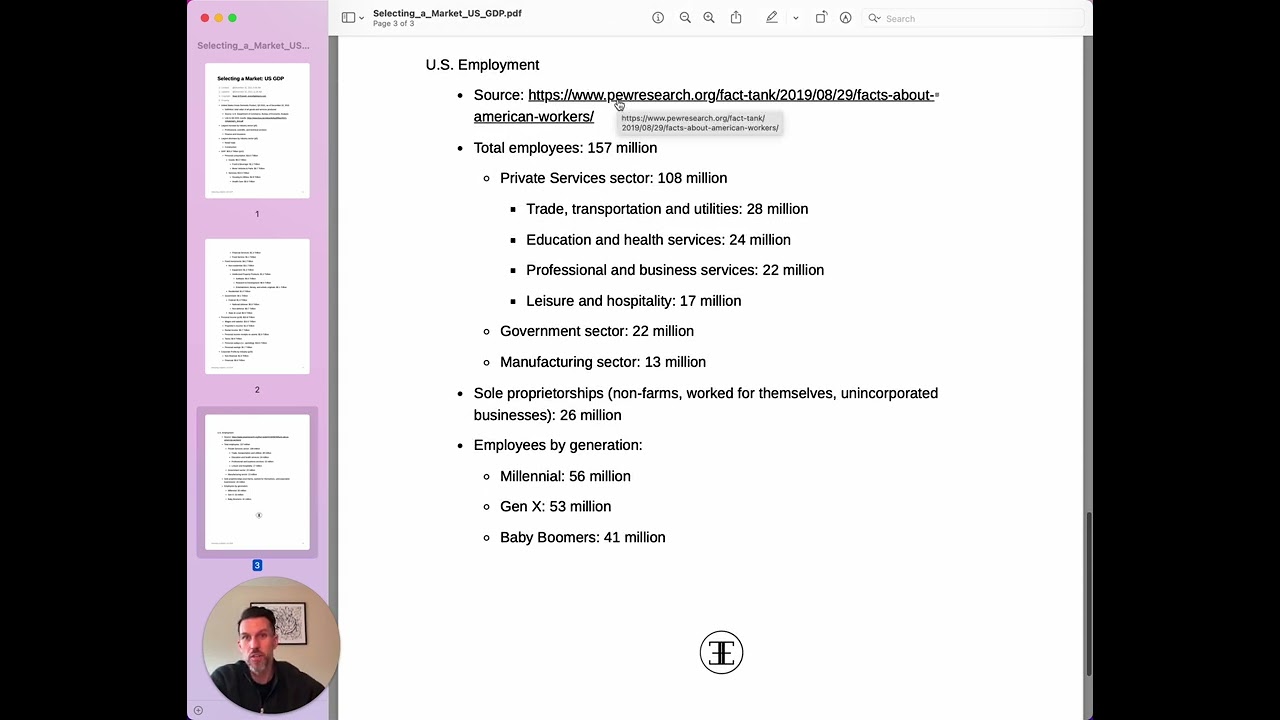
Okay, welcome back. So this is another PDF I've included in the show notes. So what I've done is actually pulled out some of the sample data that I thought was important from here. So let's take a look at this and I'll walk you through it just so you get a sense of how this works. So as I mentioned, here's a link to the PDF that, that we just went through, and then those are also included in the show notes. So let's look at largest increase and decrease by sector. So again, professional, scientific, technical, finance and insurance, decrease retail and construction. A lot of competition here, maybe not a great market to enter. It will reduce profits to zero. Okay, so GDP broke this down. We went through this a little bit. So in the personal consumption, a lot of that was food and beverage, motor vehicle and parts. But if you do some analysis on this, you'll see that that may not be a great growth sector for you. Services industry, you see housing and utilities. People gotta live, people need to take care of their house. If you need to get out of the gate and just start getting and earning some money quickly, this is a great way to do it. Granted, there's some competition, but if you're really good at what you do, you're fast, you charge a fair rate, you're trustworthy, you can capture a lot in this market. Healthcare, same thing. Potentially as we get older, people going into other people's homes. If you're timely, if you're trustworthy, if you have a good bedside manner, if you're calm, if you can have some fun with people, then this could be a gigantic industry for you. Scaling might be difficult. It requires more people. Maybe not. There's some software stuff that could be done here as well. Financial services, take care of the money. There's gonna be, I think, something like $30 trillion that's handed down from the baby boomer generation to millennial and Gen X, Gen Z over the coming decades. This will grow. Okay, and then here's some fixed investments, like where are people putting their money? Equipment to help run the companies, and then IP. IP, patents, copyrights, writing, instructions, entertainment, R&D, really interesting stuff. And then residential real estate, for example, a trillion bucks. How does the government spend money? This is super interesting. What do you do with my tax money? Well, the government's federal and state, only $4.1 trillion. That's interesting. Federal, $1.6 trillion. A trillion is spent on national defense and about $0.7 trillion, $700 billion on non-defense. But this is even more interesting. State and local, $2.5 trillion of spending. People live where they live. They're very concerned about their communities. They drive on the roads, they go to the schools, they go to their malls. They want a safe place to live with some activities and events. Another option to create some services, maybe you can get some help from the state and local governments, even city where you live. A lot of money there, more than federal. That was surprising to me. Personal income— where do we as consumers spend all of our money? It's the biggest market in the world. People think B2B, you make a lot of money. If you can figure out the consumer market, um, they spend a lot of money. So, uh, let's look at this. So here's income— wages, salaries, rental income, return on assets, basically investments— spend a bunch of money on taxes. Here's the spending and here's the savings. Consumers spend in the quarter. We made $21 trillion and we spent $16 of it. That's insane. That's like 3 out of every $4 we earn, we spend. That helps our economy grow. So there's a lot of opportunity if you build a better product, you build a better brand, and you connect with people on an emotional level. You can win. There's plenty of room. There's $16 trillion in a quarter. Multiply that times 4, $16.5 times 4 in one year, that is $66 trillion. That's a lot of millions. You can have a small amount of that and do really well for yourself. And then I mentioned that we would take— put a link in the show notes to employees. So here's just Pew Research is a good think tank. They do a lot of research that can be trusted. A lot of good folks that work there. In the United States, we've got about 320 million citizens. But how many in the workforce? It's about half of that because kids, retirees, they don't account for the workforce. But look at this private sector, 108 million people work in services. They work in services, trade, transportation, utilities. They help make our world go round. 28 million people. They educate us. They provide us with health services. Another quarter of the pop— of that working population. Professional and business services help people run companies. 22 million. And then entertainment. So isn't that interesting? Like infrastructure, education and health, business, entertainment, all about a quarter, right? Government got about 22 million, and then manufacturing, actually building the physical products that we buy and interact with, 13 million. So that's it. Those are the places you can work in this, in this country. Um, so figure out, you know, where your passion lies, what is a good fit. Ultimately, it's fit. And then sole proprietorships, um, if you start earning internet or money on the internet, you will start probably as a sole proprietor. You're not working on a farm, you're working for yourself. You maybe have one employee, you maybe don't, and unincorporated. You just schedule on your tax return that you're a sole proprietor. You don't need to create, um, an entity, a business entity. You can do it yourself. 26 million people, that's— let's see, 26 divided by 320, that's 8% of the population in the United States. Very interesting. And then if you're interested by generation, millennial generation about 56 million. They just surpassed Gen X to be the largest number of employees in the country. Baby boomers a little bit smaller, and that is that represents about 140 million people. That's pretty much the whole working class right there. So you know age 16 to 65. That's pretty much it. All right, that's it. Thanks so much for joining us today. Hope you have a great day. Thanks for spending time in our present. Appreciate you.









