Stock Options Don't Sell Houses. Systems Do
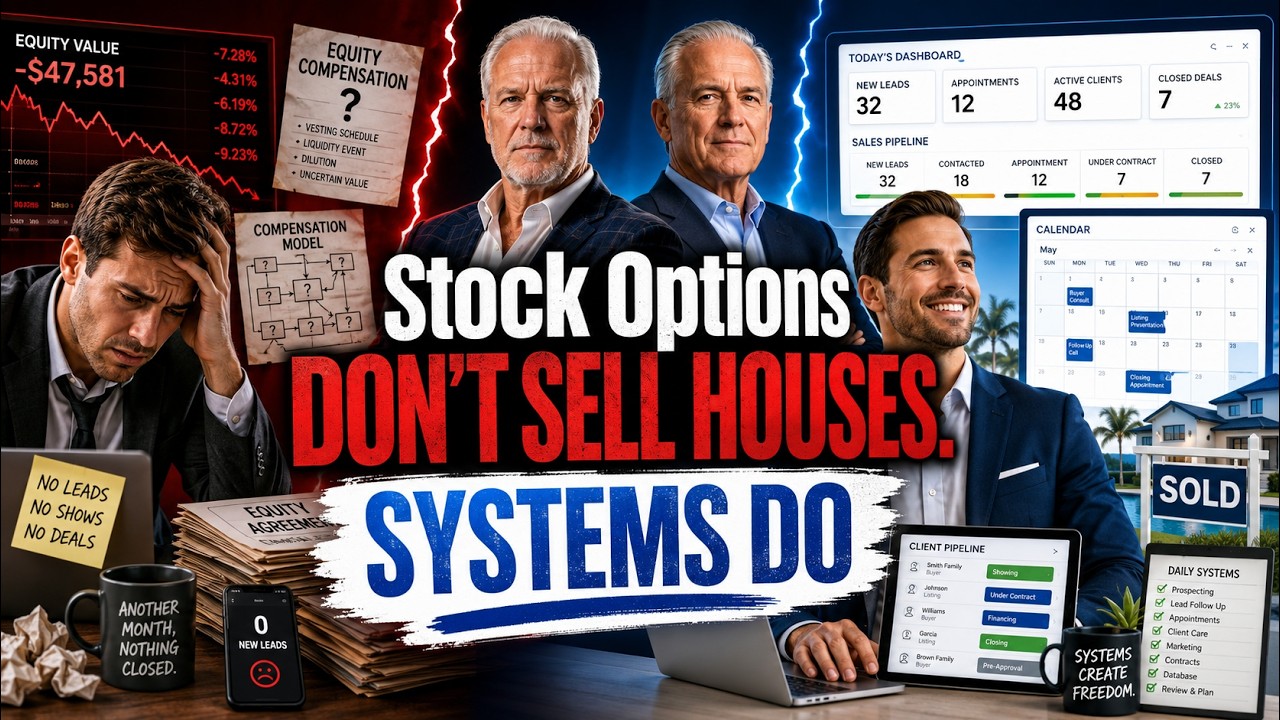
In this episode of the Brokers Uncensored podcast, hosts Dan, Becky, and Steve—seasoned real‑estate professionals from RE/MAX—discuss why flashy incentives such as stock options, downlines, and lead‑generation guarantees rarely translate into lasting success for agents. They argue that most new agents (over 80%) leave the business within a year because they rely on broker‑provided leads instead of learning to generate their own business. The conversation contrasts legacy brokerages like RE/MAX, which focus on agent support, training, and brand recognition, with newer tech‑forward models that often emphasize recruiting and “shiny objects.” They highlight the hidden costs of lead‑dependency, the lack of retirement or legacy value when agents are merely order‑takers, and the importance of treating real‑estate as a true small business with a plan, systems, and ownership of assets. Practical advice includes evaluating one’s brokerage annually, leveraging under‑used tools (e.g., RE/MAX websites), understanding who controls lead flow, and focusing on building sustainable systems rather than chasing quick‑rich schemes. The hosts also touch on why tech companies are acquiring legacy brands, suggesting that the enduring value lies in the established systems and brand equity of firms like RE/MAX.
Chapters
Welcome to Brokers Uncensored, another fantastic podcast put together by 3 people who are crazy enough to be in the real estate business for Almost a complete total of what, 75+ years? I mean, we've all been here for a long time.
Yeah.
Here we're going to be passing advice. We're going to start a new series. We're mainly going to be speaking to agents because it is that season again when agents start evaluating where their business is and where it sits and looking to see where the future goes. So we thought we would start off this series with a topic That basically is strategy and systems versus shiny objects. So that being said, Steve, Becky, let's talk.
Talk. Yep. Where do you want to start?
Talk about.
Yeah.
Well, where do you want to start?
Well, I think there's a lot of there's a lot of benefits that are being pushed to realtors, especially newly licensed realtors, and they don't know which way to turn. And I think it's important that they do something that is very critical to start their career off, and that is to talk to people in the business from various brokerages. Talk to people who have been in the business. Learn as much as you can from them. Get as much advice that you can, and then start focusing on the brokers that offer several programs that will help them become successful. Forget about just the cut. Forget about Like you said, shiny object, forget about the leads. You have to learn how to run this business yourself. And there's many people that have done it the old-fashioned way and they continue to do it the old-fashioned way and they do a tremendous amount of business. Start looking at the new people, the success rate of new people. And look, most people, 80+% of the people who get licensed will not be in a business in 12 months.
Wow.
You have to ask yourself why. So I think that's important. Do your homework.
And let's, and let's talk about this. You know, why is it that most of the, you know, everybody's now talking about the difference between the new age real estate model and the legacy real estate model? You know, all 3 of us work for what's called a legacy model, right? RE/MAX, 50-some years, you know, in existence, you know, which, by the way, without all the technology and everything, still the most productive agents on the planet. So let's just throw that in there.
Yes.
But they're all talking about new model versus legacy model, right? But let's talk about that, the legacy stuff. Why is it that all of these legacy models promote everything but selling and buying houses for the consumer? It's all about stock options. It's all about downline. It's all about, oh, I'm famous. And my fame would translate to your success. When all of that to me is just smoke, none of it's about running a business. None of it's about actually being able to have a replicatable business, you know, year over year. And that's what I think is interesting is a lot of these people, for better or for worse, poo poo. On actually running a business of real estate, like you owning a small business, starting off with with a business plan, being able to back that business plan up, and having people that can support you doing that. So you know what's your guys' thoughts on on all these different new brokerages and and what they really bring to the table? Because we see it every day. We see. We see, we deal with the agents on the other side.
Yes.
And, you know, most of them unfortunately just aren't trained.
Right. Well, I've had actually 2 conversations, um, on, on similar to this topic. The first one was, is, you know, a lot of— and you guys will probably agree too when you're meeting with agents— is, do I get— do you give me any leads? So although leads are important, especially when you are newer in the business and trying to get you know, up and running. They are, they can be very important to you, but what a lot of these companies don't teach is for the agents how to generate leads. So now they're just handing them to you. You don't know how to generate leads. So now you become very competent on that team or company because they're feeding you all of the leads and you may be on a lower split because they're paying for those leads and they're, you know, they're generating them for you. They're not physically teaching agents on how to generate those leads. So they kind of have their hands tied and they feel very competent on that. Like I said, that team or brokerage. So that was one conversation that I had recently. The other one is the shiny object brokerage is support. You know, they, they don't have a boots-on-the-ground broker or manager that they can pick up the phone and call. They have to email them, and they may be in another state, and they may get a response in a week, or they may not get a response at all. So those are 2 conversations that I've had recently that have come up when kind of on the subject of agents and, you know, how to choose a brokerage and what's important when they're looking for one and those kinds of things. So—
And if I could piggyback on something you said, Becky, we've talked about this before. If somebody's getting leads from their brokerage and they're getting, let's say, a 50% cut, and let's say you did 30 deals in a year, and if you learn how to, to create your own leads and your own customers and you did 15 deals a year, more than likely you might make more money Doing half the amount of work. You have to have a life. You have to have balance in your life. So getting leads, yes, that might be important to somebody, but you're— it's like you're sleeping with the devil. You know, you're, you're giving all of this money away for the brokerage to find you those leads.
And that may work for some agents as well, but I mean, if anybody who that's a stepping stone for them, like, how do you get out of that position where all of your business has been handed to you through leads. You know, how do you get out from underneath of that and start moving into, you know, being your own agent and generating your own leads?
I mean, you become an order taker instead of a business person.
Yeah.
Well, and I would argue, I would argue too, that, that to Becky's point, the trap is also this: you can be in that system for 5 years, you can make money, you can absolutely be generating commission. But if you decide to pull the ripcord and leave, you're basically a brand new agent.
Yeah.
5 years in, because all of those leads belong to the company. They all belong to the company or the team, and you don't get to take those with you. In fact, most agents don't realize that the production, as far as the MLS and as far as people looking you up, all gets reported under the brokerage or the team.
Mm-hmm.
So, you're a ghost if you decide to leave 5 years in. You have— you're taking nothing with you. At least if you're running your own business and you're paying for leads from something like Zillow or something like that, you at least control those leads so you can leverage them later on to get more business down the line. You know, you're paying for them once and you can farm them years later to get more business. But, you know, let's talk about the other thing that everybody always wants to, you know, Stock options, you know, all of that stuff, you know, downline. Okay, well, let's be honest. If I have 40 non-producers in my downline, what's my downline? And are you really concentrating on— are you really concentrating on helping people buy and sell homes? Are you concentrating on recruiting?
Right.
Like, why is it that I'm in real estate and I'm recruiting other agents for my downline? Like, what's that look like? And, you know, and let's be honest, that whole thing again can be taken away at any point. You know, there was a very famous— there was a very famous move a few years ago by one of these lovely real estate companies that took away all the vesting from their people who left the company. Now, originally when the deal was made, if you were vested and you left for another real estate company, you still got your monthly Pop. But then all of a sudden, the owner of the company said, no, we're going to change that. Now, before a big lawsuit, they changed it back. But again, I think it's all about, do you want to be an employee or do you want to be an entrepreneur?
Right.
And I think that's really where it comes down to, because if you're, if you're chasing all these other shiny things instead of just building a business, which I think both of you would agree with me is slow. Okay, it's not instant. It's not a get-rich-quick scheme. It is definitely a get-rich scheme, but not quick. Then, you know, that's great. Go be an employee. But I think all of us got out of our normal job into this business to not be an employee. And that's what's kind of interesting. And the fact that, that we believe that, you know, that somebody else's success is going to translate into ours, that's not the case all the time. So I think you have to look at where these agents are and, and, and the production proves it. You know, when you look at it, the production proves it. You know, RE/MAX agents, generally speaking, don't have all this stuff. But we still outproduce everybody by double in a lot of cases. So what's the magic there? You know, I think the magic is nothing but support, hard work, strategy, skill, and system building, and actually owning a business which you can take anywhere you want, right? Which I think is very important to agents. And so, you know, for those of the, you know, Any of you watching this, you know, the— let's, let's just not be, you know, the tens of people that are going to watch this. It's probably not going to be more than about 5, 10 people.
You think we're going to have 10?
Yeah, we might have double digits.
We're going viral, Dan.
The tens of people that are going to watch this.
Hundreds.
You need to stop trying to push the easy button. Stop trying to go in here and be like, you know, Oh, well, I'm gonna get this downline and I'm gonna get this. Look, to Becky's point, if you suck at lead generation on your own, okay, and I think both of you would agree to me because we do this, you're gonna suck at recruiting on your own, right? Because guess what it is? It's just lead generation of a different bucket of people.
Exactly.
So how are you going to build a downline? You're not. You know, I got called, I got called probably 2 weeks ago by one of these agents, which I always find interesting when they call me trying to recruit, you know, a managing broker. It's always kind of humorous. But the person at the other end said, yeah, my other, my other brokerage, I was doing $3 million and now I'm doing $9 million. And you should, you should want to come here. And I said, wow, $3 to $9 million, that's awesome. And they go, no, no, no, no, no, deals. Oh, I went, 9 deals? Like, that's it?
Less than one a month.
Less than one a month? Like, okay, I get it. But they were trying to recruit me into their downline, and I had a nice conversation with them and told them, you know, where I was, and, and they just, you know, didn't see it. But It's always amazing to me when you start looking at it that the agents are jumping at all of these ways to make revenue in real estate.
Well, because like you said, they're looking for the shiny object. They're looking for the quickest, easiest way to do it, and there's not. This takes a lot of hard work and time.
And everybody knows with some sort of a multi-level feature, uh, the people who are in first are the ones that make the money. Yep.
I would agree with you, Steve. Absolutely. I would agree with you. And it's funny because it all seems to be, you know, there was one, there was one company and we don't want to name anybody by names, but there was one company that jumped into this pond first. Okay. And everything that's come after that seems to be a diluted kind of, you know, derivative of that model. You know, they may add a little twist to it. They may add, but it's all this same thing of, oh, you're doing all this and, you know, know, and some people do it more virtual than anything else, which is really interesting. You know, it's, um, and, and it's funny because recently, very recently, I've had conversations which I think I've shared with both of you. I've had conversations from a few of these virtual companies, okay? Their team leaders have been reaching out wanting to know if we'll sublet space. Because we have physical offices. They're wanting to know.
I thought they didn't need it though.
I thought that was exactly the conversation I had with them. Wait a minute. Why do you want brick and mortar? Brick and mortar is horrible. And they're like, well, you know, we need a space to come together and blah, blah, blah. And I, you know, I think they're figuring out what, what, you know, all of us figured out in the beginning is, you know, this is a, this is a face-to-face business.
Yeah.
It's also a face-to-face business with your colleagues.
Right.
If you're trying to be an island and be out there on your own, you're done. But yeah, they're wanting actual physical space. And when I say conversations, I've had like 5.
Wow.
And it's shocking to me. It's shocking to me. So, I think when you, you know, if you're looking at your business right now and your business is not where you want it to be, not gonna say you're failing, I'm just gonna say it's not where you think it is. I think it's time to evaluate what the value is of the things you thought were going to put you into success where you're standing and possibly look at something different, way different, radically different, maybe in your eyes going forward before you pull the trigger again, because it's expensive to move.
Yeah.
You know, it's expensive to move and Then the question becomes, is, are you an employee or are you an entrepreneur? And I guess that becomes the big final question.
And listen, it never hurts to have those conversations. I mean, there's no obligation. You don't know what you don't know, you know? So you may think that, you know, at the time when you signed up for a particular brokerage, that this was the latest and greatest thing and this was going to get me, you know, to where I think my career should be. And maybe a year, 2, 5, years later, maybe it's not. Maybe it's just time to reevaluate. And frankly, I think agents should probably— it would be wise of them every year to evaluate their business. What worked? What didn't work?
Well, that's what your business coach is for.
What is helping me? What is not helping me? And really, you know, when they should be doing their, you know, business planning and for the upcoming year, and they need to be evaluating those kinds of things. So, and we offer those to our agents, you know, I mean, it's a voluntary basis. We're here if you want to. Let's discuss it. Let's talk about what's working.
Let's talk about what's not working.
You know, I mean, I had an agent, I saved her $400 a month she was paying for some website, and she never went on there. She didn't know how to use it, but she gets a RE/MAX website that it's already included for a fraction of the— so I'm like, I just saved you $400, you know, and you're on page 5 on your other website and you're on page 1 in the RE/MAX one and you've never even logged into it. So, you know, those kinds of things, you know, and a lot of agents, even guilty, some of our agents don't even know everything they have at their fingertips. You know, and they're not utilizing it.
So, yeah, I know. I always love when I have an agent that's been with us for a long time and I show them something and they're like, it does that? Yes, it does that. You know?
Yeah, we've had 18 classes on it too that you didn't show up to.
That's right. I think everybody has to understand that they have a lot of potential and they need to pick the right company and have the right tools to get to where they want to be. And everybody is capable of greatness. If you choose to follow the path that so many others have taken. And just, you don't need to reinvent the wheel. Just do what works and be consistent and be engaged and have balance in your life. And you can have a wonderful life and career and just all your dreams can come true. I mean, just do what works instead of chasing that shiny object like you said.
Well, this is one of the things, and I don't know if you guys do the same thing, you probably do. Because you're both very smart, capable people. But when I'm in the recruiting room with an agent that's done this for a while, one of the questions I ask them is, what value does your business have to leave to your kids? And most of them are like, well, because it doesn't. So when you're on that model where you're being handed leads and you're being whatever, the minute you are gone, it doesn't generate any more business. There's no—
Retirement plan.
You have no retirement plan. You have no— you have nothing to pass on. You have nothing to, you know, to move, you know, to leverage, to do anything versus actually owning a business. You do have something to retire on and leverage. And most agents just don't have any concept of that. And that's the other thing too. Like, you know, if you think about it right now, not that it's going to happen, but Zillow's Got how many lawsuits? I mean, 9, you know, 2 of them by the federal government. There could be an injunction tomorrow by the Department of Justice and your lead source just gets shut off.
Oh, yeah.
And then your business is done.
Right.
So, you know, I think that's another thing that they need to think about when they're evaluating, kind of like Becky said, evaluate your business. Who controls your business?
Yeah.
Who controls your business? Because I would say the person that controls the incoming leads controls your business.
Mm-hmm.
You know, I'd love to tell you, I'd love to tell you that, you know, oh, that's not the case. It's all round robin. It's this, it's that.
No.
You know, not really. If they're paying money to generate those leads, they want to know that they're going to give these big leads to their big closers because they need to, they need to recoup funds. So yeah, it's, it's just one of those things that I think we need to all sit down and evaluate. And then I think I'm gonna close it out with this. If the franchise or legacy model was so garbage, right? Why are all these tech-forward and newfangled companies moving to purchase or merge with franchise or legacy models? Why wouldn't they just let us die? We're dinosaurs. Just let us go.
Yes.
Right? Why aren't they dominating us? Why aren't they just crushing us?
Yeah, well, because they see the value. Our agents have been in the business, and our claim to fame is at RE/MAX Alliance Group— I'm going to get us a plug in there— most of our agents have been here 10, 15, 20, 30-plus years.
Yeah.
What are we doing to make our agents want to stay here for an entire real estate career?
Exactly. And, and, and be here. And, and it's funny, you know, I, I, I always want the best for every agent that, that's in my offices. I always do. And I reach out to agents that have left us because I think they just didn't know what they didn't know, maybe, and they made a mistake. There is no one that has ever left one of our offices up here in the north that has done better when they left.
Nope.
Nope.
And, you know, you can say what it is. And it's funny because most people, most people when they leave say, oh, well, the brand doesn't do anything for me. It just doesn't do it loudly.
Right.
Which is the problem. It doesn't do it loudly. You don't see it. It doesn't make fireworks. It doesn't, it doesn't have a neon sign.
The, the, the light bulb for me that went off, obviously I've been with RE/MAX for almost 30 years, so I understand the value of it. But recruiting agents from other franchises who are very well known around the, you know, United States as well, have come over to RE/MAX And they're thinking, they didn't think that the brand was going to be that big of a deal. And then they come back and they're like, I had no idea. Like, I don't have to spend any time. Like, RE/MAX is the most recognized name in the world. We are in 120 countries and, you know, they know everywhere. Where some of the other companies, they're very popular in maybe the northern states or, you know, that kind of thing.
Yep.
So, but everybody knows RE/MAX. So, they're like, I have to spend less time. And this is how it should be. You need to spend less time on where you work and what you're going to do to work for them to get their home sold. Or on a listing appointment, or, you know, build that value with the buyer. And then they go, don't call it the 800-pound gorilla for nothing.
And I think that's, I think that's what, you know, I think, you know, if you're thinking about moving, if you're thinking about leaving this year, I think it's time to start looking at again, why are the tech companies buying legacy brands? Maybe it's the unshiny object where success really lies, right? And I think that's a big deal, but All right, guys. Well, final thoughts?
Well, I think if I could just add something, you know, I'm thinking of this as we're talking. If a person is out there in this industry and are living paycheck to paycheck, they've got to figure out why and really look into their business plan and their business model. And that also includes looking in the mirror. And they can reach out to us. We can have those conversations. Uh, it can't go wrong. Doing your homework, because at the end of the day, it is your business and you should do your due diligence anyway. And we're here if you want to talk to us.
Yep, absolutely. I think that's great. Well, thank you guys for joining us. We are going to be doing this series weekly. We are going to be concentrating for the rest of the year on exactly what we think we can do to help agents. So if you have questions, comments, please drop them down below the video. We are always accessible. Our contact information is going to be at the end of this. You can always reach out. We love to have conversations. They're not about recruiting. We just are about helping. So appreciate it, and we'll see you next time.
Have a good one.
Bye now.
More from Shadd






Flight Attendants with Real Estate Licenses The Public Deserves Better! #b #professional #really

