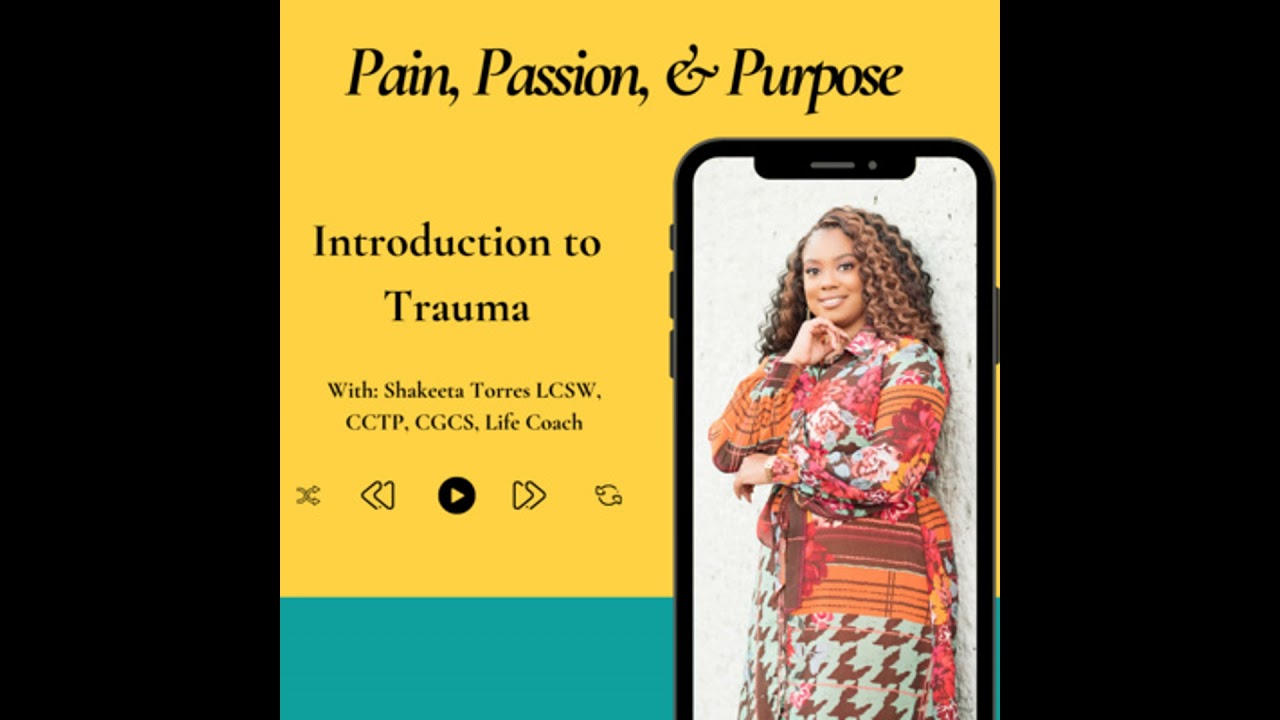
In this solo podcast episode, host Shakeeta Torres introduces the broad subject of trauma and PTSD, blending mental‑health education, biblical perspective, and practical coaching. She begins with a promotional overview of her Empowered Purpose Academy, membership community, and related products (healing anointing oil, co‑authored book). She then defines trauma, listing numerous types—from natural disasters and assaults to childhood abuse, military combat, and even spiritual or church‑related trauma—emphasizing that individual response determines its impact. The episode outlines common physical and emotional symptoms such as anxiety, fatigue, anger, guilt, shame, hypervigilance, isolation, and mood swings, illustrating each with personal anecdotes (e.g., her mother’s death, a dream about angry women). Torres discusses therapeutic best practices: assessing trauma, building trust, prioritizing anxiety management and coping‑skill development before deep trauma work, pacing treatment, and allowing breaks. She shares her own healing journey, noting that recovery can be faster than expected with the right support. Throughout, she intersperses calls to subscribe, leave reviews, and support the ministry, and announces future segments on intergenerational trauma and treatment strategies. The episode concludes with a prayerful benediction and donation information.
Chapters
Welcome to Pain, Passion, and Purpose. I am your host, Shakeeta Torres, where I share mental health education, biblical teachings, and tips to help you to heal on purpose so you can walk boldly in your God-given purpose. This podcast is sponsored by Empowered Purpose Academy, a certified online Christian academy where where we provide services such as certification for Christian life coaches, mentorship for master's level aspiring and existing Christian therapists, mentorship for Christians, and continued education courses for the body of Christ. You can visit www.empoweredpurposeacademy.com to learn more and to download your free guide. If you like today's episode, please subscribe and leave us a raving review so that others can tap into the knowledge and wisdom that will be shared on this podcast. Thank you so much for being here. Hey, so before I get started on today's episode, if you have not subscribed to the paid membership of my podcast community, please do. It is going to bless your life. Listen, my episodes are already like therapy slash coaching sessions where I give you strategy and insight and all that good stuff. But the community, you're going to get a lot more. You're going to get more resources, more tools, and be able to ask more questions where I can create episodes around your questions. And you will be able to get discounts on some of my, my products and my events. So what are you waiting for? The price is very affordable. This is for those who are not quite ready to invest in one-on-one coaching with me or into the Pain, Passion, and Purpose mentorship program, which is also low, by the way, but that one is a lot more in-depth. You get access to courses, you get access to the Facebook community, and all that good stuff. But this is for those who just need to just listen and just gain some tools along the way. So what are you waiting for? Go ahead, subscribe. You won't regret it. It'll bless your life. We'll have topics around mental health and faith, biblical teachings, prayer, um, boundaries, communication, anxiety, depression, purpose, and so much more. I have had experience in mental health since actually about 2008 when I first finished my bachelor's program, and then from that point all the way up today and moving forward, I have gained so much so much experience, so much wisdom, and I am anointed for it. So go ahead, hit that button, and I hope to see you in the community.
Hey, you guys, welcome back to my podcast. And so today we're going to talk about trauma and PTSD. Okay, first let me say trauma and PTSD is such a huge and broad topic. Okay? It's so many different types of trauma. There's so many different levels and depths of trauma and how it affects a person depending on their age, depending on their demographics, depending on their culture, their environment, their upbringing. Oh my gosh. It's a lot. And I have learned a lot about trauma over the years, even for myself. As you listen to my first episode about my pain in my past, Wow, I was definitely traumatized and I definitely had to go through in-depth healing and undoing of my thinking styles and anxiety and some depression. Depression really wasn't a thing I really struggled with. Mine was mainly anxiety. Okay, so today I'm going to break down trauma for you guys a little bit. Um, this can definitely be like a small series about the different types of trauma. Um, but today I want to kind of give you an overview so people can truly fully understand what trauma is. Oftentimes I come across clients who are not fully aware that they have experienced a traumatic event until we begin to talk about it. And then sometimes they know they have trauma or experienced a traumatic event, but they're not fully aware of how that trauma is affecting their everyday life. As a therapist, I treat clients who have been traumatized from childhood abuse, sexual abuse, who have been involved in domestic violence relationships. If they're currently in that relationship now, I prefer not to counsel them during that time because it's hard to really, for me, to really treat them for trauma whenever they're still in that situation. It's best for them to go to a person who specializes in treating women or men who are currently in that situation. Because for me, I'm not gonna lie, I'll be honest with you guys, it gives me so much anxiety because I'm always worried about that person. To be honest, I really am. So with that being said, I'm going to go ahead and break down to you guys a little bit about what trauma is. So trauma is whenever you experience a traumatic event in your life by way of a natural disaster, which is a tornado or a hurricane, a fire or a flood, sexual assault, physical assault. Um, you can have traumatic births, witnessing a shooting or stabbing of another person, a sudden death of a parent, a trusted caregiver. I, I've had clients before who have seen their loved ones die right in front of them. Having to be hospitalized. Human trafficking is definitely a form of trauma. Also, childhood abuse, whether it's sexual or physical as well. You got— there's so much type, so many types of trauma. Also veterans who in the war zone and they are constantly being exposed to violence, domestic violence, to be in an intimate partner relationship. And trauma is not just physical, but It's mentally, it's emotionally. Um, you can have trauma from church. Absolutely. You can have trauma from, um, just about anything, to be honest. And what I've learned over the years is that what might not traumatize you could traumatize somebody else. And that everybody's response to trauma is different. And that's what causes it to be traumatic for that person is how they respond to it. Not how you respond to it or how I respond to it, but how that person will respond to it. Okay. Also, if you were bullied or teased a lot growing up, that's definitely a form of trauma. So these are some different types of trauma. So how do we respond to trauma? Everybody responds to trauma different— differently. So trauma often can manifest physically as well as emotionally. Some common physical signs of trauma include paleness, lethargy, fatigue, poor concentration, and a racing heartbeat. These are all anxiety symptoms as well.
Hey, hey, hey, I hope you are enjoying this episode so far. Don't forget to subscribe and leave us a raving review. I also want to share with you more about Little Warriors in a Bottle. This is healing anointing oil that God instructed me to prepare back in 2015.
I have received so many testimonies since 2015 about this oil.
It is powerful. It has changed my life and others. So be sure to go visit www.empoweredpurposeacademy.com. Shop to learn more about the oil. And while you're there, you can check out the new book that I co-authored called Just Say No, a number one international bestseller, where I share my story called What Trauma Stole from Me. It is amazing. It will inspire you and encourage you. And there are also 13 other authors who share their story about setting healthy boundaries. So that's it for our little break. Let's get back into part 2 of this episode.
Some other trauma symptoms could also be anger. I see anger a lot in people. I remember a few, maybe about a year or so ago, I had a dream where I saw these two ladies and they were just so angry. And I remember saying to them, you have trauma. And they kept saying, what do you mean? And so I was breaking it down to them and explaining to them how anger could also be a trauma symptom. And they were just in shock and disbelief because no one had ever told them that before. And so for me personally, when I see a person who is angry, my first thought process is, okay, what happened to them? Why they so angry, because anger is a secondary emotion. Underneath all the anger is sadness, frustration, confusion. It can be all type of things that we've experienced that over time has made us angry. And sometimes easier to be angry than it is to be sad or unhappy and things like that. And also irritability, having mood swings. It's also depressive symptoms as well. Such as feeling sadness or hopelessness. Um, guilt and shame is a big one, and self-blame. Oh gosh, I definitely experienced this after my mom died in the house fire. I blame myself for my mom's death because I feel like if I had not said anything to my cousin and her pastor about what my mom boyfriend had been doing to me, then I could have been home, I could have saved my mother. But I was 11 years old whenever my mom passed away. And so I tell especially my clients who've experienced childhood trauma of any kind, whether it's sexual or physical or emotional or mental, I'm like, listen, it was not your responsibility to, you know, take care of your parent or to prevent something from happening because it's not your job to protect yourself. And so that definitely helps my clients, and it has helped me to understand that it's not my fault. I can't blame myself. I can't carry the guilt and shame of someone else's actions. Right. And so that runs— guilt and shame runs deep. It really does. And I definitely have, like, tools to deal with all these symptoms specifically. And so when I see my clients, we do like a thorough assessment and we go into detail about how the trauma has affected them. And we break it down. You can also go through, you know, withdrawing from other people, isolation, feeling sad or hopelessness, as I said earlier, feeling disconnected or numb, also not trusting people, um, hypervigilance. So hypervigilance is whenever you're always on edge, you can never really relax, like for example, like paranoia in a sense. Yeah, like paranoia, because you've been traumatized or hurt by different people and situations that you don't trust people. And it's very common when I treat clients who've experienced trauma that it takes some time to trust me. And that is completely okay. I don't force it. I don't push it. I let my clients know upfront, whenever you're ready to share something with me, you can do that. But I'm not going to force people to open up to me right away. Does it help to open up right away? It does. But if you're not ready, because they have to get to know me and trust me, that's totally understandable and totally normal. So if you are, you know, have been traumatized and you're going to see a therapist already and they're making you feel as though you have to tell them every single thing right now and you're not comfortable, then just share with them. Let them know, I'm not comfortable. We're sharing this. One of the things about trauma that I've learned too is that if you don't deal with the anxiety in therapy first, then chances are that person is not going to stay in therapy. Because whenever you are dealing with things of your past, your anxiety levels will spike up. So if your anxiety level is already moderate to high, then that means that when we deal with your trauma, it's going to intensify. And you're not going to be able to really mentally, emotionally cope with that if you don't have coping skills. So I always tell my clients first who wants to engage in trauma treatment, hey, let's deal with your anxiety first. Let's deal with some coping, get some coping skills under your belt so we can have that in case you do get too anxious. You can have that to fall back on. And they're usually pretty grateful for that. They really are. Because Some traumas are just so deep, and some of them, it hurts so bad to bring all that stuff up, and it's a lot mentally and emotionally. And some of my trauma clients, they've been in therapy for a year, sometimes a year and a half or two. I'm not consistently like every single week, but they've taken breaks to give them time to kind of like take a break and kind of woosa, and then they'll come back because It's a process, like you digging deep into areas of your life that you probably never really tapped into before, or probably never had the desire to because it hurts so bad. But I tell my clients all the time, you've already survived the worst, you've already been through the worst. Now it's time for you to heal, and healing is not going to take as long as it did as far as you carrying it. So for— what do I mean by that? So I have a whole bunch of childhood trauma since I can remember as a little girl. I've been surrounded by trauma, okay? But when I became an adult, and as I begin to grow and God began to heal me, it did not take him 10 years to heal me. It did not take him, you know, 10 years of therapy for me to heal, okay? It— the time was a fraction of that. So keep it in mind as well. The sooner you start and the sooner you find someone that's a good fit for you, the sooner you can heal. And that way you can, you know, have some relief and be walking in freedom. But trauma affects us in so many different ways, you guys. And I am going to do a small series about it. I'm going to talk more about intergenerational trauma. Um, I'll talk more about, um, how to treat trauma and what that looks like for some people. And whatever the Lord puts on my heart to share. Because as I said before, there's so many different types of trauma that we often overlook. Um, yes. So I hope this episode helps you today. Like I said, today was just an overview of what trauma is. If you have any questions, feel free to shoot me a message, shoot me an email. I am doing small segments here and there called Ask Shakeeta where people ask me questions, whether it's email or sometimes in my therapy sessions. I have clients that ask me questions, the same questions over again, and I'm like, hey, that's a good question to put on my podcast. So thank you so much for sticking this out. Thank you so much for listening. I really hope this gave you clarity and it helped you to understand trauma. Until next time, talk to you soon. Bye.
Thank you so much for tuning in to today's episode. Our prayer is that this podcast episode has blessed you. Don't forget to go and subscribe and leave us a raving review. If you would like to sow into this ministry or to this podcast, Pain, Passion, and Purpose, you can do so at anchor.fm/painpassionandpurpose or Cash App, dollar Shakeeta Torres. Thank you so much, and I will talk to you next time.









