Shamin Walsh - BAM Ventures
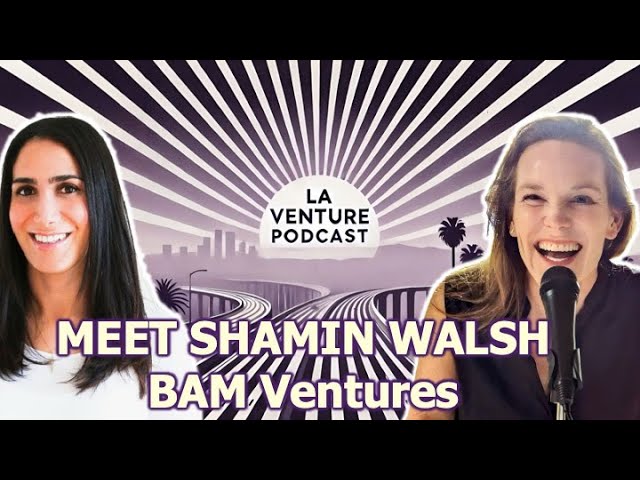
In this episode of the LA Venture Podcast, host Minnie Ingersoll interviews Shamin Walsh, managing partner at BAM Ventures. The conversation begins with a discussion of the consumer sector’s stability and its role in venture investing, noting that consumer spending accounts for 70% of GDP and that successful exits typically range from $100 million to $1 billion, often requiring modest capital compared to tech unicorns. Shamin highlights BAM’s two funds—Fund 1 (notable for a 10x return driven by Honey and other large exits) and Fund 2, a $16 million vehicle that has already returned capital and now holds about 40‑50 active portfolio companies. She explains BAM’s investment thesis: focus on pre‑seed and seed consumer brands, products, and technologies, emphasizing early evidence of product‑market fit, consumer retention metrics, and the founder’s deep understanding of their target audience. The duo discusses how to differentiate fleeting trends from lasting shifts, using examples like pickleball, athleisure, and the importance of aligning with broader lifestyle changes. Marketing strategy is explored, especially the challenges posed by iOS 14, the need to balance DTC, retail, Amazon, and agency partnerships, and the importance of being where the consumer is. Shamin describes BAM’s hands‑on yet flexible support model, quarterly check‑ins, and founder‑driven cadence. The internal decision‑making process at BAM is described as a unanimous partnership between Shamin and Brian, with input from other partners, and they stress the value of personal passion for founders. The interview concludes with Shamin’s personal background—born in LA to Iranian immigrant parents, early exposure to entrepreneurship and finance, and how her multicultural upbringing informs her view of consumer behavior. She reflects on lessons learned from past investments, the unpredictability of hype, and what “making it” means to her, emphasizing purpose, family, and love for the work.
Chapters
Hello and welcome to the LA Venture Podcast. This is Minnie Ingersoll, host of the podcast and partner at 1010. 1010 is a seed stage fund here in LA. All opinions expressed on this show by me and my guests are solely our own. If you are interested in LA venture, go to 1010.net/podcast where I've made a sortable list of all of the great LA VCs who've been on this show. Shamin has agreed to come on the podcast. Shamin Walsh is a managing partner at BAM Ventures, where she's been for 6 and a half years. Prior to joining BAM, Shamin was a partner at TYLT.
Tilt.
Tilt, an early-stage VC with supply chain infrastructure expertise. At BAM, she is focused on investing in consumer brands, products, and technologies. Welcome to the show.
Consumer brands, tech, and commerce enablement.
Perfect. That's what I was gonna say. What, tell me what I got right, what I got wrong. It's like anything that touches the consumer.
Yeah.
Great. That's how I think of you. So tell me about consumer. I feel like consumer, it's not as favorable as it was.
Yes. Consumer as a category has been taking a little bit of a beating from a venture lens, but as a category, it has been pretty stable and consistent. It's 70% of GDP. Consumer spend is still really strong. Consumers are still buying things, and it's just a different category. You know, typical successful consumer exits, at least on the brand side, varies somewhere between the $100 million to a billion mark. And so you can't finance it the same way as an OpenAI, for example, and then expect a huge return. But that doesn't mean that you can't have outsized returns. You just need to have the right capital input and capital financing structure to benefit from that.
So does that mean from like the venture point of view, yeah, it's these companies, they don't need to raise as much money and they can still have a couple hundred million dollar exit and that's great?
Yeah, I mean, for a brand in particular, we've seen many examples where they can become profitable relatively quickly. I mean, One of our favorite examples is a portfolio company that only raised $1.5 million and exited for north of $500 million because they became profitable really quickly.
So, sorry, is this the cat litter?
Yes, it's a diagnostic cat litter.
Okay, sorry, it's pretty litter.
Yeah, it is pretty litter.
Say it again. They raised $1.5 million, they exit for half a billion. Is that what you just said?
Yeah, north of half a billion. And they became profitable really quickly and they didn't need to raise anymore. And, you know, for us, we had a real venture-like return. Acquisition interest in consumer companies, especially when they take off, is really high. There's a lot of liquidity opportunities. But, you know, if you're a billion-dollar fund and your average check size needs to be $10 to $20 million, there's a whole swath of investments that aren't even really going to be eligible or relevant for you. But it doesn't mean that this isn't a good category to invest in.
And who are those buyers?
Strategics, a lot of strategics. You can think of the usual suspects depending on category, beauty, personal care, you know, the Unilevers, the P&Gs, Wrecket, L'Oréal, et cetera, they're always looking to expand their distribution channels and refresh their touch base with their consumers. So a lot of times the acquisition may not necessarily be for incremental revenue. I mean, a business that's doing, you know, $100 million, $300 million, of course is really nice, These are multi-billion dollar businesses. It's kind of a drop in the bucket from that perspective. A lot of times it's around continued relevance, being able to speak to the new generation, being able to authentically talk to folks in touchpoints that doesn't feel as natural for them to build in-house. And it's really almost like a lead gen acquisition marketing channel refresh.
Interesting. So it's a brand like Pretty Litter.
Yeah.
That is talking to people authentically, and whoever bought them might leverage that to talk to those same consumers about other brands.
Exactly.
Fascinating. So was Pretty Litter a Fund 1 company?
It's a Fund 2 company. Wow.
So Fund 1, just talk to me for a second about BAM.
Okay.
Fund 1 was a huge returner with Honey.
Yeah, Honey was by far the largest, but we also had a number of other very large outcomes like FuboTV as well.
So if I remember correctly, you've already 10x'd that fund returns.
Yes, net DPI.
Boom.
Yeah.
And then Fund 2, how big was Fund 2?
Fund 2 was a $16 million fund, 1-6, 2018, and we've about returned that fund and we have about 40 active companies.
Oh my gosh, how many companies do you have per fund?
About 50 or so.
Wow.
Yeah.
Okay, and Pretty Litter was one of those?
Yes.
That has exited?
Yeah, Pretty Litter. So exits out of Fund 2 would have been Pretty Litter, Wondery, Scopely.
Those are big ones, I know.
Yeah.
Wow, so how do you manage having 50 companies in a fund?
We get that question a lot. It's interesting because you have 50 over the entire lifecycle of the fund, but on average we have around a 5-year investing cycle. So we're doing about 10 to 12 deals a year. Our whole thesis is focused on pre-seed, seed. We'll follow on in our own A. So we're most active around the point of investment. And then what we like to tell our founders as well is that, and this is something that really came from Brian being a serial entrepreneurs, we're there for you when you need us, but just as importantly, we're not there for you when you don't need us.
Mm-hm.
So anytime we make an investment, we always figure out how we can be immediately valuable. We do at least a quarterly check-in. We have audit requirements like any fund does. And then beyond that, we let founders kind of pick the cadence of what the dynamic will be like. So we have some founders who check in with us all the time, or we'll have acute points where they're doing another round of financing, or you know, does this pricing make sense? Should I bundle? Or, you know, touchpoints where they'll reach out. And then there are other founders who are like, glad to have you on the cap table, we'll call you when we need you, but we're rocking and rolling right now. And, you know, as long as we're doing our bare minimum check-ins and things are going okay, that's fine too. So it never ends up that we have 50 companies that we're juggling at any one time.
I like the model. And how much traction do they have when you invest?
I'd say 95% of the time there's some kind of product market fit in the sense that consumers are pretty fickle and it's a tough category. So for us, it is really important to know how consumers are resonating, even if you have small numbers, just to know, you know, how did you acquire them? Are they engaging? Are they rebuying? Are they churning? What does retention look like? It might be a company that's just launched 5 or 6 months ago. But they've launched.
How do you know when something's just a trend? Like you said, consumers are fickle. Like I would think pickleball, like we already had paddle tennis. I don't understand why one thing, uh, doesn't just last for like a season.
Certain categories are very trend-driven that we kind of shy away from. In general, I'd say media and content is tough for us. Anything that kind of relies on subjective preferences. Or brand, like fashion brands. So obviously we invest in consumer brands as a broader category, but a fashion brand is a little bit hard for us because again, it's really subjective and you don't know how people's styles will evolve or change. And you constantly have to refresh it maybe even every season. And so there's a level of subjectivity that makes it a little bit harder.
Yeah.
But in terms of looking at it holistically, I think we just look at where do we think people are evolving and where do we think people will be 10 years from now? Let's not look at things today. So maybe I'm not even looking at pickleball specifically as pickleball, but I'm looking at, are people becoming more active? Are people exercising more? Are people caring more about outdoor culture? Is tennis something that's a high bar for entry for folks because it's You know, you have to have a certain level of physical fitness. You have to have access to a court. It's a little bit expensive. You need to have a level of training. Do I think maybe pickleball is more accessible for folks that wanna enter the field? And I think like that's an example of how we would look at something to understand, is this particular thing a trend or does this tie into what we think is a true shift in consumer behavior?
But aren't things like, I remember the Brian episode, which was great. Yeah. He came on the podcast very early.
Yeah.
And he talked about about deodorant and sunscreens, which seems sort of subjective to me.
How so?
I feel like most of my sunscreens kind of do the job. I don't know how to choose one over the other. I just choose the cheap one. I'm not a consumer investor, clearly.
Yeah, well, then you might not be the demo, right? Right. And like, not everything needs to target everybody. And if anything, I sometimes worry when founders do try to make everyone their audience, because when you speak to everybody, you kind of speak to no one. Like in the case of the deodorant company Brian was talking about, he felt like there were so many categories that had a sports skew, but weren't an authentic sports brand, like a Gatorade, for example, like really came up out of sports. So he said, you know, you look at something like an Old Spice and they have a sports skew, but I don't really identify this with sports. Is there the opportunity to have a Gatorade-like, like a performance? Sunscreen, a performance deodorant. I think to your point though, you're right. Like some people will resonate with it, some people won't. But you, if you can speak to the right people, then that's all you need.
And how do you look at, can someone speak to the right people?
So one thing we really look at, just remember at the stage we invest, it's so early. Even if they have traction, it's very early days. So you don't know if they, you have enough traction to know something's working, but you don't have enough traction to know if this person can make it. into something really big or not. And Brian always says, you know, we have to love the founder and not hate the idea. And we spend so much of our time trying to vet the founder and how the founder thinks and what makes them tick. So we really try to think, do you know who you're selling to? So maybe, you know, you and I may not know what speaks to someone who does CrossFit and like how their mind ticks and like what their priorities are and like how they care about nutrition. But does the founder know if they're targeting that person? Are they somebody who says, okay, I know that this is how they operate, I know this is what their lifestyles are like, I know that someone on average does this, also does these other things during that day, you know, I know that like on average this is how much they spend, or this is where there's, you know, they're willing to prioritize disposable income, et cetera, and knows how to drive that person from a, this is a great product, to I'm opening my wallet and paying for this product. Founders who can figure out how someone's brain works to get them over that decision purchase, that's what's— what we really look for. Like, do you know how to convince this person to want to pick your product over someone else? How do you get over the noise?
And what you said to me earlier, That I thought was great was that rarely are you looking at something where it's like a brand new something. No one's ever thought of this before.
Yeah, I mean, it's— it takes a lot of capital and it's really hard to completely change consumer behavior. So you really need to hook people in with something simple, low friction, or understandable, unless you have so much capital where if you do want to be Changing behavior, like you have a lot of dollars to spend on education and changing a complete consumer mindset.
Right. So there's competition.
I think that in consumer compared to categories that may have really high technical or regulatory hurdles, there's like a relatively low barrier to entry. A lot of people like to talk about this idea of like the collective unconscious, like the circumstances that have led you to start something have probably led someone else to start that same thing at the same time. Like they've picked up on the same things. So usually when we're investing in something, there's a bunch of folks doing the same thing at the same time. And not everything is a winner-take-all. So it doesn't necessarily mean that there's only gonna be one successful outcome in that particular category. I mean, let's use athleisure as an example. There's so many brands out there. It's not like everyone in the world is only wearing one brand, but there are definitely category leaders.
Yeah, no, I, you and I were talking, I can't remember your example. It was something Like a scrubby sponge?
Oh yeah, the Scrub Daddy.
The Scrub Daddy.
Yeah, I mean, but like talking about low barrier to entry, I mean, there's so many things about it that are interesting and it has, if you talk to anybody who uses one, they absolutely love it. This is not even a BAM company, so I'm not even advocating for our own company, but I think it has a different texture when it's wet or dry or depending on the side you use it. But like, look at something like that. It's like anybody could say, yeah, I mean, it's like a scrub. It's not that hard to manufacture. Like, there's a scrub, I could sell a scrub. And there's a lot of scrub brands, but how do you know someone's going to become the next Scrub Daddy? I mean, I don't know. You got to meet these people.
Interesting, right? I mean, I mostly invest in enterprise SaaS, and I don't think that everyone just feels like it's super easy to build No. I mean, making a sponge does sort of sound easier. I hate to be flip, but making a great sponge.
Yeah.
That's what I talk about with making podcasts. It's easy to make a podcast. It's hard to make really good ones.
Yeah. And that's what we were talking about, right? I mean, there are people who make— have really lucrative livelihoods off of podcasting, but it's not that hard from a technical perspective to put something out there. And there's so many, right? But there's still a Joe Rogan in the world, right?
But give me an example or something. So Honey is one we all know.
Yeah.
What did that look like? What was the discussion, decision-making?
Yeah, so Honey was an interesting one because almost everyone passed on it in the very early days, and for an understandable reason. Most of why people passed on it was because it was a Chrome extension and people felt uncomfortable with an extension as a standalone business that was reliant on Google. But it was one of those unique businesses where it was a win for everybody. So from a consumer perspective, it was as passive as you could get. It's easy to download an extension. And then from there, you're going about your regular life. And then at the point of checkout, it pops up and says, would you like to save money? And then on the brand side, I think there was also questions around, well, will brands want to cut you off? Because brands probably don't want you to take discounts if you don't have to take discounts. What they found was that they could directly attribute at the point of checkout, you know, what percentage of people drop off at checkout. And they found that if that discount pops up at that point, they can tip a lot of people over the edge. And they were a great cart abandonment tool for a lot of brands.
And Honey is such an LA company. Do you think LA understands brands and commerce just better than the Bay Area?
Yeah.
Fair.
Yeah. I mean, LA, I, I would say is the largest exporter of popular culture in the world, right? So it seems like it'd be a prime place to start a brand.
Start.
Yeah. Yeah.
What about navigating the marketing side of things? 'Cause that comes up across the board for our companies. I'm sure for all of your companies. How do they do that well?
It's become really tricky with iOS 14. And, you know, now you see a lot of companies trying to tackle that with first-party data. I would say there's no perfect solve. And also things are constantly changing. So even the marketing tactics that would've worked a year ago may not work now, or maybe the marketing tactics that you kind of overlooked a year ago are becoming more interesting now. So let's say for a while a lot of folks would focus on Facebook and Instagram, and then with iOS 14, if they find that for their product profile, you know, the CAC to LTV or the ROAS wasn't there, they now might revisit YouTube again, whereas they looked back and thought, I don't know if YouTube really speaks to my customers. So it's pretty interesting because Sometimes it's not even necessarily new technologies, but just like cycling through. We're seeing a lot of folks who may have traditionally been a D2C only brand a few years ago when that was kind of a glamorous thing to be lean more heavily into retail and kind of embrace that identity and know, you know, this is the way that our shopper shops, and this is the type of product that most people are not necessarily looking for on the internet. Maybe it's too heavy to buy, or maybe it's an impulse purchase, or maybe it's something that you're already bundling when you're already in the grocery store. And just realizing that it's not about necessarily being the sexiest brand or finding the sexiest way to attract your customer, Like maybe they're finding you at the drugstore, you know, and that's okay. Like as long as you're getting to them, you just want to be where your customer is. I think, for example, Amazon was something a few years ago where some brands didn't want to be on Amazon because they felt like there was brand dilution. And now, you know, there's a larger embracement of Amazon because back to that point, you want to be where your customer is. Then the new exercise is figuring out, okay, how do we want to split between knowing our customer? Do we now want to use our website as content and education, or do we want our highest value subscribers here? But if they're only going to buy, you know, an individual SKU, maybe it makes sense to have those on Amazon because the fulfillment costs or, you know, what it's too expensive for us to want to deliver just one-off, but if this is a high-value repeat purchaser, we want them to come to us. Or, you know, do we want to use our website as merely a directory and push folks to retail because it really doesn't make sense for us to fulfill on our own site? So if you are on multiple channels, how should you effectively use those channels to best capture the customers that you want and also be as smart as possible?
And how do I navigate working with agencies? Because I just assume that a lot of your companies do work with different agencies.
Man, agencies are so tough.
But don't a lot of your companies work with agencies?
Yes, but I would say a lot of companies find a lot of benefit from working with agencies. But where I find things fall short, and I'd venture to say like agencies themselves would agree, agree with this, I think, is when you kind of rely on the agency to run your business for you in a way where you're like, I've like pushed this off to them, they know what they're doing, they'll figure it out. I think you need to know your customer, you need to know what you want out of them, and you need to know what you're looking for, and you need to work with them and you need to help them guide you because nobody knows your business as well as you do.
Makes sense. Let's talk more about BAM. I think that IC is you and Brian?
Yeah, Brian and I are the 2 partners, but at our partnership meetings, it's Brian and I, Adam and Maurice, and we all talk about everything together. And I'd say we have a unanimous decision-making process between Brian and I. What ends up Not going through is if we're both kind of meh about something and we're like, yeah, we kind of like it, I could see it working, you know. And I think that's something a lot of people don't talk about from the investor side, is not so much does the investor think you can build a big business, but are they also passionate about either you or what you're building? Because you want them to really want to lean in And there's certain categories where different investors just don't really love it, and it has nothing to do whether the category is lucrative or not, but you just, you're just not that excited about it. And I think if you have the opportunity of choice, I think it's important to know that you may not want an investor on your cap table that even if they like you, if they're not really And like really wanting to try to like leverage their network for you.
Where did Richard go?
Rich is doing a bunch of different things. He, you know, co-founded the fund 10 years ago. And I mean, 10 years of doing anything, like, I think has earned you the freedom to be able to like do a bunch of different things.
Yeah. I love the idea of you and Brian sitting around like assessing people's personalities and their motivations.
Uh, yeah. Brian always has like new questions. I just love seeing the way his brain thinks. And he— there's no— like he never has an expected answer. It's always just to just get a sense of who they are and how they think.
What they could like.
I think recently he was asking someone like, would you go to the moon? Like, if you had the chance, like, would you go to the moon? And I was like, where did you even think of that?
Like, what? Yeah, so interesting. My boss used to ask people, like, you're in a boat with, like, 4 other people and it starts to leak and one person's gonna have to, like, leave the boat. What do you do? And I'm like, we're trying to talk about, you know, product management.
Yeah, we don't really ask, like, this isn't, like, a consulting case study. Like, we're not like, how many tennis balls fit into an airplane?
But okay, so back to your background here. So, okay, you were an angel investor in Sweetgreen, Flexport, all of this. Yeah, you've been doing this a while.
Yeah.
How have you changed? How have you evolved as an investor?
I've gotten older and more tired. Um, no, I think having the benefit— so let's say I invested in Sweetgreen in 2007, so that was a while ago. I think having the benefit of having invested in things where you've seen it play out from zero through the end has really been helpful because you see all the bumps along the road. I, I'd say in any portfolio, like speaking about BAM or anything, any angel investment in particular, sometimes the companies you're convinced early on are going to be the winners are not the winners. Sometimes the companies that take a little while to find their footing, you know, all of a sudden a few years down the line really pick off. Sometimes I've noticed the companies with the most hype around them kind of crash and burn.
Mm-hmm.
Sometimes the most hype has validity. You just realize there's like no— it never stops. Like you've never made it really. Maybe you've made it in that point of time, But something happens and maybe you'll come back or maybe you won't come back. Or, you know, or you think of all these companies that have gone public in the last 100 years and how many of those are still around, you know? But in your mind you think like once you've reached a certain caliber, you're gonna be around forever. And that's just not true. And that certain things are a function of market timing and realizing that there's certain things that are just outside of your control. I think those are some of the things that I've learned along the way that I could have only learned as a function of living through it. I mean, just like life, I guess, again.
So now do you feel like you've made it? Is this what you're gonna do? Like, how would you— would you evolve in some way from here, or is this what you're doing?
Has anyone ever made it?
No, because you always look somewhere else.
Yeah.
I like to say with my 13-year-old self.
Yeah.
Oh, that's where I want to be.
I think I've made it in the sense that there's nothing else I'd rather be doing and nobody else I'd rather be working with. And so for me, I feel like being able to do something I love and also having a family is probably the biggest luxury in life. Like, to me, that means I've made it. Like, am I going to be the most famous investor in the world or the richest in history? Probably not. But to feel like I'm spending my time where I want to be spending it and like having a purposeful life, I think is maybe one of the hardest things to be doing. Like when you think about all the people in the world who have to do things out of sacrifice, or like you just don't have the luxury of choice. Like I think anybody who has the luxury of I mean, it's a good note to end on, but we're not gonna end.
Um, so before we wrap up, give me more of your journey. Like, where did you grow up? What did your parents do when you were, you know, growing up?
Yeah, okay, my journey. So I was born in LA. I was the first person in my family that was born here. My family's from Iran. My dad, he's been an entrepreneur. He came from a small village and he was responsible for for kind of taking care of his whole family. And then he ended up becoming an importer. Like, he owned the Tehran office of an Irish company called Anglo-Irish Beef Processors. So they would import the beef from Ireland or Brazil, et cetera, that wasn't domestically produced. And then my mom was a bank manager before I was born. But then when she came to the US, you know, she was 47. I was a surprise. And so, and it was during the Iran-Iraq War. So she like raised me because I have 3 older siblings and, you know, she was in a new country, didn't speak the language, etc. So I had an interesting childhood because I was like the baby in some ways, but I was like the only child in other ways and the oldest in other ways because like my mom didn't, you know, really speak English. So I, you know, would be on the phone with like AT&T when I was like 7 years old, like navigating our phone bills and stuff like that. And then my dad wasn't here, he was in Iran. And then I had the privilege of, you know, being able to pay for school, and there's like such a luxury in like not having to take on college debt. But at the same time, like with sanctions against Iran, it was always unpredictable and uncertain. So like even though I grew up— it's weird, it's like I grew up like middle class comfortably, but also I think had some of like the uncertainty of fear of like not having anything just because even if it worked out, you didn't always know if it was gonna work out. But part of why I also love consumer is having grown up in different cultures and lived in different places, you just realize that the consumer is not a universal profile. So one good example is like I really resonated early on with Shivani, who started Tala, which is an investment at our last fund and also at BAM coincidentally. And I remember the first time we met, like, we had this really interesting conversation around the concept of credit and like the concept of credit is not really universal. And like in Iran, for example, the concept of credit doesn't really exist as much. It's like, so you want me to give you everything now? and then you will potentially pay me in the future. Do you think I'm an idiot? Like, and when you think about that, you're like, yeah, that does kind of make sense. But that's just one example of why consumers are so fascinating to me because we absorb things so differently based on where we're from, where we grew up, our socioeconomic status, our gender, our age, Et cetera. And it like, it never gets stale.
It never gets stale. I love it. Thanks for coming on the show. I like that you built the anticipation. You said you were an absorber.
Yes.
When I asked you to come on the podcast, you're like, I'm more of an absorber.
Yeah. I love it.
More from Shamin


Don’t Raise VC Money Until You Hear This | Mike Gelb with Shamin Walsh | Consumer VC