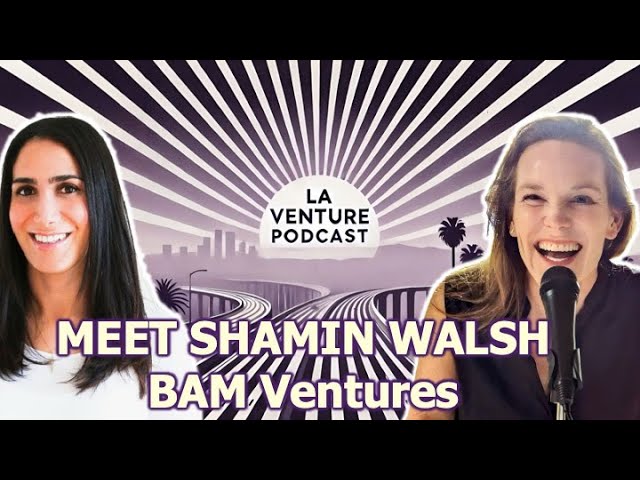
Shamin Walsh, BAM Ventures Managing Director on Consumer Investing

In this live interview on Venture with Grace, Shamin Walsh, Managing Director of BAM Ventures, discusses his unconventional path from law to venture capital and how his legal and operational experience shapes BAM’s approach. He explains BAM’s focus as a precedency, consumer‑focused fund that invests early in consumer brands, tech, and commerce, managing a roughly $50 million fund with typical initial checks of $500 k and follow‑on checks up to $1 million across about 50 companies per fund. Walsh describes the 2026 consumer market as stable and resilient, noting continued spending despite recession fears and highlighting lucrative exit opportunities ranging from $500 million to multi‑billion deals. He outlines the key metrics BAM uses to evaluate startups—cash‑flow payback, LTV:CAC, repeat purchase rates, habit formation, and distribution strength. Deal sourcing relies heavily on personal networks, founder pattern recognition, and being the first institutional investor rather than data‑driven scouting. The conversation delves into the importance of distribution versus product, using Merit Beauty’s Sephora partnership, Honey’s Chrome‑plugin friction reduction, and Aisle’s omnichannel grocery solution as case studies. Walsh shares his view on AI: it is an accelerant but not a primary investment thesis; AI‑enabled consumer companies succeed when the technology creates a sales or distribution advantage, and AI can improve customer insights, verification, and support functions. He also touches on influencer‑driven brands, the need for genuine co‑founder involvement, and lessons from enterprise (decision‑maker alignment, simplicity of messaging). Due diligence practices focus on trust, sniff‑tests, and verification of metrics via platforms like Shopify, while avoiding overly burdensome audit demands. Walsh highlights BAM’s fund performance (10x return on Fund 1, profitability on Fund 2) and reflects on the immigrant‑driven sense of responsibility to limited partners. The interview briefly explores AI‑personalized dating as an emerging consumer niche and ends with light personal questions.
Chapters
Sorry.
Okay, going live. Oh, we're live.
Okay.
Hi, Shamin. Welcome to Venture with Grace.
Hi, Grace. Great to meet you.
Uh, to start the show, I want to give a quick shout out to our amazing sponsor. This episode is brought to you by Nebius, the automate cloud for AI innovators. Nebius provides AI infrastructure you can count on, combining reliability and speed with flexibility and engineering support unmatched by hyperscalers. AI leaders like Meta, Shopify, and Hixfield already partner with Nebius to run their AI workloads. Plus, venture-backed startups can save up to $150K on compute costs when they apply for access. Visit nebius.com or nebius.com/startup to learn more. Okay, so to start the show, I want to start with like your journey into VC. So you were previously a lawyer before entering the realm of venture. Maybe if we could like dive a little bit deep into like, you know, what were some core lessons that you've You've learned during the legal era that kind of like translate into the venture era for you?
Yeah. A level set for about what BAM does in case anyone's not familiar, because my journey kind of translates into why BAM in particular is the right place. So we are a precedency consumer-focused fund. We're one of the first investors in the companies, the institutional investors in the companies that we invest in. So we focus on consumer brand, consumer tech, and commerce And the reason that's relevant is because, you know, I had a nonlinear path into venture and it really started with the ability to angel invest in companies that happened to do well along the way. And those things kind of catalyzed one another. But to your question about my legal background, so yeah, ironically, Brian and I are both attorneys by background.
Mm-hmm.
He made better use of his degree by starting LegalZoom. And I was a traditional lawyer, so to speak. But the way that the worlds kind of converged was that I had the privilege of being kind of fortuitously one of the first investors in Sweetgreen. We all went to college together. And then as I was pursuing this legal path, Prior to BAM, I worked at a small venture fund that my brother had set up that he had asked me to join because I had a combination of a strong consumer angel network. And then I also was a lawyer, so I could keep all of our legal work in-house. So if we did an SPV, I could run the SPV. And I just kind of consolidated that, those skills. I'd say what makes it relevant for BAM, you know, Brian and I don't have official titles, but if we did, I would de facto name myself the COO, so to speak. And so the experience of having kind of run the nuts and bolts of a fund day to day, and then understanding all the legal implications or the compliance or this and that, there's the sexiness of investing and then there's the reality of— running the fund. And so I think to your question of what have you learned along the way, I think that being an angel investor and managing other people's capital are 2 very different things. And so we both had the fortune of having had success as individual investors. And then Brian has had extraordinary success as an entrepreneur. And then I've always focused my career now 12 years now in venture on, you know, the operations of running a venture fund.
For sure. I, first of all, like, I feel like BAM is like a— for those who don't know, like, BAM is like a really top, like, consumer fund. And you guys invest in some of the most, like, iconic brands from, you know, Thrive Market to NerdWallet to, like, you know, many brands that you have interacted with. I don't know if I should say this on the show, but my favorite would be, like, Real Organic or, like, just like, I think it's just called Real. But so in general, maybe we could talk about, I guess, since you both have the lawyer background and obviously Brian's a successful entrepreneur, maybe we could talk about why consumer? Because I think living in Silicon Valley myself, everyone's investing in AI and everything agentic. And maybe we could talk about the general landscape of the consumer market. And obviously it's Like a really big one, people kind of like sleep on in Silicon Valley, but obviously in LA, in New York, it's still like very, very mainstream. And many of the people that so like I'm basically I'm a consultant on intro like on the side, and then a lot of the founders actually created consumer company, but they have nowhere to find like who is the right investor. I'm curious, like you know maybe we could start with like the consumer market in general. What does the landscape look like in 2026? And then the trends that you're seeing in the consumer space, and then we can do the deep dive into the fund itself.
Sure. I think you bring up a lot of good points, and I think it is true that consumer is probably not the topic of the day compared to AI, although we are seeing every day really exciting consumer exits. So we know it's working out for a lot of folks. You know, as a broad market, I would say, you know, consumer has been a very stable category in terms of the fact that people are consuming and spending money on things and more and more every year. I think what's interesting is that the data, you know, on the one hand, we have these perceived impressions that, you know, there are potentially recession fears and, and who knows how things will pan out in the future, but I will say that. In the past, some of the fears that we've had around rising costs or people spending less haven't actually accorded with the data in the sense that Black Friday has been the largest Black Friday in recent history. So people are still spending their money. And I think as a culture, as Americans, it's not part of our cultural values to be huge savers. So we know the money is going somewhere. It's really our job to figure out where. So I think as a category, it's an incredible category in the sense that it's not a fad. People still need to eat. People still want to look beautiful. People still need to send their kids to school. So the category itself is stable. I think as a venture category, it's speaks a lot to kind of why we at BAM are constructed the way we are. It's a category that may not always necessarily need a ton of funding.
Yeah.
And there are always plenty of exit opportunities, whether it's a billion-dollar outcome or a $500 million outcome. It's actually a pretty lucrative opportunity if the inputs are set up properly. And I think it may not be as, as sexy today because it is rare to have a $200 billion company. But there's also not a lot of companies that necessarily need, you know, $100 billion in funding either. And so when you look at the exit opportunities in consumer, there, there are so many Opportunities for lucrative exits for both the founders and the investors. But I think headline can sometimes get buried because the objective high-level numbers can often be smaller than what we're seeing in other categories.
For sure. I wonder, so like, I guess you brought up a really good point that like, you know, not every consumer brand should be venture-backed. So like, you know, nowadays, like I feel like there's a stat on like to be IPO, you have to generate like $300 million ARR to like, like here and there. And I guess like, how do you evaluate a consumer company that like if they could actually achieve that kind of ARR? Especially I think like one of the things in like the BAM portfolio is like, obviously you guys have like, let's call it like the beauty product or, you know, the Away luggages. So I guess like a lot of these traditional-ish Like, just like, I guess, brick-and-mortar kind of consumer brands are very capital intensive because they have to make the luggage, they have to make the lipstick to like literally put it on shelf. Like, so how do you evaluate if a company that could be venture backable versus not?
Yeah, that's very true. Some companies are very capital intensive. I think things we look at are, you know, how well the founders are able to negotiate different cash flow needs. So, you know, ideally, even if it's capital intensive to produce earlier, if you're selling through your product, well, you're, you're recouping that money at a pretty quick cadence. And so we kind of look at those ratios. We look at, you know, traditional metrics that people talk about, like LTV to CAC, you know, your, your return on ad spend, like repeat purchase. I think one thing that's Really important for us is looking at businesses that can truly become ingrained in someone's life and become part of their habitual behavior or businesses that may have large markets and super fans within those markets. So for example, I remember when we got pitched by Pretty Litter, which was a really successful outcome for us. And they only raised $1.5 million but exited for over $500 million. And so that was a true venture return. And I remember when they pitched us, he'd asked, okay, people love their pets. How many dog companies do you see? And we named off a bunch. And this was, I don't know, almost 10 years ago now. And he mentioned, okay, and how many cat companies do you see? And there weren't that many at that point. And you think about a product like that where You know, they have the cliché name of the crazy cat person. And if you usually have one cat, you have more than one cat and you have to have the litter and litter is heavy. And it's something that's natural to have a subscription because you don't want to carry it from the grocery store. And so it's just these little elements that you pick up on as you're evaluating a business to determine whether or not you know, you're selling something for $10, it's ultimately costing you $20. Like consumer brands or the product itself is not the right category for those kinds of economics. It's not very often that it works out where if you're buying, you know, I don't, I don't want to say, never say never, because I'm sure for every example I give in a tangible product, there's probably an exception out there, but it's not very often that You can buy top line growth and then just catch up in it in the sense that you can potentially with other subsidized markets and technology.
For sure. So what I'm hearing is there's 2 major components. One is, can the company really regenerate the money quickly so that the cash flow is very I guess, I guess like the cash, like the speed of like payback period is like really, really fast. And the other part is like maybe finding like a missing piece in the market. So for example, like everybody's like talking about the dogs or like servicing one particular category that's like, and then there is like, you know, like a little blue ocean for something that's like no one has been paying attention to. I wonder maybe from like the sourcing level, like how do you guys typically source these companies? Obviously, I kind of recognize some of the brands that are Like, you know, for example, like Rodeo was like the founder, like the CEO of Hinge, uh, created a new brand. And I remember like, um, he was on our show and then like we were chatting about his new company offline before. But I guess like when you are looking at these brands beyond the, I guess like the successful person from XYZ, like successful operator from like XYZ company before, um, how do you kind of like identifying like the company, or how do you source a company in general from a customer perspective, in the consumer space?
Yeah. I think that what we love about what we do and the challenge of what we do is that, like I mentioned, we're often the first institutional investors in the companies that we've invested in. And so we're not typically using large data scrapers of fundraisers or, um, you know, this kind of top-down thematic hunting approach, because if it's been widely reported on, it's probably too late for us. Um, and so what we spend a lot of time on is really evaluating people.
Mm-hmm.
Um, oftentimes when we meet founders, it's, you know, 2 founders and, and an, um, idea. So for example, you'd mentioned you had had Nectar Social, you had chatted with them before. When we met Farah and Mizbah, the business was pre-launch. So now they've done such a great job with what they've done that if I Google them, it's going to come up in a bunch of places.
Yeah.
But when we met them, that wasn't the case. And so I think for us, what we're really looking for is someone who truly understands the way that people think and operate and where things are falling short. So in that particular company example, you know, they had both come out of Meta and they had noticed there's just so much happening in the DMs. Like the DMs had effectively have their own world.
Yeah.
And, you know, you could, you could say, well, Why does something like this need to exist? The customer service or the sales support or, you know, marketing creation, like all of these different pieces exist in some capacity or another. But the way that you're talking to the consumer and the way they're relating to you and the way that you're tracking them or the way that you're servicing them through DMs is completely different than, you know, a customer support ticket on email where you say, oh, like, thank you for writing in, like, your ticket account is now closed. Like, you're just not even interacting with them in the same way. And so I think that's one small example that demonstrates how they understood there's a different, for lack of a better term, vibe in this arena.
For sure.
You know, I think a lot, you know, I think there was that popular culture kind of trend for a while where they were talking about people's Facebook personalities and LinkedIn personalities and Instagram personalities and how there is a different aspect of you that's showing up in each of those places. I think that's a nuanced emotional intelligence that you founders are naturally picking up on, whether they're building a technology company or a brand where they realize This is what the consumer in this place or for this good or what, this is what their priorities are, how they show up to it. And so they realize that products don't just sell themselves. It's a broader connection beyond that.
I wonder, so since you mentioned about there is I guess one of the things that I want to dive in before, obviously, we talk about all these amazing portfolio companies is, I guess, the portfolio construction and the check size. So from my previous research that you guys have been continuously having a $50 million fund, I guess that's really hard to actually keep as most people think of Like when you think about fund, like they typically think of like, oh, you raise a $10 million fund, $50 million fund, like $100 million fund. Like that's kind of the progression of like the fund getting bigger and bigger. The management fee is getting higher. And maybe we could talk about like the fund strategy itself. Um, since, you know, some of the company, like you mentioned, like, you know, if they are mainstream reported by every media, uh, it's already too late for you guys. Um, what would you say is like the typical check size and the valuation for these companies?
Yeah, that's a really good point that you highlighted. So we were— our initial check size is $500,000, and then we'll follow on with up to $1 million in the companies that we follow on in. So at the most, we'll invest in any single company is $1.5 million. And we invest in about 50 or so companies per fund. Given the stage that we're investing in and how early it is, no matter how confident we are in the business. There's just too many unknowns when something doesn't exist yet where we're not— if we were fortune tellers, then we'd be in a different business, I guess. And the reason that we have stayed at this $50 million fund size is for a few reasons. One is That I think to your question about sourcing and finding deals, that has been a superpower for us. And we think that it's really, really important to keep our sourcing strategy robust. And what I mean by that is that consumer is a huge category, but it's often not inherently a proprietary category. someone is starting a yoga brand, 25 other people are starting yoga brands. And to your question around how do you know who is the right person? We really feel like we're making the best read on folks based on having built our own companies or invested in successful companies based on some kind of pattern recognition of meeting the best founders. And you can only do that if you actually see and meet the founders to begin with.
Mm-hmm.
And so at a $50 million fund size and $500K check size, it's a big enough check where it's meaningful to us in our fund size and our entry point, but it's small enough where we're not disrupting anyone else in the venture ecosystem. And so a lot of times people ask, who are your competitors? And we'll often say nobody on purpose. We are friendly with everybody. And I think that's a huge advantage to our sourcing strategy to make sure that we're seeing everything. Because again, it's often not so technical, even on the tech side. I think we're talking about products a lot, but part of our biggest winners like Honey or FuboTV or Scopely, et cetera, all consumer tech companies. So a lot of what I'm saying applies to both. On the tech side as well, a lot of times The true moat, there's obviously some advantages, but the true moat is often your team, your sales, your distribution strategy, like the way that you're talking to the consumer. It's not just the tech. And so again, it really just matters to be able to see everything.
Yeah.
I think one of the other reasons is this kind of inputs and outputs. question that we were talking about at the very beginning, which is there are a lot of lucrative exits to be had in consumer. But I'd say for every $4 billion Honey acquisition, there's probably 30 $500 million exits, right?
Yeah.
And so we want to have a venture-like return, whether it exits for $500 or $4 billion. Obviously everybody wants to invest in a billion-dollar billion-dollar companies or $100 billion companies, but they just don't happen as often. And so we just want to make sure to create value for investors on both sides of the coin. I think staying small is really important in that. And we just care about our own upside. Like our fund 1 has returned 10x. Plus, but Fund 2 is already in profit. That's our 2018 fund. Fund 3 is tracking at top of the benchmarks. And so it's, Brian once said, I don't know if it's the immigrant in us, the first-generation immigrant in us, but there is something about being responsible for other people's capital where you almost feel like They're trusting me with this and I want to pay them back and I want to pay them profit and I want them to see the fruits of their labor. And I think this is the way for us where we know confidently there is a repeatable strategy.
For sure. I feel like since you mentioned the fund strategy, it's like $500K track at the initial state and then investing in 50 companies. So I guess that's half of the fund. It's like Doing the reserve and then half the fund is like investing in the first track. Um, out of all the big exits, do you feel like it was a, um, company that was like very obvious very early on? That's like, um, they become a honey or something in the billion-dollar arena. Or do you feel like it's like, you know, the, the company that you didn't really double down but they accidentally just become a unicorn?
I think this might be a strange analogy. I think it's like children, you know, like the kid who was like top of their class in the 4th grade might be having a rebellious teenage phase, you know, in middle school. And so I don't think there are a ton of companies where from day one to exit, it's just been, yep, obvious, like never had an issue. I mean, even Honey, almost went under in the very early days. And so part of why our logo is this kind of symbol is that I don't think— I think there are companies that we think will do well and do well. And there are companies we think will do well and don't do well. And I think sometimes the same attributes that can that can contribute to success in one arena is what is your downfall in another. And there are other circumstances like how well you built your team or timing of the market, or sometimes you were too early. And so yeah, I wish if I knew 100%, then I'd be batting 100%.
For sure. I think I'm curious when it comes to the AI space is I feel like a lot of our listeners are based in the Bay Area and then they are interested in AI. So in your opinion, for all the consumers, whether it's brands that you guys have invested in, or I feel like Nectar Social is an AI company on its own, how do you think of whether it's investing in the AI space? We can separate them into 2 topics. One's investing in the AI space or investing in AI consumer companies. And then on the other hand, maybe we could talk about the consumer companies. How do they leverage AI to Whether it's about their supply chain or study and doing all the analytics about their product lines. What are some trends that you're seeing in the AI space?
Yeah. So if we invest in an AI company, it's very rarely because of just the AI and more that we think they have a sales and distribution advantage or they're offering something where there's a white space. I think in the same regard that I spoke about You know, in consumer, there's— even if you have a technical advantage, who knows how long that'll persist. I think we feel the same way about AI where, you know, if someone has this unbeatable technical advantage in AI, we are not the right people to be able to identify that. Um, we're not computer scientists from, you know, 100 years in the future. And so— That the AI-ness of it all is not the deciding factor. I joke that for me, at least the way I evaluate businesses, when someone says AI, it's almost like saying, I started a business on the internet, which is like, okay. But that's not the buzzword where I think, yes, We have to invest. This is an AI company. We are looking at, again, how they think. What was interesting about what Nectar was doing, and for example, we invested pre-launch again, was the way that they understood the pain points of the retailers and how they're losing data. If you're clicking through on a social media account, you don't necessarily have the same click-through attribution or the same kind of first-party data you would if it went straight to your site. But now a lot more people are checking out like end-to-end from, you know, whatever the social platform is, whether it's an Insta or a TikTok, like you can, you can actually like go through the whole transaction through the platform itself. And so those were the kinds of problems they were solving. And it does help that their engineering and their AI backgrounds bring them a superior product. But I also think that it was their understanding of the pain point of their customer. And then we've already talked about the way that like people are actually engaging in DMs to know what's connecting and what isn't was what was interesting for us.
Mm-hmm.
So in terms of your question on investing in AI, I don't know. I mean, a $500K check I mean, it's like, I feel like it's silly to even call it a drop in the bucket in terms of what, you know, it's not, this is not the best use of capital for that particular category. So I'll let the experts deal with that in terms of investing in AI specifically. In terms of how consumer companies can use AI. I think that areas I've seen is, for example, several of our companies have used AI to better understand who their customer is. We have a portfolio company actually in that space that helps not only resurface, called Outer Signal, not only resurface who your customer is, but they do the hard work of validating on the backend. this person is this person. So if your name is like Joe Schmo, it's like the Joe Schmo that lives on this street and not on that street. So I think there are areas, um, in terms of, you know, verification that AI can work on well. I think there are areas in terms of customer service where, you know, if you had 100 customer service reps, maybe now you have 10. You still need the human at the end, I think, in today's day and age for more complex or special situations or the emotional touch, but even having AI bifurcate, like what's a simple question like, do you ship to Canada? Yes, no, versus, hey, I'm really upset. I got this and then you gave me that and blah, blah, blah. Like I don't know if AI is there yet to do the emotional handholding piece. But I think it's a really great accelerant is how I think about it and how companies using it is, is it making what you're doing a little bit faster? Is it enabling you to kind of automate things that are important but are also quantifiable? You know, like if you're— Yeah. You know, but again, it's kind of like the term algorithm from the old days where your output is only as good as your input. So for example, if you have really clean books, then AI is the most amazing thing at, you know, ingesting it and producing results for you in a much faster way than we could do manually. But not everyone has the same books or very clean books. And so I think that's where some The learning curve may be. And there are even startups that are now focused on cleaning the books or putting it in a standardized way. But yeah, I think a lot of the accelerating, automating repetitive tasks, creating formats where you can automatically create a draft, but not the final send.
Mm-hmm.
Enabling the human to just be the most efficient with their time, but still giving them that final high-stakes decision.
I totally agree with you on, I feel like maybe repeating your first point, which is everything is AI nowadays. So instead of investing in AI, AI, you still have to have the customer touch. I mean, not customer, but human touch of the last mile delivery or whether it is customer service or something, like people really still want the touchpoint of like a human. First of all, like, I really like that, like, we literally have people liking this thing from Facebook. Hi, Edwin. Like, so I just want to say, like, because I'm streaming on 6 different platforms normally, it's like, you know, obviously Twitter, like, or LinkedIn or something. But like, whenever someone's like tuning in from Facebook, I'm just like, wow, this is like really— this episode really hit. So I want to like deep dive into like a few sectors that I'm personally finding interesting. One is like, I definitely want to— curious about your perspective since you have seen a lot more like, you know, so like social or I guess like consumer-related deals more than, you know, anyone in the Silicon Valley. So I want to start with the first one is like I'm personally seeing a huge shift in like personalized AI or like DIY AI, I would say. Like, I guess I would separate them into 2 different categories, right? So one category is like One of the things that I'm seeing is like personalized dating. So like I'm an investor of a company called Ditto. So they are essentially— I'm an angel investor, so my full-time is like a founder. But, um, but like, so I'm an investor of Ditto. So like they are essentially tapping into like the date— like, so they're trying to end the swiping era, which is like providing customized like dates. And I've seen that in like quite a few companies in general. I feel like they are the most like um, like viral when it comes to like the Silicon Valley community who's like tuning in from like Berkeley to like all these like UCLA, USC, all that kind of stuff. So my curiosity is like, um, what do you see in this particular market? And then how do you see the future of like dating is going to shape out? And do you like— I feel like by personalized, I mean like in the past, like it's just like you swipe me, I swipe you, and then we're good. But like nowadays, it's like people are using AI to like, you know, personalize like your Going to go into your deep, like, deep down, like, personality test. So instead of, like, you know, you may not really match on the keyword. Like, for example, you like skydiving. I like, you know, maybe, like, you know, I don't know, like, gaming or whatever. And then maybe our keyword doesn't match, but, like, it just both giving us, like, the more, like, adventurous or, like, edginess of, like, the personality. So we kind of match because of like, there's some deep down stuff that we didn't really say that AI helped us detect. So how do you think about this kind of like industry? And since like, you know, the Tinder era was like 1,000 years ago, like how, like, how do you see that industry in general?
I think we're always looking— I feel like there, there's, without getting too philosophical, there's always like, there's always these recurring human pursuits. It's like to find connection with someone else, to be young and beautiful forever, to like find purpose in your life. You know, there's these things that will— are never changing in history, and then there's new ways of, um, trying to adapt in a way that, um, that is relevant to that era. I think that though, I'm curious to see how these platforms perform in the sense that it, to me, it feels like it is like what we were talking about with like, what is AI good for? It's almost like an accelerant, right? It's like it's— It's fast-tracking you to the things that you might connect on. It's not the— it's not going to be the ultimate, like, am I going to be with this person or not? But it is getting you to the point faster. And I think for a lot of folks, it'll really work. And, um, and then I think for others, it might be that, you know, the person that you report yourself to be, even if it's not your thing, but like, if you present— You know, I think we all have a I think what's interesting about that, and I don't have an opinion to say it's gonna work or it's not gonna work, um, it's more just, um, a curiosity question, is I feel like the way that we see ourselves is not necessarily the way we may— others may see us, or like we are not always the same person in every context with different people.
Mm-hmm.
So, you know, some people may think I'm very talkative and other people actually see me as like a more reserved person. So I'm curious about how much of like how we're showing up in those is, um, it's not like it's an AI problem, but it's the fact that like we're dynamic variable beings. And so, you know, how do we, how do we know that like we don't have like self-reported bias? You know, like if, if I'm presenting myself as someone who really loves you know, deep conversations, or I really love family, but then I meet someone who only wants to talk about, you know, SARS on every date. And I'm like, maybe I don't like deep conversations as much as I thought I did. Or, you know, I think there's, there's definitely a test, but I mean, why does it hurt to try to get to see if there is an accelerant or not? I mean, we only have so many hours in the day. And I know when I was dating, I actually met my husband on Bumble. Um, when I was dating, you know, there was, there was that test of like, do I want to get off on the couch and put on real clothes to go out with this person or not? Having personalized, um, AI kind of like help create that extra oomph to even make you want to go out with them. I mean, why not? I also think though that as things continue to become— I feel like there's always this friction between creating the most optimal digital experience and then rejecting it entirely and being like, let's just meet in person. I feel like we're gonna see those 2 parallels as well, where as things become more and more sophisticated on that end, there's also gonna be more and more solutions to just disconnect entirely.
Mm-hmm.
And I'm seeing stuff with like meetups or let's just get off the phone or let's just, and also those things might converge, you know, maybe the personalized dating will send you on a date faster. And maybe that's the whole advantage is like, you know what, like, here's one thing that we're using to get you excited. But really, no one is going to know whether you click or not until you meet in person. So the faster we can at least get you to want to meet in person, the sooner you'll know.
For sure. How do you think about the social effect of like a particular company? Or like, okay, so another— by the social effect, I mean, there's like quite a few things. One is like Obviously Honey was like a really good example of like, because I remember at one point, like, you know, all the YouTubers are plugging it in with like all the extensions on like, you know, getting this kind of stuff. Um, I'm curious, or like, you know, I feel like for right now there's like so many celebrity-related brands, but whether it's like Alex Uro or like all these kind of like TikTokers are having like tons of brands on their own or like becoming a stakeholder of something like a Poppy. So I'm curious, from the influencer perspective, is there something that you feel like is investable or you feel like the valuation typically are too high to even collaborate?
I think it depends on how relevant that influencer is to the business and how they see their relationship with the business. So we, I've seen, and we've, you know, Brian in particular has been extraordinarily successful with like celebrity-based businesses, like An Honest Company and LegalZoom, even with, um, and Arena Club now. Um, I think it depends on whether that influencer sees themselves as a true co-founder and partner in the business.
Mm-hmm.
Because If you really feel like you're building this business alongside the team, and I know that with Honest Company, Jessica was pregnant and she was the one that was worried about toxic ingredients and cleaning supplies. She was about to have a baby. So if it's core to you and there's a reason you're doing it outside of, I think this thing's going to be lit. It's not— you're not seeing it as transactionally because you're really seeing yourself as someone who is building something, as opposed to, I am the sole determinant of the success of this business, and that's why I carry a heavy premium for my involvement. I don't think any individual Maybe with a few exceptions, are like the sole determinants of any particular business.
Um, I completely agree because I think like the involvement definitely matters. Like, do they feel like they have the ownership? And then like, how do they kind of like— how passionate are they with the brand? Because I can see, like, I've seen like, you know, so many TikTokers trying to start like their own like makeup lines or whatever, but like On the other hand, like there's only like one of the few celebrities that does like really, really well to really carry out the brand, whether it's road or some other stuff. That's like the celebrity itself. It's like themselves. It's like very, very passionate about the brand and very invested invested in the you know strategy, whether it's like social media marketing, how passionate they are with the whole branding. I want to tap into like a some. Second topic is another thing I'm seeing is the consumer enterprise model, which is, for example, Hixfield or a lot of these AI companies that are doing— or whether it's even ElevenLabs. I would say right now there's a blurry line of what is consumer, what is enterprise in Silicon Valley. I mean, I'm personally a big fan of Cloud Cowork. I feel like I consider that as a consumer. kind of play because of whether it's ChatGPT or Anthropic, they are making a consumer come back for your interaction with the app itself. So what are some insights that you're seeing from the consumer perspective on how it's actually maybe shaping how enterprise has been played? Or what are some strategies that you're seeing from a consumer company that you feel like those strategies could be applying to enterprise, whether it's go-to-market or branding or I guess how you're designing a product itself?
Yeah. I mean, I think a lot of the similar principles apply in terms of understanding the psychology of your customer and that products don't sell themselves. So one of the mistakes I often see in the enterprise space is the product itself is amazing. Like, product is great, but the person who is benefiting from the product and the person who is paying for the product is not the same person. And so, you know, let's say it's an amazing tool for, I don't know, your head of HR or for your CMO or for, you know, head of customer success, but the CFO is the one who's deciding whether the company needs this. And so, You know, a lot of times like the CFO's job is not to say like, oh, well, this is gonna like make your job easier if it, if your job being easier doesn't involve like additional bottom line revenue growth.
Mm-hmm.
Right. And so I think again, that, that kind of speaks to the consumer side where it's like, are you understanding the way like people are making decisions and how you get them over that conversion hump? Because it may sound interesting, but if you don't really understand the intricacies of how decision-making plays out, great, you have this amazing product, but nobody is prioritizing or adopting it. And then I think the one thing that always works in consumer that I think anyone could benefit from, whether it's enterprise or not, is just the simplicity of messaging. I think Sometimes, especially when founders live and breathe something and this is their life's work and there are just so many applications for what they can do, especially if something is fully integrated. It's just like the magic of all the different attributes a particular product or service can have is incredible. But When you ask them, sometimes an exercise I like to do with founders is like, tell me in one sentence what you do. And I think that simplification is really important in terms of being able to articulate very clearly and also to rise above the noise. I mean, even in enterprise, there's still a lot of noise. And so you really do have to find your way to cut through that noise in a clear way where people can retain that information. I was telling a founder the other day, for example, I mean, think about Salesforce. Salesforce can pretty much do everything, I'm sure. But if you ask the average person, like, what is Salesforce? They'll— the average person would describe it as a CRM platform. Like primarily there's still like a primary explanation for what it does. And I'm sure you have Salesforce Cloud and you can integrate and do this. And I can actually—
Mm-hmm.
Create email lists, but it's overwhelming to your potential buyer if you get too into the weeds. So I think this simplicity, it's something not to beat a dead horse, but I just recalled, for example, I remember in the early days of Snap where Brian was one of the first investors, they talked about, or even Instagram similarly, They didn't release every feature day one. It was like one or two key features, a lot of use, a lot of adoption around it, like mentally understanding that behavioral change. And then the next thing and then the next thing and the next thing. And I think that's something that's a parallel between consumer enterprise that this idea of like not overwhelming the end customer with everything day one is very similar.
I wonder. So I really like what you said about really simplification is really important. And then being able to, I guess, communicate your product and service in a very short sentence or in a really short amount of time. And then really also identifying your market on who are you Yes, you build a great product, but who are you actually selling to? Figuring out, I guess, who is your actual ICP is really important. One thing that I'm curious on your thought on, maybe we could use an example from any of your portfolio, whether it's how you meet them to how you diligence them, winning the deal, or thinking about potential exit. I guess one thing I want to maybe touch up on is like the product versus distribution. How do you evaluate that as an investor? Because there are so many people can build like a good product nowadays, like, because like everyone technically can, whether it's like starting something on Shopify, like building your own, like making your own makeup brand or whatever, or to like, you know, building your own like AI agents because of like nowadays, like Oh, the no-code tool is very advanced. So my personal philosophy is I feel like distribution becoming this whole new thing. And then whether it's like what to build is more important than how you build it and stuff like that. And then also this distribution funnel is becoming even more important than the past. Looking at OpenAI acquire like TPPN, all these kind of like everyone's trying to amplify whatever they're doing, even OpenAI. So my curiosity is maybe if you could, we could use one of your portfolio companies as an example of how do you evaluate the product versus distribution?
Sure. I mean, so I guess it depends on category. I'll say in the brand category, for example, we invested early in a company like Merit Beauty and the distribution was a big Part of what compelled us.
I want to showcase I actually personally own this product. This is literally from my makeup bag, like, next to me right now.
I love it. Is that Fox?
Um, yeah, it is Cheeky. Like, that's like the little thing. Yeah.
I have the same one but in a different color.
Yeah, I'm, I'm pretty sure that I have more product than this, but like, this is literally just next to me.
So yeah, I mean, when— so when they, um, when they launched, um, they— because of Katherine's background, they had already had an exclusive with Sephora before they launched. So that was really, really compelling. It was like, okay, you have distribution locked in from out the gate. I know that's not the same case for every founder. Um, I think if you don't have distribution, from locked in from the very early days, then it's really just thinking about, you know, what have you done through your own D2C or otherwise to kind of create your own brand awareness? And then if you are a baby brand, I do think ultimately you will be, you have, you have to be where your customer is. So you'll probably be some D2C, some Amazon, some, just some TikTok shop. I think for tech, tech, the way we thought about it for something like a Honey, since we've already talked about it. We think a lot about how friction for the customer.
Mm-hmm.
And so you think about how one of its advantages and actually one of its disadvantages when it was fundraising was the fact that it was a Chrome plugin. And so people thought like, you know, it makes me nervous and rightfully so to be a plugin on something that, um, where like they ultimately control your destiny. But one of the advantages of being a Chrome plugin was that it was really passive for the consumers. Like you're, you don't have to intentionally remember to log into a separate website each time or like cut coupons if you wanted to save money. What you can go ahead and at the point of checkout, you know, have something pop up. And then they could prove to retailers that, you know, they were reducing cart abandonment by like, by coming up at the integral point where like most consumers are deciding, ah, do I really want to like finish checking out or not? We have another company in the commerce enablement space that's similar to that called Aisle. Their distribution is in grocery stores. So, you know, you go, you buy something, you immediately take a photo of what you've bought, and then you can get immediate cash back on what that product is. The, you know, the distribution in the grocery stores is interesting because there, there is this true omnichannel gap. And, you know, as much as we have solved, we, you know, there's a lot we've solved in brick and mortar retail. There's a lot we've solved in digital space, but this omnichannel like I'm looking at something online, but then I go in store and buy it is still something that's continuing to be solved.
Mm-hmm.
And so like working in this space that a lot of people hadn't necessarily focused on, which was like in grocery and reducing that consumer friction where again, I'm not making you log in, do this, download that. It's like take a photo, We'll send the money to Venmo. And so I think those are things that we look for, um, on your question around, um, distribution and just, um, either like you have— you've done it in advance, um, you're doing it in a place where you can— that's like not competing with a bunch of different folks, um, or it's coming to you easily because you've made it such a frictionless process for the customer that it's like kind of a no-brainer.
For sure. So what I'm hearing is like, one is like, so for the merit part, it's like, you know, they already have built-in distribution, like having the access to Sephora, which is like, actually, I heard getting into Sephora is like really, really hard, even for like, you know, stuff like Rhode or like, you know, all these like celebrity-related brands. Um, I mean, I have so many questions. How do they get into Sephora? Um, but So the other part I'm hearing is like, you know, having a free, free frictionless kind of like concept to make sure that like, you know, whether it's like scanning grocery to get like cash back or like, you know, being able to just like apply the product immediately for the consumer. I think instant gratification is like really, really important. From the distribution, like let's say for the Merit, for like they have like a brand, oh, well, they have like a launch like product line. Oh, I guess like they have like access to launch their product into Sephora. For this kind of stuff to happen, my curiosity is like, how do you think of like, I guess, like doing the diligence on a particular company, whether they have the distribution? So I think what I'm trying to get at is like, obviously, if they have a deal with Sephora, if it's like signed, all that, it's like very easy to verify. But you know, a lot of the usage numbers, like, you know, I remember like, you know, looking at like, when I was like working in venture, like, well, this was like many years ago. So like, as an associate somewhere, I think like one of the hardest things to verify is like, If the person gives you their usage number, whether it's monthly user or whatever, it's harder to verify because sometimes they could give you a screenshot, but do you believe in that? Or are they buying the number? How do you do the diligence to fact-check on something if it's real?
Yeah. And I think you bring up a really good point. I think these are all Signals of, if you're thinking about likelihood of success or not, these are all signals in the plus category. It's like, oh, if you're actually in the store, you're more likely to sell it. But none of these are guarantees, right? So like I said earlier, I mean, things don't sell themselves. And actually one thing that we do tell founders, especially in the CPG space, like in grocery stores, it's really hard to get into grocery, but it's much harder to stay in grocery. And so there are a lot of brands where, you know, the retailer, whether whoever, like a Target or Sephora or whoever, they might have a particular initiative or they might have a particular area that they want to revamp.
Mm-hmm.
And so it might be fortuitous that like the thing you're building and the thing they're, you know, if there's like a push for cleaner, you know, clean cleaning product, like clean cleaning products or, you know, clean beauty or, hey, like we want to do more in textured hair. Like there might be something that like is already on their radar that they want to expand that overlaps with what you're doing.
Mm-hmm.
And to your point of like, it's so hard to get in. How does that happen? A lot of times that's how it happens is like you happen to be doing the right thing at the right time that they're looking for. But I think what gets, might get overlooked is just because you're on shelf doesn't mean that you're going to stay on shelf or that they're like, their mo— their only goal is more people to get into the store. Their goal is not, hey, let me ensure that this particular brand is successful here. And so that's your job. And so I think it's really important to make that distinction of Um, you know, you— if, if you're— if everyone's playing their roles, like if you're doing your job of having your sell-through and meeting your requirements, they'll have you in all day. They will give you better deals. They'll give you end caps. They might give you a good— but if you're not working, they're like, this one didn't work. There's like a million other companies to put on that shelf space.
Mm-hmm.
Um, in terms of your questions of like diligencing, Sell-through and velocity. I mean, for a lot of companies, that information will come from, um, you know, Shopify, or like it'll be like directly reported. Um, they, they often will have like financial packets or like their quarterly reporting. I think like instinctively you have some kind of sniff test. Does something feel off. If someone is reporting that they're selling $100 million in revenue and you've never seen anyone use it, you've never seen it in a store. But I mean, I think for our stage, it's important that you're not— there does need to be a sense of trust at the earliest stages. If you are suffocating your founders with like Big 4 audit type requirements, it's, you're kind of missing the point. So I do think we always hear about stuff happening and there's always like a rogue actor.
Mm-hmm.
But I think that at, at least at the earliest stages, that's part of your job to, in like diligencing a founder, like backchanneling prior things, like staying in communication with them and like listening to your own instincts instead of trying to like gotcha catch them like a detective. You know, it's like innocent before proven guilty.
I hear you. I feel like there's like a lot of like, you know, I guess like partially it's like gut check, but also kind of like, I guess tracking their numbers from the backend. And then also like, I Um, like you said, like, if you can't really trust a founder, like, that's already like a really huge red flag. Um, so I want to be mindful of the time. Maybe we do a quick Wet My Fire run. Um, what's your favorite book?
Um, The Little Prince.
You know what, The Little Prince is making a comeback. Like, literally, I think last week someone said The Little Prince as well.
Really?
Yes. Uh, like, like And then also, you know what an elder millennial I am. Uh, it's like, yeah, I think it's a popular thing. Okay, so who would you invite to your dinner party?
Shaq.
Uh, who made the biggest impact in your career?
Um, I would say Brian.
Uh, where can we find you outside of work?
With my kids.
Love that. Well, um, Shamin, thank you so much.
Not always by choice. And I'm just kidding.
Not always by choice. It's never by choice because it's hard. I think you just choose once to have kids and then that's it. That's like default. You're like, the mom life never stops. So.
I wish I could have you with me everywhere because you do such a good job of like, like reconfiguring everything I've said in a much more succinct way. And I'm like, yeah, That, that's how you're so funny.
I love that. Um, also, like, honestly, I just, like, really like hearing your voice. This is such a random fact. Well, I was like, this is like giving, like, I'm like hearing the Kardashians or something, like the VC Kardashians vibe.
Well, I'll tell you a fun fact. I have a very, very good friend who is a professional voice actress, and she told me that I would make an amazing cartoon little sister. So if you— funny, if I stop being a VC one day, I've had a professional tell me, like, if you watch some Nickelodeon show, I could be like Dee Dee, you're someone's little sister on— oh my God. So, wow, that's a fact for you.
Okay, wow, like the part-time cartoon voice actor. I love that. In the AI era, I feel like honestly having an authentic voice is everything.
Yeah. Well, thank you so much for this.
Thank you. Let me quickly add stream once like.
More from Shamin

Don’t Raise VC Money Until You Hear This | Mike Gelb with Shamin Walsh | Consumer VC